


Top Gen AI Development Companies in 2026
In 2026, Generative AI is no longer a side project; it’s infrastructure. What started with public fascination around ChatGPT has now evolved into enterprise copilots, AI-driven decision engines, autonomous workflows, and domain-specific LLM systems embedded inside core business operations.
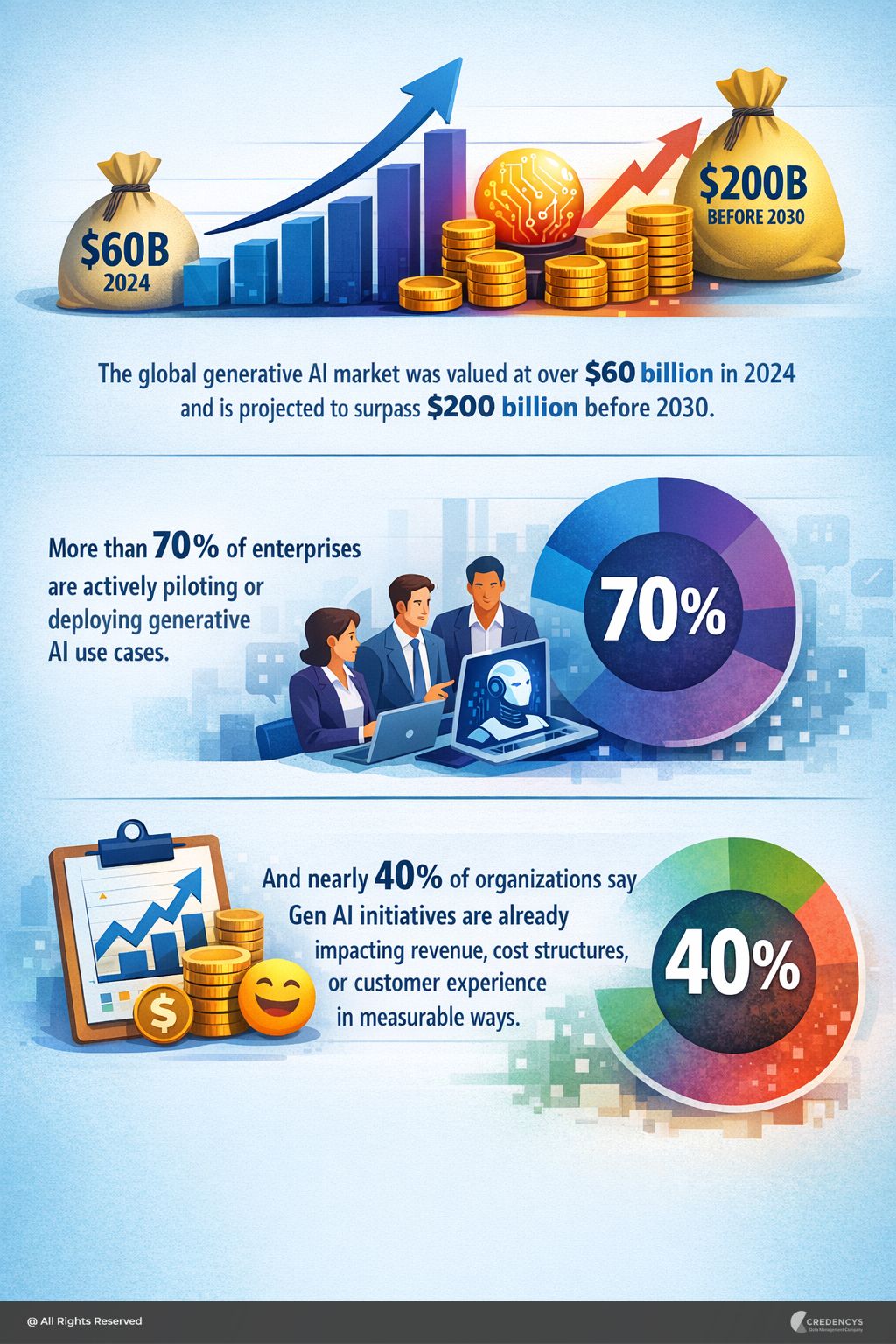
And companies are not just testing anymore; they are heavily investing. The numbers tell the story.
But here’s the catch. Building a flashy demo using GPT-4 or integrating Claude 3 into a chatbot is easy.
Building a secure, scalable, hallucination-resistant, governance-ready, production-grade AI system is hard.
And this is exactly why the demand for serious Generative AI development partners has exploded. Not agencies that “play with prompts” or vendors who repackage APIs.
But engineering-led companies that understand data pipelines, LLMOps, model evaluation frameworks, vector databases, enterprise security, and cost optimization. Because Gen AI isn’t just about the model.
It’s about data quality, architecture, fine-tuning, retrieval strategies, monitoring, compliance, integration with legacy systems, and change management. And most organizations don’t have all of that in-house.
So, the real question in 2026 isn’t: “Should we adopt Generative AI?” It’s: “Who can actually build it right and make it scale?”
In this guide, we have evaluated the top generative AI development companies in 2026 based on enterprise deployments, technical depth, industry expertise, and their ability to move from proof-of-concept to production. Let’s get into it.
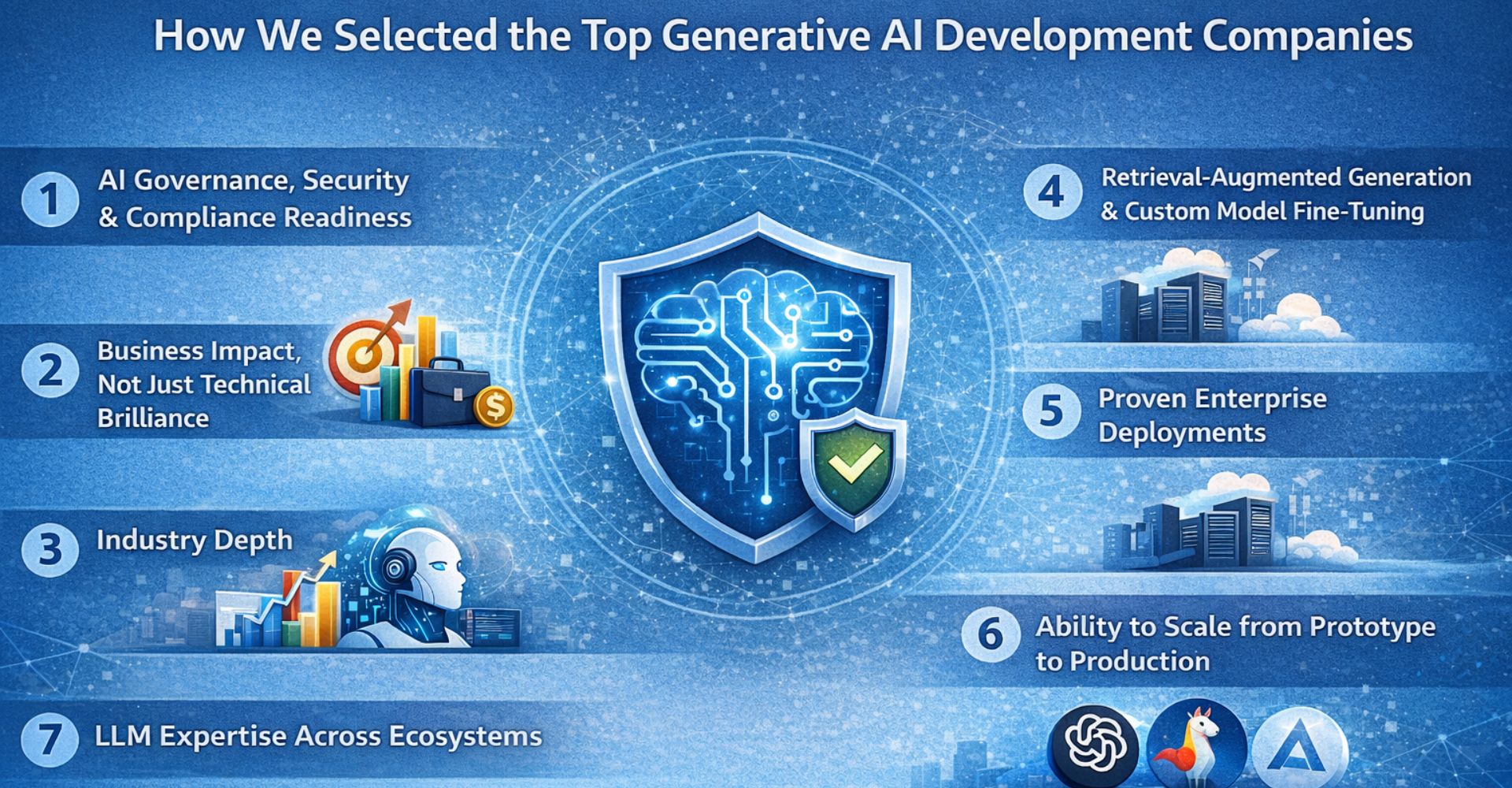
How We Selected the Top Gen AI Development Companies in 2026
Every AI company says they are “leading.” Every website says “cutting-edge.”
And every pitch deck has a slide with neural network graphics. But slides don’t ship production systems.
So, we didn’t build this list based on marketing noise. We focused on execution, real deployments, real engineering depth, and real enterprise impact.
Here’s exactly what we looked at.
1. AI Governance, Security & Compliance Readiness
In 2026, governance is not optional. Enterprises now demand:
- Role-based access controls
- Data encryption
- Model monitoring
- Bias detection
- Explainability frameworks
Especially in regulated industries. Any company that ignores governance is still living in 2023.
2. Business Impact, Not Just Technical Brilliance
Some companies build incredible models. But enterprises don’t buy models.
They buy outcomes. We evaluated whether these firms tie AI initiatives to:
- Revenue growth
- Operational efficiency
- Cost reduction
- Customer experience improvement
Gen AI is no longer a research project. It’s a business lever.
3. Industry Depth
Generic AI knowledge is not enough. Retail AI is different from healthcare AI.
Manufacturing use cases are not the same as fintech automation. We favored companies that understand industry context, compliance requirements, domain vocabulary, and business workflows.
Because context improves accuracy. And accuracy builds trust.
4. Retrieval-Augmented Generation & Custom Model Fine-Tuning
Enterprise Gen AI rarely works “out of the box.” It needs:
- Structured and unstructured data integration
- Vector databases
- Fine-tuning strategies
- Domain-specific embeddings
- Evaluation pipelines
We evaluated firms that build robust RAG frameworks, not just surface-level integrations. Because without high-quality data retrieval, even the best LLM will hallucinate.
5. Proven Enterprise Deployments
It’s easy to build a chatbot over GPT-4; however, it’s much harder to:
- Deploy it securely inside a Fortune 500 environment
- Connect it to internal systems
- Handle thousands (or millions) of user interactions
- Monitor performance and hallucinations
- Maintain uptime and cost efficiency
We prioritized companies that have moved beyond sandbox experiments.
6. Ability to Scale from Prototype to Production
Here’s where most AI initiatives collapse. They build something impressive in 8 weeks.
Leadership gets excited. And then scaling exposes every architectural weakness.
We looked for LLMOps maturity, MLOps pipelines, Cloud-native AI infrastructure, cost optimization frameworks, and continuous monitoring and feedback loops. Because scaling AI is not just a technical challenge, it’s an operational one.
7. LLM Expertise Across Ecosystems
Serious Gen AI partners don’t depend on a single model. They work across OpenAI models, anthropic models, Google DeepMind models, and Open-source models like Llama
Model selection should depend on use case, cost, latency, compliance, and control. If a company only works with one ecosystem, that’s a limitation.
So, this list isn’t about hype. It’s about who can actually design, build, deploy, secure, and scale generative AI systems in real-world enterprise environments.
And yes, that’s a much higher bar. Now, let’s look at the companies that are clearing it in 2026.
Top Gen AI Development Companies in 2026 (Ranked & Reviewed)
Let’s get into the names. These are the companies that are not just experimenting with Generative AI, they are engineering it, deploying it, and scaling it inside real enterprises.
1. Credencys Solutions
Let’s start with a company that approaches Generative AI differently. While many firms begin with “Which model should we use?”, Credencys starts with: What business outcome are we solving?
And that changes everything.
Core Strengths:
- Enterprise-grade Gen AI applications
- AI-powered Customer 360 platforms
- Retail & CPG intelligence systems
- RAG-based enterprise search
- AI-driven pricing and demand forecasting
- Strong data engineering + AI integration
What makes Credencys stand out in 2026 is its foundation in data architecture. Because Generative AI without structured, governed, accessible data is just a prompt experiment.
They focus heavily on:
- Lakehouse-aligned AI architecture
- LLMOps frameworks
- Secure deployments
- Scalable AI pipelines
Success Story: How Credencys Helped a Specialty Apparel Retailer
When talking about AI consulting companies that deliver real business impact, it’s one thing to talk strategy and another to show it. Here’s a powerful example from one of Credencys’ engagements with a leading women’s specialty apparel retailer that was struggling with fragmented data and inconsistent omnichannel experiences.
Client Challenge: With over 415 stores nationwide, the retailer faced a common but critical problem: customer and operational data were scattered across on-premises systems, cloud tools, and third-party platforms. This fragmentation made it nearly impossible to:
- Provide a seamless omnichannel experience
- Support flexible fulfilment options like buy online, pick up in store (BOPIS)
- Maintain real-time inventory visibility across channels
- Deliver personalized experiences based on unified customer data
This wasn’t just a database problem; it was a business growth blocker.
Credencys’ Solution: Instead of rolling out another isolated analytics tool, Credencys implemented a customized AI-Native Customer 360 solution to unify data across all systems, online, offline, cloud, and legacy sources. The solution included:
- A unified Customer 360° data layer that pools customer interactions and profiles
- Real-time order tracking and BOPIS support
- Centralized inventory visibility across all locations
- Personalized product recommendations and targeted promotions
- A scalable system designed to support future omnichannel innovation
In short: data chaos became clarity, and experience gaps became growth levers.
Business Impact: This wasn’t a small operational lift; it was a profound business transformation. After implementation, the retailer saw:
- 24% increase in online sales through smoother customer experiences
- 31% improvement in customer satisfaction thanks to unified omnichannel engagement
- Significant reduction in stockouts and fulfillment delays
- Strengthened brand loyalty due to consistent and personalized shopping journeys
These metrics show what happens when AI consulting isn’t just about models, it’s about data alignment, customer experience, and measurable business outcomes.
Ideal for: Mid-to-large enterprises in retail, manufacturing, supply chain, and digital commerce that want AI tied directly to measurable business KPIs.
Where many AI firms lead with models, Credencys leads with impact.
2. LeewayHertz
LeewayHertz has positioned itself as a strong enterprise AI engineering partner, particularly in the US market.
Core Capabilities:
- Custom LLM application development
- Enterprise chatbot systems
- Blockchain + AI integration
- AI product engineering
They work extensively with large enterprises looking to embed Gen AI into internal workflows. Best suited for organizations building AI-powered products or internal automation platforms.
3. Ksolves
Ksolves brings a broader enterprise technology background into AI.
What they offer:
- AI and ML development
- NLP solutions
- Conversational AI
- Data engineering services
They are particularly attractive for companies that want AI integrated into existing enterprise systems rather than built from scratch.
4. CaliberFocus
CaliberFocus operates at the intersection of AI consulting and digital transformation.
Strength Areas:
- Generative AI consulting
- Digital engineering
- AI integration within enterprise systems
They are often a fit for companies early in their AI maturity journey, needing advisory plus implementation support.
5. Xavor
Xavor focuses on AI-enabled digital engineering solutions, particularly in the US enterprise space.
Capabilities include:
- AI-driven enterprise modernization
- Custom Gen AI applications
- Intelligent automation systems
They are strong in digital transformation projects where Gen AI becomes part of a broader modernization roadmap.
A Quick Reality Check
There isn’t one “best” Gen AI company. There’s the best company for:
Your industry, your data maturity, your budget, your timeline, and your risk appetite. Some are ideal for massive global rollouts.
Some excel at focused AI product development. Some shine in data-first AI strategies.
The right choice depends on what you are trying to build and how serious you are about scaling it. Now, let’s look at the types of Generative AI services these companies actually offer beyond the buzzwords.
Types of Generative AI Services These Companies Offer
“We build Gen AI solutions” can mean a hundred different things. Some companies are building internal copilots.
Some are deploying AI-powered search across enterprise data. Some are fine-tuning domain-specific LLMs.
And some are just wrapping APIs. So, what are the real services leading Gen AI development companies offer in 2026?
Let’s break it down.
1. AI-Powered Enterprise Search
Search inside enterprises has always been messy. Files everywhere, outdated documentation, and siloed systems.
Now companies are deploying AI search systems that understand intent, summarize documents, extract key insights, and connect across structured and unstructured data. It’s not keyword search anymore, but semantic intelligence.
2. Custom Model Fine-Tuning & Domain LLMs
Sometimes off-the-shelf models aren’t enough. So, companies fine-tune models like Llama or adapt enterprise versions of foundation models through providers like OpenAI.
This is particularly important for Healthcare, Financial services, Legal industries, and Manufacturing domains. Because domain language is different, and generic models struggle with specialized nuance.
3. LLMOps & AI Monitoring Frameworks
And this is the part nobody talks about in flashy demos. Leading development companies build model-performance dashboards, prompt-management systems, cost-tracking mechanisms, hallucination-detection workflows, and bias-evaluation systems.
Because once AI goes live, you don’t just “set it and forget it.” You monitor, optimize, and iterate every week.
4. Multimodal AI Systems
Text is just one part of the story. Leading Gen AI firms are building systems that process text, images, audio, and structured data
This enables use cases like visual inspection in manufacturing, AI-driven product content generation, intelligent video summarization, and multimodal customer support systems. It’s more complex but also more powerful.
5. AI Agents & Autonomous Workflows
This is where Gen AI is heading next. AI agents that don’t just respond, they act.
They can trigger workflows, pull data from systems, execute predefined actions, and coordinate multi-step tasks. These systems often integrate with enterprise tools and leverage APIs across platforms.
It’s still evolving. But adoption is accelerating fast.
6. Document Intelligence & Automation
This is one of the fastest-growing use cases in 2026. Gen AI systems now extract insights from contracts, summarize legal documents, process invoices, analyze claims, and interpret compliance reports
And they do it at scale. When combined with automation frameworks, this dramatically reduces manual review cycles.
Less repetitive work and more strategic time.
7. Enterprise AI Copilots & Conversational Systems
This is where it all started. But it’s evolved far beyond basic chatbots.
Companies are building internal knowledge assistants, sales copilots, HR automation assistants, developer copilots, and customer support AI agents. These systems are often powered by models such as GPT-4, Claude 3, or Gemini, but are heavily customized using enterprise data.
Because generic answers don’t cut it in regulated or complex industries. And yes, accuracy matters more than creativity in enterprise environments.
8. Retrieval-Augmented Generation (RAG) Systems
This is the backbone of serious enterprise Gen AI. RAG-based systems connect large language models with internal documents, knowledge bases, product catalogs, policy databases, and real-time structured data
Instead of relying solely on pre-trained knowledge, the AI first retrieves relevant internal information and then generates responses. Result?
Fewer hallucinations, higher contextual accuracy, and better trust. If a development company doesn’t deeply understand RAG architecture, vector embeddings, and retrieval optimization, that’s a red flag.
How to Choose the Right Gen AI Development Partner in 2026
This is where most companies get it wrong. They get excited about the demo, impressed by the UI, blown away by how “human” the responses sound.
And they forget to ask the hard questions. But Generative AI isn’t a design decision is an architectural one.
So, before you sign anything, pause and ask this instead.
1. Do They Understand Your Data Architecture?
Gen AI is only as good as the data behind it. Ask:
- How will you integrate with our existing systems?
- How do you handle structured + unstructured data?
- What’s your RAG architecture approach?
- How do you ensure data freshness?
If their answer is vague, that’s a problem. Because Gen AI is 20% model and 80% data engineering.
2. What’s Their Approach to Hallucination Mitigation?
Every LLM hallucinates, even the most advanced ones. Whether it’s built on GPT-4 or Claude 3, hallucinations are real.
So, ask:
- How do you evaluate model accuracy?
- Do you implement grounding frameworks?
- How do you measure response confidence?
- What monitoring systems are in place?
3. Do They Design for Scale or Just for Demo Day?
A prototype is easy. Scaling to thousands of users is a different game.
Ask about LLMOps pipelines, auto-scaling infrastructure, latency management, cost optimization strategies, and token usage monitoring. Because Gen AI costs can escalate fast.
And suddenly your “pilot project” has a six-figure monthly bill.
4. How Strong Is Their Governance Framework?
This one’s critical. Especially in regulated industries.
Ask:
- How do you handle data privacy?
- Is sensitive information masked or filtered?
- What compliance standards do you align with?
- Do you support audit trails?
Governance isn’t an afterthought anymore, but rather a matter of board-level visibility.
5. Can They Tie AI to Business KPIs?
Here’s the real differentiator. Some firms will talk about embeddings, transformers, and fine-tuning.
That’s great. But ask them:
- How will this improve revenue?
- Where will costs reduce?
- What measurable outcome should we expect?
- What does success look like in 6 months?
If they can’t translate AI into business metrics, they are not the right partner. Because leadership doesn’t approve of cool tech but only of ROI.
6. What Happens After Deployment?
This is where reality kicks in. Ask:
- Who maintains the model?
- How are updates managed?
- What does continuous improvement look like?
- How do we retrain or optimize over time?
Gen AI systems evolve. They require iteration, evaluation, and feedback loops.
If a vendor disappears after go-live, you are left holding a fragile system that breaks easily.
7. Do They Offer Cross-Model Flexibility?
The Gen AI landscape is evolving quickly. Today, it might be OpenAI.
Tomorrow, it might be another provider. Or an open-source ecosystem.
Your partner should design architecture that allows flexibility, not lock you into a single model vendor.
Planning a Generative AI Initiative in 2026?
If you are exploring how Gen AI fits into your data ecosystem, whether it’s AI-powered Customer 360, intelligent automation, enterprise search, or domain-specific copilots, the starting point isn’t the model but your architecture and your outcomes. At Credencys, we help enterprises design, build, and scale production-grade Generative AI systems grounded in strong data foundations and measurable business impact.
If you are serious about moving from pilot to production, it might be time to have that conversation.






Tags: