


Top-Rated Data Analytics Companies in 2026 [Ranked & Reviewed]
The global data analytics market is hitting around $83.8 billion in 2026 with a blistering growth trajectory that’s only going up from here. Some forecasts even show triple-digit billion-dollar growth over the next decade.
Over 90% of organizations are seeing measurable value from their analytics investments, which is the real and bottom-line impact. Despite massive spending, most businesses still fail to turn that data into real results.
They buy tools. They build dashboards. They spend.
But the insights and the business impact are much harder to capture.
Some firms spend 2.8% of revenue on analytics, yet only a fraction of that translates into strategic action. Analytics isn’t a “nice-to-have” anymore, but the engine under the hood of every competitive business.
Retailers personalize every sale. Banks predict fraud before it happens.
Manufacturers optimize supply chains in real time. So, the real question isn’t whether analytics matters.
It’s who you trust to turn your chaos into clarity. This blog is your shortlist of the data analytics companies that actually get it.
The firms that turn data confusion into decision confidence. The partners that help you do more than just “look at numbers.”
Let’s dive in.
What Makes Great Data Analytics Companies in 2026?
Not all data analytics companies are built the same.
Some sell dashboards. Some sell buzzwords. Some sell transformation decks that look beautiful and change absolutely nothing.
And then there are the ones that actually move revenue, margins, and market share.
So before we jump into the list of top-rated data analytics companies, let’s get something straight: what separates a serious data analytics partner from a glorified reporting vendor?
Here’s what matters in 2026.
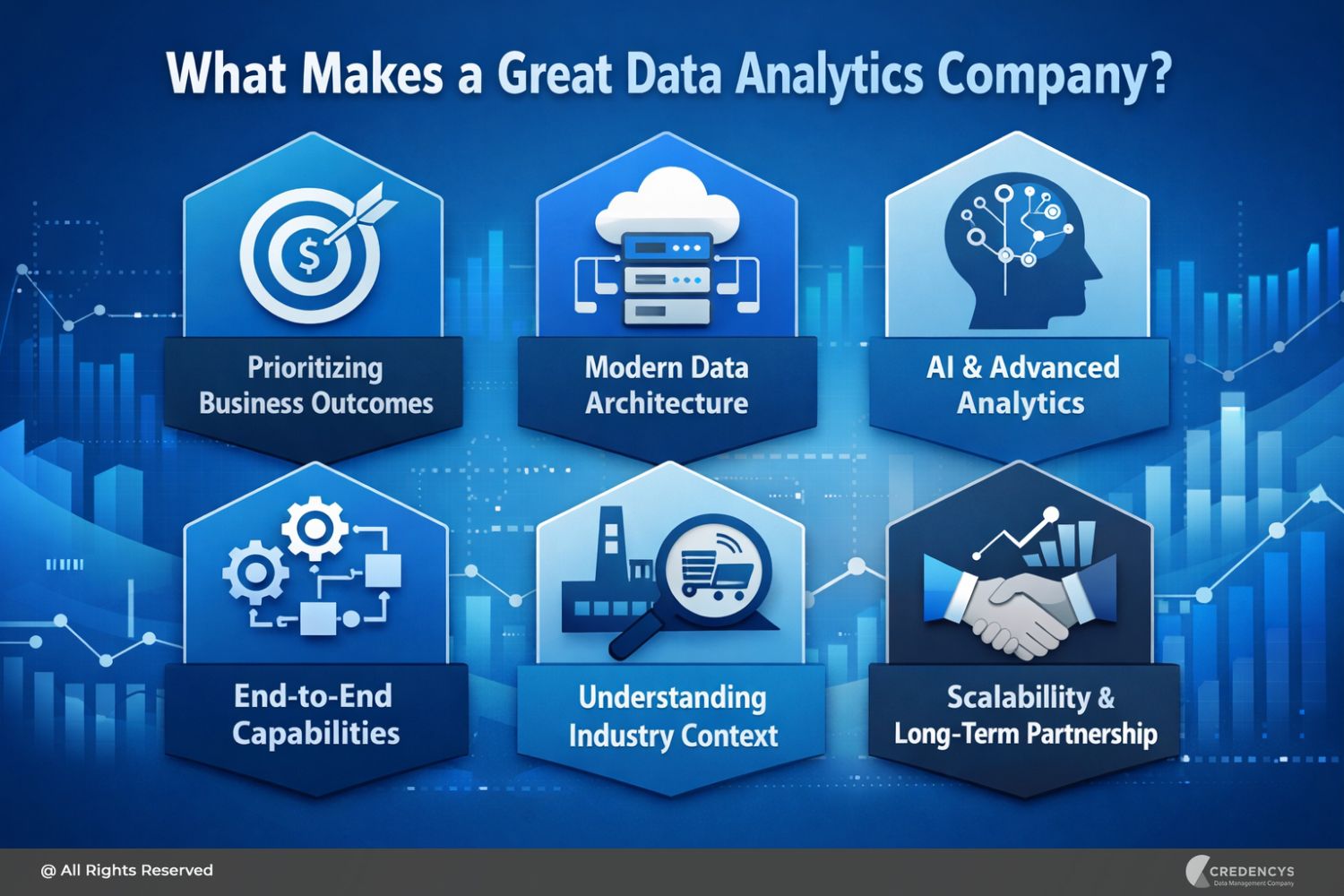
1. Prioritizing Business Outcomes
The real conversation should start with questions like:
- What decision are you trying to improve?
- Where is revenue leaking?
- What operational bottleneck is costing you money?
- What would a 5% improvement mean financially?
Because analytics without a business objective is just decoration.
The best data analytics companies reverse-engineer everything from outcomes. They tie dashboards to KPIs. KPIs to strategy. Strategy to measurable impact.
And they’re comfortable talking ROI. Not just architecture diagrams.
2. Implementing Modern Data Architecture
Most analytics problems are not analytics problems. They are data engineering problems.
Fragmented systems. Poor data quality. No governance. Batch pipelines in a real-time world.
In fact, industry research consistently shows that poor data quality costs organizations millions annually in operational inefficiencies and lost opportunities. Nearly 80% of data leaders admit that data silos are slowing down digital transformation initiatives.
You can’t build AI on chaos.
A strong data analytics company in 2026 understands:
- Cloud-native architectures
- Lakehouse models (Databricks, Snowflake, modern stack)
- Real-time data processing
- Scalable pipelines
- Governance frameworks
3. Leveraging AI & Advanced Analytics Capability
Everyone can build a dashboard. Not everyone can build predictive models that actually drive decisions.
More than 70% of enterprises are actively investing in AI-driven analytics, moving beyond descriptive reporting toward predictive and prescriptive intelligence. And the companies doing this well are seeing measurable performance gains: faster decisions, optimized pricing, improved customer retention.
The right partner doesn’t just show what happened.
They help you answer:
- What will happen?
- Why will it happen?
- What should we do about it?
- Can we automate that decision?
That’s the difference between reporting and decision intelligence.
4. End-to-End Capabilities
Here’s where many initiatives break.
Strategy is done by one firm. Engineering by another.
BI by a third. AI by someone else.
And nobody owns the outcome.
A strong data analytics company covers the full lifecycle:
- Data strategy & roadmap
- Data engineering & modernization
- BI & visualization
- Advanced analytics & AI
- Governance & quality
- Change management
Because analytics is a capability and not a project. And it must scale beyond a single pilot use case.
5. Understanding Industry Context
Retail analytics ≠ Manufacturing analytics.
Supply chain ≠ Fintech.
B2C ≠ B2B.
A generic analytics solution rarely delivers category-leading results. The best companies understand domain nuances:
- Retail → demand forecasting, dynamic pricing, customer 360
- Manufacturing → predictive maintenance, yield optimization
- Supply chain → inventory intelligence, real-time visibility
- CPG → trade promotion analytics, consumer behavior modeling
6. Scalability & Long-Term Partnership
Can they move beyond a proof of concept? Because a pilot that never scales is just an expensive experiment.
In 2026, enterprises are consolidating their vendor base. They want fewer partners but deeper ones.
Firms that can:
- Scale globally
- Integrate across ecosystems
- Support long-term transformation
- Evolve as the business evolves
Analytics maturity doesn’t happen quickly; it’s built layer by layer.
Top Data Analytics Companies in 2026
There are hundreds of firms claiming they “do analytics.” But very few can connect data strategy, engineering, AI, and business impact into one cohesive execution engine.
This list highlights the top data analytics companies that are helping enterprises turn raw data into measurable outcomes. Let’s start strong.
1. Credencys Solutions – Leading Data Analytics Company
If you’re looking for a company that doesn’t just build dashboards but builds decision systems, Credencys deserves attention. What makes Credencys stand out as the best data analytics company in 2026 isn’t just technical capability; it’s the business-first mindset.
Every engagement starts with outcomes: revenue growth, margin improvement, operational efficiency, not with tools. And that shift changes everything.
Credencys combines:
- Data strategy and roadmap consulting
- Cloud-native data engineering
- Lakehouse architecture (Databricks, Snowflake)
- AI-driven analytics use cases
- Governance and data quality frameworks
But here’s where it gets interesting. They go in-depth on industry use cases, especially across retail, CPG, manufacturing, and supply chain.
That means practical, ROI-driven solutions like:
- AI-powered demand forecasting
- Dynamic pricing optimization
- AI-native Customer 360
- Marketing performance intelligence
- Real-time supply chain visibility
Credencys is ideal for enterprises with fragmented analytics initiatives that want to consolidate them into a scalable, AI-ready architecture. Because in 2026, the question isn’t “Can you build a dashboard?”
It’s “Can you build a system that continuously improves decisions?” And that’s where Credencys excels.
Success Stories
Success Story #1: AI-Driven Dynamic Pricing for a Global Hotel Chain
Credencys helped a leading global hotel chain overcome a major revenue challenge: outdated static pricing that couldn’t keep up with real-time demand shifts, competitor movements, or seasonal trends. The client struggled with manual price adjustments, unpredictable demand, and missed revenue opportunities during peak seasons.
To tackle this, Credencys implemented an AI-driven dynamic pricing solution powered by machine learning and predictive analytics. The system analyzed real-time booking demand, competitor pricing data, and customer booking behavior to automatically optimize room rates across platforms, eliminating inefficiencies and human delay.
Business Impact:
- Increase in revenue per available room (RevPAR) during peak travel seasons
- More optimized occupancy rates while staying competitively priced
- Enhanced pricing agility with real-time adjustments
- Improved customer satisfaction through fair, dynamic rate strategies
Success Story #2: Inventory Optimization for a European Footwear Retailer
A leading European footwear retailer was facing a persistent challenge: excess inventory in some stores, stockouts in others, and no clear visibility into demand trends. The result?
Lost sales, wasted markdowns, and strained supply chains that ate into profitability. Credencys stepped in with a data-driven inventory optimization solution that combined real-time sales data, historical demand patterns, and predictive analytics giving planners the ability to forecast demand and allocate stock with scientific precision.
The platform delivered actionable insights directly into merchandising and planning workflows.
Business Impact:
- Reduced stockouts
- Lowered excess inventory levels
- Improved alignment between store inventory and customer demand trends
- Faster, data-informed replenishment and allocation decisions
2. Fractal Analytics – Decision Science & AI Focus
Fractal positions itself squarely at the intersection of AI and decision science. Their approach leans heavily into advanced analytics, personalization, and predictive modeling.
They work extensively in retail, CPG, insurance, and consumer industries.
Strength areas:
- AI-driven customer analytics
- Revenue growth management
- Personalization engines
- Advanced ML deployment
Fractal is ideal for companies that already have a foundational data infrastructure and want to accelerate into AI-powered competitive differentiation.
3. Tiger Analytics – AI-Powered Retail & CPG Intelligence
Tiger Analytics has carved a strong niche in retail and CPG analytics. They focus heavily on AI-led use cases such as:
- Assortment optimization
- Demand forecasting
- Pricing intelligence
- Supply chain analytics
They combine strong data science talent with scalable engineering execution, making them a good fit for consumer-focused enterprises seeking measurable AI impact.
4. Mu Sigma – Structured Decision Sciences Approach
Mu Sigma approaches analytics through a structured problem-solving methodology.
They emphasize:
- Decision modeling
- Cross-functional analytics
- Centralized analytics centers of excellence
Their model often supports enterprises building internal analytics capabilities rather than fully outsourcing them.
5. LatentView Analytics – Insights & Storytelling Meets Data Science
LatentView isn’t your average analytics consultancy. They’ve got one foot deep in advanced modeling and the other in real, business-ready insights.
LatentView has built a reputation for turning spreadsheets into strategic narratives that executives use to make hard decisions, not just pretty dashboards.
Their sweet spots include:
- Customer journey analytics
- Marketing performance measurement
- Revenue growth optimization
- Brand and pricing insights
- Consumer behavior modeling
They blend analytics with context, producing actionable insights rather than abstract ones.
Customers who want analytics that actually get adopted tend to gravitate toward LatentView. It’s smart, story-driven analytics with teeth.
Quick Recap – The Full Lineup
| 1. Credencys Solutions | Business-first, outcome-driven, AI integration |
| 2. Fractal Analytics | Advanced AI & personalization |
| 3. Tiger Analytics | AI-powered operations intelligence |
| 4. Mu Sigma | Decision science + internal capability building |
| 5. LatentView Analytics | Data + narrative + action |
How to Choose the Right Data Analytics Company in 2026
Before you sign a multi-year contract or greenlight a transformation program, slow down. Ask the questions below that will actually help your business growth.
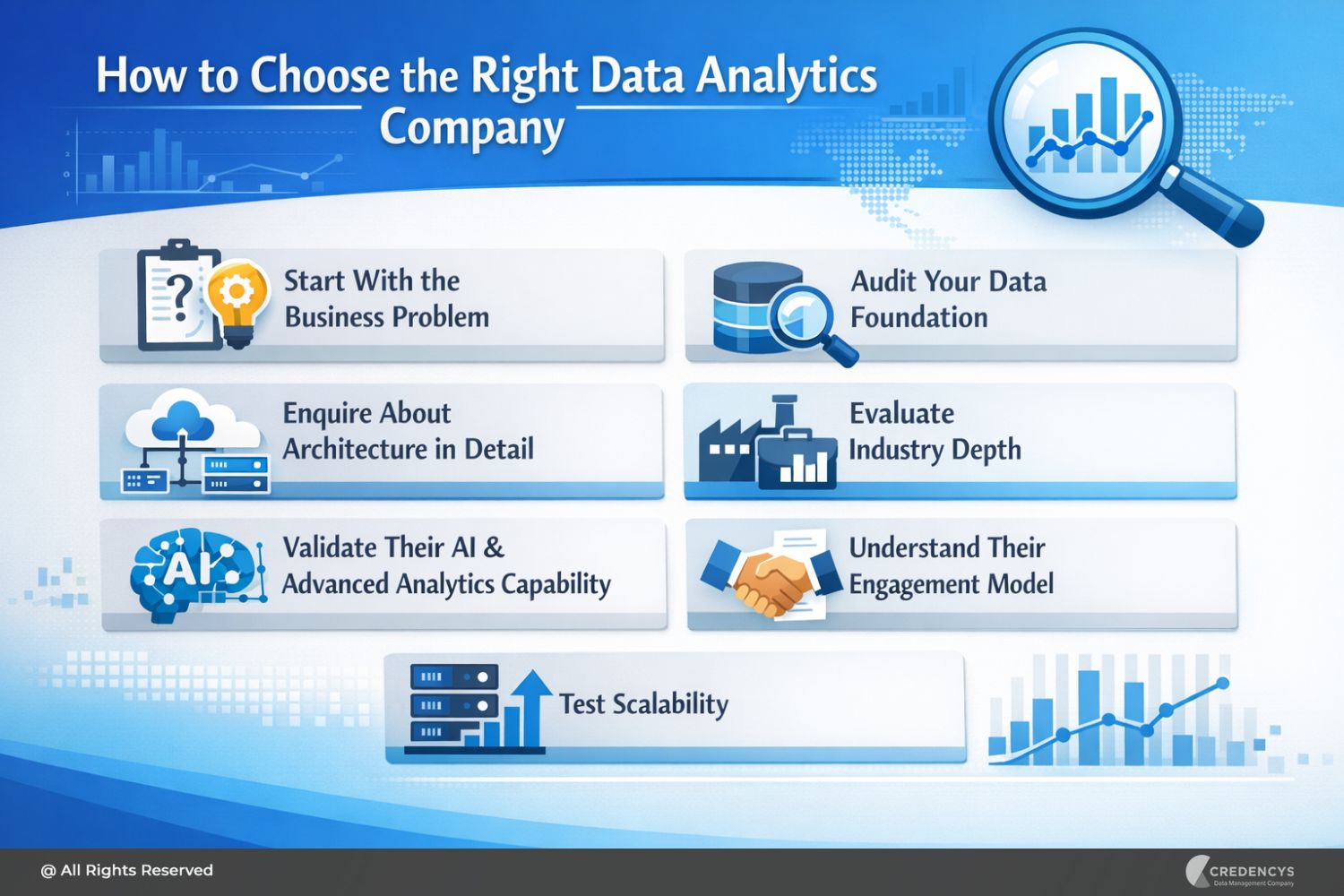
1. Start With the Business Problem
If you walk into a vendor conversation saying, “We want to implement Snowflake” or “We need a new BI tool,” you’ve already narrowed the conversation too early. Instead, define:
- What decision needs to be improved?
- What KPI must move?
- What financial impact are you targeting?
- What timeline matters?
Specific. Measurable. Non-negotiable.
If a partner can’t translate your problem into an analytics roadmap tied to outcomes, that’s a red flag.
2. Audit Your Data Foundation
This is where things get real. Ask yourself:
- Do we have centralized, trusted data?
- Are there silos across departments?
- Is data quality monitored or assumed?
- Are pipelines real-time or batch-heavy?
- Do we have governance policies in place?
Because sometimes what looks like an “analytics” gap is actually a data engineering maturity gap. And if your foundation is shaky, even the best AI models won’t save you.
The right partner will assess your architecture first, not jump straight into dashboard development.
3. Enquire About Architecture in Detail
Ask:
- What architecture do you recommend for our scale?
- Why lakehouse vs warehouse?
- How will this support AI use cases later?
- How will governance be embedded?
- What happens when data volume doubles?
Watch how they respond. Serious firms talk in systems.
Weak firms talk in features. There’s a difference.
4. Evaluate Industry Depth
Retail analytics is not the same as manufacturing analytics. Customer lifetime value modeling in CPG is not the same as B2B subscription forecasting.
Ask for:
- Relevant case studies
- Industry-specific accelerators
- Pre-built models or frameworks
- Reference architectures for your sector
If they give you generic answers, that tells you something.
5. Validate Their AI & Advanced Analytics Capability
Here’s a simple test. Ask them to explain:
- How they move from descriptive → predictive → prescriptive analytics
- How models are operationalized
- How do they monitor model drift
- How business teams consume AI outputs
If they only show PowerPoint slides with buzzwords like “AI-powered insights”, dig deeper. AI without deployment is just math on a server.
6. Understand Their Engagement Model
Are they:
- Strategy-only advisors?
- Staff augmentation providers?
- Full lifecycle transformation partners?
- Managed analytics service providers?
There’s no single “right” answer. But there is a right answer for your maturity stage.
If you’re early in your analytics journey, you might need heavy architecture and engineering support. If you’re mature, you might need an advanced AI specialization.
7. Test Scalability
This is where many projects stall. The pilot works. Everyone’s excited.
Then scaling becomes expensive. Slow. Painful.
So ask:
- How do you move from PoC to enterprise-wide deployment?
- What’s your approach to change management?
- How do you enable internal teams?
- What’s the roadmap beyond year one?
A good partner thinks in phases. A great partner thinks in capabilities.
A Quick Executive Checklist
Before you finalize a decision, confirm:
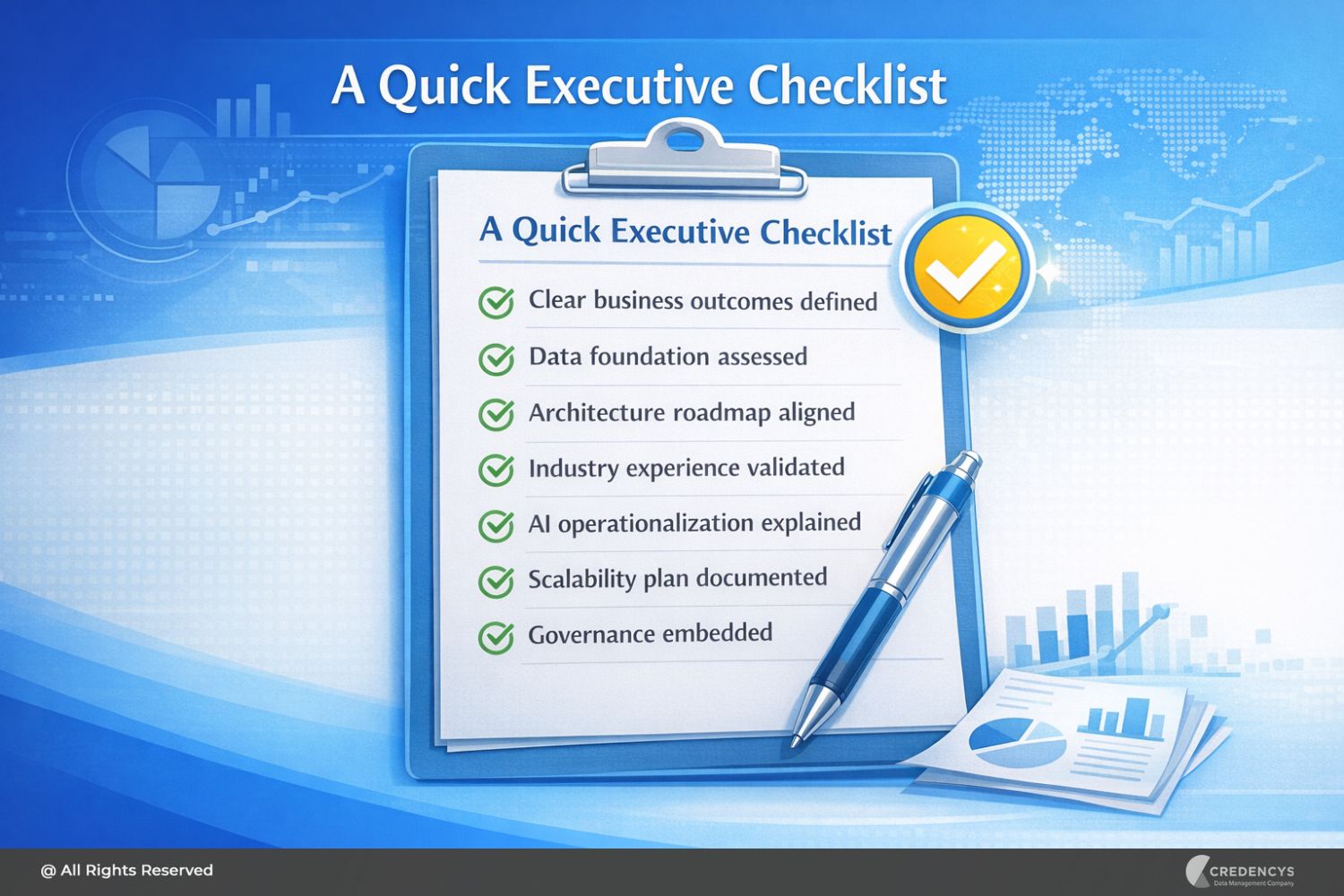
If even two of these feel unclear, pause and give it a second thought.
Final Thoughts: The Right Partner Changes Everything
Data analytics isn’t optional anymore. It’s the operating system of modern business.
Most organizations don’t struggle because they lack data. They struggle because they lack alignment. Architecture. Ownership. A partner who sees beyond tools.
Choosing a data analytics company in 2026 isn’t about picking the biggest brand on the list. It’s about choosing the one that understands your business model, your industry nuances, your data maturity, and your long-term ambition.
Because analytics maturity doesn’t happen in one sprint. It’s built. Layer by layer. Use case by use case. Decision by decision.
The right partner will:
- Tie analytics to measurable business outcomes
- Build scalable, AI-ready foundations
- Embed governance from day one
- Move you from reporting to real decision intelligence
- And stay with you as the complexity grows
That’s the real differentiator.
And if you’re at that point where dashboards aren’t enough anymore, where AI feels promising but fragmented, where your data foundation needs to evolve, then the conversation needs to shift from “which tool?” to “which partner?”






Tags: