


Key Challenges in Implementing Data Analytics Services That Limit ROI
Did you know that poor data quality costs organizations an average of $12.9 million every year? (Gartner)
Yet despite rising investments in AI, analytics platforms, and cloud data ecosystems, many enterprises still struggle to turn data into measurable business value.
Many enterprises start their data analytics journey with high expectations. The vision is clear: smarter forecasting, faster decisions, better customer experiences, and improved operational efficiency. But somewhere between data collection and actionable insights, momentum slows down.
Dashboards exist, but teams do not fully trust them. Reports are generated, but decisions still rely on instinct. Data lakes grow, yet business clarity does not.
The reality is that implementing analytics is not just about deploying tools. It is about aligning strategy, technology, governance, and people. And that is where most organizations encounter the key challenges in implementing data analytics services.
Before analytics can truly transform a business, these challenges must be understood and addressed systematically.
Key Challenges in Implementing Data Analytics Services
Implementing analytics sounds straightforward in theory. Collect data. Analyze it. Generate insights. Drive action.
In reality, it is far more complex.
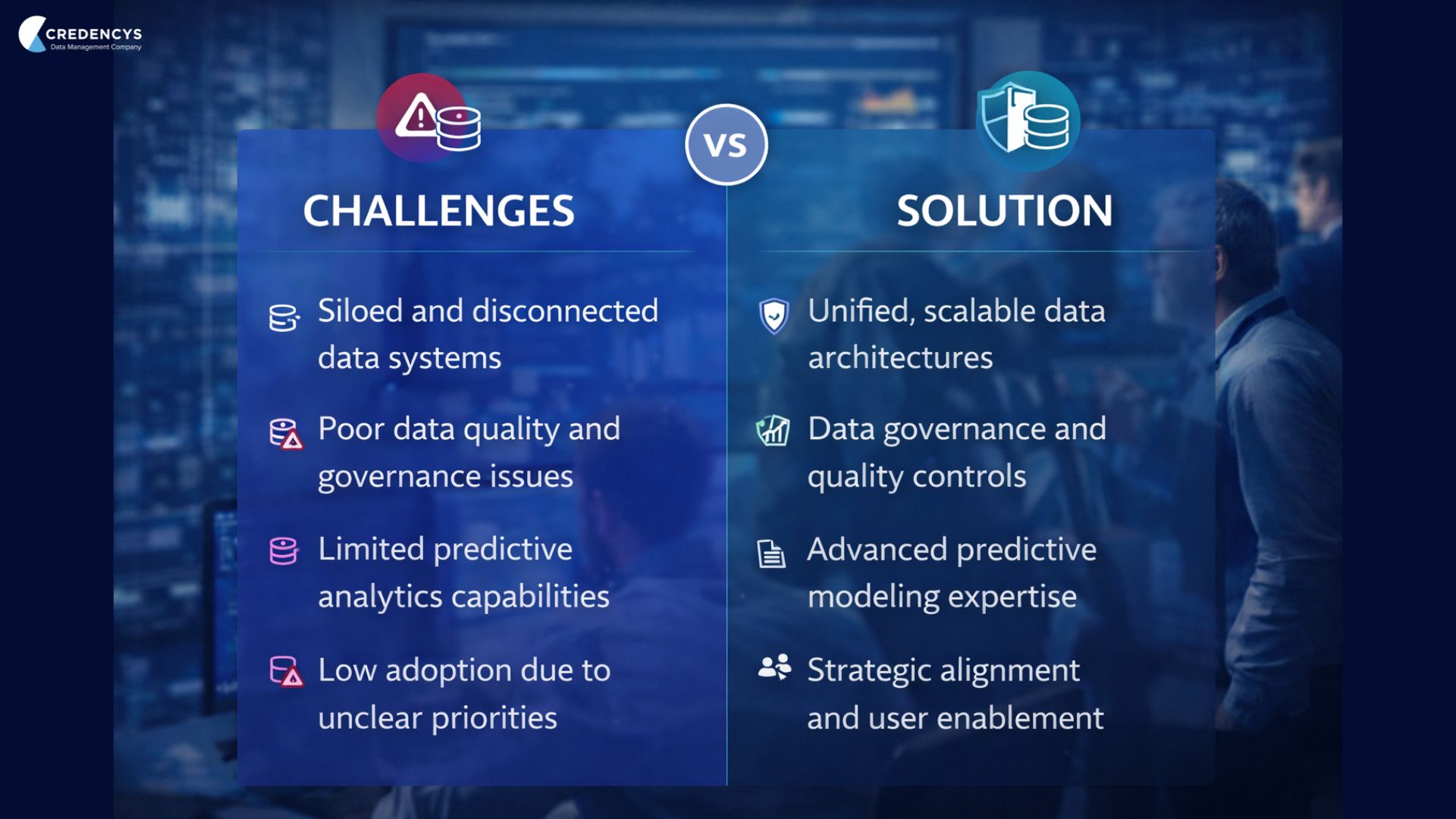
Below are the most common key challenges in implementing data analytics services that organizations encounter across industries.
1. Disconnected Data Ecosystems
Most enterprises operate across multiple systems: ERP, CRM, marketing automation, POS, supply chain platforms, and external data sources.
When these systems do not communicate seamlessly, data remains siloed. Teams spend more time reconciling numbers than interpreting them. Without unified data architecture, analytics outputs are often inconsistent and difficult to trust.
2. Poor Data Quality and Governance
Analytics is only as reliable as the data behind it.
Duplicate records, missing attributes, inconsistent definitions, and outdated data create noise. Without clear ownership and governance frameworks, errors compound over time.
Business leaders may question the accuracy of dashboards, which ultimately slows adoption and reduces ROI from analytics investments.
3. Lack of Clear Business Alignment
One of the most underestimated challenges is misalignment between analytics initiatives and business objectives.
Data teams may focus on building technically advanced models, while business users seek answers to operational questions. When analytics projects are not tied to measurable business outcomes, adoption declines.
Analytics should solve real problems, not just produce reports.
4. Legacy Infrastructure Limitations
Traditional data warehouses and manual reporting systems struggle to handle growing data volumes and real-time needs.
Outdated forecasting models, static reports, and spreadsheet-based workflows limit agility. As data complexity increases, these systems become bottlenecks rather than enablers.
Modern analytics requires scalable, cloud-native platforms and advanced data engineering capabilities.
5. Limited Advanced Analytics Capabilities
Organizations often invest in reporting but hesitate to move into predictive and prescriptive analytics.
Machine learning, AI-driven forecasting, and automated optimization require specialized skills and structured data pipelines. Without the right expertise, businesses remain stuck in descriptive analytics, reacting to the past instead of preparing for the future.
6. Change Management and Adoption Barriers
Even the most sophisticated analytics solution fails if teams do not use it.
Resistance to change, lack of training, and unclear workflows can derail implementation. Analytics transformation is as much a cultural shift as it is a technical upgrade.
Successful implementations prioritize user enablement alongside technology deployment.
These key challenges in implementing data analytics services are not signs of failure. They are natural friction points in transformation journeys.
The difference between stalled initiatives and successful ones lies in how systematically these challenges are addressed.
Experts Guide to Overcome the Key Challenges in Implementing Data Analytics Services
Recognizing the challenges is important. Addressing them systematically is what drives results.
Here is how organizations successfully overcome the key challenges in implementing data analytics services:
- Create a Unified Data Architecture: Integrate ERP, CRM, POS, and operational systems into a centralized platform to eliminate silos and ensure a single source of truth.
- Establish Strong Governance: Define data ownership, validation rules, and monitoring frameworks early to maintain accuracy and build trust in analytics outputs.
- Align Analytics with Business Outcomes: Tie initiatives directly to measurable KPIs such as forecast accuracy, cost reduction, revenue growth, or operational efficiency.
- Modernize Infrastructure: Adopt scalable, cloud-native platforms that support real-time analytics and advanced machine learning capabilities.
- Move Toward Predictive Intelligence: Go beyond descriptive dashboards. Implement AI-driven models that anticipate trends instead of reacting to them.
- Drive User Adoption: Enable teams with intuitive dashboards, training, and clear workflows to ensure insights translate into action.
How Credencys Can Help in Implementing Data Analytics Services for your Business
Addressing the key challenges in implementing data analytics services requires more than technical execution. It requires experience across industries, strong architectural thinking, and the ability to translate data complexity into business clarity.
At Credencys, data analytics implementation is not treated as a one-time project. It is designed as a long-term capability that evolves with your business.
1. Strategic Assessment Before Execution
Many analytics initiatives fail because implementation begins without a structured assessment.
Our engagement starts with a deep evaluation of your current data landscape, business priorities, reporting gaps, and technology stack. We identify where inefficiencies exist, where data friction slows decisions, and where predictive insights can create competitive advantage.
This prevents overengineering and ensures investments are directed toward high-impact use cases.
2. End-to-End Data Engineering Capabilities
Data analytics implementation demands strong engineering foundations.
Our team builds scalable data pipelines, modern data warehouses, and lakehouse architectures that handle structured and unstructured data seamlessly. We specialize in:
- Data ingestion and transformation across ERP, CRM, POS, and third-party systems
- Real-time and batch processing architectures
- Performance optimization for large-scale data workloads
- Data modeling tailored for analytics and reporting
This ensures that insights are built on stable, high-performing infrastructure rather than fragmented systems.
3. Advanced Analytics and Machine Learning Expertise
Beyond dashboards, we focus on intelligence.
Credencys develops predictive and prescriptive models that support:
- Demand forecasting
- Customer segmentation and behavior modeling
- Inventory optimization
- Revenue and profitability analysis
- Operational efficiency monitoring
By integrating machine learning into analytics ecosystems, we help organizations move from reactive reporting to proactive decision-making.
4. Governance-Driven Implementation
One of the most overlooked aspects of analytics transformation is governance.
We embed data quality checks, validation frameworks, monitoring mechanisms, and access controls directly into the architecture. This creates transparency, accountability, and auditability.
When business leaders trust the data, adoption accelerates naturally.
5. Industry-Focused Expertise
Our experience across retail, manufacturing, automotive, and enterprise environments allows us to anticipate industry-specific challenges before they become bottlenecks.
For example:
- Retail and franchise networks require accurate demand forecasting and omni-channel visibility.
- Manufacturing environments demand supply chain analytics and production performance insights.
- Multi-brand enterprises require consolidated reporting across distributed operations.
Because we understand these nuances, our implementations are not generic. They are contextual and performance-oriented.
6. Measurable Impact, Not Just Deployment
Credencys measures success by business outcomes, not by system go-live dates.
We track KPIs such as forecast accuracy improvement, inventory turnover growth, operational cost reduction, revenue uplift, and customer satisfaction impact.
This accountability-driven approach helps organizations overcome the key challenges in implementing data analytics services and build analytics ecosystems that deliver sustained ROI.
31% Higher Forecast Accuracy for a Leading Retail Group: Data Analytics Success Story
A leading retail group operating 175 stores and growing e-commerce channels struggled with stock imbalances. Some locations faced frequent stockouts, while others carried excess inventory, locking up working capital.
The issue was not lack of data. It was lack of predictive intelligence, one of the common key challenges in implementing data analytics services.
The Transformation
Credencys implemented an AI-driven forecasting framework that:
- Analyzed seasonality and external demand drivers
- Adapted to real-time market shifts
- Optimized inventory allocation across channels
- Integrated insights directly into ERP workflows
The Results
- 31% improvement in forecast accuracy
- 24% increase in inventory turnover
- 22% boost in customer satisfaction
Turning Analytics into Real Business Impact
The key challenges in implementing data analytics services are rarely about technology alone. They stem from disconnected systems, unclear priorities, limited predictive capabilities, and low adoption across teams.
But when analytics is aligned with real business outcomes, supported by strong data foundations, and designed for everyday decision-making, the impact becomes measurable.
If your organization is investing in data but still struggling to see consistent returns, it may be time to reassess the foundation, not just the tools.
At Credencys, we believe analytics should simplify decisions, not complicate them.
If you would like to explore what a more structured, outcome-driven analytics approach could look like for your business, we are always open to a conversation.





Tags: