How PIM Helps Retailers On Managing Product Data?

Well-experienced retailers worldwide will prefer to use Product Information Management (PIM) tools to be smart and successful in their way of managing product data. As a beginner or an experienced retailer, you must understand and remember the importance of properly managing your product data.

You can choose the PIM tool with important features like user-friendliness, integration with existing systems, ease of customization, flexibility of integration with product data plugins, eCommerce platforms, and marketing platforms, and the ability to assist cross-functional operations for managing the product data.

The following details explain how outstanding PIM tools help retailers like you manage product data.

Why Do Retailers Need PIM Solution?

The latest online shopping facilities have changed the way every consumer makes informed decisions and interacts with brands. The main elements that contribute to the success of digital business platforms are partners, affiliates, concessions, and franchises.

1. Maintain high-quality and consistent product data

A product information management platform is designed to categorize products for channel-specific completeness standards or minimal quality standards. You can provide your customers with a consistent and exclusive experience when you enrich your content. Include image galleries, extensive descriptions, and distinctive attributes to increase sales. You must use your customer’s tools they require for informed decisions.

2. Get products to the market in the smart and fast ways

Customer behavior changes regularly. You must make certain that you are one stop ahead and successful in your way to accommodate customers when it matters. You can use the PIM tool and update your products in real-time and respond to the competitive market faster than ever. You can include new categories, tap into the latest products, and do more in one central location.

3. Cover the complete categories and needs

Every user of the PIM tools can personalize their content as per the needs of customers. Every customer selects to spend their money with the brand they feel confident in each purchase. You can enhance your customer experience by covering all categories and understanding the needs of your customers.

You can use the PIM tool to categorize with taxonomy. Each product within the appropriate groups can be split into brands, types, featured collections, and other things. This approach helps a lot for the retailer to control and every customer to navigate.

4. Find effortless chances to upsell products

An effective PIM lets users make contextual offerings and adds relationships to the products. You can group your categories and enhance the convenience of your customers to buy an overall experience. It is worthwhile to use this tool and structure your content so that it provides enough suggestions for products your customers view and access.

5. Dip into other markets with language translations

It is a challenging thing to quickly and easily expand the business to the international market. Though global sales have increased on average in recent years, competition to enter into international waters is also high.

You can choose and use the first-class PIM tool to localize your products by properly creating and managing foreign language transactions of all items. You will get different benefits from complete access to clean workflows to assist such content.

5 Must-Have PIM Features For An ECommerce Retailer

A product information management tool helps a lot to restructure the product data and distribute the product content across different platforms.

The main features to look for in a PIM tool are as follows.

1. Integration and connection

You can buy a scalable PIM solution with high potency to deal with the maximum volumes regardless of time and location. This solution has to let you integrate with the internal enterprise resource planning systems and assist a lot in coordinating the business’s external and internal teams. It must be robust and derive details from several respiratory systems. It has to distribute data across so many platforms.

2. Intuitive user interface and beyond

Different domains’ resources have to use the PIM tool. The user-friendly PIM tool with all essential features is vital to get remarkable benefits. This tool lets its users make use of the best features it includes and have a concise view of the status of the whole product catalog.

3. Omni-channel publishing

Product information has to be published on different channels. A PIM tool must automate the process and also empower its users to maximize productivity. It has to help its users to meet the complete guidelines on various platforms with details like descriptions, images, titles, and features of products.

4. Better authority on data

A well-structured PIM tool acts as a centralized respiratory and supports a lot of publishing different data at the same time on several websites. Users of this tool are happy as data mapping and categorization modules come in handy. They reap benefits from a fully automated data enrichment module.

5. Data quality checks

The quality of product data can break or make a sale. These data face quality issues like inadequate and inappropriate information. The product information improvement attribute of the PIM tool must fix such a problem.

How To Find a Perfect PIM Tool For Retailers?

As a beginner to the PIM tools online, you may get confused about different choices and think about how to find an appropriate PIM tool.

You can focus on the following details and get answers to your questions.

1 . Who will use the PIM tool?

A PIM tool is an important component of the omnichannel retail world. It is designed to assist people who own and administrate the retail business and shoppers who need product research, the overall buying journey, and informed shopping decisions.

A PIM tool is a central source of truth that individuals can tap into and make it easy for others to control the quantity and quality of data. Retailers use the PIM tool to manage and store data in one place without complexity in any aspect. They scale their operations and provide a customer-centric brand for all customers.

2. What data management functionalities do you need?

Digital asset management systems in particular PIM tools are known for their modern data management functionalities. PIM tools in our time are better than digital asset management tools, especially for eCommerce marketplaces and retailers.

The main data management functions are aggregating and collating product details and the ability to customize the product details. A PIM tool has to include timely data synchronization, customized data backups, multi-lingual support, and ease of customization.

3. What are your data distribution challenges?

Providing and updating eCommerce platforms with flexible, accurate, and consistent product listings are challenging things. Regular updates of product data across various channels on time are very important. The PIM tool supports its users to deal with cross-department, incoming, and outgoing product information.

4. How does the PIM solution handle maintenance?

The PIM solution handles maintenance by generating enriched, standardized, and clean product data from semi-structured and unstructured data enrichment. The enriched data is malleable to PIM solutions with nuanced needs.

List of 10 Best PIM For Retailers 2021

PIM tools are designed for providing one centralized hub for the overall important details about the products. These tools store and manage product information across several channels from a unified dashboard.

Moreover, PIM tools let users upload, customize, and distribute data across their eCommerce channels. Here are the top 10 PIM software which retailers can make use of in 2021.

1. Pimcore

Pimcore is an open-source PIM tool that streamlines the marketing and product management processes. It focuses on more than data management by integrating different marketing and sales tools. It includes the best data quality control and workflow management tools together with different models for successfully managing complex data.

Pimcore has the ability to connect with 3rd party platforms via built-in application programming interfaces. The main benefits for users of this tool are data model facilitating information organization, data validation features monitor product details, and powerful workflow management tools.

Credencys has proven expertise in developing robust digital solutions by offering end-to-end Pimcore development services. We have a team of Pimcore-certified developers who are trained by the Pimcore team. We have successfully implemented advanced and tailored digital solutions for different domains by harnessing the potential of Pimcore technology.

2. PIM works

Pimworks is an outstanding PIM tool and is known for its cross-channel integrations and customizability. Attractive things about this tool are a 30-day free trial, a centralized product information management hub, and impressive cross-channel integrations.

Every user of this platform can make and distribute product content across several channels. They save resources and time as expected. They are happy about the ability of this tool to take product information from different platforms and unify such content into one central hub.

3. Akeneo

Akeneo is a popular PIM tool designed to assist everyone in the retail business with a large number of products. It supports its users to store hundreds of thousands of products together with relevant descriptions, images, and other significant details.

Akeneo has different types of useful tools to streamline the process to keep track of product data. Some of these elements are impressive collaboration, a bulk editor, raw data importation, and an asset manager.

4. Agility PIM

Agility PIM lets a high level of customization. The foremost attractions of this PIM tool are API monitoring support, powerful business analytics, inventory-tracking tools, and a customizable user interface. This versatile PIM tool satisfies all users mainly because of its high-level customization.

Every user of this tool can customize the retail business platform as per their needs. They get instant access to suitable data management and analytics tools and stay up-to-date with the inventory and other details via the product management interface.

5. Salsify

Salsify is a popular PIM tool designed to help store management efficiently. The most important reasons to buy this tool are real-time collaboration across the team, a comprehensive free trial on offer, and an option to be integrated with other marketplaces, and a versatile platform.

Salsify tool focuses on online and digital sales. This tool is designed to support store managers who seek their product data from anywhere at any time. You can use this tool to maintain first-class data devoid of compromising versatility and ease of use.

6. Syndigo

The data management tools of Syndigo are suitable for all types of retail businesses. This PIM software manages workflows ranging from the starting product creation via marketing to the final sale. Important features of this tool are automated workflows and business processes, support for e-catalogs and print media, and multi-region coverage which supports multiple languages. It is designed with enterprise-level brands in mind.

7. InRiver PIM

This successful PIM application lets users push product details virtually to any channel like in-store PoS systems, mobile devices, catalogs, and eCommerce sites. The main reasons to choose this tool are planner apps for future campaigns, product launches, and promotions, extensions for Magento-based stores, and improved search capabilities and query building. This tool is designed for both B2C and B2B retailers.

8. Plytix

Plytix is recognized mainly because of an all-in-one product information management system for Omnichannel marketing. It provides the best product data syndication, digital asset management, product sheets, brand portals, and product analytics. Exceptional benefits for users of this tool are unlimited custom attributes, product feed creation, import and export functions, and direct and bulk editing of product data.

9. Catsy

The PIM system of Catsy lets brands centralize product content in one location. It streamlines the content-sharing process with retailers, sales representatives, print documents, marketplaces, and eCommerce platforms. This tool has the best ability to link product information and digital assets.

10. Agility Multichannel

Agility Multichannel PIM tool offers streamlined processes, dynamic workflows, and enriched content. This tool is renowned and recommended mainly because of its built-in integration tools. This tool easily integrates with existing eCommerce platforms. Also, it ensures contextual views let its users personalize and adapt data to every particular channel.

Bottom Line

Every user of the first-class PIM tool can get a good improvement in their retail business. This is because they get the absolute guidance to manage product data and make informed decisions about how to keep their retail business platform online up-to-date with accurate content.

Choosing the right PIM tool is very important to get the desired benefits without difficulty. You need to research different aspects of the PIM tools before making a purchase decision. You will get remarkable benefits by using the first-class PIM tool.

A Complete Study on Liquor ECommerce Business and How It Can be Leverage with PIM

Many business people in the liquor eCommerce business are willing to keep up-to-date with the effective approaches for promoting their business. They research the modern resources and technologies recommended for enhancing the success rate of the liquor eCommerce business within a short period. They make certain that the global beverage alcohol shows positive signs of recovery and they can fulfill their wishes about the business development.
The rise in Consuming Alcohol Beverage

No-alcohol spirits and RTDs are the two fastest-growing categories in the global beverage alcohol sector. The increasing complexity of the relaxed occasion in many markets, the momentum of eCommerce as well as RTDs, and the industry pivoting rapidly in key markets are helpful a lot for the long-term beverage volume recovery.

The shutdown and the restrictions for on-trade throughout the world in 2020 played the leading role behind the 6.2% reduction of the total beverage alcohol volume. The overall pre-pandemic trends successfully developed into the pandemic trends beyond doubt and such things impact the beverage sector continuously over the upcoming years.

These trends underpin the resilience of the industry because it pivots to meet every consumer where they are in the several years to come. Many segments of the population these days have notably disposable income when compared to what they did a couple of years ago and some of which will be spent on alcoholic beverage products.

Business Model For Starting An Liquor ECommerce

The Covid-19 pandemic situation increased the impact and growth of the key industry drivers in particular the development of eCommerce, the rise of the home premise moderation, premiumization, and the requirement for convenience in product formats.

The main elements of this business model are the key partners, customer relationships, value prepositions, revenue streams, customer segments, key resources, key activities, channels, and cost structures.

An eCommerce wine and liquor marketplace encourage many people worldwide to register on the website, place their order for the best spirits, pay for such orders, and receive the order from the comfort of their home.

The admin and seller of this eCommerce website get some challenges, especially in this pandemic situation. If you are aware of the business model for successfully starting a liquor eCommerce, then you can concentrate on the working of a liquor marketplace.

Almost everyone visits the website of the liquor business and registers on it after confirming their 18+ age. They can browse through the product catalog and add the best and favorite items to the cart.

After they have added such items to the cart, they can place their orders and make the payment via the safe and convenient payment gateway. The admin of the liquor eCommerce business will get the payment which is being transferred to the wallet of the vendor after deducting the commission.

Revenue Model Of An Liquor ECommerce

Business people in the liquor and wine marketplace are advised to focus on every aspect of the revenue model and make use of every opportunity to be successful in the business sector. You can focus on how to properly and successfully define the revenue channels.

The most successful and profitable sources of revenue for the liquor and wine eCommerce business are as follows.

1. Ads

Advertisements provide the best source of revenue for almost every eCommerce marketplace in our time. Qualified entrepreneurs partner with the online or offline business for promoting each brand for escalating the sales figures. You can use display ads and pay-per-click marketing for promoting the wine and liquor business. You will be happy to generate revenue and enhance the virility of the brand.

2. Premium membership

Entrepreneurs have to emphasize properly building repeat customers and such customers place orders continuously. You can offer premium memberships to your buyers and vendors for increasing the revenue. Some of the benefits of these premium memberships are free delivery and zero transaction fees.

3. Commission on each transaction

Charging a commission on each transaction is an important source of revenue. The admin of the liquor and wine eCommerce business provides a good platform for the wine and liquor marketplace through which the transactions can be completed.

Features & Functionalities of An Liquor ECommerce

1. Safe payment with Payment gateway integration

The safety of the payment online is the vital thing to be considered by entrepreneurs while launching an online wine and liquor marketplace. This is worthwhile to provide multiple payment gateways for the overall convenience of your customers to choose and place their orders. This approach reduces the possibilities of cart abandonment and supports a lot to fulfill business needs.

2. Multilingual

Everyone in the liquor and wine marketplace with an idea to expand their business to the global market is advised to provide language-specific content. The best multilingual features of the liquor and wine marketplace ensure the easy scalability of the business.

3. Multi-currency

You have to be ready to accept payments in multiple currencies soon after you tap into the global markets. This is because it is an easy method to grow the pool of potential consumers in the wine and liquor marketplace. The multi-currency function derives customer satisfaction especially from the convenient and safe method to place orders in regional currency.

4. Product catalog

Creating a good product catalog enables the seller to showcase the overall inventory by conveniently including particular product assortments. The overall control of filtering products and adding them to the user-friendly catalog is an added advantage to keep a track of the inventory.

5. Tax management

Tax management attached to each product must be an integral element of an online liquor and wine marketplace. This feature is vital especially when your marketplace works on the global level for managing the tax-related rules of every country.

6. Reporting and analytics

The reporting and analytics feature lets entrepreneurs get insights as well as analytical data of the overall activities in the online wine and liquor marketplace. An easy way to get all the information to know and develop the business in one place is helped a lot for every entrepreneur in this competitive marketplace.

7. Inventory tracking

Keeping a track of the product inventory in the liquor and wine marketplace online is helpful to entrepreneurs to maintain enough stock and fulfill the expectations of customers.

Why Search and Discovery Matters For Product Listing Optimization?

Product Listing Optimization is an important thing to achieve the search engine optimization-related goals for your liquor and wine marketplace online. It is broken down into the search for bots and discovery for users to help every customer shop and find products online.

In Amazon and Google search engines, the search and discovery optimization concepts apply predominantly. Algorithms for the business model of each marketplace are similarly designed to make products appear in the search and also aid discovery.

The search can be standalone. However, the discovery needs an SEO foundation to gain absolute traction. There is no chance to deliver an influential discovery devoid of search. However, you can have a top-ranking product devoid of discovery.

Search means to find anything by looking or carefully and thoroughly seeking. But, discovery means finding or learning anything for the first time. You must know the main things included in a well-optimized product listing and how such a thing targets customers in various stages of the buying cycle.

The eCommerce sellers skimp on the complete optimization process. They have to keep in mind that an outstanding product listing has to include both search and discovery methods in particularly structured taxonomies, hyper-targeted SEO keywords, engaging visuals, and personalized information. Poor product experiences happen mainly because of lacking any of such things.

Tips to Optimize Search

Focus only on the most significant details

You must communicate the important details every time listing a product and such details your customers have to know about your offering. You can use this option to include rich content designed to tell a story and then engage customers. The overall content management of your product must be up-to-date and error-free.

Include search keywords in a natural way

Include commonly searched questions and phrases and high-volume keywords into the product title, images, and descriptions to compete with similar websites advertising the same products. This approach increases the visibility of the business on search engines.

Tips to Optimize Discovery

Effective Optimization

You can focus on effective methods to optimize the discovery right now. You can customize the product data in addition to the SEO-optimized content. This can be anything from the content offerings segment as per the location, product suggestions as per previous searches, and customized on-page pop-ups.

Autocomplete Search

You must have a clear taxonomy in place and use recommendations to auto-complete searches. You can combine the search and discovery for long-term success.

How does PIM offer a future-proofing e-commerce platform?

PIM solutions can come in very handy in handling when businesses witnessing growth.

Product Information Management provides a single platform to collect, bring together, manage and enhance information regarding your products, and it not only prepares a catalog but also distributes it to E-commerce channels.

Huge business transactions can happen very easily if the data is clean and organized properly.

As a business organization, future-proofing your E-commerce platform is very important. You should be acquired to deal with any future stress or shock. Managing an organization is not a smooth process. So, managing data can be a big task with a PIM solution. It can be done easily.

1. Organized product data

As the business grows and products increase, it can become very difficult to manage and organize information or data. A disorganized E-commerce platform can make it very difficult for your customers to reach out to you regarding the product of their interest.

If not taken any action it can lead to a great menace in the future. PIM prevents this from happening.

2. Customer-friendly service

PIM makes necessary information regarding the products available for customers. Customers will be able to choose properly with the given information. This will reduce instances of product return and shopping cart abandonment.

Information regarding stock availability will also be provided so customers have more control. They can research and buy according to their needs.

3. Efficiency of time

Since using PIM many unwanted worries are taken care of you can concentrate on more important things. You can think of ways to improve your business. PIM reduces manual data entry work. So, employees can engage themselves in more profitable tasks.

PIM also saves time when you want to check or delete any data, by keeping it organized and quickly accessible.

4. Cost savings

PIM will help you save money. If you have implemented a trustworthy PIM solution then you won’t have to pay extra costs for supply chains. And money loss due to bad product data will decrease drastically. You don’t have to pay extra money for hiring agents.

You can replace the stock even before customers notice. Also due to the customer-friendly service, you will earn the trust of many customers, which will eventually profit your business.

5. Transparency

As the owner of your business, you would want the data to be transparent and easily accessible to you. When many employers work on different fragments of data, it would be difficult to keep a track of who is handling what.
With PIM it will become very easy for you to keep an eye on the data and to analyze it.

PIMs are very popular these days. As PIM solutions can help a business grow immensely, business owners want to take maximum advantage of them.

Now you know that PIM is a very good solution for worries regarding future-proofing your eCommerce. Online, you can find several Product Information Software, do your research and buy a trustworthy PIM solution.

Conclusion

Everyone in the liquor and wine eCommerce sector can use the effective product information management system and make certain improvements in their regular efforts to promote the business. They get remarkable benefits from efficient use of the resources and professional guidelines for business development.

How eCommerce Retailers Provide Better Customer Experience with PIM (Product Information Management)?

eCommerce services have come to a new level in this pandemic. People are more interested in acquiring things online nowadays. If you acquire a website you need to work on it and maintain high customer service. So that your business marks potential growth.

Good customer experience is necessary to take your business to the next level. In any business customer experience plays a significant role. Good customer experience can reach your business to new heights.

What is an eCommerce customer experience and why is it so important?

As you know, having a well-planned strategy for your business is very crucial. It plays a significant role in our growth and taking your business to a great extent. The right way can make you excel in your business and increase your efficiency.

You can take your business goals to a next level. It is always said that the right knowledge and hard work take you to success. Having a well-built strategy plays a significant role. All factors in eCommerce strategy should be considered well.

If you lack to pay attention to any of the points your sales will come to the flat line. It is the same as in the game of puzzle where you lose a piece. This may cause entire efforts to go into demolition. One such important factor is customer experience

What is customer experience?

Many people are not able to differentiate between customer experience and customer service. Customer experience means an overall interaction of a customer with your website.

Many people confuse customer service with customer experience. Customer service is also important in an overall scenario however customer experience is a bit different. Customer experience is when your customer visits your website.

Customer experience is customer interaction with your website. The ultimate goal of having a good customer experience is to create a wonderful shopping experience with your services. You should provide an efficient service along with fulfilling all the needs of a customer.

  • Is the customer able to find the product they are looking for?
  • Did the customer get the right product?
  • Can they check out the products simply and easily?
  • Are they delivered with the right product of their preference?

The ultimate goal is to create a fabulous shopping experience for your customer. Customers are considered to be one of the most important factors for a business to excel. The experience should make them realize that your company cares about their demands and whatever they demand will be fulfilled on time.

Why is customer experience important?

A good customer experience builds brand loyalty. If you deliver them a better experience they will always keep your business in mind whenever they want to order something. Referral business works based on mouth publicity if you provide good work they will most probably refer to their companion.

For building brand loyalty you need to deliver excellent customer service. Brand loyalty is a very important factor in the long run.

Benefits of a good customer experience

Customer experience is an eCommerce strategy; if it’s missing it can take your sales to a flat line. Customer experience plays an important role if it is missing it will make your entire system collapse. Many business owners have understood the importance of customer experience by their previous experiences.

1. It helps you build brand loyalty

Good customer experience can help you build brand loyalty. If a customer gets good services from you, they will have your business in mind whenever they have to order something. Your business will create brand loyalty in the hearts of your customers. Brand loyalty is very important.

Well, brand loyalty is your second impression. It depicts your ethics and morals.

2. It increases referral business

Experts strongly believe business works more based on reference patterns. If you provide good services to your customers they will refer your business to someone else. It is just like the mouth publicity of your business. It serves to be a plus point for you and it is said that it will be a bonus for you.

3. It creates a wow factor

If you provide good work to your customers they will return to you. Customers are considered to be one of the most important factors for a business to succeed. Many business owners don’t consider this to be an important point and make a mistake.

They don’t provide a better customer experience and this is where they lose the entire game. If you provide a good customer experience it will create a wow factor.

4. Higher profits

To get higher profits based on this. Happy customers always lead to good business returns and higher profits. It will mark an exponential growth of your business and grow it to the next level. Many business owners are aware of providing a better customer experience and this is the chance where you can win the entire game.

5. It will satisfy your customers

Your customers will be highly satisfied by providing a better customer experience. If your customers return happily your investors will invest in your business. You can win the trust of your customers and build excellent brand loyalty. People will start trusting you blindly which will mark an exponential growth in your business.

How to improve eCommerce customer experience by leveraging PIM?

This pandemic eCommerce booster to a great extent and is expected to grow more. Many people begin window-shopping due to this problem. It is believed that satisfying a customer is not so easy you need to work on your cons and deliver an excellent customer experience.

According to research, it is indicated that 15% of customers are satisfied with online shopping.

In this industry, the key to long-term growth is to create a better customer acquaintance. To build better brand loyalty you need to work hard on your customer experience and provide the best quality products.

The key to providing a better customer experience is product information management (PIM). PIM includes master data management (MDM). It is used to manage, categorize, organize, and synchronize the entire data. PIM and MDM both altogether can both deliver an efficient customer experience.

When a retailer leverages PIM along with MDM, it not only makes them good on eCommerce websites but entire selling platforms.

MDM helps you to improve your three important factors

  • Consolidate online and in-person values to provide an excellent customer experience and shopping experience consistently whether the business is online or offline
  • Associate your customers with the best products depending upon their locality that purchase history as well as their choices.
  • Constrain customers to buy the product immediately by showing them similar products according to their interests.

If you work on PIM and MDM you can provide them with the best experience overall it creates excellent brand loyalty and trusts your customers will always keep your business in mind because of this excellent service.

If you work on this, your eCommerce website will be the best in the range of eCommerce websites and every selling platform. By leveraging PIMs retailers can provide highly personalized and amazing products.

It helps you build brand loyalty, which plays a vital role in taking your business to the next level.

Tips to improve your eCommerce customer experience

1. Make sure your employees are happy

Employees play an important role in the growth of our business. Make sure that your employees are happy with the virtue of ensuring that you take weekly feedback and quick action on it. It is noticed that happy employees drive more customers and amplify the productivity of your business if it is necessary to make your employees happy.

2. Create a user-friendly website

A user-friendly website plays a crucial role because every customer wants easy to navigate products and pages on the website. Make sure that you are distributed well in different categories.

The search button should be available easily and on the top, it shouldn’t be complicated at all. Go to cart and add to cart should be on the top and you should easily get them.

3. Provide different checkout options

You should always provide different checkout options because it ensures that your customer doesn’t go back to the homepage. To look after different payment options. Try to show the icon of a cart at every place so that you don’t have to go back just to check out your product in the cart.

You should try to furnish different payment options, for instance, PayPal, cash on delivery, UPI, or wallet. This increases the efficiency and makes sure that your customer purchases the commodity.

4. Have a look at your customer’s experiences

All you need to do is to have a look at the customer experiences, past purchased history, and persona of your customer. It is necessary to provide them with the best choice and a good match according to the convenience.

5. Customer support is essential

It is essential to have customer support because many customers buy products online and sometimes get stuffed into the problem if it is necessary to provide customer support, for instance, live chat, forums, and support pages.

6. Provide high quality and good images of the products

Providing good quality and suitable image of the product is necessary; it becomes easy for the customer to analyze the product and its size. Images provide proper navigation and describe the product well.

7. It should be optimized for the mobile

Many websites are designed as per desktop view. Make sure that your website is optimized for mobile. It is believed that 80% of people order the products from the mobile phone as it is handy.

8. Use constrained content

Compelling and educational content is important because it will retain your audience for a long time. The product should be categorized well and you should provide some categories into them so that it makes their task easier.

9. Return policy

Offer them a proper return and refund policy if they cancel the products. If you provide a good return policy it makes them confident that their money wouldn’t be stuck somewhere in between.

10. Follow up

Provide a follow-up after every purchase for a customer that everything went smoothly or not. Try to ask questions for feedback whether there is something for improvement or not.

11. Add customer feedback

Try to ask for customer feedback because there are certain areas of improvement for you. Customer feedback about the products, delivery, and customer service should be always kept in mind. You should take immediate action on the feedback.

12. See whether your customer is satisfied or not?

Customer satisfaction is the biggest key to the long-term success of your business. Try to measure your customer satisfaction and happiness after the delivery of your product.

If your customer is not satisfied try to ask the areas for improvement and work on them. Make sure that the customer doesn’t suffer from the same problem again.

13. Keep an eye on new trends

It is said that change is the only rule of this world: keep an eye on new trends and try to provide good services.

14. Depict social reviews

Depict social reviews and social proof of your previous customers. It builds trust for your new customers about your services.

15. Reduce the loading time of your website

Make sure that your website loads in within a few seconds and doesn’t show any error. If it loads too long your customers won’t address you because of the poor services.

Wrapping with

As you know that every customer looks for reliable yet affordable services try to provide an excellent service with efficient products.

Customer service plays an important role in building brand loyalty. If you work on PIM along with MDM then it will enhance the productivity of your customer services. If you are interested in amplifying the services of your business then the above points will boost your entire mechanism and will prove useful for you.

A Brief About Product Stock Keeping Unit (SKU) & Managing It Effectively Through PIM

To cope up with the increasing demand for online business, the current situations, and the urge to reach multiple audiences, are increasing the demand for e-commerce websites. As an e-commerce website owner, you are going to face many data discrepancies and you will need to perform many tedious manual tasks.

Luckily, PIM – Product Information Management software is there for you to take care of your digital era and helps you in overcoming challenges of lower efficiency due to mismanaged data.

What is the Product Stock Keeping Unit (SKU) & Its Importance?

SKU stands for Stock Keeping Unit and is a barcode or code, which is generally a combination of alphanumeric numbers. It is a scan-able barcode or code that is usually present on products. The purpose of this barcode is to differentiate products from each other and identify the product’s specific characteristics. The SKU code is generated with the help of different product variations that you offer on your online business platform.

SKU is important because with this code you can easily track down the inventory present with you. You can precisely know the amount of inventory left with you to sell. With SKU you can identify the inventory shrinkage- the unsellable items in your inventory.

At any point in time, you can know the number of products available in your hand. As SKU has information on the individual variations of products; you can learn which variants are boosting your profit. Thus, SKU gives you transparency and lets you know the information that you should know related to inventory.

Advantages of Using Product Information Management Stock Unit (SKU) for Your Business

1. Inventory management

SKU is one of the important and successful attributes for managing inventory. With SKU, you can manage the current inventory and state of your inventory. So when it’s time to restock, without being in a panic situation or doing it spontaneously, you can restock well in advance without going through any troubles.

For an eCommerce business, real-time restocking is very necessary; as you can’t keep your loyal customers waiting for their favorite products. If you do any delay in restocking, you will face customer’s frustrations and you might lose some customers. Why be careless when you can manage the exact amount of Product Information Management Stock with SKU.

2. Optimized selling process

When you properly assign your variants with SKU, then you are also streamlining your sales, maximizing profit, and delivering a better customer experience. God forbid, if ever there is a situation when you are out of stock and are unable to deliver the right products to the customer, then in that situation, SKU will inform your customer and offer them alternatives.

Whenever a new order has been placed in your eCommerce platform, the system will display product SKU and you can locate the items in order management. This will free you from mismanagement and you will never lose track of new orders.

3. More insights on buyers’ behavior

SKU management will let you analyze the sales and will give you visual insights into your inventory flow. With the results of analysis and visualization; you will get a clear understanding of the products and product variants that are most popular amongst your loyal customers.

When you have better and more insights on buyer’s behavior, then you know which products are letting you make more profit. You can know which the latest trends that your buyers follow are and you can take advantage of insight to earn more profit.

4. Improved warehouse accuracy

Managing warehouse operations cost an arm and a leg. With SKU, you can increase the productivity of the warehouse and optimize your warehouse. When you have a transparent SKU system, you are also eliminating the chances of human errors, which usually take place while performing manual warehouse management.

With proper SKU, you have automated workflow management, through automated reports of the warehouse; you can reduce the chance of inaccuracy in warehouse operations. You have a complete picture and complete control over your warehouse management. You will have rightful information of mislabeled, damaged, or out-of-stock products.

5. Enhanced logistics

Third-party logistic services are confusing and there are high chances of error in that. SKU will let you identify and locate the products real quick so there won’t be any delay or confusion. With SKU you can analyze your customer’s profile and identify sales. When you have insights into a customer’s profile and their buying preference then with the help of SKU, you can make their preferred products available to their nearer warehouse.

In this way, you are increasing your sales by targeting the audience in the right direction and without putting in any additional effort. This will boost up your revenue, and ultimately your customers will have their favorite products.

Effective Management of Product Stock Keeping Data (SKU)

To sort products, to identify the products, and to have better management of inventory; you need SKU. The management of SKU is quite simple if you know the tactics. You can efficiently and effectively manage SKU with the below-given tactics.

Deciding Product Attributes

This is very important as it is essential for SKU. To decide attributes you don’t need to follow and the traditional method, you can create your own attributes that reflect your business. Based on the specification of your business, create attributes for SKU codes and prioritize them. Keep your brand name at the beginning of the code and put on additional variant information at the end of the code.

Create a Framework

Ensure that when you are creating SKU, to manage it successfully in the upcoming future create a pattern and follow it. This framework will give you a simple and easy-to-understand pattern. For SKU product patterns, ensure that you are considering all the important features of the product. When new features are added to the product, you can update those new features in SKU management.

Ensure scalability

When inventory expands, you don’t want to create a whole new SKU management system. Your primary goal would be to let new inventory manage itself in SKU management. Thus, while creating SKU architecture ensure that it is useful when new inventory is added. To develop this type of SKU, you can consider the factor of your current inventory and your upcoming plan of expanded inventory.

Testing and Improving

As a human, we are bound to make mistakes thus it is wise to test the accuracy and efficiency of SKU system. If in the test you find any drawbacks you can improve it before putting it forward. You constantly need to monitor the system and make the most from it.

Best Practices to Follow for Better SKU Management

For better management of your product Stock Keeping Unit (SKU), you should keep practicing the below-listed procedures.

Make SKU easy to understand

The purpose of SKU is to sort and identify the product, for this, you need to pay attention to product variants. Don’t just jumble with numbers as it will lead you to confusion. Make SKU easy to understand and easy to interpret. Your SKU holds a clear description of variants, when you keep it as simple as possible; it would be easy to understand.

Arrange words in accordance with the importance

There are many ways to define the product, but there are few to define the product in accordance with its importance. Learn the most important attributes of the product, and create SKU with the highest importance attributes at first then followed by least important attributes.

Avoid using letters that resemble numbers

Another important thing to take care of is avoiding letters that resemble numbers. This will create confusion as some letters- numbers like O and 0 both resemble each other. Your primary goal is to differentiate the products; you can’t afford to have confusion that creates mismanagement.

How Pimcore’s PIM Manages Millions of SKUs?

Many product information management platforms are available in the market but most of them come with a considerable licensing cost. Pimcore is an open-source platform so it comes with zero licensing cost. Moreover, it enables you with all the advanced features and functionality that are required to manage your millions of product SKUs effectively in a centralized repository.

Managing the SKU system is one thing and managing SKU with Pimcore’s PIM managers is something entirely different. PIM does not care if you have one product or millions of products as it can take care of millions of SKU and product’s internal relationship. As stated earlier, in an eCommerce business you are going to have data discrepancies, which will bring down your overall productivity. Repetitive manual tasks and those also associated with irrelevant data will lower your working efficiency, will reduce sales, and will have more losses than profits.

If your current product information system is not sufficient enough to take care of automated and relevant data then in no time your business will fall without you knowing. The incapability of your current product information tool can lead you to nightmares that you don’t want to be in. Why not go for a PIM system that takes care of millions of SKU management and lets you work flawlessly.

1. Enter PIM automation

When millions of products and their orders are managed manually, there are high chances of inefficiency, mismanagement of orders, more time consumption, less productivity, and massive losses. Tracking inventory, getting insights into product patterns, and getting insight into customer behavior is quite tricky. With a manual process, there is a lot to digest than you can chew.

Pimcore’s PIM software lets you store the entire product’s related relevant information to one single central platform. It does not matter what is the size of your SKU, PIM is going to store all product-related descriptions, SKU information throughout a single platform so that you have consistent, relevant, complete product information. With this software, you can have an automation system that works independently.

2. Organize SKU with Data Model

Pimcore’s PIM has the capability of managing data from anywhere and also you can easily access your stored SKU. Throughout the entire product life cycle, you can get access to product SKU whenever you want. Millions of products will have thousands of attributes; their management is quite easy with PIM.

PIM lets you connect with data and with SKU effortlessly and that too in real-time. You don’t need to wait for hours to get rightful information by your side. There would be many hierarchies of various products and though you don’t need to worry as there are no chances of data duplication.

3. Connect with ERP

The connection of ERP with Webshop is another hurdle itself. You deserve to have seamless and convenient access to millions of SKUs, you need to have a system that makes automatic changes in specific product prices, can eliminate expired data on its own, and offer personalized services to customers. These factors will give rise to a better customer experience.

Pimcore can easily integrate with any of your existing software and can manage the website in one single central platform. Integration of PIM and ERP will let you have multiple automated changes and will let you send product information seamlessly and in real-time.

4. PIM takes care of Large Product Catalog

In the Inventory management system and the warehouse management system one of the prominent challenges is taking care of a large product catalog. In a larger product catalog, it is quite difficult to find relevant information in a short time; you need to go against the page loading time and data governance.

PIM tool is a highly intuitive, scalable, and responsive platform. It has one of the greatest features of taking care of a large product catalog. Though it has the capability of upholding information of large product catalogs, it still provides real-time syncing of product information through the multi sales channels.

To know more about how Pimcore’s PIM manages the product SKUs, visit Pimcore’s Product Information Management: How to manage millions of product SKUs through PIM?

Conclusion

You are bound to make blunders if you opt to work on a manual basis without the helping hand of the PIM tool. PIM in general makes your working pattern more efficient, lets you work with maximum profitability, and lets you perform better. It ensures that your internal operations will never have any conflict between them, because of data discrepancies.

Things to Consider Before Building Liquor eCommerce Store with PIM

Before putting your foot forward in business or an eCommerce store, you need to take care of four major things. You should know what will be a strength for your eCommerce business, what will be a weakness or who are your competitors in the same field, what opportunities are there for your eCommerce business, and what could go wrong with your business. When you are well prepared with these four things, you can be succeeding in any type of business.

Liquor eCommerce – An Overview

The liquor industry is one of the industries whose demand has been increasing since the pre-pandemic to the pandemic and is even going to increase in upcoming years. The exceeding demand for liquor has made it one of the best products to be traded on the eCommerce platform. Consumers are running towards websites that provide them with convenient shopping options. That being said, customers prefer to buy Liquor from the online platform.

Liquor eCommerce is the type of eCommerce platform that would never go into recession due to its everlasting demand. Consumers would not hold themselves back from storing the excess liquor so that if every next restriction on liquor shops is applied, they would be safer with their liquor store. There are many positive sides to having a liquor eCommerce store and you can’t overlook it.

In a recent survey, it was found that the liquor business is expected to grow 2.9% in volume by the end of 2021 and long-term volume recovery will increase the annual growth rate.

Rise In Alcohol eCommerce

We all remember the time when everything was shut down for an uncertain period of time due to the COVID effect. At that lockdown time, many shops were closed and the Liquor shop was also one of them. People were unable to buy liquor and enjoy having it during their lockdown time. In those days, the sales of liquor were drastically decreased.

The drastic fall in sales has urged customers to buy liquor from online platforms. Just like many other grocery items or apparel or medical requirements; people want a liquor facility at their door within a few hours or days. Customers are under the impression that they are going to be liquorless if the government puts another restriction due to the present situation.

There were days in 2019 when customers did not prefer to buy liquor from online stores and the sales of liquor were just 1% on the online platforms. In 2020, online shopping took a 360-degree turn, and consumers were bound to do shopping from the online platforms and that made the online sales ratio of more than 100%.

Many Liquor eCommerce stores have been advertising their store and product since they have established. As and when people get to know about the product and store’s facility they are making their online purchase from an eCommerce store. The active stores will attract more customers.

Thus, Liquor commerce has become more and more popular nowadays. Consumers want their favorite liquor while sitting on their couch and being safe from the threat of Covid. The liquor eCommerce store is profitable eCommerce because in other eCommerce businesses you need to target your audience, while in liquor eCommerce your targeted customers just need to hear about your existence and you don’t need to push them.

Business Model For Starting An eCommerce Liquor Store

There are two parties involved in eCommerce shopping; buyer and seller. For the buyer the process is pretty much simple, he/she needs to visit the website, register to the website, put their favorite liquor bottle in the cart, enter their necessary details, make payment, and it’s done. While for the other party, i.e. for the seller, the process is not as simple as it is for the buyer.

Buyer needs to keep on tracking on whether a customer who has registered has confirmed his legal age for liquor or not, whether the customer can browse through product catalogs or not, does the customer have enough payment options in their hand or not, does customer is facing any difficulty in completing his/her order, and does the vendor has received his commission or not.

One eCommerce can’t take care of all the above-mentioned things without having a proper business model. The business model is your eCommerce model that shows how much profit you will make through your eCommerce business. A proper business model has key partners, key activities, value proposition, customer relationship, customer segment, and revenue streams.

You need to come up with certain answers for your business model like, what value are you going to deliver to your customer, are there any issues facing by customers- can you learn from it to evolve your business, are you able to deliver products to your segmented customer, which are the areas where you can still make yourself better at?

You also need to see what will be your revenue model. Are customers willing to pay higher prices for your extraordinary products/ services, for which products your customers are willing to pay the same price, how your customer prefers to pay, and do you need to add other payment options to attract more customers towards your business?

Challenges and its Solution of Liquor ECommerce

Liquor eCommerce is considered as one of the rarest eCommerce types and just like any other eCommerce industry, liquor eCommerce has its own challenges. The owner of liquor eCommerce is facing and will face some unavoidable challenges, but luckily there are solutions to overcome the challenges.

Challenge 1: Alcohol regulation and restrictions

The setting up of liquor eCommerce is not as easy as setting up grocery eCommerce. In liquor eCommerce, the first thing to worry about is rules and regulations set forth by the government. You need to put your liquor eCommerce forward following the government’s compliance. Liquor eCommerce owners also need to monitor the whole complex process.

Due to existing rules and compliance, it is a bit tough for liquor eCommerce owners to offer duty-free delivery or free shipping of liquor.

Solution

The ultimate solution to this complex challenge is to learn the rules and regulations of operating government. If you don’t want to get involved in any kind of trouble, then the best way is to not give the government any chance to create trouble for you. Before setting up liquor eCommerce, you should get a proper license to sell and deliver your liquor products.

Challenge 2: Age-restriction

As you might be already aware, there is a certain age limit that one must pass to consume liquor. Consumers simply can’t get liquor without confirming their age limit. There are already some websites that have an age inquiry section on their website. The customer just needs to put a tick in the check box and enter their birth date.

A customer can easily fool a website owner by putting on false details of his/her. Although, strict actions are taken if caught. The challenge is how you are going to manage and identify who are false or under-age customers.

Solution

The best solution to this challenge is confirming customer’s age by asking them to submit their ID proof. In this way, the admin can confirm the age of the customer by approving or disapproving the ID proof. You can put another security measure while delivering for extra security while asking an adult to sign the delivery receipt.

Challenge 3: Temperature control and courier service

This is a unique challenge as not many other eCommerce need to worry about temperature. During delivery, it is quite a hurdle to deliver liquor if the surrounding temperature is not in support of the liquor.

Without hampering the quality of liquor, you need to be able to deliver liquor with proper tracking, and proper packaging. If you fail to do so, you are going to lose your valuable customer and that will affect your brand name.

Solution

You can create a rule for delivery and make it clear to your customer while they order that their product delivery may be postponed if the temperature is not within 45-80 degrees Fahrenheit. You can partner with logistics, which is ethical in delivery, and will make sure that liquor product’s quality won’t get hampered.

Future-Proofing ECommerce Platform with PIM

The goal of eCommerce is to earn maximum profit and satisfy their customers. When you start your eCommerce business, do you want it to just run for some 3-4 upcoming years or do you want to make it future-proof? The answer will definitely be option 2; you would love to see your growing eCommerce business position.

When business is not going as you planned it to be, or if you are lacking in delivering functions that you are capable of delivering, then you need to update your business with the help of some other tool. When you want to opt for some new tool, the big concern is whether it will integrate with your existing systems or not.

PIM-Product Information Management is a solution that is flexible, scalable, and easily integrated with your existing system. It is specifically designed to manage, store, and validate product information. When you future-proof your eCommerce platform with PIM you are ensuring that your eCommerce is going to last long.

Results of integration of PIM and your eCommerce

1. You can accomplish your objectives for growth

As you will grow in the future, you will have an increase in the number of customers and a decrease in time-to-market. With PIM, you can have a higher ranking because of the rich product data stored in it, your tedious manual tasks will not be there anymore, there would be nearly Nil or minimal product return issues.

You will have one systematic workflow in the future that automatically approves the process so that you don’t need to worry about the manual process. To fulfill your objectives, you will have PIM by your side and you will have a competitive edge over your competitors in the future.

2. You can address issues that are promoting change

Some minor or major issues can hamper your eCommerce business. The integration can let you know which are the issues present in your eCommerce that are promoting change. With PIM, you can list the issues and resolve them.

You can identify an issue that is hampering the growth of your eCommerce and use it in favor of you by having a potential solution for it.

3. Customized solution

With the help of PIM, you can implement a customized solution that fits best your eCommerce business. You can have a solution that has higher levels of functions and flexibility. PIM software delivers consistent results and has specific product information. With PIM by your side, you have relevant and consistent product information.

PIM is not biased software, as it takes care of your eCommerce business as well as your customer’s needs. Your customer will have rightful and consistent data of products so that they can buy products with maximum information.

4. Increase in Brand Loyalty

Your eCommerce will have more and more customers soon, and your goal should be to deliver a rich customer experience. To deliver a rich customer experience is not as easy as it is to attract customers. When you can deliver a rich customer experience to your existing or potential customers, you are increasing your brand loyalty.

As stated earlier, customers will have the power to make an informed purchase decision with the help of PIM, which will eventually boost up your brand loyalty

Summarize With

As the current world is moving towards digital at a fast phase, it would be a good move to do liquor business online. Sure, liquor eCommerce is a little bit tricky to handle because of the uncontrollable variants available in the eCommerce business.

However, with the help of PIM and following some basic and necessary government regulations; you can make your eCommerce long-lasting.

How to Succeed in Multi-channel Marketing Using the PIM System?

In today’s competitive marketing environment, you must know how to swim in different types of water. Meaning you must be able to deliver the best customer experience to multiple customers across various locations rather than sticking to one type of customer. Those days don’t longer exist when owning a business in a competitive world was enough, in recent times you need to stay ahead of your competitors. To be a successful player in Multi-channel marketing, you need back support of a PIM system.

What is Multi-Channel Marketing? & Why It is Important?

Multi-channel marketing is a type of marketing that attracts more and more customers by interacting with them directly or indirectly. You can communicate with customers via web stores, websites, retailer stores, emails, direct mail, direct contact on mobile phone, and by mail order catalog. In multi-channel marketing, you make customers aware of your product or service and try to convince them to buy it.

The importance of multi-channel marketing is quite simple; you without doubt need to attract more customers to your business or organization. If you fail to do so, customers have the perfect liberty to go to your competitor in a similar industry. Customers are dominating their product purchase decision because they have more options and power than you or your competitors do.

Luckily, through varieties of channels, you can reach the customers and spread awareness of your business.

Benefits of Multi-Channel Marketing

As of now, we have discussed the meaning and importance of multi-channel marketing, let us now discuss the benefits of multi-channel marketing.

1. Expanded Reach

With the Multi-channel marketing method, you can reach a more potential audience. By expanding marketing efforts to a new channel, you are also expanding your feet in the market for the audience to reach. When customers interact with a single marketing strategy, then there are fewer chances of them being potential customers.

With multi-channel marketing techniques, you are encompassing more channels and thus there are higher chances of conversion of customers into potential customers.

2. Increased Engagement

When customers just have one source of communication towards you or your brand, then what would happen if that one single mode of communication breaks down for an uncertain period? Your customers would not be engaged at all in your business.

When you have multiple channels or multiple sources to communicate with your customers, they will be more engaged. There would not be a risk of a break of communication, as there would be other modes of communication options available.

3. Reach Consumers on Their Preferred Channel

In the Multi-marketing channel, you communicate with your customers through multiple channels. Your customers are going to reach out to you or will potentially revert you in their most convenient and comfortable channel.

Your customers don’t need to wait for their favorite brands to contact them in their suitable channel, but the brand will itself interact with customers in their preferred channel. Even if the customer is not a potential customer, he will become one after noticing your brand awareness advertisement in their preferred channel.

4. Combined Channels are More Effective

When you combine two or more strategies to win over your customers, then you are doing an effective campaign. You can mix and match the varieties of channels and it will create impactful opportunities for you. You can opt for social media and television’s mix and match strategy or radio and television together strategy.

You can reach the audience or your potential customers with the help of social media. Social media is the most influential medium nowadays and that is the best medium to reach the audience. Radios advertisements are also something that is still trending, as people can listen to the radio anytime they want while doing anything they want.

The Challenges of Multi-Channel Marketing

No strategy is perfect ever; there are flaws in every strategy. Just like that, there are some challenges associated with multi-channel marketing, which you need to be aware of.

1. Efficient Management

When there is a single channel, you can efficiently manage it. Multi-channel marketing will lead to more data and more data means asking for more time. You need to devote additional time and additional resources in the name of management.

Worst comes to worst, you might also need to devote more money to create the perfect strategy for each channel. There are chances of cross-communication because of the multi-marketing channels, some aspects that are specific to some departments would be difficult for others to understand.

2. Proper Marketing Attribution

When you are following a multi-channel marketing strategy, then you are communicating to customers in various modes and are sending them many different messages. At times, the situation may take place, when a certain customer would respond to your specific message and it would be difficult for you to learn which one of your messages triggered the customer’s responsibility.

There are some marketing attribution models available, but those models also don’t get a holistic view of your all campaigns.

3. Leveraging Marketing Analytics

No matter how advanced you think you are when it comes to leveraging the marketing analytics of multi-channel marketing; your all advanced technology is nullified. For marketers, it is difficult to leverage customer data gathered by multi-channel marketing strategy.

You must be concerned with data quality while the main concern should be the integration of customer data to existing customer profiles. This challenge arises due to a lack of expertise within the organization.

4. Keeping Up With Innovations

Keeping up with innovation is not always as easy as it once was. Being a marketer you learned the trick of attracting customers with the help of social media for now, but what comes next? How will you reach more audiences in the near future? Groundbreaking innovations do not take place every year.

As a marketer, you need to come up with innovative ideas to sustain and successfully follow your multi-media marketing strategy.

5. Targeting Messages

Your duty is not just to send customers a message of your brand but your duty is to make them connect with the message. You need to make them show how they are going to be benefitted from the message. It is difficult to deliver the right important message to the right customer at the right time.

There might be times when your customers do learn about the importance of your message but by then it would be too late for you to justify the moment.

Strategies to succeed in Multi-Channel Marketing

Research your target audience

First thing first, you need to carefully research your existing customer’s preferences, their prospects, and decide on the touchpoints they prefer. You can take help from the analytical tools that elaborate and give you insights into your customer’s behavior. Once you get the insights of customer’s demographic insights then you can segment your audience.

Research your competitors

As previously stated, you need to learn to swim in every type of water; also be aware of the crocodile in the water. You need to be aware of your competitors, their actions, their strategies, and their channels. Your competitor’s actions are directly or indirectly going to affect the course of action which you may take.

Select the channels to start with

It is wise to start from scratch and then expand. Based on the first two above-mentioned strategies, you can come up with two to four channels to start with. Try focusing on the results of those two to four strategies, which you have applied to your business. For better understanding, you can also develop an app or chatbox.

Create the right message

You can have a fully crafted strategy, and recognizable brand image, but still it is not worth it if you don’t create the right message. You need to be able to fulfill your customer’s needs by delivering truthful information and in the truthful source. What is the use of information if you deliver the message through a channel, which your customer doesn’t use?

Measure your success

If you are applying so much effort in the improvement of your multi-channel marketing strategy, then you must need to measure your success every now and then. It is wise to learn whether your strategies are going in the right direction or you need to modify them. For that, you constantly need to keep track of your success.

When PIM System Becomes Essential for Ecommerce Business?

Not every business needs a PIM system in all stages of the business process, but at one stage or another, every business is going to require the PIM system. In a multi-channel marketing pattern, you will obviously have a bigger catalog and bigger data. When you have a bigger catalog, you are highly going to make some errors, there would be a repetition of data, and there would be data inconsistency.

Larger retailers have a large catalog to manage and that is nearly impossible to manage without the helping hand of PIM-Product Information Management. PIM is a system that avoids the unpleasant situations of data duplication, data inconsistency, and removes irrelevant data. PIM is a system of one single source of truthful data.

Exchanging product information In Formats and Structures

You need product data that is relevant and consistent with the whole process of the organization. There are multiple departments in the organization and at some time, there could be conflict over whose data is more updated and relevant. There would not be any conflicts between inter-departments when there is a PIM system present.

With the PIM system, different departments can coordinate with each other through a single-source-of-the-data- PIM system. In the PIM central platform, every product-related accurate information is stored with security and with easy access to the concerned party option.

You can upload relevant and consistent data of product information to your websites and product catalogs. This accurate data at the right time will also enhance your SEO rankings. Thus, to increase your SEO rankings, to have relevant product information available across all the departments; you need a PIM-product information Management System.

Challenges over the diversity of Product Information Standards

The diversity of product information means the ability to submit the data in different formats and the ability to receive the data in different formats. The issues will arise while exchanging the internal data within suppliers, partners, or customers who work in different data whose format and structures differ completely.

To sort out the diversity of product information during the exchange, the product information must be formulated through data mapping. Data mapping is nothing but transforming data formats according to the requirements.

Method of Exchanging Information

With the help of text data, voice data, product ID, visitor ID, visitor comment data, visitor login, and with the Barcode system, you can exchange the information. No matter which medium you share your data, for structural sharing you need a PIM system.

PIM system is a system, which holds all the product-related information in a consistent format and the standard format. With the help of PIM, you can perform data mapping- a process of transforming data into another format from one format. PIM can carry out that task for you, as it can transform data into a relevant format and eliminates unnecessary data.

With the help of PIM, you can link your data, which means you can set prior instructions to your data for it to be run as automation of data. In precise order, your automated data will take steps and you will have a consistent format of data.

Summarize with

Multi-channel marketing strategy has become a necessity and not an option. Targeting an audience at the right time has become a crucial step, if you fail to do so; your competitors would not hesitate to win your customers over. There are ups and downs with this type of strategy but with the support of PIM-Product Information Management, you can overcome challenges that come your way.

eCommerce Product Catalog Management – Importance, Challenges, Practices, and Scopes

Product quality is a critical yet important factor, which determines the customer’s level of satisfaction after post-purchase from your brand. To ensure that your loyal customers keep on purchasing from your brand, you need to serve them with the highest product quality and high-quality product information.

Product quality is also one of the important contributors to more revenue and higher profitability. For higher product quality, the customer is willing to pay a higher price and something that can’t be overlooked.

What is eCommerce Product Catalog Management?

An e-commerce website contains the product name, price, description, the hierarchy of products, supplier information, product availability, and much more product-related information. Now, does the e-commerce website deal with just one single type of product? Of Course, not; the website handles thousands of different products and has millions of product-related data.

eCommerce Product Catalog Management is a dynamic process, in which products are categorized or organized in one specific way to ensure that customers get high-quality product data across all channels. With Product catalog management, your brand can deliver high-quality product data to customers in their desired format.

Why is eCommerce Product Catalog Management Important?

Product catalog management is important because it brings the below-mentioned perks for your e-commerce business.

1. To deliver a consistent and rich customer experience

Any business is incomplete without its customers. A customer can break or make the business in any way he/she wants. To keep your business away from customer’s unsatisfactory levels towards your business and to deliver a rich customer experience, you need to manage the product catalog.

The customer’s product purchase process is incomplete without an accurate product description. A customer does not entertain any factor that comes in their way to hinder this process. The accurate product description is available to customers with only product catalog management. With product catalog management, you are ensuring that your customers have rich and consistent product information.

2. Boost business expansion

Your business expansion is nothing but introducing a new product range to your business. With Product Catalog Management, you can manage new and existing products by assigning them to their respective categories.

You don’t longer need to worry about the chaos which new products may bring to your business. You can introduce new products and expand your business with ease, with the help of product catalog management. Newly introduced products will be categorized according to the state of the product, and into its respective field.

3. Categories products inefficient manner

With Product catalog Management, you can efficiently categorize products. Managing product information is a tedious task and mismanagement of product information may lead to the wrong categorization of products. This will cause trouble for your customers as they are not comfortable buying products with inaccurate descriptions.

With Product catalog management, you ensure that an accurate product description is attached with an accurate product and the product indeed belongs to the category, in which it is put forward. The efficient categorization will boost up customer’s confidence in your brand.

Challenges Of Product Catalog Management

There are some challenges, which you may face while managing your product catalog.

Involvement of Stakeholders

If the product units differ from what your supplier said and what is available in your system, then the management of the product catalog can be more complex for you to handle. The involvement of multiple stakeholders within the organization and outside the organization will be a challenging task to manage.

Usability

You might categorize the product in the way that is most suitable to your system. The same data format needs to be matched with the expectations of customers. i.e. For your customers, the usability of data could be different from the one you have managed for them. This challenge is crucial because there is no alternative to it.

Catalog Management tool

You are expected to have a deep understanding of the management tool; you must know the functions of the tool before choosing it for your business. Being a business owner, you may or may not sound with technical expertise and that is challenging itself.

Expansion of Catalog

As you expand your business, you also need to expand your product catalog. The expansion is critical because you don’t just have to manage the newly introduced products, but you also need to manage its impact on your existing product catalog system.

8 Best Practices for e-commerce catalog management in 2021

1. Create brand trust with quality product information

The first and foremost important thing for you to do is to gain the trust of your customers. You need to ensure that whatever product information you are putting forward in front of them is accurate and reliable. Accurate product information will boost up their trust towards your brand and that will encourage them to continue buying from your brand.

You can gain the trust of your customers if you are delivering what they have expected from you. To ensure that your customers don’t get roam around with inaccurate information, you need to update your data on a time-to-time basis; you need to include comprehensive information related to products, and you need to make sure that a high-quality product image is accessible to your customers.

2. Tag and categorize your digital product catalog

You can tag and categorize all your products so that your customers can browse and filter out the product. This will help them in buying the product much faster, as the product is sorted in its particular product catalog. When you tag and categorize products, keep in mind that the product tagging is for the customer’s ease.

The option of filtering the product will help your customers in the product purchase process and customers can even buy similar products from the catalog, which they might need along with their original product. Thus, you are generating revenue without pushing customers to buy the secondary product. Additional product attributes will help your customers and it will help your business too.

3. Map your catalog management process

The involvement of stakeholders will cause you to challenge the management of your product catalog. One of the ways to overcome this challenge is to map your catalog management process. While mapping, you can pinpoint the pain points that you come across in your process.

In mapping, you can have a clear understanding of the areas affected the most by catalog changes. You can know when your internal and external stakeholders are affected. The mapping process will elaborate when and how you should update your product catalog. Your mapping process will update you about the further steps that your business needs to take to attain maximum profit.

4. Upsell and cross-sell with related and alternative products

As stated earlier, once you tag and categorize your products, you are increasing the chances of product-related, secondary products getting sold along with the primary product. Thus, you are generating more revenues with minimal or no-added efforts. You are helping your customers in their crucial product purchase decision.

You are increasing your order value with upselling. In this, you are not just being biased for your benefit, but your customers are also getting the proper product, which they are going to need alongside the primary product. With upsell and cross-sell related products, you are guiding your customers in what to buy and what not to buy.

5. Easily manage your e-commerce product catalog database

For optimization of your catalog, you need to maintain a database and manage your e-commerce product catalog. eCommerce catalog management is an information catalog and you can keep a clean track of it by keeping a single source of truth for your various product catalogs. When the database is available in one single source, it is more efficient and effective.

To maintain the database safe and secure, do not forget to give authorization to concerned parties. You should also define the roles and responsibilities across all channels so there would not be any miscommunication or mismanagement of the database. When you expand your business and introduce new products, you also need to maintain and update your database accordingly.

6. Select a catalog management tool

Selecting the best catalog tools needs technical knowledge. Though, you can perform a little survey that helps you in determining a catalog management tool that fits best in your business requirement. There are many tools available in the market for product catalogs.

Based on the needs of your business, you need a management tool that takes care of your overall business activities and makes your workflow smooth. You should first examine the state of your business, the business’s needs, the complexity of the product catalog, and your future-long-term goals. Pick a tool that fits in all.

7. Personalize your B2B e-commerce product catalog

For B2B eCommerce, price and product complexity are more severe than B2C e-commerce, and that is why the need for a product catalog is more important in B2B business. When you try to provide personalized solutions to your B2B customers, then you need to keep on checking whether your personalized solutions are relevant to customer’s needs or not.

8. Balance your offline and online catalogs

If you keep track of your product catalog offline and online, then learn how to use these two as complementary to each other. Ensure that both online and offline product catalogs are going hand-in-hand.

5 Tips To Improve Your eCommerce Product Catalog

1. Choose the best category

You can’t put your product hierarchy too vast or too narrow. If you keep it too vast, then customers will not be able to reach the exact product, which they need. If you will keep your product hierarchy too narrow, then your customers will not be able to explore new products. So, choose the best category that lets your customers buy the product with minimal trouble.

2. Selling Strategies

Never bind your customers by letting them buy just one product from you, keep on suggesting to the various related products according to their products added in the cart. Make your customers buy the things, which they were not planning to buy in the first place.

3. SEO-rich content

Ensure that your content is SEO-rich and that you don’t have duplicate data. Try to keep your content unique and SEO-friendly, if you will imply the same product information on every related product; your customers are going to lose interest in a product and your brand.

4. Pruning

You need to perform the pruning process to help SEO. You need to remove or update pages that no longer fulfill your SEO requirement or are lagging in providing higher SEO-rich content. Remove unwanted content so that relevant content can take place to boost SEO ranking.

5. Product Description

A good product description is short, crispy, and yet informative. Write a short product description that has all relevant information in it, which customers are ever going to require. Include bullet points and bold, specific information, which can’t be overlooked by customers.

List of Top 6 Best Catalog Management Software

1. Pimcore

Pimcore is an open-source platform that enables brands with a highly advanced Product Information Management framework. PIM of Pimcore contains the capabilities of Product Catalog management.

It contains advanced features like centralized product catalogs, enriched product content, product feed management, digital asset management, and print catalogs.

2. ServiceNow IT Service Management

It is modern, cloud-based software that is faster, automated, and smarter Software. This silo-busting solution will boost your productivity up to 20% more and will take the burden away from your IT department. This software is the best software to improve customer experience and optimize shared data.

3. Syndigo Content Experience Hub

This software allows you to store all of your product-related information in one single location. Everyone has the same product-rich information with this software. With this software you can have a faster time-to-market, you can have standardized content, you can consume more data, and can have faster expansion of the product line.

4. Salsify Commerce Experience Management Platform

It is the best software that justifies the customer’s decision to purchase from an e-commerce platform. This software is best as it is a combination of product information management (PIM), digital asset management ( DAM), and thus it delivers the best customer experience to your customers.

5. Plytix

This software is PIM-product information management software that is user-friendly and has comparatively lower prices than others. It is a popular software amongst some small to medium e-commerce businesses. This software has great functions and those are easy to use, yet effective.

6. Flxpoint

This software connects your sales with eCommerce operations, so everything works on an automated process, and you don’t have any unwanted burden on yourself. Everything would be fully automated so that you no longer need to do any manual work.

Conclusion

Proper product catalog management will benefit both, your business and your customers. Your customers will have accurate product information that they are going to need to complete their product purchase decision, while you will have maximum profit with minimal effort.

What Is Digital Transformation? – An Ultimate Guide

The ensured success of any business is quite impossible due to increasing competition. To gain a competitive edge, companies have to go the extra mile by thinking of varied ways.

Digital Transformation is one of the widely adopted approaches in today’s business world due to the constantly growing significance of digital technologies and platforms. Startups to large-scale organizations need to consider digital transformation more or less to stay relevant.

Many enterprises underestimate the increasing essence of digital transformation and changing market needs in this digital space. Sticking to the conventional ways of doing business, they have to deal with business failure.

If you are one of the enterprises that are still not conceived for adopting digital transformation, this post is specifically for you. It provides you detailed insights into every aspect of digital transformation.

In case you are half-convinced to consider Digital Transformation, I ensure this post convinces you.

Core Values, Derived from Digital Transformation

Digital Transformation is about integrating advanced and emerging digital technologies in all business areas. It changes the way you operate various business processes and delivers value to the customers. It also empowers the cultural change in your organization that continually challenges the experiment and the status quo and makes you comfortable with fear of change.

In simple words, digital transformation allows companies to rethink their old operating models and experience new ones. It drives agility in your business and empowers your ability to respond to your rivals and customers.

Well, this is just an overview of Digital Transformation. Further, in this blog post, we will unveil almost all the essential aspects of the term.

Table of Content

  • What is Digital Transformation?
  • How Digital Transformation is Different from Digitization and Digitalization?
  • Different Types of Digital Transformation
  • 6 Stages of a Successful Digital Transformation for an Organization
  • What Are The Key Drivers of Digital Transformation?
  • Benefits of Digital Transformation
  • Digital Transformation Trends that Every Business Should Considers in 2021
  • 3 Digital Transformation Success Stories
  • How to Ensure Successful Digital Transformation? [Tips to Consider]
  • When You Need to Consider Adopting Digital Transformation
  • What are the Most Common Challenges of Digital Transformation?

Let’s get started!

What is Digital Transformation?

According to Wikipedia, “Digital Transformation is the adoption of digital technology to transform services or businesses, through replacing non-digital or manual processes with digital processes or replacing older digital technology with newer digital technology.”

If explained more easily, digital transformation is the process of creating new or modifying the existing business processes, customer experience, and culture to meet frequently changing market demands and address different business challenges by embracing modern digital technologies.

Thus, digital transformation is related to anything from IT modernization or digital optimization.

The core objective of digital transformation is about improving the experience of your customers and internal users. It transcends the way your different teams operate, such as marketing, sales, customer services, and more.

Businesses shifted from paper to spreadsheets to smart applications to manage the business more effectively. This process is called digital transformation. It allows you to reimagine how to improve customer engagement and conversion and simplify the business processes using advanced digital technologies.

Well, it is not a one-time process. Companies need to consider continual adaptation to a constantly changing environment.

How Is Digital Transformation Different from Digitization and Digitalization?
How-Is-Digital-Transformation-Different-from-Digitization-and-Digitalization

Usually, people get confused between digitization, digitalization, and digital transformation. These terms seem similar until you are not aware of the difference between them. Though they are entirely different, they are connected. They are part of a digital process where a business transforms from these three stages.

Here you go to understand all of them in detail.

Digitization

Digitalization is a technical process of converting analog information into digital form.
Earlier, businesses used to manage all the records, including ledgers, documents, and other critical data on papers, in an analog form.

When the information is stored on paper, data sharing becomes a headache. For data gathering and sharing, companies have to deal with physical documents such as papers, photocopies, faxes, binders, and so on.

Since computers went mainstream, businesses have started converting analog information into digital ones. Computers allowed them to store the data either in the local folders on computers or in cloud storage.

When the information is available in digital form, it becomes easier to store, manage, search and share it. As we all know, it is proven that digital information is exponentially more efficient than analog data.

Digitalization

Digitalization is a business process or an organizational process that allows businesses to simplify their business processes using digital data.

By transforming analog and paper-based data into digital form, it becomes easier for companies to utilize the data whenever required. It helps you to define established ways to work more efficiently.

Be clear that digitalization is not about creating a new type of business or changing the way you operate your business. It is about performing the operations faster and better as the data is easily accessible.

Let’s take an example of the customer service department in a retail firm. Digitalization of customer data makes it simpler for your team to retrieve your customer data from the computer. Here, digitalization doesn’t affect your basic methodology of customer service. But, It simplifies varied processes of looking up the relevant data, responding to an inquiry, and providing a resolution becomes more efficient.

Imagine the scenario when you need to search the required data from the paper-based ledger. Instead, you manage the ledger on the computer, it becomes simpler to find the required data just by inserting required keywords.

With the emergence of new technologies, companies start generating ideas on how to utilize them to add value to the business, not just to perform old operations faster. Here’s the digital transformation that begins to take shape. New technologies open up new things and new ways of performing varied business operations.

Digital Transformation

Digital Transformation is described as the total societal effect of digitalization.

It transforms the way business gets done. Sometimes, it allows companies to create new classes of business.

In the process of digital transformation, companies take a step back and analyze every aspect of the business starting from customer interactions to internal systems both offline and online.

After this analysis, organizations need to ask a question: do we want to optimize our processes consistently to empower us with game-changing efficiency, create a better customer experience with effective personalization, and accurate decision-making.

Today, we are living in a digital world where advanced digital technologies and platforms disrupt the conventional ways industries operate.

Digital transformation is all about taking the benefits of existing technologies to inform you how your organization runs.

Now that you know what digital transformation is, it’s time to know what types of digital transformations are available.

Different Types of Digital Transformation

Adoption of digital transformation becomes imperative for organizations as the advanced digital technologies enable companies with modern ways to alter competitive landscapes, deliver value to customers, and change the underlying economics of the market.

Though digital transformation is trending these days, many enterprises underestimate its power. Here’re a few insights from them.

It won’t change your organization inside out. Various types of digital transformation impact your varied business areas. So you can pick a set of functions you want to transform.

  • It is multi-dimensional in nature, so its execution required cooperation from different departments of the company.
  • Many companies believe that digital transformation must start with organizational or cultural change. It’s not true. Organizational or cultural change is one part of digital transformation. The enterprises do not need to begin with them.
  • It’s time to understand what types of digital transformations are there and how they help transform your specific business areas.

Different Types of Digital Transformation

Business Process Transformation

Many activities and operations are involved to attain one specific business goal. Here the business process management, business process automation, and business process optimization come into the picture.

When it comes to transformation, companies give the first preference to business processes.

Levering advanced technologies such as Artificial Intelligence, Robotic Process Automation, Big Data, Machine Learning, Analytics, etc., brands are constantly embracing new ways to reinvent the existing business processes.

Adopting modern technologies, they want to attain various goals such as reduced cycle time, increased quality, lowering costs, and more.

Let’s understand process automation through the example of Domino’s. The brand has completely changed the food ordering process.

Using the Dominos AnyWare platform, customers can book orders from any device. Due to this innovative initiative, the brand has increased customer convenience tremendously. Later on, they experienced a boost in sales and revenue. It helps Domino’s to overtake Pizza Hut in sales.

Many organizations have started streamlining their several back-office processes by adopting cutting-edge technologies like Robotic Process Automation (RPA).

Process transformation delivers significant value to your overall business and diverse areas of your business.

Business Model Transformation

Many times, companies adopt digital transformation to transcend the conventional business models.

Process transformation mainly focuses on optimizing the process of different business areas. On the other hand, business model transformation allows companies to drive a drastic change in the fundamental building blocks of how value is delivered in the industry.

Examples of popular reinvention that occur as a result of Business Model Transformation are

  • Apple’s music delivery model
  • Netflix’s video distribution model
  • Uber’s cab-hailing model in the taxi domain

Another good example of Business Model Transformation is from the insurance industry.

Insurance companies like Metromile and Allstate have started utilizing analytics and data to charge customers by the mile and unbundle insurance contracts. This approach has introduced a change to the business model of the auto insurance industry.

Business model transformation is strategic and complex in nature. Thus, they need the involvement of leaders from different business units. These initiatives are usually launched separately while continuing to operate the traditional business.

As we discussed previously, Business Model Transformation changes fundamental building blocks of value so that companies can drive various new opportunities for growth.

Domain Transformation

In the domain transformation, companies focus on a niche market that contains enormous opportunities. Leveraging modern technologies, corporations can remove industry barriers, redefine products and services, and create new and non-traditional rivals.

When you implement highly advanced technologies, it opens up great opportunities that traditional businesses can’t even think of. It expands the boundaries of your business and allows you to reach an entirely distinct level to unlock new business opportunities.

Domain transformation helps you stay ahead in the competition by allowing you to serve beyond the current market. It also helps create new value for your business.

Amazon Web Services is the best example of Domain Transformation.

Amazon has started its business as an online retailer. They expanded their business by launching a new business in a new domain that is Amazon Web Services. Now, the brand is the largest cloud computing and infrastructure service provider across the globe. This domain was formerly ruled by IBM, Microsoft, and other technology companies.

To penetrate the new domain, Amazon has a powerful combination of advanced digital capabilities such as built-in storage and computing databases that support its retail business. Through the computing databases, Amazon manages relationships with thousands of young and growing companies that need computing services to grow and expand.

AWS is not a sister brand of Amazon. It is a wholly new business in a completely different market space. Amazon earns 60% of the revenue from AWS.

To ensure a successful domain transformation, you need to pick the right domains where you have less completion and high demand. By introducing the latest digital technologies in your niche, you can easily grab the market and rule over it.

Organizational/Cultural Transformation

Organizational/cultural transformation is a full and long-term digital transformation that requires redefining organizational processes, talents, mindsets, and capabilities for the digital world. Best brands know that digital transformation requires agile workflows, a greater reliance on business ecosystems, decentralized decision making, and more.

By embracing digital transformation, companies take active steps to bring change to their business.

Experian is the best example to understand how organizational/cultural transformation works.

It is a customer credit agency that has transformed its businesses by embedding agile development and collaboration into its workflows. It also drives a paradigm shift in employees’ focus from equipment to data across the organization.

The primary goal of this brand was not to forge organizational/cultural transformation. Their objective was to create value from digital technologies. For the successful digital transformation, the company pulled digital mindsets, agility, innovation, and skills in the organization. All these concrete initiatives towards the adoption of digital transformation have helped them drive tremendous business growth.

Business Functions/Activities Transformation

In an organization, multiple operations are going on including marketing, human resource, customer services, administration, production, etc.

By harnessing the potential of the latest technologies through a digital transformation, companies can streamline and automate mundane activities or business functions. It helps the businesses to improve overall productivity, focus more on strategic business areas, and boost the ROI.

Business Ecosystem Transformation

Many aspects affect a business such as stakeholders, partners, and more. They impact significantly on economic or regulatory priorities as well as evolution. Companies build and set up new ecosystems with different backgrounds using digital transformation and information. Also, data enable the brands with actionable insights and becomes innovative assets for them.

Partner, Customer, and Employee Approaches

Though digital transformation is driven by technologies, it puts people and strategy on top priority. It focuses on the behavior, needs, and expectations of the stakeholders. To address these requirements, brands need to start considering user experience, new workplace models, customer centricity, changing channel partner dynamics, work empowerment, and more.

In the process of digital transformation, technologies play a vital role but it is not the sole answer to manage all the human-related aspects such as customer experience enhancement, worker satisfaction, and so on.

Always remember people are empowered by other people. Technologies are value-added in the equation of fundamental requirements and choices.

Ecosystem and Partnership Model

The use of advanced technologies helps companies to build a collaborative, cooperative, and co-creating ecosystem. It leads you towards new revenue sources and business models. In the “as-a-service” economy, the ecosystem is the key to ensure the success of the digital transformation.

6 Stages of a Successful Digital Transformation for An Organization

The Digital Transformation of a business has its pros and cons. It is essential to understand the different stages of digital transformation to ensure the successful conversion of your offline business into a digital one. It also helps companies to develop a profound understanding of prioritizing digital transformation initiatives, set up efficient models and processes, and bring all the stakeholders on the same page.

By accelerating your digital transformation, you can give a powerful boost to your marketing initiatives. It helps you gain actionable marketing insights that allow you to design the marketing strategies in a better way.

It also gives a new direction to your business by allowing you to customize your model and attain your specific goals.

There are six stages of Digital Transformation. Let’s have a detailed understanding of each.

6-Stages-of-a-Successful-Digital-Transformation-for-an-Organization---Copy

Business as Usual

In the first stage of Digital Transformation, instead of experimenting with a new formula, companies prefer to consider a tried and tested one.

Companies are not ready to drive a drastic change in their operations due to their stiff mindset. This stops them from adopting digital transformation.

When you decide to digitally transform your business, you need to change your rigid mindset and adopt a flexible approach. You need to define goals and set perspectives about processes, business models, key performance indicators, and customers.

For example, Netflix and Blockbuster. Netflix adopted an “as-a-service” model and earned tremendous success. On the other hand, Blockbuster refused to adopt this change even after witnessing the increasing popularity of Netflix. Eventually, they pushed the brand into obsolescence.

In today’s highly competitive and dynamic business world, organizations need to build and implement the most advanced digital solutions that can adjust as per the rapidly evolving business needs.

Present and Active

In this stage, you should consider a set of experiments and analyze the results, whether they work out for you or not. If these experiments bring the best for your organization and team as well as help you to move one step nearer to your business objectives, then the experiment will be considered successful and you can spread it throughout your company.

In this phase, your focus should be on improving specific touchpoints and processes to boost the effectiveness of your business.

To gain optimum results through digital transformation, you can manage your digital products on a private server to handle spikes in traffic smartly and deliver a compelling customer experience. A better customer experience impacts positively on customer conversation. Thus, it is convincing for the management of the organizations as they can leverage the remarkable return on investment.

As your business grows, your digital transformation also extends. You need to consider more advanced technologies, buy more servers and create a network of servers across your different units and departments to achieve better results.

One more thing. Experiment with real-world situations so that when you implement it across the company, it delivers you expected results.

Formalized

As you have started experimenting more and more, at this stage, you become more adventurous with the experimentation. By this time, many organizations have become intentional and habitual with experimentation. It enables you with a great level of confidence and helps you make bold decisions that transform your business.

When experiments become frequent, they become habits. Moreover, more experimentation also boosts confidence and ensures a higher success rate. Eventually, you start getting the results.

The Formalized stage is the one in which businesses start conducting intentional experimentation with the latest technologies. At this stage, companies deal with the roadblocks created by company culture. To move beyond the limitations and gain success, organizations should focus on changing their culture.

Strategic

In the strategic stage of the digital transformation, different departments of the organization come together, collaborate, and share actionable insights that every unit of the organization can benefit from. This phase enables the firms with many different angles and perspectives.

There are chances that you get multiple solutions for the same problems as different departments see the same issue from different perspectives. Collect and analyze all these perspectives and select the best suitable ones. With the selected potential perspectives, you can create multiple new strategic roadmaps.

Once you have roadmaps in place, it becomes easier for you to define rules, plan the investment, and assign tasks or activities. While designing a digital transformation strategy, make sure you have considered all the factors that could hamper your journey towards success.

Converged

Based on the defined varied strategic aspects, you can define a strategy for digital transformation in the Strategic stage.

In the Converged stage, it’s time to form a dedicated team that executes your digital transformation strategy and ensures its success. Make sure that your team focuses on the customer and business-centric objectives and manages the various operations accordingly.

Converged is the phase where your new organizational structure starts to form. You need to define roles, processes, models, expertise, and systems that support your digital transformation. Here, you are ready to digitally transform your business and gain valuable benefits.

Innovative and Adoptive

In the last stage, you start getting the benefits of digital transformation. The top-level management also agrees that this change is significant. They adopt digital transformation as an integral part of the business.

With the new ecosystem, businesses identify market trends and act upon that data with the help of the latest technologies. Initially, the ecosystem is implemented in specific business areas. Later on, it can be implemented across the organization. It helps you to make the right decision at the right time.

What Are The Key Drivers of Digital Transformation?

What-Are-The-Key-Drivers-of-Digital-Transformation

Customer Expectations

These days customers can do almost anything and everything with a single click. There are no more geographical boundaries that limit organizations’ growth.

With the emergence of highly advanced technologies, companies can develop and implement various digital platforms that allow them to promote and sell products across the globe. For example, an Asian customer who wants to order some merchandise from North America can place an order.

Earlier, the shipping process used to take months. But, with the improved processes, customers receive the order within one or two weeks.

Online marketplaces such as Amazon enable the customers with the next level of convenience. As a result, if anyone buys a product online, they expect shortened shipping periods due to the high-level standards established by the leading marketplaces.

On the other hand, companies are forced to improve their business processes on a consistent basis by embracing modern digital platforms and delivering the best experience to their customers. Brands can utilize digital solutions not just to promote and sell the products but also to collect valuable feedback and information from the customers.

The essence of Artificial Intelligence

Artificial Intelligence is the most modern technology that has changed the way businesses operate. Thus, it becomes a key driver that pushes brands towards faster digital transformation. The increasing popularity of conversational interfaces such as Alexa and Siri has started contributing to businesses to drive success.

More than self-thinking robots, AI enables you with robust solutions that automate various business processes and operations once governed by humans. Importantly, it ensures for delivering the accurate output while the tasks performed human could be error-prone.

Almost all types of businesses and different industries have started considering AI as a part of their business. They have started focusing on defining the right AI strategy, selecting the right AI tools, and developing and implementing the tailored AI solutions that help them to meet changing market demands and business challenges.

Artificial Intelligence enables the business with the below-listed ideas at its core.

Comprehension – AI-based systems discern and analyze the data and transform the data into valuable information.

Sensing – Artificial Intelligence contains the components that collect text, images, voice, and various other forms of inputs from the systems.

Analysis – The AI components have problem-solving capabilities due to the implemented algorithm and a set of rules.

Guidance – The capabilities of components involve request verification, approval, or human assistance.

Action – AI contains the components that act automatically without any human intervention. The best example of this could be submitting reports or paying bills online to a company’s portal.

Increasing Importance of Customer Insights

To respond rapidly to today’s customers, brands need to set up a strong focus on customer insight. Understand the customers deeply and spend your time developing and executing strategy around that understanding. Companies need to study and understand the customers from many aspects instead of relying on some average facts that they find in surveys.

You need to analyze your customers from different levels.

  • Understand overall customer base
  • Understand the requirements of specific segments
  • Understand the needs of the individual customer to deliver the personalized experiences

Getting such a deep level of insights about customers, companies not only develop customer intuition and gather anecdotes but also leverage consistent customer conversion.

Innovation Becomes Necessity

These days, it is not a smart way to keep waiting for something to go wrong and then take the required steps to fix it.

This competitive era requires more advanced steps than the conventional wisdom of “what to fix something that is not broken”. It is so obsolete in today’s business context.

Buyers are looking for exciting and new experiences. Consideration of digital transformation allows you to leverage the innovation and facilitates business to open up to experimentations.

Be Open for Cultural Shift

In today’s tech-savvy business world, it becomes necessary for companies to look at leaner models. These models allow them to adopt a healthy attitude to risk.

According to Gartner, “By 2021, 80 percent of midsize to large enterprises will change their culture as a way to accelerate their digital transformation strategy.”

New Revenue Streams and Working Models

Don’t rely on conventional business models in a volatile market. It is not proactive to stick to them to meet the dynamic market needs. To gain success faster and consistent, businesses have to work hard to

  • Reinvent revenue models
  • Monetize the product and data faster
  • Identify the new income sources
  • Generate sustainable value

Improved Customer Experience

To meet the requirements and expectations of tech-savvy customers, businesses need to reinvent themselves in the digital age and need to grab the attention of buyers. Companies need to engage with the customers on a digital level and deliver deep, powerful, and lasting experiences.

Getting There First Fastest

Doing something right is not important in this era. Doing something right at the right time delivers you real value. By meeting customer expectations and making every digital interaction successful, you can boost the customer experience one level up.

Benefits of Digital Transformation

Benefits-of-Digital-Transformation

Improved Data Collection

Almost all businesses collect customer data. But, smart utilization of customer data is not considered by them on a serious note. To gain optimum results from the data, you need to keep optimizing the data, analyze the data, and redefine your strategies accordingly.

With the help of data, you understand your customers and provide them with the best products and solutions. Eventually, the brands will leverage increased customer engagement, improved conversions, and boosted ROI.

Digital Transformation enables you with a lot of advanced technologies that help you gather the right data and incorporate it fully to gain business intelligence at a great level.

Using the modern digital platforms, you allow your different business units to translate the raw customer data and get exclusive insights from varied touchpoints.

Many solutions enable you with a single view of all your crucial business data, including operations, sales, marketing, production, customer journeys, business opportunities, finance, and more. It gives you a holistic view of your organization in one go.

Enhanced Customer Experience

Every individual is getting obsessed with the latest technologies, apps, social media, and other platforms to make their life easier than ever before. Users want reliable and valuable digital solutions that address their challenges rapidly.

According to a Gartner report, “Two-thirds of marketers responsible for CX say their companies compete mostly based on CX”.

Thus, customer experience is the core of digital transformation. The primary goal of companies for adopting the latest technologies is to enable the customers with compelling experiences. Design and execute mature digital transformation strategies so that you can enhance the customer experience for sure.

As per McKinsey, in the digital transformation, the success factors of customer experience contains

  • Create and digitize the buyer’s journey
  • Increase agility and speed of insights
  • Understand customers’ digital journeys
  • Build agility in providing journey transformation

Companies that consider the digital revolution earn more trust, respect, and authority from the customers.

Improved Productivity

Considering the right set of digital tools, technologies, software, and solutions, companies can streamline and automate the workflows of different departments and help the employees improve their productivity.

By automating the varied manual activities and integrating different business data across the organization, you empower your team to work effectively and efficiently.

Enhanced Cross-Departmental Collaboration

While adopting digital transformation, many organizations fear organizational and cultural change. They think it drives massive change in the processes and strategies and it impacts the different levels of the workforce starting from leadership executives to entry-level staff.

When you modify the strategies and processes, make sure all the challenges and issues related to the core structure, company, and culture need to be addressed.

Along with the change, the adoption of digital transformation brings unity throughout the company. It strengthens the communication across the different teams and increases transparency. It encourages employees to break down social differences and age gaps to learn together and get engaged in exciting conversations.

Top management of the company can take advantage of this situation to improve the digital intelligence of the employees.

Digital transformation helps you to align your different departments and build a strong culture across the organization and ensures the confident and successful transition of manual processes to digital ones.

Get Data-Driven Customer Insights

To get exclusive insights about your customer preferences, needs, demographics, etc., every brand needs to collect and analyze the customer data. It helps you to design more customer-centric business strategies.

Consider both structured and structured data. Structured data could be the personal information of the customer. Untrusted data could be social media, websites, webshops, emails, etc. This data helps you define strategies that are more personalized, agile and drive immense business success.

Also, by tracking the metrics and analyzing the data, you can empower your digital marketing efforts. It also helps businesses optimize their processes and strategies to generate better results.

For every business, cost and revenue matter the most. You can reduce costs and generate better revenue by integrating data-based insights across your company culture. The data helps you in making accurate and right decision making that eventually contributes to overall business growth.

Improved efficiency

As we have already discussed earlier, digital transformation is about developing robust digital solutions using advanced technologies. Developing the right digital platform for your internal users, you can streamline and automate various business processes that improve the efficiency of your team dramatically.

By allowing your teams to collect, manage, and share the business data from a single platform and in a continuous flow, you ensure the seamless transition of critical business information. Digital transformation makes your business processes more time-saving, cost-effective, and requires fewer resources.

Increased Scalability and Flexibility

One of the major advantages of adopting digital transformation is to get free from the legacy systems that operate with limitations and implement more modern and scalable solutions.

Businesses that operate with legacy systems that are often based on old technology require manual inputs. When workload increases, manual processes create a bottleneck. Some manual processes won’t scale as a result, you need to engage the considerable workforce to manage such operations as processing claims, responding to service requests, providing quick customer support, and more.

Digital transformation allows you to build and set up new systems that effectively address the biggest change of any organization that is siloing the data by function or department. Modern software not only simplifies the business processes but also allows you to integrate various enterprise systems and third-party applications or software with them.

The modern digital platforms allow you to update, enrich and optimize the data in a single solution and then push the relevant data to the respective systems without human intervention.

Thus, transforming your business operations digitally, you can be more responsive and remain nimble to the latest trends and innovations available in the market.

Consolidation of different processes and operations

Another most important benefit of digital transformation is it helps companies to connect with the people, internal team, and customers. It does not just bring the workforce together but unites your entire architecture, including project management system, social media, analytics, and other such interfaces.

With the consolidated company processes and operations, businesses can connect with customers and address their needs successfully.

For example, Xylem, a leading water technology provider, has integrated all the legacy IT systems and created a single platform to improve customer engagement, business growth, and operational efficiency. They utilized various technology solutions such as IoT, analytics, mobile, social, and more. By considering all these solutions as an integral part of the business, Xylem has generated more than $30 million.

Update Knowledge and Skills of the Employees

As organizations continue to adopt advanced technologies, the team needs to update their skills and knowledge to meet the changing technological environment. There are a few highly buzzing technologies that are changing the industry and business landscape significantly. Some of the technologies that your teams need to consider and enhance the relevant skills are:

  • Artificial Intelligence
  • Machine Learning
  • Big Data
  • Cloud Computing
  • Augmented Reality
  • Data Analytics/Exploration, and more…

These days most of the organization is dealing with the lack of digital talent and experience amid their leadership and workforce. The core reason for the issue is they are fearful of the change. They consider digital transformation as a cost-carrying initiative rather than a smart investment.

By considering this change, you do not only empower your organization but also enrich the knowledge of your employees. As an organization, it helps you gain a competitive edge and leverage sustainable growth.

Product/Service Digitization

With the emergence of advanced technologies, customers’ buying patterns have changed significantly. They want things faster than before. They perform detailed research before considering any product or service, check out the reviews shared by other buyers, and analyze which brands can deliver the product or service faster.

Digital transformation allows companies to meet the requirements of the customers through advanced digital solutions.

Set Up a Digital Culture

Establishing a digital business environment, brands help their teams to improve their productivity. Beyond that, employees become flexible to adopt this technological change in the organization. Digital transformation automates various mundane activities and saves a lot of time for the staff. Your team can utilize this time to increase their creativity and design customer-centric business strategies.

It makes your teams adaptable and flexible in nature. Eventually, it helps organizations to build a stronger digital workplace. It also helps your workforce to be a part of transformation without feeling disconnected from the process.

Leverage Profitability

When you work with more efficiency, make a better decision, improve customer perception, and increase agility, it directly impacts your business bottom line. Thus, Digital Transformation helps you boost the profit margin.

If you earn a good profit, it motivates your employees and builds the feeling of trust and reliability across your customers. Once you have a good cash inflow in the business, you can focus more on improving business efficiency and process rather than just thinking of the way to make money to make your business profitable. Eventually, you will end up delivering an improved customer experience.

Digital Transformation Trends that Every Business Should Consider in 2021
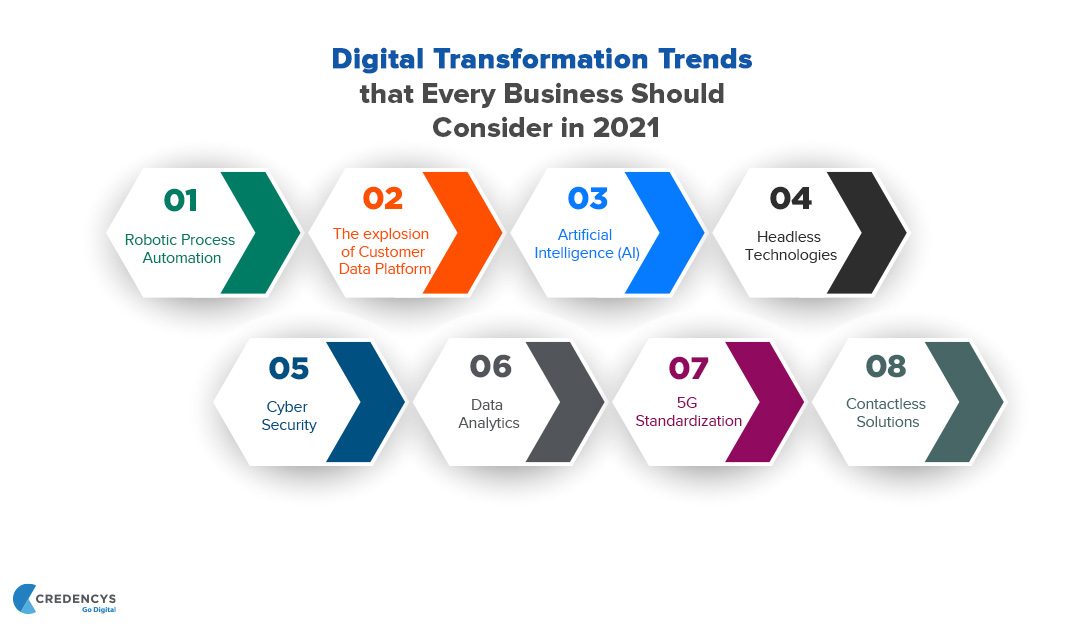
Digital-Transformation-Trends-that-Every-Business-Should-Consider-in-2021

Robotic Process Automation

Automation of different business processes is much needed to stay highly productive and effective in today’s cutthroat competition. Surprisingly, digital transformation and automation tend to co-exist. Automation of certain processes impacts others too.

When a company adopts more and more automation in the processes, they are increasing the pace of digitalization across the organization. Automation is the process that enables you with digital transformation as a result.

Now, you might be thinking of how to achieve automation.

These days Robotic Process Automation (RPA) technology is getting immense buzz across the world for the automation of various business functions. It drives a paradigm shift in the way your employees work and spend the time performing different tasks.

The technology allows you to configure the robot into a digital system. These robots interact with the applications and gather the data just like humans by emulating human actions. More importantly, it boosts the performance of various activities with zero error. The robots do not need a break like a human does while performing multiple activities at a time.

Implementation of Robotic Process Automation technology enables you with:

  • The reduced labor cost associated with low-value work
  • Manual data entry is always error-prone. RPA eliminates the human errors
  • Process the data seamlessly between multiple systems

Robots help organizations automate mundane and time-consuming functions. Implementation of RPA requires less investment and provides more benefits in terms of improving employees’ productivity, efficiency, and job satisfaction at the same time.

The explosion of Customer Data Platform

The whole world is experiencing a radical change as billions of data are proceeding at a different scale. Knowing customers is the key crux for business success these days. Thus, brands need to keep analyzing customer interactions with the company, their buying journey, and their products and service preferences.

By collecting and analyzing all these data, companies can get exclusive insights about the customers. This applies to all sizes of organizations. Based on customer data analysis, you can define the personalization strategy for the target groups.

For small-scale companies that are having limited offerings and a restricted customer base, it is easy to understand and analyze the data. However, for large-scale organizations that offer thousands of products, handle a variety of marketing channels, and manage a huge bunch of customers, it becomes difficult to get insights out of such a large pool of data.

Here, you can consider a Customer Data Platform (CDP) that manages your customer information in a single system. You can utilize CDP to create and run more relevant and personalized marketing campaigns to attract and engage the target audience.

Along with marketing, CDP helps different departments of the organizations such as Information Technology, Finance, etc. It helps the companies to make quick and effective decisions about products, services, and other business functions.

Artificial Intelligence (AI)

Artificial Intelligence is also one of the highly admired technologies. It allows companies to collect, manage, analyze and recall the data on demand. This helps companies to make effective strategic business decisions and informed sales decisions faster.

Unlike RPA, AI-powered assistants take care of data-driven and repetitive work and save a lot of time for employees. But, AI has more power than RPA. It’s the future of the tech world. The technology is designed in such a way that it collects data like sales numbers and customer habits. It recalls the information instantly.

AI-based tools identify and analyze the patterns, learn, make decisions, predict, and improve. These days most companies, regardless of startups to large-scale organizations are tech-savvy. Every enterprise tries and integrates AI-based tools and platforms in its existing processes and systems.

There are so many vendors such as AWS, Google, Microsoft, and more that offer a wide range of AI solutions. With the help of modern AI platforms, enterprises can begin their AI journey and achieve immense success.

Usually, AI platforms are a bit expensive, thus organizations need to work on them to make the solutions cost-effective.

Headless Technologies

Headless technologies are getting popular day by day. With the help of such a kind of software architecture, brands can separate their front-end from the back-end.

Front-end: User interface where the user interacts and can find on the website or app.

Back-end: App and website for internal processes. It’s also known as server-side.

Headless technologies help organizations design extremely personalized shopping experiences for targeted customers. This technology also helps increase customer acquisition too.

The new customer acquisition increases the cash flow in the organization. This ultimately increases the ROI. Now, the companies can focus on designing strategies to retain engaged customers and their loyalty.

With the right digital transformation strategy, companies can deliver compelling shopping experiences that help you to gain competitive advantages over your competitors.

Cyber Security

A few years back, the digital transformation started as an innovative approach to improve products and processes. To support the improved time-to-market, companies have started considering advanced initiatives like DevOps. While performing all the advanced initiatives, they do not pay enough attention to the security aspects.

Avoidance of security aspects results in a major service failure while managing the digital risks.

Large-scale organizations have their IT teams who take care of the security aspects of all the digital solutions. They ensure to set the security practices within the company to match the speed of digital transformation.

When said this, it does not mean they should just focus on how to make processes faster. They need to take care of how to make the processes faster safely.

To meet the expectations of customers and the changing market scenario of the industry, brands need to adopt more and more digital platforms. For each digital solution, cybersecurity is the prime requirement. Thus, it is the most popular digital transformation trend in 2021.

It is also essential to train your internal team about the new technologies and their security aspects. It’s a highly competitive era, where companies are constantly embracing and integrating advanced technologies like Artificial Intelligence (AI), multi-cloud, Machine Learning (ML) into the security solutions that are used within an organization.

Data Analytics

The key aspect of digital transformation is the latest technologies that help them to collect and analyze the data to get meaningful insights out of it. In today’s time, data works as fuel for any business. They need to sort, process, and analyze them to gain value out of them.

Consider and implement smart data analytics platforms that process the raw data and extract valuable information out of it. With effective data analytics, companies enhance organizational productivity and foster better decision-making.

Data and analysis of the data help companies to accelerate a company’s transformation and digitization efforts.

According to Gartner, “By 2022, 90% of corporate strategies will explicitly mention information as a critical enterprise asset and analytics as an essential competency”.

Different types of data analytics solutions available in the market to address the varied requirements and challenges of your different departments.

Descriptive analytics helps companies analyze what happened. On the other hand, diagnostic analytics help in defining why it happened. Using the results of the data analytics, different departments of an organization can address the complex processes.

Harnessing the fullest potential of data analytics, brands can streamline supply chain processes, predict customer behavior, optimize sales pipelines, and more.

5G Standardization

5G has become one of the highly popular technologies in the last couple of years. In the upcoming time, this trend will go mainstream. Adoption of the 5G will accelerate digital transformation.

It is also expected that 5G also empowers the organizations and helps them redefine their business models and functional processes. This indirectly improves their customer services. The new technology brings lower latency, faster speed, and most importantly higher density than 4G networks.

To leverage the benefits of 5G technologies, companies need to invest more in cloud infrastructure and tie up with reliable Cloud Service Providers.

The Cloud Service Provider works out the best approach to deliver the best services using 5G. It helps companies to pave the path of success using the software-defined technology that can support both current 4G and 5G.

Contactless Solutions

In the upcoming time, contactless solutions such as digital payments and contactless dining are the key to digital transformation.

As an impact of COVID-19, contactless solutions are highly in demand. People are following the social distancing to staying safe during this pandemic time. Thus, restaurants, cafes, and other businesses started implementing contactless digital platforms to take customers’ orders and provide better services to them.

Along with these, they have started using platforms that provide an online mode of delivering food, takeout services, in-seat ordering, and more.

For example; in the case of in-seat ordering, some solutions allow customers to place orders using QR codes and mobile apps by sitting in their chairs. If we talk about other scenarios, they do not need to stand in a queue in the convention center and miss the show in the theater.

QR code is one of the extremely popular and widely accepted solutions as it facilitates people and companies to perform various jobs.

3 Digital Transformation Success Stories

McDermott

McDermott is an American multinational engineering, construction, procurement, and installation company. They operate in various countries of the Pacific Rim, America, the Caspian Sea, and the Middle East.

They have utilized a digital twin technology. It is a computer model of oil and gas platform facilities it delivers to the client.

Digital Twin connects the physical and digital world. It allows integrating the smart components into physical objects. These components contain sensors to gather data regarding working conditions, real-time status, or position.

Moreover, these components are connected with cloud-based systems that receive and process all the data that sensors have collected and monitored. The result is analyzed against business data and other contextual data. The brand gets better insights into the objects or processes, learns the various lessons, and embraces various opportunities that are uncovered within the virtual environment.

The brand has utilized all these insights, lessons, and opportunities in the physical world. This eventually transforms their business.

After the implementation of the digital twin approach, they achieved a 15% increase in operating margin in areas like predictive maintenance.

Rolls Royce’s

Rolls Royce is a leading brand of hi-tech and royal cars. They have started R2 Data Labs initiatives that use Artificial Intelligence, Machine Learning, and Data Analytics to create new services. Under this venture, they have 200+ employees that involve data architects, data scientists, engineers, and specialist managers. The Data Labs team enabled Rolls Royce with £250m in value by performing engine health monitoring activities for the cars.

NHS Blood and Transplant

It’s a public sector unit. They have implemented a digital transformation agenda. They are trying and testing various digital platforms. They conducted some interesting trials around the likely waiting time for an organ and predictive analytics. It is essential to get clarity on organ availability in the healthcare industry. They are doing exciting digital experiments in the medical domain.

How to Ensure Successful Digital Transformation? [Tips to Consider]

How-to-Ensure-Successful-Digital-Transformation-[Tips-to-Consider]

Define your Goals for Digital Transformation

Digital Transformation does not have a specific path or solution to approach that you can just follow or implement. It’s the result of multiple digital initiatives that you consider. Thus, it is very important to define your specific goals, requirements, and long-term vision for adopting digital transformation.

Companies are considering digital transformation to attain different business objectives such as

  • Reduce the operational cost
  • Making more profit
  • Explore new markets, and more…

Based on the requirement you can define what digital solutions you need and how they help you increase ROI.

Define a strategy across your business objectives that you can achieve through digital solutions. You need to communicate the same to your team members so they understand the essence of new platforms and adopt it.

You can also analyze how your competitors are successfully moving towards digital space and look at the latest technology trends to determine your requirements for digital transformation.

Most organizations consider Digital Transformation to deliver a better customer experience, improve customer relationships, reduce time-to-market, reduce operational costs, and earn ROI.

Involve Your Team of All Levels

Digital Transformation does not bring change to one single department. It impacts your entire organization at all levels. When you have tech-savvy decision-makers and leaders, then the adoption of digital transformation becomes way easier.

As per research conducted by McKinsey and Company, when the Chief Digital Officer of an organization is involved in the transformation process, it increases the chances of successful digital transformation.

When the entire organization is involved in digital transformation strategy planning and execution. It drives a cultural change in the organization. So make sure all your team members from different departments are on board, participate in the discussion, share their suggestions and options, in the process of defining and executing the right digital transformation strategy.

It also helps you define the roles of your employees based on their skills and assign them the relevant tasks.

Utilize and Update Your Existing Tech Stack

Once your entire staff, including the senior decision-makers and executive-level employees, are on board, the next step is to take inventory of your organization’s resources and tech stack before you start planning your digital transformation. In this inventory, you can consider

  • Potential gaps in the processes
  • Technical competencies

Analyze your existing tools and processes deeply. It helps you understand how to streamline your processes and make the functions more effective. Integration of advanced tools and smooth processes are essential for the various business areas such as

  • Customer relationship management
  • Product development
  • Employee experience and support
  • Internal collaboration
  • Sales and marketing

In most companies, digital transformation begins with re-developing the existing platform. After a certain time, if not enhanced regularly, the systems become obsolete. Thus, businesses need to re-engineer them to maintain their performance.

Moreover, you cannot reengineer the technologies that you have used previously. You need to consider modern technologies while developing new features and functionality for your applications. Integration of the latest technologies drives the immense transformation of your business.

Most of the time organizations consider digital transformation to develop a better customer experience. However, it is essential to take care that it supports the employees as well in improving their productivity.

While considering digital transformation for employees, you need to take care of all the essential data flows available across different departments and teams, all the required information is quickly accessible to the respective users, and more.

The inefficient digital experience of the employees will result in

  • Negative impact on the work culture
  • Poor customer experience

Transparent Communication

In the process of digital transformation, communication must be transparent and clear. The organization’s leaders need to make sure the digital transformation strategy is communicated to all the employees so that the company gains the ultimate benefits.

You need to explain to the team members why certain processes are being executed and what the end goals they achieve as an organization. The employees of different departments should communicate the issues and try to figure out the solution together. They should try to resolve the challenges as they arise.

To simplify communication across the teams, keep all the essential information quickly accessible. Organizations can implement reliable communication tools to do so.

Invest in the Right Digital Technologies

The digital space is flooded with a lot of tools and technologies. Thus, it becomes difficult to select the right set of technologies for your business.

Automation:

Automation is the latest technology trend that every organization is looking forward to achieving. It helps the employees to focus on more creative and essential tasks. All the mundane and repetitive tasks will be taken care of by the computer automatically.

Cloud Computing:

It works as the support system for many other technologies. The cloud platform allows companies to store, manage, process, and analyze massive data with next-level security. Most importantly, it manages the data in the internet server, so it is quickly accessible too.

Cloud computing technology enables you with the flexibility to update your obsolete IT infrastructure at any point in time. It also supports the most advanced technologies such as Artificial Intelligence (AI), Machine Learning (ML), Big Data, Internet of Things (IoT), and more.

Data Analytics:

Data Analytics is one of the highly followed technology trends. With the help of advanced analytics, businesses can gain all necessary insights related to finance, customer behavior, marketing processes, and more. It allows businesses to break their operations in silos. It becomes easy for your team to respond to challenges and changes in real-time.

Consider Data-driven Approach

To ensure success and growth, businesses need to be receptive to the changing market trends and customer demands. To do this, it is essential you spend time, money, and resources for data collection and data analysis.

Monitoring and analyzing the metric and data regularly is very important as it helps you to make more relevant and accurate business decisions in terms of your future digital initiatives.

With the help of data, you can understand your customers better and enable them with extremely personalized experiences in the future.

In case you find any issue in our digital strategy, you should consider the data-driven approach. Collect the data of specific areas and take insightful actions and decisions based on the findings.

Take the Help from an Outsourcing Partner

One of the key reasons companies considers digital transformation is they want to streamline their operations. To achieve your objective quickly and effectively, it is highly suggested to take the help of an experienced outsourcing partner for your digital initiatives.

You need to focus more on defining the procedures and methods as well as utilize the teams’ capabilities to improve your operational workflow. As you can experts in that part. Digital initiatives are not your forte. So just pass your expectations and objectives to an outsourcing partner and they will help you build advanced digital solutions that help achieve your goals and address challenges.

As they have proven experience in deploying tailored digital solutions, it will be a cost-effective decision for you. Moreover, it mitigates the risks for the companies. When you outsource digital initiatives, you can have access to good quality resources, scalability, and industry experts.

By considering the outsourcing partner, you allow your team to focus more on your core business activities. On the other hand, your digital transformation is taken care of by a reliable IT solution provider company.

When You Need to Consider Adopting Digital Transformation
When-You-Need-to-Consider-Adopting-Digital-Transformation

Technological Innovations

It’s an era of technology. Emerging technologies encourage businesses to embrace digital transformation. Leveraging advanced technologies, you can transform the way you interact with your partners, customers, competitors, and other stakeholders.

These days, a lot of technologies are adopted by the companies such as Artificial Intelligence, Machine Learning, Internet of Things, Blockchain, Augmented Reality, Virtual Reality, mobility, edge computing, and more.

With the right amalgamation of technologies, you can build robust applications. For example; the mixture of AI, Big Data, Analytics, and IoT helps businesses to drive immense change in their conventional work culture.

Along with organizational change, such technologies drive an industrial transformation as well.

Customer Demand and Behavior

Today’s tech-savvy customers are exploring their required products or services through digital solutions. Well, customer-related transformation is not necessarily related to technology. It could be related to your business strategy. Consideration of digital technologies helps you to address many customer-related business challenges.

Decades ago, when technologies did not exist, the problems of customers were addressed. But, the emergence of the adoption of digital technologies has driven the transformation significantly.

Earlier, the problems of customers were taking too much time to get resolved. But, with the help of technologies, businesses can interact with the customers instantly and take action to address their issues quickly. Customer needs and behavior are also impacted by digital transformation.

Invention and Innovations

It’s a completely new approach to business challenges and humans. Invention and innovation together create a new reality in the areas of technology, science, business, or non-technological context. Invention and innovation in digital technologies transform many industries.

Leveraging the latest innovative technologies has transformed the way healthcare, manufacturing, engineering, transportation, and more.

Ecosystem

Organizations are a part of the broader ecosystem. Natural and social ecosystems as well as business ecosystems in which we live. In these ecosystems, various changes take place from time to time such as regulatory changes, demands for the partners who adopt the new change, innovation in collaboration and interaction with the transformational business ecosystem, economical changes, societal shift, geopolitical changes, and more. All these factors play a vital role in increasing the needs of digital transformation.

Especially, in this era of new normal, the importance and demand of digital transformation are constantly rising.

What are the Most Common Challenges of Digital Transformation?

What-are-the-Most-Common-Challenges-of-Digital-Transformation

Lack of Skilled IT Resources

The success of digital transformation relies on a dedicated and highly skilled IT team. Building a team of skilled IT resources is a tough job. Especially, when you don’t have profound knowledge of the domain. Moreover, to stay competitive, more and more businesses pursue advanced technologies to build next-generation business solutions. This causes the deficiencies of skilled IT professionals.

According to a recent survey, 54% of the organizations have reported that shortage of skilled IT resources holding them back from accomplishing their digital transformation objectives.

When I am saying the lack of expertise means fewer skills in the below areas:

  • Advanced Data Analytics
  • Cyber Security
  • Enterprise Architecture
  • Technical Architecture

How to overcome this challenge?

You can take the help of reliable and experienced IT solutions and service providers. They have highly skilled technology experts and consultants to support your in-house team.

Else, you need to understand your customers and tie a partnership with an IT service provider to build customer-centric solutions that satisfy the expectation of your target audience.

Organization Change Management is not in Focus

Most organizations fear change. Thus, they keep following rigid leadership styles, outdated organizational structures, and inefficient workflow that hinder the success of the digital transformation. All these businesses were struggling to survive and shift to remote business models quickly.

In such cases, if the business immediately adopts new tools and technologies, it negatively affects the team and processes.

Thus, every organization needs to follow change management when every new business and technological change takes place step by step. So that it becomes easy to adopt the new change across the organization seamlessly. It helps your staff to understand what lies ahead.

More than technology, change management impacts the people so change management is essential for successful digital transformation.

Constantly Changing Customer Needs

Modern customers do not prefer to visit physical stores to buy the products. They don’t buy any random product.

They conduct detailed online research before buying a product. Moreover, they utilize advanced digital platforms to purchase the products. With the invention of smartphones, customers’ lives have become easier than before. Thus, the customers are more demanding these days.

Now, the touchless checkout process is not considered a value-added feature. It becomes a necessity for every eCommerce platform as customers expect this feature as a default.

Absence of Well-defined Strategies

Digital transformation is not just a buzz word but it’s a present and future of many businesses. Still, people are struggling to get a clear definition of it.

Due to a lack of clarity about the concept, companies are sure that they want to and are moving towards digital transformation but they don’t have confidence where they are going.

Thus, it is essential to define a digital transformation strategy instead of implementing it randomly. It also enables companies with several benefits rather than creating chaos across the organization.

To have the right strategy in place, you need to be clear about some of your business aspects like what are the priorities and goals of my company? Are these goals consistent across the organization? Are there some stakeholders who are completely on different pages?

Based on the answers to these questions, you can design the digital transformation strategy that also ensures its success.

Limited Budget

In the absence of the right digital transformation strategy, you might face the issue of setting and sticking to your budget.

While responding to the evolving customer needs and customization requests, you might experience scope creep. If you do not have a proper strategy in place, you have to make the decisions that enable you with less or no benefits. Moreover, it increases your product timeline and budget too.

Try to focus on long-term goals for digital transformation rather than short-term objectives. Define the milestones for your long-term goals and develop a realistic project plan. To achieve these, it is very important that you understand what digital solutions you are implementing and the culture you are integrating them into.

Ineffective Business Processes

Once you set the business processes for your organization, you need to keep tracking its effectiveness. You need to analyze whether your current processes deliver you the expected results or your existing roadmap helps you to attain your long-term business objectives.

If you fail to attain these, you may need to work on your business processes. There are chances you need to change your business rules, adjust workflows, and leverage data in different ways than you previously envisioned while you implemented legacy systems. You can consider business process reengineering to make your business process more efficient.

Inefficient Data Management

There is a lot of data every business has for different purposes. Here we are talking about customer data specifically. Customer data is the key crux of digital transformation. It helps you get insights into a buyer’s behavior, preferences, and possible future decisions.

To gain the maximum benefits out of it, it is essential how you organize and capture the data. If you are using the siloed systems to manage customer data, it becomes challenging to consolidate the customer information, manage them centrally to make them accessible easily. If the data is managed in a single place, it becomes easy to perform this process.

With this data, you can learn about your customers and define strategies to serve them more effectively.

Summing Up

This post has covered every single aspect related to digital transformation. I hope this helps you define the digital transformation strategy and implement the right digital solutions to empower your business goals and objectives. If you still have any queries and concerns, feel free to connect with our experts to get personalized consultation and the right business solution that ensures immense growth and success of your businesses.

Role of DAM on Delivering Customer Experience Strategy

One loyal customer is better than ten new potential customers. Keeping a loyal customer loyal is not a piece of cake. As a business brand, you continuously need to serve the interest of customers. It is easy for customers to switch over to another brand or business, but it is not so easy for you to acquire a new customer in a short duration. Having a good customer experience is important for every business to survive in today’s heavy competitive market.

Let us here discuss the strategy of delivering a better customer experience and the role of Digital Assets Management- DAM in it.

What is a Customer Experience (CX) Strategy?

Customer experience is the wholesome amount of interaction of customers with your business in pre and post-sales. Whilst, Customer experience strategy is to be able to deliver a better, positive, and meaningful experience to customers across every interaction.

In simple terms, customer experience is the measurement of the involvement of business in a customer’s buying process. Customer experience is not just action but it states the relationship between business and customer and measures business involvement in customer’s marketing to sales journey.

Customer experience strategy, on the other hand, is a plan, design, or way of direction for your business to ensure that your customers are getting a better customer experience, which they deserve, and ensure that you are not lagging in delivering a rich customer experience.

Benefits of Having Good Customer Experience for Your Business

1. Higher Customer Lifetime Value

This value represents the amount of money your customers are willing to pay for your business. If you know the vague amount of this value, you can have a better idea of investing in retail customers and how much more needs to be invested in acquiring customers.

Your business can know this value if you in the first place have delivered a better customer experience. The stats of customer buying ratio state that there are 60-70% customers, which are willing to buy from the same business while there are 5-20% of chances for a business to acquire a new customer.

2. Reduced customer churn

The harder thing than acquiring a new customer is retaining those newly acquired customers. Reduced customer churn is the process in which loyal or potential customers are less likely to switch to any other similar business.

If you have delivered your customer a better experience, and if you are monitoring their level of satisfaction, then customers don’t have any reason to switch to other businesses.

3. Customer retention and brand name

By delivering a better customer experience, your business is not just favoring customers but you are also at a benefit. Those brands, who serve best to their customers, have a better brand name than those who do otherwise.

By delivering a better customer experience, your customers are going to be retained within your business only and that will boost up your brand name. It is a vice-versa situation in which both business and customer get to benefit from each other.

Ways To Drive Customer Experience Through Digital Transformation

Technology and digitalization have overpowered every manual strategy and plan. It is a fool’s choice to stay behind technology and try enhancing the customer experience without the help of any technology. Below are the ways to drive customer experience through digital transformation.

1. Equip Store Associates With Digital Tools

Remember the days, when customers used to visit the same local shop over and over because the shop owner made customers feel personalized with their choices? The same should be done in online business; you need to have tools that remind customers about their last purchase, their needs, and their unique preferences.

Some digital companies have built this strategy and have associates, who are guiding customers in their product buying process. These companies use mobile devices and other devices to keep track of product information and product-related other similar products.

2. Use Smarter Technology within Stores

You can use cloud and other predictive data analysis tools, which predict what customers would buy and how frequently they buy. This analytical tool is really important for businesses as you are running one step ahead of your customer and at times, you are making your customer buy the things, which they normally would not buy.

This digital transformation is more effective for business. Customers will feel more personalized and hence will continue working with your business. Ultimately, you will end up having profit in your hand.

3. Bridge the Gap between the Head Office and Store Associates

Through digital transformation, the communication barrier between head office and store associates is nearly not present. Through a digital platform, your business can effectively communicate about product information and product availability, and store in charge.

Your business will be more in control and less at risk. Your business department will be more collaborative and yet fully independent. You can make better decisions and let your customer leave you effective feedback.

4. Implement Digital Asset Management Into Your Strategy

DAM is the backbone of digital transformation. Digital transformation’s all business-related content comes to DAM in one way or the other. DAM is the system that holds every photo, video, documents, and related digital asset of your business. With an increase in demand for the integration of e-commerce platforms with social media, the need for DAM is more needed than ever.

When it comes to updated reports, training material, and other related important materials DAM plays an important role in withstanding all documents.

Thus, the need for DAM in digital transformation is as important as the need of customers in any business.

Importance of Digital Asset Management (DAM) and Customer Experience (CX)

Digital Asset Management (DAM) and customer experience are correlated. Your business cannot outrun the fact that you need DAM for delivering a better customer experience. DAM withholds the product-related digital assets, and your customer’s journey of product purchase is incomplete without those digital assets of the product.

With DAM, your business will have expanded market opportunities and your customers will be able to demand more transparently and more effectively. Your customers will be able to interact with your brand more frequently. With DAM, you can share, manage and collaborate with your customers in an advanced way.

DAM is an all-in-one solution that works as the backbone of digital transformation and also makes customers able to shop more freely and more in an advanced manner thus increasing their customer experience.

Both DAM and CX engage with the customers. Business owners can utilize the data collected through the engagement and develop a personalized touch and take a bold decision for the business improvement. Here are the benefits that business owners can get through DAM & CX.

  • Extension of Marketing Touchpoints
  • More Business Efficiency & Transparency
  • Consistent Brand Interaction
  • Better Data sharing, managing & collaborating
  • Flexibility to both Enterprise & Customer

Why Does Your CX Strategy Need a DAM Solution?

Those days no longer exist when DAM used to only mean the library of digital assets. With the increase in the demand for digital transformation and digitalization, DAM plays a vital role in delivering an accurate and powerful customer experience. Your CX strategy is incomplete without a DAM solution.

1. Brand Consistent and Decreased Time to market

DAM ensures that your brand name is safer at every given point and your brand is in a state to cope up with the trending changes of the market. DAM ensures that your brand name stays tranquil, with the assets it holds. With the help of assets and information of products, DAM delivers a rich customer experience.

DAM and CX strategy’s collaboration states that when the customer is highly likely to change his preference and hence, before the customer could demand a new product, with the help of your artificial intelligence and DAM; you will be able to deliver the new product and hence decreased time to market.

2. Decreased Cost of Production

Your business is no longer going to produce unnecessary or unwanted products, which your customers are not going to buy. Your business can take the insights from the DAM and can know what the customer’s preferences are at a given period. So your business will only produce the products that customers seek and you will save the cost of production on unwanted products.

3. Seamless integration with Market

Integration with the market is not as easy a process as you may think it is. It is a quite complex problem and needs a lot of your attention. With the DAM system, you can flawlessly integrate with the market and collaborate with the market and your business.

Thus, in keeping a consistent brand name, to have decreased time to market, to have decreased cost of production, and to integrate with the market in real-time you need DAM to enhance your CX strategy.

How DAM Solution Delivers Customer Experience?

So far as of now, we have discussed in detail the customer experience; now is the time to have a look into what DAM really is and how it impacts delivering customer experience.

DAM – Digital Asset Management is the system that is a single source of the platform, which holds all digital assets like images, audios, documents, presentations, PDF, and many more assets related to product information. Digital assets are stored in DAM so that, whenever the need for digital assets arises, they could be found easily in the DAM system.

DAM works in the following way for delivering a better customer experience

1. A Single Version Of The Truth

DAM is a single version of the truth that has digital assets stored in it, in a safer and secure place. Customers have a better journey with DAM because DAM ensures that there are not any duplicate product images or product files are accessible to customers.

If customers have duplicate images or irrelevant images of the product, then their product purchase process is going to hinder and there are chances that they may not buy the product from your business at all. DAM ensures that such a thing never happens and keeps the relevant product image ready for the relevant product.

2. Creative And Marketing Collaboration

DAM is a single source of truth and platform that holds important digital assets, yet it has the ability to give rights of the digital assets to specially authorized persons. Those authorized persons may vary from creative people to marketing people.

DAM ensures that every person works in collaboration and if any changes are made in any particular asset, then concerned parties will know about it. The collaboration between the inter-department brings a smooth workflow without any conflict and the productivity of every department will also get boosted up.

3. Content Enrichment

DAM not only holds the digital assets in the system but also makes sure that content is being a handful whenever it’s needed. DAM lets you use the stored content as and when you require. You can reuse the assets for various purposes.

Also, DAM has the ability to delete the assets, which are of no use or are in duplication. DAM sorts out the assets and leaves you with only important and meaningful assets.

4. Forging 360° Product Experiences

With DAM you can have global product insight and you can provide your retailers new, accurate, and actionable data. With DAM, Merchandisers and marketers have the opportunity to work in collaboration on the global launches.

5. Content Delivery

DAM ensures that only relevant, accurate, and approved content is roaming across the channels. DAM also makes sure that the content is not being wrongfully used than it should be. DAM seamlessly links the content with Omnichannel and commerce platforms.

Conclusion

Digital Asset Management is the backbone of digital transformation and is a key to having a better customer experience. DAM has many benefits over the business and one of the important benefits is the enhancement of customer experience. CX and DAM are correlated. DAM has a huge impact on CX and CX is incomplete without Digital Asset Management.

Role & Approaches of Master Data in Metadata Management You Must Know

In the present world, data and data management is very important. New records like agreements, introductions, photography, and imaginative documents are being added daily. When these documents are made, inalienably, so is their metadata. Metadata incorporates things actually like the record name, date, size, and maker.

Therefore, organizations are flooded with substance and its connected Metadata. They have a framework for keeping everything coordinated. That is the place where metadata management comes in.

What is Metadata Management?

Metadata management is the proactive utilization of metadata in a company to control data to empower very educated business choices and productivity in data dealing. It includes ingesting metadata to get some answers concerning the information a partnership claims it is worth, and along these lines, the advancement of information stockpiling and its retention.

Metadata management frameworks give start to finish data administration arrangements that cover source frameworks, data stockrooms, data management frameworks, and data pipelines that force endeavor applications.

Metadata Classification

Metadata comes in numerous shapes and flavors, conveying extra data about where an asset was delivered, what it is about, and loads of more subtleties around it. Like the library cards depicting a book, Metadata portrays articles and adds greater granularity to how they’re addressed.

1. Business metadata

It incorporates meanings of information documents and qualities in business terms. it will likewise contain meanings of the business decisions that apply to those credits, data proprietors and stewards, data quality measurements, and comparable data that aids business clients to explore the “data sea.” In addition, some revealing and business knowledge devices give and keep an indoor store of business-level metadata definitions utilized by these instruments.

2. Specialized Metadata

It is the commonest kind of metadata. Metadata is utilized by the apparatuses and applications that make, oversee, and use data. Specialized metadata might be a key metadata type wont to construct and keep up with the undertaking data climate. Specialized metadata normally incorporates database framework names, table and segment names, and sizes, data types and permitted values, and underlying data like essential and unfamiliar key credits and files. Inside the instance of CDI engineering, specialized metadata will contain branches of knowledge characterizing characteristics.

3. Operational metadata

will contain document size, date and season of last burden, updates, and reinforcements, names of the operational methodology and contents that should be wont to make, update, reestablish, or in any case access data, and so on.

Why is Metadata Management Important?

Having a metadata management framework set up permits those adding metadata to attempt so rapidly and precisely while guaranteeing that people all through a company can track down the substance they have effortlessly. Thus, at last, metadata management improves a decent scope of selling and creative work processes.

Dealing with your Metadata can appear to be overpowering if you’re not utilizing the appropriate apparatuses. An advanced resource management (DAM) stage can help. DAM frameworks work with metadata management for an inside and out the scope of substance — from photography to video and everything in the middle. They also offer many safety efforts to direct substance access and appropriation and devices to help innovative work processes.

Key Benefits of Metadata Management

Metadata gives an assortment of indispensable advantages to the undertaking, including:

  • Consistency of definitions Metadata contains data about data that accommodates the distinction in wording.
  • Lucidity of connections Metadata helps settle vagueness and irregularities while deciding the relationship between elements put away through data climate.
  • Clearness of information ancestry Metadata contains data about the starting points of a particular data set and might be sufficiently granular to characterize data at the property level; metadata may keep up permitted values for an information characteristic, its legitimate organization, area, proprietor, and steward.
  • Operationally, metadata may keep up auditable data about clients, applications, and cycles that make, erase, and thus the approval that was wont to play out these activities.

Various Approaches to Metadata Management

Topologically, metadata storehouse design characterizes one among the resulting three styles:

1. Centralized Metadata repository

The Centralized Metadata repository is the customary way to deal with assembling a metadata storehouse. It offers effective admittance to data, versatility to extra data stores, adaptability to catch extra Metadata, and elite.

In any case, similar to any remaining brought together design, concentrated metadata store might be a solitary mark of disappointment. It requires persistent synchronization with the members of the information climate, may turn into an exhibition bottleneck, and ought to influence the nature of metadata contrarily.

To be sure, the need to rehash data from different applications and data stores into the focal archive may bargain data quality if the correct data approval systems aren’t a neighborhood of the information procurement measure.

2. Distributed Metadata repository

A Distributed Metadata repository evades the worries and likely mistakes of keeping up duplicates of the source Metadata by continuously getting forward-thinking metadata from all frameworks’ metadata stores.

Furthermore, dispersed metadata storehouses offer unrivaled metadata quality since the clients see the first current data about the information. Notwithstanding, since appropriated design requires continuous accessibility of every single partaking framework, one framework disappointment may cut the metadata storehouse down.

Additionally, as source frameworks setups change or new frameworks become accessible, a disseminated design should adjust quickly to the new climate. This level of adaptability may require a fleeting closure of the vault.

3. Federated or Hybrid Metadata repository

A Federated or Hybrid Metadata repository uses the qualities and mitigates the shortcomings of both conveyed and incorporated models. Kind of a dispersed design, the unified methodology can uphold continuous access of metadata from source frameworks.

It likewise can midway and dependably keep up metadata definitions or references to the correct areas of the exact definitions to improve execution and accessibility.

4. The Data Catalog

The data management advantages of a Data inventory become clear by pondering the value of metadata and the capacities made with far-reaching metadata. The best worth, in any case, is generally seen inside the effect on investigation exercises. We add a period of self-administration examination.

IT associations can’t give the entirety of the information required by the consistently expanding quantities of people who break down data. Yet, the present business and data investigators are regularly working into the datasets that exist, the substance of these datasets, and hence the quality and helpfulness. They regularly work with lacking datasets prompting an insufficient and inaccurate investigation.

5. Unified Data Lineage

Unified Data Lineage might guide the information venture, which consolidates its starting point, each stop en route, and proof on how and why the data has moved over the long run. The information ancestry is frequently recorded outwardly from source to the possible objective — noticing stops, deviations, or changes en route.

The technique works on following operational perspectives like everyday use and blunder resolution. Unified Data Lineage ​assumes a significant part during this quickly evolving framework.

Following data’s starting point and the way through your business, including changes and targets, is that the lone gratitude for handling mistakes head-on and making administration gives a relic of times gone by through straightforwardness.

6. Understanding your ERP or CRM

The Metadata in your huge, complex, and tweaked ERP and CRM applications are simply excessively troublesome and tedious to search out and use inside your venture data models. In case you’re carrying out an information distribution center, data administration, data movement, or other data management project which joins SAP, Oracle, or Salesforce bundles, at that point approaching their data models is basic.

You’ll incorporate, oversee, and administer your ERP and CRM metadata inside your data models to complete the enormous image of your data engineering and heredity.

On the off chance that you’ll access and blend data from numerous sources, maybe during a data lake or undertaking data stockroom, your data researchers and examiners can utilize progressed instruments to spot examples and patterns that may help you expect the more extended term and decide.

Doing a comparable for an information inventory or data glossary task can assist with democratizing data and gives business clients admittance to precise data to help them to figure all the more adequately and decrease the amount of your time they extravagantly discover the information they have.

Role of Master Data Management in Metadata Management

The central objective of metadata management is to improve how individuals and projects find and use data.

  • Metadata gives the setting, assisting with orchestrating and supplying significance to the actual information.
  • Characteristics like document area, record size, data type, and creator are crucial signs that leave quicker questioning and replication of bits of knowledge.
  • Without these markers, inquiries regularly neglect to recover significant data, which may in some way or another change reports and discoveries.
  • For master data management, your business offers weight to your data and associates the entirety of the information your association discovers to be important. Compelling metadata management keeps data from surrendering to bedlam.
  • By getting sorted out and following data that upheld this relevant data, associations make a common guide legend that aides individuals across offices explore data with comparable effectiveness and exactness.

Also, metadata management is essential to make sound data ancestry (which incorporates data beginnings and moves over the long haul). Significant data keeps on remaining available because it moves and changes in a steadily evolving world.

1. Metadata & Master Data Management – An Overview

Without appropriate metadata management to make an exact data list, it’s close to difficult to decide data ancestry. It’s through nonstop data genealogy that medical services payors keep up full mindfulness and availability of their data resources, paying little heed to where it’s moved in data distribution centers or data lakes.

That is the reason metadata management is so significant on the off chance that you might want to shape upgrades to your association. Here are the undertakings where payers see the best outcomes with hearty data management:

A. Discovering Inefficiencies Faster

If terrible data risks your report, you will find the absolute bottom of the premise quicker. Envision that an EHR habitually displays inadequate or mistaken data. Surveying creator labels can decide whether a chosen representative routinely inputs mistaken data. That way, your association can decide any occurrences where a chosen client, office, or machine is diminishing your data’s norm and finding ways to cure the trouble.

B. Wiping out Costs

Information from your master data likewise can assist with downsizing costs for your association. For example, in case you’re running a mission to urge individuals to require the benefit of their yearly registration, appropriate master data management can assist with ensuring that copy mailers aren’t being sent bowing three individuals in a single family when one will do. Various revelations like this will wipe out budgetary waste and save your association millions.

2. Overlap Between Metadata and Master Data Management

A. Data Quality

Metadata Management prompts hierarchical comprehension of business terms and uses, expanding the egotism inside the association’s data and counteraction of outdated or erroneous utilization of that data. Metadata Management exercises like Metadata sewing and following the information Lineage better Data Quality outcomes because the legitimate data becomes associated effectively. Master Data Management gives stages to support Data Quality.

B. Data Governance

Organizations had the chance to control data resources through Data Governance, a bunch of practices, and cycles. Both Metadata and Master Data are incorporated during an organization’s data asset. Great management of each requires incorporating any Metadata Management into the bigger Data Governance structure and carrying out Data Governance into a Master Data Management Solution. Every one of those Data Management systems guarantees an organization’s capacity to master and control its data.

C. Administrative Compliance

Metadata Management requires making an information Lineage to encourage a precise comprehension of the association’s data. As a side advantage, Metadata Management creates a review trail for consistency. Master Data Management arrangements, as Naveego DQS, created for the Cloud, give understanding and permeability into basic data, prompting better underlying driver investigation and affirmation of meeting guidelines.

Concluding With

Progressed data security procedures, including covering, differential protection, data union, are frequently coordinated. As a result, the subsequent data lists will be extensive, and changes will quickly be reflected in reliance mappings between data resources. Accordingly, clients (examiners, data researchers, and designers) will be prepared to look and discover reliable data that agrees with inner and outer guidelines.