


What is Data Strategy? Importance, Challenges, and Key Components of a Scalable Roadmap
Data is one of the most valuable assets for any business. Organizations generate vast amounts of data daily, but without a clear strategy, this data remains fragmented and underutilized.
A data strategy provides a structured approach to managing, integrating, and leveraging data effectively, ensuring it drives real business value.
Why is a Data Strategy Important?
A well-defined data strategy roadmap helps businesses:
- Enhance Decision-Making: Provides reliable, data-driven insights that empower leaders to make informed choices based on facts rather than intuition.
- Enable Advanced Analytics & AI: Prepares the organization for leveraging cutting-edge technologies like machine learning, artificial intelligence, and predictive analytics for competitive advantage.
- Improve Efficiency & Reduce Costs: Eliminates data silos, streamlines data access, and enhances collaboration across departments, leading to better productivity and reduced operational costs.
- Align Data with Business Goals: Ensures that data initiatives directly support key business objectives, whether it’s improving customer experience, optimizing operations, or driving innovation.
- Ensure Compliance & Security: Helps businesses stay compliant with industry regulations such as GDPR, CCPA, and HIPAA while implementing robust security measures to protect sensitive data.
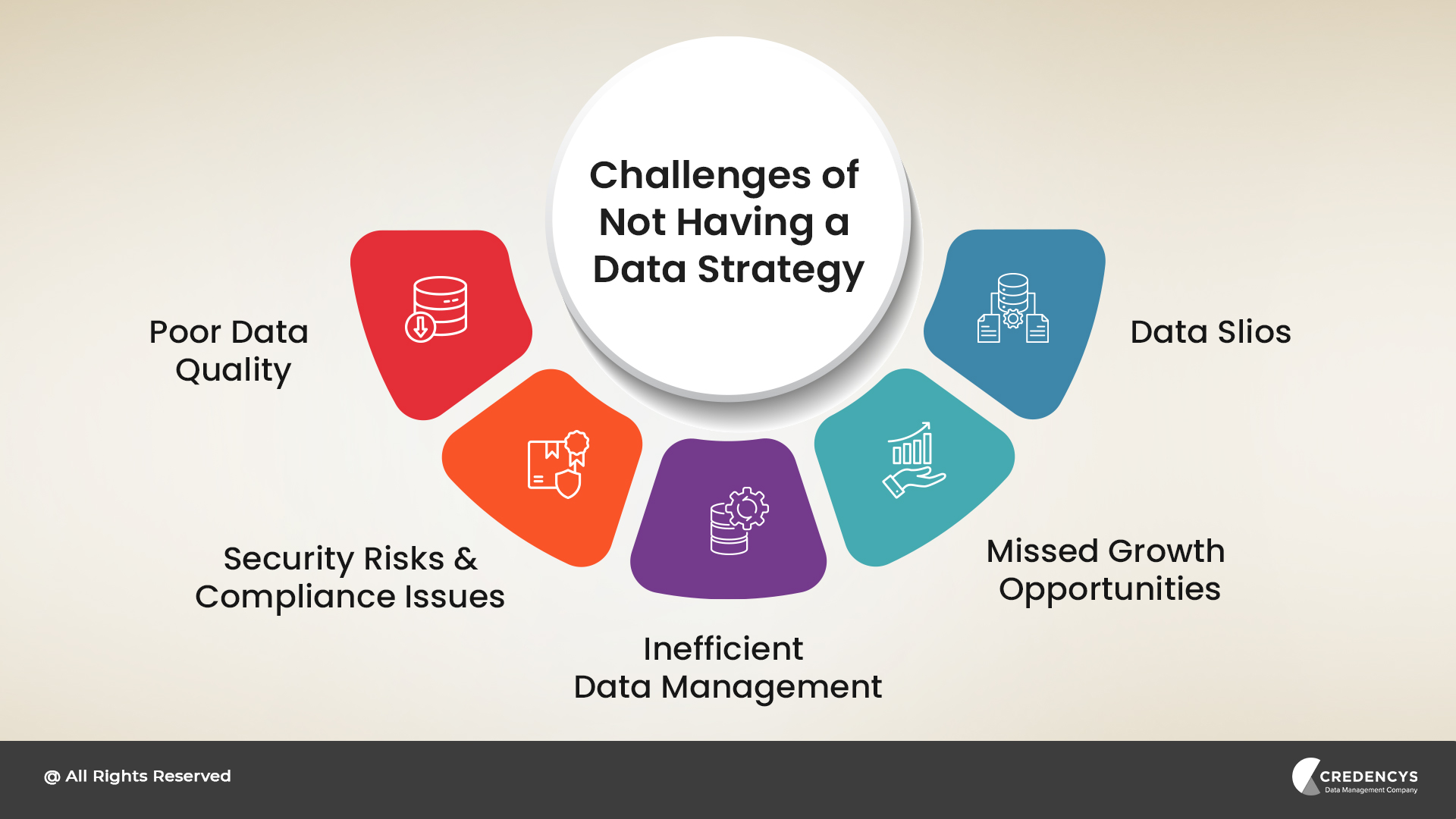
Challenges of Not Having a Data Strategy
Without a structured data strategy roadmap, organizations often face multiple roadblocks that hinder their ability to capitalize on data-driven opportunities. Some common challenges include:
- Poor Data Quality: Inaccurate, inconsistent, or incomplete data leads to unreliable insights and poor decision-making.
- Security Risks & Compliance Issues: Unstructured data management increases the risk of data breaches and non-compliance penalties.
- Inefficient Data Management: Without a proper framework, businesses struggle with data duplication, accessibility issues, and slow processing times.
- Missed Growth Opportunities: A lack of strategic direction prevents businesses from leveraging data for customer insights, market trends, and innovation.
- Data Silos: Different departments collect and store data independently, making it difficult to gain a unified view of business operations.
A well-crafted data strategy roadmap sets the foundation for business growth, innovation, and competitive advantage. Let’s dive into how you can create one for your organization.
Key Components of a Data Strategy
A well-structured data strategy roadmap consists of several key components that ensure data is effectively managed, secured, and utilized for business growth. Let’s explore the fundamental pillars that form the foundation of a successful data strategy.
1. Business Alignment
For a data strategy to be effective, it must be aligned with business objectives. Without clear alignment, data initiatives may fail to deliver value.
- Identify Business Priorities: Determine how data can support core business goals such as revenue growth, customer experience, or operational efficiency.
- Define Key Use Cases: Prioritize use cases like customer segmentation, fraud detection, demand forecasting, or personalized marketing.
- Ensure Executive Buy-in: Engage leadership teams to drive a data-driven culture and secure the necessary resources for implementation.
2. Data Governance & Compliance
A structured data governance framework ensures data accuracy, security, and compliance with industry regulations like GDPR, CCPA, and HIPAA.
- Data Ownership & Roles: Define responsibilities for data management (e.g., data stewards, analysts, and security teams).
- Data Quality & Standardization: Implement policies for data accuracy, consistency, and completeness across all sources.
- Compliance & Privacy Measures: Establish guidelines for handling sensitive data while adhering to regulatory requirements.
3. Technology & Infrastructure
Choosing the right technology stack is crucial for managing, processing, and analyzing data efficiently.
- Cloud vs. On-Premises: Evaluate whether to use cloud-based platforms (e.g., Databricks, AWS, Azure, GCP) or an on-premises infrastructure.

Unlock the Full Potential of your Data with the Right Technology Stack. Let our Experts Help you Choose the Best Solution for your Business Needs
- Data Storage Solutions: Select appropriate storage architectures:
- Data Warehouse: Structured storage for BI and reporting (e.g., Snowflake, Redshift).
- Data Lake: Stores raw, unstructured data for future processing (e.g., Delta Lake, Azure Data Lake).
- Data Lakehouse: Combines the best of both (e.g., Databricks Lakehouse).
- Data Integration & ETL Pipelines: Use tools like Apache Spark, Talend, or Informatica to ensure seamless data flow between systems.
4. Data Management & Integration
A fragmented data environment leads to inefficiencies. Strong data management practices improve usability and accessibility.
- Master Data Management: Centralize key data (e.g., customer, product, and supplier data) for consistency.
- Metadata Management: Maintain clear documentation of data assets for easy discovery and usage.
- Real-Time & Batch Processing: Implement appropriate data pipelines based on business needs (e.g., real-time analytics for fraud detection and batch processing for reporting).
5. Analytics & AI Readiness
Once data is well-structured and governed, businesses can leverage analytics and AI to drive decision-making.
- Business Intelligence: Use dashboards and reporting tools like Power BI, Tableau, or Looker for operational insights.
- Predictive & Prescriptive Analytics: Leverage machine learning for forecasting trends, customer behavior, and risk assessment.
- AI & Automation: Implement AI-driven automation for areas like customer support (chatbots), dynamic pricing, and personalized recommendations.
How Credencys Can Help You Build a Scalable Data Strategy
At Credencys, we understand that a well-structured data strategy is critical for unlocking the full potential of your data assets. Our data strategy consulting services help businesses design, implement, and optimize a roadmap that aligns with their unique goals.
Here’s how we can support your organization in building a scalable, future-ready data strategy.
1. Data Strategy Consulting: Aligning Data with Business Goals
We work closely with stakeholders to define a strategy that drives measurable business outcomes.
Our approach:
- Conducting data maturity assessments to evaluate your current landscape.
- Identifying high-impact use cases that align with your business objectives.
- Developing a customized roadmap that prioritizes quick wins and long-term success.
2. Implementing Data Governance & Compliance
We help organizations establish a robust governance framework to ensure data accuracy, security, and regulatory compliance.
Our expertise includes:
- Setting up data ownership models and governance policies.
- Implementing role-based access controls (RBAC), encryption, and audit mechanisms.
- Ensuring compliance with industry standards like GDPR, CCPA, HIPAA.
3. Designing a Scalable Data Architecture
A well-designed data architecture is essential for managing data efficiently. We help businesses choose the right technology stack for their needs.
We assist with:
- Selecting the right data storage solution (Data Warehouse, Data Lake, or Data Lakehouse).
- Building real-time and batch data pipelines for seamless integration.
- Implementing cloud-based solutions (AWS, Azure, Google Cloud, Databricks) for scalability and flexibility.
4. Enabling Advanced Analytics & AI Readiness
We empower businesses with data-driven insights and AI capabilities to enhance decision-making.
We help with:
- Developing interactive dashboards and BI reports for real-time visibility.
- Implementing AI/ML models for predictive analytics, customer segmentation, and process automation.
- Deploying data-driven automation to improve efficiency across departments.
5. Continuous Monitoring, Optimization & Training
Building a data strategy is not a one-time effort—it requires continuous monitoring and adaptation.
We provide:
- Performance tracking & KPI monitoring to measure success.
- Regular data audits and quality checks to ensure data integrity.
- Employee training programs to foster a data-driven culture across teams.

At Credencys, we help businesses navigate the complexities of data strategy and drive real business value. Whether you’re looking to enhance data governance, analytics, or AI capabilities, our experts are here to guide you every step of the way.
Let’s Transform your Data into a Strategic Asset!





Tags: