


AI Inventory Management: How Artificial Intelligence Transforms Stock Control
Inventory management is a critical component of any business that deals with physical products. From retail to manufacturing, efficiently managing stock levels ensures smooth operations, reduces costs, and enhances customer satisfaction.
However, traditional inventory management systems often struggle with inefficiencies such as stockouts, overstocking, manual errors, and lack of real-time visibility. These challenges lead to financial losses and operational bottlenecks, making it difficult for businesses to scale effectively.
Studies report 43% of small businesses either track inventory manually or don’t track it at all, leading to mismanagement and lost revenue.
This is where AI in inventory management is revolutionizing the way businesses handle stock control. AI-powered systems leverage machine learning, predictive analytics, and real-time data processing to optimize inventory levels, improve demand forecasting, and automate replenishment processes.
By integrating AI-driven inventory management solutions, companies can minimize errors, reduce operational costs, and enhance overall efficiency. In this article, we’ll explore the key challenges in traditional inventory management, how AI-powered solutions are transforming the industry, and the benefits businesses can gain by adopting AI in their inventory strategies.
Challenges in Traditional Inventory Management
Despite being an essential function, traditional inventory management often falls short in today’s fast-paced business environment. Manual tracking methods, outdated software, and inefficient processes lead to errors that can disrupt the entire supply chain.
Below are some of the key challenges businesses face with conventional inventory management systems:
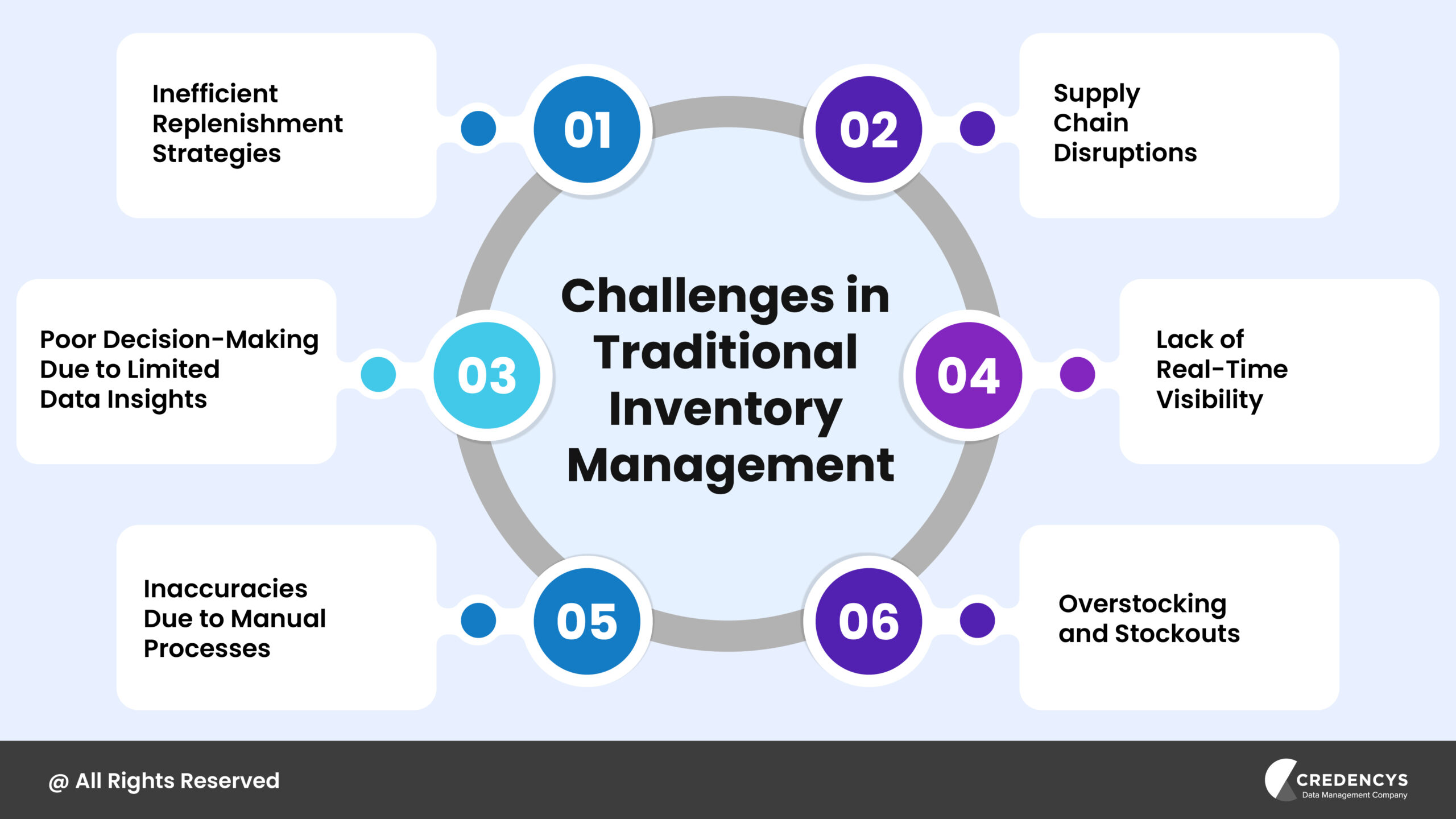
1. Inefficient Replenishment Strategies
Without automation, businesses rely on fixed reorder points or manual inventory checks, which can be inefficient and reactive. This often results in missed opportunities to optimize inventory levels dynamically based on demand fluctuations, seasonality, and market trends.
2. Supply Chain Disruptions
External factors such as supplier delays, transportation issues, and fluctuating raw material costs can significantly impact inventory levels. Traditional systems lack the ability to analyze and respond to these disruptions effectively, leading to inefficiencies and unexpected shortages.
3. Poor Decision-Making Due to Limited Data Insights
Traditional inventory management systems provide historical data but lack predictive capabilities. Without AI-driven insights, businesses struggle to make proactive decisions about purchasing, promotions, or markdown strategies.
This reactive approach often leads to missed revenue opportunities and excess inventory costs.
4. Lack of Real-Time Visibility
Traditional systems often operate in silos, making it difficult for businesses to have real-time visibility across multiple warehouses, retail locations, or supply chain touchpoints. This lack of transparency leads to delays in order fulfillment, inaccurate reporting, and misalignment between supply and demand.
5. Inaccuracies Due to Manual Processes
Many businesses still rely on spreadsheets or outdated software to track inventory, leading to frequent human errors. Mistakes in data entry, misplaced stock, or delayed updates can cause discrepancies between recorded and actual inventory levels.
These inaccuracies result in lost sales opportunities or excess stock that ties up capital.

Stop Losing Revenue Due to Inventory Errors. Leverage AI for Real-Time Accuracy and Seamless Stock Management
6. Overstocking and Stockouts
Balancing inventory levels is a constant challenge. Overstocking leads to high holding costs, increased waste (especially in perishable goods), and outdated inventory.
On the other hand, stockouts result in lost sales, damaged customer trust, and disrupted supply chains. Traditional inventory systems lack real-time demand forecasting, making it difficult to predict optimal stock levels.
By addressing these challenges, businesses can enhance operational efficiency, reduce costs, and improve customer satisfaction. This is where AI-driven inventory management solutions come into play, offering automation, predictive analytics, and real-time monitoring to overcome these limitations.
How AI Enhances Inventory Management
AI is transforming inventory management by introducing automation, predictive analytics, and real-time monitoring to optimize stock control. Unlike traditional systems that rely on reactive strategies, AI-driven solutions proactively predict demand, track inventory movements, and automate replenishment processes to improve efficiency and reduce costs.
Let’s explore the keyways AI enhances inventory management.
1. Warehouse Operations Optimization
AI enhances warehouse efficiency by optimizing storage layouts, automating order picking, and improving fulfillment processes. Key benefits include:
- AI-driven layout planning, reducing travel time for pickers.
- Faster order fulfillment, leading to improved customer satisfaction.
- Automated picking and packing using robotics and AI-guided systems.
By integrating AI into warehouse management, businesses can reduce operational costs and enhance productivity.
2. Supplier Performance Management
AI helps businesses evaluate supplier performance based on past delivery times, order accuracy, and pricing trends. This enables:
- Better supplier selection, reducing delays and inconsistencies.
- Optimized procurement decisions, ensuring reliable and cost-effective sourcing.
- Risk mitigation, by identifying supply chain bottlenecks before they escalate.
With AI, businesses can negotiate better contracts and improve supplier relationships to maintain a steady supply chain flow.
3. Automated Stock Replenishment
Instead of relying on fixed reorder points, AI dynamically adjusts replenishment based on demand fluctuations, sales trends, and supplier lead times. AI-driven replenishment systems:
- Reduce manual intervention, improving operational efficiency.
- Automatically place orders when stock reaches optimal thresholds.
- Prioritize high-demand products, ensuring fast-moving items are always in stock.
This eliminates the risk of human errors and ensures seamless stock availability without overburdening storage space.
4. AI-Powered Scenario Simulation
AI allows businesses to simulate various market conditions to test how different inventory strategies would perform under changing scenarios. These simulations help in:
- Preparing for demand spikes during peak seasons.
- Optimizing pricing and promotional strategies based on predictive insights.
- Assessing the impact of supply chain disruptions before they occur.
By leveraging AI-driven scenario modeling, businesses can develop agile inventory strategies to stay ahead of the competition.
5. Real-Time Inventory Tracking and Optimization
AI integrates with IoT sensors, RFID tags, and cloud-based inventory systems to provide real-time visibility into stock levels across multiple warehouses and retail locations. This results in:
- Accurate inventory monitoring, reducing human errors.
- Optimized stock distribution, ensuring balanced inventory levels across locations.
- Faster response times, allowing businesses to address supply chain disruptions immediately.
By leveraging AI-powered tracking, businesses can reduce shrinkage, theft, and misplacement of goods while improving inventory accuracy.
Gain Complete Control Over your Inventory with AI-powered Real-time Tracking. Optimize Stock Levels and Reduce Losses Effortlessly.
6. AI-Powered Demand Forecasting
One of the biggest challenges in inventory management is predicting customer demand. AI leverages historical sales data, seasonal trends, and market conditions to accurately forecast demand.
This helps businesses:
- Avoid overstocking, preventing excess inventory from accumulating.
- Adapt to market fluctuations, such as sudden demand spikes or declines.
- Reduce stockouts by ensuring the right products are available when needed.
Retailers, manufacturers, and eCommerce businesses use AI-driven demand forecasting to make data-driven inventory decisions and improve sales planning.
The Power of AI Demand Forecasting: Predicting Market Trends with Precision
AI-driven inventory management not only solves traditional challenges but also creates new opportunities for cost savings, efficiency, and customer satisfaction.
Key Benefits of AI in Inventory Management
AI-driven inventory management solutions offer significant advantages over traditional systems, enabling businesses to operate with greater efficiency, accuracy, and cost-effectiveness. By leveraging machine learning, real-time data analytics, and automation, businesses can optimize stock levels, enhance supply chain operations, and improve overall decision-making.
Here are the key benefits of implementing AI in inventory management:
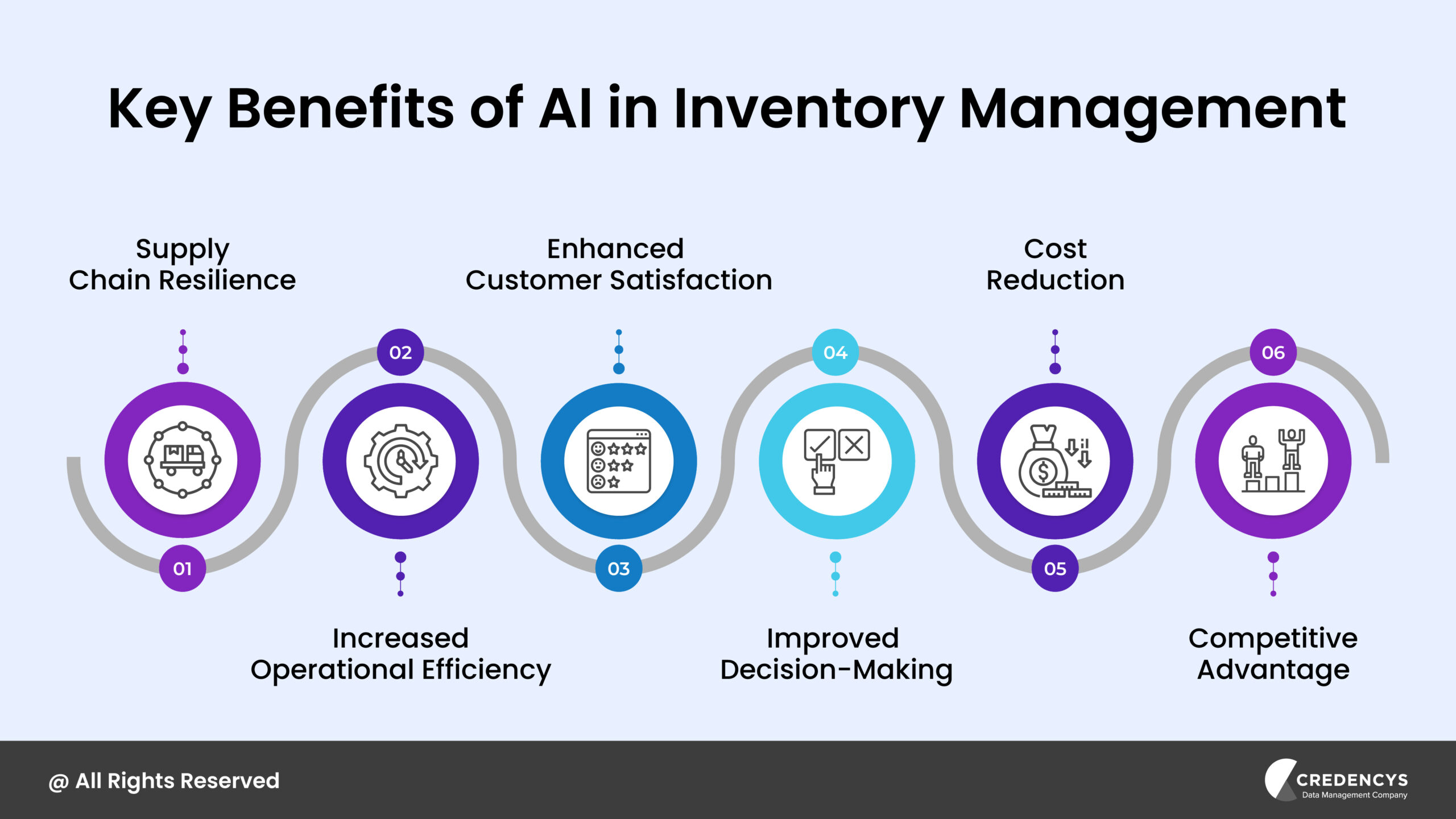
1. Supply Chain Resilience
AI-driven inventory management helps businesses adapt to supply chain disruptions by:
- Predicting potential delays and adjusting procurement strategies.
- Identifying alternative suppliers based on real-time risk assessment.
- Improving logistics and distribution, ensuring smooth inventory movement.
By enhancing supply chain agility, businesses can maintain stable inventory levels even in uncertain market conditions.
2. Increased Operational Efficiency
AI automates repetitive tasks like stock monitoring, replenishment, and order processing, leading to:
- Reduced manual labor, minimizing human errors and inefficiencies.
- Optimized warehouse management, improving picking, packing, and storage.
- Seamless integration with supply chain systems, ensuring smooth inventory flow.
This allows businesses to scale operations without increasing labor costs or complexity.
3. Enhanced Customer Satisfaction
Meeting customer demand efficiently is crucial for business success. AI-driven inventory management helps ensure:
- Faster order fulfillment, reducing delays and backorders.
- Consistent product availability, improving customer trust and loyalty.
- Personalized recommendations, enabling businesses to stock products based on consumer preferences.
By delivering a seamless shopping experience, businesses can boost customer retention and brand reputation.
4. Improved Decision-Making
AI provides data-driven insights that help businesses make smarter inventory decisions. These insights allow companies to:
- Forecast demand accurately, preventing overstocking or stockouts.
- Identify purchasing trends, optimizing stock allocation across locations.
- Analyze customer behavior, adjusting inventory based on real-time demand.
With AI-powered analytics, businesses can stay ahead of market fluctuations and make proactive inventory decisions.
5. Cost Reduction
AI helps businesses minimize unnecessary inventory costs by ensuring optimal stock levels. This leads to:
- Lower holding costs by preventing excessive inventory accumulation.
- Reduced waste and markdowns, especially in industries like retail and food.
- Optimized procurement, avoiding unnecessary purchases and reducing supplier costs.
By eliminating inefficiencies, businesses can significantly cut operational expenses and improve profit margins.
6. Competitive Advantage
Adopting AI-powered inventory management gives businesses a strategic edge by:
- Enhancing operational speed and accuracy, outperforming competitors.
- Reducing costs while increasing efficiency, leading to better profit margins.
- Leveraging AI-driven insights to optimize product offerings and pricing.
As AI continues to evolve, companies that embrace AI-driven inventory solutions will stay ahead in the market and maintain long-term growth.
Stay Ahead of the Competition with AI-powered Inventory Management. Reduce Costs, Improve Efficiency, and Enhance Customer Satisfaction Effortlessly!
Considerations When Implementing AI in Inventory Management
While AI-powered inventory management offers numerous advantages, businesses must carefully plan their implementation to maximize its benefits. Adopting AI involves integrating new technologies, restructuring processes, and ensuring data accuracy.
Here are some key considerations to keep in mind:
1. Employee Training and Change Management
AI adoption requires workforce adaptation to new technologies. To ensure smooth implementation:
- Train employees on how to use AI-driven inventory systems effectively.
- Address resistance to change by highlighting AI’s benefits in reducing manual workload.
- Establish clear communication between IT teams, supply chain managers, and operations staff to facilitate adoption.
An AI-powered inventory system should enhance employees’ efficiency rather than replace their roles entirely.
2. Selecting the Right AI Solution
Choosing the right AI-powered inventory management software is critical for success. Businesses should consider:
- Cloud-based vs. on-premise solutions, depending on IT infrastructure.
- Customizable AI features that align with business needs (e.g., demand forecasting, automated replenishment, or warehouse optimization).
- Integration capabilities with existing supply chain management tools.
Evaluating multiple AI providers and testing solutions before full implementation ensures businesses invest in the right technology.
3. Data Security and Privacy
AI-driven inventory management involves handling large volumes of sensitive data, including supplier details, sales trends, and operational insights. Businesses must:
- Implement robust cybersecurity measures to protect inventory data from breaches.
- Comply with data protection regulations (such as GDPR or industry-specific standards).
- Regularly monitor AI algorithms for potential biases or security vulnerabilities.
Ensuring data security and compliance minimizes risks while maintaining customer and supplier trust.
4. Cost of AI Implementation and ROI Evaluation
Implementing AI in inventory management requires investment in software, infrastructure, and employee training. Businesses should:
- Conduct a cost-benefit analysis to assess the return on investment (ROI).
- Start with pilot projects before scaling AI solutions company-wide.
- Choose AI solutions that offer scalability and flexibility to grow with business needs.
Evaluating AI’s long-term benefits—such as cost reduction, efficiency improvements, and customer satisfaction – helps justify the investment.
5. Data Quality and Integration
AI relies on high-quality, accurate data to generate actionable insights. Businesses need to:
- Ensure clean, structured, and updated inventory data for AI models to deliver reliable results.
- Integrate AI with existing ERP, warehouse management, and supply chain systems to enable seamless operations.
- Address data silos by centralizing inventory information across departments and locations.
Without proper data management, AI solutions may produce inaccurate forecasts and ineffective inventory recommendations.
By considering these factors, businesses can ensure a smooth transition to AI-powered inventory management, maximizing efficiency while minimizing risks.
Conclusion
AI is revolutionizing inventory management by eliminating inefficiencies, reducing costs, and improving decision-making. Businesses that adopt AI-driven solutions can accurately forecast demand, automate replenishment, and gain real-time visibility into stock levels, ultimately leading to higher operational efficiency and customer satisfaction.
Businesses that embrace AI now will stay ahead of industry trends, ensuring long-term growth, resilience, and competitive advantage.
Are you Ready to Redefine your Inventory Management Strategy with AI? Credencys can Help you Implement Cutting-edge AI Solutions Tailored to your Business Needs.






Tags: