


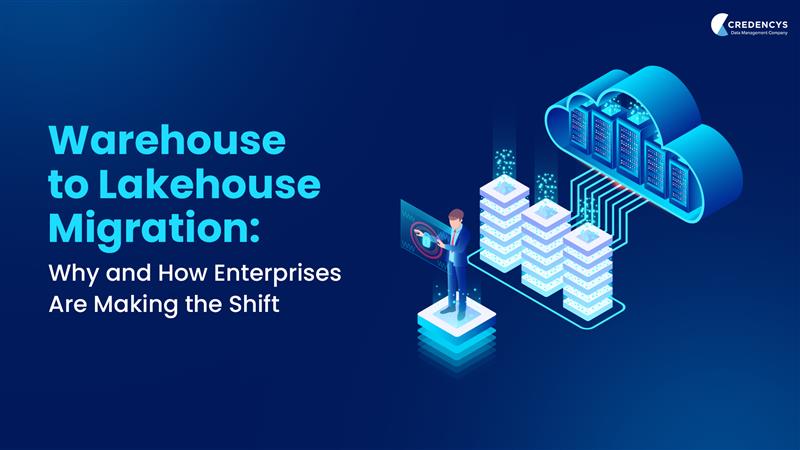
Warehouse to Lakehouse Migration: Why and How Enterprises Are Making the Shift
According to a recent review survey, 74% of enterprises report that their current data infrastructure limits their ability to innovate with AI and real-time analytics.
As data volumes explode and the demand for advanced analytics grows, traditional data warehouses are falling short, constrained by rigid architectures, high costs, and limited support for unstructured or real-time data.
This shift in requirements is pushing forward-thinking enterprises to migrate from legacy data warehouses to lakehouse architectures — a modern data paradigm that offers the scalability of data lakes with the performance and reliability of data warehouses.
Get expert guidance, a free assessment, and a clear roadmap of migration tailored to your data environment. Explore details here.
In this blog, we’ll explore why this shift is happening and how organizations can navigate the migration successfully.
What Is a Lakehouse?
A lakehouse is a unified data architecture that combines the data management features of a data warehouse with the low-cost storage and flexibility of a data lake. It supports a wide range of workloads — from business intelligence (BI) and reporting to machine learning and real-time analytics — using a single platform.
Popular lakehouse platforms include Databricks and Snowflake’s Unistore.
Why Enterprises Are Moving Away from Traditional Data Warehouses
1. Rising Costs and Scalability Limits
Traditional warehouses are optimized for structured data and often come with high licensing, storage, and compute costs. As data volumes grow exponentially, these costs become unsustainable.
2. Inflexibility with Unstructured Data
Modern use cases (IoT, video, social media, logs) require processing of unstructured and semi-structured data. Data warehouses struggle to ingest and analyze these formats efficiently.
3. Lack of Support for Advanced Analytics
Warehouse-first architectures are typically optimized for SQL-based analytics but fall short when it comes to running machine learning models, streaming analytics, or real-time data pipelines.
4. Data Silos and Operational Complexity
Warehouses often require complex data pipelines that duplicate data across storage and compute environments, creating silos and complicating data governance.
Benefits of Migrating to a Lakehouse
Migrating to a lakehouse architecture brings a wide range of strategic, operational, and financial advantages. Below are the key benefits in more depth:
1. Unified Data Platform for All Workloads
Lakehouses eliminate the need for separate systems for different data types or workloads. Whether it’s structured transaction data, semi-structured logs, or unstructured media files, a lakehouse can store and process everything in one place.
Why it matters:
This eliminates data duplication, simplifies architecture, and supports a diverse set of use cases — from SQL reporting and BI dashboards to AI/ML pipelines and real-time data processing — all from the same source of truth.
2. Reduced Total Cost of Ownership (TCO)
By leveraging cloud-native object storage (e.g., Amazon S3, Azure Data Lake Storage) and decoupling storage from compute, lakehouses significantly reduce the cost of storing and processing massive volumes of data.
Why it matters:
You can scale compute resources on-demand for analytics or data science tasks without replicating or moving data, and you only pay for what you use, leading to better cost efficiency over traditional data warehouses with fixed capacity pricing models.
3. Built-In Support for Machine Learning and AI
Lakehouse platforms like Databricks and Snowflake are built with native integration for machine learning frameworks (e.g., TensorFlow, PyTorch, MLlib) and offer collaborative notebooks, automated ML features, and version control for ML models.
Why it matters:
Your data science teams can train, deploy, and monitor models on the same data used for reporting, reducing data movement, enabling real-time ML use cases, and improving model accuracy with access to the full breadth of data.
4. Advanced Analytics and Real-time Insights
Modern lakehouses support streaming data ingestion and real-time processing using engines like Apache Spark Structured Streaming or Delta Live Tables.
Why it matters:
Businesses can respond to events as they happen — whether it’s fraud detection, dynamic pricing, inventory optimization, or personalized recommendations — providing a competitive edge.
5. Open Standards and Interoperability
Lakehouses are typically built on open file formats like Parquet, ORC, or Avro, and support table formats like Apache Iceberg, Delta Lake, or Hudi. This enables compatibility with a wide range of data tools and engines.
Why it matters:
You’re not locked into a single vendor or ecosystem. Teams can choose the best tools for their needs while maintaining a unified data foundation.
6. Enterprise-grade Governance and Security
Modern lakehouse platforms now include robust data governance features such as:
- Role-based access control (RBAC)
- Data masking and encryption
- Audit logs and activity tracking
- Schema evolution and enforcement
- Data lineage and versioning
Why it matters
This allows organizations to meet compliance requirements (e.g., GDPR, HIPAA, CCPA) while ensuring trusted and secure access to data across teams.
7. Faster Time-to-Insight
With data in one place and available for a wide variety of workloads, users no longer need to wait for lengthy ETL cycles or navigate complex data integration pipelines.
Why it matters:
Business users, analysts, and data scientists can self-serve access to fresh, reliable data, dramatically accelerating the time it takes to generate insights and make data-driven decisions.
8. Modern Developer Experience
Lakehouses support modern DevOps and DataOps practices through APIs, CI/CD integrations, notebooks, version control, and orchestration tools like Airflow, dbt, and Terraform.
Why it matters:
Engineering teams can build and deploy scalable data pipelines more efficiently, with improved reproducibility, collaboration, and quality assurance.
How to Plan a Successful Warehouse to Lakehouse Migration
Migrating from a warehouse to a lakehouse is a strategic initiative. Here’s a step-by-step framework to guide the transition:
1. Define Business Objectives
Identify the key goals: Is it cost optimization, AI/ML enablement, real-time analytics, or data unification?
2. Assess Current Data Architecture
Catalog your existing data assets, pipelines, and workloads. Understand which parts of your architecture are bottlenecks or cost drivers.
3. Select the Right Lakehouse Platform
Choose a platform based on your use case, cloud strategy, data volume, and team expertise. Evaluate factors like support for open formats, integrations, governance features, and TCO.
4. Plan Data Migration in Phases
Migrate data in logical phases:
- Stage 1: Ingest raw data into the data lake using batch or streaming
- Stage 2: Use Delta Lake or Apache Iceberg for transactional consistency
- Stage 3: Redirect analytics workloads to lakehouse tables gradually
5. Modernize Your ETL/ELT Pipelines
Rebuild or refactor data pipelines using modern tools like dbt, Apache Spark, Airflow, or Databricks Workflows. Move toward ELT where possible.
6. Implement Governance and Security
Ensure data quality, access control, lineage, and compliance using tools such as Unity Catalog, Apache Ranger, or Lake Formation.
7. Enable Self-Service Analytics
Integrate with BI tools like Power BI, Tableau, Looker, or Superset to empower business users with easy access to fresh data.
8. Monitor and Optimize
Utilize observability tools to monitor performance, costs, and data freshness. Continuously optimize workloads, storage tiers, and query patterns.
Wrapping Up
Warehouse to lakehouse migration is more than a tech shift — it’s a strategic enabler for data-first enterprises. By unifying analytics, machine learning, and governance on a single platform, lakehouses enable businesses to make faster, smarter decisions without the silos and costs associated with traditional systems.
Whether you’re starting fresh or modernizing legacy infrastructure, a well-planned lakehouse strategy can transform your data capabilities for the next decade.

Ready to Migrate? If you’re considering migrating from a warehouse to a lakehouse, now’s the time to explore your options. With careful planning and the right partner, you can unlock agility, scale, and insights like never before.



Tags: