


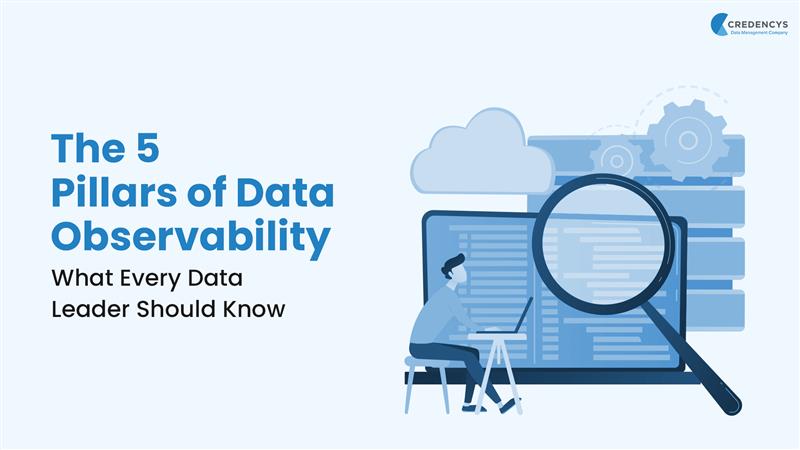
The 5 Pillars of Data Observability: What Every Data Leader Should Know
Can you trust the data driving your business decisions?
Despite massive investments in data infrastructure, 87% of data professionals report experiencing at least one data incident last year—errors that led to broken dashboards, incorrect KPIs, and costly decisions.
As data pipelines become increasingly complex and distributed across cloud platforms, traditional monitoring tools often fall short. Data observability has emerged as a critical capability, enabling organizations to not only detect issues but also understand their root causes, anticipate failures, and ensure data reliability at every step.
But what exactly does a robust data observability strategy look like?
In this blog, we explore the five essential pillars of data observability that every data leader must know to maintain trust, transparency, and performance across their data ecosystem.
Pillar #1: Freshness (Is Your Data Up to Date?)
Freshness ensures that your data is updated on time and reflects the latest available information. If your reports or machine learning models are running on stale data, the insights could be dangerously misleading.
A delay in updating sales data, for instance, can result in stockouts or overstocking, directly impacting revenue and customer satisfaction.
Data observability tools track the current state of your data across pipelines, identifying lags or failures in ingestion, ETL processes, or API sources. Freshness monitoring helps teams act quickly before outdated data reaches critical systems.
Pillar #2: Distribution (Are Your Data Values Within Expected Ranges?)
Distribution checks whether the values in your datasets follow expected statistical patterns—mean, median, min/max, and frequency distributions.
Sudden spikes or anomalies can signal data corruption, schema drift, or upstream changes. For example, a drastic drop in customer orders overnight may indicate an error in the data feed, rather than a genuine business trend.
With distribution checks, data observability provides early warnings of data drift that might not otherwise be caught until after a serious impact.
Pillar #3. Volume (Are You Getting the Right Amount of Data?)
Volume monitoring ensures you’re ingesting the correct quantity of data—neither too much nor too little. Missing rows, incomplete batch jobs, or duplicate entries are red flags that must be addressed before they snowball into larger issues.
According to Accenture, bad data costs companies an average of $12.9 million annually, and undetected volume issues are often a hidden culprit.
By continuously checking volume metrics, data observability platforms help maintain data completeness and integrity across the entire pipeline.
Pillar #4. Schema (Has the Data Structure Changed Unexpectedly?)
A silent schema change—such as adding a new column, changing a data type, or dropping a field—can wreak havoc across BI dashboards, APIs, and ML models.
Schema observability tracks structural changes in datasets and flags deviations from expected formats. This is particularly critical in distributed environments where multiple teams or tools interact with the same datasets.
Having schema checks in place reduces data breakage and ensures your downstream applications remain functional and accurate.
Pillar #5. Lineage (Can You Trace the Root Cause of Data Issues?)
Data lineage provides end-to-end visibility into how data flows across your systems—from ingestion to transformation to consumption. When something breaks, lineage makes it easy to trace the problem to its source.
This pillar is especially useful for troubleshooting, auditing, and ensuring regulatory compliance. With complete lineage, data teams can act faster and collaborate more efficiently, improving both accountability and resolution times.
Think of lineage as your data’s GPS—helping you trace where it came from, what it went through, and where it’s going next.
Conclusion: Building Trust Through Data Observability
Modern businesses run on data. But without the ability to observe, diagnose, and prevent data issues, even the most sophisticated tech stack can become a liability.
By embracing the five pillars of data observability—freshness, distribution, volume, schema, and lineage—data leaders can establish a resilient data foundation that enables smarter decisions, enhances data trust, and scales with confidence.
Whether you’re working with Snowflake, Databricks, or a hybrid cloud environment, investing in data observability is no longer optional—it’s essential.

Explore how data observability can maintain transparency and performance across your data ecosystem.





Tags: