


How Databricks and Generative AI Are Transforming Retail Marketing Analytics & ROI
Retail is evolving faster than ever. Shoppers today expect personalized experiences, instant engagement, and seamless journeys across online and offline channels. Yet many retailers struggle to keep up. The challenge isn’t a lack of data—it’s the inability to connect, analyze, and act on that data in real time.
According to McKinsey, companies that use advanced customer analytics are 23 times more likely to outperform in acquiring new customers and 19 times more likely to achieve above-average profitability.
Despite this, most retailers still operate with fragmented systems and outdated analytics models that only explain what happened in the past, not what should happen next.
This is where retail marketing analytics powered by Databricks and Generative AI is changing the game. Unlike traditional reporting tools, this new approach unifies all customer, product, and campaign data into a single source of truth. Then, advanced AI models turn those insights into personalized campaigns, real-time offers, and measurable ROI.
For retailers, the shift isn’t just about technology—it’s about survival. Shoppers now choose brands that can anticipate their needs, not just react to them. Databricks provides the data backbone, while Generative AI delivers the creative intelligence that fuels modern marketing. Together, they enable retailers to move from reactive marketing to predictive, personalized engagement at scale.
Key Takeaways from this Blog
- Why traditional retail marketing analytics falls short in today’s environment
- How Databricks creates a unified Customer 360 view by breaking down silos
- The role of Generative AI in hyper-personalization, real-time decisioning, and ROI measurement
- Real-world use cases where leading retailers improved retention, campaign efficiency, and revenue
Why Traditional Retail Marketing Analytics Falls Short
Most retailers have invested heavily in analytics over the past decade. Dashboards, reports, and campaign summaries are standard tools in every marketing department. But here’s the reality: traditional retail marketing analytics was designed for looking backward, not forward. It tells you what happened, but rarely what to do next.
This gap becomes critical in today’s competitive retail landscape, where customer journeys are fragmented across mobile apps, ecommerce, stores, and social media. Without the ability to predict and act in real time, retailers miss opportunities to engage, retain, and convert.
The biggest limitations of traditional analytics include:
1. Data Silos
Customer, product, and campaign information is often stored in separate systems—CRM, POS, ecommerce platforms, and loyalty apps. Because these systems don’t “talk” to each other, marketers struggle to build a single view of the customer.
2. Reactive Insights
Most tools only describe what already happened: last quarter’s campaign performance, previous season’s sales, or demographic summaries. They rarely predict customer behavior or recommend the best course of action.
3. Generic Campaigns
Without AI-driven insights, retailers fall back on broad segmentation (like “loyalty members” or “discount shoppers”). This often results in irrelevant promotions, wasted ad spend, and disengaged customers.
4. Measurement Challenges
Connecting marketing spend to true ROI is notoriously difficult when data is fragmented. As a result, executives often question the impact of marketing on revenue growth.
The result? Lower engagement, higher churn, and missed revenue opportunities.
Gartner found that 63 percent of digital marketers struggle to deliver personalized experiences at scale.
For retailers, the message is clear: relying solely on traditional analytics is no longer enough. To win customer attention and loyalty, marketing must be predictive, personalized, and measurable.
The New Era of Retail Marketing Analytics
Retail marketing is shifting from hindsight to foresight. Instead of just reporting on past campaigns, leading retailers are now using advanced platforms like Databricks combined with Generative AI to predict customer behavior, create personalized engagement, and measure impact in real time.
This new approach transforms retail marketing analytics into a strategic growth driver rather than a reporting function. By unifying massive datasets, applying machine learning models, and leveraging AI-generated content, retailers can deliver experiences that feel personal to every shopper—at scale.
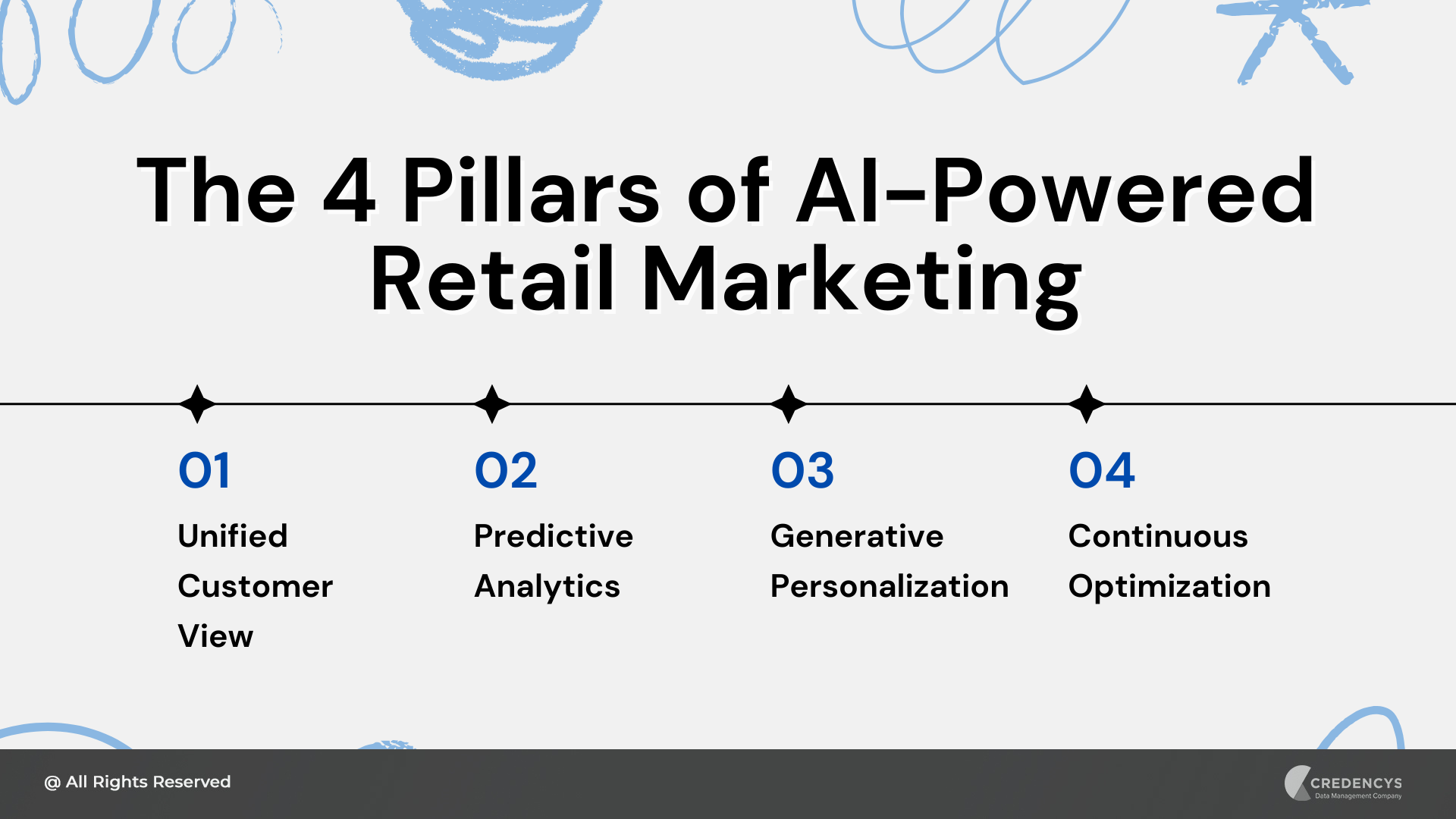
Here’s how this transformation is unfolding:
Unified Customer 360 with Databricks
Databricks breaks down data silos by merging structured and unstructured data into a single source of truth. From transactions and browsing activity to social media interactions and loyalty behavior, everything is consolidated into a holistic Customer 360 view.
Generative AI for Personalization
Instead of segmenting customers into broad buckets, Generative AI creates individualized campaigns. It can design personalized product recommendations, craft custom messages, and even generate campaign creatives tailored to a shopper’s preferences and intent.
Real-Time Decisioning
With streaming analytics, Databricks enables immediate action. Retailers can deliver personalized offers, dynamic discounts, or proactive churn-prevention messages the moment signals appear.
Measurable ROI
Unlike traditional analytics, this new model directly connects marketing activities to revenue growth, customer lifetime value, and retention. Retailers can finally close the loop between investment and business outcomes.
Retail marketing analytics has entered a new era—one where predictive intelligence, automation, and personalization work together to create measurable business impact.
The Role of Databricks in Retail Marketing Analytics
Behind every successful AI-driven marketing strategy is a strong data foundation. That’s where Databricks comes in. It provides the data and AI backbone that allows retailers to unify information, apply machine learning at scale, and collaborate across teams. Unlike legacy systems that struggle with fragmented data, Databricks is built for flexibility, speed, and scale.
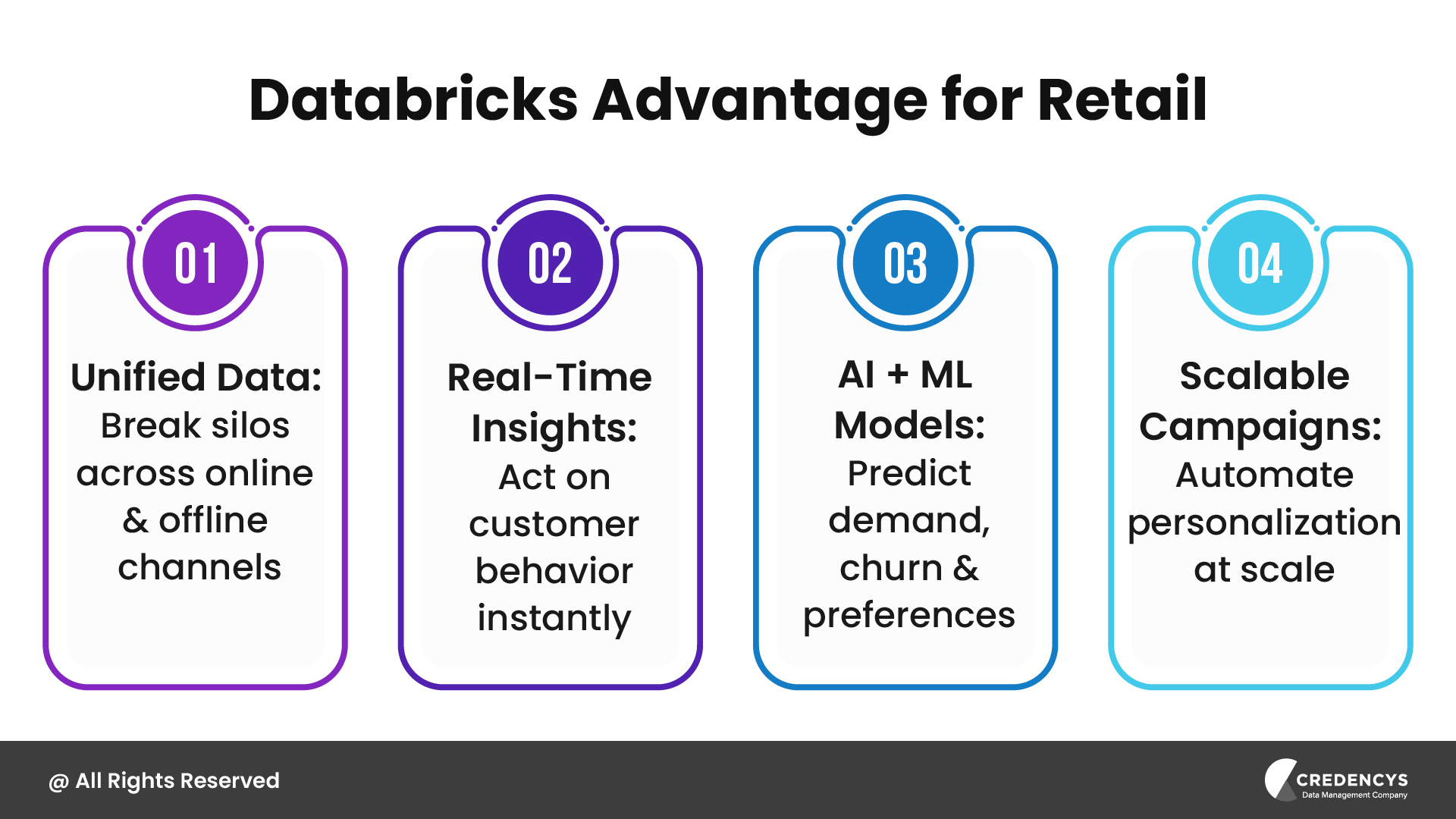
Key contributions of Databricks to retail marketing analytics:
1. Unified Data Lakehouse
Traditional data warehouses often separate transactional data from unstructured sources like reviews, clickstreams, or social media. Databricks’ Lakehouse architecture combines them all in one place, ensuring marketers and analysts work from a single version of the truth. This eliminates duplication, silos, and delays.
2. Advanced AI and ML Capabilities
Databricks integrates tools like MLflow, Delta Lake, and Unity Catalog to build, train, and deploy machine learning models at scale. This empowers marketing teams to go beyond basic demographics and use psychographics, sentiment analysis, and behavioral intent to predict churn, optimize campaigns, and identify upsell opportunities.
3. Scalability for Omnichannel Retail
Retailers today must manage billions of interactions across ecommerce, physical stores, apps, and loyalty programs. Databricks is designed to scale seamlessly, ensuring consistent personalization and analytics across every channel without performance bottlenecks.
4. Collaboration Across Teams
Data scientists, analysts, and marketers often work in silos, which slows down execution. Databricks provides a shared environment that enables cross-functional collaboration. Marketing teams can quickly act on insights instead of waiting for long IT or data science cycles.
Databricks transforms marketing analytics from fragmented reporting into a connected, AI-powered ecosystem—where insights don’t just describe the past but actively shape future customer engagement.
Generative AI: The Creativity Engine Behind Personalization
If Databricks provides the data backbone, Generative AI is the creative force that makes modern retail marketing truly personal. Instead of relying on static segments or pre-defined rules, Generative AI learns from customer behavior and context to generate messages, recommendations, and experiences tailored to each individual.
This is a significant shift. Traditional personalization often stops at “customers like you bought this.” Generative AI goes much deeper, considering browsing intent, seasonality, sentiment, and even conversational context to deliver experiences that feel human and relevant.
How Generative AI enhances retail marketing analytics:
Hyper-Personalized Campaigns
Generative AI creates individualized content—emails, push notifications, or ad creatives—that resonate with each customer. Instead of sending one-size-fits-all messages, retailers can communicate with customers in ways that feel uniquely crafted for them.
Smarter Product Recommendations
Going beyond basic collaborative filtering, AI models can recommend products based on browsing history, lifestyle signals, and even real-time context. This helps drive both cross-sell and upsell opportunities.
Automated A/B Testing
Testing campaign variations is no longer a slow, manual process. Generative AI can instantly create multiple creative options, test them in real time, and optimize for the best-performing version—accelerating time-to-market.
Conversational Engagement
AI-powered chatbots and virtual assistants can act as personal shopping companions, answering questions, suggesting products, and offering promotions in natural language. This elevates customer experience while reducing support costs.
Predictive Customer Journeys
By analyzing micro-signals (like declining app usage or browsing without purchase), AI anticipates customer behavior and triggers proactive engagement—whether it’s a special offer, loyalty perk, or personalized reminder.
And the impact is measurable. According to Salesforce, personalized experiences can increase customer spending by 20 percent on average.
Generative AI acts as the creativity engine that brings Databricks-powered insights to life—transforming analytics into real-world actions that drive engagement and revenue.

Ready to Transform Your Retail Marketing with AI? Unlock the full potential of Databricks and Generative AI to drive personalization, predict demand, and maximize ROI.
Use Cases: Databricks + Generative AI in Action
Here are two client-side success stories that illustrate how retailers and consumer goods companies are transforming data into performance—with the combined power of Databricks and intelligent automation.
Case 1: Consumer Electronics E-Tailer: Personalization Meets Performance
Client: A major e-commerce brand in consumer electronics.
The Challenge: Multiple systems held customer, campaign, and sales data—creating analytical silos that blocked real-time insight, personalization, and accurate ROI measurement. Campaign spend often hits the wrong audiences, leading to inefficiencies and stagnating conversions.
Our Approach:
- Unified all customer and campaign data by implementing Databricks Lakehouse as a central data hub.
- Built AI-driven segmentation models for hyper-personalized messaging.
- Enabled streaming analytics and automated A/B testing to optimize campaigns dynamically.
- Applied intelligent ad-spend allocation based on model outputs for maximum efficiency.
Impact:
- 31% increase in customer engagement through personalization.
- 23% reduction in customer acquisition cost via more intelligent ad allocation.
- 44% boost in conversion rates thanks to real-time campaign optimization.
- 49% faster data processing, enabling immediate insights and action.
Read the complete case study here.
Case 2: Global Consumer Goods Brand: Campaign Data Automation at Scale
Client: A globally recognized consumer brands leader, active in health, hygiene, and nutrition across 60+ countries.
The Challenge: Daily campaign planning relied on messy data flowing from APIs, Excel sheets, and SQL servers. Manual formatting slowed decisions, introduced errors, and made scaling operations a significant headache.
Our Approach:
- Built scalable ETL pipelines using Azure Data Factory to automate ingestion.
- Centralize campaign data into a SQL-based layer for consistency.
- Leveraged Azure Databricks notebooks for processing and transformation.
- Enabled modular logic and integrated CI/CD via Azure DevOps for rapid, safe updates.
Impact:
- Achieved end-to-end automation, virtually eliminating manual data handling.
- Delivered 70% faster campaign data turnaround times, supporting daily refreshes.
- Ensured 100% pipeline automation with improved quality and governance.
- Enabled agile response to changing regional campaign needs.
Read the complete case study here.
Measuring ROI with Databricks and Generative AI
One of the biggest frustrations for retail marketers is proving the value of their campaigns. Executives often ask: “How do we know this spend is driving real revenue?” Traditional analytics struggles with attribution, especially when data lives in silos and customer journeys span dozens of touchpoints.
With Databricks and Generative AI, ROI measurement becomes far more transparent and actionable. The integration of unified data, predictive models, and real-time analytics means retailers can track impact not just at the campaign level, but down to individual customer lifetime value.
How ROI measurement improves with this modern approach:
1. Attribution Accuracy
Databricks unifies data across channels, while AI models map the actual influence of each touchpoint in a multi-channel journey. This helps identify which platforms—email, paid ads, social, or in-store—are genuinely driving conversions.
2. Incremental Revenue Tracking
With AI-powered experimentation, retailers can run controlled campaigns to measure incremental lift. This reveals exactly how much extra revenue comes from personalization or specific offers.
3. Customer Lifetime Value (CLV)
Predictive models estimate the long-term impact of campaigns on retention, frequency of purchase, and wallet share. Instead of just short-term sales, retailers see how engagement strategies affect sustainable growth.
4. Reduced Marketing Waste
Generative AI helps eliminate irrelevant impressions and poor targeting. By ensuring campaigns reach the right audience, retailers reduce Customer Acquisition Cost (CAC) and improve return on ad spend.
The results are substantial.
A BCG study found that companies using AI-driven personalization see a 10–20% uplift in marketing ROI.
For retail leaders, the ability to connect every dollar spent to measurable business outcomes is what makes Databricks and AI more than a technology investment—it’s a growth strategy.
Overcoming Challenges in Adoption
While the promise of AI-driven retail marketing analytics is powerful, the road to adoption is not without hurdles. Many retailers underestimate the complexity of moving from siloed, intuition-based marketing to a unified, AI-enabled ecosystem. Success requires not just technology, but the right strategy, culture, and governance.
Common challenges retailers face, and how to address them:
1. Data Quality and Integration
The saying “garbage in, garbage out” still holds. Poorly structured or inconsistent data undermines even the most advanced AI models. This is why data governance frameworks and standardized integration practices are critical. Platforms like Databricks simplify this by unifying structured and unstructured data in one place, ensuring clean, consistent inputs.
2. Change Management
For many organizations, adopting AI means rethinking how marketing decisions are made. Teams accustomed to campaign planning based on intuition may be hesitant to trust machine-generated recommendations. Strong leadership sponsorship, cross-functional alignment, and phased rollouts can ease the cultural shift.
3. Ethical and Responsible AI
Customers are increasingly concerned about how their data is used. Missteps in personalization—such as being “too invasive”—can erode trust quickly. Retailers must establish ethical AI guidelines around transparency, fairness, and consent.
According to PwC, 85% of executives believe AI ethics will be a key differentiator for brand trust in the next five years.
4. Skill Gaps in Marketing Teams
Marketers do not need to become data scientists, but they do need to understand how to interpret and act on AI insights. Upskilling programs, cross-team collaboration, and simplified dashboards help bridge the gap between data science and marketing execution.
5. Scaling Across Channels
It’s one thing to run an AI-powered pilot campaign; it’s another to roll it out across ecommerce, stores, apps, and loyalty platforms. Retailers need scalable infrastructure and modular AI models that can expand without breaking performance.
Retailers that tackle these challenges head-on unlock a competitive advantage. By combining governance, culture, and capability building with the right platform, they ensure AI adoption isn’t just a technology upgrade—but a transformation that sticks.
The Future of Retail Marketing Analytics
Retail marketing is entering an era where analytics will no longer be a back-office function but a real-time intelligence engine that shapes every customer interaction. With Databricks providing scalable data infrastructure and Generative AI fueling personalization, the future of retail marketing will be predictive, autonomous, and increasingly human-like in experience.
Trends shaping the next decade of retail marketing analytics:
1. Real-Time Hyper-Personalization
Customers will no longer tolerate generic offers. Every touchpoint—whether in an app, on a website, or in-store—will adapt dynamically to individual preferences, behaviors, and even moods. AI models will continuously learn and optimize in the background, ensuring relevance at every interaction.
2. AI-Generated Campaigns in Hours, Not Weeks
Creative teams traditionally spend weeks designing, testing, and deploying campaigns. Shortly, Generative AI will be able to generate, A/B test, and refine campaigns within hours, enabling retailers to keep pace with shifting consumer demand.
3. Conversational and Visual Commerce
With voice assistants and visual search becoming mainstream, AI-powered shopping companions will help customers discover products through natural conversations or by simply uploading an image. Retailers that integrate voice and vision AI into their analytics will create more intuitive, seamless shopping journeys.
4. Predictive Customer Journeys
Instead of reacting to churn signals after the fact, predictive models will anticipate customer actions before they happen. This will allow retailers to engage proactively—whether by offering a personalized promotion, adjusting pricing, or triggering a loyalty reward.
5. Ethical and Responsible AI as a Standard
Personalization without trust is a short-lived win. In the future, retailers will differentiate not only on the quality of their experiences but also on their commitment to ethical data use and AI transparency. Building consumer trust will be as critical as delivering personalization itself.
As these trends unfold, Databricks will continue to serve as the foundation, enabling retailers to scale data management, ensure governance, and apply AI securely. Generative AI will act as the creative intelligence that transforms insights into action, allowing marketing to become more personal, predictive, and profitable.
Conclusion: Driving Retail ROI with Databricks and Generative AI
The retail industry has reached a tipping point. Traditional marketing analytics—focused on lagging indicators and broad segmentation—can no longer deliver the personalization and agility customers expect. Brands that rely solely on outdated approaches risk falling behind in an environment where loyalty is fragile and attention spans are short.
By combining the data unification power of Databricks with the creative intelligence of Generative AI, retailers can transform how they engage with customers. This modern approach enables them to:
- Build a unified 360-degree customer view across channels
- Deliver hyper-personalized campaigns in real time
- Optimize marketing spend with precise attribution and predictive insights
- Increase customer lifetime value and retention through proactive engagement
- Drive measurable ROI at scale
Modern retail marketing analytics is not just a tool—it’s a growth strategy. With Databricks as the data backbone and Generative AI as the personalization engine, retailers can move beyond reporting the past to actively shaping the future of customer engagement.
Now is the time to act. Retailers who invest today in intelligent, AI-native analytics will set the standard for tomorrow’s customer experience.
FAQs on Retail Marketing Analytics with Databricks and Generative AI
1. What is retail marketing analytics?
Retail marketing analytics is the use of customer and sales data to improve marketing campaigns, personalize experiences, and boost ROI.
2. Why isn’t traditional retail marketing analytics enough today?
Because it only looks backward at reports. Retailers now need real-time, predictive insights to meet customer expectations.
3. How does Databricks help retailers with marketing analytics?
Databricks unifies all customer and campaign data into one platform, enabling AI-powered insights, personalization, and accurate performance tracking.
4. What does Generative AI do in retail marketing?
Generative AI creates personalized content—like product recommendations, emails, and ads—that resonate with each customer in real time.
5. Can Databricks and Generative AI improve ROI?
Yes. They help retailers optimize spend, increase engagement, and improve customer lifetime value, often boosting ROI by 10–20%.
6. What challenges do retailers face when adopting AI in marketing?
Common challenges include poor data quality, change resistance, skill gaps, and ethical AI concerns.
7. How does retail marketing analytics prevent customer churn?
AI models identify early churn signals—like fewer purchases or reduced engagement—so retailers can act with personalized offers.
8. Is Generative AI safe to use in retail marketing?
Yes, if implemented responsibly with transparency and ethical guidelines to protect customer trust.
9. Can small retailers use Databricks and Generative AI?
Absolutely. Smaller retailers can centralize their data, run targeted campaigns, and gain efficiency without needing enterprise-level budgets.
10. Why should retailers work with Credencys?
Because Credencys is a trusted Databricks partner and has proven expertise in Databricks and AI, delivering projects that increased engagement, automated campaigns, and cut costs for global retailers.
Partner with Credencys to unify your data, automate campaigns, and accelerate retail growth. Our experts will help you build future-ready marketing strategies.






Tags: