


Retail Data Challenges: Why Snowflake Alone Can’t Deliver Golden Records
In the age of hyper-personalization and omnichannel retail, data is the lifeblood. But here’s a sobering reality:
As much as 30–40% of retail customer profiles in marketing databases are duplicates or inaccurate, meaning that nearly half of your “valuable” customers might be misrepresented. Retail TouchPoints
Put differently: when your systems treat Jane Doe with two email addresses and an alternate phone number as three distinct persons, your analytics, loyalty programs, and personalized campaigns are built on sand.
Snowflake has earned its place in retail stacks precisely because it solves big, hard problems: massive data scale, elasticity, and performance under load. But the fact remains that storing data and making it meaningful are two entirely different jobs.
Snowflake gives you the canvas. But it won’t paint the picture.
Without layers of identity resolution and merging, retailers continue to act on fragmented “truths”, and that’s the hidden fracture in the data stack.
What You’ll Learn
In this blog, you’ll discover:
- Why Snowflake alone can’t solve retail’s data chaos
- The hidden costs of fragmented customer data
- How MDM unifies and cleans customer records
- The power of Golden Records for a single customer view
- Business impact of MDM inside Snowflake
- How Snowflake + MDM enable AI-driven growth
What Snowflake Excels At and Why Those Capabilities Alone Don’t Repair Customer Data
Snowflake is powerful. It solves many of the infrastructure headaches that retailers used to wrestle with.
But when you lean too heavily on its strengths without addressing upstream data issues, you end up with beautiful infrastructure and messy business insights. Let’s unpack both sides.
What Snowflake Does Really Well
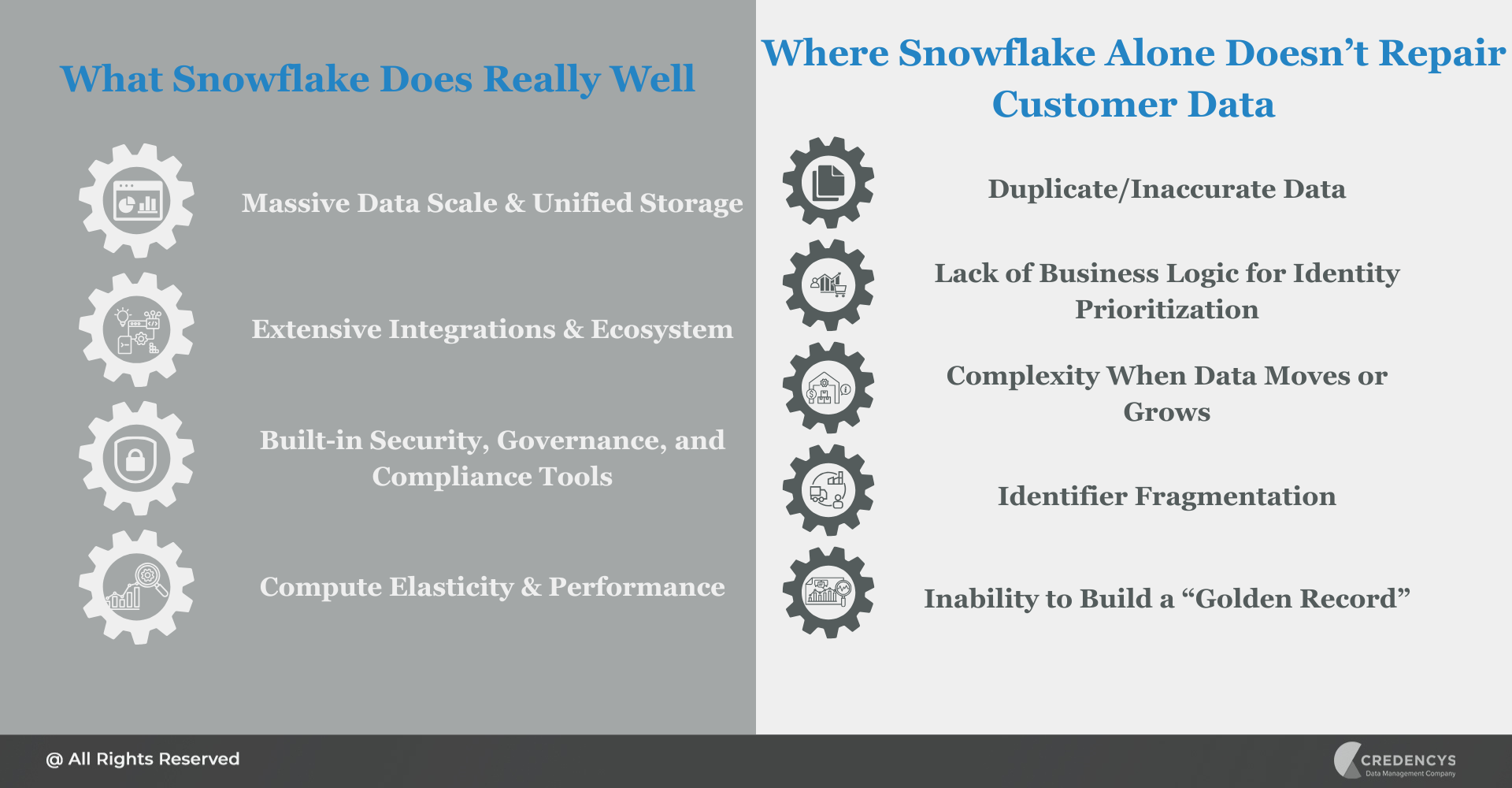
- Massive Data Scale & Unified Storage: Retailers collect data from dozens of systems, point-of-sale, loyalty apps, online stores, third-party marketplaces, customer support, etc. Snowflake gives you the ability to ingest all this data in one governed cloud platform without worrying about your storage hitting bottlenecks.
- Extensive Integrations & Ecosystem: Many third-party apps, identity resolution tools, and enrichment services are increasingly available inside or alongside Snowflake (via its Marketplace or native app framework). These let organizations bring in identity resolution/enrichment functionality without moving data out.
- Built-in Security, Governance, and Compliance Tools: Snowflake provides security features (access controls, data masking, roles, etc.), encryption, and audit capabilities. For retailers dealing with PII, payment data, and loyalty info, these are essential.
- Compute Elasticity & Performance: During peak times (holidays, flash sales, big promotions), query loads spike. Snowflake scales compute to handle heavy queries, analytics, and reporting without collapse.
Where Snowflake Alone Doesn’t Solve the Identity Problem
While the strengths above are meaningful, they don’t guarantee that your customer data is clean, unified, or trustworthy. Here are gaps and challenges:
- Duplicate/Inaccurate Data: Common causes can be
- Manual entry errors (misspellings, alternate name formats)
- Customers registering multiple times under different emails/devices
- Data from external sources or mergers of data that aren’t cleaned
According to AWS, duplication rates of 10–30% are common in systems that pull data from multiple sources. Amazon Web Services, Inc.

Don’t Let Duplicate Data Drain Your Retail ROI. See How Credencys Helps Retailers Unify and Clean Customer Data Inside Snowflake
- Lack of Business Logic for Identity Prioritization: You may need rules like: if loyalty ID exists, that’s the primary identifier; otherwise, fallback to email; if both exist but conflict, use purchase history recency. Without a master data process, these rules stay informal, applied inconsistently, or buried in ETL logic that’s hard to maintain.
- Complexity When Data Moves or Grows: As data volumes and source systems grow (new channels, acquisitions, partnerships), identity resolution gets harder. The business case for doing it later becomes more expensive. Without ongoing processes, models, or tools in place, stale or conflicting entries grow over time.
- Identifier Fragmentation: Snowflake will store all the data, but if a customer uses multiple identifiers (emails, phones, loyalty IDs, device IDs), you will end up with separate records unless there’s logic explicitly resolving them. Snowflake doesn’t natively enforce consistent identity resolution.
- Inability to Build a “Golden Record”: A Golden Record is a consolidated, de-duplicated, validated “single customer view.” Snowflake doesn’t automatically merge records or decide which attributes are authoritative; that logic must be built (or integrated via external/native apps or tools).
Snowflake gives retailers a foundation: scale, performance, security, unified infrastructure. But it doesn’t, by itself, resolve who customers really are.
To get reliable analytics, loyalty programs, and personalized marketing, you need identity resolution and business logic layered on top. Without that, even the best cloud platform is working with shaky customer data beneath.
Business Cost of Messy Customer Data in Retail
When customer data is noisy, duplicated, conflicting, or incomplete, the cost isn’t just theoretical. It shows up in wasted spend, lost revenue, tarnished customer relationships, and stalled growth.
For retailers, these aren’t just “ops problems”; they cut directly into profit margins and competitive edge. Here are the key cost areas.
1. Compliance, Legal Risks & Reputation Damage
Regulatory compliance (e.g., GDPR, CCPA) requires accurate customer records. Multiple conflicting records can lead to incorrect communications, missed “right to be forgotten” requests, or audit questions.
Moreover, bad data leads to customer annoyance, such as receiving messages for offers already used or duplicated/mislabelled communications. Over time, this erodes trust and loyalty.
2. Misleading Analytics, Poor Decision Making
Bad data corrupts analytics, skewing attribution, underestimating or overestimating lifetime value (LTV), and misconstructing customer segments. Decisions based on flawed inputs lead to strategic missteps.
Many leaders lack trust in their data owing to poor data quality.
3. Lower Customer Lifetime Value, Loyalty & Retention
Retailers with high identification rates (i.e., those that are better at recognizing customers across touchpoints) tend to have higher repeat purchase rates than those with poorer identification. Having a unified identity strongly correlates with customer loyalty.
4. Operational Inefficiency & Costly Errors
Employees spend time reconciling duplicate records, cleaning invalid email addresses, or correcting misattributed orders. Incorrect data leads to errors in fulfillment, returns, and customer support.
5. Wasted Marketing & Customer Acquisition Costs
Duplicate/invalid profiles lead to overlapping campaigns, sending multiple messages to the same person or targeting someone who doesn’t exist.
Turn Messy Data into Meaningful Customer Relationships. Discover How Credencys Powers Accurate, Unified Customer Insights.
Why Retailers Need More Than Snowflake: Enter Master Data Management
Snowflake excels at storing and scaling data, but it doesn’t inherently recognize which records belong to the same customer. That’s where MDM comes in; the toolset is designed to clean, unify, and govern customer data across systems and channels.
Let’s see how MDM addresses retail data challenges:
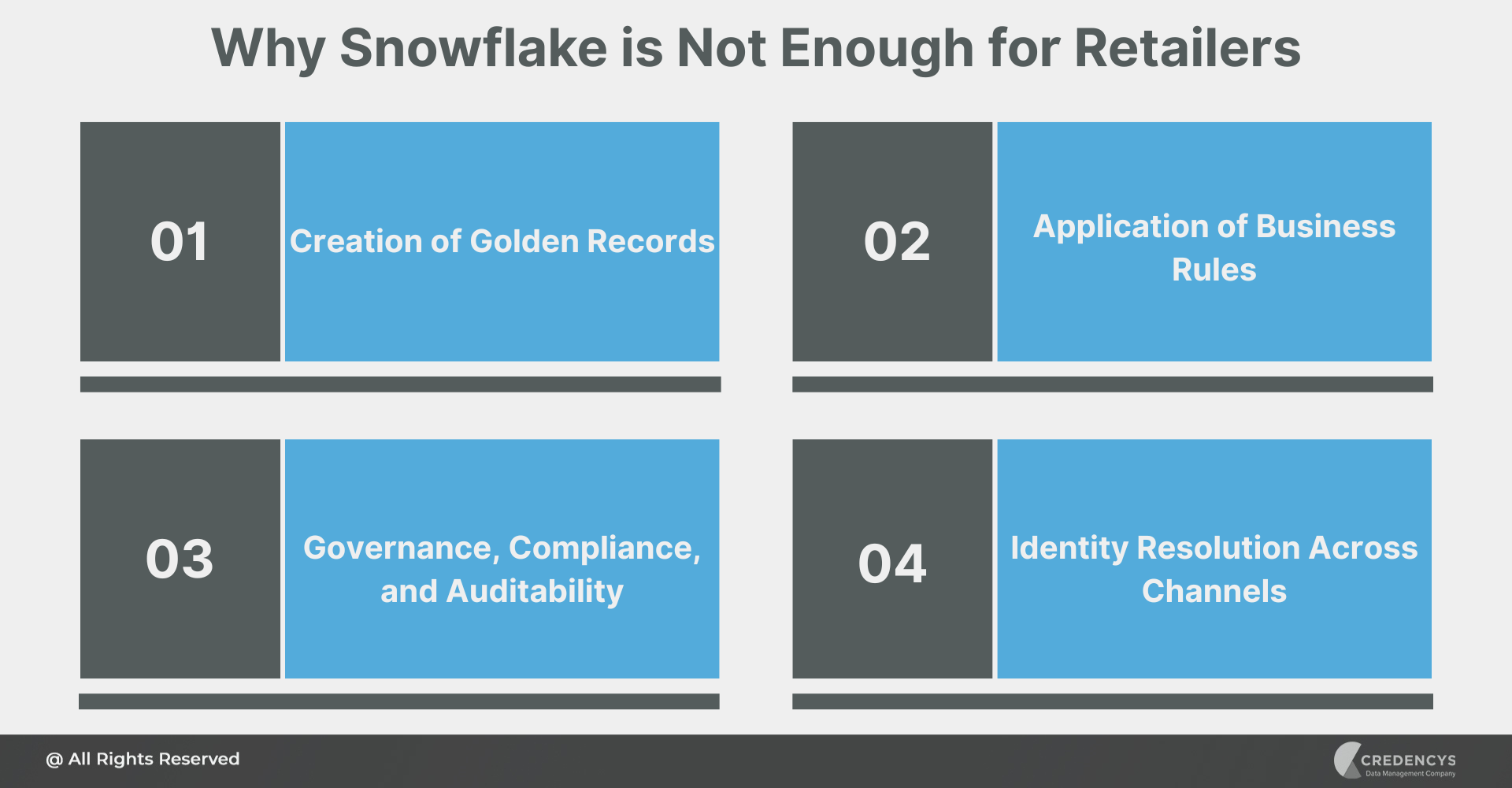
1 Creation of Golden Records
A Golden Record is a unified, authoritative customer profile that combines data from all sources, which has been verified and deduplicated. Retailers can use this record to ensure that their marketing, loyalty, analytics, and fulfillment systems are all working from the same truth.
2. Application of Business Rules
MDM enforces rules like “loyalty ID overrides email for identity matching” or “recent purchase activity trumps outdated contact info.” This ensures consistent decision-making across personalization engines, predictive analytics, and loyalty programs.
3. Governance, Compliance, and Auditability
With MDM, every change, merge, or update is tracked and recorded. This makes GDPR, CCPA, and other privacy compliance far easier and reduces the risk of fines or reputational damage.
4. Identity Resolution Across Channels
MDM identifies when multiple records belong to the same shopper, regardless of whether the customer uses an email, phone number, loyalty ID, or app profile.
Retailers need more than Snowflake’s storage and compute capabilities. To unlock accurate analytics, seamless loyalty programs, and AI-driven personalization, MDM is essential, ideally integrated directly into Snowflake.
The New Approach: Golden Records Inside Snowflake
The landscape of customer data management has undergone significant evolution. Today, retailers no longer need to extract data from Snowflake to apply MDM processes.
Modern MDM solutions now run natively inside Snowflake, unlocking a new level of speed, security, and efficiency. Below are the key advantages of MDM inside Snowflake.
1. Faster Time-to-Value
Millions of customer profiles can be unified in weeks, rather than months, compared to traditional external MDM workflows. Retailers can start using clean, actionable data almost immediately for campaigns, personalization, and reporting.
2. AI-Ready Customer Data
Golden Records feed directly into AI and ML models for personalization, churn prediction, demand forecasting, and next-best-offer recommendations. Retailers can trust that insights are based on accurate, unified, and complete customer profiles.
3. No Data Movement, More Security
Customer data never leaves Snowflake, reducing the risk of breaches or compliance issues. Sensitive information remains under the same security and governance policies you already trust.
4. Lower Operational Costs
No need for complex ETL pipelines to move data between systems. Infrastructure and licensing costs are reduced because MDM leverages Snowflake’s scalable cloud environment.
Snowflake provides the foundation for modern retail data, but MDM inside Snowflake provides the intelligence and trust necessary to make that data actionable.
Conclusion: Snowflake Needs a Partner for Retail Success
Snowflake is a powerful platform; however, it lacks capabilities for analytics, AI, personalization, and loyalty programs. The solution is clear:
Retail Success = Snowflake + MDM
For retail decision-makers, the question isn’t whether Snowflake is valuable; it clearly is. The question is: are you leveraging it with the tools that make your data trustworthy, unified, and actionable?
The future of retail customer data is clear: Snowflake provides the foundation, but MDM provides the wings.
Wondering if Your Retail Business Really Needs MDM in Snowflake? Take Our Quick Assessment to Find Out in Minutes.
FAQs
1. Can Snowflake alone manage customer data quality for retailers?
No. While Snowflake excels at storing and scaling data, it does not inherently clean, deduplicate, or govern customer records. Retailers require MDM in conjunction with Snowflake to ensure accuracy and trust.
2. What is the biggest challenge retailers face with customer data in Snowflake?
The biggest challenge is fragmented, duplicate, or conflicting customer records coming from multiple touchpoints (POS, eCommerce, loyalty apps, CRM). Without MDM, these issues persist and affect analytics, marketing, and compliance.
3. How does MDM complement Snowflake for retail businesses?
MDM creates a “single source of truth” for customer data by deduplicating, standardizing, and governing records. Integrated with Snowflake, it ensures the warehouse is filled with clean, reliable, and usable data.
4. What are the risks of not fixing duplicate or inaccurate customer data?
Retailers risk wasted marketing spend, compliance issues (e.g., GDPR, CCPA), poor personalization, and eroded customer trust.
5. How can retailers decide if they need MDM in Snowflake?
If your teams struggle with duplicate profiles, inconsistent customer IDs, or mistrusted analytics, MDM is likely needed. Credencys offers a quick tool, “Do I Need MDM in Snowflake?” to help retailers assess their readiness.







Tags: