


Why Your Snowflake Investment Deserves a Native MDM Strategy
More than 90% of global enterprises are investing in cloud data platforms like Snowflake to modernize analytics, speed up innovation, and improve decision-making.
However, despite this rapid adoption, many organizations still struggle with one fundamental roadblock: bad or inconsistent master data.
If customer records, product catalogs, or supplier information are duplicated, siloed, or inaccurate, your Snowflake investment cannot deliver its full value. The reality is that analytics and AI initiatives are only as strong as the data foundation they rely on. This is where a Snowflake-native MDM strategy unlocks unmatched efficiency and impact.
In this blog, we’ll explore why aligning Semarchy MDM with Snowflake is not just a technology choice but a strategic business decision. You’ll learn what native MDM means, the risks of relying on traditional approaches, and how companies are achieving faster time-to-insight, lower TCO, and trusted data for enterprise-wide innovation.
What you’ll learn in this blog:
- Why traditional MDM slows down Snowflake performance and ROI
- How a native MDM strategy improves governance, scalability, and agility
- Real-world examples of businesses unlocking value with Snowflake-native MDM
What is Snowflake-Native MDM?
A Snowflake-native Master Data Management (MDM) solution is designed to run directly inside the Snowflake Data Cloud, eliminating the need for constant data movement between systems. Unlike traditional MDM platforms that require heavy integration layers and duplicate storage, a native approach leverages Snowflake’s compute and storage engine to unify, govern, and enrich data without leaving the platform.
This means customer, product, and supplier records are managed where analytics and AI already live—resulting in faster processing, lower costs, and higher trust in business-critical insights.
The Business Problem it Solves
Most enterprises adopting Snowflake still rely on legacy MDM systems or fragmented spreadsheets to manage master data. This creates several challenges:
- Duplicate and inconsistent records: A customer might appear multiple times with slight variations, making analytics unreliable.
- High cost of data movement: Constantly extracting, transforming, and syncing data between MDM and Snowflake inflates TCO.
- Slow time-to-insight: Decision-makers wait longer as teams reconcile mismatched records instead of analyzing trusted data.
- AI and analytics risks: Inaccurate master data leads to flawed models, poor personalization, and compliance concerns.
For example, a large retailer may run Snowflake for advanced customer analytics. However, if the loyalty program data is riddled with duplicate customer IDs, campaigns will misfire, resulting in wasted ad spend and poor customer experiences.
By adopting a Snowflake-native MDM, organizations can align governance with performance, ensuring that every decision made inside Snowflake is powered by accurate, consistent, and trustworthy data.
How Semarchy MDM Works Within Snowflake
Semarchy MDM runs natively inside the Snowflake AI Data Cloud, leveraging Snowflake’s compute, storage, and security layers. Deployed as a Snowflake Native App from the Snowflake Marketplace, it requires no external infrastructure, no custom pipelines, and no movement of sensitive data between platforms.
By processing and governing data directly in Snowflake, MDM eliminates the overhead of traditional MDM approaches. Businesses manage golden records in the same environment where analytics and AI models already operate—simplifying architecture, lowering costs, and strengthening compliance.
In short, MDM inside Snowflake unlocks the true value of the data you already own, ensuring every report, model, and decision is powered by clean, accurate, and governed records.
Benefits and Business Outcomes of Snowflake-Native MDM
When enterprises align their MDM strategy with Snowflake, the impact goes beyond IT efficiency; it directly drives business outcomes.
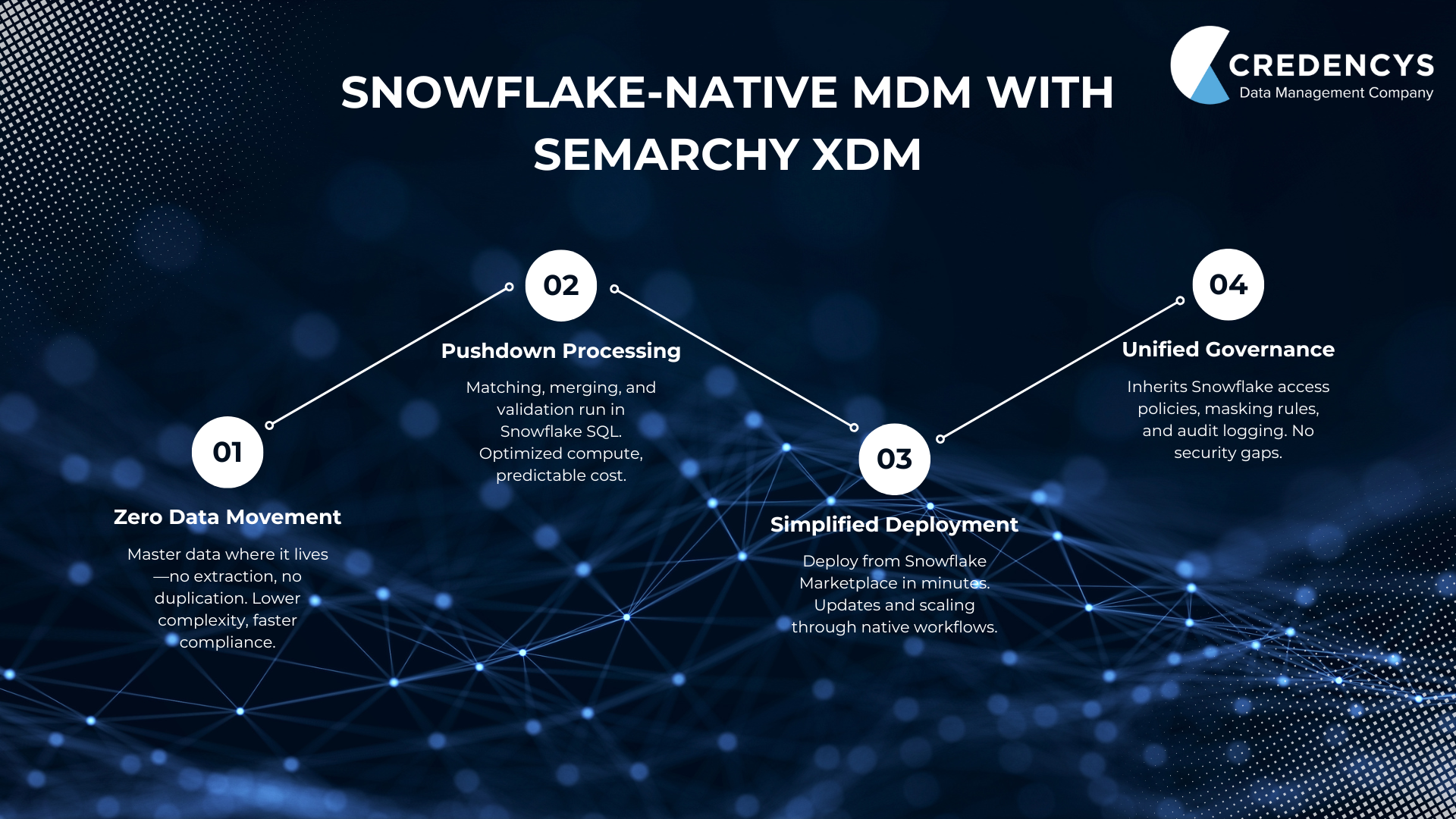
Here’s how:
1. Lower Total Cost of Ownership (TCO)
Traditional MDM often requires separate infrastructure, licensing, and integration layers. By keeping master data inside Snowflake, companies avoid costly data replication and API-heavy pipelines. According to McKinsey, organizations that modernize data platforms can reduce data management costs by up to 30%.
2. Faster Time-to-Insight
Native MDM eliminates delays caused by syncing data between multiple systems. Analysts and data scientists can work with unified, governed records in real time, accelerating reporting and AI-driven predictions. This agility is crucial in industries like retail, CPG, and financial services, where speed translates to competitive advantage.
3. Data Accuracy and Trust
With deduplication, survivorship rules, and golden record creation running inside Snowflake, business teams can rely on accurate customer, product, and supplier views. Trusted data reduces compliance risks and improves the ROI of personalization, recommendation engines, and financial forecasting.
4. Scalability and Future-Proofing
Snowflake’s elastic compute and storage allow MDM workloads to scale seamlessly as business needs grow. Whether handling millions of customer profiles or complex product hierarchies, organizations gain a flexible foundation that supports today’s analytics and tomorrow’s AI initiatives.
How Brands are Benefiting from Semarchy Native MDM for Snowflake
Case Study 1: Consumer Electronics Manufacturer
Client Overview: A global electronics manufacturer struggled with siloed product, supplier, and customer data across regions.
Problem: Inconsistent records slowed compliance, delayed product launches, and inflated data management costs.
Solution: Credencys deployed Snowflake-native MDM with Semarchy xDM to centralize golden records, apply pushdown matching and merging, and embed governance workflows.
Business Impact
- Went live in 12 weeks
- 42% faster insights
- 27% less analytics time
Read the full case study here.
Case Study 2: Global Retail Brand
Client Overview: A leading omnichannel retailer managing millions of customer, product, and supplier records across stores and digital channels.
Problem: Fragmented product catalogs and duplicate customer data reduced personalization effectiveness and weakened demand forecasting.
Solution: Credencys implemented Snowflake-native MDM to unify customer profiles, centralize product catalogs, and enforce governance for consistent, trusted data.
Business Impact
- 15% higher marketing ROI
- 22% better demand forecasting
- 80% catalog consistency across channels
Read the full case study here.
Why Your Snowflake Investment Deserves a Native MDM Strategy
Snowflake delivers immense value as a modern data platform, but without a strong Master Data Management foundation, the insights it produces can be incomplete or unreliable. A native MDM strategy ensures that customer, product, and supplier records are unified, accurate, and governed directly inside Snowflake—eliminating data silos, reducing costs, and accelerating time-to-insight.
From consumer electronics manufacturers to global retailers, the results are clear: faster compliance, improved marketing ROI, stronger forecasting, and consistent customer experiences. For enterprises looking to maximize their Snowflake investment, a native MDM approach is no longer optional—it is essential.
Frequently Asked Questions
1. What is Snowflake-native MDM?
It is an MDM solution that runs directly inside Snowflake, managing customer, product, and supplier records without moving data to external systems.
2. Why not use traditional MDM with Snowflake?
Traditional MDM requires data movement, duplicate storage, and heavy integrations, which slow insights and increase costs. Native MDM avoids these challenges.
3. What business outcomes can it deliver?
Enterprises see reduced TCO, faster insights, higher data accuracy, and measurable results such as improved marketing ROI and forecasting accuracy.
4. Which industries benefit the most?
Retail, CPG, manufacturing, and financial services are early adopters, but any enterprise using Snowflake for analytics and AI can benefit.
5. How does native MDM improve data quality?
It uses matching, deduplication, and survivorship rules inside Snowflake to create accurate golden records, ensuring data is consistent and trusted.
6. How quickly can results be achieved?
Implementations can go live in as little as 12 weeks, with immediate improvements in analytics speed and data governance.
7. Can it scale with business growth?
Yes. Snowflake’s elastic compute and storage ensure MDM workloads scale seamlessly with growing data volumes and complexity.
8. Why choose Credencys for Snowflake-native MDM?
Credencys combines Snowflake expertise with Semarchy MDM implementation experience, delivering proven outcomes like faster compliance, improved ROI, and trusted analytics for global enterprises.







Tags: