



Hidden Cost of Bad Product Data in Retail
Walk into any retail organization, whether it’s fashion, electronics, or grocery, and you will hear a familiar story. A merchandiser pulls a sales report and sees the same product listed under multiple codes.
A red shirt might appear as SKU-RED123, RSH-001, and 123-RED-L across different systems. Online reports show it out of stock.
The warehouse system shows overstock. The point-of-sale system says something else entirely.
Who’s right? In reality, none of them.
This is the hidden cost of bad product data. When retailers can’t trust their product information, everything from forecasting to customer experience suffers.
The problem isn’t about having too little data. It’s about having inconsistent, duplicate, and unreliable data spread across ERP systems, eCommerce platforms, supplier feeds, and spreadsheets.
Modern data platforms like Snowflake give retailers a powerful place to store and analyze this data, but storage alone doesn’t solve the chaos. Without clean, unified product data, even the best analytics will lead to wrong decisions.
That’s why product data management has become one of the most pressing challenges for retailers aiming to build reliable, omnichannel experiences.
What You’ll Learn
In this blog, you will discover:
- The hidden costs of messy product data in retail
- Why Snowflake alone can’t fix SKU chaos
- How MDM creates Golden Product Records
- The business impact of mastering product data
- Steps to see if your retail business needs MDM
By the end, you’ll see why bad product data = bad business and how to turn data chaos into a competitive edge.
Why Product Data Quality Matters in Retail
Product data fuels every retail function, from supply chain to customer experience. When it’s wrong or inconsistent, the impact is felt across the business.
Here’s why it matters:
- Hidden Errors, Big Impact: Duplicate SKUs or missing attributes quietly cause stockouts, returns, and lost revenue.
- Customer Trust: If “in-stock” online means “out-of-stock” in-store, shoppers switch to competitors.
- Foundation of Operations: Accurate product data powers merchandising, pricing, promotions, and inventory planning.
- Omnichannel Expectations: Shoppers demand consistent product details across online, mobile, and stores.
True Cost of Bad Product Data in Retail
Bad product data proves to be annoying as well as expensive for retailers. Below are the main ways messy product records hit a retailer’s P&L and operations.
1. Lost Sales & Poor Customer Experience
Incorrect product information, mismatched images, and inaccurate inventory levels frustrate shoppers, resulting in abandoned carts, returns, and lost loyalty. When an item shows “in-store” online but is actually out of stock, customer trust erodes, and shoppers may turn to competitors.
2. Forecasting & Analytics Errors
Demand planning, pricing strategies, and predictive models rely on accurate product data. Inconsistent or duplicate SKUs generate misleading insights, causing overproduction, stockouts, and suboptimal pricing.
Dirty data also undermines AI and ML initiatives for personalization and dynamic pricing.
3. Financial Waste
Messy product data leads to overstock, emergency purchases, and markdowns. Duplicate SKUs, inconsistent product attributes, and mismanaged inventory can result in annual costs of millions. Analysts estimate that poor data quality can impact 15–25% of a retail business’s revenue.

Don’t Let Messy Product Data Drain Your Margins. See how MDM in Snowflake Cut Costs and Protect Revenue.
4. Compliance & Brand Risk
Missing or incorrect attributes such as materials, safety warnings, or country of origin can result in regulatory failures, fines, or product recalls. Even minor errors in product information can damage a brand’s reputation and erode customer trust.
5. Operational Inefficiency
Retail teams spend a significant amount of time reconciling SKUs, cleaning product catalogs, and correcting data errors. This delays product launches, promotions, and merchandising decisions, keeping employees from focusing on strategic initiatives.
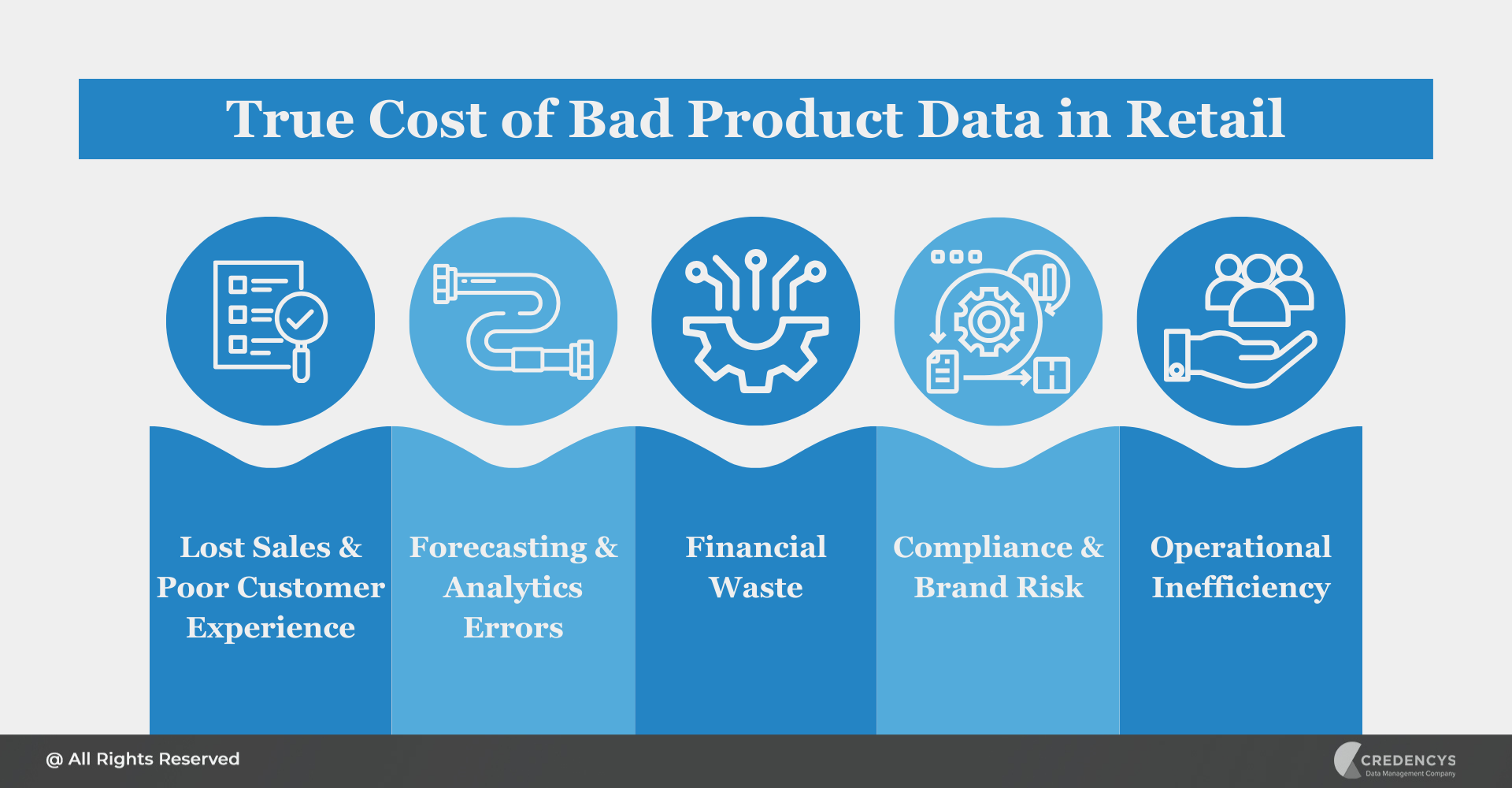
Poor product data quietly increases costs, reduces revenue, slows operations, and negatively impacts the customer experience, making it a critical issue for modern retailers.
Why Retailers Struggle Even with Modern Data Platforms
1. Data Centralization Isn’t Enough
Modern platforms, such as Snowflake, provide a centralized location to store massive amounts of product data. However, simply storing data doesn’t ensure its accuracy, consistency, or usability.
Without proper management, data remains fragmented, and inconsistencies persist across systems.
2. No Built-in Data Mastering
Cloud data platforms can organize and analyze information, but they don’t automatically detect duplicate SKUs, enforce naming conventions, or validate supplier data. Retailers often find that SKU chaos persists even after moving all their data to the cloud.
3. Analytics Depend on Data Quality
Even the most advanced analytics, forecasting, and AI models fail if the underlying product data is inconsistent or incomplete. Garbage in, garbage out: predictions, inventory plans, and personalization efforts all suffer when product records aren’t reliable.
4. Limited Governance & Stewardship
Platforms alone don’t provide workflows for ongoing data quality management. Without defined ownership, validation rules, and monitoring processes, poor product data continues to creep in as new products and suppliers are added.
Modern data platforms, such as Snowflake, provide a powerful foundation, but they cannot resolve the inconsistencies, duplicates, or missing attributes that render product data costly and unreliable. That’s why retailers need a solution that combines centralization with MDM.
The Missing Link: MDM for Retail
1. Unifies Product Records
MDM identifies and merges duplicate SKUs, standardizes product names, and creates a single source of truth. With a Golden Product Record, retailers can ensure that every system, from ERP to eCommerce, reflects the same accurate product information.
2. Streamlines Operations
By cleaning up product data at the source, MDM reduces the time spent by merchandisers, planners, and store teams on manual reconciliation. Teams can focus on strategic initiatives, faster product launches, and more accurate promotions.
3. Provides Governance & Stewardship
MDM establishes ownership, validation workflows, and ongoing monitoring processes to ensure data quality is maintained over time. This ensures that product information remains accurate and compliant, even as new products and suppliers are added.
4. Enforces Consistency & Rules
MDM applies predefined rules to maintain uniformity across attributes, supplier names, and categories. This prevents inconsistencies from creeping back into your systems, ensuring that everyone works with reliable data.
5. Supports Analytics & AI Initiatives
Clean, governed product data feeds analytics, forecasting, and AI models. Retailers can trust their insights for demand planning, pricing optimization, and personalized marketing campaigns.
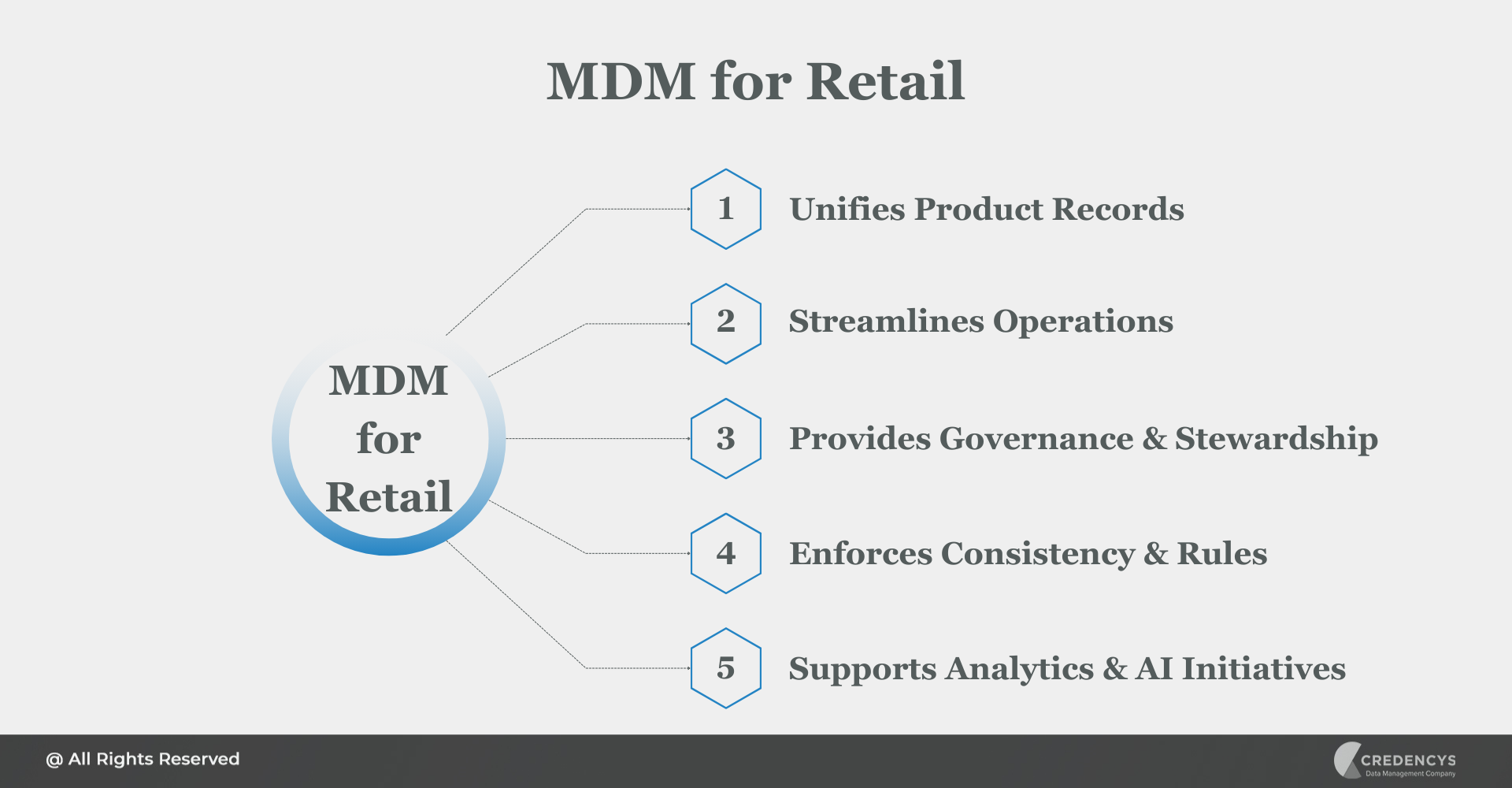
Master Data Management is the missing piece that turns centralized product data into reliable, actionable, and governed information, enabling retailers to reduce costs, improve operations, and enhance customer experience.
Ready to Turn Messy Product Data into a Single Source of Truth? Discover How MDM can Transform Your Retail Operations
Golden Product Records Inside Snowflake
Retail is a fast-paced environment; simply storing product data isn’t enough. By running MDM natively within Snowflake, retailers can unify SKUs, enforce data quality, and create Golden Product Records, all without moving data across systems.
This approach turns scattered product information into a single, reliable source of truth.
1. No Data Movement
Modern MDM solutions can now run natively inside Snowflake, eliminating the need to export, cleanse, and reload data. All product information is stored in a single, secure, and governed environment, reducing risk and complexity.
2. Single Source of Truth
Imagine multiple SKUs for the same product consolidated into a single trusted record. Every forecast, report, and procurement plan originates from a single, accurate source, enhancing decision-making and minimizing costly errors.
3. AI-Ready Data
Golden Product Records stored inside Snowflake are immediately available for analytics, forecasting, and AI initiatives. Retailers can leverage clean, unified product data for demand planning, personalization, and dynamic pricing.
4. Faster Implementation
Deploying MDM within Snowflake enables retailers to clean and unify product data in weeks, rather than months, thereby accelerating the creation of Golden Product Records and enhancing operational efficiency.
5. Lower Costs
Native MDM reduces dependency on external infrastructure and additional pipelines, cutting implementation and maintenance expenses while improving ROI.
Combining MDM with Snowflake creates a centralized, reliable, and actionable foundation for product data that drives faster insights, cost savings, and improved customer experiences.
Payoff for Retailers
1. Faster Time-to-Market
With clean product data, new product launches and seasonal promotions roll out faster, since teams don’t waste time fixing errors or reconciling records.
2. Better Forecasting & Inventory Management
Accurate product and supplier data improve demand planning, reducing stockouts and overstocks. Retailers can optimize inventory levels and free up working capital.
3. Fewer Duplicate SKUs
Retailers who implement MDM within Snowflake report a reduction in duplicate product records within weeks, resulting in cleaner catalogs and more efficient operations.
4. Cost Savings Across the Supply Chain
Lower emergency procurement costs, reduced manual effort, and fewer errors all contribute to stronger margins and better resource allocation.
5. Compliance & Brand Protection
Clean, governed data ensures that retailers remain audit-ready and compliant with regulations, while protecting their brand reputation and building customer trust.
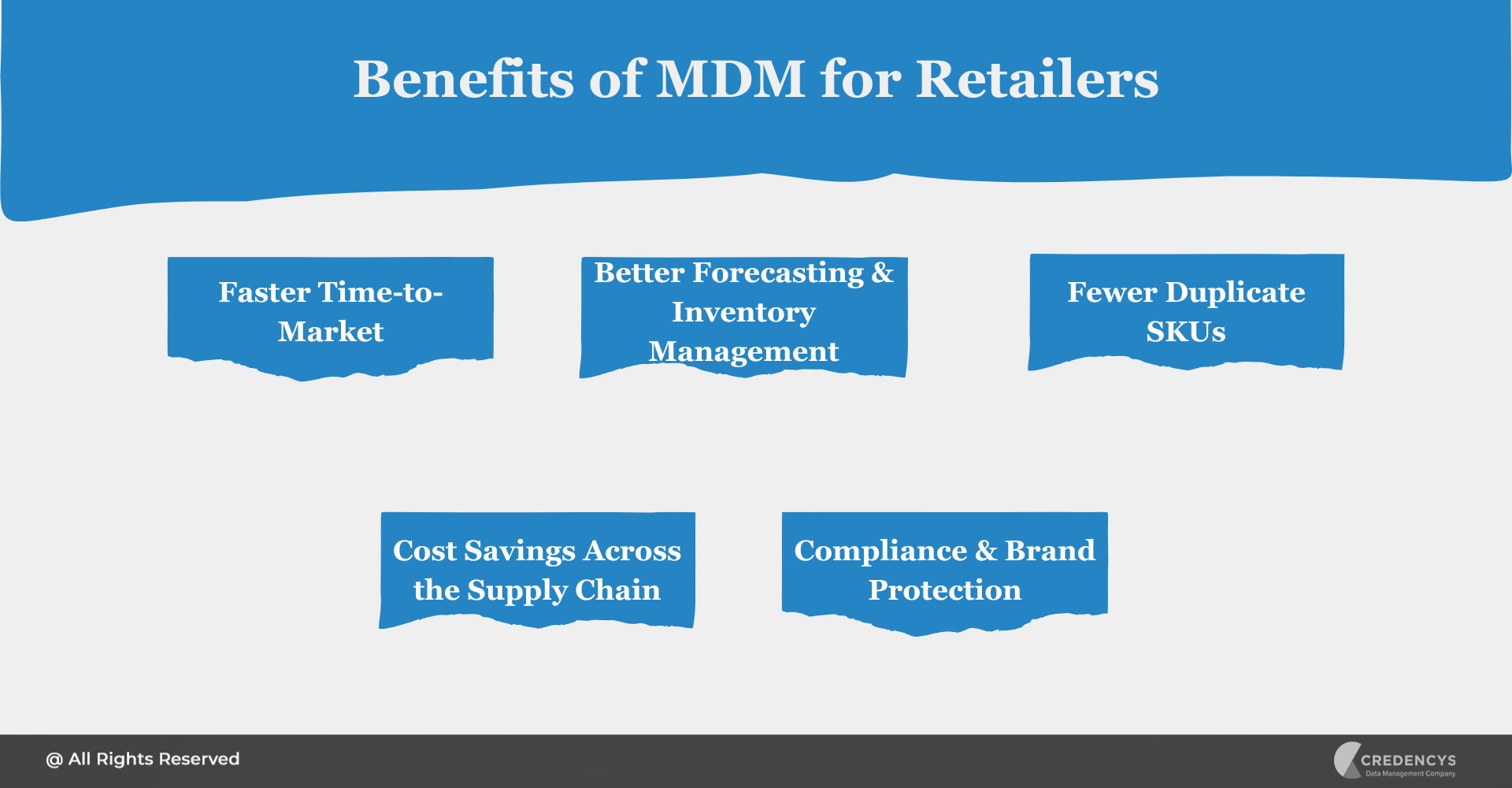
Retailers that master product data inside Snowflake don’t just reduce errors; they unlock efficiency, savings, and customer loyalty that directly impact the bottom line.
Conclusion: Bad Product Data = Bad Retail Business
Bad product data isn’t just a back-office issue; it’s a profitability killer. Duplicate SKUs, inconsistent attributes, and poor catalog management drain margins, frustrate customers, and slow down operations.
Snowflake provides the scalability and centralization retailers need, but it can’t fix bad data on its own. The real solution lies in MDM, which creates Golden Product Records and ensures every system runs on a single source of truth.
For retailers, this means cleaner operations, smarter forecasting, faster launches, and happier customers. In short, mastering product data isn’t optional; it’s the foundation of competitiveness in modern retail.
Bad Product Data Could be Costing Your Retail Business More Than you Think. Take Our Quick Quiz to Find Out if you Need MDM in Snowflake.







Tags: