


Snowflake Data Engineering for Retail & eCommerce: How to Power Real-Time Analytics
Retail and eCommerce businesses are under constant pressure to deliver seamless customer experiences, optimize inventory, and personalize offerings, all in real-time. However, traditional data pipelines often fall short in meeting the demands of dynamic consumer behavior and rapidly shifting market conditions.
This is where Snowflake Data Engineering comes into play. By combining scalability, performance, and ease of use, Snowflake enables retailers to ingest, transform, and serve data at speed and scale, empowering teams with the insights they need, right when they need them.
In this blog, we’ll explore how Snowflake is revolutionizing data engineering in the retail and eCommerce space, enabling real-time analytics that drive smarter decisions and competitive advantage.
The Role of Data Engineering in Retail & eCommerce
Retail and eCommerce companies generate enormous volumes of data every second from point-of-sale systems, eCommerce platforms, mobile apps, customer service channels, marketing tools, and supply chain systems. The ability to capture, process, and analyze this data in near real-time is a necessity for staying relevant and profitable.
Key Functions of Data Engineering in This Sector
- Data Ingestion: Pulling data from multiple touchpoints such as online stores, physical retail systems, CRM, ERP, and IoT devices.
- Data Transformation: Converting raw data into a clean, structured, and analytics-ready format.
- Data Integration: Combining data from siloed systems to create a unified view of the customer, inventory, sales, and operations.
- Data Serving: Making the processed data available for BI dashboards, marketing tools, ML models, or decision support systems.

Why Real-Time Matters
- Operational decisions, such as re-routing inventory or launching flash promotions, require immediate access to accurate data.
- Personalized customer experiences rely on real-time insights derived from browsing behavior, purchase history, and inventory status.
- Dynamic pricing strategies rely on real-time demand, competitor pricing, and stock availability.
With traditional data architectures, achieving this level of agility is challenging. That’s why many retailers are turning to Snowflake to modernize their data engineering approach and enable real-time capabilities.
Why Snowflake for Data Engineering?
Snowflake has quickly become the go-to data platform for modern retail and eCommerce organizations and for good reason. Unlike legacy data platforms that require complex infrastructure management and batch-driven pipelines, Snowflake is built for the cloud and designed to handle real-time, high-volume, and fast-changing data with ease.
Here’s why Snowflake stands out for data engineering in retail and eCommerce:
1. Flexible Programming with Snowpark
For advanced data engineering tasks, Snowpark lets developers use familiar programming languages like Python, Java, or Scala directly within the Snowflake environment. This is especially powerful for building custom transformation logic, data quality checks, or integrating with machine learning workflows.
2. Native Support for Semi-Structured Data
Retailers often deal with semi-structured data (e.g., clickstream logs, product reviews, JSON-based APIs). Snowflake natively supports JSON, Avro, XML, and other formats, making it easy to parse and analyze them without complex preprocessing.
3. Cloud-Native Architecture
Snowflake’s separation of storage and compute allows teams to scale resources independently. You can run heavy data transformation workloads without impacting analytics performance, even during high-traffic retail events like Black Friday.
4. Real-Time Ingestion with Snowpipe
Snowpipe enables continuous data ingestion from sources like web tracking events, POS systems, and mobile apps. New data is available for querying within seconds, empowering real-time dashboards and personalization engines.

Accelerate Your Data-to-Insight Journey with Real-Time Pipelines Powered by Snowpipe and Snowflake
5. Automation with Streams & Tasks
Snowflake supports event-driven architecture through Streams (for change data capture) and Tasks (for scheduling SQL-based workflows). This allows retailers to automate transformations, deduplication, and downstream updates without needing third-party orchestrators.
6. High Availability & Elastic Scaling
Snowflake automatically handles performance optimization, concurrency scaling, and resource provisioning. Retailers don’t need to worry about performance degradation during peak periods like holiday sales or flash deals.
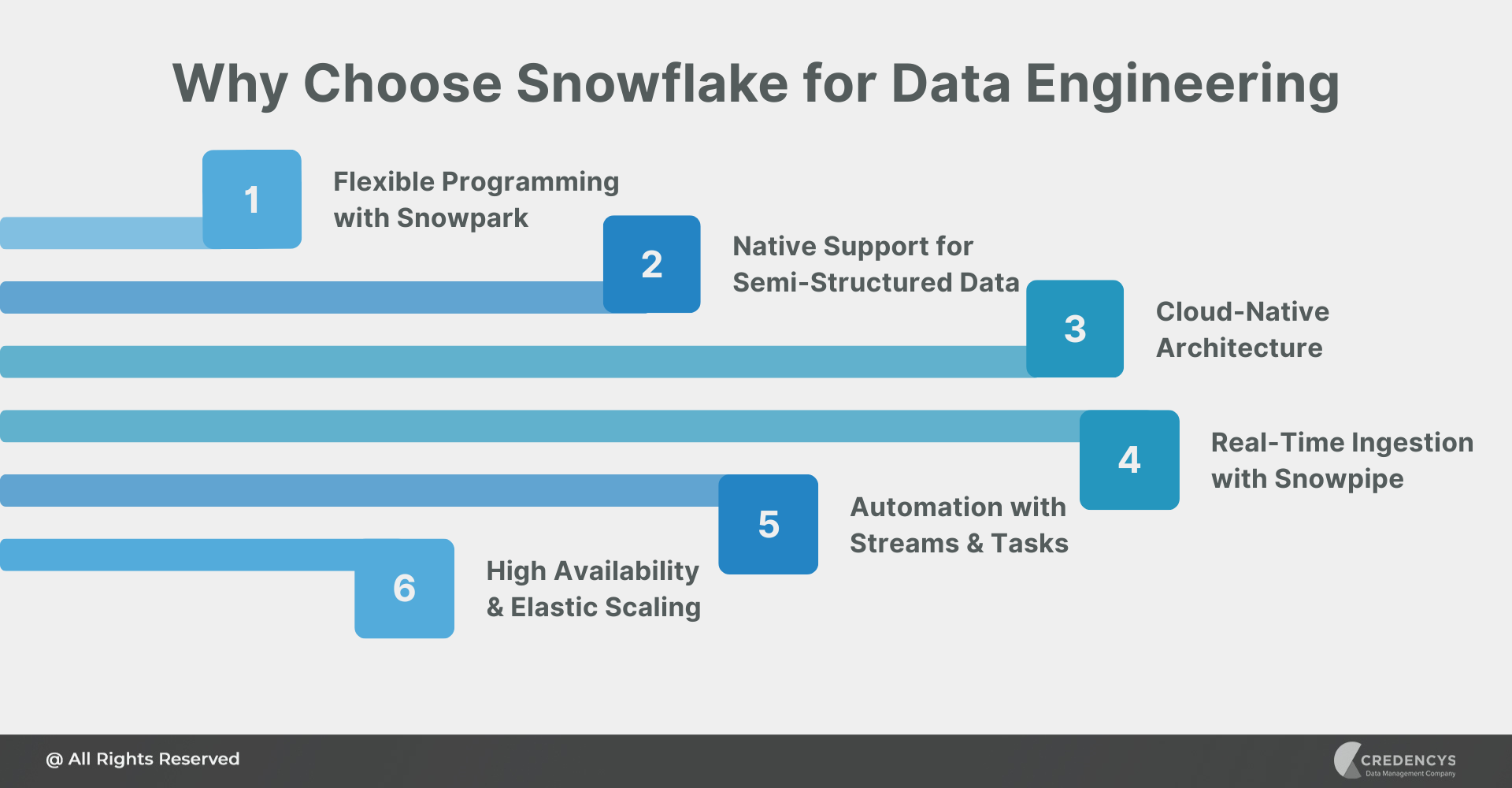
With these capabilities, Snowflake enables a modern, agile, and real-time data engineering foundation tailor-made for retail’s speed and complexity.
Real-Time Retail Use Cases Powered by Snowflake
Snowflake empowers retailers and eCommerce companies to turn their raw data into real-time insights that drive action across the customer journey and operations. Below are some of the most impactful use cases where Snowflake Data Engineering plays a pivotal role:
1. Dynamic Pricing & Promotion Optimization
With real-time access to inventory levels, competitor pricing, demand signals, and seasonality trends, Snowflake enables retailers to implement automated pricing models that maximize margin and conversion.
Example: Automatically adjust prices or discounts across regions during a flash sale based on stock availability.
2. Fraud Detection & Transaction Monitoring
Snowflake supports real-time transaction monitoring by combining payment data, device information, and behavior patterns. Anomalies can be detected and flagged in near real-time using ML models or rule-based checks.
Example: Flag suspicious transactions during checkout that deviate from the customer’s normal purchase behavior.
3. Inventory Visibility & Forecasting
Connect warehouse, store, and vendor systems into a centralized data layer to ensure accurate, up-to-date inventory visibility. Snowflake makes it easy to streamline stock forecasting and replenishment with timely data pipelines.
Example: Detect low-stock situations in specific locations and trigger restocking before out-of-stock incidents occur.
4. Personalized Product Recommendations
Feed real-time browsing, purchase, and behavioral data into recommendation engines to offer relevant products or bundles. Snowflake’s support for rapid data ingestion and transformation helps keep recommendations fresh and contextually relevant.
Example: Update product recommendations on a homepage based on the customer’s latest activity within seconds.
5. Customer 360 & Segmentation
Combine data from eCommerce platforms, CRM systems, social media, loyalty programs, and in-store interactions to create a unified customer profile. Snowflake enables this consolidation at scale, allowing marketers to build dynamic segments in real time for hyper-targeted campaigns.
Example: Instantly segment high-value customers browsing but not purchasing and trigger personalized emails or offers.
These use cases are just the beginning. With Snowflake’s powerful data engineering features, retailers can continuously innovate, optimize, and deliver better customer experiences driven by real-time intelligence.
Building the Data Engineering Pipeline in Snowflake
To unlock real-time analytics in retail and eCommerce, businesses need robust data pipelines that can handle data ingestion, transformation, and delivery at scale. Snowflake simplifies this entire process by offering a unified and flexible platform that supports batch, streaming, and event-driven architectures.
Here’s how a typical Snowflake-based data engineering pipeline is structured:
Step 1: Data Ingestion
Snowflake supports seamless data ingestion from a wide range of sources, including:
- POS systems, eCommerce platforms, and mobile apps
- Third-party APIs (for inventory, logistics, or ad platforms)
- Real-time event streams using Kafka or AWS Kinesis
- ETL/ELT tools like Fivetran, Stitch, or Airbyte
- Snowpipe for continuous file ingestion from cloud storage
Snowpipe allows new data (e.g., clickstream or transaction logs) to be ingested and made queryable within seconds.
Streamline Your Data Ingestion Process and Unlock Real-time Visibility Across all Your Retail and eCommerce Systems
Step 2: Data Transformation
Once data is ingested, it needs to be cleaned, enriched, and structured. This is where Snowflake’s Streams & Tasks and Snowpark come in:
- Streams & Tasks automate the detection and processing of data changes—ideal for incremental transformations.
- Snowpark allows you to write custom transformation logic in Python, Java, or Scala directly within Snowflake.
- Tools like dbt (data build tool) can also be used for modular SQL-based transformations and dependency management.
Step 3: Data Serving
Transformed data is made available to downstream consumers in real-time:
- BI & analytics tools like Tableau, Power BI, and Looker
- Marketing platforms for dynamic segmentation and campaign triggers
- Machine learning models for personalization, fraud detection, and demand forecasting
- Custom dashboards for store managers or operations teams

Because Snowflake supports concurrent workloads with zero performance degradation, multiple teams can query and use the data simultaneously without bottlenecks.
By adopting this architecture, retail and eCommerce businesses can ensure data is always fresh, reliable, and ready for action, empowering teams across marketing, merchandising, logistics, and finance.
How Credencys Helps Retailers Unlock the Power of Snowflake
At Credencys, we understand the unique data challenges faced by modern retail and eCommerce businesses, whether it’s unifying customer data, optimizing supply chains, or enabling real-time personalization at scale. Our expertise in Snowflake Data Engineering helps retailers transform fragmented data into actionable insights that drive growth and efficiency.
Our Snowflake Data Engineering Services Include
1. Cloud Data Warehousing Modernization
Migrate your legacy systems to Snowflake with minimal disruption and maximum performance optimization.
2. Retail-Focused Analytics Solutions
Implement Customer 360, dynamic pricing engines, inventory optimization, and personalization platforms powered by real-time data.
3. Governance, Security & Cost Optimization
We help you implement RBAC, data masking, tagging, and monitoring to ensure compliance and control over data usage.
4. Data Pipeline Design & Development
We architect robust, scalable data pipelines using Snowpipe, Streams, Tasks, and Snowpark to ensure your data is always ready for analytics.
5. Real-Time Data Integration
Connect and ingest data from multiple sources, including POS systems, ERP, CRM, eCommerce platforms, and IoT devices for unified visibility.
Why Partner with Credencys?
- Deep industry knowledge in retail, eCommerce, and supply chain
- Proven experience building real-time, AI-ready data ecosystems
- Certified Snowflake professionals and end-to-end data engineering capabilities
- Strong partnerships with other players in the modern data stack (dbt, Fivetran, Airbyte)
Whether you’re just starting your Snowflake journey or looking to optimize existing pipelines, Credencys can help you accelerate your data-driven transformation.
Conclusion
Real-time data is a business necessity for modern retail and eCommerce companies. From dynamic pricing and customer personalization to inventory optimization and fraud prevention, every critical decision hinges on having fresh, reliable data at your fingertips.
Snowflake Data Engineering offers the agility, scalability, and simplicity needed to turn raw data into immediate action. By combining powerful features like Snowpipe, Streams, Tasks, and Snowpark with a fully managed, cloud-native architecture, Snowflake empowers retailers to build robust pipelines that fuel real-time analytics and smarter business decisions.
With the right strategy and implementation partner, your retail business can move from reactive reporting to proactive intelligence, unlocking growth, efficiency, and unforgettable customer experiences.
Looking to Modernize Your Retail Data Infrastructure and Power Real-time Analytics? Partner with Credencys to Build Scalable, Snowflake-Driven Data Engineering Solutions Tailored to Your Business






Tags: