


Enterprises these days are inundated with vast amounts of data generated from diverse sources, ranging from customer interactions and operational processes to IoT devices and external partners. Effectively harnessing this data is pivotal for informed decision-making, operational efficiency, and gaining a competitive edge.
However, many organizations grapple with challenges such as:
- Data Silos: Disparate systems leading to fragmented data storage.
- Legacy Infrastructure: Outdated systems that hinder scalability and integration.
- Complex Data Integration: Difficulties in consolidating structured, semi-structured, and unstructured data.
- Security and Compliance Concerns: Ensuring data privacy and adhering to regulatory standards.
Enter Snowflake, a cloud-native data platform designed to address these challenges by offering:
- Performance: High-speed data processing capabilities.
- Security: Robust measures ensuring data protection and compliance.
- Scalability: Elastic compute and storage resources that adjust based on demand.
- Flexibility: Support for various data types and seamless integration with multiple tools.
While Snowflake provides the technological foundation, leveraging its full potential requires strategic implementation and optimization. This is where Snowflake Consulting Services come into play.
Snowflake consultants bring specialized expertise to:
- Assess and Align: Evaluate existing data infrastructures and align them with business objectives.
- Design and Implement: Develop tailored solutions that cater to specific organizational needs.
- Optimize and Manage: Ensure optimal performance, cost-efficiency, and ongoing maintenance.
By partnering with Snowflake consultants, enterprises can accelerate their data strategy initiatives, ensuring that data becomes a strategic asset driving innovation and growth.
Aligning Data Strategy with Business Objectives
Data is more than just a byproduct of operations; it’s a strategic asset. However, the true value of data is realized only when it’s aligned with overarching business objectives.
Snowflake consulting plays a pivotal role in bridging the gap between raw data and strategic goals.
1. Strategic Assessment and Alignment
Snowflake consultants begin by conducting a comprehensive assessment of your existing data infrastructure. This involves evaluating data sources, storage solutions, processing workflows, and analytics tools.
The goal is to understand how data flows through your organization and how it’s currently utilized in decision-making processes. By aligning this assessment with your business objectives, be it market expansion, customer retention, or operational efficiency consultants can identify gaps and opportunities where data can drive value.
2. Customized Roadmaps for Data Strategy
Post-assessment, consultants develop tailored roadmaps that outline the steps needed to align your data strategy with business goals. These roadmaps consider factors such as:
- Scalability Needs: Ensuring the data architecture can grow with your business.
- Regulatory Compliance: Implementing data governance practices that meet industry standards.
- Technology Integration: Seamlessly connecting Snowflake with existing tools and platforms.
Such customized strategies ensure that data initiatives are not siloed but are integral to business planning and execution.
Seamless Migration and Integration with Snowflake Consulting
Transitioning to a modern data platform like Snowflake is a strategic move for enterprises aiming to enhance scalability, performance, and data accessibility. However, the migration process can be complex, involving the transfer of vast amounts of data, integration with existing systems, and ensuring minimal disruption to business operations.
Snowflake consulting services play a pivotal role in facilitating a smooth and efficient migration and integration process.
1. Comprehensive Assessment and Planning
Before initiating the migration, consultants conduct a thorough assessment of the existing data infrastructure. This includes analyzing data sources, understanding data workflows, and identifying potential challenges.
Based on this assessment, a detailed migration strategy is developed, outlining the steps, timelines, and resources required for a successful transition.

Ready to Transform your Data Strategy with a Tailored Migration Plan? Partner with our Snowflake-certified Consultants to Ensure a Seamless Transition
2. Data Migration Execution
The actual migration involves transferring data from legacy systems to Snowflake. Consultants ensure that this process is executed with precision, maintaining data integrity and minimizing downtime.
They employ best practices to handle data extraction, transformation, and loading (ETL), ensuring that the data is accurately and efficiently moved to the new platform.
3. Integration with Existing Systems
Post-migration, it’s crucial that Snowflake integrates seamlessly with the organization’s existing tools and applications. Consultants facilitate this by configuring connections between Snowflake and various business intelligence tools, data visualization platforms, and other enterprise applications.
This ensures that users can access and analyze data without any disruptions.
4. Performance Optimization
After integration, consultants focus on optimizing the performance of the Snowflake environment. This includes fine-tuning queries, setting up appropriate indexing, and configuring resource allocations to ensure that the system operates at peak efficiency.
Continuous monitoring and adjustments are made to maintain optimal performance levels.
5. Ongoing Support and Maintenance
Migration is not a one-time event but an ongoing process. Consultants provide continuous support to address any issues that arise post-migration.
They offer training to internal teams, assist in troubleshooting, and provide recommendations for further optimizations, ensuring that the organization fully leverages the capabilities of Snowflake.
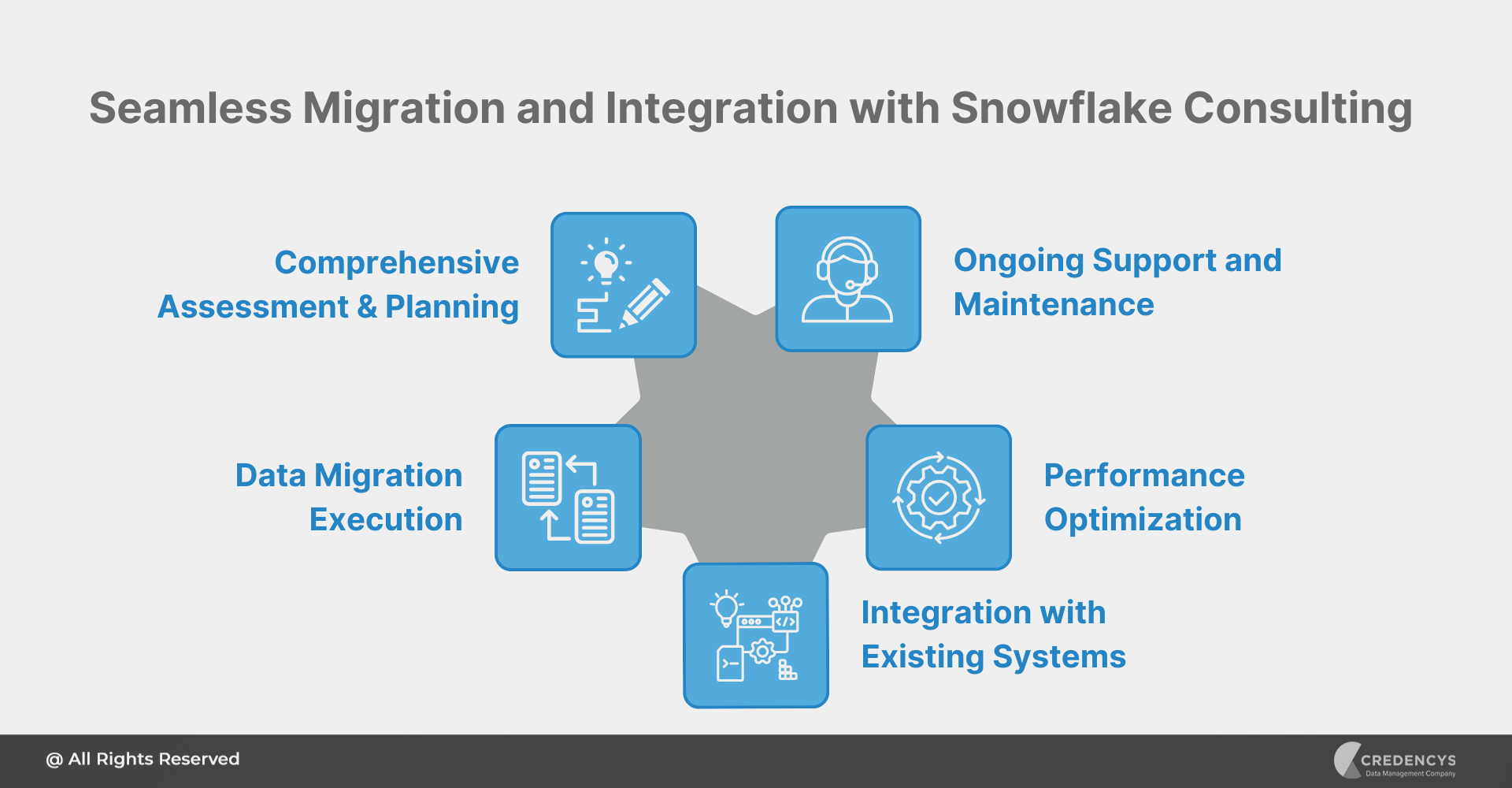
By leveraging Snowflake consulting services, enterprises can ensure a seamless migration and integration process, minimizing risks and maximizing the benefits of their new data platform.
Optimizing Performance and Cost
One of Snowflake’s standout features is its scalability and performance. However, without proper optimization, enterprises might not fully capitalize on these benefits, leading to unnecessary costs and suboptimal performance.
Snowflake consulting services play a pivotal role in fine-tuning both performance and cost-efficiency.
1. Efficient Query Design
Optimizing queries is fundamental to enhancing performance and reducing costs:
- Simplify Operations: Avoid complex operations like unnecessary joins or sorts. Instead, use window functions and filters to streamline data processing.
- Leverage Caching: Snowflake’s automatic result caching can significantly reduce query times and costs for repetitive queries.
- Materialized Views: Implementing materialized views can precompute and store complex query results, leading to faster response times and reduced compute usage.
2. Warehouse Configuration and Management
Properly configuring virtual warehouses ensures optimal resource utilization:
- Auto-Suspend and Auto-Resume: Setting warehouses to automatically suspend during inactivity and resume when needed prevents unnecessary compute charges.
- Right-Sizing Warehouses: Adjust warehouse sizes based on workload requirements. Larger warehouses can process queries faster, but may not be cost-effective for smaller tasks.
- Scaling Policies: Implementing appropriate scaling policies can balance performance and cost.
3. Monitoring and Alerts
Continuous monitoring helps in proactively managing performance and costs:
- Resource Monitors: Set up resource monitors to track credit usage and send alerts or suspend warehouses when thresholds are exceeded.
- Query Profiling: Utilize Snowflake’s Query Profile to identify long-running or resource-intensive queries and optimize them accordingly.
- Anomaly Detection Tools: Tools like Chaos Genius can automatically detect unusual spending patterns, aiding in swift corrective actions.
4. Storage Optimization
Efficient storage management contributes to cost savings:
- Data Compression: Utilize Snowflake’s compression capabilities to reduce storage footprint.
- Data Retention Policies: Implement policies to archive or delete obsolete data, ensuring that only necessary data consumes storage resources.
- Time Travel and Fail-safe Settings: Adjust the duration of these features based on business needs to avoid unnecessary storage costs.
Maximize your Snowflake ROI with Expert-driven Performance and Cost Optimization. Let our Consultants Fine-Tune your Setup for Peak Efficiency
By leveraging Snowflake consulting services, enterprises can implement these strategies effectively, ensuring that their data operations are both high-performing and cost-efficient.
Leveraging Snowflake Consulting to Enhance Data Governance and Security
In today’s data-driven enterprises, ensuring robust data governance and security is paramount. Snowflake offers a comprehensive suite of features designed to safeguard data, ensure compliance, and provide granular control over data access.
Leveraging Snowflake consulting services can help organizations effectively implement and optimize these features to align with their specific business needs.
1. Role-Based Access Control (RBAC)
Snowflake’s RBAC framework allows organizations to define roles with specific permissions, ensuring that users have access only to the data necessary for their roles. This principle of least privilege minimizes the risk of unauthorized data access.
For instance, an analyst might have read-only access to certain datasets, while a data engineer might have broader permissions to modify data structures. Implementing RBAC effectively requires a clear understanding of organizational roles and data access requirements, which Snowflake consultants can help delineate and configure.
2. Column-Level and Row-Level Security
To protect sensitive information, Snowflake provides mechanisms for both column-level and row-level security:
- Column-Level Security: This feature allows for the application of masking policies to specific columns, ensuring that sensitive data, such as personal identifiable information (PII), is obscured for unauthorized users.
- Row-Level Security: By defining row access policies, organizations can control which rows of data are visible to specific users or roles, based on conditions such as department or geographic location.
These security measures enable organizations to enforce data privacy and compliance requirements effectively.
3. Data Classification and Tagging
Snowflake’s data classification and tagging features facilitate better data governance by:
- Data Classification: Automatically identifying and categorizing sensitive data elements, aiding in compliance with regulations like GDPR and HIPAA.
- Object Tagging: Assigning metadata tags to database objects, such as tables and columns, to track and manage data assets more efficiently.
These capabilities help organizations maintain an organized and compliant data environment.
4. Auditing and Monitoring
Snowflake provides robust auditing and monitoring tools to track data access and changes:
- Access History: Detailed logs of user activities, enabling organizations to monitor who accessed what data and when.
- Object Dependencies: Insights into how different database objects are related, assisting in impact analysis and change management.
These tools are essential for maintaining transparency, accountability, and compliance within the data ecosystem.
5. Data Encryption and Compliance
Snowflake ensures data security through:
- Automatic Encryption: All data is encrypted at rest and in transit using industry-standard encryption protocols.
- Compliance Certifications: Snowflake complies with various industry standards and regulations, including SOC 2 Type II, PCI DSS, HIPAA, and more, providing organizations with confidence in their data security posture.
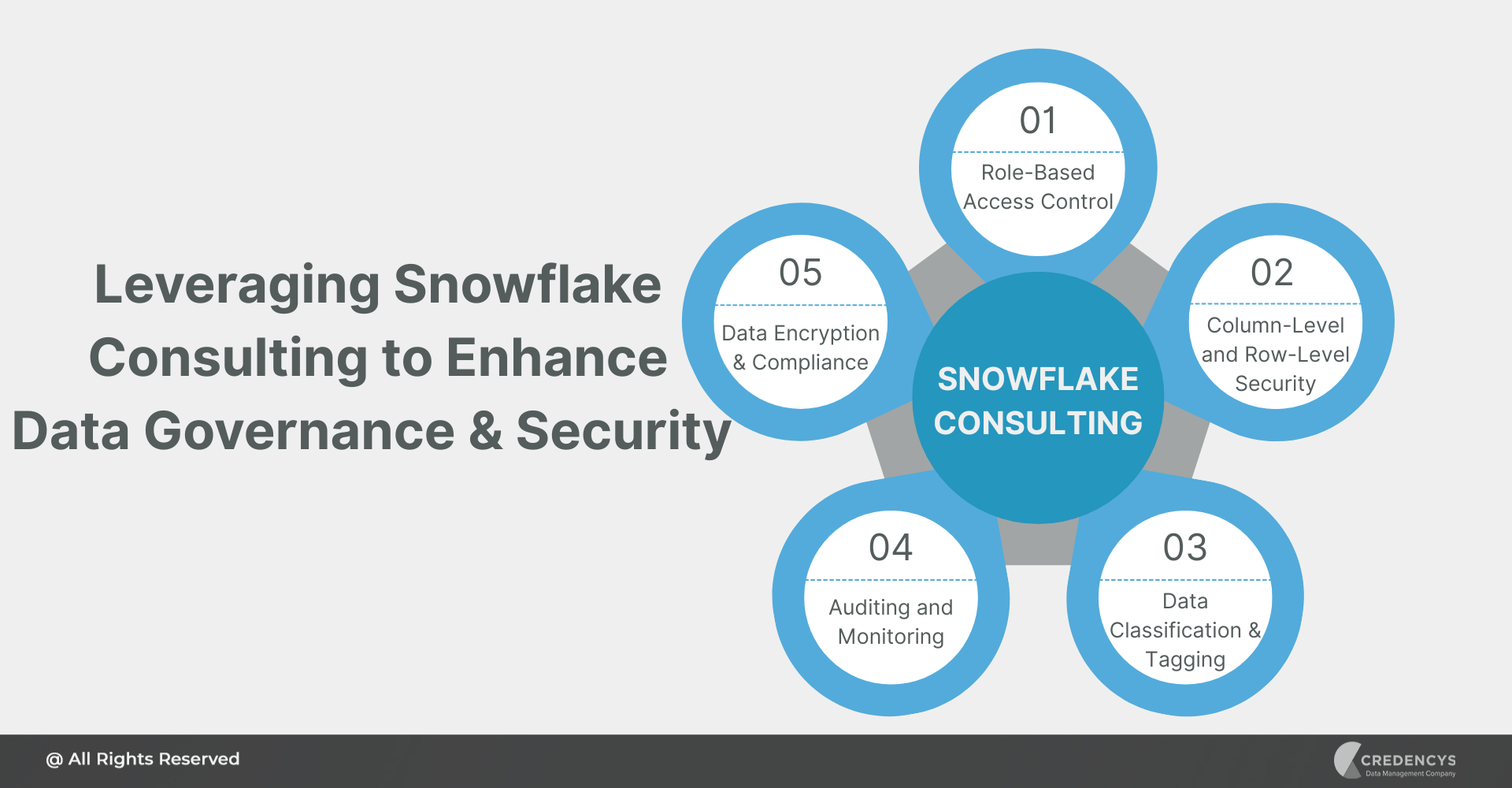
By leveraging Snowflake consulting services, enterprises can effectively implement these governance and security features, ensuring that their data strategies are both robust and compliant.
Enabling Advanced Analytics and AI/ML Initiatives
Harnessing advanced analytics and integrating AI/ML capabilities are pivotal for maintaining a competitive edge. Snowflake’s robust platform, combined with expert consulting services, empowers organizations to seamlessly implement and scale these initiatives.
1. Unified Data Platform for AI/ML
Snowflake offers a centralized data repository that supports diverse data types, including structured, semi-structured, and unstructured data. This unified approach simplifies data management and ensures consistency across analytics and AI/ML projects.
Consultants assist in designing data architectures that facilitate efficient data ingestion, transformation, and storage, laying a solid foundation for advanced analytics.
Lay the Groundwork for Scalable AI and ML with a Unified Snowflake Architecture. Get Expert Guidance to Accelerate your Advanced Analytics Initiatives.
2. Seamless Integration with AI/ML Tools
Snowflake’s compatibility with popular AI/ML frameworks like TensorFlow, PyTorch, and Scikit-learn allows for smooth integration into existing workflows. Additionally, Snowpark enables developers to write code in familiar languages such as Python and Java, executing complex data transformations and model training directly within Snowflake.
Consultants guide organizations in leveraging these tools to build and deploy machine learning models effectively.
3. Accelerated Model Development and Deployment
With Snowflake’s scalable compute resources and features like automatic scaling and concurrency handling, organizations can expedite model training and deployment processes. Consultants help in setting up MLOps pipelines that automate model lifecycle management, ensuring rapid iteration and continuous delivery of AI solutions.
4. Real-Time Analytics and Predictive Insights
Snowflake’s real-time data processing capabilities enable organizations to perform up-to-the-minute analytics, facilitating timely decision-making. By implementing streaming data pipelines and real-time dashboards, consultants empower businesses to monitor key metrics and predict trends, enhancing operational efficiency and strategic planning.
By leveraging Snowflake’s advanced analytics and AI/ML capabilities, organizations can unlock deeper insights, drive innovation, and achieve significant business outcomes.
Choosing the Right Snowflake Consulting Partner
Selecting the appropriate Snowflake consulting partner is crucial for the successful implementation and optimization of your data strategy. The right partner can accelerate your journey towards becoming a data-driven enterprise, while the wrong choice may lead to suboptimal outcomes.
Here are key considerations to guide your selection process:
- Snowflake Certifications and Partner Tiers: Ensure that the consulting firm holds relevant Snowflake certifications and is recognized within Snowflake’s partner ecosystem. Certified partners have demonstrated proficiency in deploying Snowflake solutions and are more likely to adhere to best practices.
- Industry-Specific Experience: Choose a partner with experience in your specific industry to ensure they understand the unique challenges and regulatory requirements you face.
- Comprehensive Service Offerings: A full-service consulting partner can provide end-to-end solutions, from initial assessment and strategy formulation to migration, implementation, and ongoing support.
- Proven Track Record and Case Studies: Evaluate the partner’s past performance through case studies and client testimonials. A partner with a proven track record demonstrates reliability and the ability to deliver results.
- Scalability and Flexibility: Your consulting partner should be able to scale their services to match your organization’s growth and adapt to changing business needs.
- Post-Implementation Support: Ongoing support is essential to address any issues that arise after implementation and to ensure continuous optimization of your Snowflake environment.
- Alignment with Business Objectives: Select a partner that aligns with your organization’s goals and can contribute to strategic business transformation.
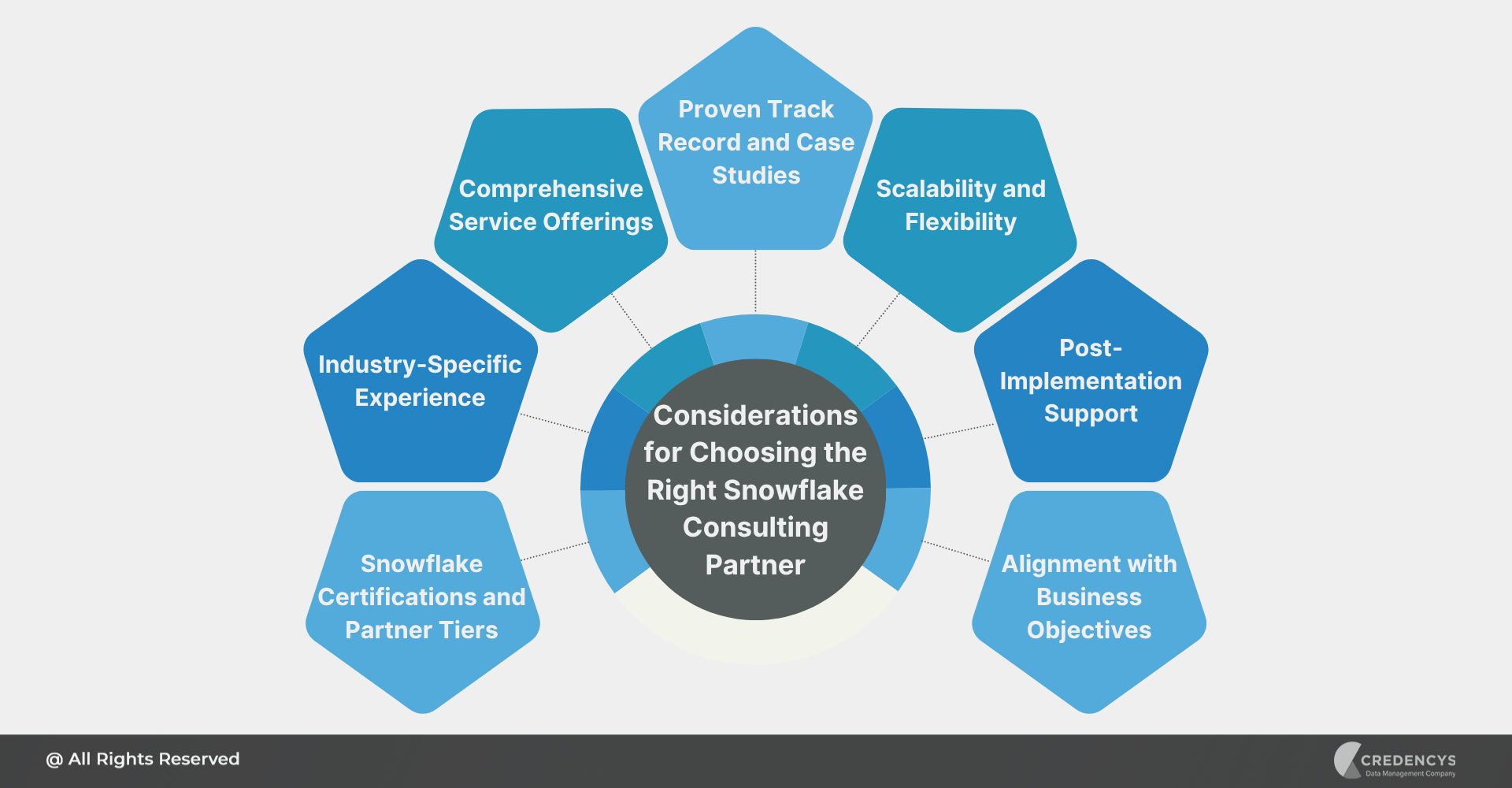
By carefully considering these factors, you can select a Snowflake consulting partner that not only meets your technical requirements but also aligns with your strategic business objectives, ensuring a successful and impactful collaboration.
Unlocking Enterprise Data Potential with Snowflake Consulting
Snowflake’s cloud-native platform offers unparalleled scalability, performance, and flexibility, positioning it as a cornerstone for modern data strategies. However, to truly harness its potential, partnering with experienced Snowflake consultants becomes essential.
Selecting the right consulting partner is a strategic decision that can significantly impact your organization’s data journey. Factors such as certifications, industry experience, comprehensive service offerings, and alignment with business objectives should guide this choice.
By collaborating with seasoned Snowflake consultants, enterprises can unlock new opportunities, drive innovation, and maintain a competitive edge in today’s dynamic business landscape.
Ready to Unlock the Full Potential of Snowflake for your Enterprise Data Strategy? Partner with Credencys to Turn your Data into a Competitive Advantage.






Tags: