


Top 5 Signs Your Manufacturing Company Needs MDM (Before It’s Too Late)
Every manufacturing business reaches a point where things simply stop flowing as they should. A production line slows down due to an outdated part number. A shipment is delayed because the customer’s address is incorrect in one system and correct in another. A supplier payment is held up because there are two vendor IDs for the same company.
Individually, these issues seem small. But together, they create friction at every step of the business.
Industry studies show that poor data quality can cost companies millions each year and waste a huge chunk of employees’ time. In manufacturing, where speed, accuracy, and coordination matter more than anything, this impact is even more severe.
This is exactly where MDM for Manufacturing becomes important. Master data management is not about building another system. It is about giving your business a stable foundation, so every team, from planning to procurement to production, works with consistent, accurate, and trustworthy data.
So, how do you know you need MDM? Here are the five clearest signs.
Sign 1: Your Teams Constantly Argue About Which Numbers are Right
If cross-functional meetings start with people checking three different dashboards or pulling out their personal spreadsheets, the problem is not your people; it is your master data.
You may notice situations where sales believes a product has been discontinued, engineering insists it is still active, and production planning is already building a forecast around it. Or maybe finance reports 4,200 active SKUs, while operations insists the number is closer to 3,000. When basic facts differ across teams, it slows down decisions, increases errors, and creates tension.
This usually happens because each system, ERP, PLM, CRM, MES, stores its own version of the truth. Without a unified approach to master data, everyone works with slightly different definitions, codes, and classifications.
MDM creates a single, authoritative record for things like materials, suppliers, products, and customers. Instead of debating whose spreadsheet is correct, everyone uses verified, approved, and shared data across the organization.
Sign 2: There’s a Constant Stream of Corrections, Fixes, and Workarounds
You know you have a data problem when small corrections start feeling like a normal part of the job. You fix a wrong UoM on a sales order. Someone updates a supplier’s bank account information in one system but forgets to update it in another. A label is reprinted because the material description does not match the packaging specifications.
Individually, none of these corrections seems dramatic, but they chip away at productivity. Teams start building long email trails to validate information. Customer service triple-checks every big order. Finance is beginning to reject invoices due to suspicious vendor data. And production teams lose trust in the system, so they create their own offline “master list” as a precaution.
With MDM for Manufacturing, errors are caught before they enter your ERP, quality rules are enforced consistently, and duplicate or incomplete records are flagged long before they cause operational damage. Instead of correcting data after it breaks a process, you prevent the bad data from entering the system in the first place.
Sign 3: Digital Transformation and AI Projects Aren’t Delivering Results
Many manufacturers begin ambitious analytics or AI programs only to discover that the insights don’t match reality. Dashboards show numbers that no one trusts. Predictive models behave inconsistently. AI pilots look promising, but never scale.
The issue is rarely the technology. It is almost always due to inconsistencies in master data. When product hierarchies differ across regions, when customer categories mean different things to different teams, or when materials are duplicated under different codes, your digital initiatives sit on a shaky foundation.
MDM creates consistency. It ensures that every analytics model, every dashboard, and every AI use case draws on the same definitions and golden records. Once the data becomes reliable, digital transformation becomes easier, faster, and far more effective.
Sign 4: Compliance, Traceability, and Audits Create Stress Across the Organization
Manufacturers operate under constant regulatory pressure. Whether it is an automotive recall, a food safety traceability requirement, or a medical device compliance audit, the ability to track who did what, and when, matters enormously.
If your company struggles to answer questions like:
- Which batch went to which customers?
- Which supplier provided this component?
- Where is the latest certificate or regulatory classification stored?
Without consistent product codes, aligned supplier records, and standardized documentation, even simple audit questions turn into frantic data hunts. MDM changes that by centralizing key information, enforcing accuracy, and keeping full audit trails of changes. Over time, traceability becomes smoother, faster, and much less stressful.
Sign 5: Your Operations Depend on Spreadsheets and Tribal Knowledge
In many manufacturing companies, the real master data does not live in the ERP. It lives in the minds of a few experienced employees or in unofficial Excel files scattered across teams. A planner maintains their own list of approved substitutes for materials. An engineer keeps a personal version of product attributes because the system is “not up to date”. A procurement manager maintains a private spreadsheet of supplier details because it is easier than searching across multiple systems.
This works until the day it doesn’t.
People go on leave. Files get corrupted. Teams change. And suddenly, the business loses visibility into how key decisions were made. MDM for Manufacturing moves all that knowledge into a governed, system-driven process. The organization becomes stronger because data is no longer dependent on individuals; it becomes institutionalized.
How MDM for Manufacturing Actually Helps
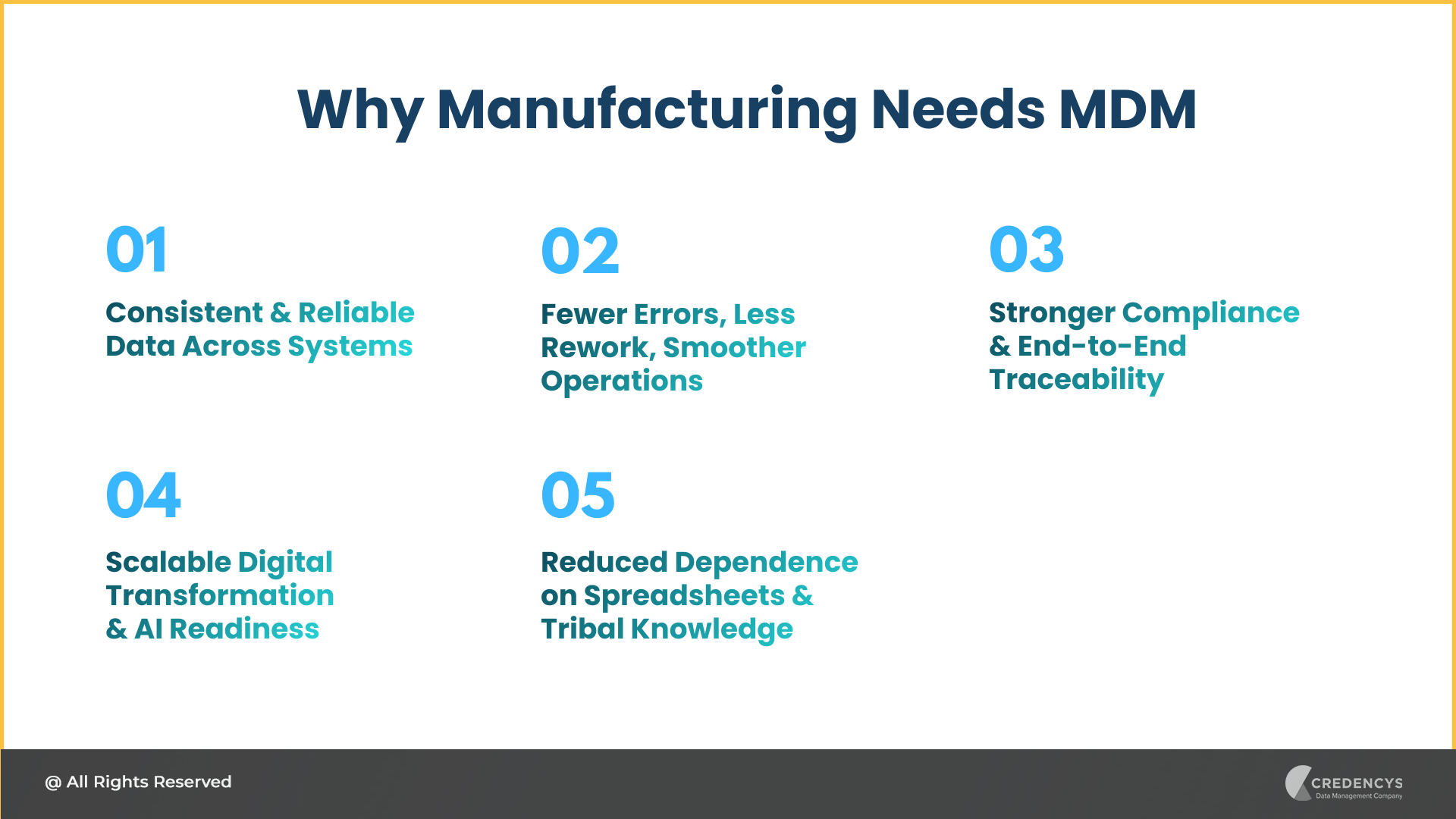
MDM solves these problems by establishing clear definitions, defining structured processes, and automating master data checks. Instead of allowing every team to create and modify data however they prefer, MDM introduces discipline, ownership, and transparency.
Product creation follows an approval workflow. Supplier onboarding is standardized. Material attributes follow rules instead of personal judgment. And because the data becomes consistent across systems, every team finally starts speaking the same language.
The biggest shift is cultural: people stop fighting the system and begin trusting it again.
Final Thoughts
Manufacturing businesses run on data the same way machines run on oil. When the data is inconsistent, duplicated, outdated, or incomplete, the entire operation slows down.
If your teams disagree on basic numbers, corrections are piling up, digital initiatives are stalling, audits feel exhausting, or your operations depend on tribal knowledge, it is time to take a serious look at MDM for Manufacturing.
The sooner you treat master data as a strategic asset, the sooner your business will see smoother operations, stronger decision-making, and a future-ready foundation for AI and digital transformation.







Tags: