


Top 6 Business Problems RAG Applications Can Solve (and How to Get Started)
While Generative AI is revolutionizing industries, up to 27% of LLM outputs contain hallucinations or factual errors. – Gartner
This poses a serious risk for businesses relying on AI for customer support, compliance, or decision-making. That’s where Retrieval-Augmented Generation (RAG) comes in.
By combining the power of large language models with real-time access to enterprise knowledge, RAG delivers accurate, contextual, and trustworthy responses solving key problems traditional GenAI can’t handle. Let’s explore the top six business challenges RAG applications help solve and how you can get started.
RAG Applications: Enhancing Customer Support Efficiency
Customer support teams often struggle with outdated knowledge bases, fragmented systems, and repetitive queries. This results in longer resolution times, inconsistent responses, and frustrated customers.
Impact on business:
- Increased average handling time (AHT)
- Poor customer satisfaction (CSAT) scores
- Higher support costs due to escalations and manual interventions
How RAG solves it:
RAG applications power intelligent support assistants, both for agents and end-users by retrieving precise answers from internal FAQs, documentation, product manuals, and CRM systems. This reduces the need to escalate tickets and ensures responses are fast, accurate, and consistent.
RAG Applications: Bridging Gaps in Real-Time Decision Making
In fast-paced business environments, decisions need to be made using up-to-date and context-specific information. Traditional LLMs, however, are limited to static knowledge and can’t access real-time enterprise data leading to stale insights and missed opportunities.
Impact on business:
- Decisions made on outdated or incomplete data
- Inability to respond quickly to market changes
- Disconnected workflows across teams and systems
How RAG solves it:
RAG applications can be integrated with real-time data sources like CRMs, ERPs, analytics platforms, or APIs to deliver insights that reflect the current state of your business. This enables dynamic, data-driven decisions supported by fresh, relevant information.
RAG Applications: Unlocking Value from Unstructured Knowledge Silos
Enterprises sit on mountains of unstructured data; PDFs, emails, wikis, call transcripts, support tickets, and more. But without the right tools, this wealth of knowledge remains inaccessible and underutilized.
Impact on business:
- Valuable insights are buried in static documents
- Teams duplicate work due to lack of shared knowledge
- Delayed decision-making from manual information retrieval
How RAG solves it:
RAG applications can process, chunk, and embed unstructured content, making it searchable and retrievable in real time. When a user asks a question, the RAG pipeline fetches relevant passages from these documents and uses them to generate accurate, natural language responses.
RAG Applications: Addressing Compliance and Audit Challenges
In industries like healthcare, finance, and insurance, AI outputs must adhere to strict regulatory requirements. Generic LLMs, trained on public data, don’t meet these standards and often lack transparency, leading to non-compliant or unverifiable responses.
Impact on business:
- Increased legal and regulatory risk
- Failed audits due to unverifiable information
- Lack of trust in AI systems across compliance-heavy teams
How RAG solves it:
RAG allows organizations to control the data used to generate responses by retrieving only from approved, auditable sources. Every answer is traceable back to a document, making the system explainable, defensible, and compliant with internal and external standards.

Ensure Your AI Solutions Meet Compliance Standards with Confidence. Build RAG Applications That are Accurate, Auditable, and Enterprise-ready
RAG Applications: Improving Enterprise Search Accuracy
Most enterprise search tools still rely on keyword matching, which often fails to understand user intent especially when dealing with large, complex datasets. This leads to frustrating experiences for employees and customers who can’t quickly find the information they need.
Impact on business:
- Wasted time searching across disconnected systems
- Reduced employee productivity
- Poor customer experience due to incomplete or irrelevant answers
How RAG solves it:
RAG enhances enterprise search by using semantic understanding. Instead of matching keywords, it retrieves the most contextually relevant information from structured and unstructured sources and then uses a language model to generate a clear, conversational response.
RAG Applications: Reducing Hallucinations in Generative AI Outputs
One of the biggest challenges with traditional LLMs is their tendency to “hallucinate,” confidently generating information that is false, outdated, or unverifiable. In enterprise contexts, this isn’t just inconvenient; it can be damaging, especially in regulated industries like finance, healthcare, or legal services.
Impact on business:
- Misinformation in customer support responses
- Incorrect internal insights leading to poor decisions
- Compliance risks when outputs are not backed by valid sources
How RAG solves it:
Retrieval-Augmented Generation tackles hallucinations by grounding AI outputs in real, trusted data. It pulls relevant context from your internal knowledge base, document repositories, or APIs and presents it to the language model during generation.
This means every response is anchored in facts, not guesses.
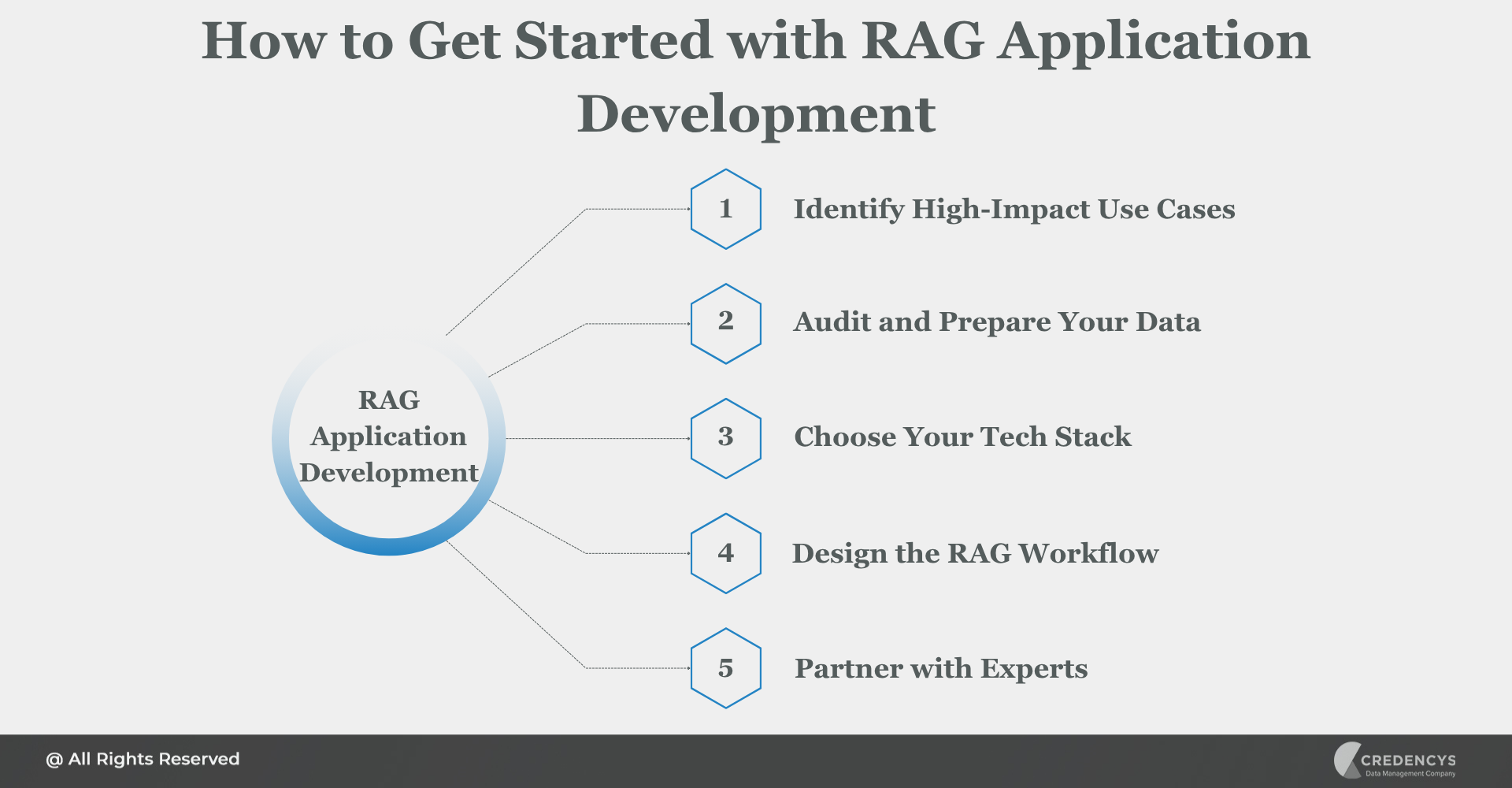
How to Get Started with RAG Application Development
Building a RAG application doesn’t have to be overwhelming. With the right roadmap, you can go from idea to production quickly while ensuring alignment with your business needs and data landscape.
Here’s how to get started:
1. Identify High-Impact Use Cases
Focus on areas where hallucinations, fragmented data, or slow information access cause friction. Common starting points include customer support, internal knowledge assistants, compliance workflows, and enterprise search.
2. Audit and Prepare Your Data
Evaluate the availability, structure, and quality of your internal data. Organize it across documents, knowledge bases, APIs, or databases so it can be used for retrieval.
3. Choose Your Tech Stack
Select tools for:
- Embedding models (e.g., OpenAI, Hugging Face)
- Vector databases (e.g., FAISS, Pinecone, Weaviate)
- LLMs (e.g., GPT, Claude, open-source models)
- RAG orchestration frameworks (e.g., LangChain, LlamaIndex)
4. Design the RAG Workflow
Define the retrieval logic, chunking strategy, prompt templates, and output formatting. Ensure traceability and relevance scoring to maintain accuracy.
5. Partner with Experts
Working with a RAG development partner like Credencys accelerates the process. We help you design, build, and scale robust RAG pipelines tailored to your domain, ensuring high ROI and faster time-to-value.
Why Partner with Credencys for RAG Application Development
Building effective RAG applications requires more than just the right tools; it demands deep expertise in AI architecture, data engineering, and enterprise systems. At Credencys, we specialize in delivering end-to-end RAG application development tailored to your unique business needs. Here’s how we help:
- Domain Expertise: Experience across industries like retail, manufacturing, BFSI, and healthcare
- Custom Architecture: We design scalable RAG pipelines aligned to your data sources and workflows
- Security & Compliance Focus: RAG solutions built with enterprise-grade governance and auditability
- Faster Time-to-Value: Accelerated go-to-market with pre-built components and proven best practices
Whether you are piloting your first RAG use case or scaling GenAI across your organization, Credencys is your trusted development partner.
Discover how Credencys can Help you Solve Real Business Problems with Retrieval-Augmented Generation





Tags: