


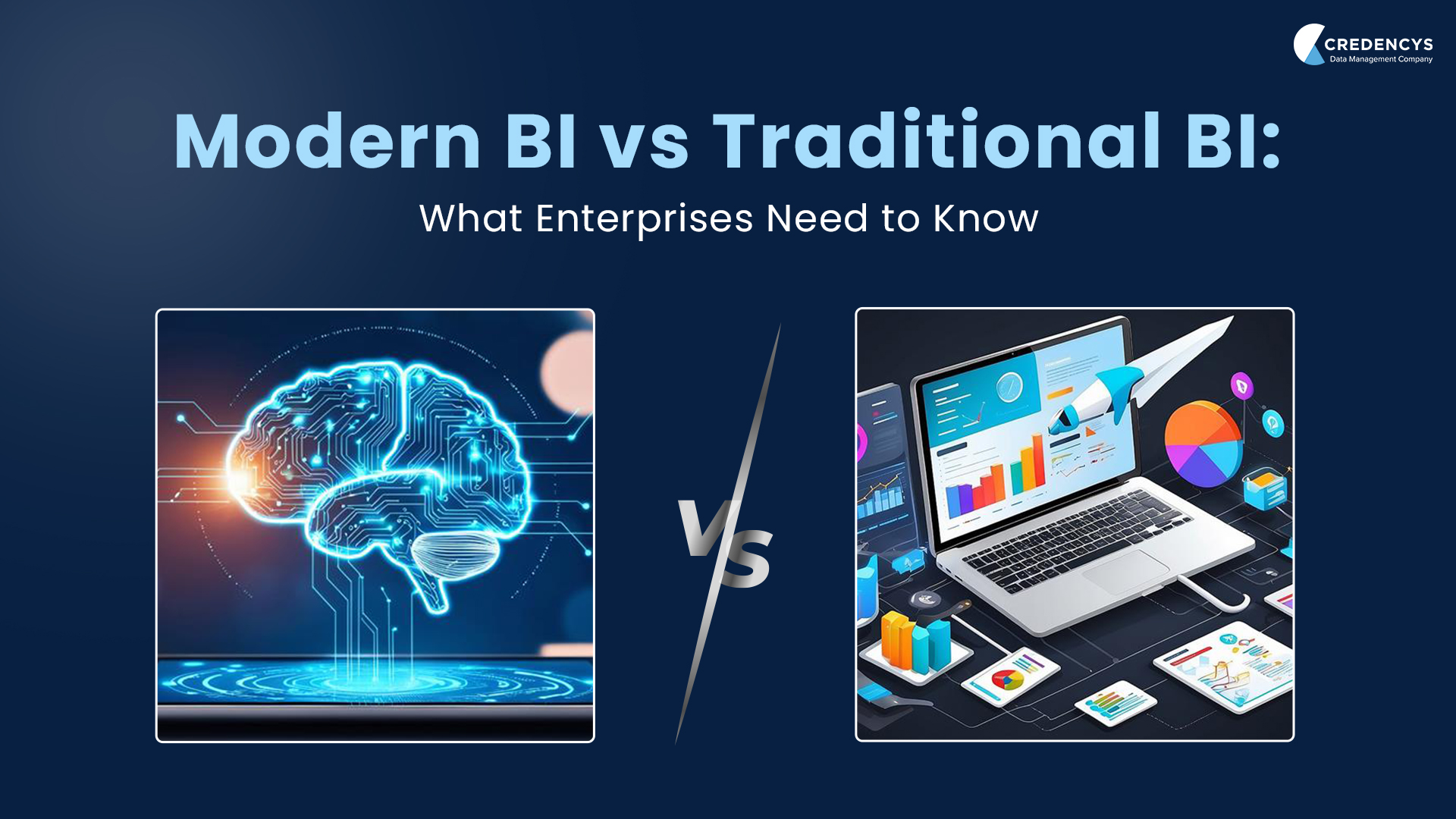
Modern BI vs Traditional BI: What Enterprises Need to Know
Businesses generate over 2.5 quintillion bytes of data every day, and the way organizations analyze and act on this data can be the defining factor between staying ahead and falling behind.
Yet, despite the rapid pace of digital transformation, many enterprises still rely on legacy business intelligence (BI) systems that were never built for today’s real-time, AI-powered world.
Traditional BI tools are known for their rigidity, heavy dependence on IT teams, and lag in delivering timely insights.
According to a Gartner report, more than 70% of organizations still struggle to move beyond basic descriptive analytics.
Why? Because traditional BI lacks the agility to support dynamic business needs.
On the other hand, Modern BI platforms are transforming the analytics landscape—empowering business users with self-service dashboards, real-time data access, and AI-driven decision-making capabilities. From faster data prep to predictive analytics, modern BI is enabling enterprises to turn data into action without the bottlenecks.
But what exactly separates modern BI from traditional BI? And how can enterprises make a strategic shift that unlocks business value?
Let’s explore the key differences, use cases, and what leaders need to consider while transitioning from old-school analytics to modern, insight-driven intelligence.
Traditional BI vs Modern BI: A Side-by-Side Comparison
To understand how far Business Intelligence has come, it’s essential to compare how traditional BI and modern BI stack up across key dimensions.
| Key Aspects | Traditional BI | Modern BI |
|---|---|---|
| Data Access | Centralized and IT-controlled | Democratized, self-service access for business users |
| Speed of Insights | Delayed, often weekly or monthly reports | Real-time dashboards and near-instant insights |
| User Interface | Static reports, tabular formats | Interactive, visual, intuitive dashboards |
| Scalability | Limited by infrastructure | Cloud-native, easily scalable with demand |
| Data Sources | Structured, siloed data from limited sources | Unified data from structured, semi-structured, and unstructured sources |
| Analytics Type | Mostly descriptive analytics | Descriptive, diagnostic, predictive, and prescriptive analytics using AI/ML |
| Dependence on IT | High dependence on report creation and changes | Low dependence; business users explore data independently |
| Deployment | On-premise, resource-intensive setup | Cloud-based, faster deployment, lower total cost of ownership |
A Closer Look: Why Traditional BI is Losing Ground
73% of executives say their organizations struggle to extract meaningful insights from data in time to influence decisions — NewVantage Partners, 2023
Traditional BI tools can take weeks to deliver a single new report, often slowing down business agility. With the explosion of big data and AI, traditional BI wasn’t designed to support continuous intelligence.
Why Modern BI is the Game-Changer for Enterprises
Modern BI is not just an upgrade—it’s a paradigm shift. It turns analytics into a daily, dynamic, and democratized function, empowering users across departments to make smarter decisions without waiting for IT. Whether it’s a marketing manager monitoring campaign ROIs in real-time or a supply chain analyst forecasting inventory needs, modern BI platforms provide on-demand insights at the speed of business.
Benefits of Modern BI for Enterprises
Modern BI platforms are more than just tools—they are strategic enablers of growth, agility, and competitive advantage. Here are the key benefits enterprises can unlock by shifting from traditional BI to a modern, cloud-native BI ecosystem:
1. Faster, Smarter Decision-Making
Modern BI empowers business users with real-time data access and AI-driven insights, dramatically reducing the time from question to answer. Instead of waiting days for IT to generate reports, decision-makers can explore live dashboards and drill into the “why” behind the “what” on their own.
According to Dresner Advisory Services, 60% of organizations using modern BI saw faster decision-making and improved operational efficiency within the first year.
2. Self-Service Analytics at Scale
Modern BI platforms eliminate the need for data analysts to handle every query. Tools like Power BI, Tableau, and Looker enable non-technical users to analyze data through drag-and-drop interfaces, natural language queries, and embedded visualizations—freeing up IT teams for strategic work.
IDC reports that companies with self-service analytics capabilities are 2.5x more likely to use data effectively.
3. Advanced Analytics with AI/ML
With built-in AI and machine learning, modern BI goes beyond dashboards. Enterprises can build predictive and prescriptive models to forecast sales, detect anomalies, and optimize operations within the same platform where they view reports.
Organizations using AI-enabled BI are 3x more likely to exceed their business goals — Forbes Insights.
4. Unified Data View Across Sources
Modern BI platforms integrate with cloud data warehouses, CRM, ERP, and even unstructured sources like social media or IoT. This means enterprises can eliminate data silos and gain a 360-degree view of customers, operations, and performance.
Over 65% of data leaders cite data silos as the #1 obstacle to becoming data-driven — NewVantage Partners.
5. Enhanced Collaboration & Data Governance
With cloud-native architecture, teams across regions can collaborate in real time, share dashboards, and comment directly within BI tools. Built-in governance, access control, and audit logs ensure that data security and compliance are not compromised.
6. Lower Total Cost of Ownership (TCO)
Unlike traditional BI systems, which require heavy on-premises hardware and maintenance, modern BI tools are cloud-based with flexible, usage-based pricing models. They scale with your needs, reducing capital expenditures (CapEx) and IT overhead.
Gartner predicts that by 2026, 75% of organizations will standardize on cloud-native BI platforms to reduce cost and complexity.
Conclusion: Time to Modernize Your BI Strategy
In a business environment where speed, agility, and data-driven decision-making define success, clinging to legacy BI tools is not just outdated—it’s risky. Traditional BI may have served well in the past, but it falls short in today’s fast-paced, AI-enabled world.
Modern BI platforms provide the flexibility, intelligence, and self-service capabilities that enterprises require to remain competitive. They don’t just report the past—they help predict the future, empower users, and unlock value from every data point.
If your organization is still stuck in the old BI world, now is the time to rethink, realign, and reinvent your data strategy with modern BI.

Ready to Upgrade Your BI Stack? Explore how modern BI can accelerate your business transformation.






Tags: