


Machine Learning in Demand Forecasting: A Game Changer for Modern Businesses
Inventory distortion; stockouts and overstocks costs retailers $1.1 trillion globally every year in lost sales and markdowns. – RetailWire.
Traditional demand forecasting, which depends on historical sales and rigid assumptions, struggles to keep pace with today’s volatile markets and rapidly changing customer behavior. Machine learning (ML) is closing this gap.
By analyzing vast volumes of structured and unstructured data in real time, ML-driven forecasting models adapt quickly, uncover hidden patterns, and predict demand with far greater accuracy. This shift isn’t just about efficiency; it’s about staying competitive in a market where precision and agility determine success.
What You’ll Learn in This Article
- Why traditional demand forecasting falls short in modern business environments
- How machine learning improves forecast accuracy and adaptability
- Key ML techniques and data inputs that power demand forecasting
- Real-world industry use cases and business outcomes
- Practical considerations for implementing ML-driven forecasting
Why Traditional Demand Forecasting Falls Short
For decades, businesses have relied on traditional demand forecasting methods built around historical sales data, spreadsheets, and linear models. While these approaches once sufficed, they are increasingly unreliable in today’s fast-moving markets.
1. Inconsistent Accuracy
Forecasts generated by legacy models tend to lose accuracy over time. In volatile environments, they are easily thrown off by sudden changes in demand patterns.
Worse, they often carry human bias, leading to costly misjudgments in production and inventory planning.
2. Rigid Assumptions
Traditional forecasting assumes that future demand will resemble the past. But markets today are shaped by rapid disruptions from inflation and shifting consumer sentiment to global supply chain shocks.
Relying on static models makes businesses slow to adapt.
3. Limited Data Utilization
Legacy systems usually work with narrow datasets like sales history and stock levels. They miss out on external signals such as weather, economic conditions, competitor activity, or even social sentiment, all of which influence buying behavior.
4. Manual and Time-Consuming
Conventional forecasting requires extensive manual effort, from collecting and cleansing data to tuning models. This slows decision-making and makes it difficult to scale forecasting across large product portfolios or geographies.

The result? Businesses either overstock and tie up capital in excess inventory or understock and risk losing customers.
Neither outcome is sustainable in a world where agility is a competitive advantage.
How Machine Learning Enhances Demand Forecasting
Machine learning offers a smarter, adaptive alternative to traditional forecasting methods. Instead of relying on static assumptions, ML models continuously learn from data, refine predictions, and respond quickly to changes in market conditions.
This makes forecasting not just more accurate, but also more actionable.
1. Automated Pattern Recognition
ML algorithms detect complex, non-linear patterns in data that traditional models often overlook. For example, they can capture how weather, promotions, or social sentiment influence sales and uncover hidden demand drivers before they become obvious.
2. Dynamic Learning Capabilities
Unlike static systems, ML models improve with every new data point. As customer preferences, seasonality, or macroeconomic factors shift, the models self-adjust, ensuring predictions remain accurate without the need for constant manual updates.
3. Integration of Diverse Data Sources
Machine learning can pull together internal data (like sales and promotions) with external signals such as economic indicators, competitor pricing, or social media trends. This 360-degree view helps companies anticipate demand with greater precision.
4. Real-Time Adaptability
Because ML models can process data in real time, businesses gain the agility to adjust production, inventory, or pricing strategies immediately rather than reacting weeks later when traditional reports are generated.
In short, ML transforms forecasting from a backward-looking process into a forward-looking capability. Companies using these approaches can make faster, more confident decisions and reduce the costly risks of misaligned supply and demand.
Key Machine Learning Techniques in Demand Forecasting
Different forecasting challenges require different machine learning approaches. From predicting seasonal sales peaks to grouping customers by behavior, ML offers a toolkit of methods that help businesses improve accuracy and agility.
1. Scenario Modeling and Forecast Simulations
ML enables “what-if” analyses, where businesses can test how different scenarios, such as price changes, promotions, or supply chain disruption, would affect demand. This supports proactive planning and smarter resource allocation.
2. Time Series Forecasting
Models like ARIMA, Facebook Prophet, and LSTM (Long Short-Term Memory networks) analyze sequential data over time. They capture seasonality, trends, and recurring demand cycles, making them highly effective for predicting future sales patterns.
3. Clustering and Classification
Unsupervised learning methods, such as K-means clustering, group products or customers with similar demand behaviors. Classification models can also categorize demand into high, medium, or low tiers, helping businesses tailor inventory and fulfillment strategies.

Ready to Explore how Machine Learning can Transform your Demand Forecasting Strategy? Let our Experts Guide you.
4. Deep Learning Models
Advanced neural networks, including Recurrent Neural Networks (RNNs) and Convolutional Neural Networks (CNNs), excel at handling large, complex datasets. They’re especially powerful for uncovering subtle patterns in high-dimensional data like customer purchase journeys, sensor inputs, or online behavior.
5. Regression Models
Linear regression and advanced variants such as Random Forest, XGBoost, Ridge, or Lasso help businesses quantify how different factors, such as pricing, promotions, or external events, impact demand.
These models are widely used because they are interpretable and effective across industries.
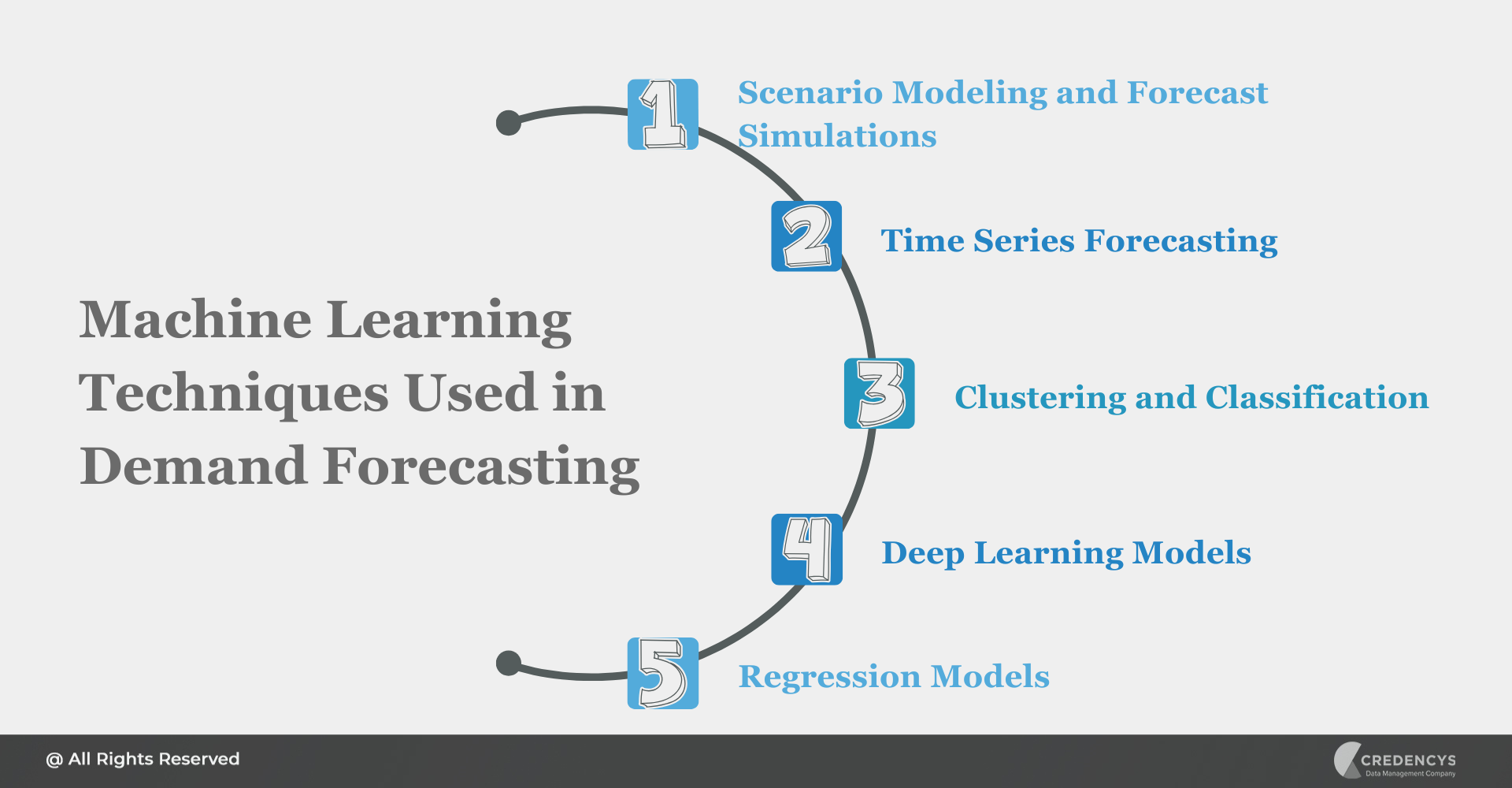
Together, these techniques equip businesses with flexible tools to address everything from short-term demand fluctuations to long-term strategic planning.
Data Inputs Powering ML Demand Forecasting
The strength of any machine learning forecast lies in the quality and diversity of the data feeding it. Unlike traditional forecasting, which relies heavily on sales history, ML models combine multiple internal and external signals to build a richer and more accurate picture of demand.
1. Historical Sales Data
Sales history forms the foundation of most models. When paired with time-based variables such as holidays or peak seasons, it helps establish baseline demand patterns.
2. Promotions and Marketing Campaigns
Discounts, advertising pushes, and special offers often cause temporary spikes in demand. Including campaign data ensures the model can distinguish between organic growth and promotion-driven sales.
3. Seasonality and Trends
Recurring patterns such as back-to-school periods, festive shopping, or weather-driven demand shifts play a crucial role in shaping consumer behavior. ML models capture these nuances to prevent under- or over-forecasting.
4. Macroeconomic and External Indicators
Consumer demand is also shaped by factors like GDP, inflation, fuel prices, and employment levels. Incorporating such data allows models to reflect broader economic conditions in their forecasts.
5. Real-Time and Behavioral Data
Modern forecasting thrives on live inputs such as clickstream behavior, social media sentiment, local weather conditions, and even in-store traffic patterns. These signals provide early indicators of demand changes, giving businesses the agility to respond faster.
By weaving together these diverse datasets, ML-based forecasting delivers predictions that are not only more precise but also more responsive to shifting market realities.
Industry Applications of ML-Driven Demand Forecasting
Machine learning is being adopted across industries to make demand planning more precise, agile, and profitable.
- Manufacturing: ML helps manufacturers align production schedules with market demand, optimize procurement, and minimize costly overproduction or material shortages.
- Consumer Packaged Goods: CPG companies use ML to manage complex product portfolios and frequent promotional cycles. Forecasting across SKUs and channels becomes more accurate, improving supply chain efficiency and promotional effectiveness.
- Retail: Retailers apply ML forecasting to balance inventory across stores, warehouses, and online channels. This reduces stockouts and overstocks, leading to better product availability and higher customer satisfaction.
By tailoring forecasting models to their unique dynamics, each industry can reduce uncertainty, improve planning, and respond faster to market shifts.
Success Story: How Credencys Modernized Demand Forecasting for a Leading Retail Group
Client Overview
A leading retail group operating 175+ stores and multiple e-commerce channels, serving millions of customers annually.
Problem Statement
The client struggled with inaccurate demand forecasts, leading to frequent stockouts, overstocking, and inconsistent customer experiences across physical and digital channels.
Challenges
- Reliance on manual and traditional forecasting models.
- Inability to factor in seasonality, promotions, and regional demand variations.
- Limited integration of data across stores and online platforms.
- High inventory carrying costs due to inaccurate predictions.
Solution Implemented
Credencys designed and deployed a machine learning–based demand forecasting solution that:
- Consolidated data from sales, promotions, and customer behavior across all channels.
- Applied advanced ML models to capture seasonal trends, buying patterns, and external influences.
- Delivered dynamic, real-time forecasts with automated adjustments.
- Provided a centralized forecasting dashboard for planners and decision-makers.
Business Impact
- 31% improvement in forecast accuracy.
- 24% increase in inventory turnover, reducing carrying costs.
- 22% higher customer satisfaction across online and offline channels.
- Streamlined decision-making with real-time, AI-powered insights.
Read the full case study here:
Business Benefits of ML-Driven Demand Forecasting
Machine learning doesn’t just make forecasts more accurate; it creates measurable business impact across the supply chain, operations, and customer experience.
1. Better Customer Experience
When products are consistently available, customers trust the brand more. Accurate forecasting supports stronger satisfaction and loyalty, translating into repeat business and long-term revenue growth.
2. Cost Savings and Efficiency
By aligning production, procurement, and logistics with actual demand, businesses cut waste, reduce markdowns, and streamline operations, unlocking significant cost savings.
Looking to Reduce Costs and Boost Operational Efficiency with ML-driven Forecasting? We are Here to Help you Get Started.
3. Smarter Inventory Management
Accurate forecasts reduce both stockouts and excess inventory. This lowers carrying costs, optimizes warehouse space, and ensures products are available when and where customers need them.
4. Enhanced Agility and Responsiveness
With real-time insights, companies can adjust quickly to shifts in demand, supply chain disruptions, or competitive moves. This agility minimizes lost sales opportunities.
5. Improved Forecast Accuracy
ML models continually refine predictions as new data flows in. This results in far more accurate forecasts than static, rule-based models, especially in fast-changing markets.
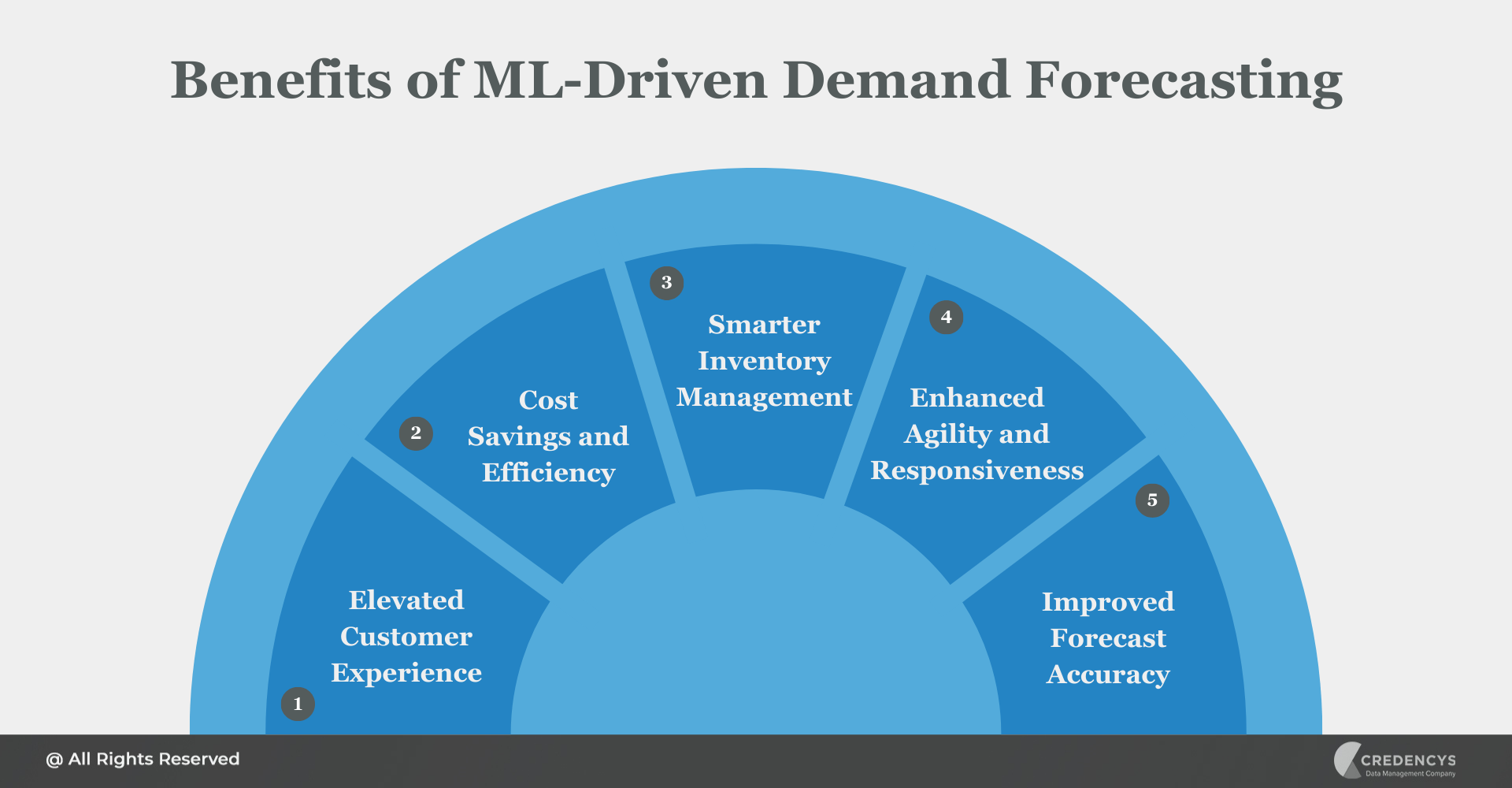
In short, ML-powered forecasting doesn’t just optimize processes, it strengthens competitiveness and resilience.
Implementation Considerations
While the benefits of machine learning in demand forecasting are significant, successful adoption requires careful planning. Businesses that prepare well see faster ROI and more sustainable outcomes.
1. Data Readiness and Quality
Machine learning models are only as strong as the data they rely on. Clean, complete, and well-structured datasets are essential.
Companies also need systems that can capture external signals, such as economic indicators or weather data, to complement internal sales history.
2. Choosing the Right Models and Tools
No single ML algorithm fits all situations. Depending on the business context, time series forecasting, regression, or deep learning may work best.
The right choice depends on data complexity, forecast horizon, and industry dynamics.
3. Infrastructure and Scalability
Processing large datasets in real time requires robust infrastructure. Cloud platforms and specialized ML tools make it easier to scale forecasting across products, markets, and geographies without overwhelming IT resources.
4. Cross-Functional Collaboration
Demand forecasting impacts multiple functions—from sales and operations to finance and supply chain. Close collaboration between data scientists, IT teams, and business stakeholders ensures models reflect real-world needs and integrate smoothly into decision-making processes.
5. Continuous Monitoring and Retraining
Market conditions evolve, and so must ML models. Regular monitoring and retraining are necessary to keep forecasts accurate as new trends, customer behaviors, and external disruptions emerge.
When these factors are addressed, businesses can unlock the full value of machine learning while avoiding common pitfalls that lead to underwhelming results.
Future Outlook: AI + ML in Demand Planning
The role of AI and machine learning in demand forecasting is set to grow even more critical as markets become faster, more complex, and more data-driven. Emerging trends point toward forecasting systems that are not only predictive but also prescriptive and autonomous.
1. Real-Time, Autonomous Forecasting
Advances in AI are pushing forecasting toward fully automated systems that update continuously without human intervention. This makes demand planning more agile and responsive, enabling businesses to react instantly to new signals.
2. Explainable AI (XAI)
As adoption increases, companies want to understand not just what the model predicts but why. Explainable AI provides transparency, making forecasts more trustworthy and supporting stronger executive decision-making.
3. Integration with IoT and Edge Devices
Connected devices, from store shelf sensors to GPS trackers, are generating vast streams of real-time data. Integrating this with ML models unlocks hyper-local insights and supports faster, more granular demand decisions.
4. Prescriptive and Collaborative Forecasting
The next wave goes beyond predicting demand to recommending actions, such as adjusting pricing, redistributing inventory, or shifting promotional spend. Collaborative forecasting across suppliers, distributors, and retailers will become standard, creating more resilient supply chains.
In the near future, demand planning will evolve from a back-office function into a strategic, AI-driven capability at the heart of business growth.
Why Credencys
At Credencys, we help enterprises unlock the power of machine learning to transform demand forecasting. As a trusted technology consulting partner, we combine deep expertise in data engineering, AI/ML, and cloud platforms to design forecasting solutions that are accurate, scalable, and aligned with business goals.
- Industry Experience: We have worked with retailers, manufacturers, CPG firms, and supply chain leaders to solve real-world forecasting challenges.
- Custom ML Solutions: Instead of one-size-fits-all models, we build forecasting systems tailored to your unique product mix, customer behavior, and market dynamics.
- Future-Ready Architecture: Our solutions integrate seamlessly with enterprise data ecosystems and are designed to scale as your business grows.
- Proven Outcomes: From reducing stockouts and inventory costs to improving promotional effectiveness, our clients see measurable ROI from ML-driven forecasting.With the right mix of technology, data, and expertise, we empower businesses to move beyond traditional forecasting into a future where demand planning is smarter, faster, and more resilient.
Conclusion
Machine learning is redefining demand forecasting, turning it into a dynamic, data-driven capability that helps businesses anticipate market needs with precision and agility. By integrating diverse data sources, learning continuously, and adapting in real time, ML-driven forecasting eliminates the guesswork of traditional methods.
The business case is clear: companies that embrace machine learning in demand planning achieve higher forecast accuracy, lower costs, leaner operations, and improved customer satisfaction. In an environment where uncertainty is constant, accurate forecasting is no longer a competitive advantage; it is a survival requirement.
Frequently Asked Questions
1. What is machine learning demand forecasting?
Machine learning demand forecasting uses algorithms to analyze historical and real-time data to predict future demand more accurately than traditional statistical methods.
2. How is ML different from traditional forecasting methods?
Traditional models rely on fixed assumptions and limited data. ML adapts continuously, processes large, complex datasets, and learns patterns that humans or basic models may miss.
3. Which industries benefit most from ML-driven demand forecasting?
Manufacturing, retail, consumer packaged goods (CPG), insurance, and supply chain-intensive industries see the biggest benefits from ML forecasting.
4. What data is required for machine learning forecasting?
Historical sales, promotions, seasonality, customer behavior, market trends, and external signals such as weather, economic indicators, and events.
5. Can machine learning improve forecast accuracy significantly?
Yes. Companies adopting ML forecasting often achieve 20–50% improvements in forecast accuracy, directly reducing stockouts, overstock, and wasted costs.
6. Does ML forecasting replace human planners?
No. It enhances human decision-making by providing accurate, data-driven insights. Planners focus on strategic actions while ML handles complex data analysis.
7. How does ML handle sudden market changes?
ML models adapt faster by integrating real-time data. For example, shifts in demand due to promotions, competitor actions, or external events can be detected quickly.
8. Is ML demand forecasting scalable for large enterprises?
Yes. Cloud platforms like Databricks, Snowflake, and AWS allow ML forecasting systems to scale across millions of SKUs, locations, and global operations.
9. What ROI can businesses expect from ML-driven forecasting?
ROI comes from reduced inventory costs, fewer stockouts, better customer satisfaction, leaner supply chains, and higher revenue from optimized planning.
10. How can Credencys help with ML demand forecasting?
Credencys builds custom ML forecasting solutions tailored to your business, integrating seamlessly with your data ecosystem and delivering measurable results.







Tags: