


Zero-Trust Data Governance: Why Enterprises Need Trusted Data Before Scaling AI Agents
Is your enterprise data ready to support AI-driven decisions?
Across industries, organizations are moving fast to adopt generative AI, predictive analytics, automation, and AI agents. These technologies promise faster decisions, smarter workflows, improved customer experiences, and higher operational efficiency. But there is one challenge many enterprises continue to face: their data foundation is not trusted enough to support AI at scale.
AI systems are only as reliable as the data behind them. When product data is incomplete, customer records are duplicated, supplier information is scattered, or business rules are inconsistent across systems, AI can produce inaccurate outputs, recommend the wrong actions, or automate flawed processes. For enterprise leaders, this creates a serious risk. AI may move faster, but poor-quality data can make bad decisions move faster too.
This is why zero-trust data governance is becoming increasingly important. Just as zero-trust security assumes that no user or system should be trusted by default, zero-trust data governance applies the same principle to enterprise data. It ensures that data is verified, governed, traceable, secure, and continuously monitored before it is used for reporting, automation, AI models, or business decision-making.
For enterprises investing in AI, the goal is no longer just to collect more data. The real priority is to create a trusted data ecosystem where every data source, data owner, data workflow, and AI-generated output can be validated. This requires strong data governance, master data management, product information management, data quality, metadata management, and clear ownership across the organization.
In this blog, we will explore what zero-trust data governance means, why it matters for AI-ready enterprises, and how organizations can build a trusted data foundation to scale AI with confidence.
Why Traditional Data Governance Needs a Zero-Trust Upgrade
Traditional data governance was designed to bring structure, ownership, and control to enterprise data. It helped organizations define standards, manage access, improve data quality, and create policies for how data should be used across business functions.
For years, this approach worked well for reporting, compliance, analytics, and operational decision-making. But the rise of AI has changed what enterprises now expect from their data governance strategy.
Today, enterprise data is no longer used only by people reviewing dashboards or reports. It is also being used by:
- AI models that generate recommendations
- Automation workflows that trigger business actions
- Predictive analytics systems that forecast outcomes
- AI agents that execute tasks across enterprise systems
- Recommendation engines that influence customer, supplier, and operational decisions
This makes data trust more critical than ever. If the data is incomplete, duplicated, outdated, biased, or poorly governed, AI systems can generate inaccurate outputs and trigger decisions that create business risk.
Traditional governance often assumes that once data enters an enterprise system, it can be trusted. Zero-trust data governance challenges that assumption. It treats every data source, data record, user, workflow, and AI-generated output as something that must be verified before it is trusted.
A zero-trust upgrade does not mean slowing down data access or adding unnecessary control layers. Instead, it helps enterprises build a governance model where trust is continuously validated through:
- Data quality rules
- Lineage tracking
- Metadata management
- Role-based access controls
- Approval workflows
- Audit trails
- Continuous monitoring
For AI-ready enterprises, this shift is important. AI can only scale when business leaders are confident that the data behind every recommendation, prediction, and automated action is accurate, secure, and explainable.
A zero-trust data governance model helps organizations move from basic data control to continuous data assurance.
Why AI Systems Fail Without Trusted Enterprise Data
AI does not fail only because of weak models or poor algorithms. In many enterprises, AI fails because the data feeding those systems is incomplete, inconsistent, outdated, or not governed properly.
When AI systems depend on fragmented enterprise data, they may generate outputs that look confident but are not accurate. This becomes risky when those outputs are used to guide business decisions, automate workflows, or trigger actions across enterprise systems.
For example, an AI system may recommend the wrong supplier if supplier quality data is not connected with contract terms. A product recommendation engine may show incorrect product information if PIM data is incomplete. A demand forecasting model may produce unreliable predictions if historical sales, inventory, and market data are not standardized.
AI systems struggle when enterprise data has issues such as:
- Duplicate customer, product, supplier, or material records
- Incomplete product attributes or missing specifications
- Outdated pricing, inventory, or contract information
- Inconsistent data formats across systems
- Poorly defined ownership and approval workflows
- Limited visibility into where the data came from
- Lack of audit trails for data changes
- Unverified AI-generated outputs entering business workflows
These issues reduce trust in AI. Business users may question the recommendations, teams may avoid using AI-driven tools, and leaders may struggle to justify further AI investments.
The challenge becomes even bigger when enterprises introduce AI agents. Unlike traditional analytics tools, AI agents are designed to take action. They can create records, update workflows, recommend decisions, trigger approvals, or interact with business systems. If the data behind those actions is not trusted, the risk moves from inaccurate insight to inaccurate execution.
This is why trusted data must come before scalable AI. Enterprises need strong governance, data quality, master data management, metadata management, and lineage tracking to ensure AI systems are working with verified and reliable information.
Without trusted enterprise data, AI remains limited to isolated experiments. With trusted data, AI can become a reliable part of enterprise decision-making and automation.
Key Principles of Zero-Trust Data Governance for AI-Ready Enterprises
Zero-trust data governance is built on a simple idea: enterprise data should not be trusted automatically. It must be verified, governed, monitored, and made traceable before it is used for AI, analytics, automation, or decision-making.
For AI-ready enterprises, this requires a shift from policy-based governance to continuous data assurance. Governance can no longer be limited to static rules or periodic data checks. It must work across systems, workflows, users, and AI-generated outputs in real time or near real time.
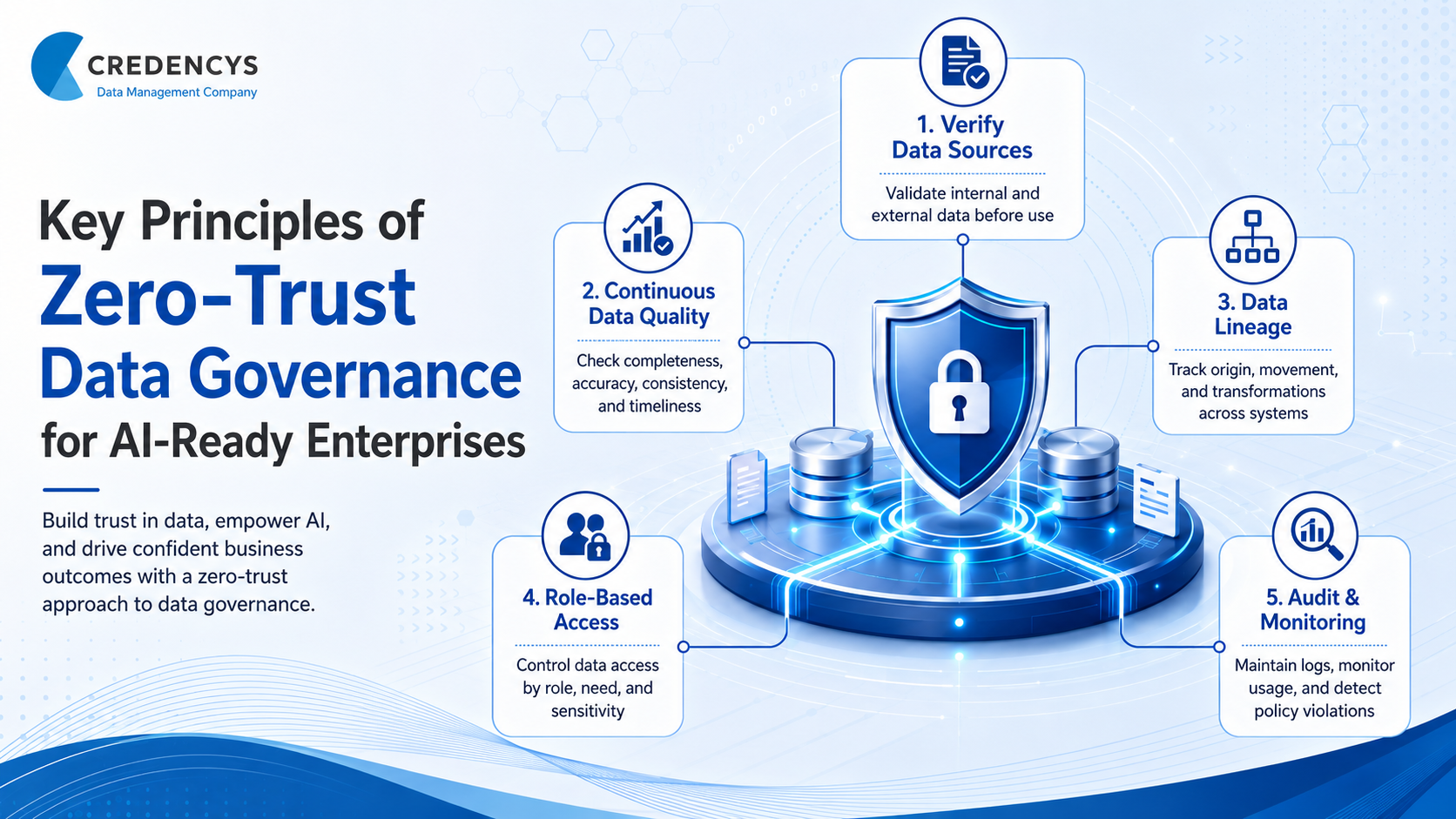
Here are the key principles that define a zero-trust data governance model:
1. Verify every data source
Every system, application, file, integration, and external data feed should be validated before its data is used. This helps ensure that AI systems are not relying on unverified or low-quality data inputs.
2. Validate data quality continuously
Data quality should not be checked only during migration or reporting cycles. Enterprises need continuous validation for completeness, accuracy, consistency, timeliness, and duplication.
3. Track data lineage end to end
Business users and AI systems should be able to understand where the data came from, how it changed, who modified it, and which systems used it. Lineage builds transparency and improves confidence in AI-driven outputs.
4. Apply role-based access controls
Not every user, system, or AI workflow should have unrestricted access to enterprise data. Access should be based on roles, responsibilities, data sensitivity, and business need.
5. Create clear data ownership
Zero-trust governance requires accountability. Data owners, stewards, and business users must know who is responsible for approving, maintaining, and correcting specific data domains.
6. Govern AI-generated outputs
AI-generated recommendations, summaries, classifications, and automated actions should also be reviewed, validated, and monitored. Enterprises should not treat AI outputs as automatically correct.
7. Maintain audit trails for every change
Every important data update, approval, correction, or AI-triggered action should be recorded. Auditability helps reduce compliance risk and supports better investigation when issues occur.
8. Monitor data usage and risk continuously
Enterprises need visibility into how data is accessed, shared, transformed, and used by AI systems. Continuous monitoring helps detect unusual activity, policy violations, and data quality issues before they impact business outcomes.
Together, these principles help enterprises build a governance model where data trust is not assumed. It is earned through verification, transparency, ownership, and ongoing control.
The Role of MDM in Zero-Trust Data Governance
Zero-trust data governance cannot work without trusted master data. Before enterprises can rely on AI-driven recommendations, automated workflows, analytics dashboards, or enterprise reporting, they need to ensure that their most critical business records are accurate, consistent, complete, and governed.
This is where Master Data Management plays a central role.
In many enterprises, core business data is spread across ERP, CRM, eCommerce platforms, supplier portals, procurement systems, spreadsheets, legacy applications, and third-party databases. Each system may hold a different version of the same customer, product, supplier, vendor, material, asset, or location record.
When AI systems use this fragmented data, they may generate incorrect insights, recommend the wrong actions, or automate decisions based on incomplete information.
MDM helps solve this challenge by creating a single, governed, and trusted view of enterprise master data. It allows organizations to verify data before it is used across business processes, analytics, and AI systems.
With MDM, enterprises can strengthen zero-trust governance through:
1. Golden record creation
MDM consolidates data from multiple systems and creates one trusted version of each critical business entity, such as customers, suppliers, products, vendors, materials, or locations.
2. Duplicate detection and resolution
It identifies duplicate records across systems and helps merge, match, or resolve them based on defined business rules.
3. Data quality validation
MDM applies validation rules to check whether master data is complete, accurate, standardized, and ready for use.
4. Data ownership and stewardship
It defines who owns specific data domains and who is responsible for reviewing, approving, correcting, and maintaining data.
5. Approval workflows and governance rules
MDM ensures that important data changes go through controlled workflows before they impact downstream systems or AI-driven processes.
6. Data lineage and auditability
It helps teams understand where master data came from, how it changed, who updated it, and where it is being used.
7. Cross-system consistency
MDM synchronizes trusted master data across enterprise systems, reducing conflicts between ERP, CRM, procurement, commerce, finance, and analytics platforms.
For zero-trust data governance, MDM acts as the control layer that ensures critical data is not trusted automatically. Every record is verified, standardized, governed, and monitored before it supports decisions or automated actions.
This becomes especially important as enterprises scale AI. AI models and AI agents need trusted context to produce reliable outcomes. If customer, supplier, product, or material data is inconsistent across systems, AI cannot make dependable recommendations.
By implementing MDM, enterprises can build a trusted data foundation where every critical record is governed by quality rules, ownership, workflows, and audit trails. This helps organizations move closer to AI-ready data governance and reduces the risk of using unreliable data in high-impact business decisions.
How Enterprises Can Build a Zero-Trust Data Governance Framework with MDM
Building a zero-trust data governance framework with MDM starts with one clear objective: no master data should be used for critical decisions until it is verified, governed, and traceable.
For enterprises, this means moving beyond basic data consolidation. MDM should not only bring data together from multiple systems. It should also validate records, define ownership, apply governance rules, and ensure that trusted master data flows consistently across the enterprise.
A strong MDM-led zero-trust governance framework includes the following steps:
- Identify critical master data domains
Start by defining which data domains have the highest business impact. These may include customer, supplier, product, material, vendor, asset, employee, or location data. Enterprises should prioritize the domains that directly support reporting, operations, compliance, analytics, and AI use cases. - Map data sources and ownership
Identify where master data is created, updated, stored, and consumed. This includes ERP, CRM, procurement systems, finance platforms, eCommerce systems, data warehouses, and third-party applications. At the same time, define business owners and data stewards for each domain. - Create data quality and validation rules
Establish rules to check completeness, accuracy, consistency, format, duplication, and timeliness. For example, supplier records may need validated tax IDs, payment terms, compliance documents, and approved contact details before they can be used in procurement or finance workflows. - Build golden records
Use MDM to match, merge, cleanse, and standardize records from different systems. The goal is to create one trusted version of each entity that can be used across business functions and downstream applications. - Apply governance workflows
Critical data changes should not move directly into enterprise systems without review. MDM workflows can route new records, updates, corrections, and exceptions to the right data owners for validation and approval. - Enable lineage and audit trails
Enterprises need visibility into where master data came from, how it changed, who approved it, and where it is being used. This helps improve trust, compliance, and accountability across data-driven processes. - Synchronize trusted data across systems
Once master data is verified, MDM should distribute it to downstream systems such as ERP, CRM, analytics platforms, AI models, customer portals, supplier systems, and reporting tools. - Monitor master data continuously
Zero-trust governance is not a one-time effort. Enterprises should continuously monitor master data quality, access, usage, policy violations, and unresolved exceptions to ensure data remains trustworthy over time.
When implemented correctly, MDM becomes more than a data management system. It becomes the governance control layer that decides which data can be trusted, who can change it, how it should move, and where it can be used.
Business Benefits of MDM-Led Zero-Trust Data Governance
An MDM-led zero-trust governance approach helps enterprises build confidence in the data that powers operations, analytics, compliance, and AI. Instead of allowing fragmented data to move across systems unchecked, MDM ensures that critical records are verified, governed, and continuously maintained.
This creates value across both business and technology teams.
- Improved trust in enterprise data
Business users can rely on consistent master data across systems, reports, workflows, and AI-driven outputs. - Better AI readiness
AI models and AI agents can work with clean, governed, and contextual master data, reducing the risk of inaccurate recommendations or flawed automation. - Reduced operational errors
Duplicate, incomplete, or inconsistent customer, supplier, product, vendor, or material records can create errors across finance, procurement, sales, service, and supply chain processes. MDM helps prevent these issues before they move downstream. - Stronger compliance and auditability
With ownership, workflows, lineage, and audit trails, enterprises can track how master data is created, changed, approved, and used. - Faster and more confident decision-making
When leaders have access to trusted data, they can make decisions without questioning whether reports, dashboards, or AI outputs are based on accurate information. - Higher efficiency across enterprise systems
MDM reduces manual data correction, duplicate record handling, and cross-system reconciliation. This helps teams spend less time fixing data and more time using it.
For enterprises preparing to scale AI, these benefits are critical. AI cannot deliver reliable outcomes when the underlying master data is fragmented, outdated, or poorly governed. MDM provides the foundation needed to turn enterprise data into a trusted asset.
Conclusion
As enterprises move toward AI-driven decisions, automation, and intelligent workflows, data trust can no longer be assumed. Every record, source, workflow, and output must be verified before it supports business decisions or automated actions.
This is why zero-trust data governance is becoming an important priority for AI-ready enterprises. It helps organizations move beyond traditional governance models and create a more reliable foundation for analytics, operations, compliance, and AI.
Master Data Management plays a central role in this shift. By creating trusted master records, resolving duplicates, applying governance rules, enabling stewardship, tracking lineage, and maintaining audit trails, MDM helps enterprises ensure that critical data is accurate, consistent, secure, and ready for use.
For organizations planning to scale AI, MDM-led zero-trust governance is not just a data management improvement. It is a strategic requirement. When enterprise data is governed and trusted, AI systems can deliver more accurate insights, better recommendations, and more dependable automation.
FAQs – Zero-Trust Data Governance
1. What is zero-trust data governance?
Zero-trust data governance is a data management approach where no data source, record, workflow, user, or AI-generated output is trusted by default. Every data element must be verified, governed, monitored, and traceable before it is used for reporting, analytics, automation, or AI-driven decisions.
2. Why is MDM important for zero-trust data governance?
Master Data Management is important for zero-trust data governance because it creates trusted, accurate, and consistent master records across enterprise systems. MDM helps eliminate duplicate records, apply data quality rules, define ownership, manage approval workflows, and maintain audit trails. This ensures that critical business data is verified before it supports decisions or AI systems.
3. How does zero-trust data governance help enterprises become AI-ready?
Zero-trust data governance helps enterprises become AI-ready by ensuring that AI models and AI agents work with clean, governed, and reliable data. It reduces the risk of inaccurate recommendations, flawed automation, compliance issues, and poor business decisions caused by fragmented or low-quality data.


Tags: