

The Scale and Complexity of Wholesale Product Data
Wholesalers manage large product catalogs across multiple suppliers, brands, categories, packaging levels, customers, and sales channels. As assortments expand, inconsistent supplier data, incomplete product attributes, duplicate records, and customer-specific catalog requirements make product information increasingly difficult to manage.
Fragmented Supplier Product Data
Suppliers provide product information through spreadsheets, CSV/XML files, APIs, portals, PDFs, and other formats, often using different attribute names, categories, identifiers, and data structures.
Large and Constantly Changing Catalogs
Thousands or millions of SKUs, new supplier products, discontinued items, replacements, packaging changes, and attribute updates create a continuous product-data workload.
Inconsistent Product and Packaging Information
Product identifiers, units of measure, case quantities, dimensions, weights, pack sizes, technical specifications, and other attributes may be represented differently across suppliers and internal systems.
Customer-Specific Catalog Requirements
Different wholesale customers may require different assortments, customer item numbers, product attributes, documents, formats, and catalog structures based on contracts, markets, or purchasing requirements.
Disconnected Product Data Across Systems
Product information may exist differently across ERP, supplier files, spreadsheets, PIM, eCommerce, customer portals, marketplaces, and sales systems, creating multiple versions of the same product record.

How Much is Your Product Data Costing You?
Get Your Score + 90-day action plan in 3 minutes.
Check Your ScoreThe Strategic Role of PIM in Wholesale
PIM gives wholesalers a governed product-information foundation for collecting supplier data, standardizing large catalogs, managing packaging and product relationships, and delivering trusted information across B2B customer and sales channels. It helps reduce manual product-data work, accelerate supplier onboarding, improve product discovery, and scale wholesale catalogs without increasing operational complexity.
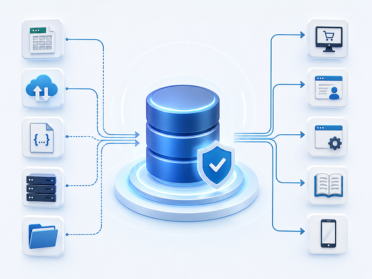
The Single Source of Truth
PIM creates one governed foundation for product identifiers, descriptions, attributes, technical specifications, units of measure, packaging information, images, documents, and channel content. It enables product, purchasing, sales, eCommerce, marketing, and customer-service teams to work with consistent product information.
- Consolidate product information from suppliers, ERP, spreadsheets, databases, and legacy systems
- Reduce duplicate, incomplete, and conflicting product records
- Maintain governed product information across brands, categories, customers, and channels

Efficient Supplier Data Onboarding
Every supplier may provide product information in a different format and at a different level of completeness. PIM standardizes supplier-data intake so incoming records can be mapped, validated, enriched, and approved before they become part of the wholesale catalog.
- Ingest supplier data from spreadsheets, structured files, APIs, and feeds
- Map supplier fields into a standardized wholesale product model
- Identify missing, invalid, duplicate, or inconsistent product information

Product, Pack, and Unit-of-Measure Management
Wholesale products may be purchased, stocked, and sold using different units and packaging configurations. PIM maintains structured relationships between products and their commercial or logistical packaging information.
- Manage each, inner pack, box, case, and other packaging levels
- Maintain GTINs, supplier numbers, distributor SKUs, and other identifiers
- Standardize units of measure, pack quantities, dimensions, and weights

Customer-Specific B2B Catalog Enablement
Wholesale customers do not always require the same product assortment or product-data view. PIM maintains one governed master catalog while providing downstream B2B platforms with the information needed to create customer, segment, region, or channel-specific experiences.
- Support customer-specific product assortments
- Maintain customer-specific item numbers and product references
- Provide enriched product information to B2B commerce and eProcurement systems

Digital Commerce and AI Readiness
B2B buyers increasingly expect to search, filter, compare, and evaluate products digitally before contacting a sales representative. Structured PIM data gives wholesale commerce, search, and AI applications richer product context.
- Improve product search, filtering, comparison, and navigation
- Support attribute- and specification-driven product discovery
- Enable related products, replacements, and cross-sell relationships
Our Approach to PIM Implementation Services
From initial assessment to final deployment, we follow a proven four-step process to deliver a scalable PIM solution aligned with your supplier ecosystem, product catalog, B2B customers, and digital-commerce priorities.
01
Assessment and Planning
Analyze your suppliers, product categories, data sources, packaging structures, identifiers, ERP environment, customer requirements, workflows, and channels to define a clear PIM implementation roadmap.
02
Customization and Configuration
Design wholesale-specific product models, categories, attributes, packaging hierarchies, supplier mappings, product relationships, validation rules, user roles, workflows, and integrations.
03
Enrichment and Governance
Cleanse and migrate existing product information, normalize supplier data and units, associate digital assets, establish data ownership, and configure enrichment, validation, review, and approval workflows.
04
Deployment and Training
Launch PIM across priority suppliers, categories, customer channels, and digital platforms, train internal users, monitor adoption, and provide ongoing post-deployment support.
Business Impact of PIM for Wholesalers
PIM transforms fragmented supplier information into a governed wholesale product-data foundation. It reduces manual catalog work, accelerates supplier onboarding, improves product-data quality, and helps wholesalers scale suppliers, customers, products, and digital channels without multiplying data-management effort.



Ready to Modernize Your Wholesale Product Data?
Build a trusted product-data foundation that simplifies supplier onboarding, standardizes large catalogs, improves B2B product discovery, and keeps accurate product information flowing across every customer and sales channel.
Book a Free ConsultationWhy Leading Enterprises Choose Credencys?
Credencys helps enterprises turn complex data into trusted insights, intelligent operations, and measurable business growth. Here’s what makes us a preferred data and AI partner:

End-to-End Data Expertise
From data strategy to AI deployment, we cover the entire spectrum—Data Management, Engineering, Insights, and Intelligence—to ensure your data drives measurable business outcomes.

Domain-Focused Solutions
Whether you're in retail, automotive, or manufacturing, our purpose-built platforms solve industry-specific challenges with precision and speed.

Enterprise-Grade Partnerships
We collaborate with the best in the business to deliver future-ready, scalable, and secure solutions.

AI-First
We help you move beyond dashboards—accelerating AI readiness, deploying GenAI and enterprise AI agents, and enabling intelligent automation across your data ecosystem.
50+
Enterprise Clients
100%
Certified Consultants
15+
Years Experience
4.9/5
Client Satisfaction
We Build PIM Solutions for


Frequently Asked Questions
PIM for Wholesalers is a centralized approach to collecting, standardizing, enriching, governing, and distributing product information across a wholesale organization. It helps wholesalers manage supplier product data, identifiers, technical specifications, categories, packaging information, units of measure, images, documents, product relationships, and channel-specific content from one governed product-data foundation.
Wholesalers often manage large catalogs assembled from many suppliers. Each supplier may provide product data using different formats, classifications, terminology, units, identifiers, images, and levels of completeness.
PIM can ingest supplier information from:
- Excel
- CSV
- XML
- JSON
- APIs
- Supplier portals
- Databases
- FTP/SFTP feeds
- Other structured sources
Incoming fields are mapped to the wholesaler’s standard product model and checked for completeness, validity, duplicates, and other data-quality issues before products are approved.
Yes. PIM platforms are designed to manage large numbers of products, attributes, categories, relationships, and digital assets. The architecture should be designed around catalog size, number of suppliers, update frequency, product complexity, integration volume, and channel requirements.
Yes. PIM can maintain structured attributes and relationships for units such as:
- Each
- Pair
- Pack
- Box
- Case
- Carton
- Pallet
- Other business-specific units
It can also store pack quantity, dimensions, weight, identifiers, and other product or packaging-level attributes. Where transactional conversion logic is controlled by ERP, the PIM should integrate with the ERP rather than create a conflicting source.
Trusted by Best
Choosing Credencys means partnering with a team that’s deeply committed to unlocking the true value of your data. Here’s why industry leaders trust us:
Our Valued Clientele


Send us a Message
