5 Best Chatbot Development Frameworks to Consider in 2023

The adoption of chatbots has considerably increased among startups to large-scale organizations.

According to BusinessInsider, 80% of businesses will adopt chatbots in 2023.

A report by Grand View Research also revealed that the worldwide chatbot market is forecasted to reach $1.25 billion by the year 2025.

Today, almost every social media platform allows integrating chatbots including Facebook, Slack, Telegram, and Hangouts.

In fact, chatbots have proven to help businesses save up to 30 percent of the cost that they spend on customer support.

These statistics clearly prove that chatbots have can be a game-changer for businesses across all industries.

So, if you’re serious about building a chatbot for your startup or business, then today we’ve shared 5 best chatbot development frameworks to help you build powerful chatbots.

5 Best Chatbot Development Frameworks

Developing chatbots used to be a complex process earlier. But thanks to giant technology companies like Google, Microsoft, Facebook, and IBM, developing chatbots has become fairly easier and simpler due to the below-mentioned chatbot development frameworks.

So without any ado, let’s dive right in!

1 – Wit.Ai (Facebook Bot)

Wit.Ai is an open-source natural language processing API that helps businesses to create both text-based as well as voice-based chatbots.

The best part about the Wit.Ai framework is that it supports most messaging platforms and almost all languages that are spoken across the globe.

And in addition to creating chatbots, Wit.Ai can also be used for automation in voice interface for mobile apps, wearable devices, and home electronics hardware.

The framework basically uses different machine learning algorithms to explore and learn human language and extract useful information.

The Wit.Ai SDK is available for Ruby, Node.JS, and Python.

2 – IBM Watson

IBM Watson is a popular and prolific chatbot development framework that was built on a neural network of 1 billion words of Wikipedia.

The framework comes with a pre-integrated and pre-trained architecture that helps businesses to easily deploy IBM Watson and build custom chatbots.

Just like Wit.Ai, IBM Watson also leverages different machine learning algorithms to respond and supports common platforms such as websites, robots, and messaging applications.

If you’re a business planning to build a chatbot for answering your customers’ queries, you should definitely consider using the IBM Watson framework for chatbot development.

3 – Microsoft Bot Framework

Microsoft Bot Framework is an AI-powered chatbot development framework that was designed to build chatbots with the ability to talk, listen, interact, and communicate with customers.

You can easily build intelligent chatbots for your business that interact with your customers across a wide range of platforms including Slack, Facebook Messenger, Skype, Website, and more.

Powered by machine learning and artificial intelligence, you can leverage the pre-built models to interact with users on all platforms while also deploying the active learning capability.

4 – Dialogflow

Dialogflow is Google’s chatbot development framework that comes helps businesses digitalize certain business processes through its unique voice navigating features to save time and money.

The Dialogflow framework basically uses speech-to-text API to facilitate human-computer interactions.

In other words, the Dialogflow chatbot framework uses AI-powered system, Big Data, and Google cloud architecture to convert speech to text and understand what users are saying to come up with an appropriate response.

You can integrate Dialogflow-based chatbot on different platforms such as Facebook Messenger, Google Assistant, and a few other platforms.

5 – Botkit

Botkit is one of the leading and popular open-source chatbot development frameworks that help to build intelligent chatbots for businesses.

The framework comes with a visual conversation builder and dozens of open-source libraries as well as plugins with useful features like metrics and in-built stats.

As far as the pricing is concerned, the Botkit is available as free and a paid version. The price of paid version starts with $5/month, which changes depending on the average number of users your chatbot interacts with.

Conclusion

What was once considered only as an emerging technology has now become a mainstream technology and an integral part of online businesses.

Chatbots, ever since they arrived, have helped businesses immensely in different parts such as customer support, lead generation, and marketing to name a few.

That being said, if you’re planning to build a chatbot for your business, then it’s important to choose a chatbot development framework that suits all your business requirements.

And this is where we come in…

We’re a leading mobile and web development company helping businesses across the world achieve their business goal.

Our chatbot developers have in-depth domain knowledge and expertise to build intelligent chatbots for businesses in every industry.

Mobile App Design Practices to follow in 2023 & Beyond

Have you ever observed a mobile app closely? When you look at any mobile application, the first thing that draws your attention is its look and feel. Then, the color scheme and the fonts play a further role in catching the eyeballs of users.

One of the most important things is how your application looks visually. While developing your mobile application, you need to consider its UI and UX as they will be the first things to strike the eyes of users.
Ui and UX are as important as the technology that you use to build your mobile application. That is one of the main reasons why some mobile apps instantly hit in the market. 85% of mobile app users confirmed that they will not go back to the mobile-app if the UI and UX is not appealing to them.

If the UI and UX of your mobile application are user-friendly, then it will attract more customers and also will impact your conversion rates. The main goal of an extraordinary UI and UX is to keep users engaged with the app.

Let us take a look at the best mobile app design practices to follow to build a robust mobile app and increase conversion rates.

Best Mobile App Design Practices to follow in 2022 & beyond

1. Planning

Planning is an integral part of the mobile app design process. Therefore, you should plan everything in detail, so that you do not make mistakes while designing the app. Further, you have to work on the estimate of the time required for creating distinctive design features.
It will help designers to work tightly according to the requirement analysis. Additionally, they also need to understand customers’ requirements and implement these things when they start designing.

2. Research

When you are in the designing phase, you need to do detailed web research to find appropriate methods and options. Every mobile application is different and every project is unique. Therefore, designers should be well aware of innovations in the world of tablets and smartphones. It will help you come up with a robust mobile application that will ensure engagement of new users.

3. Specification

Designers will start designing the application according to the specifications you provided them. It includes technologies and tools that UI/UX designers will use. Also, the specification will contain how designers will implement these tools, and this specification will be further, handed over to mobile app developers in the end.

4. Create Wireframes

After you give the specification to designers, the phase of wireframes arrives. A wireframe includes the rough sketch of all the screens of the application. It lets you navigate through different screens and click the clickable objects.

It gives the exact clarity of how your app will look and how users will be able to use different objects and what the screens will offer. The only aspects it lacks are typographic style, color, and graphics since it focuses on functionality, behavior, and priority of the content. You need to build the wireframe to know everything about your business app before it gets developed.

5. Develop a Prototype

After you are done with the wireframe, you are required to create a prototype. It is the exact copy of a live design of the future app, and it represents the interaction between the user and the application.
A prototype is used to evaluate the design and enhance the precision by system analysts and users. It also serves to provide specifications for a real working system.

6. User-Interface Design

User-interface design consists of style guides, rendered designs, and rendered click-through designs.

Style Guides

They act as the building blocks of your app’s design. A sound style guide will help tremendously with your app’s usability. It also helps you set your call-to-action button at the right place with the perfect color scheme.

Building a style guide requires you to consider a lot of things. You need to know who you are and who your customers will be. Will your app be used at night? Then, a dark theme will best suit, which will be comfortable for your users. Will the app be used by only employees? Make sure you keep the clutter to a minimum and come across to the main point.

Rendered Designs

It involves replacing the wireframes with the grayscale elements from your style guide. While doing so, make sure there is a rendered screen for each wireframe screen. Besides, if you want to change the style, you can do so or amend your style guide. The only thing you need to consider is that the design is consistent when this stage is over.

Rendered Click-through Designs

Once you have rendered all your screens, it is the time to return to the click-through model application and test your app again. Even when you have put all your efforts in the app by this time, changes can cost you more. Still, you can review everything and make feasible changes before things become concrete.

7. Project Handover to Developers

After the design part is ready, the time comes to handover the project to developers where they will start the mobile app development. On the basis of the design, they will build the necessary functionality for the app. They need to consider clients and back-end part while integrating features and functionality into the application.

3 Key Mobile App Design Tips to Consider

1. Mobile App Navigation

Navigation holds the utmost significance in a mobile application. Therefore, while navigating through the screens, the user should not face any bugs or barriers. Navigation should be simple and intuitive. A user-friendly and well-thought navigation will attract more users, and they will be able to make the most out of the app.

2. Typography in Mobile App

Similar to other things, users will also notice at the text when they will start using the application. The text has to be readable and clear, and therefore, make sure you monitor what font is used that can increase the convenience of users.

If your app consists of different visual objects, then make sure the text is clearly visible, along with appropriate spaces between lines and words. Above that, you can add an opportunity for users to change the font according to their choice.

3. Color Schemes in Mobile App

You cannot ignore colors when it comes to mobile app designing or creating your mobile app. When it comes to designing, you can play with colors and try different combinations.
While testing different color schemes, take a look at how your application looks from different angles. Make sure the colors should appropriately represent your business and your identity. The right color scheme will ensure how your users will perceive your application.

The Last Words

There is Art in graphic designing, but when it comes to mobile app designing, there is structure and series to it. This structure keeps changing according to the requirements of the application you intend to build. You can incorporate motion design into your app to make it live.

You can successfully design your mobile app with the help of steps we discussed above. At Credencys, we develop promising apps for our clients and help them achieve their desired business goals. We hold an efficient team of Android app and iPhone app developers who are dedicated to offering unconditional support to clients.

Mobile App Development Lifecycle: 9 Steps to Consider

Mobile apps have taken a remarkable rise in the tech market. App stores are overflowing with various kinds of applications. Several businesses have stepped forward in developing their mobile applications to expand their business and achieve success. Mobile applications have become an integral part of people’s lives, which has inspired enterprises to come up with their apps to satisfy their customers’ requirements.

When you plan to develop your mobile app, it is important that you integrate unique features and functionality to make it stand out in the market. Also, it is significant to see that it does not become a common app similar to others. Your mobile app has to have the potential to attract new customers and retain the existing ones as well.

The process of building an application involves a lot of things to consider. Additionally, design and functionality play a critical role in the growth of your business. You can achieve your goals only if you get your mobile app development right the very first time.

The mobile app development is divided into different phases, which contribute to building the application. You need to know these stages of development, which we will discuss in the post.

9 Phases of Mobile App Development Lifecycle

1. Planning & Research

The first phase of mobile app development involves research and planning. It is the most important stage in the entire process of building an application because whatever you will lay down will become the base of your development.

During this phase, it is crucial to do substantial research and brainstorming. While doing so, you will need to answers to questions such as what is the aim of your app? Who will be your target audience? Which platform will suit your application development? Will your app be a paid one or free?

Once you know the answers to these questions, it will be easier for you to identify how you want your app to be. The analysis will help you decide your target audience. Often, the target audience becomes a pivotal aspect in helping you decide the platform of your application, and you will come to know about what category of users will use your app.

Another thing you will need to know is to have a detailed analysis of the competition. For this purpose, you need to make a survey of your competitors’ apps to see what features they offer. Additionally, you can look for the missing features and try to incorporate them into your application to make it stand out in the market.

2. Assessment of Technical Feasibility

Analyzing visuals is not enough for app development. You need to determine whether the backend systems will support the App’s functionality. It is significant to examine the technical feasibility of the idea of your app development.

Additionally, you need to determine the platform of that you will use in the development. Application development has various requirements and they depend on the type of platform you use; Android or iOS, or both.

3. Wireframe & Prototype

When you come to this phase of mobile app development, you will have a pretty good idea about how your application will look like and what features you want to integrate. Now, it is the time to sketch out your application, which will give you a clear picture of its navigation.

The sketching of the app is technically known as wireframing. You can create wireframes of your application through online tools. Also, you should build a storyboard or a working prototype, which will allow you to have clarity about the connections among different screens of the end-user’s journey.

4. Designing the Application

When you are done with defining the prototype of the app, it is the time to start with the design and layout. The wireframe will effectively help you in creating the design of the application. You need to determine the UI/UX in the designing phase of app development. While doing so, you need to consider a few things as below:

  • Make sure you maintain a balance between the content and user interface
  • Ensure to integrate the features while designing the app
  • Do not use a lot of gestures
  • Maintain clarity and consistency in the flow
  • Create an interactive UI

5. Developing the Mobile App

App development involves a number of steps and processes. It is important to set up the actual storage solutions, databases, APIs, and servers for the backend of your app.

Additionally, it is vital to have your developer’s accounts for the app stores that you plan to use to distribute your app. This step can take you several days to complete. Read the app store guidelines thoroughly to avoid the rejection of your app during the review process.

The development process also includes the integration of the defined features into your application, backend technology selection; OpenSource, Java, .Net, etc..

6. Testing the Mobile App

You finally have a complete app concept with exciting graphics and properly placed content. Therefore, now, it is the time to test it for any technical flaws or bugs and correct them right away.

You can go through your original planning and design documents and cross-check everything with the app model to see if the requirements have met successfully. Testing an application has become easier, thanks to the online mobile UX testing tools, which give you real-time feedback and analytics. Make sure you test cross-platform compatibility of images, graphics, and user experience.

7. Deployment

When your application is tested for technical errors and flaws, then it is ready for deployment. In the deployment process, you need to deploy the app on the server and determine whether it meets the security standards defined for the data leakage. You need to make sure that the data does not leak from the server. For this, it is crucial to ensure that the database is secure by all means.

8. App Launch

Once you are sure about every aspect of your application, then the launch time arrives. You can launch your app in the App Stores. It is the final stage of mobile app development.

Register your app over different App Stores apart from the two main stores; Google Play and Apple App Store. In addition to this, it is vital to address your application towards the right audience group, along with the right platform.

9. App Enhancement

Even when you have launched the latest version of your mobile application, you are not done with the app development process yet. Yes, you read it right. The application needs to have continuous updates and upgrades at regular intervals. Also, you need to add new features with every update that will enhance the user experience.

Regular updates will also help you keep your customers and users engaged with your application.

Conclusion

App development does not end at creating the prototype, but it also includes a selection of the right technology. An application needs to go through an array of processes, and enterprises and organizations to take the benefit of the results produced.

The phases we mentioned above will help in the successful development of your mobile application.

At Credencys, our team is dedicated to offering robust and promising mobile app development services that help businesses take their business to new heights of success.

A Brief Understanding of Native App Development [A Guide]

Thinking about starting a business? Then you should seriously consider having a high performing website and mobile application for your business. In this digital era, every business needs to be online to get more consumers and to beat the competitors. When it comes to developing a mobile application you need to be aware of the fact that, mobile apps outpaces the website in certain areas like personalization, notification, accessing speed, offering potential features according to the individual consumer, and so when compared.

At the same time, the platform which you choose for developing your mobile application for your business plays a vital role. Modern-day developers prefer native app development since it develops with the platform supportive language and possesses several advantages in terms of performance.

What is Native App Development?

Native app development is nothing but just a creation of the mobile application or software program with the codes which preliminarily used on a device or a specific platform/Operating System. Developers build native apps that are compatible with desktops, smart TVs and all other existing gadgets. However, the most common and target device in which the developers develop a native mobile app is the smartphone.

Unlike normal or non-native mobile applications, native mobile apps will tend to utilize the features of the specific or chosen operating system (Android or iOS).

However, it will take significant time and a lot of effort for keeping the native app up-to-date

Why Do Developers Prefer Native App Development?

When compared with other mobile applications, a native mobile app is specially designed to meet the requirements of a specific need or system. Besides here are the few other reasons for which programmers prefer to develop a native mobile app.

1. High Performance

When compared with non-native apps, the native mobile app runs much faster and delivers good performance mainly because of using platform supportive language for development. Besides, mobile native apps tend to run smoothly without causing troubles and can be effectively used to integrate with exclusive APIs and other components to optimize the app furthermore to receive better outputs.

2. High-Level Security

Since the native mobile apps are developed using the platform supportive languages, these native apps are generally protected by the different security layers of the specific operative systems. Because of that, it’s really hard for the intruders to exploit it. Also, native mobile app development doesn’t involve using any third-party frameworks which often acts as a gateway for intruders to exploit. So, when compared with non-native applications, the native apps are highly secured.

3. Truly Tailor-made

Since the native app development carried with a language that is platform supportive, developers would feel more comfortable as they don’t need to integrate any third-party model inside the native code. Because of the ease, many experienced developers around the world mostly prefer to develop a mobile application with native code.

4. Access To Hardware Features

Unlike non-native mobile applications, apps that are developed with native codes have the advantage of utilizing all the available hardware features that are present in a mobile device. Besides, the implementation of the hardware features is pretty easy with the native codes the best examples of native apps which utilizing hardware features of a mobile phone is Google Pay and Siri, thanks to the exclusive APIs offered by Android and iOS on their operating system.

5. Easier To Scale

Applications that are developed by the native code are easy and faster to configure because of the platform supportive language used for the app development. Besides, users don’t need to worry about the different versions of Android; you are free to use any of the available features from the given platform Android or iOS. Also, developers can stay with the native code and they can extend some of the modules to make the app as the cross-platform one.

6. Offers More Stability

Well, we all know the stability of the Android and iOS, since the native apps developed under these platforms are ultimately more stable than the non-native apps developed with other programming languages where you may worry about losing support from the language makers. Also, native apps are accessible faster than other apps since it doesn’t include any third-party APIs for becoming cross-platform applications.

Besides, developers prefer native mobile app development on considering its imposed standards of utilizing better UX/UI patterns for a specific platform. Owing to that, the integration process of this native application with platform-specific features like Google Pay or Siri can be easier than the platform-independent applications.

These are the vital reasons that enforces developers and business owners to develop an appealing native application with all capabilities and standards. Also, a native app will have all the benefits of a normal web or mobile application along with the impact of utilizing the features of the specific platform where it is going to operate.

Native App Development for Android Platform

Developers prefer Java, Kotlin and C++ programming languages for developing a native app for the android platform. In addition, developers make use of the advanced android development tools offered by Google, which are listed below.

  • Android SDK
  • Firebase
  • Android Jetpack

Native App Development for iOS platform

For creating native apps for iOS, developers prefer Objective- C or Swift programming languages. Meanwhile, unlike Android, the iOS platform has closed source code which is specifically designed for Apple devices. So developers need a Mac device for native mobile app development for the iOS platform.

Apart from that, Apple has several tools and excellent resources for developing applications for the iOS platform which are listed below.

  • iOS SDK
  • XCode
  • Swift Playgrounds
  • TestFlight
  • AppCode
  • CodeRunner

Essential Features for Native Mobile App Development

Regular Updates: Since the native mobile apps tend to be operating in the stand-alone mode it requires regular updates from time-to-time. In fact, developers can develop a native app with automatic sync-up with an app store for updating themselves automatically by sending notifications promptly to the users.

Need To Focus on User-Driven Actions: Native apps are specifically designed to meet the individual user’s need and it should be developed to offer convenience to the users. To achieve it, it requires understanding the user’s usage patterns and to collect the user profiles and to adjust or modify the app accordingly.

Requires Regular Monetization: Native mobile app development is expensive and it may have legal or technical restrictions. So, monetizing native mobile app could be tricky and at the same, it is essential because some native apps support the payment system. Hence developers should implement trackers and maintenance with the user’s knowledge.

List of Top Native Applications You Can Find In-App Market

Well, developing mobile applications under the native division is the latest trend among the developers and also for business owners. The main reason could be the advantages possessed by the native app among the users.

Here are the lists of few top native mobile applications in today’s market.

Final Verdict

If you are looking to develop a fantastic mobile application with high performance and high reliability along with supreme security features then choosing native app development could be the best and wise option. The native app offers various features along with app monitoring tools which are effective for both developers and owners to follow the app operations and to adjust the app function according to the end-user effective usage.

Frequently Asked Questions on Native Application Development

1. Does Native App Provide Better User Experience in terms of Look and Feel?

Yes! Since the mobile applications which are developed using native scripts, they developed under close guidelines for performing in popular platforms. Also, these apps are specifically designed to provide quick accessibility and learning aspects to the users. Besides, there are plenty of other reasons that offer better user experiences.

2. What Languages are used to develop a Native App?

Developers can make use of any potential language for developing a quality Native App, however, experts advise to make use of the languages which are specific to the operating system in which the native app is going to function. Obliviously, the modern age developers primarily prefer Java for Android and Objective-C for iOS platforms.

3. What are the popular languages used by programmers to develop a Native App?

Though Native Apps can be developed in different programming languages programmers worldwide commonly use Java, Objective-C for iOS, Kotlin, and COBOL for developing a native mobile app.

4. Why You Should Go For Native App Development Then Others?

Unlike other apps, Native app development allows developers to design native components using the latest web technologies. Besides, developers can combine the prominent web technologies with the native code to develop an awesome application that can be used for several components like android jetpacks and so.

5. How long does it take to develop a Native App?

In general, developing a typical Native mobile application might take around 4 to 6 months, however, it can take less time or it may consume more time depending upon the requirements for native mobile app development.


Top 9 Software Development Trends to Watch Out in 2023

Technology and software keep changing constantly and therefore, it becomes difficult to keep on top of trends. Moreover, with the emerging technologies, businesses and different industries deploy them in their fields to keep up with the competition. They constantly strive to serve their customers the best and unique products.

If companies and professionals do not leverage emerging technologies, then it might be difficult to compete against companies which have started to leverage technology to boost their businesses. However, it may be challenging to sort through the latest technologies to identify which one will be viable for your field. Also, you need to consider them in aspects of Return on Investment (ROI).

If we take a look at 2018, then you will find that there have been significant technological advances in the IT industry. Significant software technologies like Blockchain, IoT, AI, and more have been in the limelight for the past couple of years. These technologies are still evolving with improved use cases in 2022. It is expected that the software industry is forecasted to experience an 8.3% rise in 2022.

Let us take a look at which technologies you will need to watch out in 2022 if you are planning to expand your business on the horizon of software technologies.

Top 9 Software Development Trends that will rule 2022

1. Artificial Intelligence

With the emergence of Artificial Intelligence, it became easier to do those tasks that were limited to human minds. It is because the machines are programmed to conduct them exactly like humans. Therefore, you can say that Artificial Intelligence-based software can think intelligently like human beings.

Machine learning and deep learning are subsets of Artificial Intelligence, and they are gaining popularity among businesses. Therefore, more and more organizations have started to take machine learning development services as a necessity.

Artificial Intelligence makes simplifies business tasks and also brings an improvisation. Moreover, it has proved to be a great support to developers to experiment. This quality of AI has made its successful deployment in healthcare, banking, education, mathematics, and more.

2. Progressive Web Applications

Progressive Web Applications (PWAs) are a kind of a mobile app that is delivered through the web. They are developed using common web technologies including HTML, CSS, and JavaScript. PWAs can work on any platform that uses a standards-compliant browser. These applications are equipped with functionality that includes working offline, push notifications, and device hardware access, enabling creating user experiences similar to native applications on mobile devices. They have a script called service worker is an integral part upon which they majorly work.

Since they are web applications, developers do not need to install web apps via digital distribution systems such as the Apple App Store or Google Play. Moreover, PWAs are easy to develop & maintain, and can be loaded quickly even with low internet speed. Therefore, several mobile app development companies have shifted their focus on Progress Web Applications in the past recent years.

3. IoT

IoT known as the Internet of Things is the extension of Internet connectivity into physical devices and everyday objects. These objects are embedded with electronics, Internet connectivity, and other forms of hardware. They can communicate and interact with other similar devices over the Internet and can be monitored and controlled as well.

Applications based on the Internet of Things have spread to both customer and industrial domains. IoT has exponential demands in the sectors of safety and customer experience.

4. The Mixed Reality

Mixed Reality combines two technologies, Virtual Reality (VR) and Augmented Reality (AR). Let us take a look at the findings by statista in relevance to the demand and deployment of these technologies.

According to Statista, “The statistic shows the automotive industry’s spending on augmented and virtual reality (AR/VR) worldwide in 2017 and 2025. In 2025, the global automotive AR and VR market is forecast to reach about 673 billion U.S. dollars, with a CAGR of 175.7 percent from 2018 to 2025. Technological advancement in connectivity is a major reason that drives the fast growth of the market.”

global-ar-vr-automotive-spending

AR has remarkably grown over the years with the increased use and its integration on smartphones apps. With the rise in the emergence of different smartphones, companies are scrambling to invest in building their AR application. They also hire AR app developers for this purpose. Unlike Virtual Reality, AR apps do not need hardware with the latest specifications.

5. Cloud Computing

Cloud computing evolves every year and is expected to forecasted to expand in 2022. Companies deploy hybrid and serverless cloud architectures to support various apps and to lower operational costs. Cloud service providers like AWS, Google Cloud and Microsoft Azure promote serverless models for computing. It beats even virtual infrastructure, which is the main concern for developers.

Moreover, lots of open source frameworks have accelerated in the direction of revolutionizing the way enterprise software apps are developed on the cloud.

Application containers will rise across enterprise environments. These containers will help developers develop and deploy apps faster and independently. Therefore, cloud services are forecasted to use more tools such as Docker enterprise, Kubernetes, Mesosphere etc. for managed containers.

6. Blockchain

Blockchain has always been one of the most talked about technologies in the world of software. The introduction of this technology has brought digital currencies such as bitcoin and Ethereum in the market. Along with being extensively used in the financial sector, industries such as media & publishing, banking and finance, and healthcare software development services have started to embrace Blockchain technology.

Thus, this technology is on a remarkable rise in 2022, and majority businesses will expand by embracing it.

7. Microservices

Microservices is expected to mature from a trend to the best practice in 2022. As a result, developers will adopt microservices as their must-have strategy. According to IDC, “by 2022, 90% of all apps will feature microservices architectures that improve the ability to design, debug, update, and leverage third-party code”.

Microservices architecture effectively meets the increasing demand for highly scalable applications. It offers separate data storage, minimize time-to-market, improve fault isolation, and a centralized security module.

8. Language Trends

Mostly, full stack developers use JavaScript to develop a software, as it is one of the most popular languages that offers great adaptivity for hybrid apps as well. It is crucial to select the right language to avoid repercussions in the later stage. You can come to know about these languages from various surveys.

Moreover, in the stack overflow survey of commonly used libraries, frameworks, and programming languages, Node.js scored 49.9% and Angular scored 39.6%. Other popular libraries, frameworks, and languages are React, .NET core, spring etc.

9. Cybersecurity

Organizations has always aimed to protect their critical information from unwanted access. However, the transformation came with the creation of Hullabaloo by WannaCry.

Cyber Security is critical for any business on both the internal and external front. It is very important to consider safety when it comes to safeguarding software and other internal functionalities. Enterprises take all kinds of measures to ensure that no vulnerabilities will attack their system through the development phase. Still, the question remains the same; what about the later stage? A lot of cybersecurity setups have emerged across the globe to provide external security. However, you still may need to take extra measures for the internal protection.

Conclusion

From the above discussion, it is very clear that these trends are going to be significantly present in the tech market in 2022. Along with these trends, the development industry is transforming to the next level of efficiency and productivity.

Software development is the core of the software industry and the tech world as well. Therefore, developers will need to update themselves with the changing and emerging trends to keep up with the latest technologies and their deployment.

Top 11 Fintech App Development Ideas for Fintech Startups to Invest

There was a time when to send money, transfer funds, deposit/invest money, make payments, etc. we used to visit banks or respective financial institutions.

With the emergence of technologies, everything is possible with just a few clicks on the mobile phone.

Fintech is one of the industries that use technologies to create new and deliver better financial services to consumers. It empowers different startups and encourages them to compete with the banks and leading financial institutes.

Many startups have been doing great by considering different fintech app monetization strategies. The apps not only help them to serve the financial services to the large audience but also to deliver a better customer experience.

Fintech market is booming these days as many startups have started developing fintech apps by focusing on a specific set of services.

Role of Fintech Apps in the Growth of Fintech Startups

Developing feature-rich fintech apps, startups perform all the operations including insurance, finance management, asset management, payments, and more for the businesses as well as individuals.

The technology constantly improves payment processes and transaction security of mobile solutions. Along with payment, fintech apps take care of other financial factors such as insurance, equity, shares, stock, risk compliance, and more.

If you are catering any of the above financial services, then it is very essential for you to discover the fintech app ideas that fuel your startup.

Do you want to explore which fintech app ideas are in trend in 2020 and beyond? Here you go!

11 Best Fintech App Ideas for Fintech Startups

1. Crowdfunding Apps

When it comes to fintech startups, crowdfunding is one of the platforms amongst other fintech ideas. The concept is popular across the US and UK regions.

Crowdfunding apps help startups to raise money for your new or existing enterprise through collective efforts from a number of individual contributors and ventures.

2. Equity Apps

Equity financing becomes easy with fintech apps as it helps you to make money faster. Such apps are developed by companies that try hard to connect the investors with the people who need funding to build their business.

With the equity apps, the fundraising process can be done online without any paperwork. Thus, it becomes quite simplified for investors to invest in funds.

3. Investment and Trading Apps

Users can manage all assets and investments in one place using investment and trading apps. With a fintech app development for investment and trading, users can hold, sell, and buy stocks, forex, shares, funds, cryptocurrency, and more. They can check the asset valuation as well.

Build a secure, scalable, and fast investment and trading application that helps the users to stay informed and make the right decisions.

There are investment platforms that allow users to capture and aggregate investment data from different sources. Also, the apps provide a detailed and secure analysis of trading or investment data through business analytics and AI.

Key features of investment & trading fintech apps

  • Virtual stock exchange
  • Send stock alerts
  • Algorithmic trading
  • Stock market games for users to play

4. Personal Finance Apps

The personal finance apps allow users to manage their money, investments, expenditure, incomes, and other finances in a hassle-free way using a mobile or web platform.

The apps enable users with spending trends, data visualization, categorization of all financial activities. If required, the app asks for access to the user’s bank account and other data, and interact with the respective banking API.

Benefits of Personal Finance Apps

  • Get access to financial products or services anytime and anywhere
  • Reach out to a large audience and serve them by developing a responsive design
  • Enable the businesses to explore the new ways to distribute their wide range of products and services
  • Cross-platform fintech app development boosts your conversion rate and provides insights about customer preferences and requirements

5. Money Transfer Apps

Digital technologies such as blockchain, face and voice biometrics, NFC, etc. have changed the conventional ways of people sending the receiving the money. For the international money transfer, banks charge a good amount as a fee.

With the money transfer apps, it becomes easy to send and receive money from any corner of the world at cheaper rates and in the least time-consuming way.

6. Regtech Apps

These are basically regulatory apps that solve the regulatory problems and challenges of fintech startups using advanced technologies such as machine learning, cloud computing, and big data.

Using Regtech mobile applications, startups can improve the different operational areas mentioned below.

  • Identifying the client and legal personas
  • Monitoring of the various types of payment transactions
  • Trading in the financial market
  • Reducing risk in data collection, modeling, and predictions
  • Finding out new regulations

How digital technologies help fintech startups in risk compliance?

  • Blockchain, Biometrics, Cryptocurrency provide better security
  • Artificial Intelligence (AI), Machine Learning (ML) & Robotic Process Automation (RPA) prevent the fraud
  • Cloud applications to drive efficiency and better scalability
  • API integration ensures better interoperability

7. P2P Lending Apps

There are person-to-person fintech apps that allow individuals to land and receives loans to other individuals directly without using the services of any financial institutions. It’s a platform that connects both the lenders and borrowers.

In such apps, the loan rates could be either fixed or assigned based on the reverse auctions. The apps allow borrowers to assign the maximum rates at which they want to take a loan.

On the other end, landers bargain with each other to lend the fund at the lower rates. The objective of the creditors is to get more customers or borrowers.

Creating a finance app for P2P lending, businesses can bring their processes to the next level and increase the customer base. Through the fintech app development, P2P lending businesses are taking benefits of

Elimination of expensive intermediary

Zero investment in the integration of expensive intermediary. Customers need to pay any change of banking services, convince creditors, and visit branches to issue the loan.

Lenders & borrowers have the flexibility to define conditions

The apps allow creditors and borrowers to share the deadline, sum, and interest rate for the future bargain.

Users need to register with the fintech app by filling up a form. Registered users can get the loan, check the user’s solvency through the special ratings and approve the loan.

Leverage least Interest rates on the loans

Compared to banks and microfinance companies, the P2P lending business charges less interest rate. Moreover, P2P businesses do not need to set up an office and manage documentation as every operation can be performed using the fintech app only.

8. Insuretech Apps

These are insurance fintech apps that are powered by business intelligence, data science, IoT and mobility solutions. These apps gathered the data and analyze them to provide customers the personalized offers, pricing, and recommendations.

Offering real-time data to the insurers, the apps help them to manage risks effectively and increase the ROI.

With the fintech app development, insurance companies can improve their business process and customer experience.

Insurtech mobile apps are accessible to the customers at any point in time and at any place. It is not possible with the agents as humans cannot available 24/7*365 to serve the customers but apps can.

9. Mobile Banking Apps

Almost every bank has their own mobile apps to enable customers with a better experience by allowing users to perform all the banking operations just with a few clicks. The large share of the population that uses digital banking are Millennials.
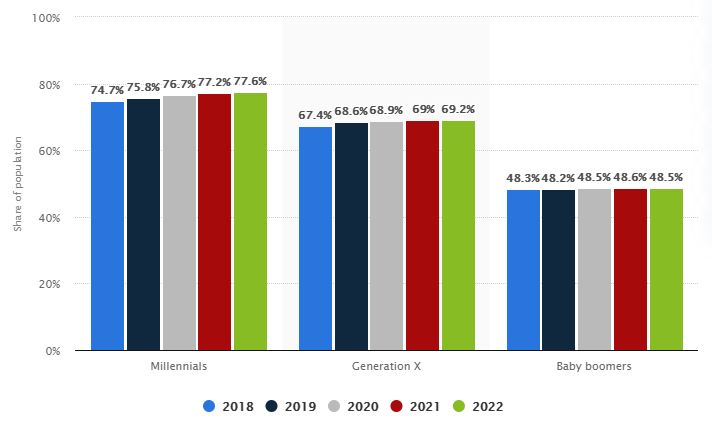
Digital Banking in the United States from 2018 to 2022

“The above graph shows the share of the population using digital banking in the United States from 2018 to 2022, by generation. In 2018, almost 75 percent of Millennials in the U.S. used digital banking, which is set to rise to 77.6 percent by 2022.”

Statista

The new generation does not like and does not have time to stand in a queue of the banks. They want to have all the financial details on their fingertips. Thus, they love to use mobile banking apps.

Using the fintech apps, banks can gain more business. In the United States, almost every bank is using mobile apps.

If we talk about Asian and African regions, banks enable customers with the flexibility to perform different banking operations anytime and anywhere through fintech app development.

10. P2P Payment Apps

Peet-to-Peer payment apps are very useful when users need to send money to their friends or relatives or other individuals. These apps link the user’s account with the other user’s digital wallet.

When the user performs a transaction, the P2P apps send money directly to the recipient from the sender’s account and record the transaction.

“Peer-to-peer (P2P) payments are increasing significantly in the US, driven by tremendous growth from Venmo and Zelle. Our latest estimates show that P2P mobile transactions will total $309.95 billion this year, growing 27.9% to hit $396.48 billion in 2020.” –

eMarketers

Three different types of P2P apps are available in the fintech market for the users to send money to their dear ones.

Connected with banks

There are P2P mobile apps in which banks are allowed to conduct transactions. The apps facilitate users to transfer funds through partner credit unions and banks.

Connected with digital wallet services

Samsung Pay, Apple Pay, Android Pay, etc. are the popular platforms that allow for peer-to-peer money transfer in real-time.

Connected with standalone services

It refers the online payment companies like PayPal that work independently without getting linked with any financial organization. It contains a wallet like a feature where users can store money before sending it to another peer.

11. Payday Loan Apps

Payday apps connect fintech startups with borrowers in an interesting way. Startups can lend a certain amount to the users as a loan to deal with any financial emergencies such as paying medical bills, electricity bills, EMIs, other bills, and more.

Users need to add bank account details in the app so the fintech startups deposit the money into it. Users cab cash the money at any time as the apps keep a record of every transaction they made.

Important features of payday loan Apps

  • Assured security of the users’ bank details and data
  • Get a loan of a particular amount with just a few clicks
  • No hidden charges
  • Notification and alerts about upcoming payments

Bring Your Fintech App Development Idea to Life with Credencys

I think you have enough fintech app ideas to explore and invest in it. Go with the one or more that you feel more profitable for your startup.

Credencys will help you bring your dream into reality by offering end-to-end mobile app development services to build a robust fintech app for your startups. We have a team of 150+ season developers who hold extensive knowledge of iOS, Android and cross-platform technologies and have exposure to working with different types of businesses in the fintech domain.

Leverage our proven experience of fintech app development for the effective execute your idea and on-time launch of the app. We develop a perfect mobility solution for your business with the right set of features.

Frequently Asked Questions About Fintech App Development

Should a financial startup hire a mobile app development company or freelancers for fintech app development?

Choose a reliable mobile app development company over the freelancers for the robust and reliable fintech app for your business. Explore the top reasons for considering a mobile app development over freelancers.

What technologies are disrupting the fintech industry?

Cryptocurrency, AI, ML, data science, blockchain, etc. are the disruptive digital technologies that have been terraforming the conventional finance industry inside out by developing robust web and mobile applications.

What are the best programming languages to build a fintech app?

The selection of the right technology stack depends on the r project requirements. C, C#, Java, Python, Ruby, C++, are the technologies that are used to develop a simple to complex fintech app.

How can I validate my fintech app idea at the initial phase of app development?

To ensure the success of your fintech app idea, you can go for Minimum Viable Product (MVP), Proof Of Concept (POC) or working prototype. It helps to check the market potential of your product without developing a full-fledged app.

Top 8 Security Measures iPhone App Developers should consider

Security holds a significant place in any sector. Likewise, it is important to have robust security in your mobile applications. Here, we shall be talking about iPhone app development. One of the key factors to a successful mobile-app is the Security of the App.

It is critical to have software security as the prime concern in all the phases of iPhone app development and its deployment as well. When you hire iPhone app developer to build your business iPhone app, make sure they always develop apps with the latest technology and security advances.

iPhone app development has recently gained immense popularity, but when you consider the app security, it should start with the development phase. Therefore, iPhone app developer has to make sure to test the code thoroughly while developing the application.

There can be various vulnerabilities in the application’s source code, and iOS app developers should focus on the security area. Therefore, robust security has to be the topmost priority of every developer while building an app through all stages.

Let us understand how you can cope with the security issues that may arise in the iOS app development.

Security Breaches to Consider

1. Leakage of Sensitive Data

Often, a large chunk of applications contain leakage of sensitive data, which is ignored by the developers due to lack of awareness while developing iOS app. Poor coding and vulnerabilities give way to malware attacks.

These attacks can cause major damage to the application in further stages. Security issues have emerged in recent years and have taken a rise in the world of app development. Therefore, it has become critical for iOS app developers to take appropriate security measures while developing the app.

2. Password & Administrative Security Breaches

One of the security breaches is about password security and administrative rights leakage. When you have weak system passwords, fraudsters can easily track them and tap them by malware. Additionally, it allows others to intrude easily.

It is a serious issue and the relevant system analysts, designers, and security in-charge should take steps in the direction of codes. iOS app experts have to follow the guidelines and make the code immune of any malware attack or illegal intrusion.

Apple has made sure to keep the App Store secure and keep smartphones safe. If you have noticed, then iPhone apps are well-known for their strong security standards. In spite of taking high-security measures, frauds and malware attacks have become prevalent in recent times. iOS app developers come across several challenges during the development phase, and one of them is the App Security.

iPhone app developers need to understand the security measures we will discuss below.

Top 8 Security Measures iPhone App Developers need to Consider

1. Secure the Code

Fraudsters target the design and code of the application by taping vulnerabilities or bugs. They also repackage popular apps into Rogue Apps that contain malicious code and post them on third-party app stores to instigate unsuspecting users to install them on their devices.

Therefore, the app developers should use such tools that help them detect and resolve security vulnerabilities. It will help them prevent their apps from reverse engineering.

2. Cautious Selection of third-party Libraries

App developers use third-party libraries while developing iOS applications. These libraries help to speed up the development process to a great extent. When you use third-party libraries, your application becomes vulnerable to hackers and fraudsters, as several of them can contain malicious code. This code is operated by anonymous developers with an intent to hack the application’s data.

Therefore, you can safeguard your application’s security by ensuring that developers use the proven and tested third-party libraries & components.

3. Secure the Data

Often, mobile apps need to access enterprise data, documents, and information that is stored on the device. You can secure this data with the help of mobile data encryption. It will secure the data within the app sandbox against malware and other illegal access.

Further, you can ensure data security by controlling and encrypting the individual data elements, which, in turn, will help you control application data sharing on the device. iPhone app development should abide by all security rules and regulations that also includes testing the app code during the development process.

4. Secure the App Transactions

Users mostly, carry out their transactions with enterprise apps on the go, which increases the risk. For example, if you are access certain information through an app, then it has a lower risk of malware or getting hacked. While the approval of a large payment to a new supplier can be considered as a high-risk transaction.

Therefore, developers should consider the criteria of different transactions while developing the application.

5. Test & Update Regularly

Security of your iPhone app is an on-going process that involves to ensure security at every stage of development and deployment. App professionals have to practice the security standards in their routine to overcome the relevant malware issues.

Testing is one of the inevitable areas of app development that every iPhone app developer needs to consider. If your testing is improper or inappropriate, it may result in the failure of your mobile app. Therefore, it is critical to test the application at regular intervals or at every stage of development and fix the vulnerabilities or loopholes that come across with the release of every new updated version.

6. Secure your Network Connections on the Backend

Mobile app APIs access servers and cloud servers, therefore, they should also be protected to according to the standard security measures. It will help prevent unauthorized access as well. Additionally, iOS developers should verify APIs and the ones who access them, as it will help prevent the passing of sensitive information from the client’s server to the application’s server & database.

You can use either a VPN (Virtual Private Network), SSL (Secure Sockets Layer), or TLS (Transport Layer Security) connection to ensure the safe transmission of data. They add extra security to your data transmission.

7. Integrate High-level User Authentication

Authentication and authorization are the integral components of mobile app security. Though majority it depends on end-users when it comes to using these elements, it becomes your responsibility as the app owner to educate them about authentication and authorization.

Regardless of your iPhone mobile app dealing with sensitive information, you should always leverage advanced mobile app security technologies like JSON web tokens, OAuth 2.0, and OpenID Connect protocol. These technologies help you increases your application’s security.

8. Encrypt all the Data

When it comes to securing your iOS application, you do not only have to strengthen the security of source code. The secure transmission of data between the mobile app and the backend server is also of utmost importance. You can ensure high-level data security by encrypting it, which will make it harder for hackers to read your app data.

Therefore, iOS app experts should make sure that all the data transmitted from every unit is perfected encrypted. It will effectively strengthen the security of your mobile app.

Conclusion:

With the increasing iPhone app users, the number of fraudsters is also increasing, and they are waiting to steal your app data within no time. Therefore, it is crucial to hire iOS app developers to develop apps that will make your end-users secure by all means and give them a pleasant end-user experience at the same time.

At Credencys, we use high-end security standards and measures to offer robust iPhone applications. Application data security is our top priority while building them. Consult us to offer your customers a highly secured iOS app.

Swift or Objective C – What to Choose for iOS Development?

For many years, mobile app development world has given a predominant place to Objective-C. It is a compound of C language and is used extensively for developing iOS and OS mobile applications. It is enriched with object-oriented features and efficient runtime. It was a dominant language used for iOS development, until Apple launched a unique programming language in 2014 called Swift.

In comparison to Objective-C, Swift is safer, more concise, and sophisticated programming language. Additionally, it encourages interactive development system. It consists of features such as generics, short syntax, closures and type interface. These features simplify the coding and eliminate complicated patterns that was experienced in Objective-C.

While Objective-C has proven to be stable and has dominated iPhone app development for many years, Swift has emerged as the newest and unique programming language. It provides numerous benefits and a modern way of coding.
Despite the unique functionality and features of Swift, developers still feel the dilemma in selecting the right programming language for better iOS app development.

Let us understand both these programming languages in brief so that you can take the right decision for iPhone app development.

Objective C at a glance

Object-C is a compiler-based object-oriented language, and it first appeared in the 1980s. Apple had acquired this programming language, and it became the fundamental basis for iOS and OS X apps development. It adds Smalltalk-style messaging to the C programming language. NeXT selected Objective-C as the main language for its NeXTSTEP operating system, from which macOS and iOS are derived.

Swift at a glance

Swift is a general-purpose compiled programming language developed by Apple for iOS, macOS, watchOS, tvOS, Linux, and z/OS. It is primarily designed to work with Apple’s Cocoa and Cocoa Touch frameworks.

Apple built Swift with the intention of supporting many core aspects of Objective-C. Additionally, it has features that address some common programming errors like null pointer dereferencing.

Key Differences of Swift or Objective C for iOS Development

Let us now understand both these programming languages through key differences which we will discuss below.

SwiftObjective-C
Types are enforced at compile timeTypes are checked but not enforced in the compile time
Prevents out of bounds and stack overflowsOccurrence of out of bounds and stack overflows
One file contains both interface and implementationSeparate header files and implementation files
Static method of dispatch for all value typesDynamic method of sending messages
No support for Objective-C++Supports Objective-C++
Automatic memory management for CoreFoundationManual memory management for CoreFoundation


Objective-C

1. Long Lasting Experience

Objective-C has been in use for more than 30 years, which has contributed to its development and maturity. It is a well-tested language, and millions of code lines are written in it. Additionally, it consists of a large number of libraries, comprehensive documentation (including open source), and tutorials.

In short, Objective-C offers reliability of the code and ensures easy finding of answer to any question.

2. It is a stable language

Long and dominating existence in the world of mobile app development makes Objective-C a stable language. It is considered mature and does not need to release constant updates and versions.

Additionally, you can develop your application without the fear of spending extra money and effort when you migrate it to a new version every few months.

3. Easy use of Private APIs

In cases where a custom solution is inevitable, Objective-C is easier to connect with private APIs. For example, when you need to a specific color change or integration, this programming language comes to the rescue.

Additionally, this particular characteristic becomes helpful when it comes to unit testing. Good unit tests will help you improve your app’s stability and reliability.

4. Good Compatibility with C++

Objective-C is a superset of C, and therefore, it is easy to integrate C and C++ code into Objective-C. Moreover, you can also use Objective C++ if you are well-inclined. The compatibility feature is helpful, especially when you are dependent on third-party C and C++ libraries.

Swift

1. Faster Development

Swift helps programmers to free themselves from the redundant work. It is because they can accomplish a task with fewer lines of code, which ultimately saves time. Additionally, the conciseness of the code ensures fewer errors and eliminates the redo of the work and fix bugs. Due to this, Swift provides faster time-to-market and improved app monetization.

2. Advanced Functionality

Swift offers more functions and features when compared with Objective-C. These functions include the optimized memory management, support for dynamic libraries, and namespace differentiation. Additionally, it can completely interact with Objective-C code.

3. Safer

Today, app data security has become an inevitable aspect to make your product successful. The structure of Swift has been designed in such a way that it eliminates and avoids mistakes with the help of its features such as generics, optionals, and type interference. All these characteristics of the language help in achieving app stability. Therefore, apps developed using Swift are less prone to bugs and crashes.

4. Dynamic iOS Swift Libraries

One of the biggest changes in iOS Swift libraries is the replacement of static libraries with the dynamic ones. Dynamic libraries are pieces of code that can be connected directly to an app, while the updates of the static libraries are conducted only when some major updates are rolled out.

As a result, an application can use the most up-to-date versions of Swift. It indicates that the language is capable of developing faster than the iOS platform. The use of dynamic libraries allows to reduce the initial size of the app, as it is loaded into the memory and all external code will run only when it is needed. Therefore, the initial waiting time has reduced.

5. Better Memory Management

When it comes to supporting ARC, Swift is more unified. Its ARC is complete for code paths like procedural and object-oriented. Therefore, there are no extensive leaks of memory when you use this language for iOS development.

Thus, coders do not need to worry about the memory for each digital object when they use Swift and can focus on core app logic.

The Last Words

From the above comparison of Objective-C and Swift, you can understand that both these languages are efficient and robust in their different ways. Both of them have their unique and promising features that will help you build your dream iOS app.

Hire iOS developers from Credencys who have in-depth knowledge about both the languages. They have proven experience of developing high-performing iPhone apps that will help you take your business to new heights of success.

Kotlin Vs Swift – Key Differences You Should Know About in 2023

Both Kotlin and Swift have taken the mobile app development world by storm.

For instance, ever since Google announced Kotlin as an official language for Android app development, the adoption rate of Kotlin sky-rocketed.

Kotlin Statistics

Today, lots of global brands and companies have adopted Kotlin in their software products.

Companies using Kotlin

In fact, according to JetBrains, the creator of Kotlin, thinks that Kotlin will soon overtake Java as a preferred Android app development language.

Swift, on the other hand, recently climbed in the TIOBE Index top 10 programming languages.

And just like Kotlin, Swift is also being adopted by popular brands and companies including Uber, Apple, 9GAG, and Intuit to name just a few.

In today’s Kotlin Vs Swift post, we’re going to share key differences between Kotlin and Swift that everyone should about in 2022.

Let’s start with the basics!

What is Kotlin?

Kotlin was first unveiled in July 2011, a new programming language for JVM.

It is a statically typed, cross-platform, general-purpose language with type interface, which is fully-interoperable with JVM and Java.

And even though Kotlin is younger than most other Android app development languages, lots of developers as well as big brands have adopted the language, all thanks to the first-class support from Google.

What is Swift?

Apple introduced Swift in 2014 and described it as “Objective C without the C”.

Swift is basically a multi-paradigm, general-purpose, compiled programming language, which is built using the LLVM compiler.

It was developed to curb the difficulties and issues that are present in Objective C.

In fact, ever since its inception, Swift has become one of the most popular and most preferred programming languages for TvOS, WatchOS, macOS, and iOS application development.

So, now that the basics are clear, let’s directly jump into the subject and discuss the main 5 key differences between Kotlin and Swift.

Kotlin Vs Swift – 5 Key Differences

Though there are many similarities between Kotlin and Swift, but they’re actually completely different from each other.

That being said, let’s look at the most important differences between the two.

1 – Enums

Enums basically means enumeration, which is used in the coding. Now, Swift has its own name constraints under an enum list.

For example, enums in Swift helps to perform structs features, computational properties, and some other different values.

Kotlin, on the other hand, does not have enum.

2 – Tuples

Tuples basically come with structured data that has multiple parts of an ordered value. They usually work in relational databases, which help the developers to facilitate interactions between various components.

In Swift, you can use Tuples for defining component-based interfaces. But Kotlin does not support any type of Tuples.

3 – Delegated Properties

Delegated Properties basically allow mobile app developers to send methods and citations from one class to another class.

Apart from this, Delegated Properties also allow in defining different properties of classes.

However, Delegated Properties are not available in Swift and so iOS app developers need to be content with the default properties only.

Kotlin, on the other hand, supports and allows Android app developers to use Delegated properties.

4 – Structs

Since Kotlin programming language works almost the same as Java, it does not offer any particular type of Structs.

Swift, on the other hand, does offer the iOS app developers to choose their preferred struct while developing a mobile app.

5 – Memory Management

Swift and Kotlin both have completely opposite approaches towards memory management.

Swift uses ARC (Automatic Reference Counting) while Kotlin uses the Garbage Collection method for memory management.

If we compare both approaches, the Automatic Reference Counting is actually more dependable and precise than the Garbage Collection method.

Future of Kotlin

Kotlin’s future certainly looks bright, especially ever since Kotlin received first-class support from Google.

But apart from Google’s support, Kotlin actually has a lot of plus points. For starters, it has a lower cost of development and maintenance, while offering a wide range of great features.

Overall, you can most certainly consider using Kotlin for Android app development.

Future of Swift

Unlike Kotlin, Swift had a lot of things to fix when it was first launched. But over the last few years, it has certainly become a much more mature programming language.

So, despite how many controversies you might have heard about Swift, we’re confident that Swift is indeed the right language to use for building iOS applications.

In fact, there are many giant companies that have already adopted Swift such as Facebook, Uber, Twitter, and Groupon to name just a few.

And by looking at their success stories, it looks like the Swift adoption will continue to grow in 2022 and beyond.

In a nutshell, you can definitely rely on Swift if you’re planning to build an iOS app in 2022.

Conclusion

So these are the main 5 key differences between Swift and Kotlin. And at present, both Kotlin and Swift looks stable and convenient to use for mobile app development.

If you still have any doubts though, you can always connect with our experts or leave your thoughts in the comment box below to get a quick response.

Frequently Asked Questions

Q:1 – Is Kotlin and Swift familiar?

Ans: Kotlin and Swift are kind of familiar because they resemble the same thing. For instance, both Kotlin and Swift are bridging the gap between Java and Objective C.

Q:2 – Is Kotlin better than Java?

Ans: Yes, Kotlin is indeed much better than Java for many reasons. For example, Kotlin has very well implemented documentation. Secondly, Kotlin provides better security, compatibility, syntax, functional programming, and some other things.

Q:3 – Does Kotlin have a future?

Ans: Yes and the main reason is that Google itself is becoming Kotlin-oriented, which is why many developers have already shifted towards building Android apps using Kotlin.

Q:4 – Which is better Swift or Objective C?

Ans: Swift is better. For starters, Objective C is 30+ years old and therefore it has more clunky syntax. Swift, on the other hand, is easier to learn and read and it also requires less code to develop iOS apps.


Flutter App Development for Startups: 5 Reasons to Consider Using it in 2023

“90% of startups fail every year!”

We’re sure you have read this too many times on the Internet.

But have you ever thought how to be in the 10% of the startups that succeed every year?

If you’re a mobile app startup struggling to figure it out, we’ve got you covered.

Through this blog post, we will share 5 important keys that make a mobile app startup highly successful and where you can get that combo from a single platform.

Yes, you guessed it right!

We’re talking about Flutter.

But do you know about the 5 important keys that make a mobile app startup highly successful?

Well then, read on to find out!

In today’s cut-throat competition, most mobile app startups face the same challenge of periodic evolution.

These startups fail to meet the changing demands of customers, keep up with the new trends, and continuous development.

And not just startups, but tech giants like Google also faced the doom’s day and had to shut down Google+ and Google Allo.

The point is, acting on the changing market needs and keeping up with new trends are just the tip of the iceberg.

In this post, we’re going to share 5 important keys that are needed for the success of a mobile app startup.

5 Important Keys for Mobile App Startup Success

When it comes to the success of a mobile app, the choice of technology plays a huge role.

For example, the technology must be cost-effective and it should also be evolving with the market needs.

Specifically, a startup needs to consider the following 5 important keys to make sure their mobile app becomes successful.

  • Cross-Platform Support
  • Fast Development
  • Powerful Design
  • Flexible & Scalable Backend
  • MVP Development

And as you might have guessed it, Flutter provides all these features.

What is Flutter?

Flutter is created by Google and it’s an open-source mobile development framework that allows building high-quality mobile apps for both iOS and Android.

It is based on Dart, Google’s programming language and although Flutter is still young, there are many industry giants like Hamilton Music, Tencent and Alibaba have adopted in their software products.

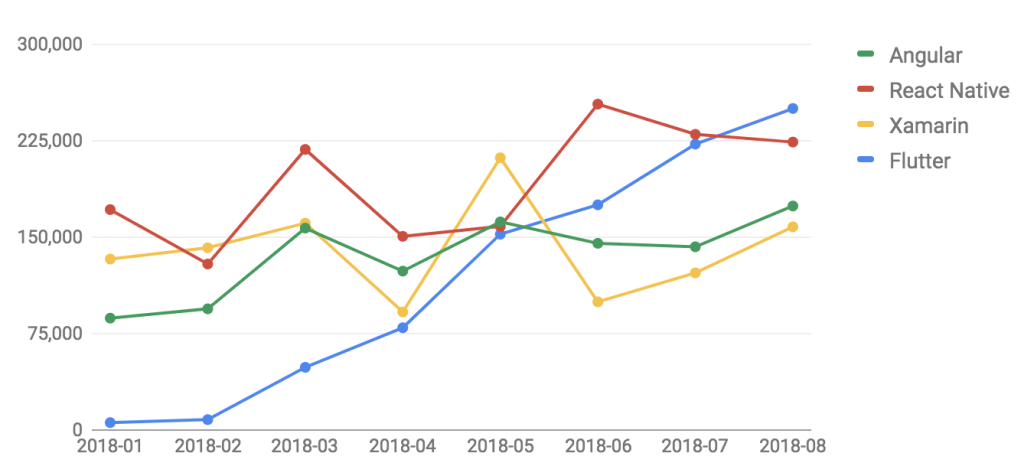
Not only that, but in a very short span of time, Flutter’s popularity has also outgrown Xamarin, React Native, and Angular.

flutter stats

The above graph clearly proves Flutter’s dominance in the cross-platform framework space.

But if you’re still not convinced, here are the 5 major reasons why mobile app startups need to seriously consider Flutter App Development in 2022.

5 Reasons to Consider Flutter App Development in 2022

Here are the main 5 business benefits of choosing Flutter app development for your mobile app startup.

1 – Helps you Go Beyond Cross-Platform Limitations

Mobile app developers always dream of a perfect cross-platform framework that allows building truly bespoke mobile apps.

But even the most popular frameworks like Ionic and React Native cannot deliver the truly native user experience.

Flutter, on the other hand, has the capability to create a truly native user experience.

You see, unlike React Native and Ionic, Flutter uses the native UI elements of both iOS and Android, which is something mobile app developers around the world have been longing for.

So, this is how Flutter can help you go beyond a cross-platform framework’s limitations and design a powerful mobile app UI.

2 – Fast Development

One of the main USP of Flutter is its Hot Reload feature.

Hot Reload basically allows developers to fix bugs in real-time, meaning there is no need to recompile & generate new builds every time a bug is identified and fixed.

Bug fixing happens in real-time in Flutter.

As a result, this Hot Reload feature increases developers’ productivity significantly, which ultimately leads to reduced development time and thus reduced development costs.

3 – Powerful Design

Apart from the Hot Reload feature, Flutter also allows creating powerful design experience.

This is mainly because of the Flutter & Material Design’s partnership.

It allows app developers to create a smooth user experience that users generally expect from mobile applications.

So, if you’re planning to build an iOS app and an Android app and native user experience is your top priority, you can still consider going with Flutter app development for your startup.

4 – Flexible & Scalable Backend

If your mobile app product requires support for cloud storage, cloud functions, real-time databases, etc., then there would be no better cross-platform framework than the Flutter.

Flutter can integrate Firebase, which is also a Google platform that offers services as a real-time database, cloud storage, cloud functions, and so on.

In fact, Firebase also makes the app’s infrastructure scalable, redundant, and serverless, meaning startups won’t have to invest resources for backend development & deployment.

Firebase comes with a lot of common tools that are generally required to develop mobile apps. These tools can also, in fact, help developers to automate certain modules of mobile app development.

5 – Perfect for MVP Development

If you’re a startup with a limited budget, don’t let the mobile app development cost keep you from entering the mobile app space.

Flutter can help you build a mobile app real quick and without any fuss, even if you’ve limited time, resources, and money.

It comes with a wide range of native UI widgets, Hot Reload functionality, and supports 2D GPU accelerated APIs that make all UI animations extra-attractive and smooth.

This set of features contribute significantly to developing feature-rich and highly user-friendly mobile applications.

Conclusion

So, now that it’s been validated that Flutter is the answer to all your startup needs, it’s time to get in touch with Flutter experts from Credencys and begin your mobile app development journey.

Frequently Asked Questions

Q:1 – What is Flutter app development?

Ans: Flutter is a mobile UI framework that allows developing high-quality mobile apps for both iOS and Android platforms.

Q:2 – What programming language does Flutter use?

Ans: Flutter uses Dart programming language, which was also created by Google. In fact, Dart will also be the default programming language for Google’s upcoming Fuchsia OS.

Q:3 – Why did Google created Flutter?

Ans: Google created Flutter to create and explore powerful tracking apps and help developers build better mobile apps from a single codebase.

Q:4 – Are Flutter apps native?

Ans: No, Flutter apps are not technically native as the technical architecture is completely different from the Native. For instance, Flutter uses Dart, while Native Android app development uses Kotlin & Java.