How Agile Makes Risk Management Easier

Software projects have conventionally been plagued by several risks forcing them off-schedule, over-budget and out-of-scope. Agile project management reduces this risk exposure by providing higher visibility and faster results to business owners. However, before we explain how exactly Agile mitigates Risks, it is important to have a general definition and brief understanding of the traditional risk management practices.

What is Risk

A risk is generally defined as a set of “uncertain conditions” which can together or individually have a definite measurable impact on at least one project objective. Some of these “uncertain conditions” are listed below:

Internal Uncertainties

Resource: The team size proves to be insufficient to meet the project goals.
Time: The timelines are not realistic or have been revised to such a level.
Budget: The allocated budget is insufficient to meet the project goals.
Skills Mismatch: The team does not have the required skills.
Lack of Clarity: There is a lack of consensus among stakeholders.

External Uncertainties

Disruption: A new technology might jeopardize the current technology investments.
Regulatory Landscape: There are challenges in meeting compliance.
Competitive Landscape: There are challenges in generating value proposition or USP.
Government Policies: Restrictions on outsourcing, higher trade tariffs.

All these conditions have a certain likelihood or probability of occurrence. Further, their individual impact also varies. The product of probability and impact defines the risk exposure level for a project.

Impact x Probability = Risk Exposure
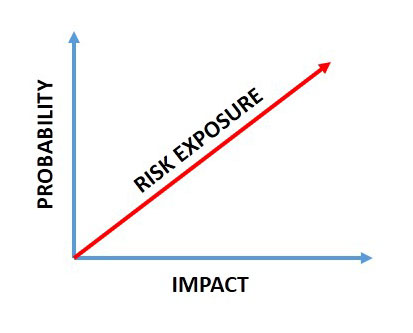
image3

In the traditional waterfall methodology management of risk was a major concern for project owners. The process frameworks in waterfall used to put perpetual pressure on teams to complete requirements and design even before starting any development work. This would translate into an opaque working environment where project owners were unable to attain any value from the ongoing work. Further, the long feedback and change management cycle used to deter business owners from recommending any changes.

Hence, Risk Management was recognized as an essential process for systematic identification, assessment, and mitigation of project detriments that if not addressed in time would damage the project beyond repair. Nonetheless, even this process involved significant time investment, documentation, and maintenance of a risk register. Complex CPM methods, mindmaps, and PERT charts were often used for estimation and risk management purposes.

Solve your Design Puzzle
Develop a POC/Prototype/MVP in a 15-day workshop

START A BLUEPRINT

How Agile provides implicit management of Risks

Agile methods implicitly manage risks where blockages or project impediments are identified in standup meetings on an ongoing basis. It is generally accepted that the short duration sprints effectively break down risks and provide an opportunity for their early mitigation. Risks are also minimized with the involvement of cross-functional teams that maintain a predictable project velocity with continuous feedback and transparency at all times.

Therefore, most project managers usually do not see any major value in assessing and documenting the risks elaborately in Agile project management. However, you can keep a simple risk register with limited fields for your reference. This could include a small description of the risks, their probability, impact, action items, and the final status. Further, you can also quantify risks for dealing with them in a prioritized manner.

Risk mitigation with Burn-Down Charts
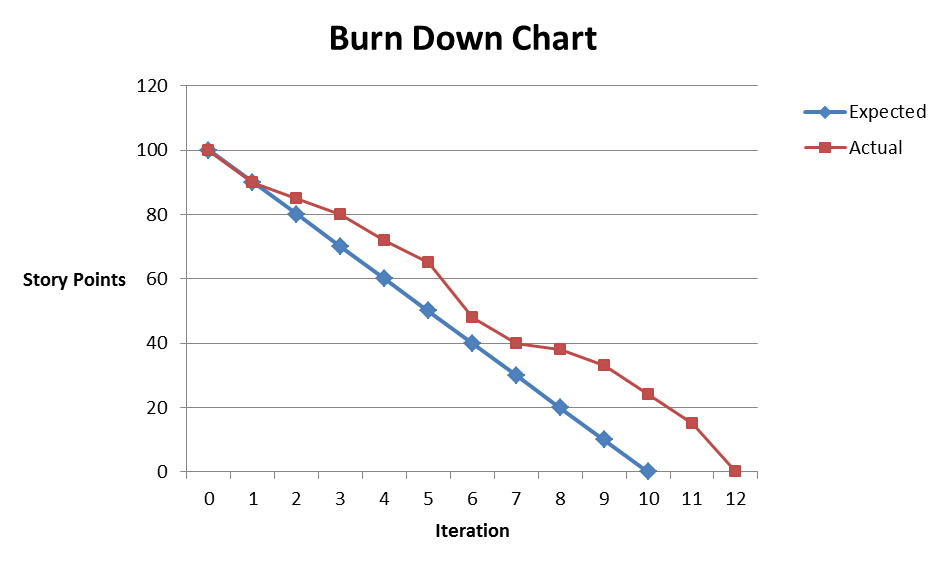
image2

A major part of traditional software project management involved tracking of schedule and cost overruns. The accuracy and frequency of these tracking measurements used to depend on the size of the project. As discussed, Agile makes this tracking easier. With burn-down charts, project managers can get a daily assessment of effort and schedule. These charts provide easy visibility into project progress and any major deviations from the ideal velocity help in early identification of issues/risks.

As discussed, the onus of identifying risks in Agile is shifted to the team members. Major risks can be discussed in the sprint review or sprint retrospective sessions. The retrospective session can help all stakeholders in identifying lingering issues and select the best way forward. Further it provides clarity for better planning on risks to be mitigated in the future sprints.

Design to Standout
Reengineer User Experience in a 15-day workshop

START A BLUEPRINT

It is seen that organizations are often wary of engaging with a new software development firm because of their inability to gauge their risk exposures. There is no way to ascertain if the vendor would be able to deliver quality results in a timely fashion. Paradoxically, the only definite way to quell these apprehensions is to start working with the vendor.

At Credencys, the Blueprint workshop addresses such concerns for our new clients by introducing them to our work approach. Blueprint is a 15 day collaborative workshop which helps our clients create a roadmap for their application development starting from building a proof of concept to creating clickable prototypes and MVPs.

Credencys Solutions Inc is a leading mobile applications development company and solutions provider. You can contact us for mobile strategy consulting and developing mobile apps for multiple platforms. Subscribe to our blogs for getting similar articles on software project management, strategy, leadership and more.


 

The best practices for managing your outsourced software project

CIOs and project managers are often overburdened with the management of multiple IT projects with several interdependencies. While application outsourcing is often seen as a viable option towards the reduction of this application development backlog, completing such projects within planned budgets and timeframes is never easy.

In the previous blog, we discussed how you can choose an application development company with a long-term business focus. This is crucial for optimum management of projects as dealing with a single vendor can help you achieve higher process efficiency and better coordination on multiple interlinked projects.

Aligning business objectives and project goals

It is a widely known fact that the majority of application outsourcing projects fail due to poor requirements gathering, analysis, and planning. For example, it is seen that retailers usually invest in mobile app development to increase online sales. However, the business objective of higher online sales can also be achieved with a mobile website or a progressive web app. Hence, it is important that the vendor and the client have a common understanding of business goals before they finalize a particular project requirement.

This entails higher collaboration between the client and the vendor in the early stages of solution definition. While business objectives are likely to remain more or less constant, the project requirements might change over the course of a project. For this change management, organizations used to create and rely on a requirement traceability matrix (RTM document). However, these days Agile based software project management tools provide better transparency with version-control and change-tracking facilities, effectively removing the need for RTM documentation.

Defining the Scope

Explore Design Thinking
Build a POC/Prototype/MVP in a 15-day workshop

START A BLUEPRINT

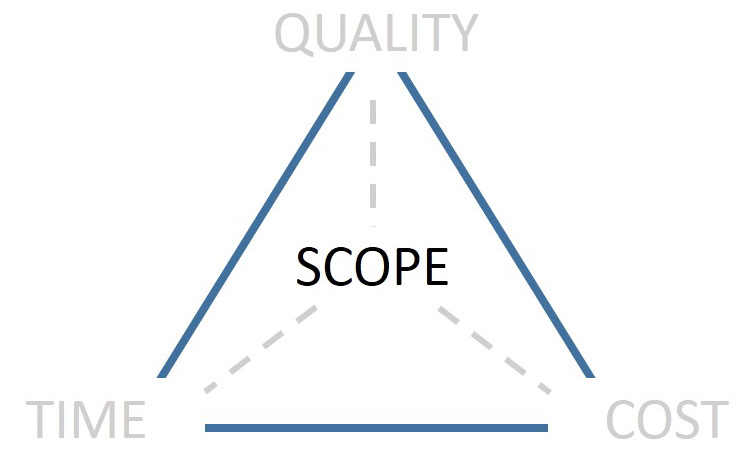
Scope

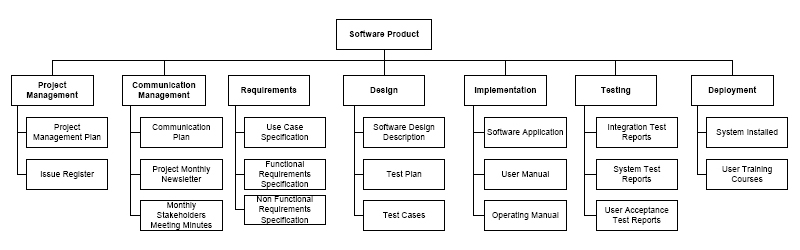
While business owners usually want to restrict their roles to validating and accepting the final builds, they must go beyond their comfort level in defining the scope of a project. In the traditional method of software project management, the software vendor was expected to create an outline of the key deliverables at every stage of the project. This used to translate into creation of a schedule of measurable deliverables, as described below:

project-management-institute

However, this method of requirements and scope documentation is very tedious and time-consuming as all requirements have to be envisioned in advance with considerable detail. While this method, in theory, left little to chance, the downside was that specification document used to eat up a lot of valuable time. Further, the requirements would change during the project with new discoveries often rendering the Scope document obsolete.

In an Agile project, Scope is defined by high-level requirements, also known as User Stories. While details on these requirements are critical, they are produced just-in-time. This means that detailed documentation of user stories is done on Sprint-by-Sprint basis, where there is a possibility to fail early, make new discoveries and make relevant changes in the User Story backlog for upcoming Sprints. This ensures that there is no wastage in specifying things that might not be needed. Further, this approach provides enough room for change – which otherwise becomes a point of debate in waterfall based methodologies. Change management is easier in Agile:

image

Things You Must Know about Change Management in an Agile environment

  • The goal of Agile is to enable change management, not prevent it.
  • Change management is inevitable in Agile.
  • There should be no change management during an iteration.
  • Change management does not mean no prioritization.
  • Change management does not change highest value story scheduling.
  • Agile does not eliminate change management challenges but provides a disciplined, streamlined way to manage them.
Source: TechTarget

Quality Assurance

quality

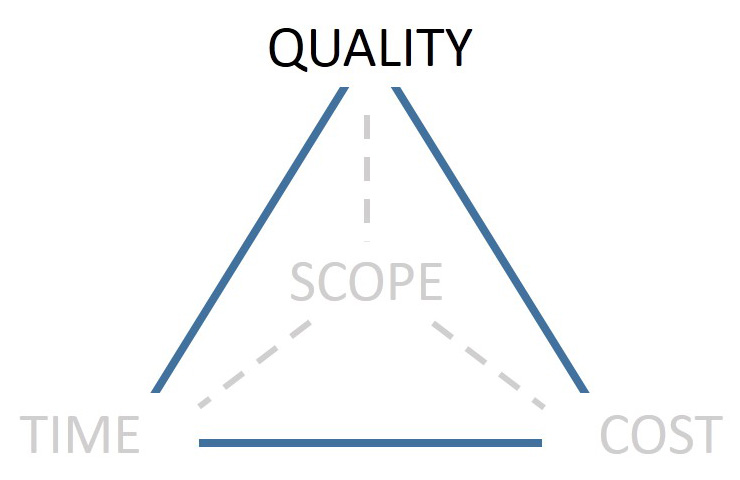
If you have subjective expectations on quality, then you are in for a surprise. As soon as you develop an understanding of the key deliverables for initial sprint, you should start working with the application development company on defining the parameters for quality assurance evaluation. In Agile this is accepted as a collaborative ongoing process where User Stories are developed just-in-time along with their Acceptance Criteria (AC). AC ensure that all the parameters of a User Story are met as per every stakeholders’ agreement. Only when the AC are “Accepted” the user story is marked as “Done”.

Ideally, AC should have only two values – either acceptable or not acceptable. There is no place for partially acceptable. To ensure this, AC have to be carefully defined with some measurable or tangible parameter. Sometimes, it might also be possible to link payments with AC. That’s why project management experts usually advise including AC in contractual agreements on external projects. However, this might involve lengthy documentation with AC being defined within the requirement and project scope statement. Nonetheless, defining AC in advance can save a lot of hours and money usually spent in change management related disputes.

Schedule Management

time

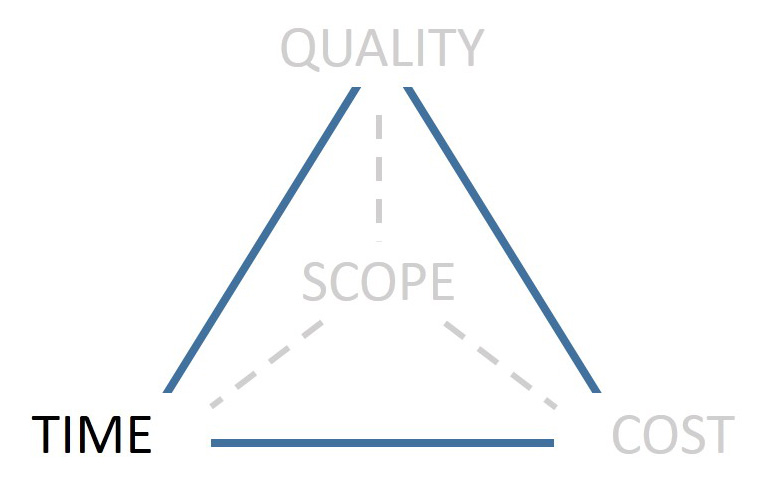
In the past, schedule management used to depend on a very lengthy document based procedure. It involved defining the critical-path, which was a complex process, often based on inaccurate assumptions/estimates.

Unlike the past, when the focus was to schedule every single task, an Agile approach relies on visually communicating the high-level definitions of the project deliverables. Agile provides facilities to schedule lower level features and tasks in a flexible way where builds are delivered in short sprints.

Planning of these short sprints is easier and more accurate than any other scheduling method used in the past. Teams using Scrum often size their backlogs with Fibonacci effort-points and prioritize feature deliveries with MoSCoW prioritization. As discussed earlier, the product owner will need a clear understanding of business objectives for this prioritization.Also, an Agile team can provide you a fairly accurate time-estimate which is based on the empirical data on effort-points, velocity, and approximate hours taken to complete one story point. Further, you can get the visibility into an ongoing project schedule during a team’s iteration planning meet and daily standups.

Also, an Agile team can provide you a fairly accurate time-estimate which is based on the empirical data on effort-points, velocity, and approximate hours taken to complete one story point. Further, you can get the visibility into an ongoing project schedule during a team’s iteration planning meet and daily standups.

Cost Projections

cost

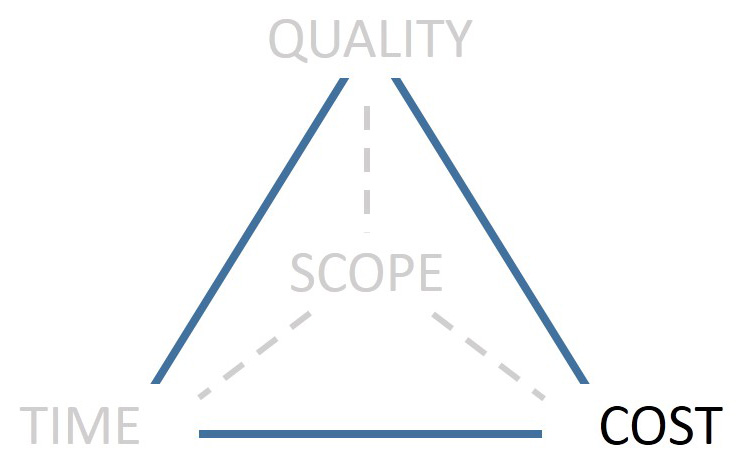
In addition to the quality, scope, and time, the cost of your offshore software development project will also depend heavily on the resource allocation. If you have a higher budget, you can easily reduce the time and improve quality by hiring a large team of experienced developers. A project manager can also put multiple teams in parallel to work on a prioritized backlog. Here’s the typical Agile team structure in an offshore software development project:

product

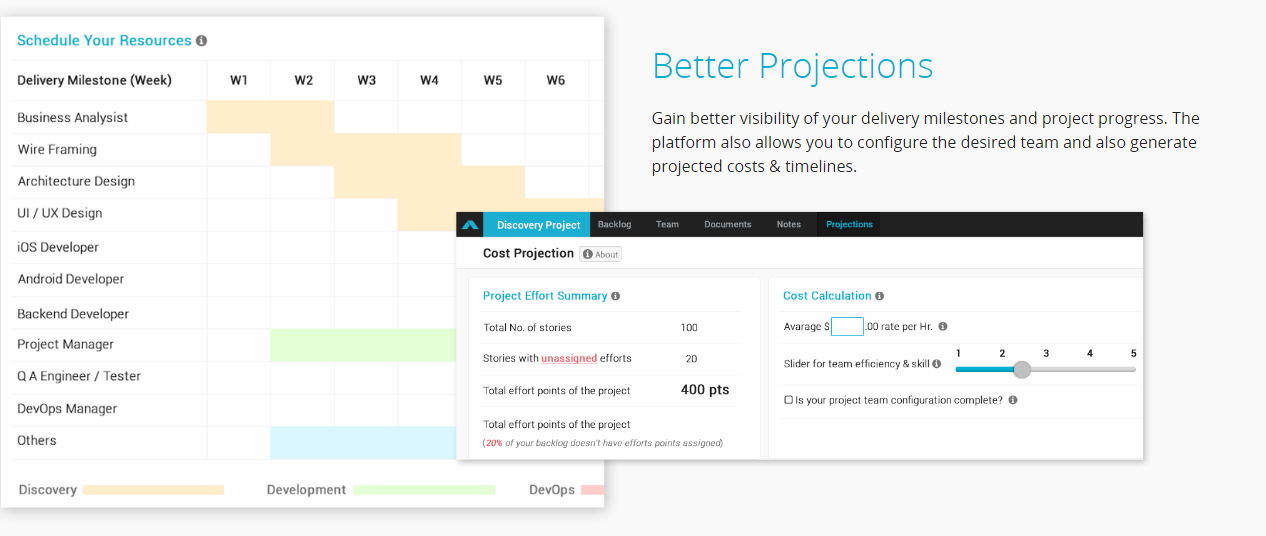
The term elastic team refers to a team in which additional resources are scaled up and down as needed. For all budget, timeline, and resource allocation related projections, you will need a Project Management Solution. You can checkout AgileFirst, which is a simple and free software project management software that allows you to manage your project in an Agile manner.

Agilefrist

Credencys is currently using an MVP version of this software to manage its Blueprint workshops with its clients. Blueprint is a collaborative workshop from Credencys for Small & Medium Enterprises. With the help of this workshop you can convert your mobile application’s idea into a working prototype/POC/MVP. The Blueprint workshop will help you create a roadmap for the mobile app development starting from building a proof of concept to creating clickable prototypes and MVPs.

Nix Complexity. Fix Design.
Build a POC/Prototype/MVP in a 15-day workshop

START A BLUEPRINT

Credencys Solutions Inc is a leading mobile application development company and solutions provider. You can contact us for mobile strategy consulting and developing mobile apps for multiple platforms. Subscribe to our blogs for getting similar articles on software project management, strategy, leadership and more.
 

How to Choose the Right Vendor for Custom Software Development

The technology is changing at an alarming pace and enterprises today have to rely on a fragmented IT infrastructure with systems and applications developed during a long span of time. In an ideal world, enterprises would have preferred to work with a single vendor to meet this ever growing demand for new software. However, usually, it involves working and collaborating with different vendors and companies that develop mobile applications.

Therefore, the foremost requirement for any enterprise is to identify an mobile application development company which is ready for a long-term engagement with capabilities to meet evolving software needs. The software vendor should employ standard processes to provide required transparency and maintain integrity at all times.

Needless to say, it is not an easy task and there is no one-size-fits-all strategy for selecting an app development company.

Mobile Applications Development Company: Offshore vs Nearshore vs Onshore 

There is no simple answer to this conundrum. Yet, sourcing managers have traditionally relied on a mixed model to meet their varied demands. There are projects which will require onsite collaboration due to security or policy constraints.Yet, at times it might be possible to rely upon application outsourcing to offshore locations. Nonetheless, the size of skilled resource pool, maturity level of the software processes, management of risk, and ultimately the costs continue to dictate these outsourcing decisions. Let’s explore these factors in detail:

The Size of Skilled Resource-pool

While the IT vendor should have the capability to allocate more resources to your project during the development, it is also crucial to evaluate how your software vendor will deliver in the long run. The application maintenance and support offered by the vendor will determine your business continuity and long-term value. As a part of your SLA with the application development company, you should make sure that there are enough engineers on the bench to support all the stages of software development, deployment, and support.

Maturity Level of the Software Processes

Agile and Scrum based processes along with DevOps have become a default route for application development. These processes will provide you granular visibility into the project progress and help you keep tabs on your software investment. Moreover, the processes heavily rely on clear communication and significantly reduce project risks. Further, vendors working in the Agile mode should be able to provide you early ROI with contracts requiring very short term engagement. This means you will get the opportunity to engage in a “Sprint” and evaluate if the processes set up by the vendor meet your expectations. You must also explore what tools the vendor will be using for the software project lifecycle management, general communication, task management, document sharing, code quality management, and administration.

Data Migration Strategy

It is alright that you are investing in application development that will help you scale up your business. However, most enterprises forget to take into account the cost of data migration. It is not advisable to spend a lot of time and money on a custom software which would refuse to work with your legacy systems.

Unlike the common conception, data migration isn’t a simple task and treating it as an afterthought can be costly for businesses. Application migrations are complex in nature as applications interact with each other on many levels and have their own data models. By design, they are not built to be portable. Hence, a middleware is often required to make application migrations successful. Make sure that your software vendor has a data migration strategy which covers all these aspects.

Accelerate your Time to Market
Develop a POC/Prototype/MVP in a 15-day workshop

START A BLUEPRINT

Security Procedures

It is often seen that enterprises mobility solutions is carried out without the involvement of internal IT and security teams. These teams are then tasked to ensure that there isn’t any security outage when the newly developed applications are deployed. However, traditional solutions for vulnerability and application scanning may take up to an entire day to complete a scan depending on the complexity of the application. Code review tools aren’t any faster. All this can significantly overburden your internal IT and security teams. Even with Web Application Firewalls, security continues to be a major concern for enterprises developing new software code on daily basis.

This means that the app development company you select should have set-up security measures at various levels of their development facility that will include physical security, networking, database security and ad hoc security procedures for any specific project requirement. When engaging with a third party iPhone application development vendor, you must evaluate the processes put in place by the vendor to ensure the security of all personally identifiable information (PII) or other critical data which might be exposed to the vendor during the outsourcing engagement.

Management of Intellectual Property

Another major aspect of security is related to the protection of intellectual property (IP). IP is not restricted to your copyrights, patents, designs, and trademarks, but can also be in the form of software code. The contract with the vendor should explicitly allow you to retain the IP rights over your code/technology, at all times. This means that you should have access to the API, data, and servers during the development. Further, the vendor should have strict processes detailing and restricting the access to critical data resources. You can also include NDA, NCA and other letters of non-disclosure depending on your needs. Further, as IP laws vary from country to country, it will make sense if you are dealing with companies that come under the purview of laws in your country.

General Administration

Working with an offshore mobile application development company might create some communication issues during the project. As the teams will be working in different time-zones, you must discuss the how the vendor will sync the timings during the project. Further, discuss the procedures for leave approvals, attendance management, and resource replacement. If possible try to gauge the employee retention rates and Glassdoor ratings of the vendor to evaluate the working conditions. This is crucial as too many members leaving your project in between can affect the project timeline (with the time lost in replacement/knowledge transfer).

Domain Expertise

Last but not the least, you must evaluate the past work and domain expertise of the vendor. It is possible that a particular vendor might be well known in the industry, but would have done limited projects in your domain. A vendor specializing in your domain will have set processes based on your business requirement and will provide swift decisions related to the selection of right technology stack, mobile applications development platform and so on.

Take your idea to a Development Ready Design
Engage in a 15-day workshop

START A BLUEPRINT

Credencys Solutions Inc is a leading mobile applications development company and solutions provider. You can contact us for mobile strategy consulting and developing mobile apps for multiple platforms. Subscribe to our blogs for getting similar articles on management, strategy, leadership and more.
Developing Strategies for Enterprise Mobile App Development

An interview with Credencys CTO, Sagar Sharma

sagar-sharma

  • Former Toyota and Oracle Solutions Architect Sagar Sharma is the CTO of Credencys, an LA-based mobile applications development company
  • Sagar has helped numerous startups, SMBs, and enterprises in choosing the right strategy for developing mobile apps
  • He is a proponent of Agile and is currently developing a project management system for Agile software deliveries

Enterprises today are engaged in a perpetual cycle of application development and overhaul for embracing latest disruptions. Developing mobile Apps takes up a major share of these activities as the smartphone is a common touchpoint for customers, partners, and employees. In this interview Sagar will answer some of the most common questions and challenges in the mobile strategy planning stage:

How do you develop a mobile strategy for your clients?

Although defining a mobile strategy is most often similar to defining a business plan, it’s very contextual. Some of the clients come to us with a business plan complete with SWOT analysis, competitive analysis, elevator pitch, GTM plan and everything you can think about it. I remember working with a couple of clients who had developed screens and workflows in-house and just required developers to implement those designs. You need not discuss strategy with such clients. On the other hand, we also have clients who come to us and say – I need an Uber-like App for my cab rental business. This is where a client’s needs and wants might differ. Developing a Mobile strategy is more important in such cases.

What can you tell us about the common misconceptions or mistakes done by businesses in developing a mobile strategy?

As I said, sometimes businesses do not have a long-term vision. The focus on solving an immediate need prevents them from looking at the larger picture. Developing mobile Apps with such a narrow focus rarely provides any substantial return to businesses. For example, enterprises often spend their budgets in developing separate mobile solutions for better collaboration, secure remote access, and real-time information exchange. However, there is rarely any planning for future or compatibility with existing legacy systems. Moreover, it is not rare to see multiple applications for doing a single task within an organization.

Such inefficiencies can be removed with proper planning, selection of correct technology stack and development of solutions that complement existing enterprise infrastructure. Further, enterprises should consider creating an internal group which leads all enterprise mobile initiatives. The creation of a centralized body for mobility initiatives helps in creating a mobile strategy which is aligned closely with key business goals.

How pronounced is the need to repurpose existing systems (websites, e-commerce tools, CRMs, CMS etc)?

There’s always a need, yet most of the legacy enterprise systems are so large that nobody wants to mess with them. Businesses are not keen to disturb their mission critical systems. These systems are disturbed only when they become annoyingly slow to sustain enterprise needs for higher collaboration and efficiency. Needless to say, such reactive measures compound the problem over a period of time.

There is a need to be proactive in transforming these legacy systems and make them work in sync with modern mobile platforms and browsers. A lot of times information flow is restricted due to complex interface and lengthy workflows. This complexity can be reduced with UX redesigning. Further, enterprises can allow employees and partners to design their personalized workflows depending on their needs. By integrating mobile closely within an enterprise ecosystem, organizations can significantly increase the efficiency of their existing systems.

How do you help companies align their business and mobility goals?

Having a sharp focus, concrete goals, KPIs and a sufficient budget is instrumental to any mobile strategy. If a business wants to compete in the B2C domain with its App, a proper understanding of the market is most critical. In such cases, businesses have to study the competition, evaluate incumbent’s offerings and list down the key opportunities, threats, and challenges. This can help businesses in creating a strong business case for their mobile application. On the other hand, businesses sometimes adopt blue ocean strategy to tap into new market spaces with unknown growth potential.

As defined by Gartner, most of the enterprise mobile initiatives are these days classified into two broad categories – Mode 1 and Mode 2 initiatives. Mode 1 initiatives refer to tried-and-tested models, where implementing a proven system is expected to provide a set outcome. Mode-2 initiatives carry an element of surprise. These are more exploratory and innovative in nature. As a strong follower of Agile, I have seen that Agile practices support both these initiatives very well. Adopting an Agile approach, I help my clients in better prioritization by telling them what is easily doable and can produce maximum value for their business or what could be done in the later versions. Further, I help clients to get started early and achieve maximum value without any elaborate documentation processes. That’s why we frequently engage with clients via Blueprint workshop which helps them design mobile application in a 15-day sprint.

Go Agile
Make your idea DEVELOPMENT READY in a 15-day Sprint

START A BLUEPRINT

Tell us something about the new project management system your team is working on.

AgileFirst is industry’s first project management system supporting Scrum based Behavior-Driven Development processes – which are central to our working methodology at Credencys. It aims to provide better collaboration between all stakeholders involved in creation and grooming of Backlogs. With this single tool, people can create user stories, acceptance criteria, notes & invites for their teams to collaborate on their backlog items.

We have focussed on developing a highly intuitive interface supporting drag-and-drop of user stories. Project managers can manage and monitor user stories in four major dashboards. They can get a hawk-eye view of backlog stories in the List View, view associated scenarios in an infinite scroll in the Capture View, view stories with Fibonacci story points on Effort Board and get MoSCoW prioritization on the Value Board. The system will support entire software development cycle providing better visibility on delivery milestones and project progress. The system will also allow managers to configure their desired team and generate projected costs & timelines.

When is AgileFirst going LIVE?

The first phase is already LIVE and we are currently using it for running our Blueprint workshops. Organizations interested in evaluating the platform can use it for designing their products.

Can you share some insights on how organizations can prepare for the future of mobility?

Future is never too far away. All that an organization need is a bit of initiative to look beyond the obvious. Technology is already in place to support future innovations. Artificial Intelligence, Blockchain, Augmented and Virtual Reality, Internet of Things are all rapidly evolving technologies with a lot of scope for innovation. Businesses have to explore these technologies and create new products and revenue models for their business. As I said, a lot of this will involve sailing in the blue oceans. And that is where Credencys comes into the picture – we enable those organizations who are willing to experiment and leverage technology, not waiting for others to show them the way forward.

Routine. Extreme. Everything.
Build POCs, Prototypes & MVPs with the latest technology

START A BLUEPRINT

Credencys Solutions Inc is a leading mobile applications development company and solutions provider. You can contact us for mobile strategy consulting and developing mobile apps for multiple platforms. Subscribe to our blogs for getting similar articles on management, strategy, leadership and more.
Here’s the Enterprise Mobile Strategy for 2020and Beyond

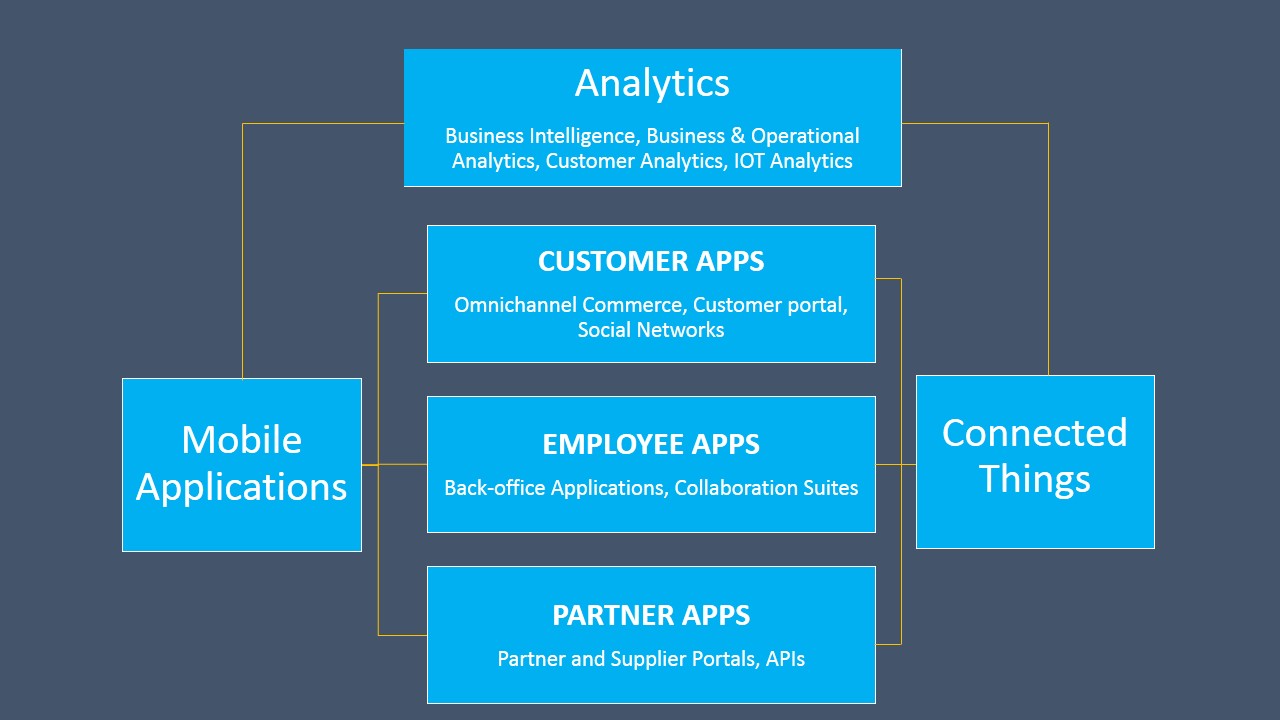
Many enterprises are today stuck in a complex IT ecosystem which needs mobility to leverage latest advancements. Mobile led initiatives are transforming every business sphere:

Enterprise-Mobile-Strategy1

While some of these mobility initiatives are strategically planned, some others, not so well. Most of the mobile application development projects are based on competitor offerings and immediate business needs. The lack of foresight and inability to form a holistic enterprise mobile strategy prevents organizations from harnessing good returns on their mobile-related investments. This article will help you align all your mobility initiatives with the proper mobile strategy planning and develop a framework which keeps all projects on track with minimal course correction.

6 strategic steps for the success of your mobile initiatives

1) Bring all stakeholders to a common ground

It is often seen that different IT stakeholders and strategic decision makers have different opinions, expectations, and agenda when it comes to leveraging mobile. For example, a CMO might not show a keen interest in developing enterprise mobile apps for the internal communications team. Further, the IT team is often tasked to look out for point solutions to meet immediate needs. This approach creates a complex ecosystem of applications and solutions which rarely works in sync or provides any value to the organization.

It is important for an enterprise to take a step back and redefine its mobile strategy to remove these inefficiencies arising from the fragmentation of IT. As discussed, the first step is to compile and map all immediate and future requirements with their respective end user/beneficiary groups. The above initiative will play an important role in providing clarity for the following mobile application development stages:

  • Goal Setting, business case identification: Identify and prioritize your enterprise mobility goals vis-a-vis your business goals. This will help you in better alignment of mobility strategy with your core business objectives.
  • Drawing the enterprise mobile roadmap: Create a roadmap with the team driving the mobility initiative. This shall help you create realistic deadlines while bringing everyone on the same page.
  • MADP platform evaluation and selection: It’s important to choose an MADP platform that not only meets business needs but also allows developers to create user-friendly solutions with ease.
  • Solution architecture, design, development, and deployment: Most businesses often lose track of their project during these critical stages. Organizations need to adopt latest Agile frameworks for better visibility and control over these processes.
  • Quality Assurance: Choose tools and methodologies to support quicker development without compromising on the quality. Most of this can be achieved with Automated testing.
  • API management and modernization: Enterprises have developed a complex ecosystem of APIs that interact with each other. There is a need to manage these APIs in a secure and scalable environment.
  • Mobile UX improvement: A lot of enterprise resources are never utilized as complex workflows hinder their access to the intended users. Improvements in UX can remove such inefficiencies.
  • Governance, Security, and Compliance: Develop policies to create a perfect balance between connectivity, security, and productivity needs of your organization.

2) Identify mobile-readiness and create a transition plan

Most organizations have a core business group which frequently interacts with partners and top executives. Somehow, their needs for mobility are well addressed as they have more freedom to experiment and adopt third party products. At the same time, internal employees and field workers continue to perform on legacy platforms. This creates pronounced differences in the way different groups in an organization collaborate. It also creates visible bottlenecks in the information flow and availability.

While there is a need to create a common mobile ready enterprise suite, it would not be prudent to force all your teams to suddenly jump onto this new system for routine office and field work. There could be many challenges:

  • Data Migration: Data migration can be a headache for the IT team and there could be compatibility issues
  • Reluctance to change: generally, people in an organization develop a working culture which is not conducive to adoption of new solutions
  • BYOD management: there could be security and authorization related concerns

During the mobile strategy planning, decision-makers need to create a transition plan for any mobile initiative which affects the entire organization. It is advisable to avoid any overlap with a business-critical initiative. A roadmap describing phased release can be drawn after taking inputs from all the teams.

3)  Gauge and improve user experience (UX)

Enterprise-Mobile-Strategy2

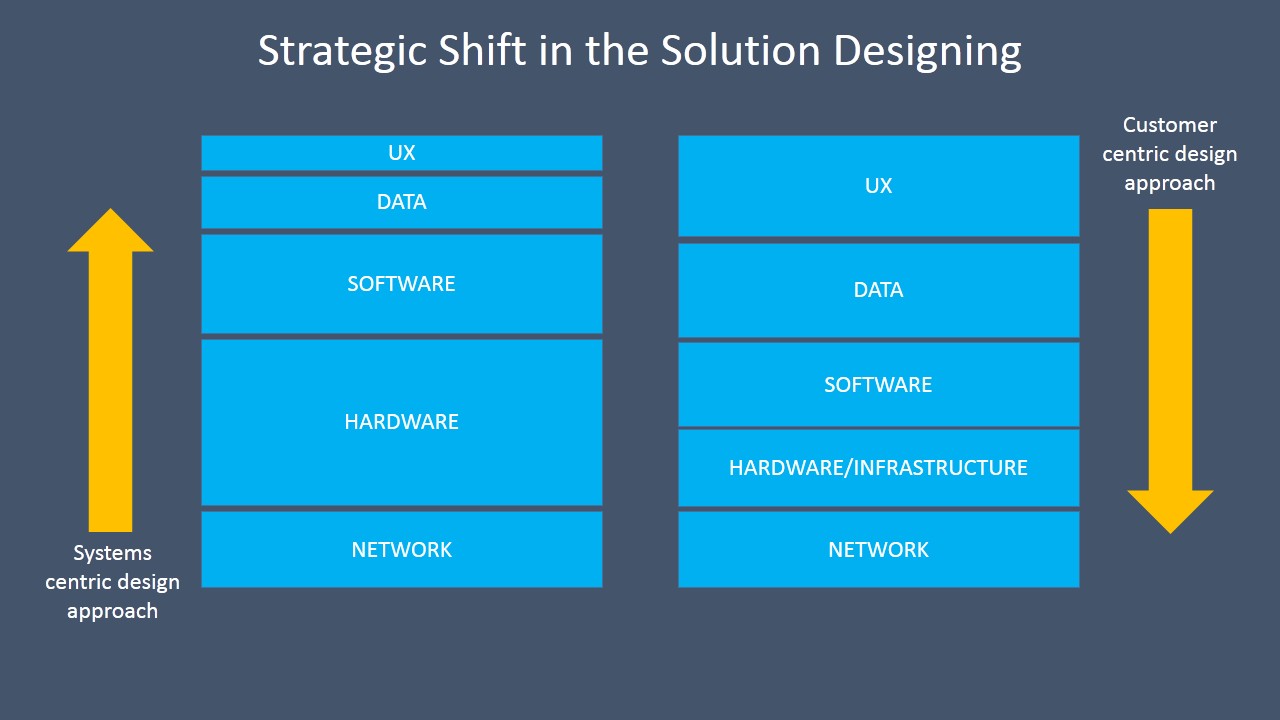
There are ‘n’ number of solutions to most problems – yet only certain solutions gain acceptance. UX is a critical factor in deciding this acceptance. If you are planning to solve a certain problem with a mobile solution, it must simplify things for the end-user. For example, improvements in the UX can not only make mobile a preferred medium for catalog viewing but also reduce shopping cart abandonments. Hence, UX is a key consideration for designing the functionalities and behavior of a customer App.

Further, a myriad of enterprise applications remains underutilized due to the similar UX deficiencies. As a business decision maker, you must ensure that all technology specific decisions – starting from the ‘selection between a native and a hybrid app’ to the selection of ‘data access points’ and a ‘content delivery network’ – are taken with UX as a top priority.

Capitalize on the UX
Build a Strong Foundation

START A BLUEPRINT

4) Work with Agile & DevOps communities

While creating an enterprise mobile strategy you will have to select a working methodology and tools that can support high speed development and collaboration among the developers. Agile and DevOps frameworks have become a default choice for companies that develop mobile applications with higher transparency, speed, and quality. DevOps will help you gain end-to-end visibility and access to your application designs, code, test scripts and other related documents. It will help you easily identify all the APIs and services used in the development.

Further, it is most suited for enterprise projects which are expected to run over a long frame of time with the involvement of multiple teams and vendors. Devops ensures that with continuous integration the code delivered by one team is reusable and can be integrated with a code delivered by another team. Also, DevOps will automate a lot of functional tests, ensuring that quality is not compromised for quicker deliveries. Make sure your software vendor is employing a DevOps framework to provide:

  • Continuous integration and continuous delivery
  • Automated testing and monitoring
  • Mobile app delivery

5) Setup Governance, Security, and Compliance policies

While high-profile data breaches involving advanced malware, APTs, and phishing scams hog most of the news headlines, the fact is that lost or stolen enterprise mobile devices (including laptops and tablets) continue to be the leading cause of data breaches. According to a news report “25.3 percent of data breaches that have occurred since 2006 were due to malicious actors getting their hands on a corporate mobile device”. To make sure that mobile doesn’t become a liability, your enterprise mobile strategy should clearly define a strong governance process. This will involve standardization of protocols for:

  • Mobile application development and deployment processes
  • Mobile sourcing vendor and vendor management
  • Mobile Device Management (password, encryption, data security, remote wipe, lockouts etc)
  • Mobile Application Management
  • Provisioning and de-provisioning of devices
  • Integration of MDM Solution with Enterprise Systems

6) Create a watch group to gauge disruptive trends

Enterprise-Mobile-Strategy3

During the mobile strategy planning, you should also evaluate its associated technology trends. The general perception of mobility has changed drastically in the last two decades. Facebook recently announced its plan to eliminate smartphones from the consumer space. Discarding any associated trends in the technology space without any proper evaluation can prove to be costly for enterprises.

Enterprises must keep track of the latest developments in Blockchain, IoT, Conversational Apps, Artificial Intelligence, and immersive technologies like AR & VR. To meet these objectives, enterprises often create R&D labs for testing and validation of new ideas with PoCs.

Further, organizations need to promote ideas and incentivize those who come forward and take a lead in such initiatives. These technology initiatives may or may not align with your core mobility efforts, but some of them might carry the potential to transform your organization.

Leverage the Latest
Create superfast PoCs, Prototypes & MVPs

START A BLUEPRINT

Credencys Solutions Inc is a leading mobile applications development company and solutions provider. You can contact us for mobile strategy consulting and developing mobile apps for multiple platforms. Subscribe to our blogs for getting similar articles on management, strategy, leadership and more.
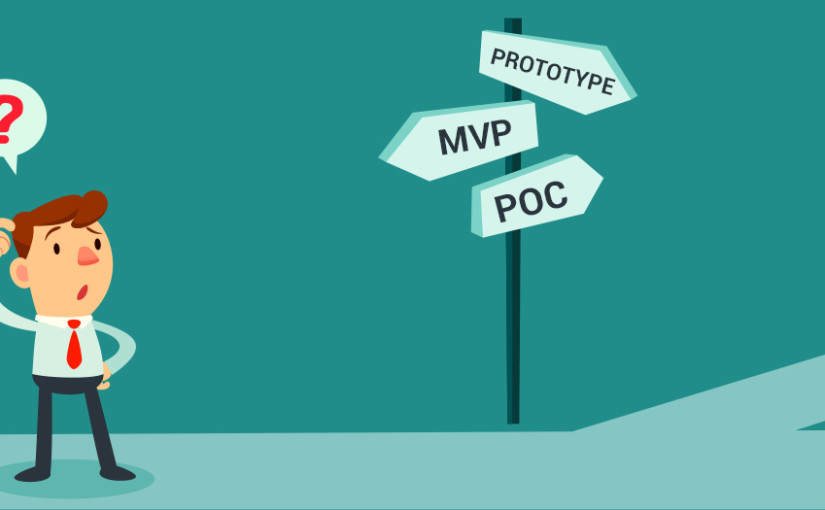
When people ask me “should I build an MVP or a POC or a Prototype?” I say, yes!

A lot of enterprises today have various teams working on different projects with ever expanding software needs. Almost every one of them feels the need to overhaul existing systems, create new customer experiences, and launch new business initiatives. There’s a massive backlog of mobile application development work that needs new approaches to decentralize and accelerate. Yet most of these software development projects never see the light of day (Chaos Report, The Standish Group) due to lack of proper planning, poor prioritizing, budget over-runs and numerous other project management related failures.

The need for rapid validation of new ideas

This has made enterprises more cautious about their software development related investments. Decision makers now seek better validation of new ideas prior to investing heavily in a project. They also need to validate new ideas with higher agility. This validation can be done with a Proof of Concept (POC), a Prototype, or a Minimum Viable Product (MVP). However, the teams that have not traditionally managed a software development project, may find it difficult to choose a starting point. Besides, there is no “one-size-fits-all” offering which can meet their varied needs.

So what should you build?

First of all, it is important to go beyond the buzzwords and identify the real business needs.

  • Identify what you are trying to validate
  • Identify who are your trying to convince
Say NO to Guesstimating.
See Your Idea Taking a Shape.

START A BLUEPRINT


POC

A POC is generally intended for internal consumption and it is employed to validate marketability on a very short budget. It is sometimes developed as part of the pitch targeted at those who decide future investments in your idea. In its simplest form, a POC would involve the creation of wireframes, flow diagrams and an initial design for a mobile or web application. With a POC, decision makers can better visualize the application/solution and its benefits from the end-user perspective.

Prototype

However, depending on the business needs, you can also take a POC further to develop a mobile application prototype. While a POC shows all the possible features in a mobile App with wireframes, mockups, and flow diagrams, Prototyping involves creating a clickable version. Mobile App Prototyping helps you create intuitive navigation schemes for your App. It is important to mention here that the purpose of Mobile App Prototyping is similar to a POC. Also, the end product is not market ready.

MVP

According to Eric Ries, the author of The Lean Startup, “The MVP is that version of a new product which allows a team to collect the maximum amount of validated learning about customers with the least effort”. This product should be sufficiently stable to be tested in the market. The term “minimum viable” suggests that the product should contain bare essential features to gauge the market response. Based on this response, iterative development stages would take the product further towards completion.

Team Structure

Usually, following roles are needed to be filled in for a development of POC/Prototype/MVP:

  • Lead Consultant – Solution understanding, Team Lead
  • Business Analyst – Business Goals, Competitive Analysis, SWOT Analysis, Documentation, Initial Wireframes
  • Software Architect – System Readiness Assessment, Server Infrastructure, App Architecture, Technology Stack, Integrations
  • Designers – UI and UX
  • Developers

The number of developers might vary and it is possible that a person might handle more than a single role.

Process Stages

Here are the common stages involved in the development of a POC/Prototype/MVP:

Requirement Gathering

  • Customer and business requirements
  • Functional requirements
  • Quality requirements (availability, usability, reliability, scalability, recoverability etc)
  • Security requirements
  • System requirement – upgrade, rollback, deployment etc
  • Performance requirement
  • Readiness and constraints

Designing Screenshots, Wireframes, Flow-diagrams and Prototypes

Following tools are commonly used in mobile UI wireframe and other mobile app design related processes:

Adobe MuseHTML/CSSPencil
Adobe PhotoshopInvisionPowerpoint
Adobe IllustratorJustinmindProto.io
AxureMacawUXPin
BalsamiqMockupsWebflow

Development (of MVP)

The above approach for designing a solution requires Agile development practices. A team managed on a Scrum will be able to give you constant visibility into the work progress so that you can provide them timely feedbacks. The size of the team will depend on the product requirement.

While the above definitions might clear a lot of doubts around these practices, they kind of oversimplify the procedures involved. Further, building an MVP is not the only approach to product development. The common aim of all the above practices is to ensure that the product development is put on a specific mobile strategy roadmap with clear goals and visibility for all the stakeholders.

Credencys Credencys Solutions Inc is a leading mobile applications development company and solutions provider which has helped numerous businesses in their business growth. If you wish to develop a POC/Prototype/MVP, we can help you out with our Blueprint workshop.


Get Ready For a Deep Dive and See Your App Come to Life.

START A BLUEPRINT


These 5 tech-trends are transforming the way content is created and consumed

When Apple launched its smartphone in 2007, little did the world know that the small screen devices will soon upend the online world. Businesses had to scramble to adopt the Mobile First approach and those who still haven’t, continue to miss the massive opportunity. Consumers spend a significant amount of daily time on their smartphones and use it as a preferred medium for researching before doing any purchase.

Mobile gives consumers a freedom to consume digital content at all times and places. This means businesses have more opportunities to display and advertise their content. Naturally, the formats have changed over the years and businesses are exploring new mediums and delivery channels.

Textual content

Long form journalism still exists, but certainly, has lost its popularity. With the democratization of distribution and the atomization of content, the readership for traditional newspapers has been declining at an alarming rate. While some may call it an evolution, the fact remains that people are unlikely to read a long article on their mobile phone where there are many other apps and notifications distracting them every now and then. However, there is still some hope for those who like to read in depth articles.

Spritz has developed a technology which makes “the reading experience more focused and efficient, resulting in less effort with the best comprehension.” The technology helps readers to increase their reading speed, and read articles across all screen sizes. Since its launch, the technology has been adopted by leading publishers across the globe.

Automated Content

Again the impact of technology is not restricted to reading; it’s also impacting the way articles are generated. Automated Insights offers Artificial Intelligence (AI) based natural language generation platform to publishers, which is being used extensively in publishing articles for sports and stock markets. The platform helps publishers create thousands of stories, reports, and articles within no time. Further, AI is not restricted to textual content. The Grid offers an AI engine named Molly, which creates web-pages with minimal human intervention. If webpages aren’t impressive enough, one can check out IBM Watson’s AI engine which recently spooked everyone by creating the following movie trailer:

360° Video and VR Content

While traditional long-form journalism has its own flavor, the consumers are inclined towards hyper-immersive formats such as 360° videos and Virtual Reality (VR) content. News providers such as ABC, CBS and New York Times are now offering an increasing number of 360° videos and VR content to engage their viewers. The trend is not limited to journalism; the technology first introduced for gaming and entertainment has become popular among retailers as a preferred medium for consumer engagement.

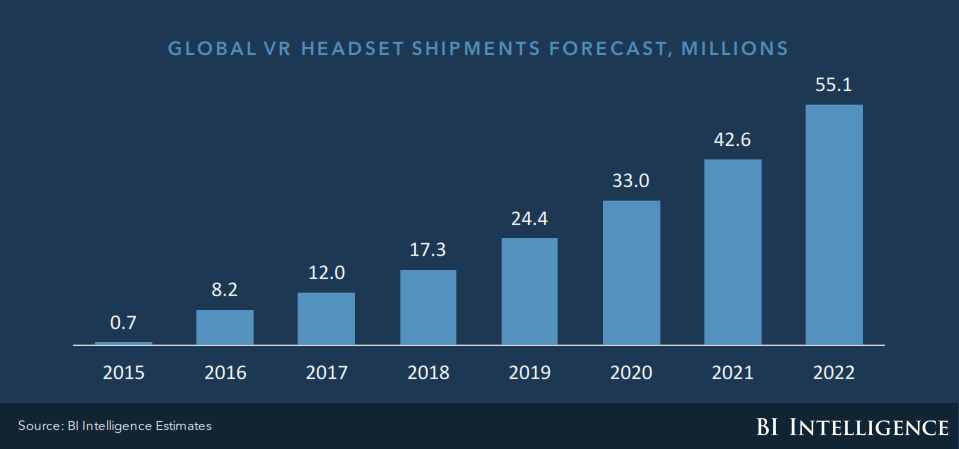
Driven by mobile based VR products, the Global VR content market is expected to grow at an exponential rate and is estimated to be worth $70 billion by 2020. For some perspective, that’s roughly the current market value of Uber.

OTT Video

OTT video refers to “Over The Top” content broadcasting by service providers such as Netflix, Hulu, and Amazon. It is increasingly becoming popular over traditional broadcasting, as consumers get more choice and freedom to watch their favorite shows in their own time. With high-speed connectivity, connected TVs and smartphones entering every major market around the globe, the infrastructure is already mature for OTT to become a global phenomenon.

Media companies have a lot to gain by making their video content available via the internet “over the top” of traditional broadcasting channels. For OTT service providers, there is a huge demand from emerging economies where most of this content is consumed on mobile phones, which is in contrast to the trends in the West. This perhaps explains why Indians are the fastest in the world at binge watching.

Further, OTT video content is ideal for LIVE events like concerts and sports. Twitter recently experimented with the format paying NFL a reported $10 million to stream 10 Thursday Night Football games for free. Around 20 million viewers followed these live streams. The experiment is seen as a major success for the company which has struggled to increase its user base over the years.

LIVE Streaming

“People comment 10 times more on Facebook Live videos than on regular videos” – says Facebook. In recent times, LIVE streaming with its inherent “must-see hype” has become a major priority for Facebook, Snapchat, Twitter, and YouTube, who are investing heavily on building their LIVE stream platforms as a default for everyone else. Though there is no clear leader at the moment, more and more brands are banking on LIVE streaming as it provides higher user engagement and instant feedback.

It is clear that the trends in content creation and distribution are changing rapidly with mobile still being central to all developments. Brands need higher agility to stay on top of these trends and make most of the opportunities in the digital space.

Credencys Solutions Inc is a leading software development services and solutions provider which has helped numerous businesses in their business growth. Subscribe to Insights by Credencys for similar company updates along with articles on business management, technology, strategy, leadership, and more.

Banks can Bank on IoT for Higher Efficiency

India employs around 35,000 men and 8,800 vehicles to maintain its more than 200, 000 ATMs. Despite its scale, the numbers don’t make headlines in normal circumstances. However, the recent demonetization drive did divert people’s attention towards these ATMs. Caught off-guard by the surprise decision, banks went in a state of mass delirium re-calibrating these 200,000 ATMs to fit the newly printed notes.

While these ATMs are a crucial part of India’s march towards financial inclusion, operating them has always been a huge task. The costs aren’t easy to ignore either if you start adding up costs involved in transportation and loading of cash, ATM’s annual maintenance and management, electricity bills, security (guard’s salary, security cams), space rent, interest for maintaining idle funds, and depreciation. A 2014 estimate (assuming an average ATM running cost at Rs 50,000/month) pegs India’s total annual expenditure on ATMs at around Rs 10,000 crore.

Banks have limited means to cut these costs and that’s why the burden is often shifted to the customers in terms of transaction charges. Further, these costs are unlikely to go down for banks if India if it has to match its global counterparts in terms of financial inclusion.

Banks can significantly reduce their AC operations cost with IoT

IoT can bring in significant cost savings in management and operations of ATMs. It is often seen that ACs are either not working or are cooling too much. These malfunctioning ACs can be detected via temperature sensors installed at each ATM premises. Further, malfunctioning doors can also be detected by sensors. By connecting these sensors to a central cloud-based reporting and management dashboard, banks can take preventive actions in time, eventually saving a lot on energy and maintenance costs.

Described above is just one of the many simple ways in which IoT can benefit banking organizations.

Other major use cases of IoT for Banks

Prevention of frauds

IoT can help in identifying debit/credit card transaction related frauds. Whenever a customer swipes a card, by matching the account holder’s mobile/device location with the transaction location, a bank can approve or decline the transaction with increased precision without any need for telephonic verification (which is the present method).

Reduction in NPAs

A significant earning for banks comes from lending to businesses. At the same time, they also constitute a major part of banks’ NPAs. By interpreting the data from sensor devices installed at borrower’s warehouse, banks can keep track of raw material and inventory stocks. This integration will help banks in ensuring that the loan amounts are paid when the inventory is sold. As modern warehouses increase IoT adoption, banks can leverage the same to reduce overhead costs in tracking and thus reduce their NPAs.

Agriculture lending

IoT is already modernizing agricultural landscape. However, banks can also receive advanced estimates for farm crops output based on real-time weather data and projections. Data analytics tools can help interpret this data into actionable intelligence for banks. This can improve advance planning for banks.

Capturing the factors affecting IoT adoption by Banks in India

StrengthsWeaknesses
  • Support for efficient operations
  • Support for automation
  • Better insights for marketing, cash flows and overdrafts
  • Support for financial inclusion goals
  • Lack of agility in decision making
  • Unclear roadmap for technology adoption
  • Lacking readiness for newer technology
OpportunitiesThreats
  • Increasing IoT adoption elsewhere
  • Higher consumer awareness & demand for swift and personalized services
  • The government’s push towards cashless transactions
  • Reduced costs for sensors and  technology enabling M2M connectivity
  • Evolving security threats
  • Market disruption by IoT startups

Despite its potential advantages, banks have so far shown little interest in developing IoT capabilities. The reputational and financial costs associated with threats in IoT are probably overweighing the opportunity costs at the moment. However, advanced platforms as those offered by IBM Watson and Xively are helping organizations across varied sectors expedite their IoT initiatives and banks can also take their advantage in building advanced IoT solutions for better efficiency.

Credencys Solutions Inc is a leading software development services and solutions provider which has helped numerous businesses in building strategies for their business growth. Subscribe to our blogs for getting similar articles on management, strategy, leadership and more.
 

Mobile App Development Trends for 2023 & Beyond

The Mobile World Congress (MWC) in Barcelona has become the default platform for businesses launching their next big smartphone. However, the biggest headline in this year’s Mobile World Congress was Nokia 3310 making a comeback, which isn’t exactly your regular smartphone. No need worry; dumbphones aren’t invading the market.

While smartphones are going stay here for a while, there is a need to gauge the evolving mobile App development trends in the industry. As per the data coming in, most of the growth in smartphone sales is projected to arise from emerging markets like India, China, Myanmar, Indonesia, and Japan. The high demand for smartphones in emerging economies stands in contrast to the declining unit sales in mature markets like Western Europe.

Developing applications for the next billion smartphones

As there is an apparent shift in the market, it is likely that most of the smartphone vendors would have to take into account the unique regional demands in Asia. It will be safe to say that Android is way ahead of iOS in the region, so far. This perhaps explains Apple’s move to start manufacturing in India. It will be too early to say if this move will give the company any definitive edge over numerous Android players operating in the market. Nonetheless, the war for supremacy is not going to be easier as Huawei is also getting vocal about its aspirations to be the market leader.

Applications running without the Internet

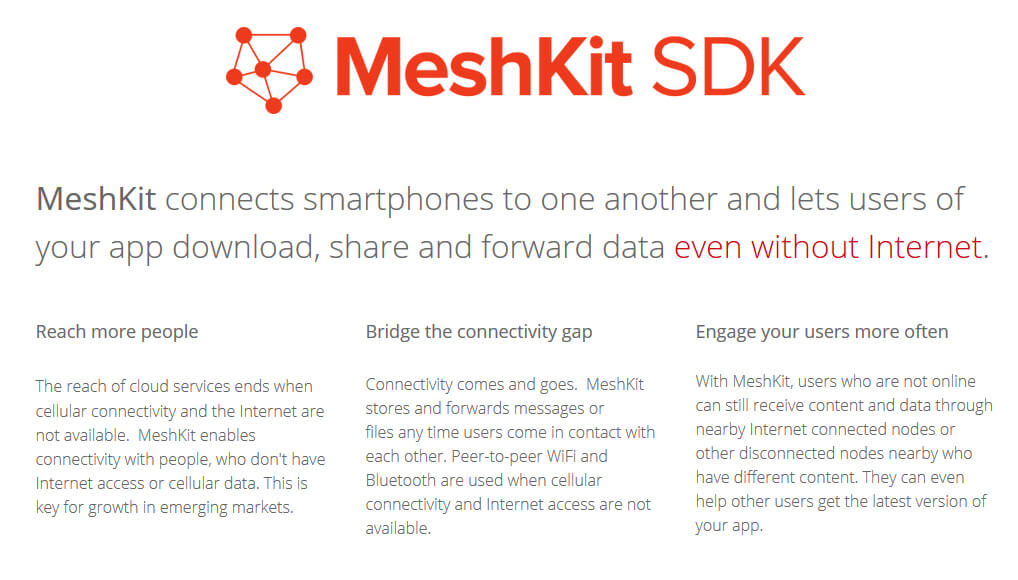
Cloud-based Apps and services with the ability to share and sync data in real time are becoming increasingly common. However, in the emerging economies, you will find that Internet penetration is not equal in urban and rural spaces. Needless to say, businesses operating in the region will have these issues at the back of their minds while developing mobile applications and solutions. Perhaps, these challenges will increase adoption of platforms like MeshKit which allow users to continue App usage, (sharing and forwarding data) even without the Internet.

meshkit

Though this isn’t a completely new idea, the technology enabling it in MeshKit has come of ages in terms of security, content exchange and nearby discovery. This means a lot for a country like India which is aiming to be a cashless economy. Applications enabling digital payments with multiple network protocols are likely to become more popular in the coming days.

Applications bringing a positive socio-economic change

Despite all the controversy surrounding the demonetization drive in India, the fact remains that technology is not something which prevents India from going cashless. In fact, it’s the opposite – it’s an enabler. Case in point – mPesa – a mobile payment service which has transformed the payments economy in Kenya. mPesa has more than 30 million users in 10 countries and it supports international transfers, loans, and health provision. In 2016, the service at its peak processed 529 transactions per second. mPesa has also made a significant impact in social value, creating opportunities for small businesses and reducing poverty. Similar applications have the potential to impact socio-economic structures in India and other emerging economies around the world.

Applications leveraging IoT

Apart from money transfer, in the emerging economies, there is a huge scope for mobile enabled IoT applications for healthcare, citizen’s information, electricity distribution, logistics, and governance. IoT Applications make tremendous value proposition by enabling access, increasing efficiency and customizing services to an individual level. Further, as Telecom operators start collaborating, operator agnostic solutions will also enter the market. A recent example is AT&T joining hands with China Mobile for developing a common IoT platform. According to the official press release, “the deal will help AT&T global business customers connect and deploy their assets and offerings in the Chinese market.” Such deals among telecom operators will tremendously expand the potential of IoT, globally.

Applications rich in Video Content

“AccuWeather “Video First” Strategy Drives 160% Video Audience Growth,” says official press release of AccuWeather, which is among world’s most trusted weather information channels. The company has responded well to consumer demand with its immersive 360-degree videos of storms, breaking weather coverage and other exciting video content on smartphone. According to another research report by ExchangeWire, Mobile is on track to be the “number one Video Screen in the UK”. As 4G services become increasingly affordable and widespread in the rest of the world, applications rich in video content are likely to become more common. According to Verizon’s Mobility report, globally the video content will rise to 60 percent of all App traffic by 2023 Mobile App Development Trends for 2023 & Beyond; that’s three years from now.

Applications with AR & VR Content

According to IDC forecasts, worldwide revenues for AR/VR market will reach $13.9 billion in 2017 from $6.1 billion in 2016 (annual growth of 130.5%). The market will reach $143.3 billion in 2023

and Retail will be the largest spender. Retailers are already experimenting with AR & VR creating immersive omnichannel experiences for their customers. However, beyond retail and entertainment, there are several other possibilities with these technologies which can be beneficial to emerging economies. The technologies can help architects, civil engineers, and automobile designers create better designs for buildings and cars. Medical professionals can have a better view of human anatomy with AR & VR. For industries like manufacturing, construction, and oil and gas, VR-based training simulations can be a great tool in preparing the workforce without exposing it to operational hazards. Such applications are bound to explode in the near future.

While it’s true that smartphone growth in the emerging economies is driven by the consumers, with widespread mobile connectivity, businesses are also leveraging the power of mobile for creating new revenue streams. Businesses are aware that mobility can make supply chain and logistics operations more efficient and streamlined. Not to mention, mobile is one of the best tools for marketing. It will not be a surprise if the next phase of growth for mobile Apps will come from the emerging economies.

Credencys Solutions Inc is a leading software development services and solutions provider which has helped numerous businesses in building strategies for their business growth. Subscribe to our blogs for getting similar articles on management, strategy, leadership and more.
Credencys to build IoT solutions with IBM Watson IoT

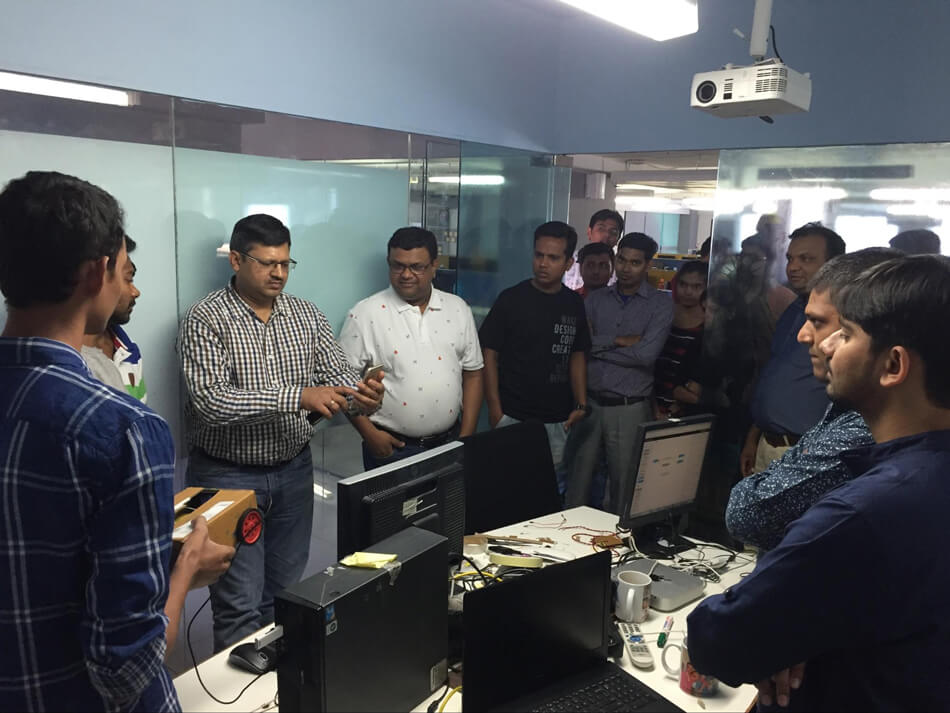
Credencys recently signed a multi-year strategic partnership agreement with IBM, adding Watson IoT (Internet of Things) and Bluemix platform capabilities to its enterprise application development services. A 48 hour ‘Hackathon’ was recently conducted by Credencys to create some unique POCs highlighting the power of IBMs platform. In this workshop, developers produced some applications while getting used to IBM’s tools, APIs, and frameworks.

Watson IoT platform is a unique platform which helps in expediting development of IoT solutions. It offers developers tools and ecosystem for connecting and managing different devices. By accessing the Watson IoT Platform on IBM Bluemix, developers can easily set up and manage IoT devices, gather live data, build dedicated mobile Apps, visualization dashboards and more. The partnership ensures that the developers at Credencys get access to all the tools and services required in building IoT applications at one place.

credencys-hackathon

The Hackathon event provided a unique opportunity to software developers at Credencys who worked with Arduino Microcontrollers and sensors (humidity, temperature, air quality etc) to develop multiple PoC solutions. Notable among these were a parking management system, a two-wheeler IP camera enabled rover which is controllable remotely via a smartphone and an automatic plant watering system.

credencys-hackathon Sanjay Mittal, Associate Director – IBM India and Sandeep Agrawal, CEO Credencys Solutions interacting with developers at Hackathon

While the above systems included IoT components, the teams also used Watson APIs to develop PoCs for a kids tutor (built on Watson’s visual recognition APIs) and real-time voice language translator (built on Watson’s speech and language translation APIs). These PoCs have the potential to solve numerous real world challenges as described below:

Watson in Works

The IoT Rover

This PoC can be expanded to create solutions for monitoring hazardous and critical industrial systems which are otherwise unapproachable by human inspectors. To enable all this, the rover can be customized to include sensors for detection of toxic gasses, high or low temperature (fire threat), water level, accurate location and distance, smoke, unauthorized access and more. Similar solutions can also be developed for surveillance, security and law enforcement purposes.

Parking Management System

In big cities, finding a parking space has become a daily nuisance. According to an estimate, people spend a total of 2,549 hours (~106 days) in their lifetime searching for a parking space whether it is on the school run, the local high street or a supermarket or airport car park. Technology can play a critical role in reducing this wastage. The parking management solution, which was developed using Watson’s engines at the Hackathon is planned to be a part of Credencys logistics solution offerings.

Interactive Kids Tutor

This application was designed to interact with 2-5-year-olds, helping them recognize real world objects like animals, fruits, birds etc. The application utilizes image and speech recognition and also has the conversational ability. The PoC can be expanded to create chatbots for customer support, counseling, office reception and numerous other applications requiring routine human interaction.

Automatic Plant Watering System

The solution developed by a Credencys team utilizes soil moisture sensors to gauge requirement for watering plants at home. This solution can be extrapolated to increase the efficiency of drip irrigation systems. Further, IBMs weather forecast data can improve the scope of this solution, creating systems which can plan irrigation, weeks in advance.

Real Time Voice Language Translator

As the name suggests, this application recognizes speech in any particular language and can translate it to another language on a real-time basis. With similar solutions, news channels can source LIVE news from across the world and can broadcast it to a local audience in their preferred language. Further, such applications can assist tourists in foreign locales, ease communication between doctors and patients, customs officers and immigrating nationals, and so on.


"The challenge with the technology is that it’s moving faster than most businesses perceive. IoT is enabling real-time interactions between factories, machines, systems and their human managers. Decision makers need to be on top of these interactions and this is where IBM Watson IOT platform makes the biggest difference. We have developed some impressive IoT applications in the past and we are certain that this partnership will add significantly to our application development capabilities"


SANDEEP AGRAWAL CEO Credencys Solutions Inc

Augment IoT with Watson’s Cognitive Abilities

A major advantage of Watson IoT platform is its Cognitive API which helps in building solutions that can leverage its proven cognitive analytics capabilities. As is well known, the real business value of IoT is not in connecting sensors, devices and things – it lies (largely untapped) in analyzing the data that all these ‘things’ produce. Applications built on Watson IoT Platform are well equipped to convert arcane data into meaningful insights for business decision makers. It’s up to businesses to explore, innovate and build applications that go beyond the obvious. For some inspiration, perhaps they should start taking science fiction seriously. Watson’s language, vision, speech and data APIs can offer an unparalleled edge to businesses. Here’s a small list of some of the more popular Watson APIs available on Watson Developer Cloud:

  • AlchemyLanguage – social media listening and intelligence
  • Conversation – chatbots that understand natural language
  • Language Translator – build once, broadcast across multiple languages
  • Speech – Speech-to-text and text-to-speech converters
  • Vision – systems that can comprehend visual content
  • AlchemyData News – smart news and trend analysis

Credencys Solutions Inc is a leading software development services and solutions provider which has helped numerous businesses in their business growth. Subscribe to Insights by Credencys for similar company updates, along with articles on business management, technology, strategy, leadership and more.