



 Client Overview
Founded in 1975, Tractmotor Parts (M) SDN BHD is a Malaysia-based equipment and spare parts provider serving the agriculture, machinery, light construction, and manufacturing sectors. The company works with overseas manufacturers and suppliers to deliver industrial equipment and spare parts to customers across Malaysia.
 Problem Statement
Tractmotor managed product information and media assets across Excel sheets, mobile devices, local computers, and disconnected business systems. This fragmented environment made it difficult to update catalogs, collaborate with suppliers, manage pricing, and provide sales teams with current product information.
The company needed a connected digital platform that could centralize product and asset data, integrate accounting and inventory systems, automate catalog updates, and improve customer-facing sales operations.
 Key Challenges
-
Scattered Product and Asset Data
Product information, images, documents, and other media files were stored across multiple devices and platforms, creating inconsistencies and limiting accessibility.
-
Disconnected Business Systems
The accounting and inventory systems were not properly connected, causing information gaps and reducing operational visibility.
-
Manual Catalog Updates
Catalog creation and maintenance required extensive manual work, resulting in outdated information and reduced team productivity.
-
Limited Supplier Collaboration
The absence of a centralized platform made it difficult to maintain accurate and timely information from manufacturers and suppliers.
-
Outdated Customer Information
Sales teams sometimes approached customers using outdated product and pricing information, affecting engagement and revenue opportunities.
-
Complex Customer Pricing
Different pricing structures for different customer groups were difficult to manage without a connected commerce platform.
-
Limited Customer Insights
The company lacked consolidated purchasing data needed to understand customer behavior and support more informed sales decisions.
-
Knowledge Transfer Challenges
Product knowledge was distributed across individual employees, devices, and files rather than stored in a centralized repository.
 Solution Implemented
-
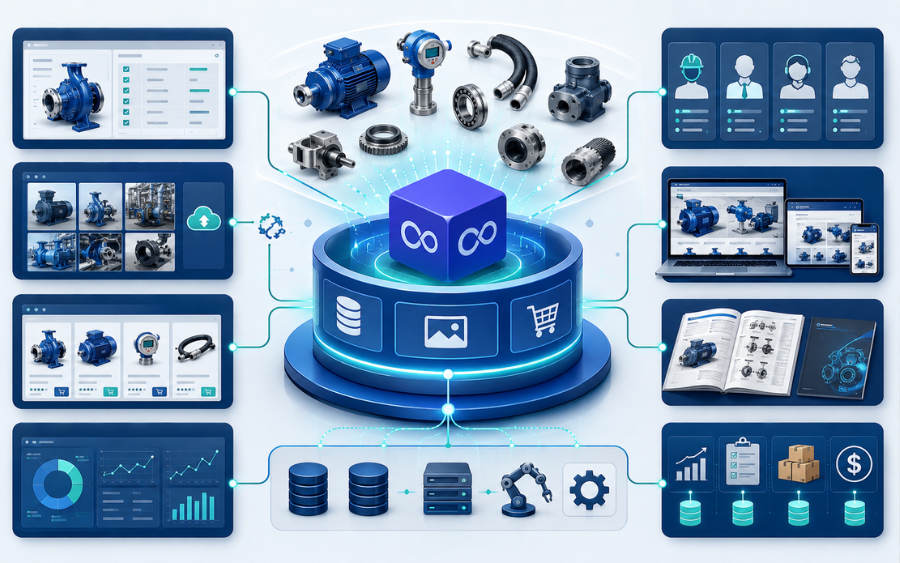
Centralized Product Information Management : Implemented Pimcore PIM to create a secure, centralized repository for product specifications, categories, attributes, and related information.
-
Digital Asset Management : Introduced DAM capabilities to centrally manage images, videos, documents, and other media assets and connect them with the appropriate products.
-
Digital Commerce Platform : Implemented digital commerce capabilities to manage complex customer pricing and enable teams to generate quotations and offers through the platform.
-
Flexible Product Data Modeling : Created a scalable data model for representing spare parts and equipment using accurate product categories, attributes, specifications, and taxonomies.
-
Automated Catalog Updates : Replaced manual catalog maintenance with automated product data synchronization and publishing workflows.
-
Accounting and Inventory Integration : Connected the new platform with existing accounting and inventory systems to enable consistent, bidirectional data exchange.
-
Role-Based Access Control : Configured user permissions to protect critical product information while allowing teams to collaborate efficiently.
-
Product Attribute Enrichment : Enabled teams to define, update, and enrich product attributes so customers and sales representatives could access complete product information.
 Business Impact
-
50% Faster Time-to-Market
Centralized product management and automated catalog processes enabled the company to introduce and update products more quickly.
-
40% Reduction in Catalog Creation Time
Teams could generate and distribute catalogs using centralized information instead of manually compiling product data from multiple sources.
-
35% Increase in Customer Engagement
Accurate and updated product information helped sales teams improve customer conversations, trust, and sales opportunities.
-
25% Improvement in Operational Efficiency
Automation and centralized data management reduced manual effort and allowed employees to focus on higher-value work.
-
Improved Sales Enablement
Sales teams gained access to current product specifications, assets, inventory information, and customer-specific pricing.
-
Stronger Supplier and Internal Collaboration
A shared product data platform improved information exchange between suppliers, product teams, sales representatives, and operational systems.
Highlights
- 50% faster time-to-market
- 40% reduction in catalog creation time
- 35% increase in customer engagement
- 25% improvement in operational efficiency

Is Data Management a Challenge in Your Organization?
Discover how Credencys can streamline your data processes, just like we did for our clients. Let’s connect to discuss solutions tailored to your needs.
Book a Free Consultation