


What Makes Snowflake Data Warehouse a Game-Changer for Modern Enterprises
As businesses generate more data than ever before, traditional data warehouses are struggling to keep up. Issues like limited scalability, complex maintenance, and rigid architectures often slow down data-driven decision-making.
Snowflake changes the game. Built for the cloud, Snowflake Data Warehouse offers a scalable, fully managed platform that simplifies data storage, processing, and analytics.
In fact, over 9,000 organizations, including 500 of the Fortune 500, now rely on Snowflake to power their data strategies.
In this blog, we’ll explore why Snowflake stands out as a modern solution and how it’s reshaping the future of data warehousing.
The Evolution of Data Warehousing
For decades, traditional data warehouses served as the backbone of enterprise reporting and analytics. These systems were designed for structured data and batch processing, running on expensive on-premises infrastructure with limited flexibility.
However, as data volumes exploded and use cases evolve from real-time analytics to AI/ML applications legacy warehouses began to show their limitations:
- Performance degraded under concurrent workloads.
- Semi-structured and unstructured data were difficult to handle.
- Scaling was slow and costly, often requiring hardware upgrades.
- Data sharing between teams or external partners was inefficient and risky.
The rise of cloud computing introduced a paradigm shift. Organizations needed a solution that could:
- Scale elastically based on demand,
- Handle diverse data types,
- Support modern analytics workloads,
- And reduce infrastructure overhead.
This paved the way for cloud-native data platforms like Snowflake, purpose-built to meet these modern data demands without the trade-offs of legacy systems.
What Sets Snowflake Apart?
Snowflake is a complete reimagining of what a modern data platform should be. Here’s what makes it stand out:
1. Zero Management
Snowflake is fully managed, meaning:
- No infrastructure provisioning.
- No indexing or tuning required.
- Automated scaling and performance optimization.
- Built-in resiliency and automatic backups.
Teams can focus on data strategy and insights not system administration.
2. Support for All Data Types
Unlike many legacy warehouses, Snowflake natively supports:
- Structured data (like SQL tables),
- Semi-structured data (JSON, Avro, Parquet),
- Unstructured data (images, videos, documents via external cloud storage integrations).
This allows enterprises to consolidate all data into a single, unified platform simplifying analytics and reducing silos.
3. Elastic & Infinite Scalability
Snowflake scales instantly and automatically to meet any demand:
- Spin up multiple compute clusters during high traffic.
- Scale down during idle times to save cost.
- No need to overprovision resources.
With its pay-per-second pricing model, you only pay for what you use making it cost-efficient at any scale.
4. Unique Architecture
At the heart of Snowflake’s innovation is its multi-cluster, shared data architecture, which separates compute, storage, and services:
- Storage Layer: Centralized and scalable for structured, semi-structured, and unstructured data.
- Compute Layer: Independent virtual warehouses that can scale up or down based on workload.
- Cloud Services Layer: Handles metadata management, query optimization, and access control.
This separation ensures that multiple users and workloads can run simultaneously without resource contention or performance drops.


Unlock the full potential of modern cloud data architecture with Snowflake’s unmatched flexibility and performance expertly implemented by Credencys
Comparing Snowflake with Traditional Warehouses
To understand Snowflake’s disruptive impact, it’s important to compare it directly with legacy data warehouse systems. The differences highlight just how far the industry has evolved:
| Features | Traditional Data Warehouse | Snowflake |
|---|---|---|
| Architecture |
|
|
| Scalability |
|
|
| Data Types Supported |
|
|
| Performance Under Load |
|
|
| Maintenance |
|
|
| Cost Model |
|
|
| Data Sharing |
|
|
| Cloud Flexibility |
|
|
Legacy systems were never designed for the scale, speed, or diversity of today’s data needs. Snowflake’s modern approach not only solves these problems, but it also creates new opportunities:
- Accelerating time-to-insight with instant scalability.
- Democratizing access to data through secure sharing.
- Reducing total cost of ownership through automation and cloud-native economics.
Snowflake is a fundamental shift in how organizations think about data warehousing.
How Snowflake Empowers Modern Use Cases
Snowflake’s versatility goes far beyond traditional analytics. Its cloud-native design, rich feature set, and seamless integrations enable a wide range of modern data applications across industries.
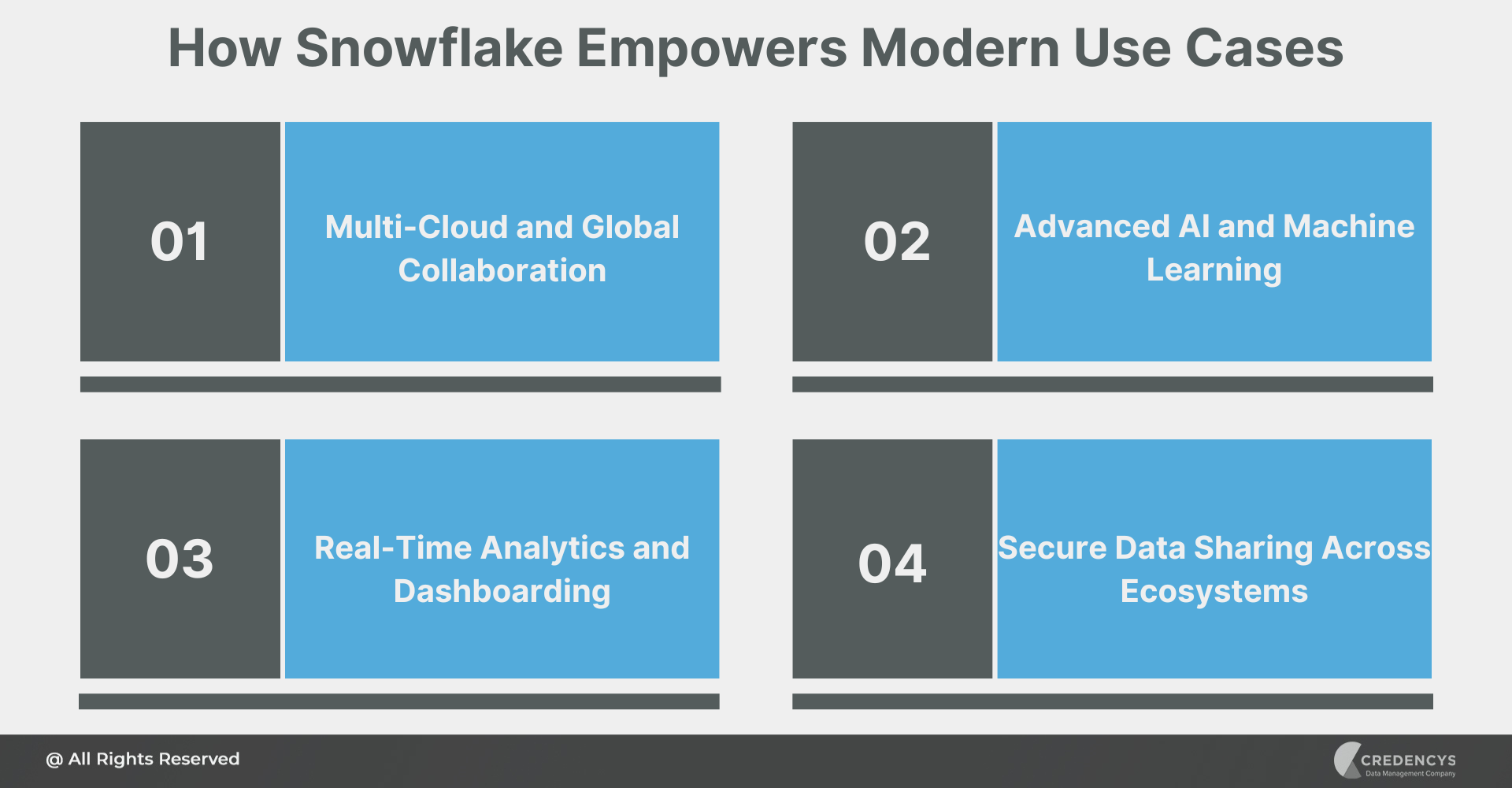
1. Multi-Cloud and Global Collaboration
Snowflake runs on AWS, Azure, and Google Cloud with cross-cloud replication and global data access capabilities. This enables:
- Business continuity across regions.
- Seamless collaboration across geographies.
- Avoidance of vendor lock-in.
2. Advanced AI and Machine Learning
Snowflake’s support for semi-structured data and integration with tools like DataRobot, AWS SageMaker, and Python notebooks makes it a powerful backend for AI/ML workloads. Use cases include:
- Predictive customer segmentation.
- Demand forecasting for inventory planning.
- Dynamic pricing based on behavioral data.
3. Real-Time Analytics and Dashboarding
With Snowflake’s ability to ingest and process data in near real time (via tools like Snowpipe and Kafka integrations), businesses can:
- Monitor supply chain disruptions as they happen.
- Track customer behavior across digital channels.
- Power dashboards that update dynamically without performance lags.
4. Secure Data Sharing Across Ecosystems
The Snowflake Data Cloud enables organizations to securely share data across departments, partners, or even customers without duplicating or moving data.
- Retailers sharing SKU-level sales data with suppliers.
- Financial institutions collaborating with regulators or fintech partners.
- Healthcare providers exchanging anonymized clinical data for research.
Leverage Snowflake to power real-time insights, AI-driven decisions, and seamless data collaboration tailored to your business use case by Credencys
Real-World Benefits for Enterprises
Snowflake delivers measurable business impact across functions, industries, and use cases. Here are some of the most compelling benefits enterprises realize after adopting Snowflake:
1. Lower Total Cost of Ownership (TCO)
- No infrastructure to manage or upgrade.
- Elastic compute avoids overprovisioning and idle costs.
- Usage-based pricing means you only pay for what you use.
2. Faster Time-to-Insight
- Run complex queries on massive datasets in seconds.
- Enable real-time data-driven decisions with minimal latency.
- Empower business users and analysts to explore data without IT bottlenecks.
3. Future-Ready Infrastructure
- Supports structured, semi-structured, and unstructured data natively.
- Seamlessly integrates with modern data tools, AI/ML frameworks, and BI platforms.
- Adapts to your evolving needs whether you’re scaling to new geographies or shifting cloud providers.
4. Increased Productivity
- Data engineers can build pipelines faster with simplified ingestion and transformation tools.
- Analysts access unified data from a single source of truth.
- Developers integrate data into applications using Snowflake’s rich ecosystem of APIs and connectors.
By bridging the gap between performance, simplicity, and flexibility, Snowflake helps enterprises turn data into a true competitive advantage.
Maximize Your Snowflake Investment with Credencys
While Snowflake provides the technology foundation, unlocking its full potential requires the right strategy, implementation, and optimization. That’s where Credencys comes in.
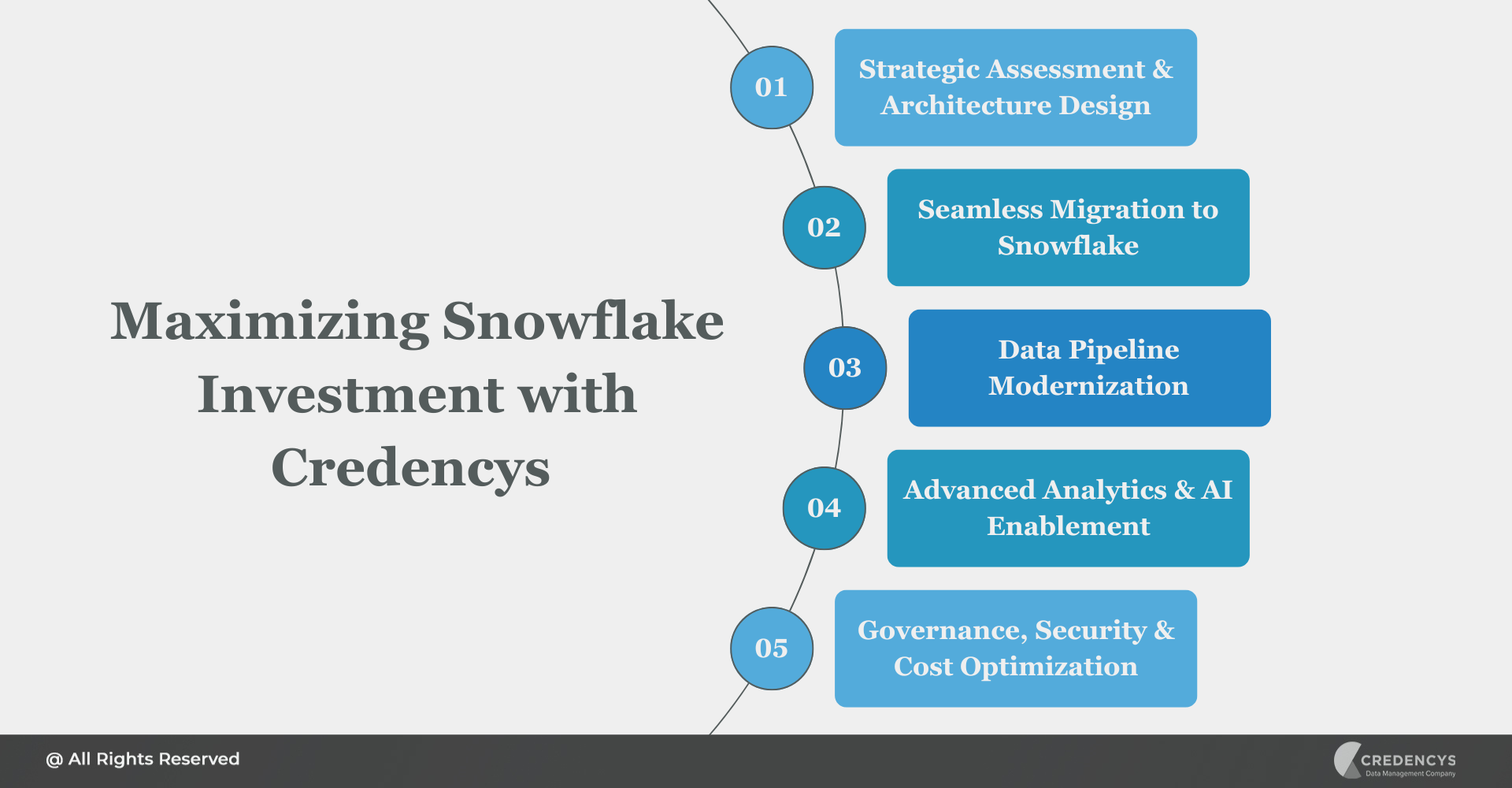
As a Snowflake consulting partner, we help enterprises accelerate data modernization and deliver real business outcomes with a tailored, end-to-end approach:
1. Strategic Assessment & Architecture Design
- Evaluate your current data landscape.
- Identify performance bottlenecks and modernization opportunities.
- Design scalable, cloud-native architectures aligned with business goals.
2. Seamless Migration to Snowflake
- Migrate from legacy data warehouses (like Oracle, Teradata, or Hadoop) with minimal disruption.
- Ensure data integrity, performance optimization, and compliance throughout the migration.
3. Data Pipeline Modernization
- Build robust, real-time data pipelines using tools like Fivetran, dbt, or Apache Kafka.
- Shift from batch-based ETL to modern ELT workflows.
4. Advanced Analytics & AI Enablement
- Enable self-service analytics, dashboards, and AI/ML solutions.
- Integrate Snowflake with your BI tools, data science platforms, and marketing ecosystems.
5. Governance, Security & Cost Optimization
- Implement role-based access, data masking, and monitoring for compliance.
- Optimize compute/storage usage to reduce Snowflake costs over time.
With Credencys as your Snowflake partner, you get more than a platform; you gain a strategic advantage through expert-led implementation, faster ROI, and continuous innovation.
Why Now is the Right Time to Modernize with Snowflake
Snowflake is a powerful, future-ready data platform that empowers businesses to move faster, work smarter, and scale without limits. Its unique architecture, elastic performance, and native support for diverse data types make it a game-changer in the world of modern data infrastructure.
But technology alone isn’t enough. To truly unlock Snowflake’s value, you need a strategic partner who understands your data landscape, business goals, and long-term vision.
Ready to Transform Your Data Strategy? Let Credencys help you make the most of Snowflake. From migration to optimization, we guide you every step of the way






Tags: