


Introduction to Unity Catalog in Databricks: A Complete Beginner’s Guide
Organizations are generating and consuming data at an unprecedented scale. With this explosion of data comes a critical need for effective data management and governance—especially as enterprises move toward modern analytics and AI platforms.
Databricks, a leading lakehouse platform, brings together data engineering, data science, machine learning, and analytics into a unified workspace. However, as data environments become increasingly complex, the challenge of securing and governing data assets across teams and workloads also grows.
According to a 2024 IDC report, over 75% of organizations struggle with fragmented data governance across their cloud ecosystems, leading to compliance risks, data silos, and inefficiencies.
To address this challenge, Databricks Unity Catalog is a unified governance solution that provides centralized access control, fine-grained permissions, and end-to-end data lineage across all data assets in the Databricks Lakehouse. Unity Catalog simplifies governance by giving data teams a single interface to manage and secure data, regardless of its location or usage.
This beginner’s guide aims to demystify the Unity Catalog.
What is Unity Catalog?
Unity Catalog is Databricks’ unified data governance solution designed to provide a single, centralized interface for managing all data assets across your Databricks Lakehouse environment. It enables organizations to secure, discover, audit, and consistently manage data, regardless of the cloud provider or workspace in use.
At its core, Unity Catalog addresses a long-standing challenge in modern data architectures: the fragmentation of data governance across multiple tools, storage systems, and access models. Before the Unity Catalog, managing permissions and visibility across data, notebooks, ML models, and dashboards often required manual effort and inconsistent policies. Unity Catalog brings these under one governance umbrella.
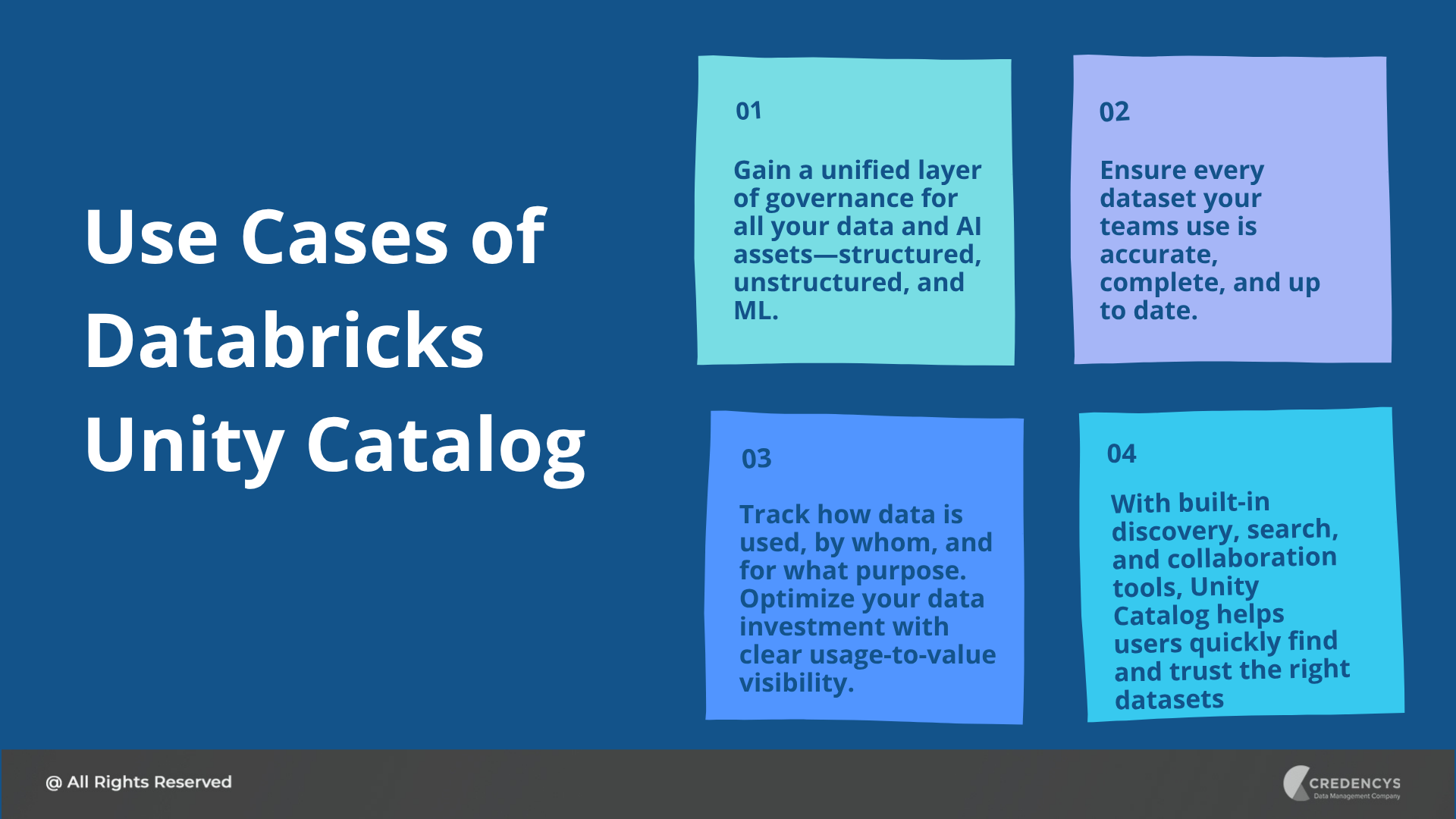
Key characteristics of Unity Catalog include:
- Unified metadata layer across all workspaces
- Fine-grained access controls using standard ANSI SQL
- Built-in data lineage tracking for transparency and traceability
- Audit logging to monitor access and usage patterns
- Multi-cloud and multi-workspace support, making it ideal for enterprise-wide deployments
Whether you’re building machine learning models, generating BI dashboards, or ingesting data from multiple sources, Unity Catalog ensures that your data remains secure, compliant, and easy to govern at every step.
By centralizing governance and metadata management, Unity Catalog not only simplifies data operations but also empowers teams to collaborate more effectively without compromising security or compliance.
Key Features of Unity Catalog
Unity Catalog is packed with powerful features designed to simplify and standardize data governance across the Databricks Lakehouse. Here’s a closer look at its most important capabilities:
1. Centralized Metadata Management
Unity Catalog introduces a single metastore to manage metadata across all Databricks workspaces and cloud environments. This provides a unified, consistent view of all your data assets—structured, semi-structured, and unstructured.
- No more siloed metadata by workspace or region.
- Makes data discovery faster and more reliable.
2. Fine-Grained Access Control
Unity Catalog enables role-based access control (RBAC) at the table, column, and row levels, all of which are defined using standard SQL syntax.
- Allows you to implement least-privilege access without complex workarounds. Example: A data analyst may only see a subset of customer fields, whereas a data scientist has full access.
- Supports both data access policies and privilege inheritance across data objects.
3. Automatic Data Lineage Tracking
Unity Catalog automatically captures data lineage across queries, jobs, and notebooks. You can trace where data originated, how it’s transformed, and where it flows—all without manual tagging.
- Supports end-to-end lineage for both SQL and notebook workflows.
- Enhances auditing, debugging, and impact analysis.
4. Built-in Audit Logging
Every access request—whether it’s reading a table, executing a job, or modifying permissions—is logged automatically. This supports regulatory compliance and internal audits.
- Logs can be exported to cloud-native monitoring tools.
- Helps detect unauthorized access or data misuse.
5. Unified Governance for All Data Assets
Unity Catalog governs not just tables and views but also files, machine learning models, notebooks, and dashboards—all under a consistent access control model.
- Encourages secure collaboration between data engineering, analytics, and ML teams.
- Enables governance for non-relational assets, such as files and objects, in cloud storage.
6. Multi-Cloud and Multi-Workspace Support
Designed with enterprise-scale in mind, Unity Catalog supports multiple Databricks workspaces across AWS, Azure, and Google Cloud, utilizing a centralized metastore.
- Simplifies governance in hybrid or multi-cloud environments.
- Ensures policy consistency across the entire data landscape.
With these features, Unity Catalog becomes a foundational pillar for organizations looking to scale their data operations without compromising security, visibility, or compliance.
Benefits of Using Unity Catalog
Unity Catalog isn’t just a technical upgrade—it’s a strategic enabler for organizations striving to scale their data and AI initiatives responsibly. By centralizing governance and simplifying control across complex data environments, Unity Catalog delivers tangible business and operational benefits.
1. Enhanced Data Security and Compliance
With fine-grained access controls, lineage tracking, and built-in audit logging, Unity Catalog enables organizations to enforce robust data security policies and meet regulatory requirements, including GDPR, HIPAA, and SOC 2.
- Reduce data exposure and control who accesses what data—and how.
- Maintain detailed audit trails for every data access or modification event.
2. Consistent Governance Across the Lakehouse
Instead of applying different governance models for files, tables, and ML assets, Unity Catalog provides a single control plane. This eliminates policy inconsistencies, making it easier to scale governance across teams, workspaces, and clouds.
- Set once, enforce everywhere.
- Simplifies cross-functional collaboration and governance reviews.
3. Improved Collaboration and Productivity
By centralizing metadata and access controls, Unity Catalog accelerates data discovery and reduces access bottlenecks. Teams no longer need to wait on manual approvals or navigate siloed systems.
- Business users and analysts can access trusted data more quickly.
- Engineers spend less time managing permissions and more time delivering value.
4. Greater Transparency Through Data Lineage
Automatic lineage tracking provides complete visibility into how data flows and transforms from ingestion to consumption. This helps teams understand dependencies, perform root cause analysis, and manage the impact of schema or logic changes.
- Empower better decision-making and governance through traceability.
- Simplify audits and improve data trust.
5. Scalability for QWWEnterprise Data Management
Unity Catalog is built to support multi-workspace and multi-cloud deployments, making it ideal for large, global enterprises. It allows governance policies to scale within the organization without creating overhead.
- One governance model for thousands of users and datasets.
- Supports both centralized and federated data architectures.
Getting Started with Databricks Unity Catalog
Implementing Unity Catalog is a crucial step toward achieving enterprise-grade data governance—but it requires the right strategy, technical skills, and domain expertise to get it right. That’s where Credencys comes in.
As a trusted Databricks partner, Credencys empowers organizations to adopt the Unity Catalog seamlessly, ensuring faster implementation, reduced risk, and long-term success.
Here’s how we help:
- End-to-End Implementation: From metastore setup to catalog configuration and access policies, we handle it all.
- Cloud & IAM Integration: Seamless connection to AWS, Azure, or GCP environments with secure identity and storage management.
- Access Control & Compliance: Fine-grained permissions, automated lineage tracking, and audit logging to meet governance goals.
- Training & Support: Hands-on onboarding for your teams and ongoing guidance to ensure smooth adoption.
Whether you’re starting fresh or migrating from legacy systems, Credencys ensures a secure, scalable, and compliant Unity Catalog deployment—ready for enterprise growth.

With Credencys’ Databricks-certified experts, you get tailored implementation, seamless integration, and ongoing optimization to unlock the platform’s full potential.




Tags: