


Generative AI in PIM: How to Unlock Smarter Product Experiences
In an era when speed, accuracy, and consistency determine competitive advantage, PIM systems are evolving into intelligent, generative engines. As digital catalogs balloon in size and complexity across omnichannel networks, brands face mounting pressure to produce compelling, accurate, and localized content at scale.
Manual processes simply can’t keep up.
The global PIM market is projected to expand to $32.84 billion by 2030, at a CAGR of 16.7%.
Meanwhile, adoption of generative AI is surging – 71% of organizations now report regular use of generative AI in at least one business function.
These twin trends, robust growth of PIM as a foundational platform and rising trust in generative AI, set the stage for a transformation that embeds generative AI within PIM to automate, enrich, and optimize product content workflows. In this post, we’ll explore how generative AI is reshaping PIM, from use cases and architectural choices to ROI frameworks and governance guardrails.
Whether you are leading product, data, eCommerce, or digital transformation, this guide offers a grounded roadmap to modernizing your PIM for the AI era.
What You’ll Learn
In this blog, we’ll explore how Generative AI is transforming PIM and what it means for modern enterprises. You’ll discover:
- The role of Generative AI in PIM
- Key business benefits
- Real-world use cases
- Implementation best practices
- Future outlook
What is Generative AI & Why It Matters for PIM
Generative AI (GenAI) refers to advanced artificial intelligence models capable of creating new content such as text, images, audio, or even structured data rather than just analyzing or classifying existing information. Unlike traditional AI systems that rely on rule-based automation or pattern recognition, Generative AI leverages large language models (LLMs) and multi-modal architectures trained on massive datasets to generate human-like, contextually relevant outputs.
GenAI’s power lies in its ability to co-create with humans, producing tailored outputs that blend creativity, accuracy, and efficiency. In the context of PIM, this means moving from manual content creation, where teams painstakingly write product titles, descriptions, and metadata, to content co-generation, where AI assists in producing enriched, consistent, and brand-aligned product information at scale.
For organizations managing thousands of SKUs, this shift is transformative. Generative AI can:
- Scale effortlessly, handling new product launches or catalog expansions with minimal manual effort.
- Reduce operational costs while freeing up teams for higher-value creative or strategic work.
- Accelerate content creation by automating product descriptions, translations, and SEO metadata.
- Ensure consistency across omnichannel platforms.
In short, Generative AI is redefining how businesses create, manage, and scale product information in a digital-first world.

Ready to Explore How Generative AI can Supercharge your PIM Strategy and Streamline Content Operations? Let’s Uncover What’s Possible for Your Business.
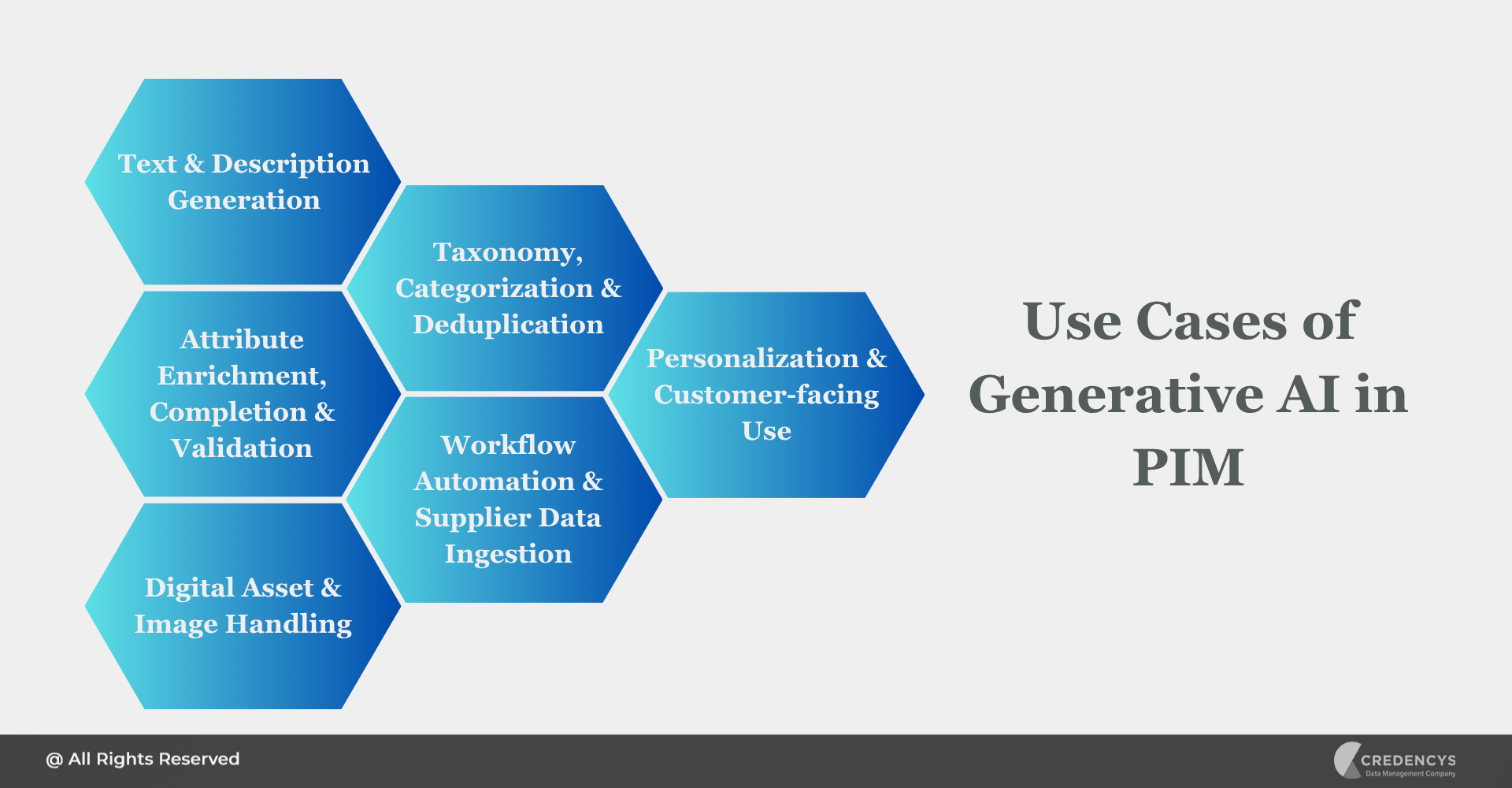
Use Cases of Generative AI in PIM
Generative AI is redefining how organizations create, manage, and distribute product data. Beyond just automating text generation, it is helping brands ensure accuracy, consistency, and personalization at scale all within their PIM workflows.
Below are some of the most transformative use cases currently emerging.
1. Text & Description Generation
One of the most powerful applications of Generative AI in PIM is automating product content creation. Instead of teams manually writing every product description, AI can now generate optimized text in seconds.
- Multi-channel adaptation: A single master description can be tailored for different sales channels; eCommerce listings, mobile apps, or printed catalogs. For example, a long-form web description can be condensed for Amazon or rewritten for a social media ad.
- Localization and multilingual support: Tools powered by GenAI can localize not only the language but also cultural tone, measurement units, and regional nuances.
- Seasonal content updates: Instead of rewriting entire product catalogs for new collections, AI can refresh content with relevant seasonal or trend-based language.
- Audience adaptation: AI can adjust tone and complexity, from technical specs for B2B buyers to lifestyle-oriented content for end consumers.
| Before | After |
|---|---|
| Content teams spent days writing and localizing descriptions manually. | AI generates context-aware, multilingual product narratives within minutes, freeing teams for higher-level strategy. |
2. Attribute Enrichment, Completion & Validation
Product data often arrives incomplete, missing key attributes like dimensions, colors, or compatibility information. GenAI can detect these gaps by recognizing category-specific patterns and suggest accurate values.
- Attribute completion: AI infers missing attributes from context, for example, if “Men’s Leather Jacket” lacks a color, it can extract that from accompanying images or similar SKUs.
- Automatic error correction: Detects anomalies like incorrect units (e.g., “5 kg shoe” instead of “500 g”).
- Cross-attribute validation: Ensures logical consistency; e.g., a “cotton shirt” shouldn’t list “machine wash: no.”
These capabilities enable intelligent data hygiene, ensuring every product record meets quality standards before reaching the customer-facing channel.
| Before | After |
|---|---|
| Manual QA and spreadsheet-based checks led to delays and human errors. | Automated attribute enrichment ensures accuracy, completeness, and trust in product data. |
3. Digital Asset & Image Handling
Product visuals are integral to customer experience, and Generative AI is elevating how they’re managed within PIM systems.
- Content consistency: AI cross-checks whether the image matches the product description, e.g., detecting if a “blue dress” image mistakenly shows a red one.
- Generative image variations: Emerging models can generate new product views (front, side, lifestyle) or adjust backgrounds for brand consistency.
- Auto metadata and tagging: AI can automatically generate alt text, image captions, and SEO tags for product images.
These capabilities enhance product discoverability and accessibility while reducing manual DAM (Digital Asset Management) work.
| Before | After |
|---|---|
| Image metadata and QA were fully manual. | GenAI automates tagging and ensures alignment between visuals and text, delivering a consistent brand experience. |
Want to See How AI can Automate Image Tagging, Metadata Creation, and Quality Checks Across Your Product Catalog? Discover how GenAI Enhances Digital Asset Workflows in PIM.
4. Taxonomy, Categorization & Deduplication
Categorizing and maintaining large product catalogs is one of the most time-consuming aspects of PIM. GenAI simplifies it dramatically.
- Automated categorization: When a new SKU enters the system, AI analyzes its description, attributes, and images to assign the correct category automatically.
- Attribute normalization: Maps supplier-specific terms to a unified taxonomy; e.g., “Color: Crimson” → “Color: Red.”
- Duplicate detection: AI compares records across multiple supplier feeds to flag potential duplicates.
This ensures data remains consistent and search-friendly across platforms. This use case reduces catalog chaos, especially when onboarding thousands of SKUs from multiple vendors.
| Before | After |
|---|---|
| Data teams manually reviewed each record to maintain taxonomy integrity. | AI continuously monitors and organizes data, minimizing redundancy and improving catalog usability. |
5. Workflow Automation & Supplier Data Ingestion
Managing supplier data is one of the biggest operational bottlenecks in PIM. GenAI can streamline this with intelligent automation.
- Intelligent task routing: Based on product category or data completeness, AI assigns approval or review tasks to the right team members.
- Automated schema mapping: AI maps incoming supplier spreadsheets or XML files to the canonical PIM schema, regardless of formatting differences.
- Event-driven updates: Triggers automatic updates or notifications when new SKUs, images, or attributes are added.
This reduces onboarding friction and speeds up time-to-market for new products.
| Before | After |
|---|---|
| Supplier feeds required manual reformatting and constant oversight. | GenAI automates mapping, validation, and routing, ensuring faster, cleaner data integration. |
6. Personalization & Customer-facing Use
Generative AI extends PIM’s influence beyond internal operations to customer engagement.
- Content for personalization engines: Clean, enriched data from GenAI-enhanced PIM systems feeds recommendation algorithms with higher precision.
- Conversational assistants: Chatbots can pull real-time product information directly from PIM, offering instant, accurate responses.
- Automated product comparisons: AI generates detailed side-by-side comparisons to help shoppers make informed choices.
- Smart recommendations: Based on enriched attributes, AI suggests complementary products or accessories.
| Before | After |
|---|---|
| Product discovery was static and generic. | AI enables dynamic, context-aware experiences, improving conversions and customer satisfaction. |
ROI, Metrics & Phased Adoption Strategy
Generative AI in PIM is about measurable business impact. To justify investment and secure stakeholder buy-in, organizations should track key performance metrics that link directly to operational efficiency and revenue outcomes.
Key Metrics to Measure Success
The ROI of AI-enabled PIM can be quantified through:
- Number of SKUs enriched per cycle: The volume of product data that moves from incomplete to fully enriched with AI support.
- Return rate reduction: Improved accuracy and clarity in product information, leading to fewer customer returns.
- Time-to-publish per SKU: How quickly new or updated products go live across channels.
- Conversion uplift: Higher sales conversion driven by richer, more relevant content.
- Error rate reduction: Fewer inconsistencies in attributes, descriptions, or taxonomy.
Organizations adopting GenAI experience up to 50% faster content creation cycles and 30–40% cost savings on manual data management tasks, clearly indicating a bottom-line impact.
Want to Uncover How AI can Improve Your PIM Performance and Deliver Measurable ROI? Let Our Experts Help You Identify the Right Success Metrics.
Pilot – Scale Approach
The most effective way to adopt Generative AI is through a phased rollout:
- Start small: Choose a single use case (e.g., automated product descriptions) or category.
- Validate results: Measure enrichment accuracy, efficiency gains, and content quality.
- Secure buy-in: Share early success stories with leadership and cross-functional teams.
- Scale gradually: Expand to other workflows like taxonomy, localization, and supplier onboarding.
Balancing Cost and Benefit
While upfront investments include model integration, compute usage, and monitoring infrastructure, the long-term returns of faster time-to-market, consistent product experiences, and reduced manual overhead far outweigh initial costs. Success depends on strategic scaling, where early pilot learnings guide enterprise-wide adoption without operational risk.
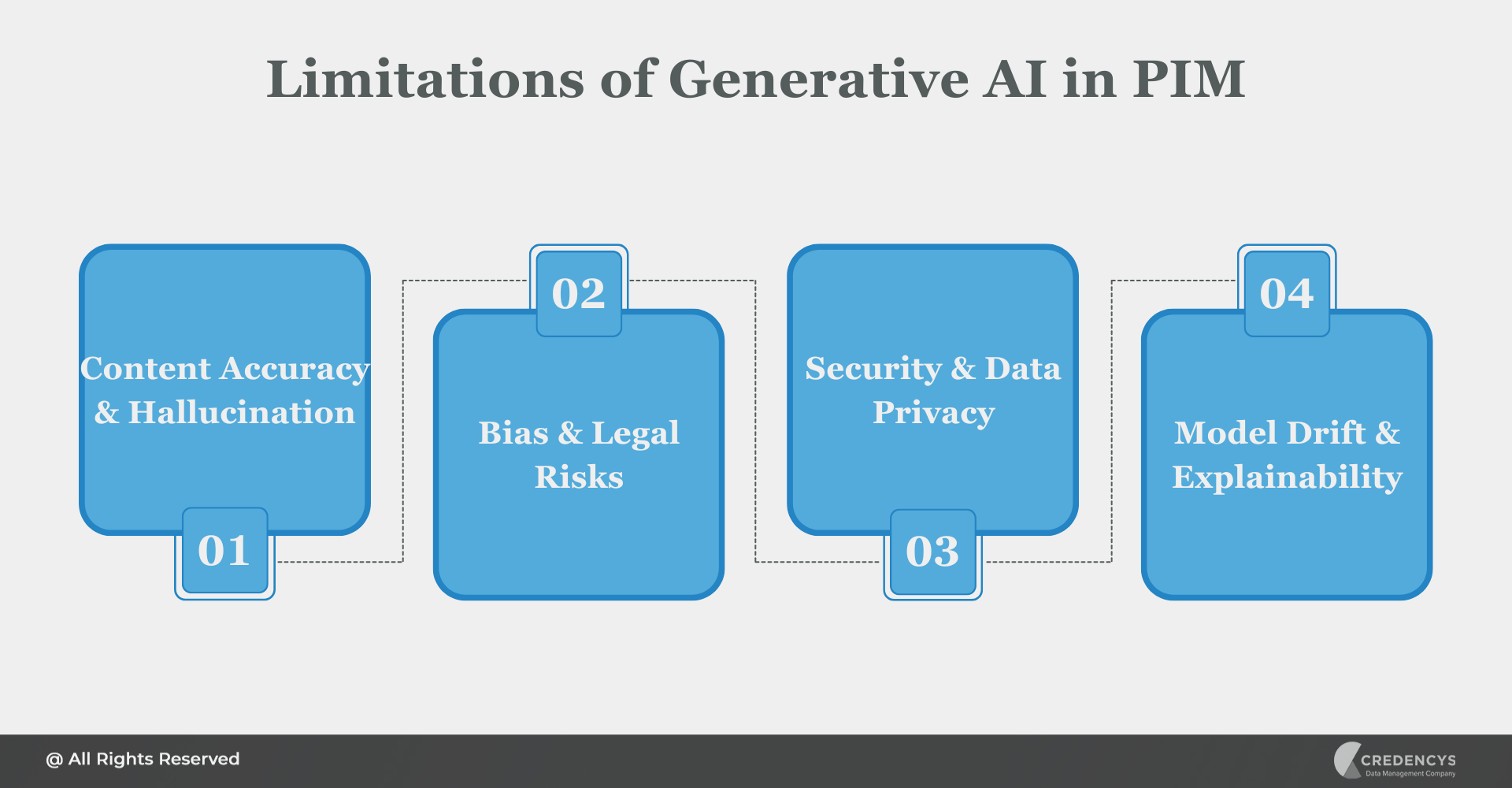
Limitations of Generative AI in PIM
While Generative AI brings transformative potential to PIM, it also introduces a new set of risks that businesses must actively manage.
1. Content Accuracy & Hallucination
Generative models can sometimes produce hallucinations, which are outputs that sound plausible but are factually incorrect. In a PIM context, this could mean generating the wrong technical specifications, dimensions, or product attributes.
To mitigate this, enterprises must implement human-in-the-loop reviews and validation guardrails that flag uncertain outputs before publishing.
2. Bias & Legal Risks
AI-generated content can reflect underlying biases present in training data, leading to unfair or non-compliant descriptions. This poses particular challenges for regulated industries (e.g., medical devices, cosmetics, or electronics), where accuracy and labeling are legally mandated.
Regular model audits and controlled training data sets help minimize these risks.
3. Security & Data Privacy
If organizations send product or supplier data to external GenAI APIs, there’s a potential exposure risk. Sensitive data (such as vendor pricing or proprietary SKUs) should be masked or processed through private or hybrid AI models.
Encryption, anonymization, and clear API governance policies are essential.
4. Model Drift & Explainability
Over time, AI models can experience drift, where predictions gradually diverge from expected outcomes. Continuous monitoring, version control, and explainable AI (XAI) tools ensure transparency and traceability across all outputs.
When Not to Use Generative AI
Generative AI may not deliver ROI in cases such as:
- Small product catalogs with limited data.
- Highly regulated categories requiring manual oversight.
- Teams lacking domain experts to review outputs.
By combining guardrails, fallback logic, audit trails, and human verification, organizations can safely harness Generative AI while maintaining governance, compliance, and confidence in every product record.
Conclusion
Generative AI is no longer science fiction; it’s becoming a co-pilot for modern PIM systems, helping businesses create, enrich, and manage product data faster and smarter. The key is to start small, validate results, and scale responsibly, blending automation with human oversight to build trust and accuracy over time.
If you are ready to explore how Generative AI can transform your product data workflows, download our PIM + AI Readiness Checklist to map your AI adoption journey.







Tags: