


AI is no longer just a tech buzzword. It’s everywhere.
You probably feel it at work, in meetings, in strategy decks, and even in casual coffee conversations. That’s because businesses aren’t just experimenting with AI any longer; they’re betting billions on it.
Globally, the AI consulting market is booming. It was valued at more than $11 billion in 2025 and is expected to grow even larger in 2026 as companies scramble to build real-world AI solutions.
While nearly 78% of consulting firms have fully deployed AI tools in client engagements, many organizations still struggle to turn AI hype into actual outcomes like productivity gains or revenue impact. And that’s exactly where AI consultants come in.
Companies need partners who can knit all the pieces together: strategy, data, implementation, and continuous optimization. They need trusted guides, not just vendors selling fancy dashboards.
So, in this crowded and fast-moving landscape, how do you separate the mere talkers from true transformers who actually help businesses make AI real? That’s exactly what this guide is here to do.
We are giving you business leaders, CTOs, Heads of Data, and decision-makers, a clear, practical, no-nonsense look at the top AI consulting companies in 2026. Let’s dive in.
What Makes an AI Consulting Company “Top” in 2026?
Before we jump into names and rankings, we need to answer something more important. What actually makes an AI consulting firm worth hiring in 2026?
Not branding. Not marketing.
Not a shiny “GenAI practice” page. Real capability.
And the bar is much higher now.
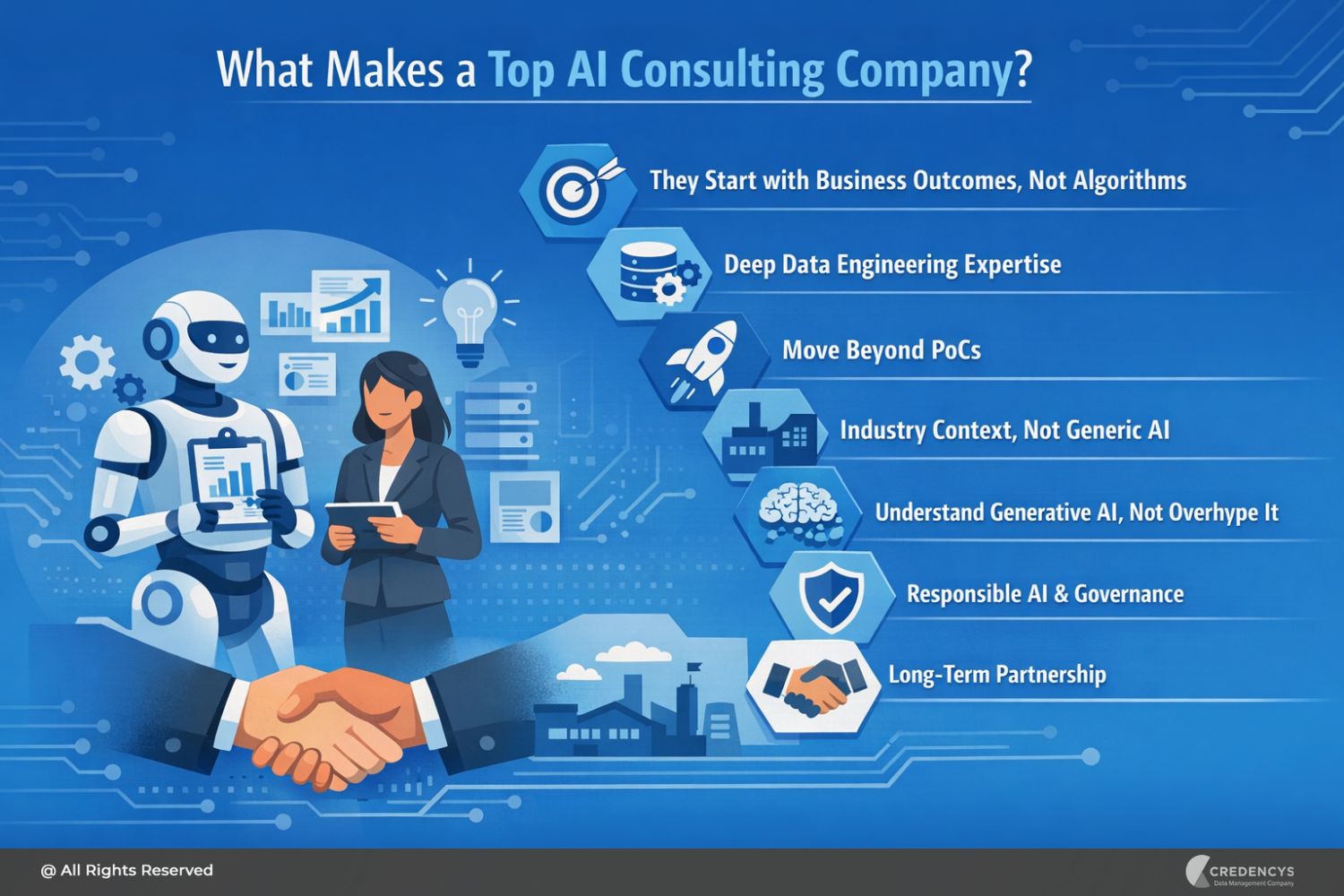
1. They Start with Business Outcomes, Not Algorithms
The best AI consulting firms don’t walk in talking about models. They discuss margin expansion, customer retention, supply chain efficiency, fraud reduction, and the impact of dynamic pricing.
According to McKinsey & Company, companies that successfully scale AI across business units can see a 20–30% improvement in EBIT in AI-enabled functions.
That’s not experimentation. That’s transformation.
If a consulting firm can’t clearly articulate how AI connects to measurable business KPIs, that’s your first warning sign.
2. They Have Deep Data Engineering Expertise
AI projects fail more often because of data problems, not model problems. In fact, research from Gartner shows that 85% of AI projects fail to deliver on expectations, often due to poor data quality, unclear objectives, or lack of operationalization.
So, a top AI consulting company in 2026 must be strong in:
- Data architecture
- Data lakehouse implementation
- Data governance
- Data quality frameworks
- Integration across legacy systems
Because AI without a clean, governed data foundation is just hallucinating at scale.
3. They Know How to Move Beyond PoCs
Proofs of concept are easy. Scaling is hard.
And many firms quietly live in PoC land forever. But enterprise AI success depends on:
- MLOps frameworks
- Model monitoring
- Continuous retraining
- Deployment pipelines
- Cross-functional adoption
According to IBM’s Global AI Adoption Index, while AI adoption has grown significantly, only a fraction of organizations have achieved full-scale, enterprise-wide AI integration. This gap is where the real consulting value lies.
4. They Bring Industry Context, Not Generic AI
AI is not one-size-fits-all. Retail AI is different from manufacturing AI.
BFSI AI is different from healthcare AI. The best firms bring:
- Pre-built accelerators
- Domain-specific data models
- Industry-trained ML frameworks
- Regulatory awareness
Because building a fraud model without understanding banking regulations is risky. And building demand forecasting without understanding supply chain variability is incomplete.
5. They Understand Generative AI But Don’t Overhype It
Yes, generative AI changed the conversation. But mature consulting firms know when to use GenAI and when not to.
The global generative AI market is projected to exceed $100 billion by 2030, according to Bloomberg Intelligence.
Big numbers. But smart firms ask:
- Does this use case actually require GenAI?
- Or would predictive analytics do the job better?
- What are the data privacy implications?
- How do we prevent hallucinations?
Hype is loud. Responsible implementation is quiet and far more valuable.
6. They Embed Responsible AI and Governance from Day One
By 2026, AI governance isn’t optional anymore; it’s board-level. Top firms provide:
- Bias detection frameworks
- Explainability models
- Audit trails
- Compliance alignment
- Model risk documentation
Because one flawed AI decision can damage trust overnight, which is hard to rebuild.
7. They Offer Long-Term Partnership
AI is not a one-time project. It evolves, adapts, and learns. The strongest AI consulting firms structure engagements around:
- Continuous optimization
- Managed AI services
- AI Centers of Excellence
- Internal capability building
They don’t want you dependent forever. They want you to be capable.
That’s a huge difference. So, what separates the best from the rest?
It’s simple. Anyone can build a model.
Fewer can deploy it. Even fewer can scale it.
And only a handful can align AI with business strategy, data foundations, governance, and long-term enterprise growth, all at once. That’s the lens we are using to evaluate the companies in the next section.
Let’s get into the list.
Top AI Consulting Companies in 2026
These companies are recognized for their ability to move AI from idea to implementation and, more importantly, from pilot to measurable business impact.
Credencys Solutions
If AI success depends on strong data foundations, Credencys stands out. Unlike firms that begin with flashy AI demos, Credencys starts where it matters most: data engineering, governance, and scalable architecture.
Because AI without reliable data isn’t intelligence. It’s noise.
Credencys focuses on building AI systems that are not only accurate but production-ready and business-aligned.
Core Strengths:
- AI-native Customer 360 solutions
- AI-driven demand forecasting
- Dynamic pricing optimization
- Data lakehouse architecture implementation
- AI operationalization & MLOps frameworks
- Retail & CPG-focused AI accelerators
What makes them different?
They don’t treat AI as a standalone project. They embed it into business workflows: merchandising, supply chain, marketing, and pricing, where it directly drives revenue and efficiency.
And because they combine data strategy with AI engineering, clients don’t get stuck in endless proof-of-concept cycles. They get deployed systems.
Best For: Mid-to-large enterprises that want outcome-driven AI solutions built on a strong data foundation, especially in retail, CPG, and data-intensive industries.
Success Story: How Credencys Helped a Specialty Apparel Retailer
When talking about AI consulting companies that deliver real business impact, it’s one thing to talk strategy and another to show it. Here’s a powerful example from one of Credencys’ engagements with a leading women’s specialty apparel retailer that was struggling with fragmented data and inconsistent omnichannel experiences.
Client Challenge: With over 415 stores nationwide, the retailer faced a common but critical problem: customer and operational data were scattered across on-premises systems, cloud tools, and third-party platforms. This fragmentation made it nearly impossible to:
- Provide a seamless omnichannel experience
- Support flexible fulfilment options like buy online, pick up in store (BOPIS)
- Maintain real-time inventory visibility across channels
- Deliver personalized experiences based on unified customer data
This wasn’t just a database problem; it was a business growth blocker.
Credencys’ Solution: Instead of rolling out another isolated analytics tool, Credencys implemented a customized AI-Native Customer 360 solution to unify data across all systems, online, offline, cloud, and legacy sources. The solution included:
- A unified Customer 360° data layer that pools customer interactions and profiles
- Real-time order tracking and BOPIS support
- Centralized inventory visibility across all locations
- Personalized product recommendations and targeted promotions
- A scalable system designed to support future omnichannel innovation
In short: data chaos became clarity, and experience gaps became growth levers.
Business Impact: This wasn’t a small operational lift; it was a profound business transformation. After implementation, the retailer saw:
- 24% increase in online sales through smoother customer experiences
- 31% improvement in customer satisfaction thanks to unified omnichannel engagement
- Significant reduction in stockouts and fulfillment delays
- Strengthened brand loyalty due to consistent and personalized shopping journeys
These metrics show what happens when AI consulting isn’t just about models, it’s about data alignment, customer experience, and measurable business outcomes.
Accenture
If you are a Fortune 500 enterprise planning AI at global scale, Accenture is almost always in the conversation. They have invested billions into AI capabilities, acquisitions, and partnerships.
Their strength lies in enterprise transformation and AI model development. Think cross-border deployments, multi-cloud AI architecture, and board-level digital strategy.
Key Capabilities:
- Enterprise AI transformation
- Generative AI integration
- Responsible AI frameworks
- Industry-specific AI accelerators
Best For: Large global enterprises looking for end-to-end AI transformation.
Fractal Analytics
Fractal is more AI-focused than traditional consulting giants. They specialize in advanced analytics, consumer intelligence, and AI decision science.
Particularly strong in retail, CPG, and financial services.
Key Capabilities:
- AI-powered customer intelligence
- Advanced predictive modeling
- AI strategy consulting
- Data science at scale
Best For: Consumer-driven enterprises prioritizing AI-powered decision intelligence.
IBM Consulting
IBM Consulting blends legacy enterprise depth with modern AI engineering. Backed by IBM’s AI ecosystem and hybrid cloud expertise, they are strong in automation-heavy transformations.
They have also been vocal about responsible AI and enterprise governance. According to IBM’s own AI adoption research, enterprises that fully operationalize AI significantly outperform peers in revenue growth and operational efficiency.
Key Capabilities:
- AI + automation integration
- Hybrid cloud AI deployment
- AI governance frameworks
- Enterprise data modernization
Best For: Large enterprises modernizing legacy systems while embedding AI.
Mu Sigma
Mu Sigma built its reputation around decision sciences. Their model focuses on long-term analytics partnerships rather than one-off projects.
They emphasize data-driven decision-making frameworks.
Key Capabilities:
- Enterprise analytics transformation
- AI-powered decision frameworks
- Data strategy + AI integration
- Operational analytics
Best For: Organizations seeking long-term analytics-driven transformation partnerships.
Red Flags to Watch When Hiring an AI Consulting Company
Knowing who’s good is one thing, and knowing who to avoid is more important. AI projects are expensive.
High visibility, politically sensitive. If they fail, everyone notices.
So, here are the warning signs you should not ignore while hiring AI consulting companies.
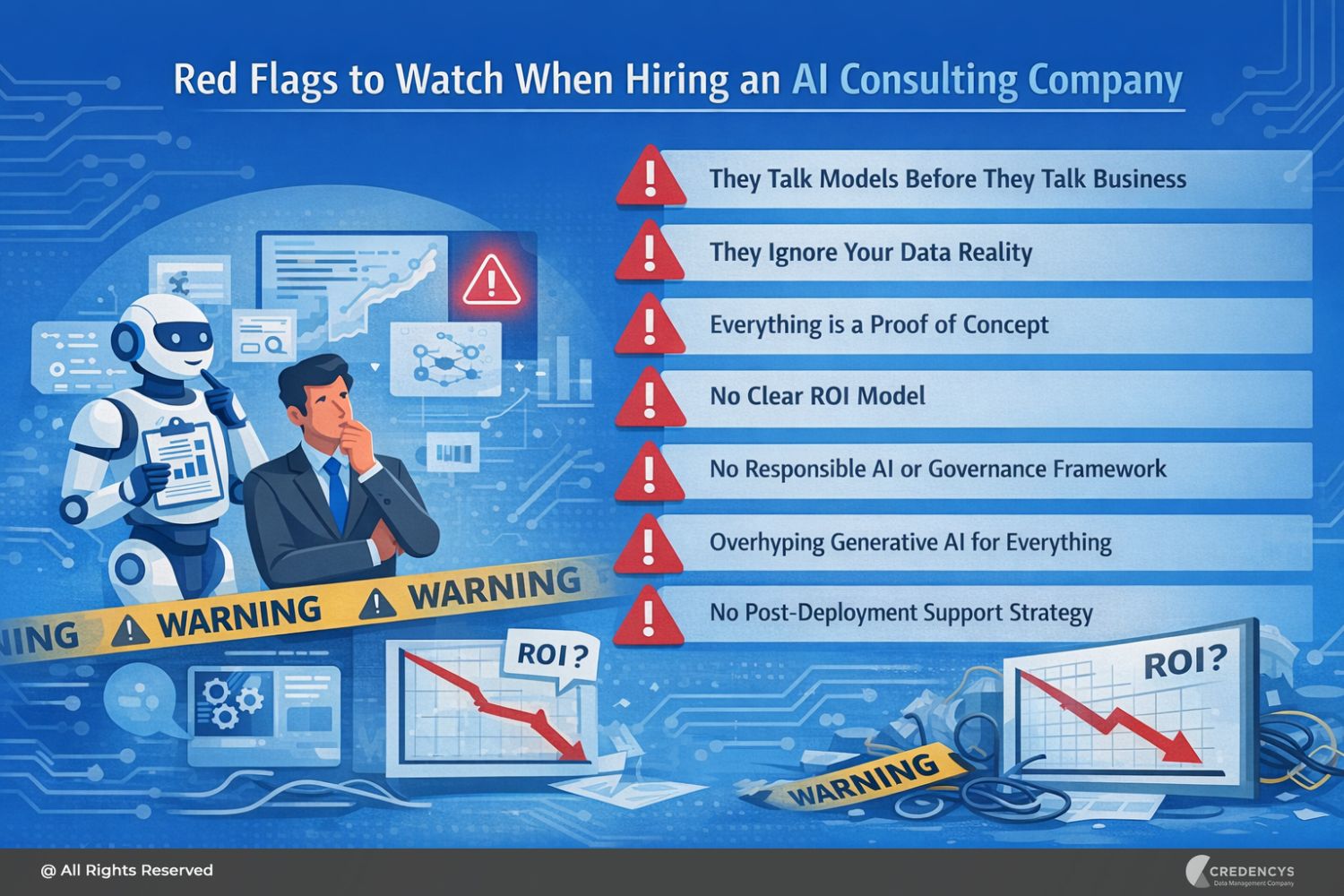
1. They Talk Models Before They Talk Business
If the first few meetings are filled with:
- Neural networks
- LLM fine-tuning
- Transformer architecture
- Vector databases
But no one asks about:
- Revenue targets
- Margin pressure
- Customer churn
- Supply chain inefficiencies
Pause. AI without a business anchor drifts fast.
The best firms always start with outcomes.
2. They Ignore Your Data Reality
If a consulting firm assumes your data is “ready enough,” that’s dangerous. Most organizations struggle with:
- Inconsistent master data
- Siloed systems
- Poor data quality
- Limited governance
And research from Gartner consistently highlights that poor data quality remains one of the primary reasons AI initiatives fail. If they don’t assess your data maturity before proposing AI, that’s not confidence, but negligence.
3. Everything is a Proof of Concept
PoCs feel productive. They look impressive in steering committee meetings.
But if the firm cannot clearly explain:
- How the model will be deployed
- How it integrates into workflows
- Who owns monitoring
- How retraining happens
- What the MLOps framework looks like
Then you are stuck in demo mode. And demos don’t generate ROI.
4. No Clear ROI Model
AI consulting without measurable impact metrics is a risk. You should see:
- Cost reduction projections
- Revenue uplift modeling
- Efficiency gains
- Time-to-value estimates
If they leave figuring out ROI later, that’s a red flag. AI isn’t R&D anymore.
It’s an investment-grade transformation.
5. No Responsible AI or Governance Framework
By 2026, AI governance is not optional. If a firm doesn’t proactively discuss:
- Explainability
- Audit trails
- Model risk management
- Bias testing
- Compliance alignment
You should question their maturity.
6. Overhyping Generative AI for Everything
Yes, GenAI is powerful, but not every use case needs it. If every conversation magically turns into “Let’s build a chatbot” or “Let’s deploy an LLM,” be careful.
Sometimes a predictive model is smarter, faster, and cheaper. Mature consulting partners know the difference.
7. No Post-Deployment Support Strategy
AI is not plug-and-play. It needs:
- Monitoring
- Retraining
- Drift detection
- Continuous improvement
If the engagement ends at deployment, your AI system will decay over time.
Conclusion
AI in 2026 isn’t optional. It’s operational, competitive advantage, and boardroom-level strategy.
But here’s what most organizations eventually realize: AI success doesn’t come from buying tools, from flashy demos, and from running endless pilots. It comes from alignment.
Alignment between business goals and AI strategy, data foundations and model development, and between deployment and measurable ROI. That’s why choosing the right AI consulting partner isn’t just a procurement decision.
It’s a long-term growth decision. Some enterprises will need the scale of global consulting giants.
Others will need focused, execution-driven AI specialists who can move fast, modernize data foundations, and embed AI directly into revenue-generating workflows. And that’s where companies like Credencys Solutions bring a distinct advantage.
Because AI isn’t treated as a standalone experiment. It’s built on strong data engineering, structured governance, industry-specific accelerators, and operational scalability.
Especially for retail, CPG, and data-intensive enterprises, that combination makes a difference. The AI consulting landscape will only get more crowded from here.
More firms, more AI claims, more “GenAI-first” banners. But the next wave of winners won’t be the ones selling the most models.
They will be the ones delivering measurable business outcomes, faster, safer, and at scale. So, if you are evaluating AI consulting partners in 2026, don’t just ask: “What can they build?”
Ask: “What business impact can they prove?” And more importantly: “Can they scale it across my organization?”
Because that’s the difference between experimenting with AI and actually leading with it.






Tags: