


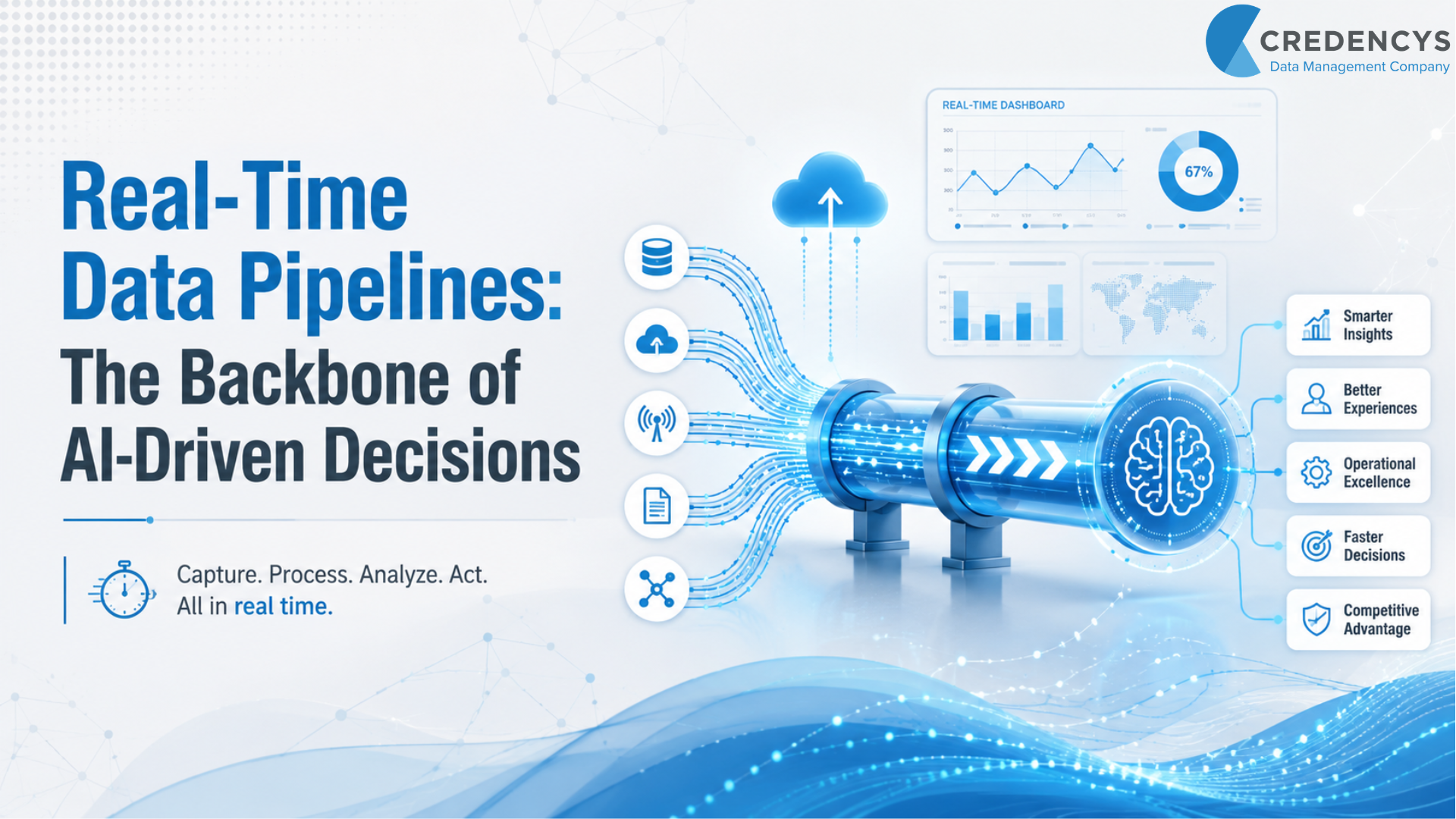
Real-Time Data Pipelines: The Backbone of AI-Driven Decisions
Artificial intelligence is becoming central to how enterprises make decisions. From personalized product recommendations and demand forecasting to fraud detection and supply chain optimization, AI is helping businesses move faster and respond with greater precision.
But AI-driven decisions are only as strong as the data behind them. Many organizations still rely on batch-based systems that collect, process, and analyze data at fixed intervals.
While this approach works for historical reporting, it often fails when businesses need to respond to customer behavior, operational changes, or market signals as they happen. This is where real-time data pipelines become essential.
Real-time data pipelines help organizations collect, process, and deliver data with minimal delay. They ensure that AI models, analytics dashboards, and business applications are powered by fresh, accurate, and actionable data.
What Are Real-Time Data Pipelines?
A real-time data pipeline is a data architecture that continuously collects, processes, transforms, and delivers data from multiple sources to analytics platforms, AI/ML models, and business applications with minimal latency. Unlike traditional batch pipelines that process data at scheduled intervals, real-time pipelines process data as events occur.
These events can include customer clicks, product views, POS transactions, inventory updates, payment activity, IoT signals, or marketing campaign responses. In simple terms, real-time data pipelines help businesses move from “What happened yesterday?” to “What is happening right now, and what should we do next?”
A typical real-time pipeline includes:
- Data sources such as CRM, ERP, POS, eCommerce platforms, mobile apps, and IoT systems
- Ingestion tools that capture data continuously
- Processing engines that clean, enrich, and transform streaming data
- Storage platforms such as data lakes, data warehouses, or lakehouses
- AI/ML models, dashboards, alerts, and business applications that activate insights

Why Real-Time Data Pipelines Matter for AI-Driven Decisions
AI models need accurate, timely, and contextual data to generate meaningful outputs. When data is outdated, incomplete, or fragmented, AI systems may produce inaccurate predictions or delayed recommendations.
Real-time pipelines reduce the time between data creation and business action. They help enterprises respond faster to customer behavior, operational risks, and market changes.
For example, a retailer can use real-time browsing data to personalize product recommendations while the customer is still active on the website. A supply chain team can respond to inventory movement before stockouts occur.
A marketing team can optimize a campaign while it is still running, rather than waiting until it ends. This speed matters because modern business decisions are increasingly time-sensitive.
Real-time data pipelines support:
- Faster customer personalization
- More accurate demand forecasting
- Dynamic pricing decisions
- Fraud and anomaly detection
- Real-time operational monitoring
- AI-powered decision intelligence
Operational intelligence is built on real-time visibility into streaming events and business operations, enabling organizations to act on insights through manual or automated actions. For decision-makers, the value is clear: real-time pipelines help enterprises shift from reactive reporting to proactive, AI-driven execution.
With the right data and analytics services, businesses can transform streaming data into timely insights, predictive intelligence, and automated actions.
Batch vs Near Real-Time vs Real-Time Data Pipelines
| Pipeline Type | How It Works | Best For | Limitation |
|---|---|---|---|
| Batch Processing | Processes data at scheduled intervals | Historical reporting, compliance, periodic dashboards | Delayed insights |
| Near Real-Time Processing | Processes data with short delays | Operational monitoring, alerts, business dashboards | May not be fast enough for time-sensitive AI use cases |
| Real-Time Processing | Processes data continuously as events occur | Personalization, fraud detection, dynamic pricing, AI automation | Requires stronger architecture, governance, and monitoring |
Not every business process needs real-time data. Before implementing streaming pipelines, organizations must understand the required latency level.
The right approach depends on business priorities. For example, monthly financial reporting may not require real-time processing.
But real-time personalization, fraud detection, and inventory optimization often do. The goal is not to make every pipeline real-time, but to apply real-time processing where speed directly impacts revenue, customer experience, risk, or operational efficiency.
Key Components of a Real-Time Data Pipeline
A reliable real-time pipeline requires multiple layers working together. Each layer plays a specific role in moving data from source systems to business action.
Building these layers requires a modern data engineering strategy that balances scalability, latency, governance, and business usability.
1. Data Sources
Real-time pipelines begin with enterprise data sources. These may include CRM systems, ERP platforms, POS systems, eCommerce websites, mobile apps, IoT devices, payment systems, customer service platforms, and third-party APIs.
In retail and CPG, this data may come from online browsing behavior, in-store purchases, inventory systems, loyalty programs, supplier systems, and marketing engagement platforms. The broader the source ecosystem, the more important it becomes to properly unify and govern data.
2. Data Ingestion Layer
The ingestion layer captures data continuously from source systems. This may involve APIs, streaming platforms, event queues, log-based ingestion, or change data capture.
The objective is to move data into the pipeline as soon as it is created or updated.
3. Stream Processing Layer
The stream processing layer transforms incoming data while it is still in motion. This layer can clean, filter, validate, enrich, aggregate, and join streaming data with historical or reference data.
Apache Flink, for example, is known for high-throughput, low-latency stream processing, event-time processing, and state management. Stream processing is important because raw events are rarely ready for decision-making.
They need a business context before they can be used by AI models or analytics systems.
4. Storage Layer
Processed data may be stored in a data warehouse, data lake, lakehouse, operational database, or real-time analytics store. For AI-driven enterprises, lakehouse architecture is becoming increasingly relevant because it supports both structured and unstructured data, analytics, and AI workloads in a unified environment.
The storage layer should support scalability, security, accessibility, and performance.
5. Governance and Monitoring Layer
Real-time does not mean uncontrolled. Data quality, lineage, schema management, access control, observability, and compliance must be embedded across the pipeline. Without governance, real-time data can quickly become unreliable.
Monitoring is also critical. Teams need visibility into pipeline latency, failures, throughput, data drift, and data quality issues.
6. Activation Layer
The final layer is where data becomes valuable. Real-time data can power AI/ML models, dashboards, alerts, recommendation engines, marketing platforms, pricing engines, and operational workflows.
This is where businesses move from data processing to business impact.
Common Real-Time Data Pipeline Patterns
Real-time data pipelines can be designed in different ways depending on the use case, data volume, latency needs, and existing architecture.
1. Event Streaming
Event streaming captures business events as they happen and makes them available to downstream systems. This is useful for customer behavior tracking, fraud detection, order monitoring, and operational alerts.
2. Change Data Capture
Change Data Capture tracks changes in databases and sends updates to downstream systems. This helps businesses keep data warehouses, lakehouses, and applications synchronized without relying only on batch jobs.
3. Stream Processing
Stream processing transforms and enriches live data before it reaches analytics or AI systems. This pattern is useful for aggregations, filtering, anomaly detection, and real-time personalization.
4. Lambda Architecture
Lambda architecture combines batch and real-time layers. It allows organizations to maintain historical accuracy while also supporting fresh insights.
5. Kappa Architecture
Kappa architecture uses streaming as the primary processing model. It simplifies architecture by reducing the need for separate batch and streaming layers.
6. Stream-Table Joins
This pattern combines real-time events with reference or historical data. For example, a live product view can be joined with customer profile data and inventory availability to generate a personalized recommendation.

Recent research on Kafka-based event-streaming systems identifies patterns such as change data capture, stream-table joins, exactly once pipelines, log compaction, event sourcing replay, and multi-tenant topics.
Real-Time Data Pipeline Use Cases for Enterprises
Real-time data pipelines create value across multiple enterprise functions.
1. Real-Time Customer Personalization
Retailers can use real-time data to understand customer intent as it happens. For example, if a customer repeatedly views a product category, the system can instantly personalize recommendations, offers, or content.
When combined with Customer 360 data, this enables highly relevant omnichannel engagement.
2. Dynamic Pricing
Pricing decisions can be improved using real-time signals such as demand, inventory levels, competitor activity, customer segments, and seasonality. Instead of relying only on static pricing rules, businesses can use AI-powered dynamic pricing to adjust prices based on current market conditions.
3. Demand Forecasting
Demand forecasting becomes more accurate when AI models can access fresh sales, inventory, promotional, weather, and customer behavior data. This helps retailers and CPG businesses reduce stockouts, avoid overstocking, and improve replenishment planning.
4. Inventory and Supply Chain Optimization
Real-time pipelines help supply chain teams monitor inventory movement, warehouse activity, order status, and delivery delays. This visibility enables faster intervention when issues occur and supports better operational planning.
5. Fraud and Anomaly Detection
Financial transactions, payment events, and user activity can be monitored continuously to identify unusual behavior. Real-time detection helps reduce risk by allowing businesses to act before damage escalates.
6. AI-Powered Decision Intelligence
Real-time pipelines feed AI systems with fresh signals. These AI systems can then generate recommendations, alerts, predictions, or automated actions.
This is especially important as enterprises move toward AI agents and automated decision workflows.
How Real-Time Pipelines Support AI and Machine Learning
AI and machine learning systems depend on data freshness, consistency, and context. Real-time pipelines support AI in multiple ways by:
- Providing fresh data for predictions
- Enabling streaming features for real-time models
- Helping monitor model performance continuously
- Detecting changes in customer behavior or operating conditions
- Triggering automated actions based on live events
For example, a retail AI model can recommend products based on current browsing behavior, past purchases, available inventory, and active promotions. Without real-time data, the recommendation may be less relevant or too late to influence the purchase decision.
The connection is simple: if enterprises want AI to support real-time decisions, they need pipelines that can deliver real-time data.
Best Practices for Building Real-Time Data Pipelines
To successfully build real-time pipelines, enterprises should follow a structured, business-first approach.
1. Start with High-Impact Use Cases
Not every process needs real-time data. Start with use cases where speed creates measurable business value, such as personalization, fraud detection, dynamic pricing, or inventory visibility.
2. Define Latency Requirements Clearly
Real-time means different things for different use cases. Some decisions require millisecond-level responses, while others can tolerate seconds or minutes of delay.
Define latency expectations before choosing tools or architecture.
3. Design for Scalability
Pipelines should be able to handle growing data volume, traffic spikes, and expanding use cases. Scalability should be built into the architecture from day one.
4. Embed Data Quality Checks Early
Data validation, deduplication, schema checks, and anomaly detection should happen before data reaches AI models or business applications. This helps ensure that decisions are based on trusted data.
5. Implement Pipeline Observability
Track pipeline health continuously. Monitor latency, failures, processing delays, data freshness, throughput, and error rates.
Observability helps teams detect and resolve issues faster.
6. Strengthen Governance and Security
Apply role-based access, data lineage, cataloging, encryption, and compliance policies across the pipeline. This builds trust and reduces risk.
7. Choose the Right Architecture and Tools
The right technology stack depends on your data volume, latency needs, cloud environment, team skills, and business goals. For some organizations, Databricks may be ideal for lakehouse-driven streaming and AI workloads.
For others, Snowflake may be a better fit for analytics, governed data sharing, and modernizing cloud data platforms.

How Credencys Helps Build Real-Time Data Pipelines
Building real-time data pipelines requires the right mix of strategy, architecture, engineering, governance, and platform expertise. Credencys helps enterprises design and implement modern data ecosystems that support AI-driven decisions.
With expertise in data engineering, cloud data platforms, Databricks, Snowflake, AI/ML enablement, and industry-focused analytics, Credencys helps organizations move from fragmented data systems to scalable, real-time data architectures. Credencys can support enterprises across the pipeline journey, including:
- Data engineering strategy
- Data pipeline architecture and implementation
- Real-time data integration
- Lakehouse and cloud data platform implementation
- Databricks and Snowflake consulting
- Data quality and governance frameworks
- AI/ML-ready data infrastructure
- Retail-focused Customer 360, personalization, forecasting, and pricing solutions
For businesses looking to scale AI, real-time data pipelines are not just a technical foundation. They are a competitive advantage.
Conclusion
AI-driven decisions require more than advanced algorithms. They require timely, trusted, and connected data.
Real-time data pipelines help enterprises bridge the gap between data creation and business action. They enable organizations to respond faster, personalize experiences, improve operations, and power AI systems with fresh, contextual information.
As businesses adopt AI agents, dynamic pricing, predictive operations, and real-time customer intelligence, the need for robust real-time data pipelines will only grow. Enterprises that modernize their data pipelines today will be better prepared to make faster decisions, deliver better experiences, and unlock measurable value from AI.
FAQs
1. What is a real-time data pipeline?
A real-time data pipeline continuously collects, processes, and delivers data as events happen. It helps businesses power faster analytics, AI predictions, alerts, and automated decision-making.
2. Why are real-time data pipelines important for AI?
Real-time pipelines provide AI models with fresh and contextual data. This improves decision accuracy, personalization, responsiveness, and the ability to act on live business events.
3. What is the difference between batch and real-time data pipelines?
Batch pipelines process data at scheduled intervals, while real-time pipelines process data continuously as it is generated. Real-time pipelines are better suited for time-sensitive use cases such as fraud detection, dynamic pricing, and personalization.
4. What are the key components of a real-time data pipeline?
The key components include data sources, ingestion layer, stream processing layer, storage layer, governance and monitoring layer, and activation layer.
5. Which industries benefit from real-time data pipelines?
Retail, CPG, manufacturing, logistics, financial services, eCommerce, healthcare, and supply chain-intensive businesses benefit significantly from real-time data pipelines.





Tags: