

Data Integration Trends You Can’t Ignore in 2026
In 2026, data is flowing in from more sources than ever: cloud applications, IoT devices, mobile apps, legacy systems, third-party platforms, and beyond. But access to vast amounts of data is only valuable if it integrates seamlessly, reliably, and in real time.
Data integration, once a behind-the-scenes IT task, is now a strategic driver of business agility, analytics, and AI success. As organizations accelerate digital transformation, connecting, unifying, and activating data across distributed environments has become mission-critical.
Yet, traditional approaches to data integration are buckling under the pressure. Siloed systems, slow batch processing, and inflexible pipelines can’t keep up with today’s dynamic business requirements.
To stay competitive, businesses must adopt a modern, intelligent, and scalable integration strategy. This article explores the top data integration trends shaping 2026 and what they mean for your enterprise.
What Is Data Integration and Why Does It Matter?
Data integration brings together data from different sources- cloud-based, on-premises, structured, or unstructured- into a unified, consistent view for analysis, reporting, operations, and decision-making. Traditionally, this has involved ETL (Extract, Transform, Load) pipelines, where data is collected from multiple systems, transformed into a standardized format, and then loaded into a data warehouse or lake.
But modern integration extends far beyond ETL.
Why It’s More Important Than Ever:
- Data is everywhere: From marketing tools and ERP systems to social platforms and IoT devices, business-critical data is scattered across disconnected environments.
- AI and analytics depend on it: Without unified, high-quality data, even the most advanced AI models or BI dashboards fail to deliver value.
- Operational agility requires it: Real-time decision-making, automation, and customer personalization rely on integrated systems working in sync.
Modern Data Integration Includes:
- Batch and real-time streaming data
- Orchestration and automation of workflows
- Data transformation, cleansing, and enrichment
- Cloud-to-cloud, on-prem to cloud, and hybrid integrations
- APIs and event-driven architectures for seamless communication
In short, data integration ensures that your data is not just accessible, but usable, trustworthy, and ready to drive business outcomes.
Key Drivers of Change in Data Integration
The data integration landscape has transformed dramatically in recent years, and 2026 marks a tipping point. Businesses are no longer integrating data just to centralize it.
They are integrating to enable real-time insights, AI, automation, and seamless digital experiences. Here are the key forces accelerating this shift:
1. Rise of Composable Architectures and APIs
Monolithic systems are giving way to composable architectures built on APIs and microservices. Data integration must support modularity and reusability, enabling seamless connectivity between dozens or even hundreds of systems.

Want to Future-proof Your Integration Strategy with Scalable, API-first Architecture? Let Credencys Help You Get There
2. AI and Machine Learning Readiness
AI doesn’t just need data; it needs integrated, clean, labeled, and timely data. Modern integration strategies must feed AI/ML pipelines continuously and reliably, making AI-readiness a key outcome of integration efforts.
3. Data Governance and Compliance Pressures
With stricter regulations like GDPR, CCPA, and industry-specific mandates, enterprises need full visibility and control over their data. Integration solutions must now include metadata management, lineage tracking, and auditability by design.
4. Demand for Real-Time Data and Streaming
Static, batch-based integration pipelines no longer meet the needs of today’s fast-paced decision-making. Businesses are embracing event-driven and streaming architectures to respond instantly to changes in customer behavior, inventory levels, or system states.
5. Cloud Adoption and SaaS Proliferation
With organizations increasingly adopting cloud platforms (AWS, Azure, GCP) and hundreds of SaaS applications, data is more distributed than ever. Integration must now be cloud-native, scalable, and agile enough to handle hybrid and multi-cloud environments.
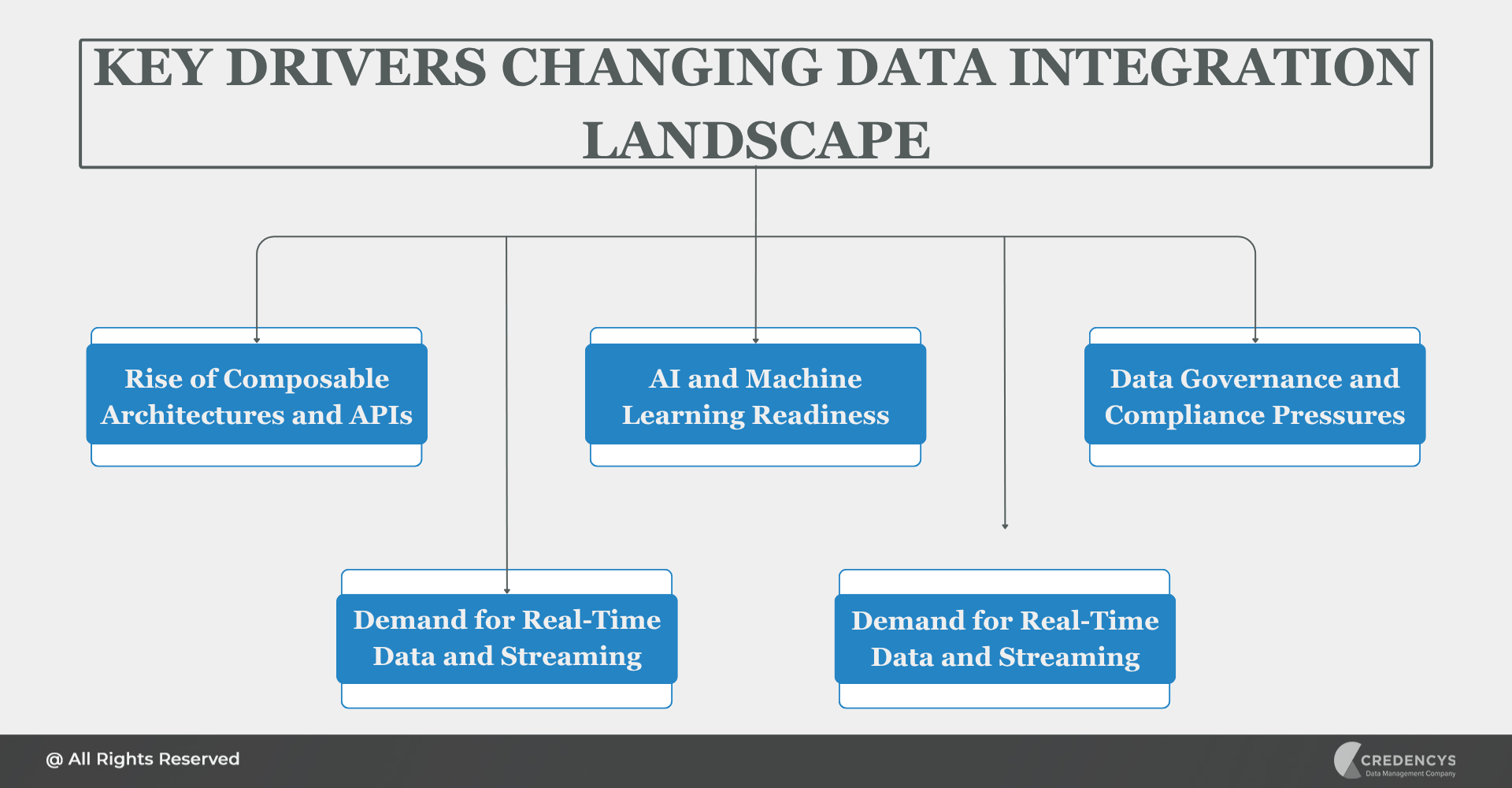
These drivers are pushing organizations to modernize their integration frameworks, moving beyond siloed, script-heavy pipelines to scalable, automated, and intelligent integration ecosystems.
8 Data Integration Trends to Watch in 2026
To stay competitive in 2026 and beyond, enterprises must evolve their data strategies. Integration is no longer just about moving data; it’s about doing it intelligently, securely, and at scale.
Here are the top trends that are reshaping the future of data integration:
1. Integration Platforms Embedded with Data Governance
Modern integration tools are integrating data governance features like data lineage, quality checks, policy enforcement, and audit trails. This ensures compliance, enhances data trust, and simplifies reporting in regulated industries.
2. API-First and Microservices-Based Integration
APIs are the new building blocks of integration. Organizations are adopting API-first architectures to create modular, scalable, and reusable data flows.
This shift is enabling faster development, easier maintenance, and more responsive data systems.
3. AI-Augmented Integration Tools Accelerate Delivery
AI is increasingly simplifying data integration. From automatic schema mapping to anomaly detection and predictive workflow optimization, AI-powered integration platforms help teams build and maintain pipelines faster and with fewer errors.
4. Hybrid and Multi-Cloud Integration Takes Center Stage
As organizations spread workloads across public clouds, private data centers, and SaaS platforms, integration strategies must span these ecosystems. The focus is on building cloud-native, platform-agnostic integrations that keep data consistent and reliable across environments.
5. Low-Code/No-Code Integration Platforms Empower Business Users
The rise of low-code tools is democratizing data integration. Business analysts and non-technical users can now build and modify data workflows with visual interfaces and drag-and-drop components, reducing dependence on IT and speeding delivery.
6. Seamless Integration with AI/ML Workflows
As AI becomes core to business strategy, integration pipelines are evolving to support machine learning workflows, connecting raw data to feature stores, models, and monitoring tools. Integration is now a foundational layer for MLOps and AI-driven decision-making.
Ready to Align Your Business with the Latest Data Integration Trends? Let Credencys Help You Build Intelligent, Scalable, and Future-ready Data Pipelines
7. Real-Time and Event-Driven Integration Becomes the Norm
Batch-based ETL is giving way to real-time streaming and event-driven pipelines. Businesses want to act on data as it’s generated, whether it’s a customer transaction, a sensor reading, or a website click.
Tools like Apache Kafka, Flink, and cloud-native services are enabling low-latency integration for real-time insights.
8. Integration for AI Agents
AI agents and copilots are moving from pilots into daily operations, and they need governed, real-time access to enterprise data and actions. Integration teams are exposing data through secure APIs and emerging standards such as the Model Context Protocol (MCP), with the same access control, audit, and data quality rules as any other consumer.
Together, these trends reflect a shift toward faster, smarter, and more business-aligned data integration, making it a strategic enabler of innovation and growth.
How Credencys Supports Future-Ready Data Integration
At Credencys, we don’t just move your data; we empower your business to unlock its full potential through modern, intelligent, and scalable data integration solutions. Whether you are modernizing legacy systems, enabling real-time analytics, or preparing data pipelines for AI and ML, we build custom integration architectures that align with your business goals.
Here’s how we help enterprises stay ahead:
1. API-Based and Microservices Integration
We embrace modularity and agility by implementing API-first integration architectures that simplify system interactions, reduce complexity, and increase development velocity.
2. Industry-Specific Solutions
We bring deep experience across retail, manufacturing, eCommerce, and CPG sectors, delivering tailored, scalable integrations optimized for your unique data landscape.
3. End-to-End Integration Strategy
We design and implement robust integration frameworks that connect your data across cloud, on-premises, SaaS, and third-party platforms, ensuring a single source of truth across the enterprise.
4. Cloud-Native & Hybrid Integration Expertise
Our team has experience building integration solutions across AWS, Azure, Google Cloud, and hybrid environments, seamlessly connecting distributed data systems while optimizing for speed, cost, and reliability.
5. Real-Time & Event-Driven Architecture Enablement
From batch to streaming, we architect pipelines that deliver data when it’s needed most. We help businesses shift to event-driven models that enable instant decision-making and faster customer response.
6. Governance, Quality, and Compliance Built In
Credencys ensures every integration workflow aligns with best practices in data quality, metadata tracking, security, and compliance, so you stay audit-ready while keeping full control of your data.
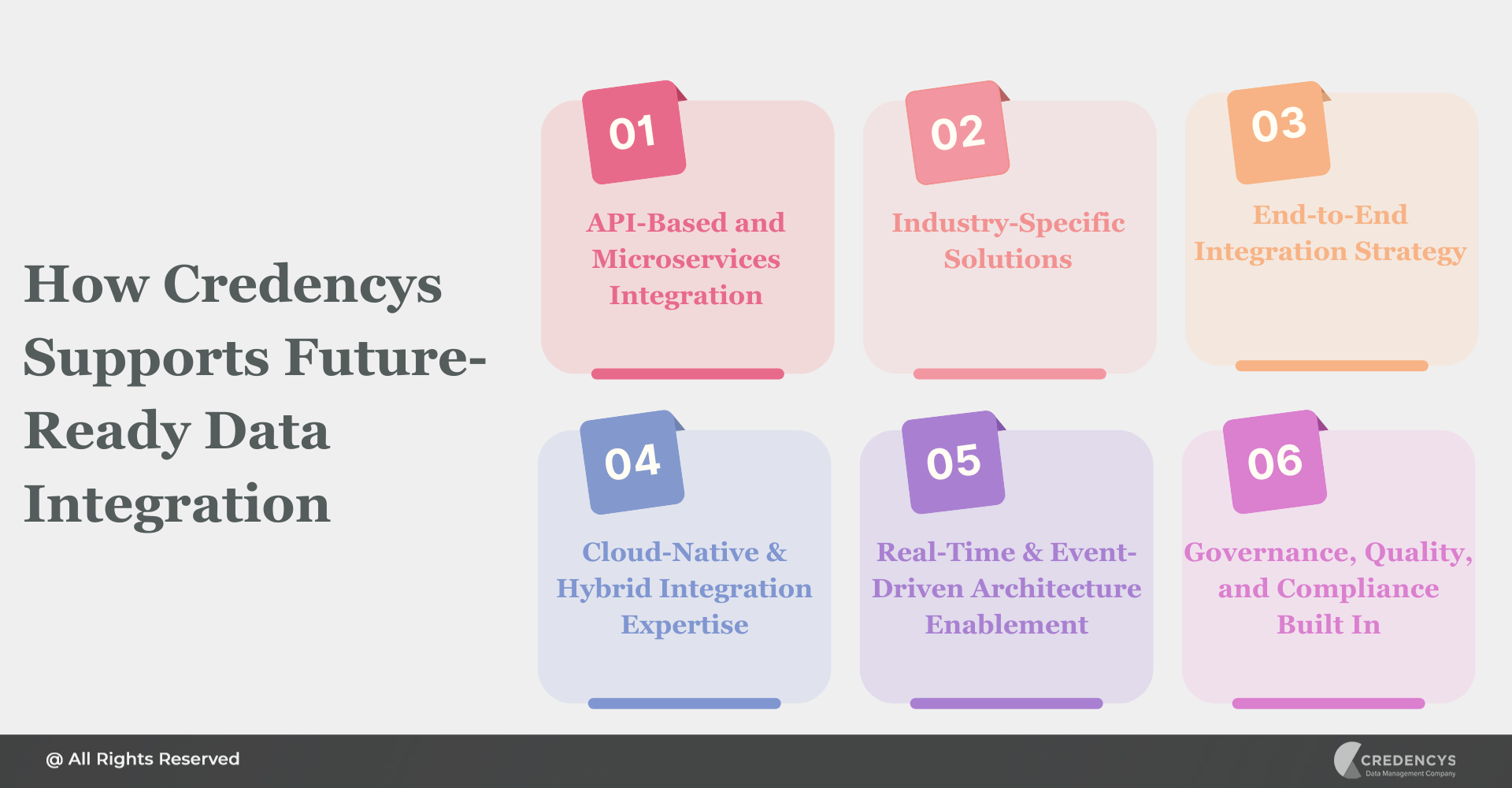
With Credencys as your integration partner, you get more than just pipelines; you get a foundation for innovation, insight, and growth.
Conclusion: Data Integration is the Launchpad for Digital Success
In 2026, enterprises can no longer afford disconnected systems, fragmented insights, or slow decision-making. To thrive in a real-time, AI-driven world, you need more than just access to data; you need data that’s unified, trustworthy, and instantly actionable.
Modern data integration is no longer optional; it’s foundational. It powers analytics, fuels automation, enables compliance, and drives smarter customer experiences.
By embracing the latest trends in data integration, from real-time streaming to AI-augmented pipelines, your business positions itself for agility, innovation, and long-term success.
Ready to Transform How Your Business Integrates Data? Let Credencys Help You Build Scalable, Intelligent, and Future-ready Data Integration Solutions Tailored to Your Needs




Tags: