


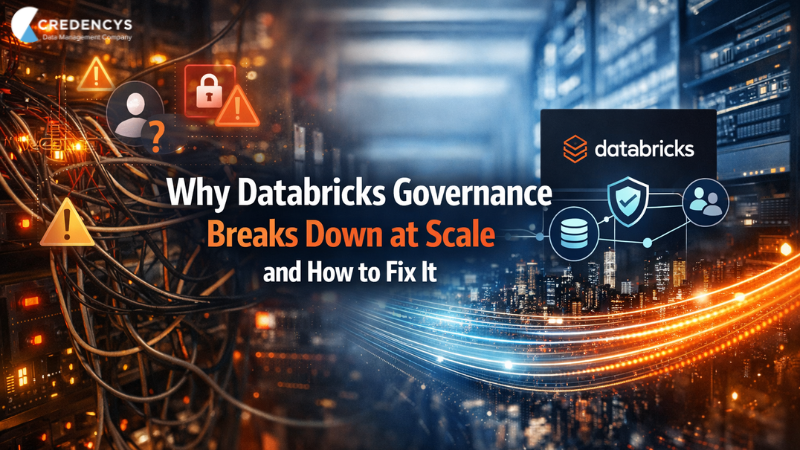
Why Databricks Governance Breaks Down at Scale and How to Fix It
Databricks governance often feels manageable at the beginning. Teams move fast, new data sources are onboarded quickly, and access controls stay informal. For early-stage analytics programs, this flexibility feels like progress.
Then scale sets in.
As more users, departments, and data domains come onto Databricks, governance complexity increases quietly. Finance, operations, marketing, and compliance teams begin relying on the same data platform for critical decisions. What once worked with a few teams starts to strain under enterprise-wide usage.
This challenge is more common than many organizations expect.
Industry studies show that more than 60% of enterprises struggle to maintain consistent data governance once analytics expands across departments.
Poor governance is also estimated to erode 15-25% of the value of data initiatives, not because data is unavailable, but because it is difficult to trust, access, or control.
At scale, Databricks governance problems build gradually. Access policies vary by workspace. Sensitive data spreads faster than controls. Ownership becomes unclear. Compliance teams ask questions that data teams cannot confidently answer.
Many organizations only recognize governance gaps when audits, security concerns, or conflicting reports surface. By then, governance feels reactive, costly, and restrictive rather than supportive.
This blog explores why Databricks governance becomes painful as organizations scale, what changes beneath the surface as complexity grows, and how enterprises can rethink governance to support secure, cross-functional data access.
What you will Learn
In this blog, you will learn:
- Why Databricks governance works early on but becomes harder as more teams and data are added
- The most common governance challenges that appear at the enterprise scale
- How cross-functional data access increases pressure on security and compliance
- Why traditional governance models struggle with modern analytics workloads
- How leading organizations redesign governance to scale without slowing teams down
- A real-world example from a large Southeast Asian aviation group managing governance at scale
Why Databricks Governance Feels Easy at the Start
In the early stages, Databricks governance rarely feels like a priority problem. Teams are small, use cases are well defined, and most people know who owns which data. Access is often granted manually, naming conventions evolve organically, and security controls are applied just enough to keep things moving.
At this stage, Databricks does exactly what it promises. It removes friction. Data engineers can experiment freely, analysts can query data without long approval cycles, and business teams start seeing value quickly. Governance exists, but it lives more in people’s heads than in formal policies. This works because complexity is still limited.
- Fewer workspaces mean fewer access rules to manage
- Data volumes are manageable and mostly structured
- Compliance requirements are light or handled on a case-by-case basis
- The same teams that build data pipelines also consume the data
As a result, informal governance feels sufficient. Many organizations rely on tribal knowledge, shared documents, or basic role-based access controls. And for a while, nothing breaks.
The problem is that this early success creates a false sense of security. Governance practices that work for one team or one department do not scale cleanly to ten or twenty. What feels flexible at a small scale often becomes inconsistent at an enterprise scale.
What Changes as Databricks Adoption Scales
As Databricks adoption expands, governance challenges do not appear all at once. They build up gradually as more users, data, and expectations converge on the platform. What once felt flexible and fast slowly becomes harder to control.
One of the first noticeable shifts is the diversity of users.
Databricks is no longer used only by data engineers. Analysts, data scientists, finance teams, operations leaders, and even compliance stakeholders begin accessing the same data environment. Each group needs different levels of access and visibility, which makes manual access management increasingly risky.
- Different personas require different permissions
- Manual approvals become inconsistent and slow
- Overexposed data becomes a real security concern
Another major change is data sprawl.
As new use cases are added, teams often duplicate datasets to avoid breaking existing pipelines or dashboards. Over time, multiple versions of the same data start circulating.
This creates confusion and erodes trust. Business users begin questioning which numbers are correct, and data teams spend more time validating reports than generating insights.
- Multiple versions of the same dataset
- No clear source of truth
- Increased effort spent reconciling data
Workspace and environment growth adds another layer of complexity.
Separate workspaces are created for teams, regions, or projects, often with good intentions. However, governance standards do not always scale alongside them.
- Inconsistent access policies across workspaces
- Naming and tagging standards drift
- Security controls vary by environment
Finally, compliance and accountability expectations increase.
As analytics becomes business-critical, leadership and regulators expect clear answers on data access, usage, and lineage. Without centralized governance, even simple audit questions take significant effort to answer.
At this point, the challenge is not Databricks itself. The real issue is that early governance approaches were never designed for enterprise-wide scale. In the next section, we’ll dive into the most common Databricks governance pain points that emerge once organizations reach this stage.
The Most Common Databricks Governance Pain Points at Scale
When Databricks expands across teams and business units, governance challenges quickly move from background concerns to daily obstacles. These issues tend to appear consistently across large organizations.
1. Inconsistent Access Control
Permissions are often managed differently across teams and workspaces, making it difficult to track who should have access to what.
- Users often have broader access than necessary
- Access approvals become slow and inconsistent
- Removing or updating access is error-prone
2. Limited Visibility into Data Usage.
Teams know data is being used, but lack clear insight into how, by whom, and for what purpose. This makes governance reactive and weakens confidence in compliance.
Data ownership also becomes unclear as datasets are shared across departments. When quality or access issues arise, responsibility is often spread across multiple teams.
- No clear owner for shared data
- Quality issues surface late
- Governance tasks fall between teams
3. Compliance pressure increases.
Audit and regulatory requests require fast, accurate answers around access, lineage, and controls. Without strong governance, these requests consume time and create risk.
At this point, governance feels painful because it was never designed to scale this way. In the next section, we’ll explore why traditional governance approaches struggle in Databricks environments and what must change to support growth.
Why Traditional Governance Approaches Fail in Databricks Environments
1. Built for Static Data, Not Continuous Change
Traditional governance models were designed for centralized data warehouses where data structures changed slowly, and access patterns were predictable. Databricks operates in a very different environment. Data is ingested continuously, pipelines evolve frequently, and new use cases appear faster than manual governance processes can respond.
2. Process-Heavy, Visibility-Light
Conventional governance relies heavily on documented policies, periodic reviews, and manual approvals. While these processes exist, they are often disconnected from real platform usage. As a result, policies quickly fall behind how data is actually accessed and shared.
- Access reviews happen infrequently
- Policy enforcement depends on manual intervention
- Usage insights are limited or delayed
3. Centralized Control in a Decentralized World
Databricks enables domain teams to work independently and move quickly. Traditional governance tries to pull control back to a central team, creating friction. This mismatch slows down analytics and encourages teams to create workarounds that weaken governance.
4. Restriction Over Enablement
To reduce risk, traditional models often rely on broad access restrictions. While this may feel safer, it reduces agility and frustrates users. Over time, teams bypass controls to get work done, increasing risk rather than reducing it.
At enterprise scale, governance cannot rely on static rules and manual oversight. It must be embedded into the platform, adaptive, and aligned with how data is actually used. In the next section, we’ll explore what effective Databricks governance looks like when designed to scale.
What Effective Databricks Governance Looks Like at Scale
At enterprise scale, Databricks governance must shift from a control mechanism to an enablement layer. The goal is no longer just to restrict access, but to make the right data available to the right people, at the right time, with clear accountability.
1. Centralized Policies with Distributed Access
Effective governance starts with centrally defined policies for security, privacy, and compliance. These policies are applied consistently across workspaces and environments, even as individual teams retain the freedom to build, analyze, and experiment within approved boundaries.
This balance reduces risk without slowing delivery.
2. Clear Ownership and Accountability
Scalable governance makes data ownership explicit. Each dataset has a clearly defined owner responsible for quality, access decisions, and lifecycle management. When issues arise, teams know exactly where to go.
- Defined data owners and stewards
- Clear approval paths for access changes
- Faster resolution of quality and compliance issues
3. Built-in Visibility and Traceability
Governance at scale requires continuous visibility into how data is used. Leaders and compliance teams need confidence in who accessed data, how it was transformed, and where it was consumed.
This level of transparency turns audits from fire drills into routine checks.
4. Governance that Supports, Not Slows, Teams
When teams embed governance into workflows, they no longer experience it as friction. Access requests become predictable, policies remain clear, and automated guardrails apply consistently.
Governance provides the foundation that allows Databricks to scale safely across the enterprise without blocking innovation.
Case Study: Enabling Cross-Functional Data Access for a Leading Aviation Group in Southeast Asia
About the Client
This Southeast Asian aviation group operates multiple airlines, cargo services, and a large travel loyalty program. As a digital-first and highly regulated organization, it needed unified, secure data access across finance, operations, HR, and marketing teams.
Key Challenges
Data was siloed across departments, forcing teams to rely on manual data extraction for reporting. This slowed decision-making, limited collaboration, and made it harder to meet governance and compliance requirements at scale.
Solution Implemented
The organization built a unified reporting and analytics layer using Microsoft Fabric and Power BI, consolidating data into OneLake and automating data preparation. The team integrated the platform with Databricks and Apache to support large-scale processing and advanced analytics.
Business Impact
- 80% reduction in manual reporting time
- 100% cross-departmental data visibility
- Real-time dashboards across 4+ business units
- Stronger compliance through secure data sharing
- A scalable data foundation for future growth
Making Databricks Governance Work at Scale
Databricks governance becomes painful when early, informal practices are pushed beyond their limits. As teams, data, and compliance needs grow, what once supported speed can start creating friction.
Strong Databricks governance establishes clear ownership, enforces consistent access policies, and provides visibility into how teams use data. When organizations embed governance into the platform and align it with real usage, it enables scale instead of slowing teams down.
Organizations that address governance early can enable cross-functional analytics, respond confidently to audits, and maintain trust in their data as they grow. At scale, the real question is whether your Databricks governance model is ready to support what comes next.





Tags: