


AI-Powered PIM for Retail: Redefining Product Information Management for Modern Retailers
Recent industry research shows that most organizations have moved past pilots and integrated AI into multiple systems and workflows. Many of them are now reporting measurable gains in product content quality and revenue.
78 percent of organizations reported using AI in at least one business function, showing this is not a laboratory trend but real-world adoption.
Product catalogs that were once maintained in spreadsheets, via email, and with last-minute copy edits are now enriched, localized, and published by AI-driven pipelines. This has significantly reduced manual effort and shortened time-to-market. Retailers that don’t adapt AI-powered PIM for Retail risk being outplayed on discovery, conversion, and margin.
What you will learn
- The role AI plays inside a modern PIM and why it matters to retail teams.
- Concrete ways AI is changing day-to-day PIM workflows, from content generation to quality control.
- Key benefits retailers see when they adopt AI-enabled PIM, with measurable outcomes to track.
- A Credencys case study that shows a typical implementation and business impact.
- A clear view of where PIM systems are headed and how Credencys can help retailers get there.
The Role of AI in Product Information Management
Product Information Management systems exist to collect, organize, enrich, and distribute product data across channels. Traditionally this has been a mostly manual or semi-automated process that required category managers, translators, designers, and merchandisers to coordinate across tools and spreadsheets.
When AI is added to the PIM layer, several things change. AI turns repetitive work into suggestion-driven work. It turns noisy inputs into normalized, structured records. It transforms content tasks from full manual writing to human-led editing of AI drafts. At scale, this reduces friction across the entire product lifecycle.
Why does that matter for retail teams?
Speed matters in retail. Faster catalog updates mean faster promotions and better seasonal response. Studies show that organizations using PIM can significantly accelerate their time-to-market for new products, sometimes by as much as two times compared with non-adopters. Faster launches lead to measurable margin and operational benefits.
Consistency drives customer trust. When every channel displays the same attributes, sizing, and imagery, conversion rates improve and returns drop. AI helps spot or fix inconsistencies across hundreds or thousands of SKUs.
Scale requires automation. Retail assortments and variants grow quickly. Automation with AI lets teams manage large catalogs without linearly increasing headcount.

Ready to modernize your product data management?
Discover how AI-powered PIM can streamline your retail operations and accelerate time-to-market.
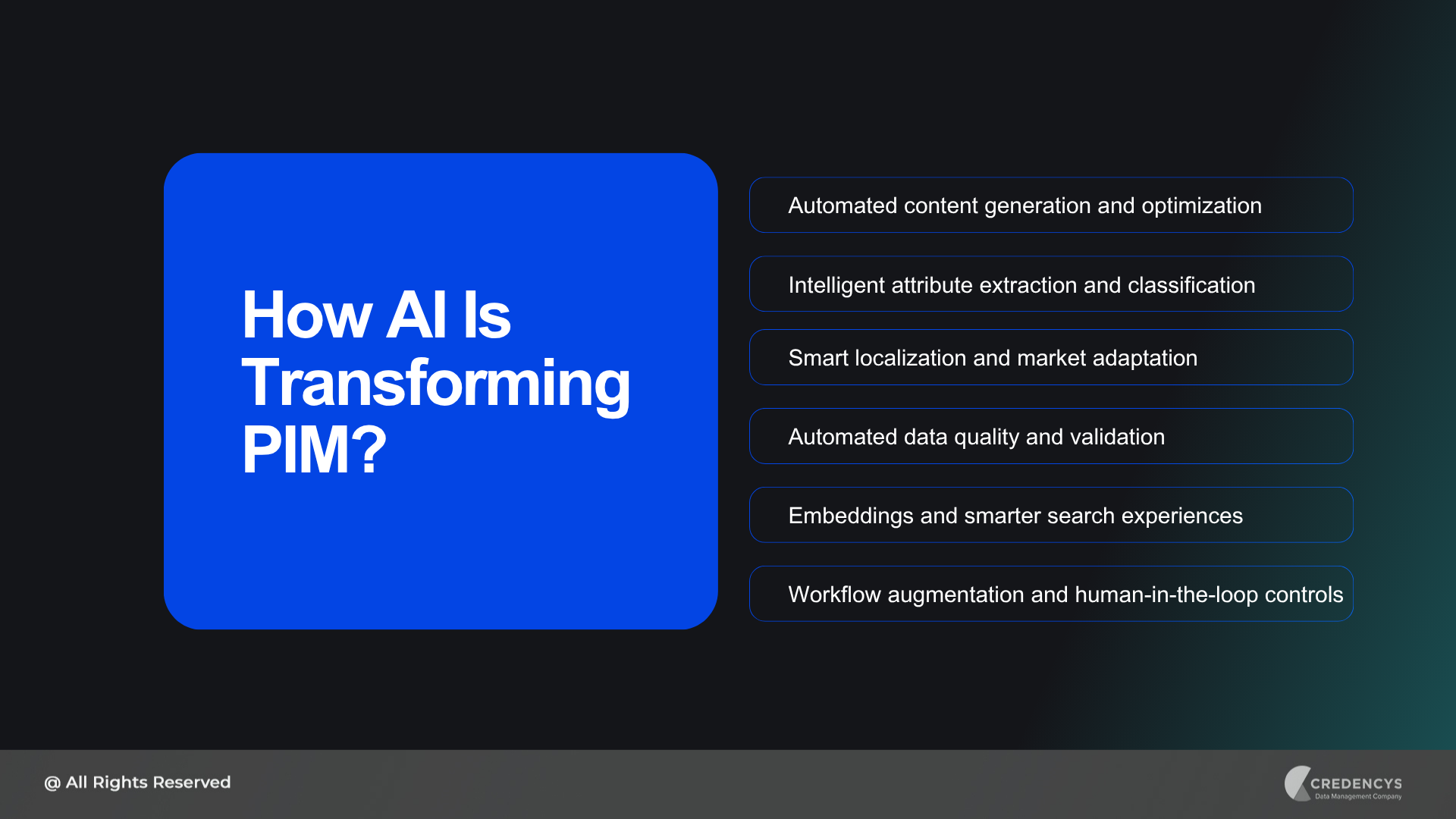
How AI Is Transforming PIM
Below are the core functional changes retail teams will see when AI is used inside PIM.
1. Automated content generation and optimization
AI can produce product titles, feature bullets, short descriptions, and long descriptions from structured attributes and images. This reduces the manual burden of copywriting for large catalogs and supplies editorial drafts that editors can quickly refine. Vendors and practitioners report tangible gains in speed and quality from this capability.
2. Intelligent attribute extraction and classification
AI models can read supplier sheets, PDFs, images, and free-text documents to extract attributes such as dimensions, materials, colors, and compatibility. Then, models can map those attributes to the correct taxonomy nodes in PIM. This reduces errors caused by manual transcription.
3. Smart localization and market adaptation
AI-driven translation, combined with locale-aware rewriting, helps brands localize product content quickly while preserving brand tone and ensuring legal compliance. This enables faster entry into new markets and consistent experiences across geographies.
4. Automated data quality and validation
AI can detect missing attributes, duplicates, inconsistent values, and likely errors. It can also prioritize fixes based on business impact, for example, by surfacing the top SKUs that block a promotion or a marketplace listing.
5. Embeddings, retrieval, and smarter search experiences
Embedding product text and attributes in a vector space enables retrieval-augmented experiences, such as conversational product assistants and smarter site search. This is a step beyond traditional PIM use, opening product data to advanced discovery and merchandising use cases.
6. Workflow augmentation and human-in-the-loop controls
AI should not replace human reviewers. The modern approach is AI suggestions plus human validation. This maintains brand voice and legal accuracy while dramatically reducing time per SKU.
Key Benefits for Retailers
Adopting AI in PIM creates outcomes that matter to both operations and topline growth.
1. Faster time-to-market
Retailers that centralize product data and add AI-driven enrichment can release products and collections faster. PIM adopters in recent analyses have reported up to twice as fast launches for new products. Faster launches translate to earlier shelf time and quicker revenue recognition.
2. Higher catalog quality and fewer returns
Cleaner, consistent product data means customers find what they expect. Clear attributes and accurate imagery reduce sizing and specification errors. That lowers return rates and increases customer satisfaction.
3. Lower operational cost per SKU
Automating description writing, attribute extraction, and translation reduces manual hours spent on each SKU. Teams can redeploy staff onto higher-value work, such as merchandising strategy and conversion optimization.
4. Better omnichannel consistency and discoverability
AI helps tailor product content to meet channel-specific requirements while maintaining a single source of truth. That improves marketplace compliance and search relevance across channels.
5. Actionable data and faster decisions
With AI-powered validation and prioritized fixes, teams know which issues to fix first and how those fixes will impact revenue and conversion.
Case Study 1: Streamlining New Product Launch Workflow
Challenges
The client’s New Product Introduction process was manual and consisted of five phases, each requiring multiple approvals. This led to delays, duplicated efforts, and inconsistent product data across systems.
Solution Implemented
Credencys implemented a centralized PIM and DAM to establish a single source of truth. Automated workflows replaced emails and spreadsheets, while validation and enrichment checkpoints ensured products were complete and retail-ready. AI-driven enrichment further reduced manual effort and sped up approvals.
Business Impact
- Approval cycles became faster, eliminating duplication.
- Time-to-market improved significantly.
- Product data accuracy increased, enabling smoother channel syndication and merchandising.
Case Study 2: SM Retail Streamlines Product Data and Boosts Efficiency with Pimcore
About Client
SM Retail, the Philippines’ largest omni-channel retail brand, operates 1,300+ stores nationwide. Known for its wide product range and seamless integration of physical and digital platforms, SM Retail serves millions of customers daily.
Challenges
As operations scaled, SM Retail’s legacy PIM system couldn’t keep up.
- Inaccurate product data caused inconsistencies and delayed product launches.
- High operational costs from an outdated, inefficient platform.
- Data security gaps due to a lack of permission-based access controls.
Solution Implemented
Credencys implemented a modern Pimcore PIM solution within just four months, ensuring a smooth migration and business continuity.
- Integrated Pimcore PIM, DAM, and CMS to manage the complete product lifecycle.
- Enabled automated pricing updates, role-based access, and data validation workflows for greater efficiency and governance.
- Delivered a unified and scalable data foundation to support SM Retail’s digital growth.
Business Impact
- 59% faster pricing updates
- 47% better internal efficiency
- Robust data governance with Pimcore PIM
The Future of PIM Systems
PIM systems are moving from standalone catalog tools to central pillars of a broader commerce data fabric. Expect these trends to accelerate in the near future.
1. PIM as the hub for AI-enabled experiences
PIM will become the authoritative source for embeddings and product knowledge used by on-site chat assistants, voice commerce, and internal sales tools. Product data will power downstream AI agents that help customers and employees alike.
2. Platform extensibility and open AI integration
Future PIMs will be built to easily plug into different AI models. This flexibility will let teams use off-the-shelf models for common tasks and custom models for domain-specific needs.
3. Stronger governance and model monitoring
As AI sits atop PIM, governance becomes essential. Enterprises will require model monitoring, audit trails, and human review workflows to ensure quality, compliance, and brand safety.
4. Smarter automation, not blind automation
Automation will be guided by expected business impact and human oversight. The successful pattern is AI suggestions combined with human validation for final publication.
5. Market growth and business signals
The PIM market is experiencing rapid growth as commerce expands and product complexity increases. Analysts forecast strong growth driven by e-commerce expansion and technologies like AI. The market growth reflects real demand from retailers who need scalable product operations.
Conclusion
AI-powered PIM is transforming how retailers manage and deliver product information. It replaces manual effort with automation, improving speed, accuracy, and consistency across channels. Retailers that embrace AI-PIM achieve faster launches, cleaner data, and better customer experiences.
The key is not just using AI, but integrating it into a strong data foundation. Credencys helps retailers achieve this through intelligent PIM solutions that combine data engineering, workflow automation, and AI-driven enrichment.
With AI-powered PIM, retailers can move faster, stay consistent, and meet customer expectations — and Credencys can help make it happen.
Transform your product information into a competitive advantage.
Book a free consultation with Credencys to explore how AI-driven PIM can help you deliver consistent, high-quality product experiences across every channel.
Frequently Asked Questions (FAQs)
1. What is AI-Powered PIM?
AI-powered PIM is a Product Information Management system augmented with artificial intelligence to automate content generation, attribute extraction, localization, quality checks, and other catalog tasks.
2. Will AI replace product teams?
No. AI reduces repetitive work and surfaces suggestions. Humans remain essential for crafting a brand voice, ensuring legal accuracy, and making high-value merchandising decisions.
3. How fast can we see results?
For a well-scoped pilot in a single category, operational benefits can appear within weeks. Time-to-market and reduced manual hours are common early wins.
4. What should we measure?
Track time-to-publish, percent of SKUs enriched automatically, search click-through rate, conversion, and return metrics.
5. How do I start with Credencys?
Begin with a readiness assessment. Credencys evaluates your data sources, workflows, and integration needs, then recommends a pilot that targets a measurable business outcome.







Tags: