


Reducing Returns with AI Product Data Enrichment - A Retail Playbook
Globally, eCommerce return rates average between 20% and 30%, and for categories like apparel, furniture, and electronics, that number can soar even higher.
Behind every returned order lies a hidden cost: reverse logistics, inspection, restocking, lost sales, and, often, a disappointed customer who may never come back. What’s striking is that a majority of these returns are preventable.
They don’t stem from defective products, but from misleading, incomplete, or inconsistent product information, which creates a gap between what customers expect and what they receive. This is where AI-enriched product data changes the equation.
By leveraging artificial intelligence to enhance product descriptions, fill attribute gaps, improve imagery accuracy, and personalize content, retailers can dramatically reduce return rates while improving conversion and customer satisfaction.
What You’ll Learn
In this playbook, we’ll explore:
- The root causes of unnecessary returns and how poor data contributes to them
- How AI-powered enrichment corrects those weaknesses
- A practical checklist to make your product data “return-proof”
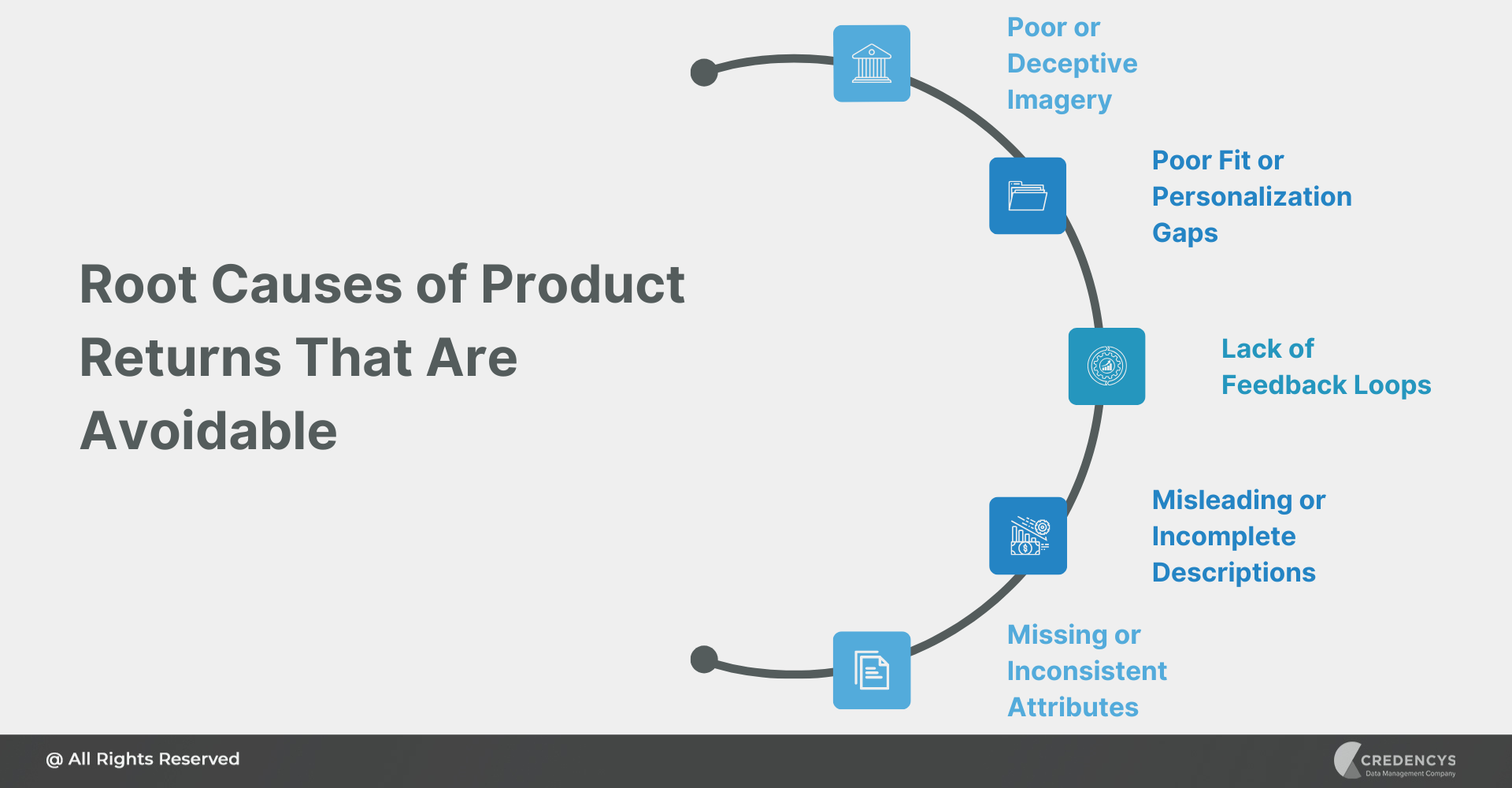
Root Causes of Product Returns That Are Avoidable
Product returns are inevitable in retail, but not all of them are unavoidable. Many returns stem from gaps in product information, not from product quality.
When customers don’t get what they expect, they send it back, and that expectation gap often starts with poor data management. Let’s break down the most common and preventable causes.
1. Poor or Deceptive Imagery
Images shape 90% of online purchasing decisions. Yet, many retailers still rely on inconsistent product visuals, such as photos taken from different angles, varying lighting conditions, or different color settings.
When the product delivered doesn’t visually match what customers saw online, it breaks trust instantly. Moreover, missing variant images (e.g., color or size options) lead to confusion and uncertainty.
AI can automatically flag mismatched visuals, tag missing images, and even generate high-quality, standardized images to create consistency across SKUs.
2. Poor Fit or Personalization Gaps
A large portion of returns, especially in apparel, footwear, and accessories, comes down to fit. Generic size charts or a lack of contextual guidance force shoppers to guess.
Without AI-driven insights into purchase patterns, body type preferences, and brand-specific sizing, even satisfied customers often order multiple sizes and return most of them. Personalization powered by AI can recommend the right size, fit, or variant based on historical data, dramatically cutting down “trial-and-error” returns.
3. Lack of Feedback Loops
Retailers often have rich data hidden in return reasons, reviews, and support tickets, but it goes unanalyzed. Without structured feedback loops, the same data errors persist across the catalog.
AI can close this loop by automatically analyzing patterns in return reasons (“too small,” “color mismatch,” “not as described”) and triggering enrichment workflows for affected SKUs. This turns reactive operations into predictive product intelligence, preventing future returns before they occur.

Discover How AI-powered Enrichment can Help your Retail Team Predict and Prevent Returns
3. Misleading or Incomplete Descriptions
Customers rely on written descriptions to decide whether a product fits their needs. When descriptions are vague, inconsistent, or lack crucial details like materials, care instructions, or compatibility, customers often make assumptions that lead to disappointment.
Incomplete or inconsistent product descriptions often occur when retailers source data from multiple suppliers or systems without standardization; a problem AI can easily detect and correct.
4. Missing or Inconsistent Attributes
Attributes, such as dimensions, weight, materials, and specifications, are critical to helping customers make informed decisions. But when this data is incomplete, duplicated, or misaligned across systems, customers can’t rely on it.
Centralizing and enriching product attributes through an AI-powered PIM ensures that every product carries accurate, complete, and uniform data across all selling channels.
In short: Returns are not just a logistics problem; they’re a data problem. And that means they can be fixed not with more warehouse space, but with smarter, AI-driven product information management.
How AI Enriches Product Data to Prevent Returns
Reducing returns starts long before the sale; it begins with data clarity. AI enables retailers to not only manage product data efficiently but also enrich it intelligently by filling gaps, ensuring accuracy, and creating product experiences that set the right expectations.
Here’s how AI transforms product information into a powerful tool for reducing returns.
1. AI-Generated and Optimized Product Descriptions
NLP models can analyze product specs, supplier feeds, and customer reviews to automatically generate or refine product descriptions. This means every product can have:
- Accurate, complete, and keyword-rich descriptions
- Consistent tone and structure across categories
- Dynamic language tailored to target audiences
AI doesn’t just rewrite, it clarifies. It ensures a backpack described as “water-resistant” is never misrepresented as “waterproof,” preventing the kind of expectation mismatch that drives costly returns.
Additionally, AI can A/B test description variants to see which versions lead to fewer return reasons, continuously improving content performance.
2. Visual Intelligence for Product Imagery
Images sell, but inconsistent visuals cause confusion and mistrust. AI-powered image recognition tools can:
- Tag and organize images automatically
- Generate accurate alt text for accessibility and SEO
- Detect visual inconsistencies between product variants (e.g., incorrect color representation)
- Recommend or even create missing imagery for key attributes
Advanced retailers are also using AI-driven 360° views, AR previews, and virtual try-ons to bridge the gap between online perception and in-hand experience. This minimizes “looks different than expected” returns, a top return driver in categories like apparel and furniture.
3. Personalized Fit and Variant Recommendations
Generic size charts are outdated. AI leverages historical purchase and return data to predict the right size or variant for each shopper.
For example:
- Recommending “M” for a returning customer who previously bought “L” and marked it as too large
- Suggesting the right shoe fit based on brand-to-brand size variations
- Highlighting “best-fit” variants based on region, gender, or climate preferences
This personalization layer ensures customers make confident buying decisions, reducing the likelihood of size or fit-based returns by double digits.
See How Leading Retailers Use AI to Make Every Purchase the Right Fit, the First Time
4. Intelligent Attribute Completion and Validation
Missing or inconsistent attributes are a silent killer of retail profitability. AI models trained on product catalogs can detect attribute gaps, infer missing values, and validate anomalies across SKUs.
For example:
- Identifying missing size, dimension, or material data
- Standardizing inconsistent units (e.g., “cm” vs. “inches”)
- Flagging improbable combinations (e.g., “leather” sneakers priced at $20)
By enriching every SKU with complete, standardized metadata, AI ensures that customers receive precise information, and retailers maintain a reliable, cross-channel product database.
5. Predictive Analytics and Feedback Loops
AI transforms post-purchase feedback into proactive insights. By analyzing return reason codes, product reviews, and customer support notes, machine learning models can identify patterns of recurring data issues and trigger corrections before they snowball.
If “color mismatch” complaints spike for a particular SKU, the AI flags potential imagery or metadata issues, prompting a recheck in the PIM system. This feedback loop closes the gap between sales, operations, and content teams, ensuring data improvement is continuous, not episodic.
6. Real-Time Data Governance and Quality Monitoring
AI also acts as a watchdog. It continuously scans product data for inaccuracies, inconsistencies, or policy violations, alerting teams in real time.
For instance:
- Detecting missing mandatory attributes before product launch
- Ensuring brand tone consistency in AI-generated descriptions
- Enforcing channel-specific formatting rules automatically
This creates a self-healing product information ecosystem, where data quality is maintained at scale without manual effort.
In essence, AI doesn’t just automate data tasks; it elevates data intelligence. It helps retailers deliver precise, transparent, and personalized product information that builds trust, reduces friction, and cuts returns at their source.
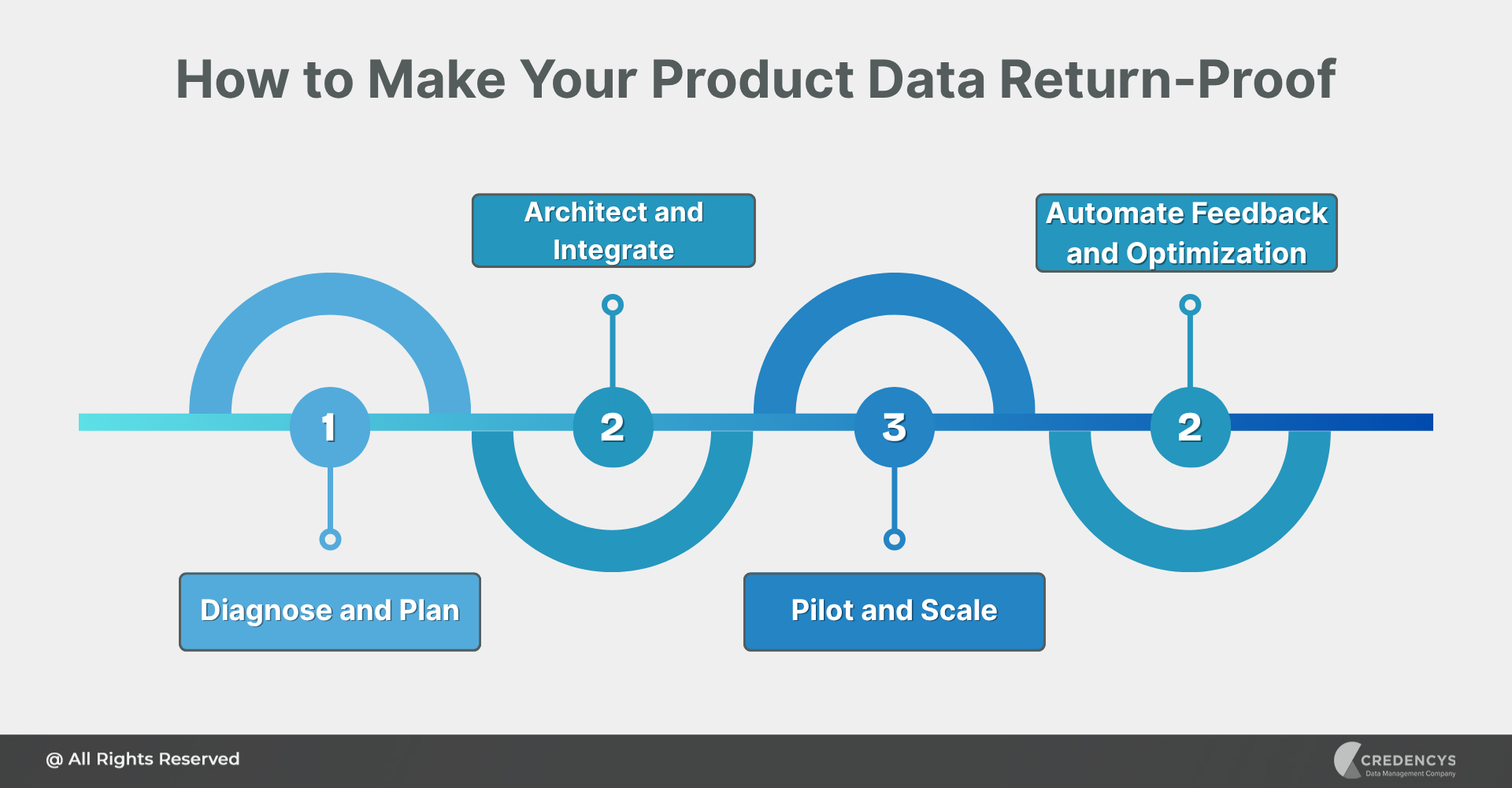
Implementation Playbook: How to Make Your Product Data Return-Proof
Transforming product data into a strategic advantage doesn’t happen overnight. It requires a structured approach, one that aligns technology, processes, and people.
This implementation playbook outlines the key phases retailers can follow to build an AI-enriched product information ecosystem that minimizes returns and maximizes customer confidence.
Phase 1: Diagnose and Plan
Before deploying AI, start with clarity. Conduct a comprehensive product data audit to uncover inconsistencies, gaps, and weak points that trigger returns.
Key actions:
- Analyze current product return data and categorize by reason (e.g., size, color, quality mismatch, misleading info).
- Map these reasons back to content and data gaps.
- Identify the systems (ERP, PIM, DAM, eCommerce) where these issues originate.
- Define measurable KPIs, such as target reduction in return rate, improvement in product completeness, or enrichment coverage.
The output of this phase should be a data maturity baseline and a roadmap that quantifies the ROI potential of AI-led enrichment.
Discover How a Structured Audit can Uncover Hidden ROI in Your Product Data
Phase 2: Architect and Integrate
AI can only perform as well as the data foundation it sits on. The next step is to design an integrated architecture where AI and PIM work in harmony.
Key actions:
- Select or enhance your PIM system as the single source of truth for product data.
- Connect it with AI modules for description generation, attribute enrichment, and image validation.
- Establish seamless data flows across ERP, DAM, and eCommerce platforms.
- Define data governance rules that AI can automate, what requires human approval, and who owns final validation.
At this stage, it’s critical to ensure interoperability and governance; the two pillars of reliable AI-enriched data.
Phase 3: Pilot and Scale
Don’t try to overhaul your entire product catalog in one go. Start small with a pilot program targeting a specific product category or a subset of SKUs with high return rates.
Key actions:
- Use AI to enrich attributes, descriptions, and imagery for the pilot SKUs.
- Implement personalization features like AI-driven size recommendations or variant suggestions.
- Monitor metrics like return rate, product page conversions, and customer satisfaction.
- Gather feedback from merchandising and operations teams to refine enrichment workflows.
Once the pilot delivers measurable improvement, roll out the approach across your catalog in phases.
Phase 4: Automate Feedback and Optimization
AI-driven data enrichment thrives on continuous learning. To sustain long-term results, integrate feedback loops that feed back return and review data into your enrichment models.
Key actions:
- Analyze return reasons regularly to spot emerging product data issues.
- Use sentiment analysis on customer reviews to uncover hidden quality or expectation gaps.
- Automate re-enrichment workflows when product data accuracy drops below defined thresholds.
- Schedule periodic audits to ensure AI-generated content remains brand-compliant and up to date.
This phase turns your product data ecosystem into a self-improving, AI-guided system, one that evolves with every transaction.
Product Data Readiness Checklist
Use this quick checklist to assess where your organization stands:
- Have you audited your product data for completeness and consistency?
- Do you analyze return and review data to find patterns?
- Is your PIM system integrated with AI for attribute and content enrichment?
- Are product images standardized, tagged, and verified for accuracy?
- Do you provide AI-based size, fit, or compatibility recommendations?
- Have you defined clear data governance and approval workflows?
- Are feedback loops in place for continuous model training and enrichment updates?
- Do you track KPIs linking product data quality with return rates?
AI enrichment of product data is a continuous cycle of data improvement. Retailers who adopt this proactive, feedback-driven approach don’t just reduce returns; they create frictionless buying experiences that build trust, loyalty, and long-term profitability.
Evaluate Your AI Readiness and See How Credencys can Help you Reduce Returns and Boost Profitability
Risks & Mitigations for AI-Enriched Product Data
AI-powered product data enrichment delivers remarkable efficiency and accuracy, but without proper oversight, it can introduce risks that affect trust, compliance, and customer satisfaction. Here’s how retailers can stay ahead of potential pitfalls while ensuring their AI implementation remains responsible and results-driven.
Risk 1: AI Hallucinations and Inaccurate Content
AI-generated product descriptions or attributes can sometimes be incorrect or misleading, especially when trained on incomplete or biased data. In retail, even a minor inaccuracy, such as wrong material, fit, or compatibility detail, can drive returns and damage customer trust.
Mitigation:
- Always maintain human-in-the-loop validation for enriched data, especially in early stages.
- Use prompt engineering and fine-tuning with verified product datasets to reduce hallucinations.
- Create a “data truth layer,” a rule-based validation engine that checks AI output against master data before publishing.
Risk 2: Biased or Non-Compliant Data
AI models trained on third-party data can unintentionally embed cultural, gender, or regional biases, leading to exclusionary or non-compliant product content, particularly problematic in global retail.
Mitigation:
- Train AI models on diverse, domain-specific datasets relevant to your product categories.
- Apply content moderation filters to detect biased or sensitive language before publishing.
- Regularly test AI outputs for compliance with industry and regional regulations (e.g., product labeling laws, environmental standards).
Risk 3: Misalignment Between AI and Business Objectives
Sometimes, AI models optimize for speed or automation rather than accuracy and customer value, causing disconnects between business KPIs and AI outcomes.
Mitigation:
- Define clear success metrics, such as reduction in return rates, faster product onboarding, and improved PDP conversions.
- Monitor performance using feedback loops that connect return data, reviews, and AI enrichment quality.
- Continuously retrain models using fresh product and performance data to maintain alignment with business goals.
Risk 4: Over-Automation without Governance
Retailers eager to scale enrichment quickly often let AI operate autonomously, resulting in inconsistent tone, incomplete metadata, or brand misalignment.
Mitigation:
- Establish a Data Governance Framework defining what AI can autonomously generate vs. what requires human approval.
- Implement approval workflows within your PIM to review enriched data before publishing to eCommerce channels.
- Periodically audit enriched product data for brand voice, accuracy, and compliance.
Risk 5: Data Privacy and Security Concerns
When enriching data from multiple sources, product catalogs may inadvertently expose supplier, pricing, or customer-related information if not managed securely.
Mitigation:
- Ensure role-based access controls (RBAC) in your PIM and AI systems.
- Anonymize sensitive supplier or partner data before feeding it into AI models.
- Use secure API integrations and encryption for all system interconnections.
Best Practices for Sustainable AI-Enriched Product Data
Retailers who treat AI as a collaborative enabler, not a replacement for human expertise, achieve the best results. Here’s what leading organizations do differently:
- Start small, scale smart: Pilot enrichment in high-return categories before expanding across the catalog.
- Create data feedback loops: Use return data and reviews to fine-tune AI models.
- Balance automation with governance: Let AI handle repetitive enrichment tasks, but keep human oversight on accuracy and tone.
- Standardize taxonomy and attributes: Ensure all channels and teams use consistent data models.
- Track enrichment ROI: Measure impact on conversion rates, return reductions, and time-to-market.
- Evolve continuously: Keep retraining AI models as new SKUs, languages, and product lines emerge.
Ready to Put These Best Practices into Action With an AI-enriched PIM Strategy?
AI can be your strongest ally in building return-proof product data, but only when guided by structure, governance, and feedback. By balancing automation with accountability, retailers can achieve scalable accuracy, faster product launches, and higher consumer confidence, all without losing control of their brand’s voice or integrity.
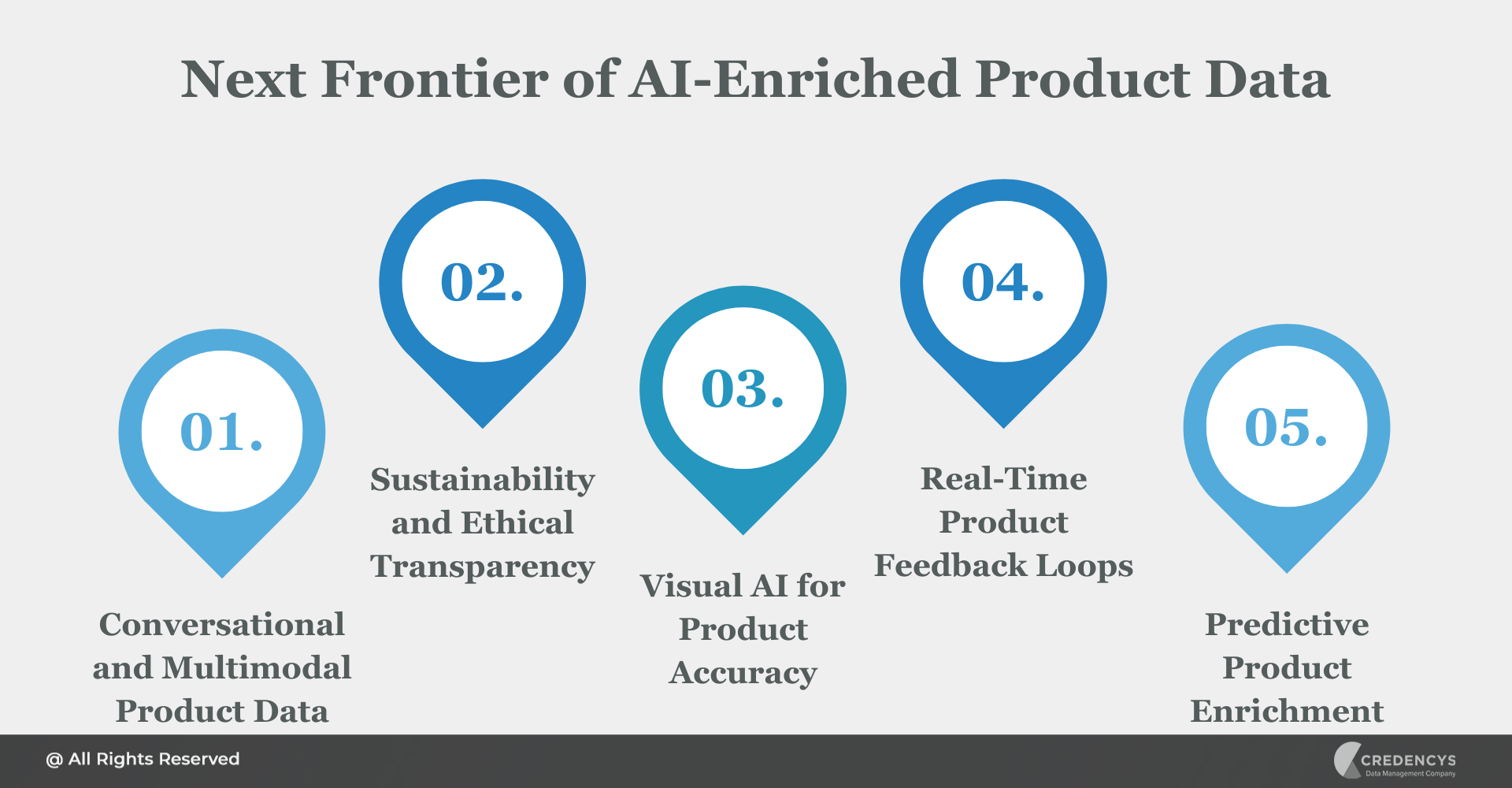
Future Outlook: The Next Frontier of AI-Enriched Product Data
The retail industry is entering a new phase where product data intelligence will no longer be a back-office function; it will be a strategic differentiator. In the coming years, the convergence of AI, automation, and PIM will fundamentally redefine how product experiences are created, managed, and optimized.
Here’s what’s ahead:
1. Conversational and Multimodal Product Data
As voice and visual commerce expand, AI will enable product data that’s conversational, interactive, and personalized. Imagine a customer asking, “Will this chair fit in my living room corner?”, and your product data instantly providing dimensions, placement visuals, and complementary product suggestions.
AI will make this kind of contextual intelligence possible at scale.
2. Sustainability and Ethical Transparency
As customers increasingly seek sustainable and ethically sourced products, AI will play a key role in verifying, classifying, and communicating sustainability attributes, from material sourcing to recyclability. AI-driven data validation will help retailers ensure compliance and build trust through transparent, verifiable claims.
3. Visual AI for Product Accuracy
Next-generation visual AI will verify product accuracy by comparing images against master data, flagging inconsistencies in color, material, or dimensions. This means fewer visual misrepresentations, improved PDP consistency, and stronger buyer confidence, especially in high-return categories like fashion and home décor.
4. Real-Time Product Feedback Loops
Future-ready retailers will integrate AI with real-time feedback systems, connecting returns data, product reviews, and behavioral insights back into their PIM platforms. This continuous loop will allow instant correction of misleading content, ensuring product pages evolve dynamically based on customer experiences.
5. Predictive Product Enrichment
AI will go beyond reactive data enrichment. Future models will use predictive intelligence to anticipate which attributes, formats, and content variations drive the best outcomes for each channel or audience segment.
AI-enriched product data is a strategic necessity, moving ahead. Retailers that invest in intelligent PIM systems today will not only reduce returns, but they’ll also future-proof their operations, enhance product discovery, and deliver richer, more accurate shopping experiences.
From Returns to Revenue – The Power of AI-Enriched Product Data
When customers receive incomplete, inconsistent, or inaccurate information, disappointment follows, leading to increased returns. But when your product data is enriched, contextualized, and constantly learning from customer behavior, you turn every purchase into a confident one.
That’s the real promise of AI-enriched PIM, not just fewer returns, but stronger margins, faster conversions, and higher customer lifetime value. Forward-thinking retailers are already seeing measurable ROI by integrating AI into their product information strategy.
With smarter data comes fewer returns, and with fewer returns comes more profit.
Ready to Reduce Returns and Improve your Bottom Line? Discover how AI-enriched Product Data can Transform your Retail Performance







Tags: