



End-to-End PIM Consulting: Why it Starts with Getting Product Information Right
As an ecommerce retailer, manufacturer, or brand owner, you already know one uncomfortable truth. Customers return products.
It’s just part of the business.
But do you know.
Nearly 45 percent of product returns happen because the product didn’t match the information shown online.
Simply because what customers received was not what they were led to expect. That gap between expectation and reality is not a CX problem alone. It’s a product information problem.
And this is exactly where end-to-end PIM consulting becomes less of a “system discussion” and more of a business-critical conversation.
Most organizations don’t struggle because they lack product data. They struggle because their product data lives everywhere. Spreadsheets owned by merchandising teams. ERP records managed by operations. Marketplace templates updated manually. Marketing content stored in shared drives. Technical attributes buried deep in legacy systems.
Each team does its best.
Collectively, the experience breaks.
Poor product information doesn’t just increase returns. It slows launches, causes marketplace rejections, creates internal rework, and quietly erodes trust with customers.
According to industry research, bad data costs businesses an average of 15 percent to 25 percent of their revenue each year when you factor in inefficiencies, rework, and lost opportunities.
That’s why end-to-end PIM consulting is not about “implementing a tool.” It’s about fixing the entire product information lifecycle, from how data is created to how it is governed, enriched, and delivered across every channel.
At its core, Product Information Management is meant to answer one simple question:
Can every team, system, and customer trust the product data they see?
When the answer is no, scaling ecommerce, omnichannel retail, or digital manufacturing becomes painful.
When the answer is yes, something powerful happens. Teams move faster. Errors reduce. Product launches feel predictable instead of stressful.
Before we go any further, it’s worth pausing and asking a simple question.
Not “Which PIM tool should I buy?” but:
What is PIM and What End-to-End PIM Consulting Really Means
Product Information Management, commonly referred to as PIM, is a system designed to help businesses centralize, manage, enrich, and distribute product information across all sales, marketing, and operational channels from a single source.
At a basic level, PIM ensures that the product information your teams create internally is the same information your customers see externally, whether they are browsing your ecommerce website, shopping on a marketplace, flipping through a catalog, or interacting with your brand on a mobile app.
The core objective of PIM is simple but powerful: make accurate, consistent, and up-to-date product data available everywhere it is needed, without manual duplication or last-minute fixes.
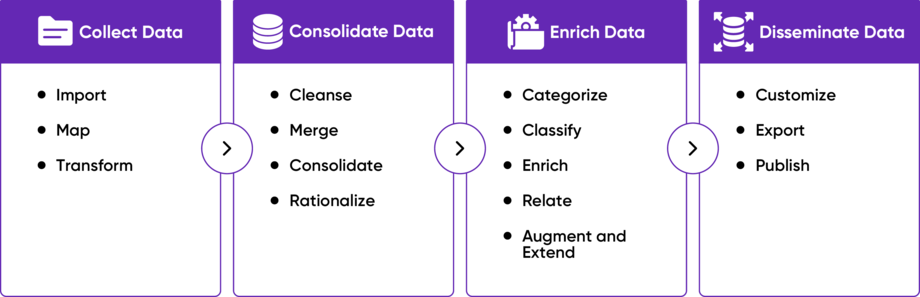
A PIM solution acts as the central hub for product data, sitting between upstream systems like ERP or PLM and downstream channels such as ecommerce platforms, marketplaces, print, and syndication partners. Instead of each channel pulling data from different sources, PIM becomes the single point of truth that governs what product information is published, where, and how.
Most modern PIM platforms support capabilities such as:
- A centralized platform to store and manage all product information, including attributes, descriptions, images, documents, and metadata
- Tools to enrich product data with marketing content, technical specifications, and digital assets
- Built-in workflows and validations to improve data quality before products go live
- Distribution capabilities to push channel-ready product data to ecommerce sites, marketplaces, apps, and partners
- Support for localization, enabling teams to manage region-specific, language-specific, and channel-specific content
- Improved collaboration across merchandising, marketing, compliance, and operations teams
- Automation of repetitive tasks such as categorization, attribute mapping, and content updates
While this explains what PIM does, it does not fully explain why many PIM initiatives fail to deliver long-term value.
End-to-End PIM Consulting focuses on designing, aligning, and operationalizing the entire product information lifecycle. It recognizes that product data challenges are rarely caused by technology alone. They are usually rooted in unclear ownership, inconsistent processes, fragmented systems, and unmanaged growth across channels.
With an end-to-end approach, PIM is treated not just as a repository, but as a business capability. Consulting starts by understanding how product data is created, how it evolves over time, who owns it at each stage, and how it must adapt for different channels and markets. Only then is the PIM platform configured to support those realities.
Benefits of PIM for Modern Businesses
When implemented through an end-to-end consulting approach, PIM delivers value across teams, channels, and customer experiences.
1. Improved efficiency
By automating repetitive tasks such as data updates, enrichment, and distribution, PIM reduces manual effort and allows teams to focus on higher-value work.
2. Increased data accuracy
Centralized data management eliminates inconsistencies and errors across channels, ensuring customers always see accurate and reliable product information.
3. Enhanced customer experience
Rich, consistent, and complete product content improves clarity and builds customer confidence, leading to stronger brand trust.
4. Faster time-to-market
Centralized product data and structured workflows speed up product launches across regions, channels, and marketplaces.
5. Reduced product returns
Accurate and detailed product information helps customers understand what they are purchasing, reducing mismatched expectations and returns.
6. Increased conversions
High-quality, compelling product content enables customers to make confident buying decisions across every channel.
Core PIM Capabilities That Power End-to-End PIM Consulting
Before discussing implementation or AI, it is important to understand what a modern PIM platform is fundamentally designed to do. At its best, PIM is not just a database for product attributes. It is a structured system that supports how product information is created, governed, enriched, and activated across the enterprise.
At Credencys, we evaluate and design PIM capabilities based on how your business actually operates, not how a tool demo suggests it should.
Key PIM capabilities typically include:
1. Centralized product data management
A single, authoritative platform to manage all product attributes, descriptions, specifications, digital assets, and metadata, eliminating inconsistencies across spreadsheets, systems, and teams.
2. Data enrichment and quality management
Built-in validation rules, completeness checks, and enrichment workflows that ensure product data meets internal standards and external channel requirements before publication.
3. Omnichannel product data distribution
The ability to prepare and distribute channel-ready product information for ecommerce platforms, marketplaces, print catalogs, mobile apps, and partner feeds without rework.
4. Localization and regionalization support
Structured management of language-specific, region-specific, and market-specific product content, including regulatory and compliance-driven attributes.
5. Workflow-driven collaboration
Role-based workflows that allow merchandising, marketing, compliance, and operations teams to work together without overwriting or duplicating efforts.
6. Scalable product data modeling
Flexible data models that support complex catalogs, variants, bundles, and evolving product structures as the business grows.
End-to-End PIM Implementation Services: From Strategy to Scale
Technology alone does not fix product data challenges. At Credencys, PIM implementation is approached as a phased transformation rather than a one-time deployment.
1. PIM Consulting and Assessment
Every engagement starts with understanding your current state. Our consultants assess your existing product data landscape, systems, processes, and pain points to identify gaps and opportunities. Based on this assessment, we define a clear PIM roadmap aligned to your business goals, growth plans, and channel strategy.
This phase also includes helping you select the right PIM platform by evaluating factors such as feature fit, scalability, integration requirements, and total cost of ownership.
2. Customization and Workflow Design
No two product catalogs are the same. We customize the PIM solution to reflect your specific product structures, business rules, and workflows. This includes configuring automated enrichment workflows, approval processes, attribute dependencies, and channel-specific publishing logic.
Where standard functionality falls short, we design and develop custom modules or extensions to ensure the PIM system supports real-world use cases without workarounds.
3. Data Migration and Cleansing
One of the most underestimated aspects of PIM success is data migration. As part of our end-to-end PIM consulting, we cleanse, standardize, and migrate product data from legacy systems, spreadsheets, and disparate sources into the new PIM platform.
This process focuses not just on moving data, but on improving its quality so the PIM system delivers value from day one.
4. Implementation and Configuration
Our implementation teams configure the PIM system based on defined workflows, user roles, governance rules, and integration points. This ensures that each team interacts with product data in a way that is intuitive, controlled, and aligned with business responsibilities.
5. System Integration
A PIM system does not operate in isolation. We integrate PIM with ecommerce platforms, marketplaces, ERP, CRM, DAM, and other enterprise systems to enable seamless data flow and reduce manual intervention. Wherever possible, we automate data updates and content syndication to improve speed and accuracy.
6. Ongoing Support and Maintenance
PIM is a living system. As products, channels, and markets evolve, the PIM platform must adapt. We provide continuous support, system upgrades, security updates, and periodic data quality assessments to ensure long-term stability and performance.
AI for PIM: Bringing Intelligence Into Product Information Management
AI has become a game-changer in modern PIM, transforming how product information is created, maintained, and optimized at scale.
Rather than replacing human expertise, AI enhances it by reducing repetitive work and improving consistency across large catalogs.
1. AI-Powered Product Description Generation
AI-driven content generation helps teams create ready-to-edit product descriptions using your brand’s tone of voice while incorporating relevant product keywords. This significantly reduces the time required to launch or update products, especially for high-SKU catalogs, while maintaining content consistency across channels.
2. AI-Based Translations and Localization
Generative AI enables faster and more accurate translation of product content into multiple languages. These translations can be tailored for specific industries or content types, such as technical specifications, compliance-driven documentation, or marketing copy, helping global teams scale without compromising accuracy.
3. Intelligent Attribute Recommendations
AI excels at identifying patterns in existing data. By analyzing your product catalog, AI can recommend missing or incomplete attributes such as size, color, material, or technical specifications. This improves data completeness, reduces manual audits, and strengthens downstream channel readiness.
When integrated thoughtfully, AI capabilities elevate PIM from a management system to a decision-support platform, making end-to-end PIM consulting future-ready and scalable.
Case Study: Streamlining Product Operations for a Quick Commerce Pioneer
The Challenge
Operating across 580+ cities, the client struggled to manage high-volume product data using spreadsheets and email-driven workflows. Manual processes slowed product onboarding, limited real-time visibility, and made collaboration with brand partners inefficient.
The Approach
Through end-to-end PIM consulting, Credencys centralized product data and workflows using Pimcore. A brand portal enabled direct product submissions, while automated workflows handled enrichment, pricing, approvals, and catalog integration via APIs.
The Impact
- 29% faster time-to-market for product launches
- 41% reduction in manual effort across teams
- 32% improvement in data consistency
Final Thoughts: Why End-to-End PIM Consulting Matters More Than Ever
Product information has quietly become one of the most influential drivers of customer trust, operational efficiency, and scalable growth. As businesses expand across channels, regions, and product lines, the cost of fragmented, inconsistent product data becomes harder to ignore.
What this blog shows is simple: PIM is not just a system you implement. It is a capability you build.
End-to-End PIM Consulting ensures that product information is treated as a strategic asset, not an afterthought. It aligns people, processes, data, and technology so that product content remains accurate, consistent, and ready for every channel, today and as the business evolves.
Whether you are struggling with slow product launches, frequent data corrections, marketplace rejections, or rising returns, these challenges often trace back to the same root cause: product information that is not designed to scale.
With the right PIM foundation, teams work with clarity instead of workarounds. Customers shop with confidence instead of confusion. And growth becomes predictable rather than reactive.



Tags: