


ERP Cloud Migration Strategy: Step-by-Step Framework for Success
Legacy ERP systems often struggle to support the speed, scalability, and flexibility modern enterprises need. As organizations accelerate digital transformation initiatives, ERP cloud migration has become a strategic priority to improve operational efficiency, enable real-time decision-making, and support AI-driven innovation.
The shift towards cloud ERP is growing rapidly.
Reports show that over 70% of ERP deployments are now cloud-based, while nearly 79% of new ERP implementations prefer cloud solutions.
However, ERP cloud migration is not simply a technology upgrade. Organizations often face challenges such as:
- Complex legacy integrations
- Poor data quality
- Downtime risks
- Security and compliance concerns
- User adoption issues
Without a clear migration strategy, these challenges can delay projects, increase costs, and disrupt business operations.
Gartner also predicts that by 2027, more than 70% of ERP initiatives may fail to fully achieve their intended business outcomes due to poor alignment and execution.
A structured ERP cloud migration strategy helps enterprises reduce risk, modernize efficiently, and maximize long-term business value. In this blog, we will explore a step-by-step ERP cloud migration framework, key challenges, best practices, and strategic considerations for a successful transition to the cloud.
Understanding ERP Cloud Migration
ERP cloud migration is the process of moving an organization’s ERP system, applications, databases, and business processes from on-premises infrastructure to a cloud-based environment. The goal is to improve scalability, flexibility, system performance, and operational efficiency while reducing the dependency on legacy infrastructure.
Unlike traditional ERP systems that require heavy hardware investments and ongoing maintenance, cloud ERP platforms provide centralized access, automatic updates, easier scalability, and better integration capabilities.
ERP cloud migration can involve:
- Migrating ERP applications and workloads to the cloud
- Transferring historical and real-time business data
- Modernizing integrations with other enterprise systems
- Optimizing workflows for cloud-native operations
- Improving security, accessibility, and disaster recovery capabilities
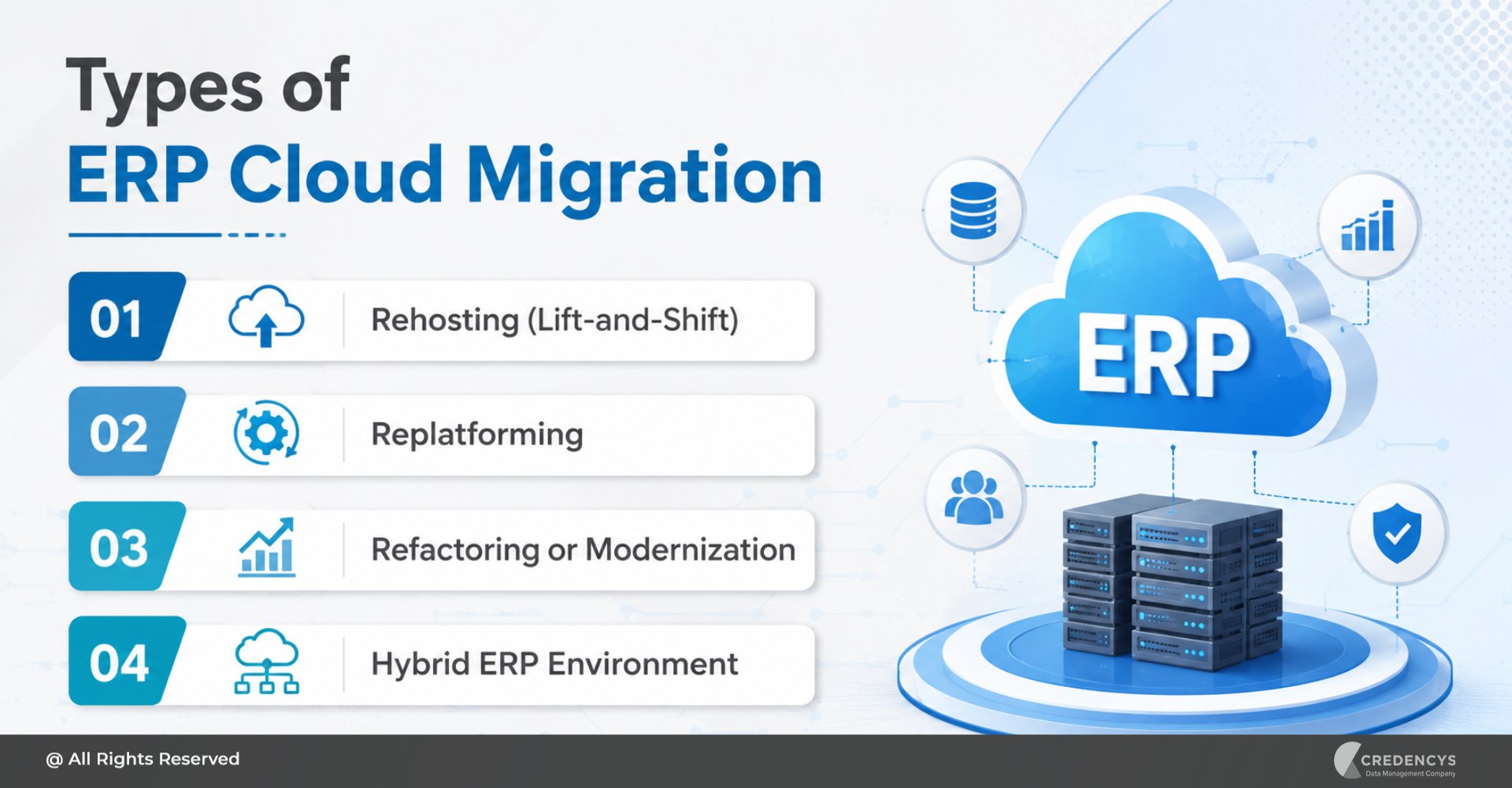
Types of ERP Cloud Migration
Enterprises can choose different migration approaches based on their business goals, legacy complexity, and modernization requirements.
- Rehosting (Lift-and-Shift): Moves existing ERP applications to the cloud with minimal changes. This approach is faster but may not fully utilize cloud-native capabilities.
- Replatforming: Makes selective optimizations during migration to improve performance, scalability, or integration without redesigning the entire ERP architecture.
- Refactoring or Modernization: Redesigns ERP applications and workflows to fully leverage cloud-native technologies, automation, and advanced analytics capabilities.
- Hybrid ERP Environment: Combines on-premises and cloud ERP systems, allowing organizations to migrate gradually while maintaining critical legacy operations.
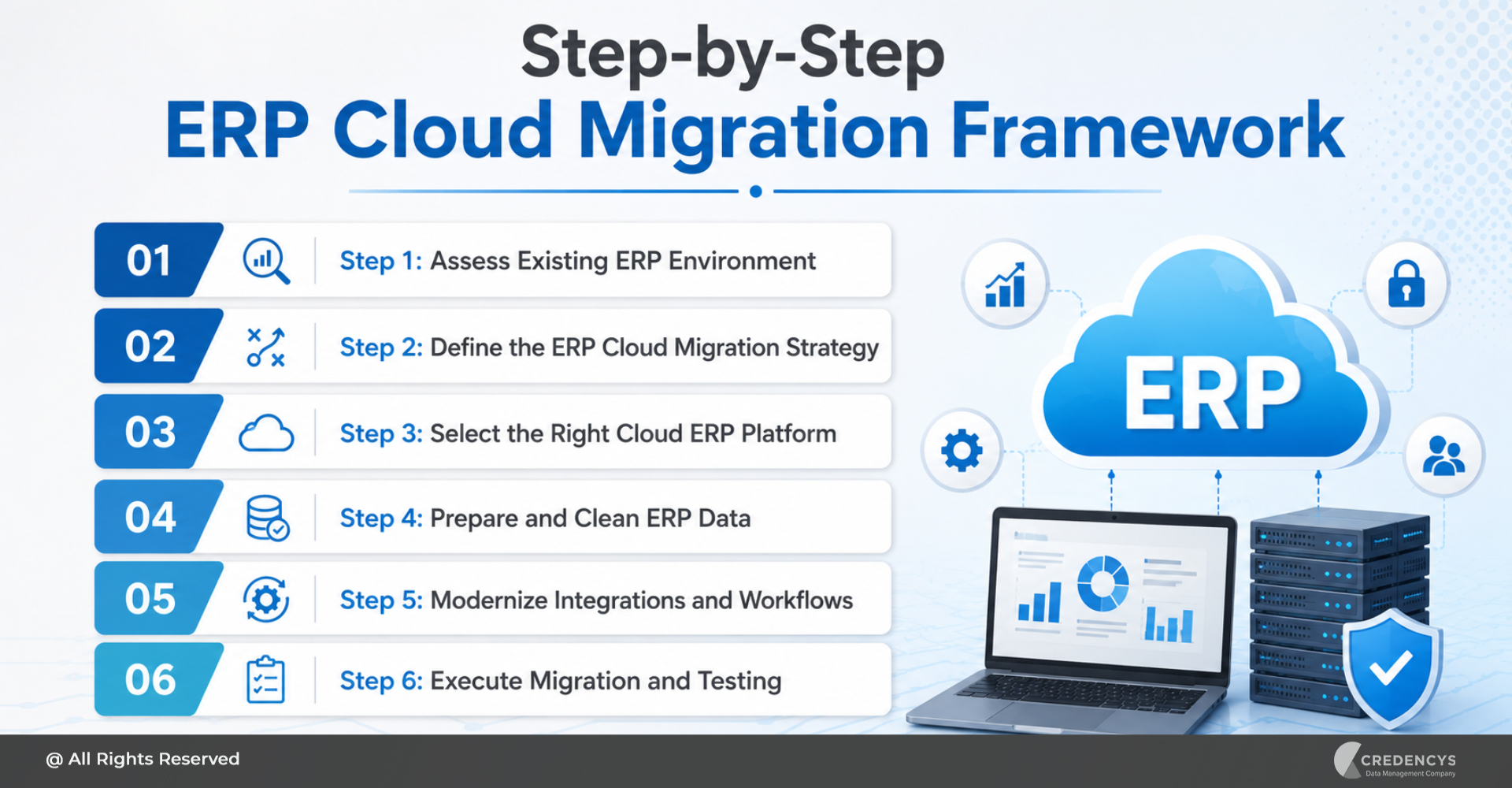
Step-by-Step ERP Cloud Migration Framework
A successful ERP cloud migration requires more than simply moving applications to the cloud. Enterprises need a structured framework that aligns business objectives, technology decisions, data management, and operational continuity throughout the migration journey.
Below is a step-by-step ERP cloud migration framework that helps organizations reduce risk, improve efficiency, and maximize long-term business value.
Step 1: Assess Existing ERP Environment
Before starting the migration process, organizations must evaluate their current ERP ecosystem to understand technical limitations, business dependencies, and modernization requirements.
Evaluate Existing Infrastructure: Begin by analyzing,
- Legacy ERP architecture
- Customizations and configurations
- Third-party integrations
- Application performance issues
- Infrastructure dependencies
This assessment helps identify systems that require modernization, replacement, or optimization before migration.
Identify Business Objectives: Clearly define the outcomes the organization expects from ERP cloud migration, such as:
- Reducing operational costs
- Improving scalability
- Enhancing customer experiences
- Enabling real-time analytics
- Supporting global expansion
- Increasing operational agility
Aligning migration goals with business priorities helps organizations make better technology and investment decisions.
Conduct a Cloud Readiness Assessment: A cloud readiness assessment evaluates whether the organization’s infrastructure, data, security posture, and internal processes are prepared for migration. Key areas to assess include:
- Data quality and governance
- Security and compliance requirements
- Network and infrastructure readiness
- Internal IT capabilities
- Integration complexity
This stage also helps organizations identify potential risks, dependencies, and resource gaps early in the migration process.
A thorough ERP assessment creates a strong foundation for building a migration strategy that minimizes disruptions and supports long-term scalability.
Step 2: Define the ERP Cloud Migration Strategy
Once the existing ERP environment has been assessed, the next step is to create a clear migration strategy. This stage focuses on selecting the appropriate migration approach, defining the cloud architecture, and building a roadmap aligned with business objectives.
A well-planned strategy helps organizations reduce migration risks, control costs, and ensure smoother implementation.
Choose the Right Migration Approach: Different organizations require different migration models depending on their ERP complexity, operational requirements, and modernization goals.
- Big Bang Migration: In this approach, the entire ERP system is migrated to the cloud in a single step. While this method can accelerate transformation, it also carries greater risks of downtime and operational disruptions.
- Phased Migration: A phased approach migrates applications, modules, or business units gradually over time. This strategy reduces risk and allows teams to resolve issues incrementally.
- Hybrid Migration: Some enterprises adopt a hybrid model in which certain ERP workloads remain on-premises while others move to the cloud. This approach is useful for organizations with strict compliance or legacy system dependencies.
Select the Right Cloud Deployment Model: Choosing the right cloud environment is equally important for long-term ERP performance and scalability.
- Public Cloud: Offers cost efficiency, scalability, and faster deployment. Ideal for businesses seeking flexibility and lower infrastructure management responsibilities.
- Private Cloud: Provides greater control, customization, and security for enterprises with strict regulatory or compliance requirements.
- Hybrid Cloud: Combines public and private cloud capabilities, allowing organizations to balance flexibility, security, and operational control.
Build a Detailed Migration Roadmap: An ERP cloud migration roadmap provides a structured execution plan and ensures alignment across technical and business teams. The roadmap should include:
- Migration timelines and milestones
- Budget and resource planning
- Risk assessment and mitigation strategies
- Testing and validation plans
- Disaster recovery and rollback procedures
- Post-migration optimization goals
At this stage, organizations should also establish governance frameworks, define stakeholder responsibilities, and create communication plans to ensure smooth collaboration throughout the migration lifecycle. A clearly defined ERP cloud migration strategy helps enterprises execute migration projects more efficiently while minimizing operational disruptions and unexpected costs.
Step 3: Select the Right Cloud ERP Platform
Choosing the right cloud ERP platform is one of the most important decisions in the migration journey. The platform should not only support current operational needs but also enable future scalability, integration, automation, and innovation.
Selecting the wrong platform can lead to performance limitations, integration challenges, higher costs, and poor user adoption.
Key Factors to Consider: Organizations should evaluate cloud ERP platforms based on both technical and business requirements.
- Scalability and Flexibility: The ERP platform should support business growth, increasing transaction volumes, multi-location operations, and evolving business models without major infrastructure changes.
- Integration Capabilities: Modern ERP systems must seamlessly integrate with CRM platforms, supply chain systems, HR applications, analytics tools, and third-party business applications.
- Security and Compliance: Security features such as identity management, encryption, access controls, and compliance certifications are essential for protecting enterprise data and meeting regulatory requirements.
- Customization and Industry Fit: Different industries have unique operational requirements. Enterprises should choose ERP platforms that support industry-specific workflows, compliance standards, and customization needs.
- AI and Analytics Support: Modern cloud ERP platforms increasingly offer built-in AI, automation, predictive analytics, and real-time reporting, improving operational efficiency and decision-making.
- Total Cost of Ownership: Organizations should evaluate licensing costs, implementation expenses, infrastructure savings, maintenance requirements, and long-term operational costs before making a decision.
Popular Cloud ERP Platforms: Several enterprise-grade cloud ERP platforms are widely adopted across industries.
- SAP S/4HANA Cloud: Known for large-scale enterprise operations, advanced analytics, and strong manufacturing and supply chain capabilities.
- Oracle Cloud ERP: Offers strong financial management, automation, and enterprise performance management features.
- Microsoft Dynamics 365: Provides seamless integration with the Microsoft ecosystem and supports flexible deployment for mid-sized and large enterprises.
- NetSuite: Popular among growing businesses for its scalability, cloud-native architecture, and unified business management capabilities.
- Odoo: A flexible and modular ERP platform known for its open-source capabilities, customization flexibility, and suitability for businesses seeking scalable and cost-efficient cloud ERP solutions.
Align Platform Selection with Long-Term Business Goals: Rather than selecting an ERP platform based solely on current requirements, enterprises should focus on long-term transformation goals, such as:
- Global business expansion
- AI adoption
- Process automation
- Data-driven decision-making
- Omnichannel operations
- Operational agility
The right cloud ERP platform creates a strong foundation for innovation, operational resilience, and future digital transformation initiatives.
Step 4: Prepare and Clean ERP Data
Data is one of the most critical components of any ERP cloud migration project. Migrating inaccurate, outdated, or duplicate data into a new cloud environment can create operational inefficiencies, reporting issues, and poor user experiences.
Before migration begins, organizations must establish a strong data preparation and governance strategy to ensure data accuracy, consistency, and reliability.
Conduct a Data Audit: The first step is to evaluate the quality and relevance of existing ERP data. Organizations should identify:
- Duplicate records
- Incomplete or inaccurate data
- Obsolete business information
- Redundant datasets
- Unused master data
This process helps reduce unnecessary data migration costs and improves overall system performance after migration.
Define Data Governance Standards: Clear data governance policies help maintain consistency across departments and systems. Key governance areas include:
- Master data management
- Data ownership and accountability
- Data classification policies
- Access controls and security standards
- Compliance requirements
Strong governance ensures that business-critical information remains accurate and secure throughout the migration lifecycle.
Clean and Standardize Data: Data cleansing is essential for improving ERP performance and analytics accuracy in the cloud environment. This stage may involve:
- Removing duplicate entries
- Correcting inconsistencies
- Standardizing naming conventions
- Validating records
- Enriching incomplete datasets
Clean data improves reporting accuracy, workflow automation, and decision-making capabilities after migration.
Build a Data Migration Plan: A detailed migration plan helps organizations move data securely and efficiently. The plan should include:
- Data mapping between old and new systems
- Migration timelines
- Validation and testing procedures
- Backup and recovery strategies
- Rollback planning in case of migration failures
Organizations should also prioritize critical business data to minimize operational disruptions during migration.
Test Data Before Go-Live: Before final deployment, migrated data should be thoroughly tested to verify:
- Data accuracy
- System compatibility
- Integration performance
- Reporting consistency
- Security and access permissions
Comprehensive testing reduces the risk of business disruptions and ensures a smoother transition to the new cloud ERP environment.
Well-prepared and governed data not only supports a successful ERP cloud migration but also strengthens long-term analytics, automation, and operational efficiency initiatives.
Step 5: Modernize Integrations and Workflows
ERP systems are deeply connected with multiple business applications, including CRM platforms, supply chain systems, HR software, finance tools, and analytics platforms. During ERP cloud migration, organizations must modernize these integrations and workflows to ensure seamless operations in the new environment.
Simply migrating outdated processes to the cloud can limit the full value of cloud ERP transformation.
Analyze Existing Integrations: Identify all systems connected to the current ERP environment. This may include:
- Customer Relationship Management (CRM) platforms
- Supply chain and inventory systems
- HR and payroll applications
- Business intelligence and analytics tools
- eCommerce and customer service platforms
Understanding integration dependencies helps organizations avoid disruptions and compatibility issues during migration.
Redesign Business Processes: ERP cloud migration is also an opportunity to optimize and standardize workflows. Organizations should:
- Eliminate redundant manual processes
- Simplify complex workflows
- Improve cross-department collaboration
- Automate repetitive operational tasks
- Align workflows with modern business requirements
Modernized workflows improve productivity, reduce operational bottlenecks, and enhance user experiences.
Enable API-Driven Connectivity: Cloud ERP platforms rely heavily on APIs and cloud-native integrations for real-time data exchange. API-driven integration enables:
- Faster system connectivity
- Real-time data synchronization
- Improved scalability
- Easier third-party application integration
- Better interoperability across cloud environments
This approach also supports future digital transformation initiatives involving AI, automation, analytics, and IoT ecosystems.
Focus on Automation Opportunities: Modern cloud ERP platforms offer built-in automation capabilities that can streamline operations and reduce manual effort. Organizations can automate:
- Invoice processing
- Inventory updates
- Procurement workflows
- Customer order management
- Reporting and approvals
Automation not only improves efficiency but also reduces human errors and operational costs.
Ensure Integration Security and Performance: As integrations expand across cloud environments, organizations must prioritize:
- Secure API management
- Access controls and authentication
- Data encryption
- Performance monitoring
- Integration testing
Strong integration governance ensures reliable and secure communication between business systems.
By modernizing integrations and workflows during ERP cloud migration, enterprises can create a more connected, agile, and scalable operational ecosystem that supports long-term business growth.
Step 6: Execute Migration and Testing
Once the migration strategy, data preparation, and integrations are in place, organizations can begin the actual ERP cloud migration process. This stage requires careful execution, continuous monitoring, and rigorous testing to minimize operational disruptions and ensure system stability.
A well-managed execution phase helps enterprises reduce downtime, identify issues early, and improve overall migration success rates.
Start with a Pilot Migration: Before migrating the entire ERP environment, organizations should conduct a pilot migration for selected modules, users, or business units. A pilot migration helps:
- Validate the migration strategy
- Identify performance or compatibility issues
- Test integrations and workflows
- Evaluate system stability
- Reduce risks before full-scale deployment
This phased validation approach improves confidence and minimizes unexpected disruptions during final migration.
Perform Comprehensive Testing: Testing is critical to ensure the cloud ERP environment functions properly across all business operations. Key testing areas include:
- Functional Testing: Verifies whether ERP modules, workflows, and business processes operate correctly after migration.
- Performance Testing: Evaluates system speed, scalability, response times, and workload handling under real business conditions.
- Security Testing: Ensures data protection, access controls, authentication mechanisms, and compliance requirements are properly implemented.
- User Acceptance Testing (UAT): Allows end users and business teams to validate workflows and confirm the system meets operational expectations.
Minimize Downtime and Operational Disruptions: ERP systems support mission-critical business operations, making downtime management a top priority during migration. Organizations can reduce disruptions by:
- Using parallel environments during transition
- Scheduling migration during low-traffic periods
- Implementing rollback and recovery plans
- Monitoring system performance in real time
- Establishing clear communication protocols
A strong business continuity strategy helps maintain operational stability throughout the migration process.
Monitor Migration Performance: During execution, organizations should continuously track:
- Migration progress
- Data transfer accuracy
- Integration performance
- System availability
- Error logs and issue resolution
Real-time monitoring enables teams to quickly identify and resolve issues before they impact business operations.
Successful execution of an ERP cloud migration depends on careful planning, rigorous testing, and proactive risk management. Enterprises that prioritize testing and operational continuity can significantly improve migration outcomes and long-term system reliability.
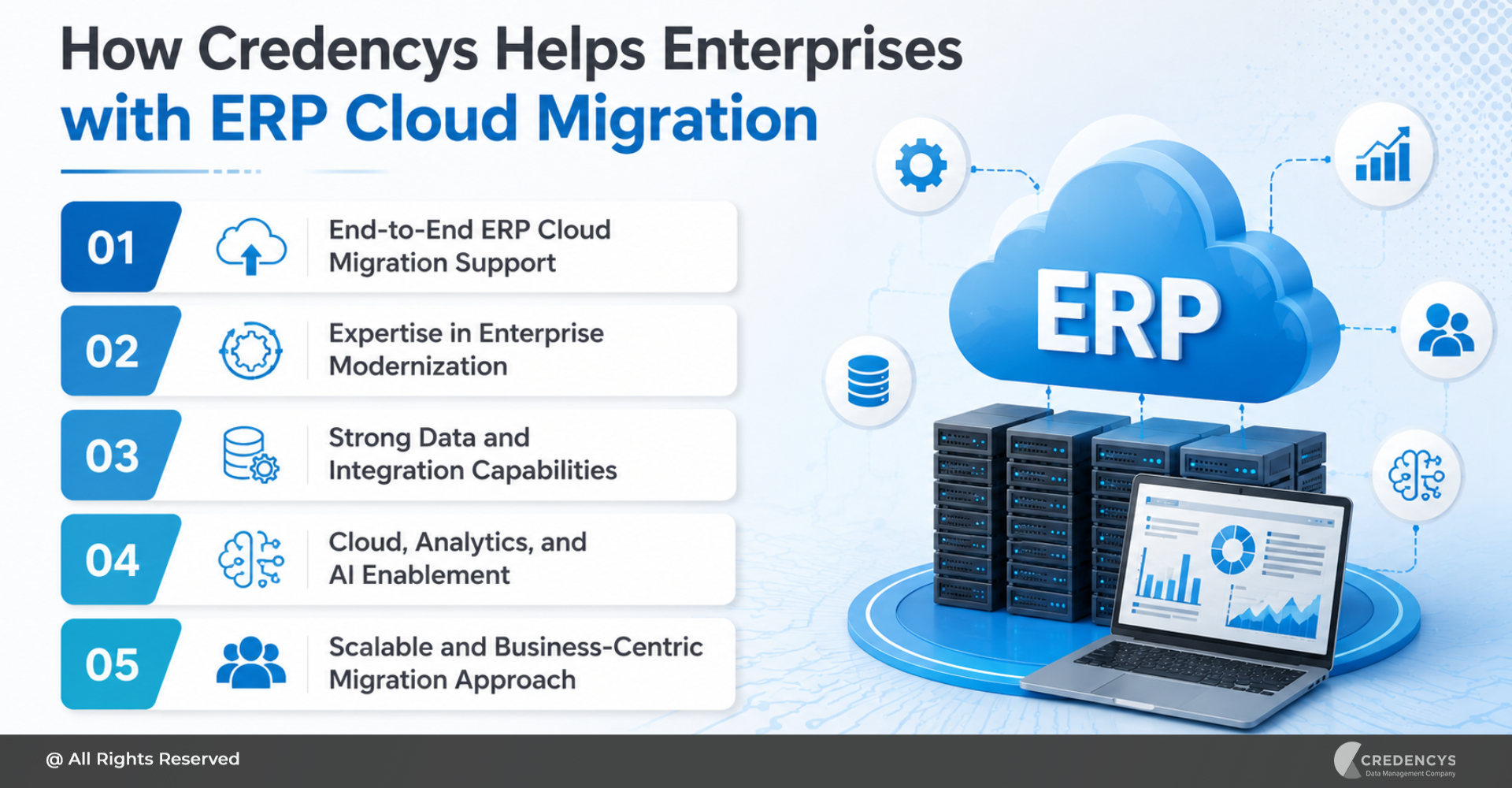
How Credencys Helps Enterprises with ERP Cloud Migration
ERP cloud migration requires the right combination of strategy, technical expertise, data governance, and process modernization. Enterprises need a trusted technology partner that can manage migration complexities while ensuring scalability, security, and long-term business value.
Credencys helps organizations modernize legacy ERP environments through structured cloud migration strategies tailored to business goals and operational requirements.
End-to-End ERP Cloud Migration Support
Credencys supports enterprises throughout the entire migration lifecycle, including:
- ERP assessment and cloud readiness evaluation
- Migration strategy and roadmap development
- Data migration and governance
- Integration modernization
- Workflow optimization
- Testing and deployment
- Post-migration support and optimization
This end-to-end approach helps businesses reduce migration risks and accelerate cloud adoption.
Expertise in Enterprise Modernization
Credencys helps organizations modernize legacy ERP ecosystems to improve:
- Operational efficiency
- Scalability
- System performance
- Business agility
- Cross-functional collaboration
The focus is not just on moving systems to the cloud, but on building a future-ready digital foundation for long-term growth.
Strong Data and Integration Capabilities
ERP migration projects often involve complex data structures and multiple enterprise integrations. Credencys provides expertise in:
- Data cleansing and governance
- Master data management
- API-driven integrations
- Cloud-native architectures
- Real-time data synchronization
This ensures seamless communication between ERP systems and other business-critical applications.
Cloud, Analytics, and AI Enablement
Modern cloud ERP systems create opportunities for advanced analytics, automation, and AI-driven decision-making. Credencys helps enterprises leverage:
- Real-time business intelligence
- AI-powered automation
- Predictive analytics
- Scalable cloud infrastructure
- Unified enterprise data ecosystems
These capabilities help organizations improve operational visibility and accelerate digital transformation initiatives.
Scalable and Business-Centric Migration Approach
Every enterprise has unique operational challenges, compliance requirements, and growth objectives. Credencys adopts a business-centric migration approach that aligns technology implementation with long-term business goals.
By combining cloud expertise, enterprise integration capabilities, and data modernization experience, Credencys helps organizations execute ERP cloud migration projects more efficiently and with greater confidence.
Conclusion
ERP cloud migration has become a critical step for enterprises looking to modernize operations, improve scalability, and accelerate digital transformation initiatives. However, successful migration requires much more than moving applications and data to the cloud.
Organizations need a clear strategy that addresses infrastructure assessment, data governance, integration modernization, security, user adoption, and post-migration optimization. A structured ERP cloud migration framework helps reduce operational risks, minimize downtime, and maximize long-term business value.
By following the right migration approach and best practices, enterprises can build a more agile, scalable, and future-ready ERP ecosystem that supports innovation, automation, and data-driven decision-making. As cloud technologies continue evolving, businesses that invest in strategic ERP modernization today will be better positioned to adapt, compete, and grow in an increasingly digital business landscape.



Tags: