

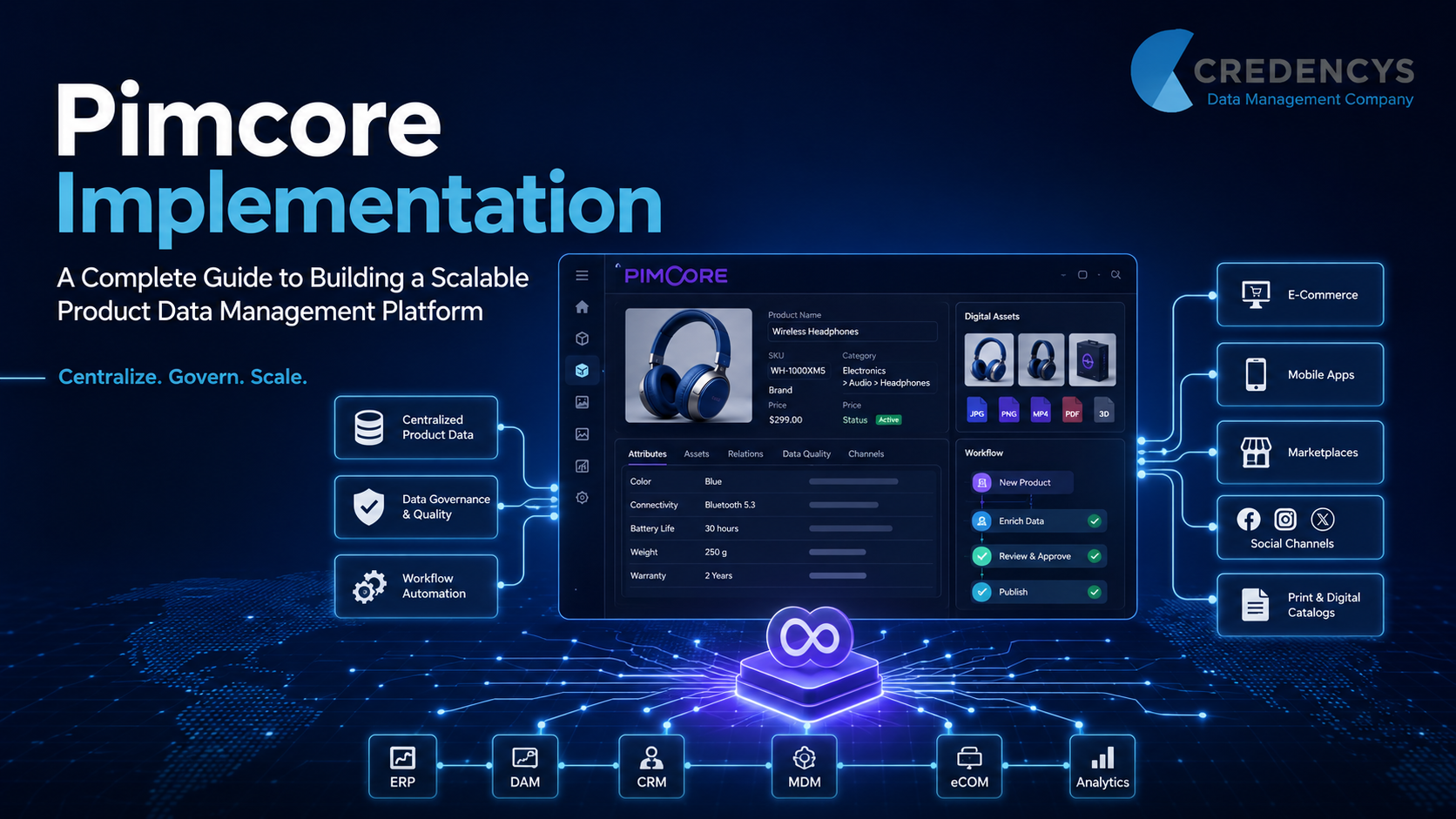
Pimcore Implementation: A Complete Guide to Building a Scalable Product Data Management Platform
Product data is no longer just backend information stored inside ERP systems, spreadsheets, or internal databases. It directly influences how customers discover products, compare options, make purchase decisions, and trust a brand across digital and offline channels.
But as businesses grow, product data becomes increasingly complex. Product attributes sit in ERP systems. Images and videos are stored in DAM folders. Pricing and inventory live in commerce platforms. Marketing descriptions are managed in spreadsheets. Regional teams create their own versions of product content. Suppliers send data in different formats. Marketplaces demand different product feeds.
This is where Pimcore implementation becomes a strategic business initiative.
Pimcore helps businesses centralize product information, master data, digital assets, customer information, and experience management capabilities within one flexible platform. Pimcore positions itself as a Data & Experience Management platform covering PIM, MDM, DAM, CDP, DXP/CMS, Commerce, Product & Digital Asset Experience Portals, and Data Syndication & Delivery.
For companies dealing with growing product catalogs, multiple channels, disconnected systems, and inconsistent product experiences, Pimcore implementation creates the foundation for scalable, governed, and omnichannel-ready product dadta management.
Building a Centralized Product Data Ecosystem with Pimcore
Pimcore implementation is the process of planning, configuring, customizing, integrating, migrating, and deploying Pimcore to manage enterprise product data and related digital experiences from a centralized platform.
A successful implementation does not simply install a PIM system. It creates a connected product data ecosystem where product information, digital assets, workflows, business rules, user roles, integrations, and channel-specific content work together.
Depending on the business requirement, Pimcore can be implemented for:
- Product Information Management
- Master Data Management
- Digital Asset Management
- Product Experience Management
- eCommerce data management
- Marketplace and channel syndication
- Product and digital asset portals
- Digital experience management
- Data quality and governance
- Workflow automation
Pimcore’s PIM page describes its product information management capability around consolidating and optimizing marketing, sales, and technical product information to support integration, efficiency, and actionable insights.
In practical terms, a Pimcore implementation helps answer questions like:
- Where should product data be mastered?
- How should product attributes, variants, categories, and relationships be structured?
- Which systems will send data to Pimcore?
- Which channels will receive data from Pimcore?
- What approval workflows are needed before publishing?
- How will product images, videos, manuals, and documents be linked to product records?
- How will data quality, completeness, and consistency be measured?
- How will business users enrich product data without depending on IT for every change?
The goal is to create a scalable product data foundation that supports the business today and can evolve as new products, markets, brands, channels, and customer experiences are added.
Why Growing Businesses Outgrow Disconnected Product Data Systems
Many businesses start with a simple setup. Product data may be managed in ERP, Excel sheets, shared drives, eCommerce platforms, supplier files, and internal databases. This works when the product catalog is small and the number of channels is limited.
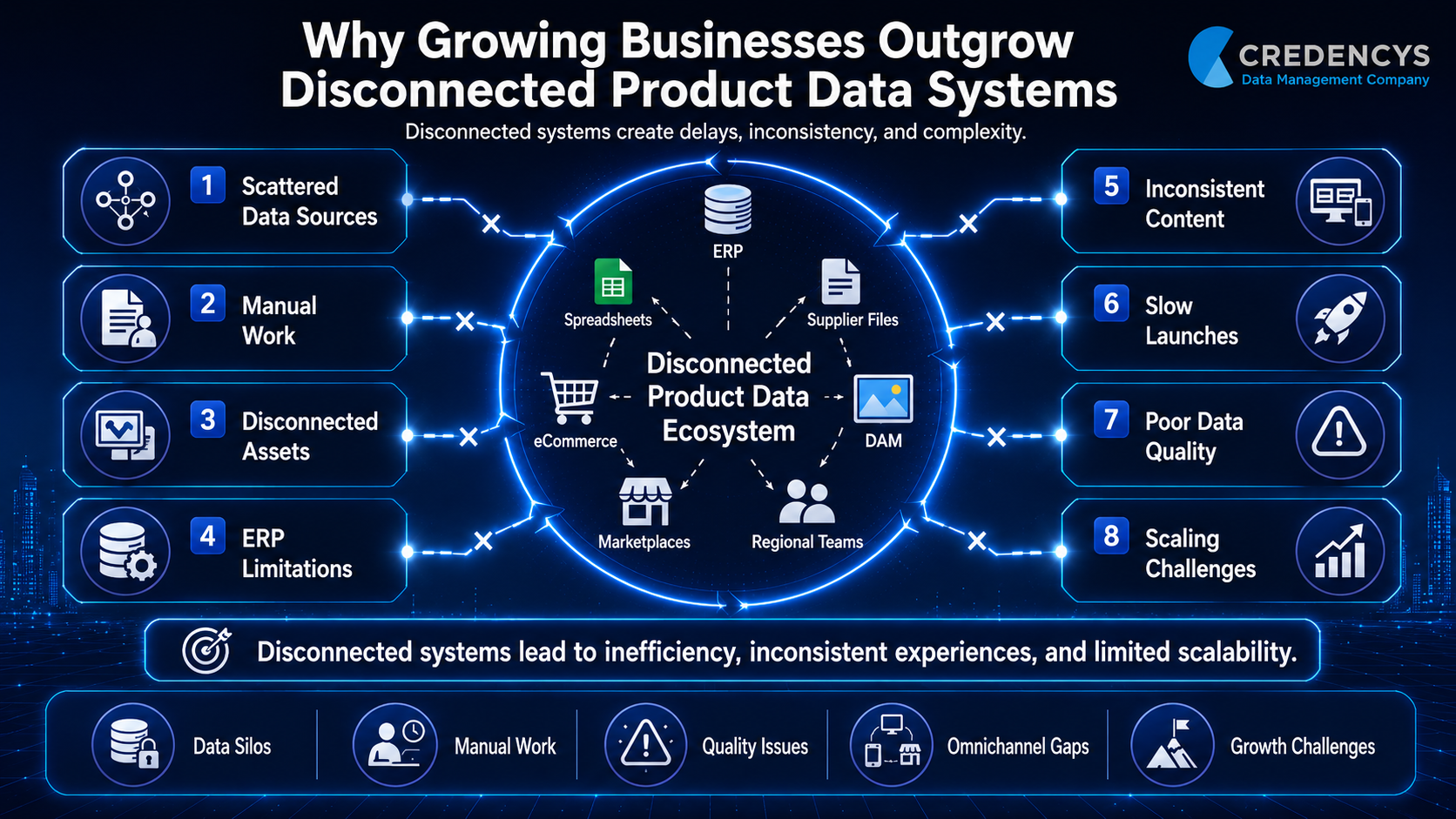
But as the business scales, disconnected product data starts creating operational and customer experience problems.
Product teams struggle to maintain consistent attributes. Marketing teams rewrite descriptions manually. eCommerce teams wait for updated product images. Sales teams use outdated product sheets. Regional teams modify content independently. IT teams spend time fixing repetitive data issues. Customers see incomplete or inconsistent product information across different touchpoints.
Over time, this results in:
- Slow product launches
- Inconsistent product content across channels
- Duplicate and incomplete product records
- Manual enrichment and approval delays
- Poor digital asset management
- Higher chances of product content errors
- Reduced customer trust
- Difficulty expanding into new marketplaces
- Limited visibility into product data quality
ERP systems are excellent for managing transactions such as inventory, pricing, procurement, orders, and finance. However, they are not designed to manage rich product experiences across websites, marketplaces, catalogs, mobile apps, print, distributor portals, and sales channels.
A dedicated Pimcore implementation helps bridge this gap by creating a single source of truth for product information and enabling governed distribution across multiple channels.
Pimcore highlights that PIM can improve time-to-market, data quality, and omnichannel delivery by centralizing product information, enforcing rules and validations, automating approvals, and supporting faster channel connections.
Key Goals of a Successful Pimcore Implementation
A Pimcore implementation should be planned around business outcomes, not just technical deployment. The goal is to create a product data management platform that improves speed, quality, consistency, and scalability.
1. Create a Single Source of Truth
The first goal is to centralize product data in one trusted system. This includes product names, descriptions, specifications, technical attributes, categories, variants, relationships, pricing-related information, compliance data, and channel-specific content.
When Pimcore becomes the central product data hub, teams no longer need to depend on multiple spreadsheets, disconnected tools, or duplicate records.
2. Improve Product Data Quality
Data quality is one of the most important success factors in any PIM implementation. Pimcore supports data quality management through validations, mandatory fields, completeness checks, dashboards, workflows, and automated enforcement.
This helps teams identify missing values, incorrect attributes, duplicate records, incomplete descriptions, and content gaps before product information is published.
3. Connect Product Data with Digital Assets
Product experience is not limited to text and attributes. It also includes product images, videos, manuals, certificates, installation guides, safety documents, lifestyle images, packaging files, and other digital assets.
With Pimcore, product data and digital assets can be connected in one ecosystem, helping teams deliver richer and more consistent product experiences.
4. Automate Workflows and Approvals
A scalable Pimcore implementation defines clear workflows for data creation, enrichment, review, approval, translation, compliance validation, and publishing.
Pimcore includes workflow and business process management capabilities that help centralize and streamline data and experience management, including automation and integration with tools such as Teams and Slack.
5. Enable Omnichannel Publishing
Modern businesses need to distribute product data across websites, eCommerce platforms, marketplaces, mobile apps, print catalogs, distributor portals, and internal systems.
Pimcore supports data distribution across channels and systems using flexible integration options and automated workflows.
6. Build a Scalable Product Data Foundation
A well-planned implementation prepares the business for future growth. New brands, SKUs, regions, suppliers, channels, languages, and data requirements can be added without rebuilding the entire system.
Step-by-Step Pimcore Implementation Process
Every Pimcore implementation should follow a structured approach. The exact process may vary depending on the business model, industry, product complexity, and existing technology stack, but the following steps form the foundation of a successful implementation.
1. Business Requirement Discovery
The implementation starts with understanding the business goals. This includes identifying why the organization needs Pimcore, what problems it wants to solve, and which outcomes matter most.
Key areas to assess include:
- Current product data challenges
- Product catalog size and complexity
- Existing systems and data sources
- User roles and team responsibilities
- Current workflows and approval processes
- Channel and marketplace requirements
- Localization and regional content needs
- Compliance and governance requirements
- Reporting and data quality expectations
This stage ensures the implementation is aligned with business priorities rather than being treated as a purely technical project.
2. Product Data Audit
Before moving data into Pimcore, businesses need to understand the current state of their product data.
A product data audit helps identify:
- Duplicate product records
- Missing attributes
- Inconsistent naming conventions
- Poor category structures
- Incomplete product descriptions
- Unmapped digital assets
- Incorrect product relationships
- Outdated supplier data
- Unstructured spreadsheets
- Channel-specific data gaps
This step is critical because migrating poor-quality data into a new platform only transfers the same problems into a new system.
3. Data Model Design
The data model is the backbone of Pimcore implementation. It defines how product information will be structured, stored, enriched, and distributed.
A strong Pimcore data model includes:
- Product hierarchy
- Categories and subcategories
- Product families
- Attributes and attribute groups
- Variants and configurable products
- Product relationships
- Digital asset links
- Localization fields
- Channel-specific fields
- Supplier data structures
- Compliance and technical specifications
Pimcore supports advanced data modeling with customizable data components, no-code model creation, and the ability to manage complex relationships across structured, unstructured, and binary assets.
This flexibility is especially useful for industries such as retail, CPG, manufacturing, automotive, grocery, and distribution, where product data models can be highly complex.
4. Workflow and Governance Setup
Once the data model is defined, the next step is to establish workflows and governance rules.
This includes defining:
- Who can create product records
- Who can edit specific attributes
- Who approves product content
- Which fields are mandatory
- What happens when data is incomplete
- How translations are reviewed
- How digital assets are approved
- How product data moves from draft to published status
Clear governance reduces manual errors and ensures accountability across teams.
5. Pimcore Configuration and Customization
Pimcore needs to be configured based on the organization’s data model, workflows, user roles, integrations, and channel requirements.
Configuration and customization may include:
- Custom object classes
- Attribute groups
- Dashboards
- User permissions
- Data validation rules
- Workflow states
- Business rules
- Import and export templates
- Channel-specific views
- Custom modules
- Approval flows
The goal is to make Pimcore fit the way the business manages product data, while also improving processes that are currently manual, fragmented, or inefficient.
6. System Integration
Pimcore rarely works in isolation. It usually connects with several enterprise systems.
Common Pimcore integrations include:
- ERP systems
- CRM platforms
- eCommerce platforms
- Marketplaces
- Supplier portals
- DAM systems
- Data warehouses
- BI and analytics tools
- Translation systems
- Print catalog tools
- Internal applications
Pimcore PIM supports integration with ERP and commerce systems using REST APIs, GraphQL APIs, Data Hub, ETL mappings, and webhooks for bidirectional data exchange.
This allows product data to be imported, transformed, enriched, validated, and distributed across channels.
7. Data Migration
Data migration is one of the most important phases of Pimcore implementation.
It includes:
- Extracting data from source systems
- Cleaning duplicate and incomplete records
- Mapping old fields to the new Pimcore data model
- Normalizing product attributes
- Connecting digital assets to product records
- Validating mandatory fields
- Running test migrations
- Reviewing sample data with business users
- Migrating final data into Pimcore
The success of migration depends heavily on data preparation. Businesses should avoid a “lift and shift” approach where old, inconsistent data is moved without proper cleansing and structure.
8. Testing and Quality Validation
Before go-live, the implementation should be tested thoroughly.
Testing should cover:
- Data accuracy
- Workflow performance
- User permissions
- Product search and filtering
- Data imports and exports
- ERP and eCommerce integrations
- Marketplace feeds
- Digital asset mapping
- Publishing rules
- Performance under expected data volumes
Business users should be involved in testing because they understand real product data scenarios better than technical teams alone.
9. User Training and Change Management
A Pimcore implementation succeeds only when teams know how to use it effectively.
Training should be provided for:
- Product managers
- Data stewards
- Marketing teams
- eCommerce teams
- Merchandising teams
- IT teams
- Regional teams
- Supplier management teams
Training should cover day-to-day usage, workflows, data ownership, validation rules, content enrichment, asset management, and publishing processes.
Change management is equally important. Teams need to understand why the organization is moving to Pimcore, how their roles will change, and how the platform will make product data management easier.
10. Go-Live and Continuous Optimization
Once testing and training are complete, the Pimcore implementation can go live.
However, go-live is not the end of the journey. Product data requirements keep evolving as businesses add new products, channels, markets, brands, and customer experiences.
Continuous optimization may include:
- Adding new workflows
- Improving data quality rules
- Expanding integrations
- Optimizing performance
- Adding new channels
- Improving dashboards
- Enhancing automation
- Extending Pimcore to support more business units
The most successful Pimcore implementations are treated as long-term product data transformation programs, not one-time software projects.
Common Pimcore Implementation Challenges
Pimcore is a flexible and powerful platform, but implementation success depends on planning, governance, and execution. Businesses should be aware of common challenges before starting.
1. Poorly Defined Data Model
If the data model is not designed properly, teams may struggle with incomplete structures, duplicate fields, rigid taxonomies, or difficult product enrichment workflows.
2. Low-Quality Source Data
Incomplete, duplicate, or inconsistent data can slow down migration and reduce trust in the new system.
3. Lack of Data Governance
Without clear ownership, approval rules, and validation processes, product data issues can continue even after implementing Pimcore.
4. Complex Integrations
ERP, eCommerce, marketplace, and supplier integrations need careful planning. Poor integration design can create synchronization errors, delays, and data inconsistencies.
5. User Adoption Issues
If business users are not trained properly, they may continue using spreadsheets and manual processes outside Pimcore.
6. Over-Customization
Customizing every process too heavily can increase complexity and make future upgrades or changes difficult.
7. No Long-Term Roadmap
A Pimcore implementation should support future growth. Without a roadmap, businesses may solve today’s problems but struggle when they add new channels, products, or regions.
Pimcore Implementation Best Practices
To get maximum value from Pimcore, businesses should follow these best practices.
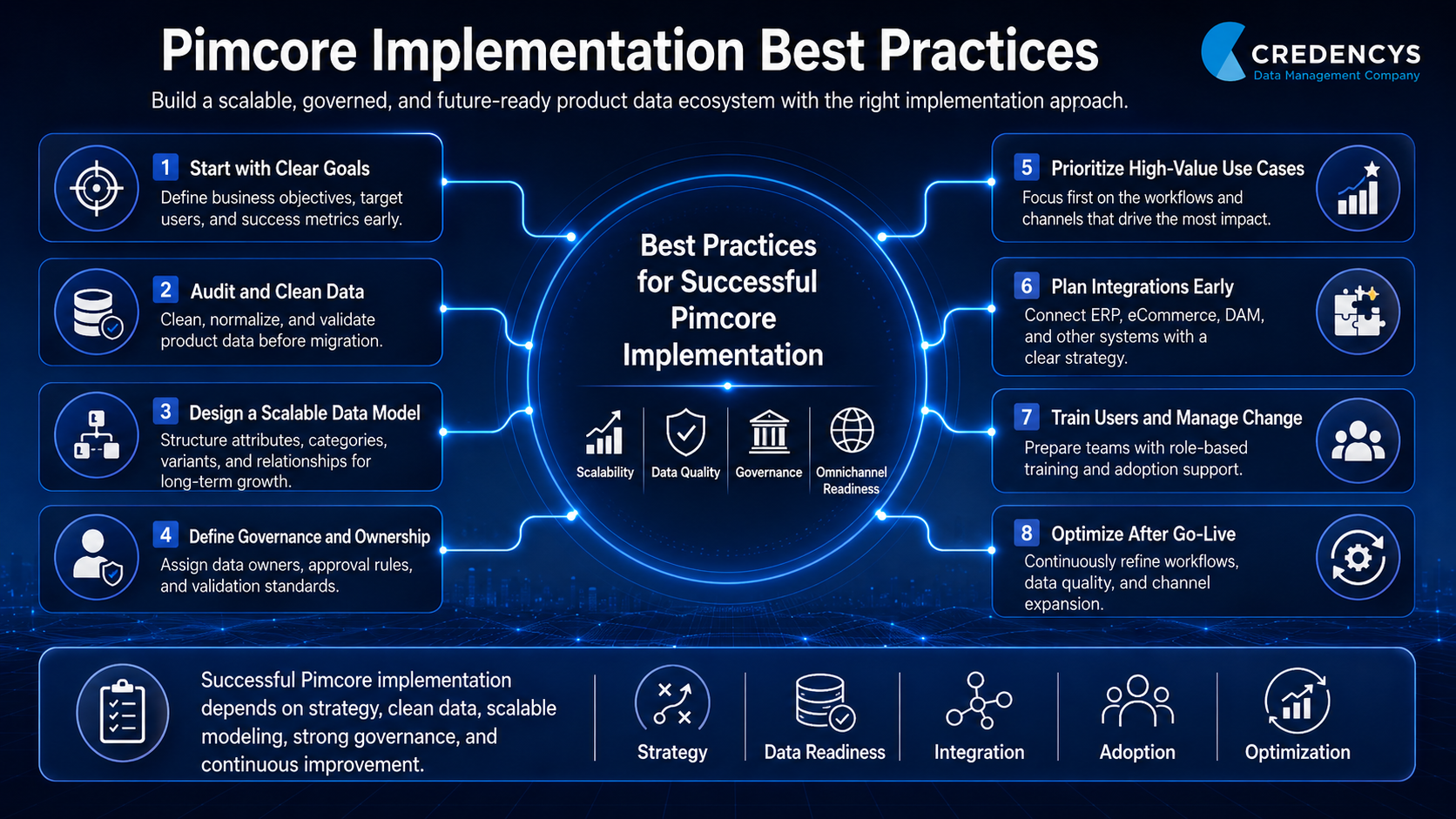
1. Start with a Product Data Strategy
Before implementation begins, define what product data means for your business. Identify key use cases, business goals, data owners, channels, and success metrics.
2. Clean Data Before Migration
Do not move messy data into Pimcore. Clean, normalize, deduplicate, and validate data before migration.
3. Design for Scalability
Build a flexible data model that can support future product categories, variants, languages, markets, and channels.
4. Prioritize High-Impact Use Cases
Instead of implementing every feature at once, start with the use cases that deliver the highest business value. For example, centralizing product data, improving data completeness, or automating eCommerce publishing.
5. Define Clear Ownership
Every important data field should have an owner. Clear ownership improves accountability and reduces confusion.
6. Automate Repetitive Processes
Use workflows, validations, and integrations to reduce manual work and improve consistency.
7. Involve Business Users Early
Pimcore is used by business teams, not just IT. Involve product, marketing, eCommerce, merchandising, and regional teams during discovery, testing, and training.
8. Choose the Right Implementation Partner
An experienced Pimcore implementation partner can help avoid common mistakes, accelerate deployment, and design the platform around long-term business goals.
Why Choose Credencys for Pimcore Implementation?
Choosing the right Pimcore implementation partner is critical because the success of your platform depends on data modeling, integration planning, migration quality, workflow design, customization, and long-term scalability.
Credencys is a Strategic Partner of Pimcore and helps brands deploy tailored Pimcore solutions to manage data and digital experiences from a single platform.
Credencys brings deep expertise across:
- Pimcore consulting
- Pimcore implementation
- PIM and MDM implementation
- DAM and digital asset management
- Data modeling and governance
- ERP, CRM, eCommerce, and marketplace integrations
- Product data migration
- Workflow automation
- Data quality management
- Omnichannel data delivery
- Support and optimization
Credencys also highlights its team of 120+ certified Pimcore experts and its ability to help businesses unlock efficiency, growth, and digital leadership through Pimcore.
For retail businesses, Credencys offers RetailOne, a Pimcore-powered retail PIM accelerator that includes pre-built data models, stakeholder groups, integration templates, reference architecture, workflows, governance, supplier portal capabilities, AI/ML capabilities, and centralized digital asset management.
With experience across retail, CPG, grocery, automotive, manufacturing, and distribution, Credencys helps enterprises implement Pimcore in a way that supports business-specific product data complexity and future growth.
Final Thoughts
Pimcore implementation is more than a technology project. It is a strategic step toward building a scalable, centralized, and governed product data management platform.
For businesses struggling with scattered product information, disconnected digital assets, inconsistent channel content, manual workflows, and slow product launches, Pimcore provides the foundation to unify data and deliver consistent product experiences across every customer touchpoint.
A successful implementation starts with the right strategy, clean data, scalable data modeling, strong governance, seamless integrations, and user adoption. With the right implementation approach and the right partner, Pimcore can become the backbone of your product data and digital experience ecosystem.




Tags: