


Top Use Cases of Snowflake Data Warehouse Across Industries
Every industry leader wants to become data driven. Yet most enterprises still struggle to turn raw data into decisions before the window of opportunity closes. Data promised clarity. Instead, it left many businesses drowning. What these leaders require is efficient data warehouse solutions.
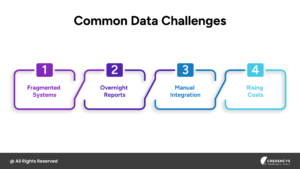
The more data businesses collect, the less control they seem to have. Until Snowflake rewrote what a data platform could do. Its cloud-native architecture unlocked on-demand performance, unified governance, and real-time insights.
Many organizations rely on expert Snowflake consulting services in order to speed adoption & optimization. With the right partner, businesses modernize their data foundation faster and achieve Snowflake ROI more effectively.
Let’s explore data management and data warehouse capabilities of Snowflake for three key industries.
Data-Driven Manufacturing with Snowflake Data Warehouse
Production lines generate more data in an hour than many organizations once stored in a month. However, manufacturers still struggle to connect insights across plants, machines, and suppliers. Siloed systems delay decisions; quality issues surface only after defects; and maintenance is reactive instead of predictive.
These pain points represent opportunity to transform operations with live, governed, and scalable data. This is why modern manufacturers turn to Snowflake. It offers the ability to unify sensor, ERP, and supply chain data into a single, analytics-ready platform. Moreover, it also helps strengthen end-to-end data management. Manufacturers can amplify their data warehouse efficiency. This helps drive measurable performance gains.
Why implementing data warehouse with Snowflake works for manufacturing
- Integrates data models that bring operational, financial as well as quality data together
- AI-ready architecture for predictive maintenance & anomaly detection
- Secures collaboration across partners & suppliers
Case Study: A leading US manufacturer accelerates new product rollouts with Golden Product Records in Snowflake
A mid-sized US manufacturer struggled with inconsistent data management. This impacted their forecasting accuracy and supply chain operations. We implemented Semarchy xDM directly on the Snowflake data platform. This enabled the client to match, cleanse, and merge product and supplier data into a trusted “Golden Product Record.”
Snowflake use cases for the manufacturing industry
| Use case | How it works | How Snowflake helps |
|---|---|---|
| Predictive maintenance | Predict machine failure before breakdown to avoid downtime. | Stores massive sensor/IoT datasets, supports ML-based anomaly detection at scale. |
| Product quality monitoring | Flag defects early and reduce scrap/waste. | Processes semi-structured machine logs as well as applies analytics across plants instantly. |
| Supplier collaboration | Real-time data sharing between OEMs and suppliers. | Secure, governed data sharing eliminates manual integration and accelerates coordination. |
| Supply chain visibility | Track components and material flow across partners. | Centralized lineage, auditability for compliant traceability. |
| Product planning and capacity optimization | Balance workloads and improve throughput. | Real-time analytics on machine, labor, as well as supply capacity signals. |

End-to-end data warehouse solutions with Snowflake
We help you design, build, and scale a high-performing data foundation on Snowflake.
Customer Experience Management for Retailers with Snowflake Data Warehouse
Retailers deal with torrents of data. Their data sources include POS transactions, customer interactions, supply metrics, and online behavior. These must be analyzed quickly to stay competitive.
Snowflake’s cloud-native architecture integrates disparate retail data into a single analytics-ready platform. Moreover, it unifies data from disparate sources into a single analytics-ready platform. Additionally, the platform helps companies with efficient data management. Retailers can significantly amplify Snowflake data warehouse performance and power decisions that reflect real-time demand signals. They can turn omnichannel visibility into measurable revenue and customer experience gains.
Why implementing data warehouse with Snowflake works for retail
- Real-time customer 360 views across channels
- Demand forecasting that integrates web, mobile, and in-store datasets
- Automated reporting for merchandising and inventory teams
Snowflake use cases for the retail industry
| Use case | How it works | How Snowflake helps |
|---|---|---|
| Demand forecasting | Predict product demand to optimize inventory and pricing. | Ingests massive SKU, seasonal as well as transactional data for live forecasting. |
| Customer 360 and personalization | Personalize offers, promotions based on unified behavior. | Combines loyalty, POS, app or web data for segment-level insights. |
| Supply chain and logistics visibility | Track goods and detect disruptions across the network. | Integrates warehouse and supplier feeds in near real-time dashboards. |
| Product assortment optimization | Identify profitable SKUs to optimize stock at store level. | Runs analytical workloads and ML models across historical and current data. |
| Omnichannel performance analytics | Analyze customer journeys across online/in-store touchpoints. | Unifies omnichannel data streams for attribution as well as journey mapping. |
Modernizing FMCG Data Pipelines with Snowflake Data Warehouse
FMCG brands operate in one of the fastest-moving sectors. Consumer preferences shift overnight, retail shelves change weekly, and margins depend on forecasting demand accurately. However, many companies still suffer from fragmented and delayed data pipelines. This leads to unnoticed stockouts, overproduction, and poor promotional ROI.
Modern FMCG leaders choose Snowflake consulting services to integrate distributor, POS, loyalty, & demand data into a scalable, governed analytics platform. Snowflake amplifies the performance of existing data warehouses and enables proactive forecasting. Additionaly, it also helps businesses with promotion optimization and supply chain responsiveness.
Why Snowflake works for FMCG
- Enables rapid response to shifting demand signals.
- Powers AI-driven promotion and assortment optimization.
- Simplifies integration beyond legacy data pipelines.
Snowflake use cases for the FMCG industry
| Use case | How it works | How Snowflake helps |
|---|---|---|
| Demand forecasting | Predict demand fluctuations driven by promotions, seasons, and external factors. | Integrates POS, distributor, retailer as well as market signals to power real-time forecasting models. |
| SKU and product lifecycle optimization | Manage product mix, launches, and discontinuations profitably. | Centralizes sales, promotion, and production data to evaluate SKU performance across channels. |
| Supply chain visibility | Gain real-time insight into stock, shipments, and distributor flows. | Securely shares governed datasets across partners to track volumes, delays and shortages. |
| Trade promotion analytics | Measure ROI and effectiveness of retail and distributor promotions. | Unifies pricing, promotional, as well as sales uplift data for performance dashboards with predictive analytics. |
| Consumer insights | Understand shopper behavior across markets and channels at scale. | Combines loyalty, retailer data feeds, market research, digital touchpoints for segmentation and targeting. |
Snowflake Data Warehouse for insights-driven growth
For too long, enterprises have been dealing with voluminous data but mining only the surface. Snowflake allows industries to finally utilize their data efficiently. It helps turn scattered datasets into insights that drive deliberate action.
The companies that adopt Snowflake achieve data excellence with value-driven analytics. With the right Snowflake consulting company, business leaders can turn growing data challenges into catalysts for sustainable growth.
Snowflake Consulting Services
Achieve data-driven transformation and build a future-ready data platform with Snowflake.





Tags: