Nearly three out of four retailers have already piloted or partially adopted AI for operational tasks, and those early adopters are seeing measurable benefits: predictive analytics can cut stockouts by about 35% and reduce excess inventory by roughly 28%, directly protecting revenue and margins.
Retail demand forecasting used to be a seasonal spreadsheet exercise. Today it’s a continuously learning system that ingests point-of-sale data, promotions, weather, local events, and online signals, then turns those inputs into fast, location-level decisions about what to stock, when to replenish, and where to move inventory. The difference for retailers is clear:
- Better forecasts mean fewer lost sales
- Lower carrying costs
- Freed-up working capital that can be re-invested in growth
This blog explores how AI is reshaping demand forecasting in retail, driving smarter decisions, better inventory planning, and ultimately higher profits.
Why You Need Retail Demand Forecasting
Most conventional models depend on limited datasets and linear projections. As a result, they struggle with:
- Over-reliance on historical averages without contextual signals
- Inability to factor in external variables like promotions, holidays, or weather
- Manual adjustments that introduce bias and inconsistency
- Slow recalibration cycles, often monthly or quarterly
- Lack of real-time visibility across omnichannel inventory
The consequences are expensive.
- Excess inventory ties up working capital and increases markdown risk
- Stockouts result in lost sales and damaged brand trust
- Poor replenishment planning increases operational inefficiencies
- Margin erosion becomes a recurring problem
Retail leaders often believe their forecasting problem is a data issue. In reality, it is an intelligence issue. The data exists. What is missing is the ability to interpret it dynamically and at scale.
Instead of reacting to past performance, AI-driven Retail Demand Forecasting systems continuously learn from patterns, detect anomalies early, and adjust predictions in near real time.
How AI is Redefining Retail Demand Forecasting
Artificial intelligence does not simply automate existing forecasting processes. It fundamentally changes how predictions are generated, refined, and acted upon.
Unlike traditional models that depend on static formulas, AI-powered Retail Demand Forecasting systems continuously analyze massive volumes of structured and unstructured data. They detect hidden patterns, correlations, and demand drivers that human-led models often overlook.
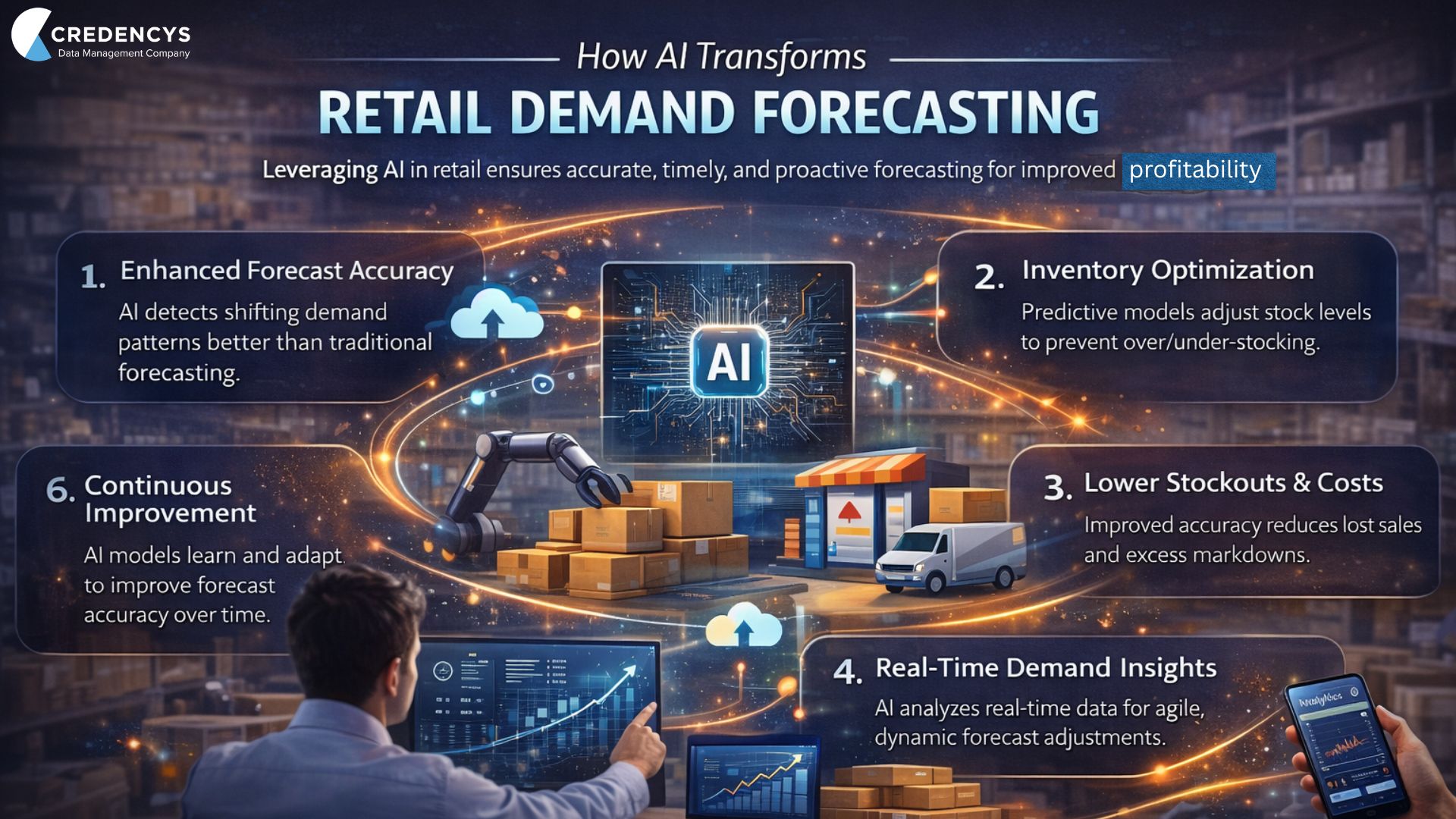
At its core, AI introduces three transformative capabilities: learning, adaptation, and contextual awareness.
1. Learning from Complex Data Patterns
Modern retail ecosystems generate data from multiple sources:
- POS transactions
- E-commerce browsing behavior
- Loyalty programs
- Promotions and discount campaigns
- Weather data
- Social sentiment and trend signals
- Supply chain movement data
AI models process these variables simultaneously, identifying relationships that would be impossible to detect manually. For example, a spike in umbrella sales may correlate not only with rainfall but also with regional search trends and weekend footfall.
This multi-variable analysis dramatically improves forecast accuracy.
2. Real-Time Adaptation
Retail demand is rarely static. Promotions, competitor pricing shifts, and viral trends can change buying behavior overnight.
AI models continuously retrain using fresh data, enabling:
- Dynamic demand recalibration
- Faster response to sudden demand spikes
- Early detection of anomalies
- Real-time inventory adjustments
Instead of waiting for the next monthly planning cycle, retailers can respond instantly.
3. Predictive and Prescriptive Insights
AI does not just predict demand. It recommends actions.
Advanced Retail Demand Forecasting systems can:
- Suggest optimal replenishment quantities
- Identify SKUs at risk of stockout
- Flag overstock situations before markdown pressure builds
- Recommend pricing adjustments based on demand elasticity
This shift from descriptive reporting to predictive and prescriptive intelligence is what directly drives higher profitability.
The Direct Impact of AI on Retail Profitability
Improving forecast accuracy is important. Improving profit margins is critical. The real value of AI-powered Retail Demand Forecasting lies in how it translates better predictions into measurable financial outcomes.
When forecasting becomes smarter, the ripple effects are felt across inventory management, supply chain operations, merchandising strategy, and cash flow planning.
1. Reduced Inventory Carrying Costs
Excess inventory quietly erodes margins. It ties up working capital, increases warehousing costs, and often leads to heavy markdowns.
AI improves demand precision by:
- Aligning procurement volumes with actual buying patterns
- Preventing over-ordering of slow-moving SKUs
- Optimizing safety stock levels based on risk probability
- Continuously adjusting forecasts as demand shifts
The result is leaner inventory without compromising availability.
2. Fewer Stockouts, Higher Revenue Retention
Stockouts are not just lost sales. They often push customers to competitors.
With AI-enabled Retail Demand Forecasting, retailers can:
- Identify high-risk SKUs before inventory depletion
- Trigger automated replenishment workflows
- Prioritize distribution across high-demand locations
- Allocate inventory dynamically between online and offline channels
By protecting product availability, retailers protect revenue.
3. Smarter Promotion Planning
Promotions can either drive growth or destroy margins if poorly forecasted.
AI models analyze historical campaign performance, price elasticity, seasonal demand, and customer behavior to:
- Predict promotional lift more accurately
- Avoid underestimating demand during peak events
- Prevent excess stock post-promotion
- Optimize discount depth without sacrificing profitability
This allows retailers to treat promotions as strategic growth levers rather than risky bets.
4. Better Working Capital Optimization
Retail profitability is closely tied to how efficiently capital is deployed.
Improved forecasting supports:
- More accurate procurement planning
- Reduced emergency logistics costs
- Lower markdown exposure
- Improved sell-through rates
When forecasting becomes proactive instead of reactive, financial planning becomes more predictable and resilient.
Case Study: AI-Powered Retail Demand Forecasting for a Leading Retail Group
A leading retail group managing franchise rights for global brands partnered with Credencys to modernize its Retail Demand Forecasting approach. With 175+ stores and a growing eCommerce presence, legacy rule-based models were causing stock imbalances, seasonal inaccuracies, and working capital inefficiencies.
Credencys implemented an AI-driven forecasting solution on Databricks, using machine learning models to analyze historical sales, seasonality, and external demand signals. Forecast outputs were seamlessly integrated into existing ERP and replenishment systems, enabling smarter inventory allocation across stores and online channels.
Business Impact
- 31% improvement in demand forecast accuracy
- 24% increase in inventory turnover
- 22% boost in omni-channel customer satisfaction
What Retailers Need to Successfully Implement AI in Retail Demand Forecasting
AI can dramatically improve Retail Demand Forecasting, but only when supported by the right data, infrastructure, and organizational alignment. Retailers that treat AI as a plug-and-play tool often struggle. Those that build a strong foundation see sustained profitability gains.
1. Unified and High-Quality Data
Accurate forecasting starts with reliable data. Retailers must eliminate silos and create a single, trusted source of truth across channels.
Key focus areas include:
- Consolidating POS, eCommerce, ERP, and inventory data
- Cleaning and standardizing historical sales records
- Integrating promotional, pricing, and seasonal variables
- Ensuring real-time data ingestion pipelines
Without data consistency, forecast accuracy improvements remain limited.
2. Scalable and Modern Data Infrastructure
AI models require computing power and flexibility. Cloud-native environments and lakehouse architectures enable retailers to process large data volumes efficiently and retrain models continuously.
Retailers should prioritize:
- Scalable storage and compute environments
- Automated model retraining workflows
- Real-time analytics capabilities
- Secure data governance frameworks
This ensures forecasts adapt quickly to demand volatility.
3. Cross-Functional Alignment and Operational Integration
Forecasting is not just a supply chain function. It influences merchandising, finance, marketing, and operations.
Successful AI-driven Retail Demand Forecasting requires:
- Embedding forecasts directly into ERP and replenishment systems
- Providing decision-ready dashboards for business teams
- Aligning KPIs across departments
- Establishing accountability for forecast performance
When insights are operationalized, predictions translate into profit impact.
4. Continuous Monitoring and Optimization
Consumer behavior evolves constantly. AI models must evolve with it.
Retailers should:
- Track forecast accuracy metrics regularly
- Identify bias or model drift early
- Refine algorithms based on new data patterns
- Maintain a feedback loop between business users and data teams
Sustainable profitability comes from continuous refinement, not one-time deployment.
The Future of Retail Demand Forecasting: From Prediction to Profit Engine
Retail Demand Forecasting is no longer a back-office planning exercise. With AI at its core, it becomes a strategic growth engine that directly influences revenue, margin, and customer experience.
As retail environments grow more dynamic, AI-powered forecasting shifts organizations from reactive correction to proactive optimization. Instead of responding to stock imbalances after they occur, retailers can anticipate demand shifts, align procurement intelligently, and protect margins before pressure builds.
AI-driven Retail Demand Forecasting enables retailers to:
- Respond instantly to seasonal spikes and market disruptions
- Optimize working capital without compromising availability
- Reduce markdown dependency through smarter inventory planning
- Improve omni-channel customer satisfaction with better product availability
- Turn forecasting insights into measurable financial outcomes
More importantly, it builds resilience. When demand becomes unpredictable, AI provides clarity. When competition intensifies, data-driven precision becomes a differentiator.
Retailers that invest in intelligent forecasting today are not just improving accuracy. They are strengthening profitability, operational agility, and long-term competitiveness.
![Top AI Consulting Companies Powering Business Growth [2026 Edition]](https://www.credencys.com/wp-content/uploads/2026/02/AI-Consulting-Companies-Powering-Business-Growth_thumb-825x510.png)


![Top-Rated Data Analytics Companies in 2026 [Ranked & Reviewed]](https://www.credencys.com/wp-content/uploads/2026/02/Top-Data-Analytics-Companies_thumb-1.jpg)
![Top Data Management Companies 2026 [Complete List]](https://www.credencys.com/wp-content/uploads/2026/02/Top-Data-Analytics-Companies_thumb-2.jpg)

![Top Data Engineering Companies 2026 [Updated List]](https://www.credencys.com/wp-content/uploads/2026/02/Top-Data-Engineering-Companies_thumb.jpg)