Pros & Cons of Hybrid Mobile Apps Development

Mobile apps have been with us from the past 10 years, and since that time, they have significantly changed how we do business.

For instance, hybrid mobile apps development has now become a common approach among businesses today.

Earlier, however, mobile app developers had limited native-specific options. But, due to the growing demand for different mobile apps, hybrid app development technologies such as Ionic,Titanium, and Phonegap have emerged.

In fact, these technologies have shortened the development time and are offering better opportunities for building near-native mobile applications.

In today’s blog, we will discuss the pros and cons of using hybrid technologies for mobile application development.

But, before we get into the subject, we’d like to make one thing clear. In this blog, we’ve compared the pros and cons of Hybrid frameworks with Native mobile application development.

Apart from native and hybrid approach, you can also build mobile apps for iOS and Android platform using Cross-Platform frameworks like Xamarin and React Native.

Though both these cross-platform frameworks are very popular, but our focus in this blog will be to discuss the pros and cons of Hybrid frameworks that are Phonegap, Ionic, and Titanuim.

With that being said, let’s dive right in!

What is Hybrid App Development?

Hybrid mobile apps development is basically a practice of developing a mobile app for multiple platforms such as Android and iOS using a single code base.

As a result, it drastically reduces development costs. On the other hand, however, Hybrid app development does have a few disadvantages.

For example, the rendering time in hybrid approach is usually longer than the native approach as each OS needs a separate code base.

That being said, let’s look at the pros and cons of hybrid mobile apps development individually.

Pros of Hybrid Mobile Apps Development

1 – Lower Development Costs

Compared to native app development approach, the hybrid app development is proved to be 30% cheaper.

With the hybrid approach, the developers need to create only one project for both Android and iOS. However, as the need for customization increases, the cost of maintaining the mobile app on both platform increases as well.

2 – Fast Development

With hybrid app development approach, mobile app developers don’t need to write unique code for each platform.

The hybrid frameworks allow developers to mostly work with a single codebase to handle both iOS and Android app development.

Simply put, hybrid frameworks make it possible to reuse a big chunk of codebase between two platforms, making the development process faster than native.

3 – Greater Market Reach

Businesses often face the same dilemma – For which platform to build a mobile app first, iOS or Android?

No matter how much research you put into finding on which platform the majority of your audience is using, it is always a trade-off when you choose to develop your mobile app for just one platform.

Hybrid approach, therefore, is a better approach if you wish to capture a wide audience in the beginning. hybrid app development allows you to target users from both platforms at the same time.

4 – Support for Cloud & Enterprise-Level Solutions

Hybrid frameworks like Ionic, Titanium, and PhoneGap can be easily integrated on Cloud due to Exchange Integration Code.

These frameworks basically provide easy-to-use plugins that help developers to upgrade app functionality, aesthetics, and validity.

As a result, developers can easily integrate the hybrid apps into popular cloud services like Salesforce and AWS.

Cons of Hybrid Mobile Apps Development

1 – Slow Performance

Performance is one of the most important aspects of mobile apps and it depends on multiple things.

But, if you compare the performance of a native app with a hybrid app, both having the same functionalities, then the performance of the native app will be slightly faster.

Although, the difference in performance is usually a small one, especially if your app is a simple one.

2 – Functionality Limitations

If your mobile app involves complex features and functionalities, then hybrid app development might not be the right approach for you.

This is because few hybrid frameworks like phonegap don’t provide support for every native feature. And as a result, this restriction might impact the stability of your mobile app as a whole and make it sub-optimal.

3 – Long Wait for New Features

Every time Apple and Google releases a new feature for iOS and Android platform, it takes some time for hybrid app developers to add support for the new feature.

This is because the native apps are provided with new SDKs much faster than the cross platform frameworks.

This gives your competitors an advantage over you if they have built their mobile apps using the native approach.

4 – May Lack 3D Support

If you want to design eye-catching graphics or add 3D elements, then hybrid approach may not be right for you as you may face quality issues.

Although you can use third-party tools such as Unity 3D to fill the quality gap, but the overall efforts will be increased compared to the native approach.

Concluding Thoughts…

With all things considered, whether or not should you go with hybrid mobile apps development boils down to one thing. – Type of your mobile app.

Simply put, not every mobile app should be built using hybrid frameworks. But, the hybrid approach is also definitely worth considering, as it drastically decreases the cost and time of mobile app development.

How Mobile Supply Chain Solutions are a Boon for Logistics and Supply Chain Companies?

There was a time when you used to sign a paper whenever you received a delivery. However today, you’re still signing but on a smartphone instead of a paper. This might seem like a small change for you, but in reality, it is a massive shift for logistics companies. This small change saved millions if not billion dollars of supply chain businesses across the world.

Mobile supply chain solutions have helped companies not only to reduce their paperwork significantly but also to optimize various processes in supply chain management. Mobile apps for logistics have brought several benefits to every employee persona, starting from the managers to delivery persons.

9 Benefits of Mobile Supply Chain Solutions

1. Efficient Warehouse Management

One of the most crucial elements of supply chain management is warehouse management. A warehouse is a place where companies store all their inventories before dispatching them to their customers. Mobile supply chain solutions allow companies to store inventory data in the database, which will be divided into various categories based on the product type. Whenever an item, belonging to a particular product type, is checked in or checked out, the database will automatically update its information/details. Since all the inventory data is over the cloud, inventory managers can access it from anywhere at any time. Moreover, this new system will be capable of generating detailed reports, which would help managers to manage warehouses efficiently.

2. Easy Dispatch of Orders

Mobile apps for supply chain management can help you increase the speed of order processing as well as increase revenue by reducing the miles driven by delivery persons. These apps are integrated with a third-party route management software which helps drivers by calculating the optimum route. Here, a mobile app is used to display that optimum route to drivers.

3. Real-time information

Mobile supply chain solutions help drivers to get real-time information and data about various shipments. They can instantly receive information in case of a slowdown or delay, which improves dispatch operations, record keeping, inventory management, inspections, goods tracking, and more. Improvising all these processes will lead to better and optimized operations in your supply chain business.

4. Flexible Delivery Process

In supply chain business flexible delivery process plays a significant role in enhancing the customer experience. After ordering, a customer can ask for an address change or ask the delivery person to leave their product with a neighbor. Mobile apps for logistics can help you manage such actions seamlessly. This increase in control of the supply chain allows businesses to increase customer retention and generate better opportunities for a high level of cooperation between delivery person and customers.

5. Vehicle tracking

Mobile and GPS technologies allow us to track drivers and their vehicles. Mobile supply chain solutions help delivery managers to optimize the transportation process by allowing them to get real-time updates of every vehicle in transit. The GPS-enabled mobile app also helps drivers to learn about each other’s location, which allows them to collaborate in a better way.

6. Monitor Performance

Mobile supply chain solutions help managers to keep a check on performances of various operations and processes. It helps to monitor functions like load planning, transportation optimization, and load management. This enhanced visibility also helps them to increase agility, reduce performance gaps, predict specific problems, and make data-driven business decisions.

7. Go Paperless

Earlier, paper forms and services orders made the process of collecting information chaotic. Issues such as filling up incorrect and incomplete information ended up in unoptimized processes and inefficient order handling. Now, with the help of mobile supply chain solutions drivers, can collect information into a mobile device which gets stored in the databases of the company. Apart from this, mobile forms also help in collecting data of various matrices such as mileage and time taken by a driver to reach a particular destination.

Moreover, the mobile app becomes a one-stop place for receiving all the organizational as well as consumer updates. Replacing paper-based information with digital information saves the time of every employee and allows them to receive instant mobile reports safely and securely. This automation of various processes makes the data accessible to everyone, which increases productivity.

8. Manage Human Resource

Logistics is a business where a lot of human resource management is required because of the massive human workforce. Every new employee joining the company will require proper training to help them understand the business processes. A mobile app can also help them train to work effectively by providing them with an overview of your business and warehouse. These handheld devices can manage employees across various departments. The mobile app also acts as a bulletin board where employees can receive all the organizational updates.

9. Grow Faster with Emerging Technologies

IoT and sensor networks have taken a permanent place in supply chain management. Sensors collect information such as dead batteries, trailer temperatures, etc. which would affect a shipment. Mobile apps process the data coming from sensors, which helps employees to know whether a shipment is ready to be delivered or not. It will help companies to prevent shipping of damaged goods.

Conclusion

There has never been a perfect time for logistics companies to adopt and embrace mobile supply chain solutions. Whether it is a small or global level supply chain business, mobile apps are here to help them optimize processes and increase productivity. Mobile apps for supply chain management helps the firms to avoid disruptions in machines and data delivery, which streamlines the old school supply chain management and optimizes logistics operations.

Top 5 Tips for Improving Performance of a Node.js Application

You might already know about the popularity of JavaScript. It’s the #1 programming language of the web according to the latest Stack Overflow Survey.

But, did you know that the main reason behind JavaScript’s rapid adoption is because of Node.js?

For anyone who doesn’t know, Node.js is a leading JavaScript framework used for building fast and scalable web applications. It is built upon Chrome’s V8 JavaScript engine and is best known for its high performance and developer productivity.

The event-driven architecture and asynchronous I/O of Node.js help greatly in optimizing scalability and throughput during web application development.

However, Node.js does have a few weak points, which if not considered, can make a Node.js application prone to underperformance. This problem mostly arise when a Node.js app experiences rapid traffic growth.

If you’re facing the same problem of underperformance, use the following tips to immediately improve the performance of your Node.js application.

5 Tips to Improve Node.js App Performance

1 – Run Things in Parallel

If your Node.js app often requires multiple internal calls in order to fetch API data, you should consider using different middleware for each of the functions.

Though JavaScript comes with a built-in asynchronous component that doesn’t stop subsequent function calls from executing while it completes. But, if you wish to optimize the current performance, you can use the async.js module, which can help you better manage your asynchronous code.

Here’s an example of how you can run different functions in parallel using the async.js module:

node js

2 – Implement a Node.js Load Balancer

One of the best ways to achieve high performance in Node.js applications is by running multiple application servers as well as balance loads among each other.

Although, executing the Node.js load balancing can sometimes become tricky as Node.js enables data exchange with JSON objects through a high-level of interaction between JavaScript code running on the application servers and JavaScript code running in the web browser.

But, the load balancing implementation becomes easier with Nginx.

Nginx is basically an open-source HTTP server that has an in-built load balancing. The Nginx is also very easy to configure and has lots of features that actually make the configuration process easy.

Using Nginx, you can select particular processes to receive and handle more requests than others, add timeouts, enforce sticky sessions, and a lot more.

3 – Go Asynchronous

Since Node.js is single-threaded, it has lots of synchronous components that may potentially lock up your entire Node.js application.

While you can avoid using synchronous methods in the entire code of your Node.js application, but you might still need to use at least one external library having a blocking call. And this can affect the performance of your application.

So, when choosing an external library or a third-party module, make sure that it doesn’t revert any synchronous calls.

The best way to overcome this situation is to always use asynchronous APIs, especially in performance-critical functions.

4 – Cache Static Files

If your web application is fairly new with just a few dozen users, the performance will stay intact. The problem only starts occurring when the traffic grows.

When this happens, you’ve two choices:

You utilize as much as you can from the Node.js server.
Or, you add application servers and load balance them amongst each other.

Now, we’ve already discussed how implementing a load balancer using Nginx can significantly improve the performance. Implementing Nginx basically makes it easy to not only add load balancing but also caching.

Caching static files on the Nginx server drastically offloads the work from the application server and helps to achieve even higher performance.

5 – Plug Memory Leaks

In Node.js, each process has capacity of 1.5 GB memory heap, regardless of the total memory available. But, the V8 engine in Node.js has a built-in Garbage Collector (GC), which cleans inactive memory automatically in order to make it available to use.

Sometimes, though, the data in the memory expired for a long time escapes the garbage collector and results in a memory leak.

In simple terms, many times the memory usage keeps increasing and the garbage collector fails to clean it. And this needs an urgent fix.

But, tracking the memory leak is tougher than you think. The best way to track memory leaks in a Node.js application is to by taking memory heap snapshots and analyze them to identify objects and classes growing at a steady pace.

In fact, if you fail to diagnose the memory leak, there are high chances of your Node.js application running out of memory and being shut down.

If that occurs, you can always hire Node js developer to help you set up automatic alerts when a memory usage threshold is approaching the defined limit.

Apart from this, you should also consider taking stock of your application’s infrastructure and gather intel on its performance to detect if there are any resources available and ready to be scaled up for optimization.

Conclusion

Node.js application performance management is a challenge that could only be overcome through the ability to diagnose the root cause of the underperformance. But in most cases, the tips mentioned in this blog post can definitely help you improve the performance of your application.

Mobile Apps for Law Firms: How Much Worth is it to Invest?

Mobility is transforming every enterprise and small business. Enabling digital transformation throughout the organization have become a trend among enterprises. It helps them to improve the quality of service to their customers and increase operational productivity by streamlining various processes.

Experts believe that mobile apps for law firms will change their future forever. But how? Will it bring any operational change in the organization? Is it going to change the way lawyers used to operate? How efficient will an attorney get after using a mobile app? Will it help law firms to improve customer experience? Read further to know more.

9 Reasons to Invest in Mobile Apps for Law Firms

Whether it is to optimize internal operations or to engage clients, mobile apps for law firms bring terrific benefits to the businesses of legal services providers. Here’s how.

Internal Operations

1. Simplify Client Appointments and Time Management

Big law firms have to deal with hundreds of clients a day. Every person, including timekeepers, executives, lobbyists, etc. are very particular about managing appointments, time, and solutions for them as well as their clients. They prefer to do these activities on-the-go, which will help them save time.

A mobile app will be a perfect solution to this problem. It will help employees of the law firm to manage time and appointments better. The could have a feature which will automatically update as soon as a client makes an appointment. Once the meeting is set, the app will help attorneys to remind the date and time via push notifications.

The app could also track the time a client spends with an attorney. Since most law firms bill their customers per hour, mobile apps for law firms will support the accounts department by calculating billable hours.

2. Easy Access to the Library and Case Files

Lawyers often refer to old cases and law books. Hence, easy access to these files in digital will help them to increase their productivity. Mobile apps for law firms help lawyers to refer to any of the previous case files or legislation at any time from anywhere. Mobile apps not only help them to access the data on-the-go but also helps them to access it faster because of the search functionality. Using it, lawyers can search a particular document by case number, dates, client names, and keywords. This functionality will save the time of attorneys and the time and money of their clients.

3. Replacing Physical Paperwork with Digital Paperwork

Paperwork is one of the most essential aspects of legal business. Every law firm is dealing with a massive amount of paperwork daily. The reason why they require mobile apps for law firms is that it will help them to organize and manage all the paperwork in digital space. While communicating with clients, lawyers often take notes which help them to understand the case better. Unlike physical records, mobile apps can help them to store such crucial information in one place they provide them accessibility whenever they require.

Despite digitizing most of the paperwork, there will be some processes which will repel digitization and generate physical papers instead. Therefore the app must have the functionality to scan documents and create a PDF. This feature will help attorneys and executives to make multiple copies of a document and save it on the cloud to prevent it from getting misplaced.

4. Effective Employee Communication

Communication in large law firms is done mostly by email or messaging tools such as skype. Having a functionality of billboard in the app will help employees to stay updated on the events happening within the organization.

External Benefits

5. Safer Communication with Clients

A crucial element between the relationship of client and attorney is “confidentiality.” Legal firms are obliged not to share the information about any client and protect their integrity at any cost. Since the communication between clients and attorneys has to be extremely confidential using third-party communication platforms such as Skype or email can be dangerous. However, the messages sent on both the platforms are encrypted end-to-end; it is better to use a custom chat platform to prevent hacking. A built-in chat in the mobile app will solve the problem of secure communication.

6. Mobile Source to Face the Law Lingos

Professional and experienced attorneys are trained to make clients feel comfortable in every meeting/communication. To do that, attorneys need to avoid as many law lingos in the conversation as possible. However, a fresher might not be able to do the same as the experienced one. Mobile apps can help clients to understand various lingos instantly. The app will consist of a ‘law dictionary,’ which will help them understand every law lingo on-the-go without needing an Internet connection.

7. Boost Productivity On-the-go with E-signatures

One of the contributions that attorneys demand from clients is to sign various documents on-time. Sometimes clients need to remain present at a specified location to sign the documents. On the other hand, some document signing will not require the physical presence of the client. In that case, mobile apps for law firms can speed up the process of signing and authentication.

8. Increase Customer Loyalty

Mobile apps for law firms help them to deliver excellent customers service and hence, increase their loyalty. The app can help you provide excellent service by providing them customized feature based on their requirement. Features such as automatic appointment scheduling, communication with chatbots, etc. can significantly boost customer experience.

9. Generate Referrals or Reviews

Online referrals are a great way to increase business. An app can help you do that effortlessly. All you need to do is market the referral program to your potential customers and let them know the perks of it. Mobile apps also offer a great way to collect reviews from past clients. You can feature a form open for all where any customer can provide reviews. Another way to collect reviews is by sending push notifications to the clients as soon as their service ends. This way, you’ll be able to collect more reviews and hence more reputation in the market.

Conclusion

The primary reason for the existence of mobile apps for law firms is to challenge the status quo by modernizing the daily operations of a law firm and enhance the client experience. As seen above, mobile apps can become a significant driver to increase the productivity of employees on allowing them to stay a bit more organized by tracking documents, appointments, and billable hours on-the-go. A mobile app will help you solve concerns of a client faster as they increase communication efficiency.

If you are looking to develop an application which has all the above features then hire our mobile and web developers now. To learn more about how else can you increase your productivity through a mobile app, contact our experts.

Angular 8 Features – What’s New & What has Changed?

Angular 8 is finally released! And with it came a variety of new features and upgrade.

Talking about the release, the original launch date was planned for March or April, but the launch didn’t happen until the month of May.

But now that Angular 8 has now been launched, it’s time to learn what has changed and what are the new Angular 8 features.

With that being said, let’s dive right in!

New Angular 8 Features!

Our Angular development team has thoroughly analyzed the new Angular 8 from inside out and here’s what they’ve found.

CTA – Do you want to upgrade your Angular Application? – Let’s Talk!

1 – Angular Ivy

For over a year, the Angular Team has been telling about their new Ivy renderer, so it is obviously the major part of the Angular 8 update.

Ivy renderer is basically the new compiler of Angular framework. Though our Angular developers were really hoping for the final release of the new compiler, but unfortunately the Ivy renderer is only available as an opt-in preview in Angular 8 update.

Compared with the current Angular compiler, Ivy renderer will offer the following benefits:

  • Template type checking will be improved, which will allow catching more errors at build time
  • Payload time will be decreased, which will help browser download and parse applications faster
  • Rebuild times will also get faster

The best part is, Angular team has planned to make Ivy renderer compatible with existing Angular applications, meaning you won’t have to make major changes once it is finally released.

2 – Router

  • Location

A bunch of new stuff has been added to the location services in the new Angular 8 update.

Platformlocation, for example, provides access to the protocol, port, and hostname.

There is also a new getstate() method, which will help developers get the history.state.

All of these updates are really useful if you’re using ngUpgrade.

  • Lazy Loading with Import() Sytax

The Angular 8 update includes a new way to declare lazy-loading routes using the TypeScript syntax – import().

In the latest Angular version, this will be the preferred way of declaring a lazy-loading route and the Ivy renderer will only support this.

Here’s how you can change the lazy-loading route for Angular 8 for example:

Old way:

loadChildren: ‘.admin/admin.module#AdminTestModule’

New Way:

loadChildren: () => import(‘./races/races.module’).then(m => m.RacesModule)

As you can see, the schematic offered by CLI automatically migrates your declarations, making it easier to run ng update @angular.cli.

3 – Forms

  • FormArray.clear

The FormArray in the new Angular 8 now offers a clear method so that it becomes quicker to remove all the control it contains.

In earlier version of Angular, developers had loop over these controls and remove them one by one.

// `customers` is initialized with 2 customers
const customers = fb.array([customer1, customer2]);
customers.clear();
// customers is now empty

  • markAllAs Touched

The AbstractControl class in Angular now has a new method – markAllAsTouched, in addition to the existing markAsTouched, markAsPending, and markAsDirty methods.

As the name suggests, the markAllAs Touched method will mark an AbstractControl as touched and also its descendants.

AbstractControl is basically the parent class of FormControl, FormArray, and FormGroup, making the method available on all of the reactive form entities.

Here’s the syntax to use this new method:

form.markAllAsTouched();

3 – Support for TypeScript

Angular is finally going to include updates to the latest version of Angular’s dependencies, which are mainly TypeScript and RxJS.

In fact, it is now mandatory to upgrade to TypeScript 3.4 in the Angular 8 update.

Though it may look like just a small improvement, but if you look at the positive side then this update is extremely good since the TypeScript team always introduces new features in their every new release.

4 – Service Worker

  • Registration Strategy

The service worker registration in the Angular 8 update now has a new option to specify when the registration should take place. Earlier, the service worker had to wait for the app to be stable in order to avoid slowing the start of the application.

For example, if you had run a recurring asynchronous task in the previous version of Angular, the service worker would never get registered as Angular would consider application to be not stable due to the recurring task.

With Angular 8, however, you can use the new registrationStrategy option to handle the registration of the service worker.

For instance, suppose you want to register the service worker after 5 seconds. Here’s how you would do it in Angular 8.

providers: [
ServiceWorkerModule.register(‘/ngsw-worker.js’, {
enabled: environment.production,
registrationStrategy: ‘registerDelay:5000’
}),
// …
]

  • Bypass a Service Worker

In the new Angular 8 update, you can now also bypass the service worker for a particular request using the new ngsw-bypass header.

this.http.get(‘api/users’, { headers: { ‘ngsw-bypass’: true } });

  • Multiple Apps on Sub-Domains

In the earlier version of Angular, developers had no option to have multiple apps use @angular/service-worker on different sub-domains because that would cause the service worker to overwrite the caches of other sub-domains.

Now in Angular 8, this glitch has been fixed.

5 – Support for Bazel

Bazel in Angular 8 is an opt-in option for now, but it is expected to be included in the Angular CLI in version 9.

Bazel basically offers fast build time, which means you can build your application through an incremental build and deploy the last changes only.

6 – No More @angular/http

The Angular 8 will no longer support @angular/http. So, if you have an existing Angular application built using the previous version, then you need to make appropriate adjustments to the code and replace @angular/http with @angular/common/http.

7 – Builders API

The Angular 8 update has now added support to use Builders API, also referred as Architect API.

Builder is basically just a function with a bunch of commands that you pass to createbuilder() method through the @angular-devkit/architect package.

These builders are basically used for the following main operations:

  • Serve
  • Build
  • Test
  • Lint
  • e2e

In addition, developers can now also create their own custom builders in addition to the built-in builders from here.

Conclusion

Angular 8 has certainly brought notable features and improvements, making the framework much simpler and easier to use. The latest version looks quite promising and we look forward to leveraging all of these features for building modern Angular application in the near feature.

DIY App Builders – Why Saving A Few Bucks Can Hurt Your Business

The mobile app market is exploding like never before, and as a result, every small business wants to leverage its potential to expand their presence in the world.

However, most small businesses don’t often have the in-house expertise or the capital to outsource their mobile app development project to an agency.

This has led many business owners to opt for DIY app builders to build their dream app.

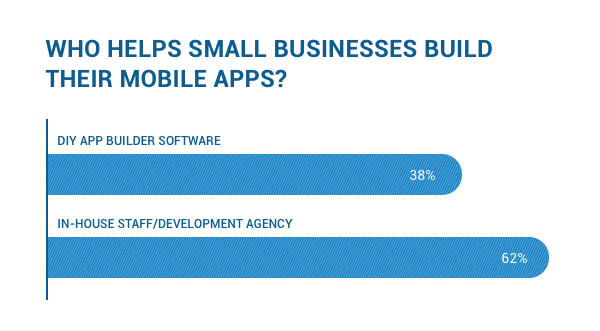
According to a survey, 38% of small businesses have used a DIY App Builder to build their mobile apps.

DIY App Builder New


While the option to build a mobile app for substantial low price sounds perfect on paper, but this route is actually more expensive and often leads to failure.

In this blog, we will explain what these DIY App Builders are and share 6 reasons why you should not use them to build a mobile app for your small business.

What are DIY App Builders?

DIY App Builders are basically online platforms that make it possible to create a mobile app without any coding experience.

These platforms basically have a drag-and-drop editor and some pre-defined templates that allow users to select themes and add features according to their preferences.

To use a DIY app builder, you need to pay a fixed amount of subscription fees on a monthly or yearly basis. These fees range from a few hundred dollars to a thousand or more dollars, depending on the complexity of your mobile app.

That being said, let’s look at the most popular DIY app builders.

Top DIY App Builders in The Market

Building mobile apps has certainly become much easier with DIY app makers.

Now, anyone can easily build and publish an app using one of these DIY app builders listed below.

Appypie

Appypie is the most popular DIY app maker available in the market today. In this platform, all you need to do is drag and drop your preferred features in its web interface to build your mobile app.

The price of Appypie starts from $30 USD per app per month and goes all the way up to $200 USD per app per month.

BuildFire

BuildFire is another powerful DIY app builder that has gained huge popularity in the market. The platform claims to have built over 10,000 mobile apps and has 10 million users.

The price of BuildFire starts from $53 USD per month to $500 USD per month.

AppInstitute

AppInstitute is a cloud-based DIY app maker which is often referred to as the ‘WordPress for mobile apps’. Founded in 2011, AppInstitute has now grown to over 140K users.

The price of AppInstitute starts from $42 USD per month to $340 USD per month and higher.

While these platforms may seem like an easy and quick solution for building your mobile app, but it’s always better to go with the traditional approach instead of using DIY app builders.

Here are the top 6 reasons why you should not use DIY app builders to build your business mobile app.

6 Reasons Why You Should Not Use DIY App Builders

The whole drag and drop technique to build a mobile app is indeed fast and fun, but most of the DIY app builders have too many drawbacks.

Let’s discuss these drawbacks and see why building mobile apps using DIY app makers is not worth it after all.

1 – It Violates Apple’s Guidelines

If you’re planning to build an iOS app using a DIY app builder, then the first thing you should know is that your mobile app will have a higher risk of being rejected from Apple App Store.

In 2017, Apple had updated its App Store Submission guidelines to widen its ban on templated apps that are being created using App generation services.

apple-guidelines

The main reason for bringing this update is because whenever an app gained instant popularity, hundreds of its clone apps were created and flooded the App Store.

As a result, the original creators were losing huge revenues.

So now, Apple has started to ban apps created using app generation services and has made it necessary to build mobile apps with the custom approach.

2 – They Actually Cost More In The Long Run

The subscription fees of DIY app builders may seem cheaper for developing mobile apps but that’s only in the beginning.

If you look at its cost from a long-term point of view, then it turns out to be more expensive than the traditional custom development approach.

For example, you will have to continually pay the annual subscription fees until your mobile app lives in the App Store. On the other hand, you will have to pay a one-time cost in the custom app development approach.

So, when you compare the long-term cost, the custom approach is quite cheaper actually.

3 – Limited Customization

No matter what all DIY app makers claim, you just cannot have the level of customization the custom approach offers.

Custom development allows building an app at any scale as well as usability, while in DIY app builders the options are often limited. You cannot have every possible customization even if you go with the most advanced subscription in DIY app maker platforms.

Simply put, after spending thousands of dollars on an app generation service, you might still end up with a mobile app in a web view which cannot take the full advantage of smartphone’s hardware & OS capabilities to its fullest.

Therefore, it’s always best to spend a little more in the beginning and take advantage of all of the hardware and operating system capabilities.

4 – Security Issues

Security is often users’ primary concern and if you build your mobile app using the custom approach, then you can easily double-check its level of security.

DIY app builders, on the other hand, don’t fully clarify their level of security. Hence, you’ll always be in dark as to whether the platform has a standard level of security or not.

So, if you’re serious about the security concern, then custom development is the right approach.

5 – Nothing Unique

If you’ve decided to use DIY app builder just because most of your competitors have done the same, then how are you going to stand-out?

In today’s competition, you just can’t expect to win users through a templated mobile app.

DIY app makers can’t really design a truly unique UI. They often provide a list of theme templates, which are most likely to used by your competitors as well.

What custom approach can do is just unmatchable by DIY app makers, especially when it comes to UI/UX design.

6 – Supports Limited Devices

Even though DIY app makers allow to create apps for multiple devices and operating systems, there is no guarantee that your app will work smoothly in all OS and devices.

As a result, you’ll end up neglecting a large number of devices, losing thousands of users along the way.

Custom app development approach, on the other hand, allows you to target and cater to a large number of audience with smooth user experience.

Conclusion

The development of your business mobile app is the foundation of the growth of your business. And if you make compromises by using any of the DIY app builders, then the end result might not be the best for your business.

Custom application development, on the other hand, can definitely be expensive in the beginning, but you can always outsource your mobile app development project to a different country where the costs are often lower.

Mobile App vs Mobile Website: Which one should you select?

2019 has turned the tech world into a completely mobile era. Today, people use more of their smartphones for everything. With the rise of Android and iPhone mobile devices, internet usage has taken the next level.

With everything going mobile, businesses have also gone mobile. It means that they have started to market their brands over the web through websites and mobile applications. With people searching on the internet for various purposes, website and mobile app development came into existence. Eventually, websites also have their mobile versions.

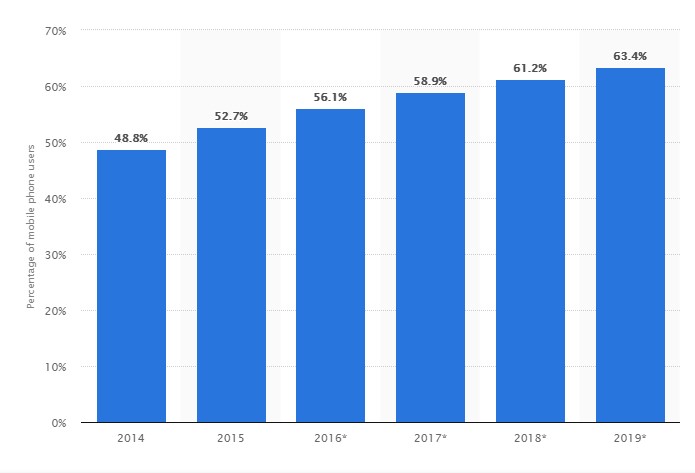
According to Statista Research Department, “This statistic gives information on the mobile phone internet penetration worldwide from 2014 to 2019. In 2015, 52.7 percent of the global mobile phone population accessed the internet from their mobile phone. This figure is expected to grow to 61.2 percent in 2018.”

Thus, the rise of mobile apps and mobile websites made it easier for smartphone users to accomplish their several tasks more conveniently.

Mobile Apps & Mobile Websites: Definitions

Mobile Apps:

A mobile app is a software program installed on a mobile device or a smartphone that you can access via the internet. Mobile applications, when downloaded on a mobile device, can use its native features. It helps developers to build better, more intuitive, and faster user experiences for consumers.

Mobile Websites:

A mobile website is similar to any other website with the difference that it is specifically built to optimize and scale mobile devices. It means they act as websites for smartphones. Primary features of a mobile website include smaller fonts, fewer page elements, and less white space when you compare it with a desktop version.

statista research department

Mobile Apps vs Mobile Websites: Usage

According to the Pew Research Center, today, 81% of Americans have their smartphones and 50% have tablets. All these mobile devices boost 71% of the country’s digital traffic. If we look at the data of other countries, then Mexico has its 75% internet usage on mobile devices, 71% in China, and 67% in Spain.

As we know that mobile applications have remarkably taken a rise in the tech market, a majority of mobile users spend their mobile time on applications than browsing the rest of the internet. Moreover, several business websites now have apps that provide the same functionality as sites. Therefore, users only have to download a particular app to have access to their specific needs.

Mobile Apps vs Mobile Websites: User Preferences

Have you ever wondered, why customers spend more time within apps? It is because they prefer apps over mobile sites due to improved user experience, increased speed, additional features, and special offers.

Retail and E-Commerce businesses have launched more applications than other businesses after the launch of news-apps. According to Statista, mobile apps are expected to generate $189 billion in revenue by 2020.

Moreover, 21% of Millenials open an app 50+ times a day. Also, mobile apps offer 57% of all digital media usage, and the average smartphone user uses 30 applications each month.

Mobile Apps or Mobile Websites: Conversions

How do apps work compared to other channels within E-Commerce? According to a report by Criteo, mobile apps close the deal with customers as people view 4.2 times more products per session within apps, when compared to mobile sites.

Moreover, apps push more people down the purchase funnel, thereby resulting in 3 times higher conversion rates compared to mobile sites. Mobile apps result in 1.5 times more conversions per session than desktop as well.

Why do applications function better than mobile sites? Shopping cart abandonment rates on mobile sites are quite higher than they are on desktop. One of the reasons is that consumers get annoyed and drop their shopping cart when they have to provide their credentials at the time of checkout. Mobile apps, on the other hand, save user data.

Mobile Apps & Mobile Website Trends for 2019 (and Beyond)

M-Commerce has taken a significant rise with the increased use of mobile apps and various smartphones. It drives 50% of E-Commerce in developed countries. By 2021, mobile devices will generate a revenue of $152 billion, which will come to almost 24% of the total online sales.

Additionally, it is too early to predict or declare the end of mobile-optimized websites. It is because most users still find stores by using their browser. Therefore, mobile websites or excellent mobile apps will continue to be an essential asset for businesses in the future, even with the above in mind.

Let us now take a look at the features of mobile apps and mobile websites.

Main Features of Mobile Apps

1. Appropriate Formats for Interactive Software Development

If your software consists of user interactive features, then implementing it on a website will not be a wise decision. Instead, integrating it into a mobile app will be best suitable. You can use it for the development of game apps and others, where the functionality requires immediate responses to user interactions. It is one of the most crucial benefits of mobile apps over mobile websites.

2. Extensive Abilities to use Special Capabilities on User Devices

People have increased the usage of different mobile apps, and today, various kinds of apps are available on the app store. You can get an app for almost everything. For example, if you want to improve your user experience in clicking pictures, then you can get a relevant app on your mobile device.
The IT field is continually advancing, and it is possible to create websites that can provide video communication between remote users. However, the relevant site may not give the expected performance, while mobile apps can enhance the user experience effectively.

3. Favorable Conditions for Notifications

Traditional emails do not work when you have to communicate with your users occasionally. It is because most of the bulk emails go to the spam, and users do not bother to even open them.
With mobile apps, it becomes effective to notify users for some significant information via push notifications. It enhances communication with your valuable customers without the need to worry about whether they got the information or not.

4. Potential to Function Offline

However effectively a website can function, it will never be able to work without an internet connection. On the other hand, a mobile app is an influential choice if your software idea emphasizes functionality that can also be available offline.

5. Preferable Choice for Brand Promotion

If your business holds a reputable position on the market, then having a mobile app is an excellent way to further promote your brand and expand your target audience.
Marketing via a mobile app indicates the high status of a business brand and offers more capabilities for developing unique features & functionality. For example, IKEA has launched its application that is based on Augmented Reality to help potential clients to try the products in their homes.

Main Features of Mobile Websites

1. Compatible with any existing OS & Screen Resolution

One of the benefits and unique characteristics of a mobile website is that it is supported by all smartphones and tablets, regardless of screen resolution and OS. It indicates that your target audience can be diverse and varied because a user can visit your site with a single click on the link required.
On the other hand, when it comes to apps, the user has to download it from the app store to access its functionality. Thus, little time and effort are spent on the introduction to the website.

2. Simple Development

Developing a website is relatively simple. There are paid or free options available that offer readymade templates for creating modern sites on the internet. Skills in programming languages such as HTML, CSS, and XML are required, which are quite easy to learn. For developers, it becomes easier to build a mobile website than creating a mobile app.

3. Easily Updated

When compared to mobile apps, mobile websites are easier to update. You need to spend additional time for getting the approval by the relevant platform’s marketplace to update a mobile app. Moreover, after you update it, the user has to download it all over again from the app store.
On the other hand, a website is automatically available and refreshed immediately after the update, which is a critical benefit over the app solution.

4. Websites can Exist Forever

Websites can exist forever except in a circumstance where you do not pay for domain and hosting renewals. When we talk about dedicated apps, they are automatically deleted from the marketplace if they are unused for a period set by the App Store/Google Play terms, which is normally, 30 days.

5. Comparatively Cheaper to Develop

It costs less to develop a website when compared to building a mobile app. The main reason for the vast difference in the development cost of both of these is that you do not need to create separate versions for Android and iOS. Moreover, you need to pay for registration in the App Store or Google Play.

6. Easily Optimized in Search Engines

A website, when effectively optimized, will be located on the first pages of all popular search engines when relevant keywords are entered. It is useful to those users, who are directly interested in your specific company.

When we talk about mobile apps in this relevance, users search them in the frame of their respective marketplace. Also, their position in search engines directly depends on user ratings, complicates their promotion a little.

7. Website Support is Easier & Cheaper than App Support

It is essential to make timely investments to make your software idea exist over a continuous period of time. In concerns of testing, administration, compatibility assurance, and updating, mobile websites are worth more than mobile apps.

Conclusion:

Today, every business promotes its brand over the web through either mobile apps or mobile websites. However, from the discussion above, we can see that the significance of mobile apps weighs far more than mobile websites.

However, websites still exist and have their unique significance in the tech market. It is all dependent on how you want to promote your brand to your targeted audience.

If you are planning to develop a responsive software that will integrate user devices’ resources to the full extent and develop a personal interface with unique functionality, the mobile app is the best fit for you.

If you have a software idea, then Credencys will help you create a robust mobile website or mobile app that fulfills your business requirements. Our team of dedicated iPhone and Android app developers provides unconditional support at every stage of development until we hand you over your final software.

11 Ways M-Commerce Apps Will Boost your Retail Business

Mobile apps used to be a fancy thing with Amazon or Instagram before 3-4 years. However, today, they are not a fancy thing anymore. Moreover, with emerging technologies and smartphones, mobile applications have taken a remarkable rise in various sectors. As various mobile services are available on the market today, the mobile app development cost has dropped down.

With the increasing competition to survive and retain the customer base, businesses have stepped in to adopt applications. Besides, markets and the digital world are quite dynamic today. A majority of people prefers shopping with a smartphone rather than going physically to shops. The use of mobile apps is all about user convenience and experience. Therefore, Mobile Commerce is the next generation of E-Commerce.

Businesses, small or large now, find mobile apps to be a useful tool to market their brand and attract new customers while retaining their loyal ones.

According to Statista, “This statistic presents the projected global m-commerce transaction value from 2014 to 2019. According to the source, worldwide mobile commerce revenues amounted to 96.34 billion U.S. dollars in 2015 and are set to surpass 693 billion U.S. dollars in 2019.”

What is M-Commerce?

M-Commerce is also known as Mobile Commerce. It refers to conducting business transactions through mobile devices or smartphones over a wireless internet connection.

What is the Role of M-Commerce in the Growth & Development of Retail Business?

Mobile devices have become common, and people spend more of their time on smartphones than on desktops or tablets. With the rising applications in the tech world, M-Commerce is likely to develop as a leading practice of marketing and selling among businesses.

Top 11 Benefits M-Commerce Apps offer to Retail Business

1. Faster Purchases

Today, many websites have mobile versions. But, apps are 1.5 times faster when it comes to loading data and search results on smartphones. With applications, there is no need to fetch data from a server, and therefore, customers are able to browse and make purchases faster. Mobile apps offer the same functionality as desktop apps. Therefore, people can buy products directly within an application.

2. Offers Easy Store Access

Today, everyone leads a hectic life. Think if you have to go to the store physically when you are burdened with office schedules. But, with useful mobile applications, your tasks have become easier, and you do not have to travel to the store, but simply order products online.
Mobile apps not only make shopping easier and convenient, but it also improves the shopping experience.

3. Attracts New Customers

Mobile applications have become popular with people due to their numerous benefits. Therefore, if you have your business app, then it has the potential to attract new customers.
Due to the increased use of mobile devices and apps, mobile searches are one of the major ways that customers will find your site. Therefore, if your site is fully optimized, then it is more likely to bring more business.

4. Mobile Payment Benefits to Both Customers & Retailers

Today, people love doing everything over their smartphones through different applications. If they choose to shop online, then surely, they will prefer paying through one such application. It means, as a retailer, your E-Commerce site should be compatible with one or more mobile payment platforms such as Google Wallet, PayPal, Square, or others. It will help your customers to have a convenient means of payment, thereby increasing the number of purchases for you.

Moreover, it is significant to consider how your consumers interact with your website when you plan to develop mobile payment options. Mostly, people hate to enter numbers of their cards for making payments. Therefore, a few companies have come with apps that directly scan their consumers’ cards for the payment procedure. You can come up with an application accordingly.

5. Localization

Knowing the physical location of the user at a specific time increases the value of Mobile Commerce. When you have the information about the user’s location, you can provide a lot of location-based applications. For example, you can quickly notify the user about his/her friends who are nearby via mobile services. Moreover, such a mobile service can also help them have the direction to the nearest restaurant or ATM for instance.

6. Personalization

People majorly use their mobile devices to find all sorts of information from the internet through various applications. However, the relevance of data is more significant.
Typically solo individuals use different mobile devices. Therefore, different mobile devices often require different sets of services and apps. Thus, you can personalize Mobile Commerce services and applications to offer information or perform services competently to specific users.

7. Better Data

Mobile Commerce apps help brands to have more helpful consumer data, as it is an integral part of the purchase process. Usually, in a traditional retail setting, the customer travels to the store, buys a product, and leaves. In such a situation, it gives a little insight as to why they made the purchase.

However, with M-Commerce applications, brands can connect with their customers from the moment of inquiry all the way through the purchase. As a result, businesses get access to valuable hints of purchase intent.

8. Scalability

Businesses have a lot of operations and transactions to perform, which requires their valuable time to invest. However, it becomes difficult for them to keep a balance among different processes without precise information on this relevance.

With M-Commerce apps, brands are adequately able to scale everything from inventory to marketing. Mobile apps have made it easier for them to get the required information related to a particular process or operation. For example, they can increase their mobile app marketing when consumer interest hikes and downscale when it decreases.

9. Global Reach

As people, today, own their smartphones, it becomes easier for brands to reach their customers globally. Moreover, M-Commerce apps allow retail businesses to enter markets they have never considered before. The large user base offers a lot of potential sales leads for brands.
Mobile Commerce apps have made it possible for customers to reach different brands and vice-versa.

10. Efficient Analytics

As a business owner, it is crucial for you to know your customers and their demands. When you offer them your Mobile Commerce app, you can create and set user analytics of various levels to truly understand your target audience. It will help you increase your sales.

When you have your M-Commerce app, you can effectively use mobile, online, and sales data to deliver better customer experiences. You can fetch rich customer data, shopping patterns & behavior, and trends from your mobile app. These details can help you make more reliable forecasts about your consumers to anticipate their needs more effectively.

11. Cost Reduction & Productivity

With your M-Commerce app, you can easily and faster reach your audience. As a result, you can effectively cut down your marketing campaign costs. Moreover, if the app has social media integration, then users will also be able to take part in spreading the word about your brand. Later, you can even earn from placing ads within your application.

Wrapping Up

From the above-mentioned benefits, it is clear that M-Commerce apps are on the rise. In the competitive market, retail businesses have come forward with their applications to enhance their customer experience.

Therefore, if you still, do not have your business app, then it is the right time to have one. At Credencys, we aim at helping enterprises and startups to achieve high performance by offering the most promising software solutions in the form of robust applications. Our team of highly skilled Android and iPhone developers are dedicated to supporting our invaluable clients at every stage of their project development.

21 (All Time Best) Mobile App Marketing Strategies to Pursue

Experts say that to create an app, the most important thing is the idea, which, in a way, is true. But, not entirely. The purpose is essential as, without it, you cannot build an app in the first place. However, the next most crucial thing before creating an app is its marketing.

Even though your app is one of a kind and needs no recognition or visibility, it is vital that you market your app. Mobile app marketing is also essential for brand building and positioning. Before you start creating the marketing plan for your freshly built app, it is crucial to learn how you to market a new mobile app by creating various mobile app marketing strategies.

Similar to mobile app development there are mainly three stages of mobile app marketing.

  • Pre-launch
  • Initial launch
  • Post-launch

Mobile App Marketing: Pre-launch

#1 Competitor Analysis and Market Research

One of the most crucial elements in “mobile app marketing” is to analyze your competitors. Hence, it is the first stage in mobile app marketing. Market research mainly includes understanding your customers and identify the place/platform where you can find them. Once, you’ve done that you need to identify the pain-point of your customers and learn how using your app can they address their problems. Finally, when you have all the data, all you need to do is approach your customers via forums, ads, blogs, social media, and other channels.

#2 Create User Personas

Before you start to outreach your customers, identify various user personas. Ask these questions to yourself that Who are your customers? Where do they live? What is their range of age/How old are they? etc. Based on the user persons, pre-think whether your app has the required features or not. Add or remove the features based on your identification.

#3 Analyze the Competetive Market

Today, the app market has become highly competitive. For a single application, there are several apps in the app store. So, you need to make a list of those apps which are already famous and share the app idea similar to yours; Identify their cost(if applicable), monetization options, review, pros & cons, ranking, etc. Make sure you’ve removed all the negative points from your app before the release. Include at least one if not two features that would make your app stand out.

#4 Establish your Brand

Yes, it’s true, even apps have brand value and positioning. Create a story and messaging of your brand, which you want your customers to hear(not literally). The messaging can come from the problem that your app solves, the experience that your app provides, etc. After creating your brand messaging, you’ll need to create a style guide where you have to identify the fonts, colors, textures, etc. that enhances your brand value and separates you from your competitors.

#5 Gather PR Materials

It is often recommended that you start collecting all the PR material and create a press kit. The kit will include high-resolution pictures of your logos, screenshots, icons, videos, and other marketing-related images. Also, create a story about your app as to how did you come up with this idea with a little bit of your and your team members’ background. Once, everything is ready, publish the press releases on popular platforms.

#6 Define the Monetization Strategy

No one builds an app for charity. So, you have to define how you’re going to earn money from your app. You can earn money via in-app purchases, ads, or by making your customers pay for the app itself.

#7 App Store Optimization and Content Marketing

App store optimization is a technique to rank your app higher in a particular category and increase conversion rate. Apart from that, creating a content strategy for mobile app marketing is a critical element to consider. Content marketing includes blogging, podcasting, social media marketing, and video publishing. Content marketing will help you drive traffic, create your brand, target niche audience, and engage your customers.

Mobile App Marketing: Initial Launch

#1 Increase your User Acquisition Rate

Once, the app is released, your first aim should be to increase downloads by all means. You can do that by offering discounts (if any), spread the word among your friends and family, link your app to virtually everywhere, i.e., your website homepage, social media profiles, etc., run paid ads on various social media platforms, and more. Basically, do anything to get more and more downloads; Because nothing can help you receive a higher rank in the app store than continuously surging of downloads.

#2 Engage with acquired customers

Engaging with the people who trusted you already is extremely important to remain ahead in the race. Connect with them using your website or social media platforms and build a community that would help you gain more popularity.

#3 PR and Content Marketing

Never stop content marketing even though you’re receiving a massive amount of downloads. However, now, instead of creating content around how your app can help customers, you can create content around how your app is benefiting customers right now. Publish the content on various guest blogging sites, social media platforms, and more. Invite celebrities, journalists, etc. and create podcasts and videos for various PR and media publications.

#4 Reach Out to Professional Reviewers, App Listers, and Editors

To gain more credibility of your app, you can ask professional reviewers to review your app and post it on their website, blog, youtube channel, or social media platforms. Contact people who are known for creating lists of top apps in different categories, and ask them to list your app on their website. You can also contact the editorial team of the App Store for iOS apps and Play Store for Android apps. Getting your app featured in the “Editor’s Choice” list can help you gain more visibility and hence, more downloads.

#5 Apply for Awards

Recognitions and awards are a great way to attract new customers and increase credibility among old customers. On receiving awards, you can boast them on all your social media platforms, website, and even in your ad campaigns.

#6 Collect Feedback and Comments

Once you receive enough amount of app downloads, you’ll start receiving user reviews and comments. Respond to every comment (if possible), give special attention to the bad reviews, and improvisations advice by users. Immediately act upon those improvisations to maintain the app ratings.

#7 Engage and Re-engage Users

Engage your customers by sending them push notifications, conducting quizzes and competitions, providing discounts, offers, and loyalty benefits, etc. You can also engage with more customers via offline mediums such as seminars and live events. Re-engage inactive users by sending them personalized notifications and engaging content.

Mobile App Marketing: Post-Launch

#1 Engage More with Your Users

After the launch of the app, it’s time for you to listen to your customers more via platforms where two-way dialogue is possible. Creating burst campaigns is also an excellent idea to gain the attention of more potential users in less time. In a burst campaign, the idea is to purchase almost every paid media for 48 to 72 hours and expose your app to a broader audience. However, it is risky as it can drag you to debt if it didn’t work. So, you must be quite sure before you decide to do “burst campaign.”

#2 Provide Referral Bonus

Referral bonus is one of the oldest yet, highly efficient technique to increase customer base. The reason why referral programs have a notion of guaranteed success is that it benefits both users and the company.

#3 Build your Website

You might have the question, “Isn’t it better if I build it before the launch?” The answer is yes it is better to build your website before the launch but, if you don’t have enough time and resource to build a site pre-launch then making one post-launch becomes a necessity. It is essential for two reasons. The first is that it does the SEO which provides more visibility to your app, and second is that it acts as a way to connect and engage with your customers.

#4 Don’t Stop SEO Activities for your Website

Doing SEO for your website will help you kill two birds with one arrow. It will increase your website ranking on Google and hence, your app ranking on respective platforms. Again, the most efficient way to do SEO is through content marketing.

#5 A/B Testing

A/B Testing is a critical element of mobile app marketing. It is often used to identify the taste of a particular target group. It helps you to recognize which type of experience suites best to your customers. It is a data-driven approach to optimize an app from UX and algorithm point-of-view.

#6 Gather User Reviews and Feedbacks

Ask a long-term user to review your app on the Play Store or App Store if he/she hasn’t done it yet. Reminding user to express their feelings about your app after allowing them to use it for a sufficient amount of time is a great way to express gratitude for which customers are always hungry. However, this pop-up can adversely affect customer experience if it happens more often or a user has already sent his/her feedback.

#7 Prepare for Continuous Improvement

After asking so many times to your customers about your app and asking them to help you identify the flaws in your app, they are expecting those improvements. The customer experience will come to a full cycle when a customer uses the app-suggest a change-you make the change-customer loves the change. Your aim should always be to add value to a user every time you release an update.

Conclusion

Mobile app marketing is no child’s play. Once you’ve identified how to market a new mobile app, you need to learn how to keep track of your efforts. It can be for marketing as well as development. Only by keeping track of your marketing and development efforts can you prevent things from going haywire, increase downloads and active users and hence, generate more revenue.

Outsourcing Software Development Company: 10 Tips to Select the Right One

Today, competition has increased with the emergence of various technologies. It is because firms and entrepreneurs continuously try to offer the best to their customers by integrating the latest technologies into their businesses.

The increased use of mobile phones has given rise to various applications that help organizations to present their products and services in an innovative way. Apart from approaching clients through their software, they also seek creative ways to accomplish their business goals for less money.

Therefore, they choose to outsource their majority of the work to skilled and cost-effective external service providers. Especially, when it comes to developing a web application, website, or a mobile app, they prefer to outsource it to an outsourcing software development company. It is feasible as well to do it, as hiring a whole team for the purpose may result in unnecessary expense.

Outsourcing your software development can help you streamline significant business processes. However, choosing the best fit for accomplishing your business goals is a critical decision. It can involve risks such as operation, financial, reputational, and others.

Therefore, it is crucial to consider certain factors before you select an outsourcing software development company to build your web or mobile application.

Are you confused as to how to select the right software development company for your business app? Then, we will discuss some must-have factors you need to consider while making the decision.

Top 10 Tips to Select the Right Outsourcing Software Development Company

1. Hire a Company With a Clear Business Strategy

When you think of presenting your business through a mobile app, you will encounter uncountable ideas. Moreover, you will find an application for almost everything today; from food to health care. Therefore, the success of your business idea of developing an application depends on how unique it will be.

You can come with a unique app idea, only if you are clear with your ideas, policies, and roadmap. Once you have built up your idea with the help of your team, it is crucial to communicate it to your outsourcing software development company.

2. Examine the Company Carefully by an External Expert

You cannot completely rely on the testimonials of previous clients when it comes to examining the company. It is because no one will provide a bad testimonial when the project is completed. Moreover, several things fade into the background in the development process. The relief of completion makes both sides happy.

Therefore, it is significant to estimate the final output and not the testimonials. If you are not sure of the quality you will get, then it is better not to start. Inquire with an external expert about the potential outsourcing software development company and make a deep analysis.

3. Study the Domain Expertise of the Company

One of the important aspects you should examine is the domain expertise of the potential software partner. It means that you should study their area of professional skills. Mostly, outsourcing software development companies provide information on certification and many of them are certified to high-grade standards.

Moreover, you can also check the background of experience and degrees of the team of the agency. Also, find out in what technologies the chosen company is proficient, take a look at its implemented software, and examine their accomplishments.

4. Do not make Decision based only on the Price

Though you may get tempted to select a company that offers the lowest development price. However, it is crucial to examine every factor before taking the plunge. A majority of the experienced businessmen who have outsourced many projects and evaluated hundreds of proposals mostly avoid the highest-priced and the lowest priced bid.

These experienced entrepreneurs report that their most successful projects are the ones where the vendor offered them a balance of good value and quality results.

5. Review Portfolios and Samples

When you make the decision of selecting the right outsourcing agency, it is vital to study their previous work and make sure it meets your expectations for quality and style. However, this evaluation is not enough for you to know their capabilities, then you should consider asking them to provide a basic outline of the work plan.

An outsourcing software development company that really wants to win your business will come up with a rough concept so that you can understand their problem-solving approach. By selecting a reliable outsourcing software development company, you can reap numerous benefits. However, it is to be noted that you should not cross the line between asking for a mock-up and insisting on the agency to provide you with the finished work. No qualified professional expect to work for free, and you should take it into account.

6. Decide your Budget

Every outsourcing software development company is different. Some offer packages and some offer the charge per hour. Therefore, it is vital to define your budget just you determine your goals. Take a look at the top development companies and see what they offer for the type of app you want to develop.

Price is an inevitable aspect when you have defined your budget. However, make sure you do not compromise with the quality due to this.

7. Insist on Project Management Tool

Software development outsourcing includes having the right communication. Communicating with the development team is an integral part of project development. A management tool enables you to keep an eye on the progress and allows you to update your objectives and spot mistakes.

Essentially, it helps you manage time. Several outsourced projects get delayed because of the absence of the management tool. Therefore, you should not put blind trust in the outsourcing software development company. Always push for the Project Management Tool and Sprint-based development review.

8. Set Realistic Milestones

Businesses often, fail to set milestones of their project or go overboard with their expectations. Milestones help you measure your success and growth in terms of quantifiable data. If you do not set them, then it becomes tough to track what you have accomplished and what needs to be done in the future.

Besides, unrealistic goals are also not feasible for your growth and development. They can cause unnecessary stress and demotivation for yourself and the development team as well. Therefore, keep realistic milestones for the successful completion of your dream project.

9. Never go with a Company that does not provide Documentation

Software projects need to have perfect documentation before the development process starts. Therefore, if your potential agency does not provide proper documentation, then avoid going with it.

Documentation includes all essential details about the project, along with the significant phases of development. If the project lacks documentation, then you are likely to lose your track halfway through the project.

10. Ensure Quality Assurance Availability

Testing a significant and integral part of every web or mobile app development. The potential outsourcing software development company should have a dedicated team for Quality Assurance. Moreover, it should be able to provide QA testing and support protocols within your budget.

Testing at regular intervals and at every stage of development ensures that the project is bug-free and efficient. Moreover, if any errors or bugs arise, then that can be solved beforehand.

The Last Words

From the points we discussed above, you can make your considerations while selecting the right outsourcing Software Development Company. There are thousands of companies available to outsource software development in various domains. However, you need to be wise and rational while choosing the best one for your dream software.

At Credencys, we have a dedicated team of Android and iPhone app developers who are skilled and experienced in different domains to provide efficient development services. If you have an idea, then we can help you transform it into a robust business software. We have delivered 500+ software solutions, and the count is still continued.