Mobile App vs Mobile Website: Which one should you select?

2019 has turned the tech world into a completely mobile era. Today, people use more of their smartphones for everything. With the rise of Android and iPhone mobile devices, internet usage has taken the next level.

With everything going mobile, businesses have also gone mobile. It means that they have started to market their brands over the web through websites and mobile applications. With people searching on the internet for various purposes, website and mobile app development came into existence. Eventually, websites also have their mobile versions.

According to Statista Research Department, “This statistic gives information on the mobile phone internet penetration worldwide from 2014 to 2019. In 2015, 52.7 percent of the global mobile phone population accessed the internet from their mobile phone. This figure is expected to grow to 61.2 percent in 2018.”

Thus, the rise of mobile apps and mobile websites made it easier for smartphone users to accomplish their several tasks more conveniently.

Mobile Apps & Mobile Websites: Definitions

Mobile Apps:

A mobile app is a software program installed on a mobile device or a smartphone that you can access via the internet. Mobile applications, when downloaded on a mobile device, can use its native features. It helps developers to build better, more intuitive, and faster user experiences for consumers.

Mobile Websites:

A mobile website is similar to any other website with the difference that it is specifically built to optimize and scale mobile devices. It means they act as websites for smartphones. Primary features of a mobile website include smaller fonts, fewer page elements, and less white space when you compare it with a desktop version.
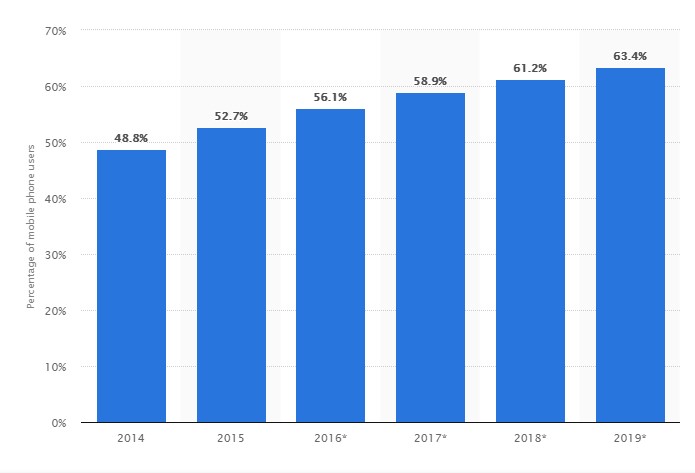
statista research department

Mobile Apps vs Mobile Websites: Usage

According to the Pew Research Center, today, 81% of Americans have their smartphones and 50% have tablets. All these mobile devices boost 71% of the country’s digital traffic. If we look at the data of other countries, then Mexico has its 75% internet usage on mobile devices, 71% in China, and 67% in Spain.

As we know that mobile applications have remarkably taken a rise in the tech market, a majority of mobile users spend their mobile time on applications than browsing the rest of the internet. Moreover, several business websites now have apps that provide the same functionality as sites. Therefore, users only have to download a particular app to have access to their specific needs.

Mobile Apps vs Mobile Websites: User Preferences

Have you ever wondered, why customers spend more time within apps? It is because they prefer apps over mobile sites due to improved user experience, increased speed, additional features, and special offers.

Retail and E-Commerce businesses have launched more applications than other businesses after the launch of news-apps. According to Statista, mobile apps are expected to generate $189 billion in revenue by 2020.

Moreover, 21% of Millenials open an app 50+ times a day. Also, mobile apps offer 57% of all digital media usage, and the average smartphone user uses 30 applications each month.

Mobile Apps or Mobile Websites: Conversions

How do apps work compared to other channels within E-Commerce? According to a report by Criteo, mobile apps close the deal with customers as people view 4.2 times more products per session within apps, when compared to mobile sites.

Moreover, apps push more people down the purchase funnel, thereby resulting in 3 times higher conversion rates compared to mobile sites. Mobile apps result in 1.5 times more conversions per session than desktop as well.

Why do applications function better than mobile sites? Shopping cart abandonment rates on mobile sites are quite higher than they are on desktop. One of the reasons is that consumers get annoyed and drop their shopping cart when they have to provide their credentials at the time of checkout. Mobile apps, on the other hand, save user data.

Mobile Apps & Mobile Website Trends for 2019 (and Beyond)

M-Commerce has taken a significant rise with the increased use of mobile apps and various smartphones. It drives 50% of E-Commerce in developed countries. By 2021, mobile devices will generate a revenue of $152 billion, which will come to almost 24% of the total online sales.

Additionally, it is too early to predict or declare the end of mobile-optimized websites. It is because most users still find stores by using their browser. Therefore, mobile websites or excellent mobile apps will continue to be an essential asset for businesses in the future, even with the above in mind.

Let us now take a look at the features of mobile apps and mobile websites.

Main Features of Mobile Apps

1. Appropriate Formats for Interactive Software Development

If your software consists of user interactive features, then implementing it on a website will not be a wise decision. Instead, integrating it into a mobile app will be best suitable. You can use it for the development of game apps and others, where the functionality requires immediate responses to user interactions. It is one of the most crucial benefits of mobile apps over mobile websites.

2. Extensive Abilities to use Special Capabilities on User Devices

People have increased the usage of different mobile apps, and today, various kinds of apps are available on the app store. You can get an app for almost everything. For example, if you want to improve your user experience in clicking pictures, then you can get a relevant app on your mobile device.
The IT field is continually advancing, and it is possible to create websites that can provide video communication between remote users. However, the relevant site may not give the expected performance, while mobile apps can enhance the user experience effectively.

3. Favorable Conditions for Notifications

Traditional emails do not work when you have to communicate with your users occasionally. It is because most of the bulk emails go to the spam, and users do not bother to even open them.
With mobile apps, it becomes effective to notify users for some significant information via push notifications. It enhances communication with your valuable customers without the need to worry about whether they got the information or not.

4. Potential to Function Offline

However effectively a website can function, it will never be able to work without an internet connection. On the other hand, a mobile app is an influential choice if your software idea emphasizes functionality that can also be available offline.

5. Preferable Choice for Brand Promotion

If your business holds a reputable position on the market, then having a mobile app is an excellent way to further promote your brand and expand your target audience.
Marketing via a mobile app indicates the high status of a business brand and offers more capabilities for developing unique features & functionality. For example, IKEA has launched its application that is based on Augmented Reality to help potential clients to try the products in their homes.

Main Features of Mobile Websites

1. Compatible with any existing OS & Screen Resolution

One of the benefits and unique characteristics of a mobile website is that it is supported by all smartphones and tablets, regardless of screen resolution and OS. It indicates that your target audience can be diverse and varied because a user can visit your site with a single click on the link required.
On the other hand, when it comes to apps, the user has to download it from the app store to access its functionality. Thus, little time and effort are spent on the introduction to the website.

2. Simple Development

Developing a website is relatively simple. There are paid or free options available that offer readymade templates for creating modern sites on the internet. Skills in programming languages such as HTML, CSS, and XML are required, which are quite easy to learn. For developers, it becomes easier to build a mobile website than creating a mobile app.

3. Easily Updated

When compared to mobile apps, mobile websites are easier to update. You need to spend additional time for getting the approval by the relevant platform’s marketplace to update a mobile app. Moreover, after you update it, the user has to download it all over again from the app store.
On the other hand, a website is automatically available and refreshed immediately after the update, which is a critical benefit over the app solution.

4. Websites can Exist Forever

Websites can exist forever except in a circumstance where you do not pay for domain and hosting renewals. When we talk about dedicated apps, they are automatically deleted from the marketplace if they are unused for a period set by the App Store/Google Play terms, which is normally, 30 days.

5. Comparatively Cheaper to Develop

It costs less to develop a website when compared to building a mobile app. The main reason for the vast difference in the development cost of both of these is that you do not need to create separate versions for Android and iOS. Moreover, you need to pay for registration in the App Store or Google Play.

6. Easily Optimized in Search Engines

A website, when effectively optimized, will be located on the first pages of all popular search engines when relevant keywords are entered. It is useful to those users, who are directly interested in your specific company.

When we talk about mobile apps in this relevance, users search them in the frame of their respective marketplace. Also, their position in search engines directly depends on user ratings, complicates their promotion a little.

7. Website Support is Easier & Cheaper than App Support

It is essential to make timely investments to make your software idea exist over a continuous period of time. In concerns of testing, administration, compatibility assurance, and updating, mobile websites are worth more than mobile apps.

Conclusion:

Today, every business promotes its brand over the web through either mobile apps or mobile websites. However, from the discussion above, we can see that the significance of mobile apps weighs far more than mobile websites.

However, websites still exist and have their unique significance in the tech market. It is all dependent on how you want to promote your brand to your targeted audience.

If you are planning to develop a responsive software that will integrate user devices’ resources to the full extent and develop a personal interface with unique functionality, the mobile app is the best fit for you.

If you have a software idea, then Credencys will help you create a robust mobile website or mobile app that fulfills your business requirements. Our team of dedicated iPhone and Android app developers provides unconditional support at every stage of development until we hand you over your final software.
11 Ways M-Commerce Apps Will Boost your Retail Business

Mobile apps used to be a fancy thing with Amazon or Instagram before 3-4 years. However, today, they are not a fancy thing anymore. Moreover, with emerging technologies and smartphones, mobile applications have taken a remarkable rise in various sectors. As various mobile services are available on the market today, the mobile app development cost has dropped down.

With the increasing competition to survive and retain the customer base, businesses have stepped in to adopt applications. Besides, markets and the digital world are quite dynamic today. A majority of people prefers shopping with a smartphone rather than going physically to shops. The use of mobile apps is all about user convenience and experience. Therefore, Mobile Commerce is the next generation of E-Commerce.

Businesses, small or large now, find mobile apps to be a useful tool to market their brand and attract new customers while retaining their loyal ones.

According to Statista, “This statistic presents the projected global m-commerce transaction value from 2014 to 2019. According to the source, worldwide mobile commerce revenues amounted to 96.34 billion U.S. dollars in 2015 and are set to surpass 693 billion U.S. dollars in 2019.”

What is M-Commerce?

M-Commerce is also known as Mobile Commerce. It refers to conducting business transactions through mobile devices or smartphones over a wireless internet connection.

What is the Role of M-Commerce in the Growth & Development of Retail Business?

Mobile devices have become common, and people spend more of their time on smartphones than on desktops or tablets. With the rising applications in the tech world, M-Commerce is likely to develop as a leading practice of marketing and selling among businesses.

Top 11 Benefits M-Commerce Apps offer to Retail Business

1. Faster Purchases

Today, many websites have mobile versions. But, apps are 1.5 times faster when it comes to loading data and search results on smartphones. With applications, there is no need to fetch data from a server, and therefore, customers are able to browse and make purchases faster. Mobile apps offer the same functionality as desktop apps. Therefore, people can buy products directly within an application.

2. Offers Easy Store Access

Today, everyone leads a hectic life. Think if you have to go to the store physically when you are burdened with office schedules. But, with useful mobile applications, your tasks have become easier, and you do not have to travel to the store, but simply order products online.
Mobile apps not only make shopping easier and convenient, but it also improves the shopping experience.

3. Attracts New Customers

Mobile applications have become popular with people due to their numerous benefits. Therefore, if you have your business app, then it has the potential to attract new customers.
Due to the increased use of mobile devices and apps, mobile searches are one of the major ways that customers will find your site. Therefore, if your site is fully optimized, then it is more likely to bring more business.

4. Mobile Payment Benefits to Both Customers & Retailers

Today, people love doing everything over their smartphones through different applications. If they choose to shop online, then surely, they will prefer paying through one such application. It means, as a retailer, your E-Commerce site should be compatible with one or more mobile payment platforms such as Google Wallet, PayPal, Square, or others. It will help your customers to have a convenient means of payment, thereby increasing the number of purchases for you.

Moreover, it is significant to consider how your consumers interact with your website when you plan to develop mobile payment options. Mostly, people hate to enter numbers of their cards for making payments. Therefore, a few companies have come with apps that directly scan their consumers’ cards for the payment procedure. You can come up with an application accordingly.

5. Localization

Knowing the physical location of the user at a specific time increases the value of Mobile Commerce. When you have the information about the user’s location, you can provide a lot of location-based applications. For example, you can quickly notify the user about his/her friends who are nearby via mobile services. Moreover, such a mobile service can also help them have the direction to the nearest restaurant or ATM for instance.

6. Personalization

People majorly use their mobile devices to find all sorts of information from the internet through various applications. However, the relevance of data is more significant.
Typically solo individuals use different mobile devices. Therefore, different mobile devices often require different sets of services and apps. Thus, you can personalize Mobile Commerce services and applications to offer information or perform services competently to specific users.

7. Better Data

Mobile Commerce apps help brands to have more helpful consumer data, as it is an integral part of the purchase process. Usually, in a traditional retail setting, the customer travels to the store, buys a product, and leaves. In such a situation, it gives a little insight as to why they made the purchase.

However, with M-Commerce applications, brands can connect with their customers from the moment of inquiry all the way through the purchase. As a result, businesses get access to valuable hints of purchase intent.

8. Scalability

Businesses have a lot of operations and transactions to perform, which requires their valuable time to invest. However, it becomes difficult for them to keep a balance among different processes without precise information on this relevance.

With M-Commerce apps, brands are adequately able to scale everything from inventory to marketing. Mobile apps have made it easier for them to get the required information related to a particular process or operation. For example, they can increase their mobile app marketing when consumer interest hikes and downscale when it decreases.

9. Global Reach

As people, today, own their smartphones, it becomes easier for brands to reach their customers globally. Moreover, M-Commerce apps allow retail businesses to enter markets they have never considered before. The large user base offers a lot of potential sales leads for brands.
Mobile Commerce apps have made it possible for customers to reach different brands and vice-versa.

10. Efficient Analytics

As a business owner, it is crucial for you to know your customers and their demands. When you offer them your Mobile Commerce app, you can create and set user analytics of various levels to truly understand your target audience. It will help you increase your sales.

When you have your M-Commerce app, you can effectively use mobile, online, and sales data to deliver better customer experiences. You can fetch rich customer data, shopping patterns & behavior, and trends from your mobile app. These details can help you make more reliable forecasts about your consumers to anticipate their needs more effectively.

11. Cost Reduction & Productivity

With your M-Commerce app, you can easily and faster reach your audience. As a result, you can effectively cut down your marketing campaign costs. Moreover, if the app has social media integration, then users will also be able to take part in spreading the word about your brand. Later, you can even earn from placing ads within your application.

Wrapping Up

From the above-mentioned benefits, it is clear that M-Commerce apps are on the rise. In the competitive market, retail businesses have come forward with their applications to enhance their customer experience.

Therefore, if you still, do not have your business app, then it is the right time to have one. At Credencys, we aim at helping enterprises and startups to achieve high performance by offering the most promising software solutions in the form of robust applications. Our team of highly skilled Android and iPhone developers are dedicated to supporting our invaluable clients at every stage of their project development.

21 (All Time Best) Mobile App Marketing Strategies to Pursue

Experts say that to create an app, the most important thing is the idea, which, in a way, is true. But, not entirely. The purpose is essential as, without it, you cannot build an app in the first place. However, the next most crucial thing before creating an app is its marketing.

Even though your app is one of a kind and needs no recognition or visibility, it is vital that you market your app. Mobile app marketing is also essential for brand building and positioning. Before you start creating the marketing plan for your freshly built app, it is crucial to learn how you to market a new mobile app by creating various mobile app marketing strategies.

Similar to mobile app development there are mainly three stages of mobile app marketing.

  • Pre-launch
  • Initial launch
  • Post-launch

Mobile App Marketing: Pre-launch

#1 Competitor Analysis and Market Research

One of the most crucial elements in “mobile app marketing” is to analyze your competitors. Hence, it is the first stage in mobile app marketing. Market research mainly includes understanding your customers and identify the place/platform where you can find them. Once, you’ve done that you need to identify the pain-point of your customers and learn how using your app can they address their problems. Finally, when you have all the data, all you need to do is approach your customers via forums, ads, blogs, social media, and other channels.

#2 Create User Personas

Before you start to outreach your customers, identify various user personas. Ask these questions to yourself that Who are your customers? Where do they live? What is their range of age/How old are they? etc. Based on the user persons, pre-think whether your app has the required features or not. Add or remove the features based on your identification.

#3 Analyze the Competetive Market

Today, the app market has become highly competitive. For a single application, there are several apps in the app store. So, you need to make a list of those apps which are already famous and share the app idea similar to yours; Identify their cost(if applicable), monetization options, review, pros & cons, ranking, etc. Make sure you’ve removed all the negative points from your app before the release. Include at least one if not two features that would make your app stand out.

#4 Establish your Brand

Yes, it’s true, even apps have brand value and positioning. Create a story and messaging of your brand, which you want your customers to hear(not literally). The messaging can come from the problem that your app solves, the experience that your app provides, etc. After creating your brand messaging, you’ll need to create a style guide where you have to identify the fonts, colors, textures, etc. that enhances your brand value and separates you from your competitors.

#5 Gather PR Materials

It is often recommended that you start collecting all the PR material and create a press kit. The kit will include high-resolution pictures of your logos, screenshots, icons, videos, and other marketing-related images. Also, create a story about your app as to how did you come up with this idea with a little bit of your and your team members’ background. Once, everything is ready, publish the press releases on popular platforms.

#6 Define the Monetization Strategy

No one builds an app for charity. So, you have to define how you’re going to earn money from your app. You can earn money via in-app purchases, ads, or by making your customers pay for the app itself.

#7 App Store Optimization and Content Marketing

App store optimization is a technique to rank your app higher in a particular category and increase conversion rate. Apart from that, creating a content strategy for mobile app marketing is a critical element to consider. Content marketing includes blogging, podcasting, social media marketing, and video publishing. Content marketing will help you drive traffic, create your brand, target niche audience, and engage your customers.

Mobile App Marketing: Initial Launch

#1 Increase your User Acquisition Rate

Once, the app is released, your first aim should be to increase downloads by all means. You can do that by offering discounts (if any), spread the word among your friends and family, link your app to virtually everywhere, i.e., your website homepage, social media profiles, etc., run paid ads on various social media platforms, and more. Basically, do anything to get more and more downloads; Because nothing can help you receive a higher rank in the app store than continuously surging of downloads.

#2 Engage with acquired customers

Engaging with the people who trusted you already is extremely important to remain ahead in the race. Connect with them using your website or social media platforms and build a community that would help you gain more popularity.

#3 PR and Content Marketing

Never stop content marketing even though you’re receiving a massive amount of downloads. However, now, instead of creating content around how your app can help customers, you can create content around how your app is benefiting customers right now. Publish the content on various guest blogging sites, social media platforms, and more. Invite celebrities, journalists, etc. and create podcasts and videos for various PR and media publications.

#4 Reach Out to Professional Reviewers, App Listers, and Editors

To gain more credibility of your app, you can ask professional reviewers to review your app and post it on their website, blog, youtube channel, or social media platforms. Contact people who are known for creating lists of top apps in different categories, and ask them to list your app on their website. You can also contact the editorial team of the App Store for iOS apps and Play Store for Android apps. Getting your app featured in the “Editor’s Choice” list can help you gain more visibility and hence, more downloads.

#5 Apply for Awards

Recognitions and awards are a great way to attract new customers and increase credibility among old customers. On receiving awards, you can boast them on all your social media platforms, website, and even in your ad campaigns.

#6 Collect Feedback and Comments

Once you receive enough amount of app downloads, you’ll start receiving user reviews and comments. Respond to every comment (if possible), give special attention to the bad reviews, and improvisations advice by users. Immediately act upon those improvisations to maintain the app ratings.

#7 Engage and Re-engage Users

Engage your customers by sending them push notifications, conducting quizzes and competitions, providing discounts, offers, and loyalty benefits, etc. You can also engage with more customers via offline mediums such as seminars and live events. Re-engage inactive users by sending them personalized notifications and engaging content.

Mobile App Marketing: Post-Launch

#1 Engage More with Your Users

After the launch of the app, it’s time for you to listen to your customers more via platforms where two-way dialogue is possible. Creating burst campaigns is also an excellent idea to gain the attention of more potential users in less time. In a burst campaign, the idea is to purchase almost every paid media for 48 to 72 hours and expose your app to a broader audience. However, it is risky as it can drag you to debt if it didn’t work. So, you must be quite sure before you decide to do “burst campaign.”

#2 Provide Referral Bonus

Referral bonus is one of the oldest yet, highly efficient technique to increase customer base. The reason why referral programs have a notion of guaranteed success is that it benefits both users and the company.

#3 Build your Website

You might have the question, “Isn’t it better if I build it before the launch?” The answer is yes it is better to build your website before the launch but, if you don’t have enough time and resource to build a site pre-launch then making one post-launch becomes a necessity. It is essential for two reasons. The first is that it does the SEO which provides more visibility to your app, and second is that it acts as a way to connect and engage with your customers.

#4 Don’t Stop SEO Activities for your Website

Doing SEO for your website will help you kill two birds with one arrow. It will increase your website ranking on Google and hence, your app ranking on respective platforms. Again, the most efficient way to do SEO is through content marketing.

#5 A/B Testing

A/B Testing is a critical element of mobile app marketing. It is often used to identify the taste of a particular target group. It helps you to recognize which type of experience suites best to your customers. It is a data-driven approach to optimize an app from UX and algorithm point-of-view.

#6 Gather User Reviews and Feedbacks

Ask a long-term user to review your app on the Play Store or App Store if he/she hasn’t done it yet. Reminding user to express their feelings about your app after allowing them to use it for a sufficient amount of time is a great way to express gratitude for which customers are always hungry. However, this pop-up can adversely affect customer experience if it happens more often or a user has already sent his/her feedback.

#7 Prepare for Continuous Improvement

After asking so many times to your customers about your app and asking them to help you identify the flaws in your app, they are expecting those improvements. The customer experience will come to a full cycle when a customer uses the app-suggest a change-you make the change-customer loves the change. Your aim should always be to add value to a user every time you release an update.

Conclusion

Mobile app marketing is no child’s play. Once you’ve identified how to market a new mobile app, you need to learn how to keep track of your efforts. It can be for marketing as well as development. Only by keeping track of your marketing and development efforts can you prevent things from going haywire, increase downloads and active users and hence, generate more revenue.

Outsourcing Software Development Company: 10 Tips to Select the Right One

Today, competition has increased with the emergence of various technologies. It is because firms and entrepreneurs continuously try to offer the best to their customers by integrating the latest technologies into their businesses.

The increased use of mobile phones has given rise to various applications that help organizations to present their products and services in an innovative way. Apart from approaching clients through their software, they also seek creative ways to accomplish their business goals for less money.

Therefore, they choose to outsource their majority of the work to skilled and cost-effective external service providers. Especially, when it comes to developing a web application, website, or a mobile app, they prefer to outsource it to an outsourcing software development company. It is feasible as well to do it, as hiring a whole team for the purpose may result in unnecessary expense.

Outsourcing your software development can help you streamline significant business processes. However, choosing the best fit for accomplishing your business goals is a critical decision. It can involve risks such as operation, financial, reputational, and others.

Therefore, it is crucial to consider certain factors before you select an outsourcing software development company to build your web or mobile application.

Are you confused as to how to select the right software development company for your business app? Then, we will discuss some must-have factors you need to consider while making the decision.

Top 10 Tips to Select the Right Outsourcing Software Development Company

1. Hire a Company With a Clear Business Strategy

When you think of presenting your business through a mobile app, you will encounter uncountable ideas. Moreover, you will find an application for almost everything today; from food to health care. Therefore, the success of your business idea of developing an application depends on how unique it will be.

You can come with a unique app idea, only if you are clear with your ideas, policies, and roadmap. Once you have built up your idea with the help of your team, it is crucial to communicate it to your outsourcing software development company.

2. Examine the Company Carefully by an External Expert

You cannot completely rely on the testimonials of previous clients when it comes to examining the company. It is because no one will provide a bad testimonial when the project is completed. Moreover, several things fade into the background in the development process. The relief of completion makes both sides happy.

Therefore, it is significant to estimate the final output and not the testimonials. If you are not sure of the quality you will get, then it is better not to start. Inquire with an external expert about the potential outsourcing software development company and make a deep analysis.

3. Study the Domain Expertise of the Company

One of the important aspects you should examine is the domain expertise of the potential software partner. It means that you should study their area of professional skills. Mostly, outsourcing software development companies provide information on certification and many of them are certified to high-grade standards.

Moreover, you can also check the background of experience and degrees of the team of the agency. Also, find out in what technologies the chosen company is proficient, take a look at its implemented software, and examine their accomplishments.

4. Do not make Decision based only on the Price

Though you may get tempted to select a company that offers the lowest development price. However, it is crucial to examine every factor before taking the plunge. A majority of the experienced businessmen who have outsourced many projects and evaluated hundreds of proposals mostly avoid the highest-priced and the lowest priced bid.

These experienced entrepreneurs report that their most successful projects are the ones where the vendor offered them a balance of good value and quality results.

5. Review Portfolios and Samples

When you make the decision of selecting the right outsourcing agency, it is vital to study their previous work and make sure it meets your expectations for quality and style. However, this evaluation is not enough for you to know their capabilities, then you should consider asking them to provide a basic outline of the work plan.

An outsourcing software development company that really wants to win your business will come up with a rough concept so that you can understand their problem-solving approach. By selecting a reliable outsourcing software development company, you can reap numerous benefits. However, it is to be noted that you should not cross the line between asking for a mock-up and insisting on the agency to provide you with the finished work. No qualified professional expect to work for free, and you should take it into account.

6. Decide your Budget

Every outsourcing software development company is different. Some offer packages and some offer the charge per hour. Therefore, it is vital to define your budget just you determine your goals. Take a look at the top development companies and see what they offer for the type of app you want to develop.

Price is an inevitable aspect when you have defined your budget. However, make sure you do not compromise with the quality due to this.

7. Insist on Project Management Tool

Software development outsourcing includes having the right communication. Communicating with the development team is an integral part of project development. A management tool enables you to keep an eye on the progress and allows you to update your objectives and spot mistakes.

Essentially, it helps you manage time. Several outsourced projects get delayed because of the absence of the management tool. Therefore, you should not put blind trust in the outsourcing software development company. Always push for the Project Management Tool and Sprint-based development review.

8. Set Realistic Milestones

Businesses often, fail to set milestones of their project or go overboard with their expectations. Milestones help you measure your success and growth in terms of quantifiable data. If you do not set them, then it becomes tough to track what you have accomplished and what needs to be done in the future.

Besides, unrealistic goals are also not feasible for your growth and development. They can cause unnecessary stress and demotivation for yourself and the development team as well. Therefore, keep realistic milestones for the successful completion of your dream project.

9. Never go with a Company that does not provide Documentation

Software projects need to have perfect documentation before the development process starts. Therefore, if your potential agency does not provide proper documentation, then avoid going with it.

Documentation includes all essential details about the project, along with the significant phases of development. If the project lacks documentation, then you are likely to lose your track halfway through the project.

10. Ensure Quality Assurance Availability

Testing a significant and integral part of every web or mobile app development. The potential outsourcing software development company should have a dedicated team for Quality Assurance. Moreover, it should be able to provide QA testing and support protocols within your budget.

Testing at regular intervals and at every stage of development ensures that the project is bug-free and efficient. Moreover, if any errors or bugs arise, then that can be solved beforehand.

The Last Words

From the points we discussed above, you can make your considerations while selecting the right outsourcing Software Development Company. There are thousands of companies available to outsource software development in various domains. However, you need to be wise and rational while choosing the best one for your dream software.

At Credencys, we have a dedicated team of Android and iPhone app developers who are skilled and experienced in different domains to provide efficient development services. If you have an idea, then we can help you transform it into a robust business software. We have delivered 500+ software solutions, and the count is still continued.

MobileAppDaily Recognizes Credencys Solutions Inc. As A Top React Native App Development Company

Credencys Solutions Inc. is an agile full stack application development company that was founded over a decade ago. The primary objective of their team of app designers and developers is to help their clients in driving profits. In addition to this, they also focus on helping businesses succeed through cutting edge digital transformation across multiple domains.

With a team of more than 150 skilled technology professionals, Credencys Solutions Inc. is here to create highly competitive digital business solutions while making use of the latest web and mobile tech across a wide range of platforms which also includes WordPress, PHP, Angular.js, Android, iOS and React Native, as well as emerging technologies such as Augmented Reality (AR), Virtual Reality (VR), IoT (Internet of Things), and Chatbots.

Why MobileAppDaily Chose Credencys Solutions Inc.?

MobileAppDaily is a leading news and media portal that has made a well-known presence for itself in the tech industry. Being a reliable source of all the latest and trending updates from the mobile application sector, hundreds and thousands of tech enthusiasts follow this platform.

From the very start, this portal has kept the mobile app users up-to-date with what’s happening in the tech industry, be it the latest app funding or launch of a new mobile application in the Apple App Store or Google Play Store.

From innovative startups to well-established Fortune 500 companies and large-scale enterprises, Credencys Solutions Inc. has offered only the very best app development and digital services to its clients. This is one of the main reasons why MobileAppDaily decided to feature Credencys in its exclusive Leading React Native App Development Companies report.

Apart from in-depth annual reports, readers will also find detailed Android, as well as iOS app reviews of the mobile & web apps that are ruling in their respective categories. The annual report consists of only top mobile app development companies belonging to different industry verticals. A few reports that were highly requested by the readers were Top iOS App Development Companies, Top Beacons App Development Companies, Top Mobile App Developers in the U.S. and many more.

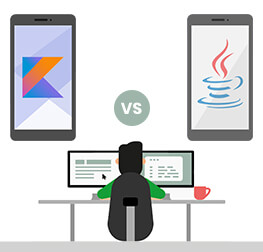
10 Reasons You Should Know Why Kotlin is Better than Java for Android App Development

According to Statista, in the second quarter of 2018, 88 percent of all smartphones sold to end users were phones with the Android operating system.

kotlin-vs-java-stats

When you speak about Android development, the programming language that comes to mind is Java. It is because Java has been popularly used for Android app development for years.

It is true that the majority of Android apps are written in Java. However, it is not the only option for Android app development. You can build Android applications using other languages too that can compile and run on the Java Virtual Machine (JVM). Recently, one JVM-compatible programming language has caught the attention of the Android community, and it is Kotlin.

What is Java?

Java is a popular programming language developed in 1998 by Oracle Corporation. It has been widely used for Android app development because of its core benefits that include: it works on different platforms, open source & free, simple to use & easy to learn, and many more. Besides, Java is old, verbose, error-prone, and slow to modernize.

Moreover, OpenJDK developers have begun to bridge the gap with Java 8, but Android does not utilize all the features of Java 8. Therefore, developers are stuck in the old Java 7 and 6 worlds. As they cannot completely rely on Java for Android app development, Kotlin came to the rescue.

The Rise of Kotlin for Android App Development

Kotlin is a programming language for the Java Virtual Machine (JVM) developed in 2011 by JetBrains. It can be used where Java is used virtually. It has gained an astounding amount of interest among developers in the last 2 years, specifically after Google announced it as an official language for Android apps.

Kotlin offers a broad array of benefits over Java while developing Android applications. Let us take a look at the key benefits as below.

10 Reasons for Choosing Kotlin Over Java for Android App Development

1. Completely Interoperable with Java

Interoperability is one of the greatest strengths of Kotlin. It works as a potential alternative to Java when it comes to Android development. The benefit is that you can use Java and Kotlin code side by side in the same project without disturbing any of the factors.

It means when you want to integrate Kotlin into the project, you only need to add its tools and frameworks without any change in the project.

2. More Concise than Java

Kotlin is considered to be more concise than Java, as it solves the same issues with only a few lines of code. It enhances code maintainability and readability. As a result, developers have benefited from writing, reading, and changing code more effectively and efficiently. It offers conciseness through features such as type inference, smart casts, data classes, and properties.

If you are planning to develop your Android app using Kotlin – Consult Credencys

3. Safer Code

Kotlin is essentially safer than Java code, as it prevents the occurrence of common programming errors by design, which results in fewer system failures and application crashes. When writing Java code, certain errors are likely to happen, while Kotlin pushes developers to write robust code.

4. Write Less Code

Kotlin is easy to use once you understand its syntax. It is not redundant like Java. Kotlin is crisp, concise, and minimizes a lot of the boilerplate code for developers in the daily routine.

5. No more Null-Pointer Exception

Kotlin offers the benefit of implementing APIs on NonNull parameters. It will not compile if you specifically put null into a non-null API. Moreover, the IDE will also notify you about your mistake.

Thus, if you are to re-write APIs, and you have a runtime null going into a non-null API, then Kotlin will force a crash with a null argument exception. It tremendously benefits, particularly when you are busy rewriting your APIs and communicating with your team.

6. Helps Reduce Errors and Bugs in the Code

The Kotlin compiler informs system failures rapidly in relevant cases. As a result, it becomes more convenient and easier to search for bugs and even prevent them beforehand. The compiler performs several checks, thereby avoiding runtime errors and reducing the cost and effort of error fixes.

7. An Enterprise Language

Kotlin is developed by JetBrains and has been in the market since 2011. It is primarily, designed to solve practical and real-world development problems, and unlike other JVM-based languages, Kotlin does not emerge from an academic or research background. It has been built keeping the enterprise in mind.

JetBrains did not want to create something revolutionary, but to offer something that is usable and cost-effective to enterprises who aspire to have an Android app development.

8. Kotlin has Better Support for Functional Programming

Developers use functional programming to solve several tasks easily and consistently. Functional programming was also introduced in Java 8. However, Kotlin has better support for functional programming.

It suggests that you can concisely and explicitly use functional concepts with proper function types. Kotlin also helps improve performance with the help of inlining, which is not currently possible in Java.

9. Speeds Up Everyday Development Tasks

In addition to the features we discussed above, Kotlin offers a wide range of handy features that expedite the daily development tasks, which Java does not provide. These features include parameter values, object declarations, extension functions, and many more. Moreover, they also help speed up the development time, along with maintaining the code base efficiently.

10. Easier to Learn and Maintain

One of the biggest advantages of Kotlin is that a Java developer can understand the majority of the code even without having written a line of Kotlin. It is because JetBrains had aimed to make the transition from Java simple, with a language that nearly resembles what you already know.

With the simplicity of Kotlin language and the help of the IDE & compiler, it is easier to handle the basics of the language. The only complex part to understand is the concepts that Java lacks rather than the Kotlin syntax.

Kotlin is considered as a one-stop language for all kind of Android application development, as it supports lots of IDEs, along with Android Studio. Therefore, you can use all the tried and tested development tools that help you in maintaining your codebase at scale.

Final Thoughts

As Kotlin is 100% interoperable with Java, you can use Kotlin code with Java and vice versa. You can also migrate large software projects from Java to Kotlin step-by-step, and it allows you to use Java libraries with Kotlin seamlessly.

At Credencys, we provide excellent Android app development services to our valuable clients. Our Android app developers are dedicated to offering high-quality applications. We deliver effective Android solutions to enterprises, startups, and digital agencies and help them achieve high performance.

Software Outsourcing Company v/s In-house Team v/s Freelancers – Which is Better to Hire iPhone app Developers

Today, the app development market has grown so big that not only many people can develop an app, but there are too many ways you can choose/hire iPhone app developers for your project.

We have seen CIOs and Managers get quite confused when it comes to hiring developers to build mobile apps. The confusion is both obvious and invalid. It is obvious for the people who don’t know how the mobile app business works. A straight forward answer to this question is, “It Depends.” It depends on your requirements, needs, and desires.

We all know that in software development changes are inevitable. Because of this “change,” you might as well have to consider another model. For example, you have hired an offshore development firm to build a mobile app. While the development was going, you found that for the app to work well, you need to develop a new module. If this new module requires the skills which the offshore company cannot provide, then you’ll have to rush to another company or hire a freelancer or work out with the in-house team.

Before we proceed to identify which model is the best, it is essential to know that there is nothing like “a perfect choice.” Of course, there can be “a better choice” when it comes to choosing a hiring model.

Three Options to Hire iPhone app Developers – Choose the One Smartly

1. Offshore Software Development Company

Offshore development is often suitable for large size or long-term projects. Offshore development firms can provide you developers on full-time as well as part-time basis. Hiring these remote developers can save you a lot of bucks. If you’re looking for a reliable yet cheaper development center, then offshore software companies can be your best bet.

Pros

1. Before you hire iPhone app developers from an offshore company, they sign a legit contract which has deadlines, privacy policy, development cost, etc. written on it.

2. Offshore companies save your time on recruiting talent by providing you a team of hard-working professionals and subject matter experts.

3. The quality of work is guaranteed in offshore development companies because of their experience and expertise.

4. For offshore companies, you don’t need to check their performance every now-and-then. Companies hire only talented people who are beyond questionable.

5. Hiring developers from third-world countries like India, Vietnam, South Africa, etc. can help you save money to a great extent.

Cons

1. The most prominent drawback of hiring an offshore company is dealing with the time difference. It becomes a huge barrier for companies and their clients.

2. It might take a bit longer for you to hire iPhone app developers from a company than to hire freelancers because unlike freelancers, you can’t hire developers from a company on the click of a mouse.

3. Hiring a dedicated developer might be a bit costly than hiring a freelancer. It won’t be a huge concern for you if you’re not on a tight budget.

2. In-house Team

Similar to outsourcing software companies, an in-house team is also recommended for long-term projects. You can have great control over an in-house team rather than outsourcing companies or freelancers. Based on your requirement changes, you can increase or decrease your team capacity. An in-house team is a better choice if your project demands you to communicate with developers continuously.

Pros

1. You’ll be able to engage more often and better with your team members because of their all-time physical presence on the floor. Because of it, the collaboration will also increase.

2. Another benefit of the in-house team is that they dedicatedly work on your project only and not any other.

3. Communication is more effective as the team members are physically present all the time, and there won’t be any language barriers as they will be from the same country and culture.

Cons

1. The cost of having a full-time in-house team is higher as you’ll not only have to pay the developers a handsome amount but also require a proper infrastructure to execute the process.

2. Recruiting new people to your organization to do a specific job full-time is a tough job as not every employee you hire is going to have the required skills and talent.

3. Your dependency on the people you hire will become a huge concern if any one of them falls sick and take leave. In that case, you’ll need to hire a replacement which may or may not be a good fit for the project.

4. You’ll need to consider a part of your revenue to train the new hires. Even though they have the required skill set if you want your project to be a success, then you’ll have to train the employees regularly.

5. After the project completion, the maintenance of the software is also crucial. For that, you’ll again need to hire people which is costly even though you hire them ‘on-call.’

3. Freelancer

Hire a freelancer if your project size is small or you need someone to finish a half-done task, or you require a developer to fix a few bugs in your new software. For these applications, freelancers can be not only a cheaper option but also an efficient option.

Pros

1. Freelancers are economical to hire. The pricing models of freelancers is mostly based on time, which means they’ll cost you by the hour. However, if your project turns big with time, freelancers will no longer be an economical choice.

2. Finding a perfect fit for your project requirements is easy as there are millions of options available.

3. Freelancers can work out of office hours as well, which will help you to develop software faster.

Cons

1. As freelancers work alone, they don’t have the exposure to work in teams. An essential element of software development is learning. But, as freelancers have less exposure to other developers, they won’t be able to learn and implement the same in your project.

2. In a way hiring a developer can be easy because of platforms like Upwork, Freelancers, and more. But, it is also tough as you’ll need to decide based on factors such as nationality, experience, etc.

3. Freelancers are called “Free” because they are indeed free spirits. They cannot make them available for you all the time. They lack discipline. A majority of freelancers care more for their income rather than your company reputation.

4. Most freelancers work from their homes. And, a significant disadvantage of working from home is that a home can also be full of distractions which can deteriorate the quality of work.

5. Your idea is valuable, and not all freelancers understand it. Sharing your idea with a freelancer whom you haven’t met or even seen his/her face without signing an NDA can be dangerous. Unlike companies, freelancers don’t have a well-structured NDA to protect your idea.

Verdict

As you can see, every hiring models have their pros and cons. Choosing from any of these models will entirely depend on your needs and desires. Still confused? Go with an offshore software development company as they have Triple “E” or EEE. Offshore companies have the required expertise, experience, and are also economical. Freelancers might be cheaper than companies but, they don’t provide the true value which offshore companies do. If you think budget is a huge concern you can check out different engagement models to hire iPhone app developers which every offshore development company offers.

How to Enhance the Security of Mobile Banking Apps

The world has shifted from manual to mobile with the emergence of smartphones and mobile applications. The banking sector is one of the many to have drastically transformed by the rise of mobile banking. Banking customers today, no longer have to go to a bank, or even to an ATM, all thanks to the mobile banking apps.

They can carry now carry their accounts in their pocket through a smartphone. Mobile banking apps have unquestionably changed the scenario of overall banking transactions. However, there are more than 1.5 million applications available in public mobile app stores, and there are thousands of downloads of various apps every day.

With the increased use of mobile banking apps, the chances of fraud are also on the rise. Yes, hackers or fraudulent are always on their high alerts to find their way through these apps to hack an account and take advantage.

Moreover, security researchers are on the continuous hunt of discovering malware that targets mobile banking apps. For example, there is a spyware called FakeBank that monitors SMS activity for incoming verification messages from a customer’s bank. When a user of a mobile banking app gets an SMS with a verification code, the spyware copies the details and send them to fraudsters.

Today, hackers have become tech-savvy, and they are well aware of the use of different technologies. They use them to their advantage in the purpose of hacking accounts. Therefore, it is critical to be thoughtful and cautious in choosing your mobile banking app development team and also examine your existing banking apps for vulnerabilities.

There are certain security measures you can take to secure your mobile banking apps. Let us take a look at these.

10 Ways to Secure your Mobile Banking Apps

1. Build Mobile Security Standards & Apply them

While developing mobile banking apps, all banks have some standards and guidelines to follow when they develop their applications. However, they often forget to focus on the security factor while following the other details. Also, there are differences between Android and iOS when ensuring that auto-complete is turned off or the password field is appropriately protected.

It is critical to assure that you have solid security standards and guidelines for all technologies that are in use.

2. Conduct a Manual Verification

Once you have performed design or architecture reviews with threat modeling, you should conduct some level of manual verification. You can determine the scope and level of difficulty by the amount of risk posed by the application.

Moreover, the size and complexity of the app will ascertain multiple levels of verification through iterative code reviews and penetration testing. Financial service providers must employ mobile verification experts to work alongside internal teams. They

should keep an eye towards building a strong testing group within the staff.

3. Introduce Fingerprinting Device

Introducing Fingerprinting devices can add a dimension to mobile banking apps. The integration of this feature will help confirm a user identity with the use of a unique set of signals offered by the device. These signals consist of an IP address, location, screen size, browser, time of day, device type, etc. You can hire Android or iPhone app developers from a mobile app development company to build an app that will integrate fingerprinting feature or the one that is compatible with fingerprinting devices.

4. Add Multi-Factor Authentication

We mentioned earlier that frauds have increased with the use of the latest technologies. Therefore, submitting a password to access a customer’s bank account in a mobile banking app is no longer adequate to avoid fraud. Banks need to add an extra layer of defense like one-time generated passwords or biometrics to increase mobile banking security.

Biometric authentication can be based on static physical characteristics or human behavioral patterns. Besides, static biometrics examine peoples’ physiological characteristics, such as fingerprints, iris, retina, etc. While behavioral biometrics deals with a person’s voice, typing rhythm, scroll speed, swipe patterns, and other traits, revealing the unique ways people interact with their devices. It is impossible for fraudsters to mimic these factors.

5. Provide Real-Time Text & Email Alerts

You can safely assume that someone using mobile banking on their smartphone has direct access to their email or text messages. Banking service providers can prevent fraud by notifying a customer account activity through a quick, real-time email or text alert. For example, some mobile banking apps allow you to be notified if more than a customer-specified amount of money is spent.

Such a notification can easily let the concerned customer know if their information has been compromised. As a result, they would likely be aware of such a large amount of money being withdrawn from their account.

6. Behavioral Analysis

With the latest technologies hitting the market, specialized software has emerged that monitor and analyze the login location and activity, along with the online account activity of consumers. Due to this technology, your mobile banking application could signal abnormal behavior for further investigation.

As part of further investigation, it can send an email or text alert to the customer advising of suspicious activity. Also, a call from the bank further investigating the suspicious activity can occur.

7. Use Secure Access

Banking and financial service providers should always encourage their customers to use secure connections via technologies like HTTPS. These technologies can protect their accounts against data theft and fraudulent logins.

With the increasing use of the latest technologies, the risk of fraud both for the bank as well as the customer is growing. With cyber-criminals continually finding their way through apps, there is a need to constantly improve the security of mobile banking apps.

8. Implement Safe Digitalized Documentation

Banking service providers can effectively increase the security of their mobile banking apps through Safe Digitalized Documentation. It consists of setting up an electronic signature, which helps in several verticals like eCommerce, call centers, retail branches, etc.

Digitized Documentation helps in bringing a major part of the documentation on mobile, which enables financial service providers to offer various benefits to their customers, particularly, helps in preventing fraud.

9. End-to-End Encryption

In many online transactions, several entities like payment cards, merchants, card brands, and the issuing bank play a significant role. Moreover, the exchange of a lot of sensitive data worth billions of dollars takes place in a year, which has become a hotspot for hackers.

End-to-End encryption comes to the rescue in such situations. It ensures that the data is secure and sound even during online transactions. It performs security audits and penetration tests, which takes the security measures to the extra mile.

10. Encourage the Use of NFC-Embedded SIM Cards

Though you cannot force this security option to your customers, you can highly encourage them to have it on their mobile banking apps. An NFC-embedded SIM card is a SIM card that allows consumers to securely download their credit card information into the Near Field Communication (NFC) SIM card.

This security option enables consumers to protect their overall account information without carrying their actual card. It reduces the risk that their credit card information could be compromised, potentially giving access to their mobile bank application.

Summing Up

Mobile apps and online platforms have undoubtedly made banking transactions easier and more convenient for us. However, with the increasing use of the latest technologies, hackers have also become quite tech-savvy. Therefore, the key to improving the security of mobile banking apps is to deploy the security measures we discussed above.

Credencys has been providing secured mobile app development services for years. Our team consists of highly qualified and experienced Android and iPhone app developers who offer a broad array of expertise to help you build your robust mobile application.

How Mobile Banking Apps are transforming the Banking Sector

Technological disruption has impacted every domain, including the banking sector. The growing dependency on mobile devices has led to the increased popularity of various mobile apps. Today, everything is going mobile, and in this tech era, if you do not have a mobile application, you do not exist.

The rise of mobile apps has immensely influenced the banking sector. Gone are the days when you had to stand in a long queue to transfer, deposit, or withdraw cash. Mobility has transformed the way we used to do our banking transactions.

Instead of going physically to a bank, you can perform your relevant tasks on a laptop, desktop, or smartphone in no time through a mobile banking app. These transactions may include paying credit card bills, utility bills, transferring funds, and others to list a few.

From going paperless to making transactions ultrafast, integration of mobile apps has tremendously transformed the banking sector. Customers love doing their banking transactions globally in their comfort zone without physically going to a particular bank.

Thus, a majority of people prefer using mobile applications on their smartphones. It means they have also replaced their physical wallets with these banking apps.

As we now know the significance of mobile banking apps, let us understand how they have transformed the banking sector.

Key Features of Mobile Banking Apps to Consider

Cashless Payment

According to World Payments Report 2018, Global non-cash transaction volumes grew at 10.1% in 2016 to reach 482.6 billion and is forecasted to grow at a compound annual growth rate (CAGR) of 12.7% through to 2021.

Digital payments are on the rise, and with mobile banking apps joining the scene, it has taken the banking sector to new heights of providing benefits. Additionally, non-banking applications are also capable of offering a variety of payment services, which has increased the significance of mobile banking apps.

Moreover, there is remarkable growth in Peer-to-Peer payments as well, where customers can send or receive money with each other directly through an application.

Simple & Secure Sign-In

Security has become the topmost priority of any mobile app, and when it comes to a mobile banking app, it holds a critical significance. Multi-factor authentication is secure but its a time-consuming technology. It irritates most of the users, particularly when compared to authentication based on biometric data.

Biometric authentication technology includes examining physical metrics to identify and verify a person. It consists of recognizing a user’s voice, typing rhythm, and gestures as well. However, a lot of other characteristics can also be used for the same.

Intelligent Chatbot for Customer Support

Every business aims at providing personalized benefits to their clients. When it comes to banks, it is utmost crucial for them to offer support, professional consultation, or advice 24/7 to their customers.

Therefore, banks have utilized AI Chatbots to support their clients. Through an intelligent Chabot, they can easily answer hundreds of customers at the same time without letting them wait for a long time. Chatbots work around the clock, always polite, and never get exhausted. Wells Fargo Bank has taken the benefits of its customer support Chatbot.

Voice Payments

In the popularly emerging tech world, the perception of doing things is continuously changing every single day. Among the growing technologies, Voice Search has taken a significant place in our lives. You can ask your connected devices and smartphones to do any task simply by telling them verbally.

Now, in this scenario, what if transferring money was as simple as saying hello? Yes, you read that right. Voice banking is gradually finding its way into the banking sector, bringing immense benefits for customers. You can take examples of successful leaders in the banking sector in this relevance. The Royal Bank of Canada and Barclays are the early adopters of voice technology. Apart from security concerns, this change can bring a new revolution in accessibility.

Financial Planning

Budget management is one of the biggest challenges among many. There are several apps that facilitate financial planning. However, if a mobile banking app can take care of that facet as well, then it will be the cherry on the cake for customers.

Mobile banking apps assist in making the right financial decisions and also provide tips for thoughtful money management, increase savings, improve investments, and a lot more. As a result, it helps in increasing brand loyalty, which is an essential aspect of the sustainability of the banking sector.

ATM Locator

Earlier, it was tough to find an ATM if you wanted to withdraw or deposit cash. With the increased use of technology, you can get its locations on the Internet. However, with the rise of mobile banking apps, a few have come up with the ATM Locator feature to help their customers to find an ATM.

The Royal Bank of Canada has demonstrated how this feature works. Also, RBC has added a unique feature to its mobile app that allows users to locate the nearest branch or ATM with the help of Virtual Reality technology. The bank spokesperson reported that about 90 percent of users updated to avail of this feature on their mobile banking app. Also, there have been about 25,000 new downloads of the application since the time, the new feature integrated.

Advanced Security

Today, threats, breaches in confidentiality, etc are on the rise, and the banking sector has been upgrading itself to secure its customer base. Therefore, banks have started offering mobile apps that are coming up with security features in the form of facial recognition, fingerprint scanning, etc. apart from the regular sign-in. If reports are to be trusted, then the trendsetters in the banking sector are also testing the Voice security systems.

Notifications

Digital marketing has been utilizing Notifications feature to enhance the customer experience. Banks are on the path of coming up with context-based notifications, considering privacy and security issues. However, if this feature can be executed well, then it could be the next big thing in the banking sector. It will be a trend that could take personalization to the next level.

Geolocation

It is not worth traveling to an ATM where there is no cash. Time is money for everyone, and when it comes to bank customers’ time, it is more critical. It can be an utterly thoughtful thing if mobile banking apps come up with the location-based service. The Geolocation feature can help in locating the nearest branch or ATM with accurate digital updates, along with the details of the availability of cash.

QR Code Payments

Scanning QR codes directly from a mobile banking app is an efficient, fast, and convenient method of paying for goods and services. Additionally, all that is needed for users to do is to scan the QR code is a smartphone.

QR codes are not a new technological thing in the market. However, only a few bank apps have executed payments via QR code until now. For example, Dutch banks ING and Rabobank were among the first with their mobile app Payconiq, released in January 2018. It simplifies online and in-store payments with the help of a QR scanner inbuilt in the app.

Wrapping Up

The Banking sector has been an inevitable and integral part of our lives. However, in the cut-throat competition, it needs to come up with innovation and advancements similar to other sectors. With the integration of mobile apps, the banking sector has transformed in several ways.

Mobile banking apps have made our lives easier by empowering us to accomplish our critical tasks related to funds and finance hassle-free. The features we mentioned here are the most significant features of any mobile banking app, which you must know.

At Credencys, we aim at providing the highest level of services to our clients. Our team of experienced and skilled mobile app developers offers promising iPhone and Android app development services. You can hire a full stack developer from our team to help you build your business app.

How to Build an Awesome M-Commerce App: Top 10 Features to Consider

Since it’s inception, mobile commerce or popularly known as m-commerce have been a booming business. The number of mobile commerce users is increasing with the number of people being able to access the Internet on mobile devices is increasing.

According to the statistics released by OuterBox, 79% of the total smartphone owners in the US have purchased products online via their smartphones. Out of 230 million smartphone users in the US, 182 million uses their smartphone to make an online purchase. These numbers are enough to identify the importance of m-commerce app development in this day and age.

Have you ever heard of Progressive Web Apps? No? Well, they are websites which look and feel precisely like mobile apps. If you have a full-fledged e-commerce website up-and-running, and you’ve heard recommendations to go with a PWA development rather than an Android or iPhone app development, then please consider these aspects before making the final decision.

If you’ve identified that m-commerce app development is your way-to-go to boost your retail business, then here are a few features that you must consider to make your app stand out.

Below are the top 10 features for m-commerce app development

#1 Smooth Registration and Login

One of the first actions that a user performs is the registration or login. Including a lot of information in the registration process will ruin the customer experience. It is not necessary to take all the personal data from a user in the first go. You can take them later (probably, at the time of check out) once you have the basic information such as name, email, and phone number.

Registering users through their social media profiles is also a great hack to onboard new customers.

After the registration, a user should directly be redirected to the landing page or product page.

#2 High-quality Product Images

The image quality of your product can either make or break your retail store. Especially for the customers who just moved from offline shopping to online shopping. If these customers receive a realistic shopping experience similar to a brick and mortar store, then they can become your lifelong customers. In the case of regular customers if you want to increase customer retention showing high-quality product images should be your way-to-go.

#3 Full-length Product Description

Similar to your e-commerce site, your mobile app must also consist of a detailed description of your products. But, there is has to be slight variation in it as the mobile screen size is small the description length must be adjusted accordingly.

While creating descriptions for your mobile devices, you must remove all the unnecessary paragraphs which are not related to the product. Also, you must consider writing information in bullet points rather than paragraphs as it will increase the readability in mobile devices.

#4 Simple Navigation

A lot of times, customers will come to your app looking for very specific products. At that time if a customer will find it challenging to navigate through the app, it will ruin his/her experience. Organize your products properly, based on categories and keywords. Including a search bar with proper search optimization can immensely help a user as they usually don’t have time to browse through various products to find the one they have been looking.

#5 Personalization

Personalizing the app for customers is one of the critical elements which will deliver an excellent user experience. Personalization can be done in two ways:

Customizing the home page or landing page of the app based on the shopping activities of a user.
Showing offers and products based on the season or the location of a customer. For example, Let’s say you own an online cloth store and you sell clothes starting from shorts to winter coats. Now, to increase sales, you must show winter coats in the home screens of customers living in Manhattan and Shorts in the home screens of customers living in Southern California.

#6 Show Discounts and Run Flash Sales

Despite providing fantastic user experiences via an intuitive user interface, you need to give your customers a reason to buy from your store. Of course your products are the first reason they are here, but giving discounts and offers on your products will motivate them further to make a purchase.

Adding a separate section during the seasonal sale will upscale the customer experience instantly as they will no longer have to ponder here and there in the store to search for products with the offer.

#7 Retail Integration

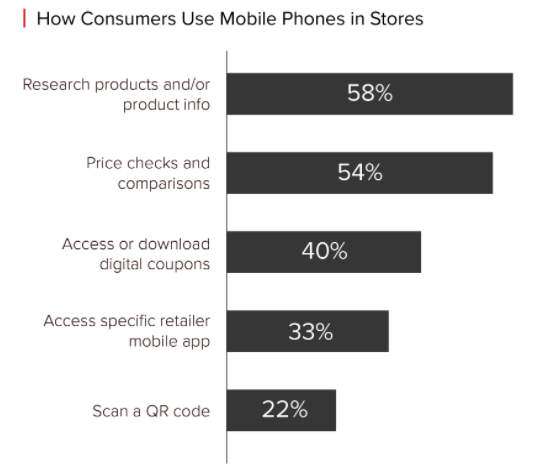
The term “omnichannel commerce” is getting popularity nowadays, and for a good reason. Even though your customers are physically present in your retail store yet, they can virtually wander around in your competitor’s store via their mobile app and compare your products with yours. Because according to Retail Dive, 54% of the customers use their mobile phones inside a store to check and compare prices of products.

consumers use mobile phones

To deliver an excellent omnichannel experience to your customers, the simplest thing to do is to provide them free wifi inside the store so that they don’t have to rely on mobile data to access your app.

You can also provide a feature in your app that’ll help customers identify where (which aisle of which floor) is the product that they are looking for is located in the store.

To deliver true omnichannel commerce experience, your app must have a reverse feature. It helps customers to purchase something from the offline store that they have viewed on your app and vice-versa. This feature will help you get more app downloads.

#8 Smooth and Secure Checkout

After putting all the efforts and money to deliver a great digital experience to your customers via an app if the checkout options aren’t user-friendly, then it will ruin the entire customer experience till then.

So, whenever you decide to go with m-commerce app development, make sure that your app has faster checkout options, integration with popular mobile wallets, and multiple card saving options. Following these basic practices will help you to increase customer retention.

#9 Push Notifications

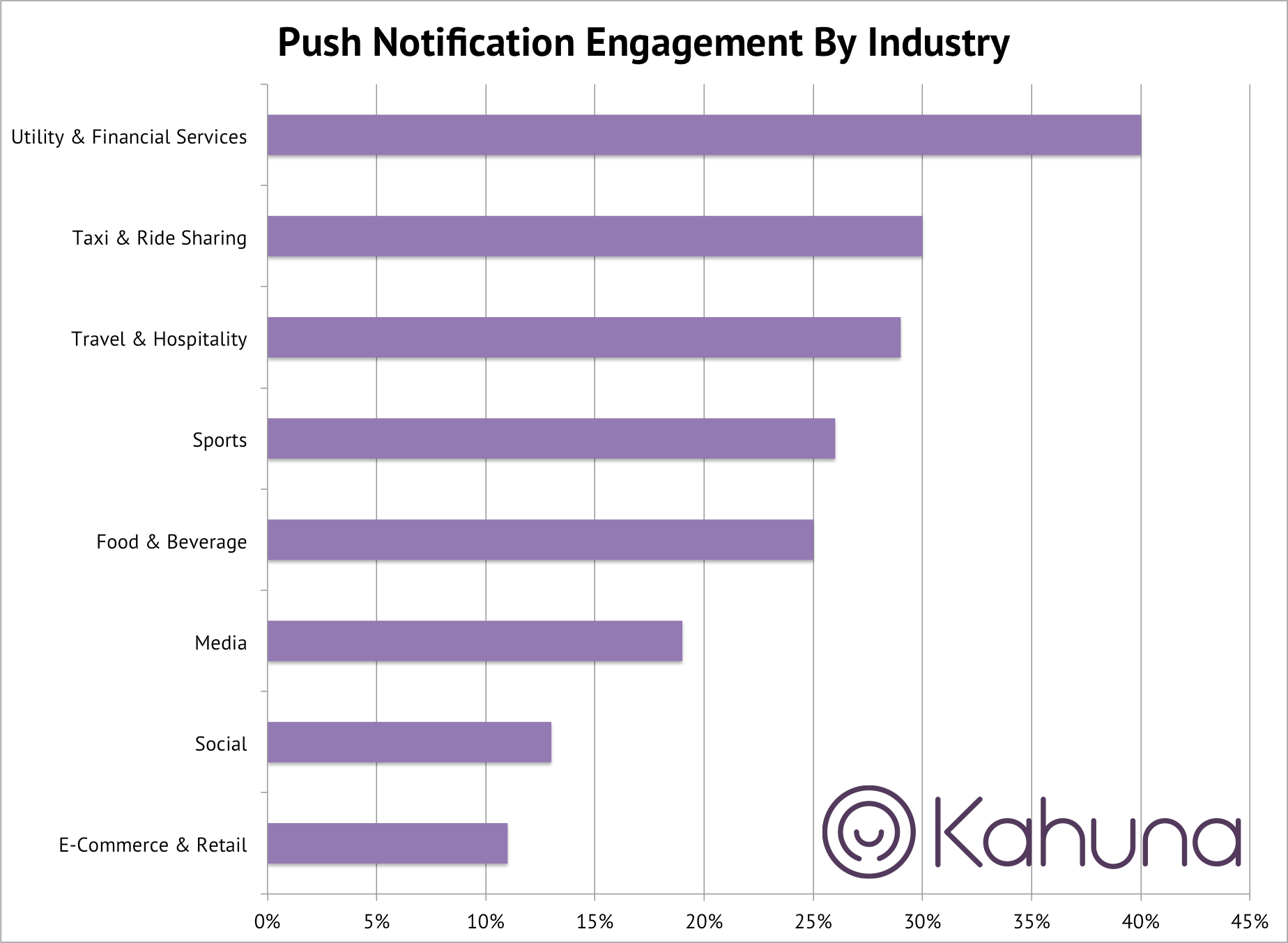
Push notifications are an essential element to awake your customers if they haven’t shopped from your store for a long time. It is also one of the most vulnerable features to have in an m-commerce app. According to Kahuna, the CTR for Retail industry is the least at 12% among the eight sectors.

push notification industry

One of the primary reasons for this is the number of push notifications per day or week. Sending too many push notifications can overwhelm the customers even during festive seasons. Therefore, even though, push notifications are a great way to engage with your customers; it is recommended to understand your customers’ shopping behavior and send personalized push notifications to each customer in the apt amount accordingly.

#10 Simplified Customer Service

Despite providing amazing product images, detailed product descriptions, simplified search, and FAQs, customers are always going to have questions in their heads. They are inevitable. As your store will grow, these questions are only going to increase. If you succeed in addressing all these questions, you’ve won the war.

It is recommended that you provide multiple customer support options such as live chat, phone call, or email. The main agenda behind providing all these options must be to solve queries of your customers at any cost.

Conclusion

All the features mentioned above are quite useful to create a good m-commerce app. However, if you want to achieve massive success through m-commerce app development, always listen to your customers. It can be in the form of feedbacks or analytics. Leverage this data to identify the features which are lacking in your app. Include those features in an update and repeat the same at every fixed interval. It can be a month, a quarter, or six months.

Don’t get too confused as to who will you be able to do all these things. Start by including these features into your app and leave the rest on your customers. They will be your ultimate guide throughout your entrepreneurial journey.

We have been featured as Top CRM Software Development Company on SoftwareDevelopmentCompany.co