I advise businesses scrambling to avoid disruption, and this is what I tell them

It is not rare for enterprises to revamp systems and processes only to discover that by the time the entire change is done – it’s time to move again. With advancements in technology and decline in costs, business models and ecosystems are constantly evolving. Technology has become a multi-headed Hydra; it’s not easy to master it. Digital platform is getting increasingly populated with frequent innovations in social, cloud, mobile and data space. Choosing the right technology mix vis-a-vis its associated business value is a complex task and more people with specialized expertise are needed in such strategic decisions. Hence, we see technology experts mushrooming in abundance, joining the strategic c-suite and brainstorming on how to avoid disruption.

You can’t avoid disruption – it’s not a fad

However, in the jungle of disruptive technologies, you can either be part of the disruptive forces or be at the receiving end. There’s no other alternative. Hence, an important shift in attitude is required to sustain and thrive in this jungle; you can’t avoid disruption – it’s not a fad. Instead, strategize to disrupt. This is the only strategy which will keep your stakeholders invested and you alive for a longer period.

Start envisaging the future

The future is never too far away; it’s important to draft a technology roadmap for short term, medium term and long term with clear deadlines. Also, for business strategy planners, optimism and pessimism are only two sides of the same coin. Lee Child puts it very nicely in words – “Hope for the best; plan for the worst”. There’s a caution sign here – be realistic! Don’t plan for doom scenarios that are unlikely to happen. Also, not all technologies and innovations are going to sustain the five year threshold period; so, invest only in those technologies which have some empirical evidence of delivering worthwhile ROI.

Hope for the best; plan for the worst

Transform to Disrupt

Below is a list of technology trends that are most likely to drive enterprise digital transformation in coming years. Aligning your organization’s future strategy with these trends will help you stay strong amidst disruption.

Chat Bots

Bots are invading Chat rooms – and no, this time they aren’t built for scamming. Bots are built on AI Algorithms and are designed to help users perform numerous functions (such as news reading, calendaring and organizing, food orders, flight bookings etc) via Messaging Apps (which are now bigger than Social Media). For enterprises, Bots are even more useful as they can reduce the workload for their customer communications teams. Advancements in speech recognition and natural language parsing is easing development of bots which can gather information from humans and translate it into structured data for processing. Further, Message.io, a Y-Combinator backed startup is now offering bot developers a private beta access to its bot management platform, which makes it possible to develop once and deploy across multiple messaging services.

10K+ developers are building chatbots for Facebook –TechCrunch

Internet of Things

Internet of Things (IoT) is billed as bigger than Industrial Revolution. It’s already making major headlines across the technology corridors. IoT Platforms Xively are allowing businesses to leverage over 300 connected product models. The economy is expanding with numerous vendors offering sensors, connectivity, integrations and application development services. Still, developing high performance and secure IoT systems presently comes at a high cost. A news report quoting Peter Sondergaard, SVP Research at Gartner says that “half the cost of implementing (IoT) solutions will be in integration and security…” It might be the right time to take early advantage. Having said that, investing in DIY IoT is not recommended; form partnerships with organizations which can provide you right strategy and expertise for.

Half the cost of implementing IoT solutions will be in integration and security

Streaming or Realtime Analytics

The premise of IoT lies in leveraging the information from things (and machines) to make them work better. However, the amount of this information or data is unlike anything the world has seen so far. Yet, implementing IoT without making full use of data will be a gross under-utilization. Data can help you in Descriptive (what happened), Predictive (what will happen) and Prescriptive (what could be done) analysis. Still, it’s reported that “only 8% of businesses are using more than 25% of their IoT data”. To derive optimum value from IoT, businesses need to invest in Realtime Analytics; and this is what they seem to be doing. According to a Markets & Markets report, investment in this field is growing at a CAGR of more than 30% (expected to reach $13.70 billion mark in 2021 from just $3.08 billion in 2016).

Only 8% of businesses are using more than 25% of their IoT data – Verizon

APIs

There’s an API for everything. As a business owner, you should look to expedite implementation of your business policies. APIs can help you do this and much more. There is a need to look at API beyond its utility in software development; APIs hold strategic business value. APIs facilitate creation of new user experiences with shared resources and expertise. Amazon’s highly successful business in (AWS) is based entirely onleveraging powerful API-based elements such as EC2. Google Maps would not have been so successful if developers couldn’t access its code and users were made to access it via website only. Hence, as a business, you need to have a strong API strategy for utilizing, sharing and managing APIs.

Netflix receives more than 5 billion daily requests to its public API – Deloitte

Blockchain

While Bitcoins have failed to live up to their initial hype, experts are now showing an increasing interest in the underlying technology. Together, public and enterprise Blockchains are all set to revolutionize the global economy. Blockchains can power financial applications for instantaneous funds transfer across geographies, micropayments, self-executing contracts, government aid/subsidy transfers, healthcare, digital rights management for artists and more. According to CoinDesk Research, “More enterprise firms than ever are working on Blockchain PoCs (70 to be precise)…14 of the top 30 banks are engaged in Blockhain PoCs.” Even central banks across the globe are now taking interest in exploring the platform. Although, making early investments in the technology is not advisable at this moment; it certainly has the potential to be a part of your long term strategy.

Sweden’s central bank is eying Digital Currency – Blockchain is seen as an option – FT

Credencys Solutions Inc is a leading software development services and solutions provider which has helped numerous businesses in building strategies for their business growth. Subscribe to our blogs for getting similar articles on management, strategy, leadership and more.

When people ask me ‘should I do Scrum or Kanban?’ I say, yes.

In the last blog, we discussed how to start implementing or introducing Agile to small groups and prepare them for the change. Next, it comes down to choosing between Scrum, Kanban and various other frameworks which have been evolving since last one decade. There’s no simple formula; each implementation has its own benefits and challenges. Once you understand all these benefits, you can make selections for your team and perhaps form a project management style of your own. Here are few things to keep in mind about all these methodologies:

SCRUM

Although, there’s no strict definition for selecting a methodology based on an organization’s size, there’s statistical evidence supporting Scrum being the most prominently used Agile implementation method. Despite enterprises implementing mature Agile frameworks (SAFe, LeSS, DAD etc), teams continue to use Scrum for managing their work.

Main benefits – Scrum makes you sprint

Being constantly put under deadline, the time-boxed delivery pattern motivates teams to work towards a definite, achievable goal. Asking team members to estimate their task completion times and then report their pending work in daily standups, not only makes them accountable to their work but also keeps them updated with their team’s overall progress. The Retrospective at the end of Sprint provides opportunity to all individuals to analyze what went wrong and what should be continued or avoided in succeeding Sprints.

Groups familiar to strict waterfall-style projects, find Scrum’s rigid structure easier to follow as compared to loosely structured Kanban. At the same time, Scrum gives them more freedom over waterfall when it comes down to responding to change/improvement requirements.

Caution – Mixing Scrum Master and Product Owner Roles

Understand the vital difference between these two roles.  Despite an obvious conflict of interest, in many organizations, a single person plays both the roles. In organizations where Scrum Master is given a Product Owner responsibility, it is generally seen that business priorities take a backseat while development teams remain in their comfort zone. The exact opposite happens when a Product Owner is pushing a team and leading the Scrum. For sanity, it is advisable to keep these two roles allotted to separate individuals. This will help you keep your backlog priorities stable – which is essential for Scrum to function properly.

KANBAN

kanban

According to Scrum Alliance, Kanban is the second most preferred Agile method. It’s common for scrum teams to use Kanban board for improved visibility into their projects.

Main benefits – it’s highly efficient

Though, there’s always a deadline – In theory, Kanban does not rely on time boxed deliveries as in Scrum. Still, it provides high efficiency by posing restrictions on items to be put under Work in Progress (WIP) list. This allows teams to have a better focus on their tasks. Using Kanban tools you can identify more valuable pieces of work and avoid time wastage in duplication, defects or lapses. On the other hand, Kanban allows timely customer feedback to make changes in requirements and priorities. It might appear counterproductive – but this is the very essence of Kanban enabling continuous development and delivery (as per client’s expectation).

Caution – Kanban won’t make your work simple

Kanban can be simple to use, it’s not an answer to all your management worries. Also, it might reduce wastage, but don’t expect it to raise your natural speed of work.

SCRUMBAN

As the name suggests, this hybrid of Kanban and Scrum allows teams to retain planning, review and retrospective meetings without any requirement to make sprint time commitment. Instead, teams using Scrumban are supposed to continuously groom their backlog while ensuring that the task list in WIP column isn’t crossing the defined limit. Usually, planning meetings are triggered when WIP limit is crossed or there are very few items in the list. While removing the constant pressure of Sprint deadline, this approach shifts focus to meeting customer expectation.

Main benefits – Thinking beyond Velocity

Scrumban discards Velocity (story points completed in a Single Sprint) as teams try to meet their commitments, at times compromising quality. Also, with newer teams (new to Scrum), estimates often go wrong and this may prompt stakeholders to question a team’s efficiency. Scrumban replaces Velocity with cycle time. This metric gauges the time taken by a ticket for its completion. By accounting all tickets in a project, one can calculate the mean cycle time and standard deviation for a team. This mean cycle time can help in future project planning and time estimations.

Caution

Although, Scrumban brings in the best of both worlds; it’s not flawless. If work remains in progress for too long, you will not be able to gauge its progress. Visualizing blockages can also be an issue and this can delay your projects. Hence, Scrumban is suitable for mature agile teams working in an unpredictable environment, where plans and requirements change frequently.

The Bottom Line

Choosing the correct Agile implementation can be tricky; however as discussed in this article starting with Scrum is easier for people new to Agile principles. Also, you will get ample training, tools and resources (both online and on-premise) to support your Scrum implementation. Once things get started and teams get familiar with Agile, you can introduce them to newer processes and eventually allow them to make a choice for themselves.

It is important to note that there is always a scope for improvement and you need to accept changes for continuous improvement. Agile, promotes flexibility and adaptation. That’s why every organization has its own method of implementing Agile. You can also experiment and evolve your own hybrid approach while ensuring that all these changes are improving your overall productivity.  All you need to do is take a decision and start.

The-Bottom-Line

Credencys Solutions Inc is a leading software development services and solutions provider which has helped numerous businesses in building strategies for their business growth. Subscribe to our blogs for getting similar articles on management, strategy, leadership and more.

Learning digital the hard way: India’s demonetization chaos

Catching citizens and banks by surprise, India recently discontinued the 500 and 1000 Rupee currency notes in its economy. The government reasons that the demonetization drive was essential to curb the black money and fake currency menace. Indian economy is largely slanted towards cash transactions, which constitute more than 90% of all transactions in rural India. As banks and ATMs run out of cash, people are losing patience. While the debate on whether the move will accomplish government’s said goals or not is still fresh, there is a need to focus on slightly tangential and more primal challenges in front of India’s economy.

Some experts believe that this move will prepare India for cashless transactions. This means that people would be expected to increase usage of e-wallets like Paytm and Ola-money. On the other hand, this will also reduce Cash on Delivery (CoD) transactions for e-commerce players. It may be noted that CoD is huge in India and is a big challenge for e-commerce players who have to bear costs for returns. Such transactions put extra pressure on supply chain and increase payments cycle for e-commerce vendors. Increase in amount of card payments can be a huge relief for the industry.

However, it is not as simple as it seems. India’s literacy levels (more than a third of population is still illiterate) and lack of low-level computer skills pose a huge challenge. A majority of population cannot be expected to make use of smartphones, online portals and e-wallets.

Further, World Economic Forum ranks India on 91st position on Networked Readiness Index; much behind its BRICS and Asian counterparts. While the situation is better in urban areas, rural areas lack basic infrastructure for high-speed connectivity. Overall, only 5.5 percent of the mobile users have mobile broadband and internet penetration is only 15% for Indian households. All this means that the relief for e-commerce players and e-wallet companies can only be momentary as the things are likely to get back to their default as soon as cash supply is normal.

The Silver Lining

The Indian government has ambitious digitization goals and has been generating a huge response with its “Digital India” initiative. 93% of adults or more than 100 crore people now have biometric-based Aadhaar cards, which are facilitating reduction of black money in the economy. The present government also launched 24 crore Jan Dhan bank accounts recently to improve Direct Benefit Transfers (DBT), which ensures credit subsidies directly into the account of beneficiaries, bypassing middlemen in the process. These steps have made a huge impact towards financial inclusion.

However, despite these laudable efforts, only a little over 50 percent of India’s population has access to banking services. Further, according to World Bank, India suffers from high dormancy rate of around 43 percent – which means that the bank accounts are lying idle.

Digitization of Banking Services

The infrastructural changes will take their time. Meanwhile, banks also need to gear up for the future. The answer lies in Digitization. Although it is too early to gauge the impact of demonetization on economic behavior and practices; emerging trends suggest that the things will be getting better by 2020. According to a Google-BCG report, digital payments industry in India will grow 10 times to $500 billion by 2020 and contribute 15% of GDP. Further, the report predicts that non-cash transactions will surpass cash transactions in the Indian economy by 2023. Yet another report from BCG says that about 315 million people in rural India (or 48% of the total online population) will be connected to the internet by 2020.

As the rural-urban divide becomes less prominent; there is a need to focus on solutions which are friendlier to the unique needs of rural India. Banking and Financial services working elsewhere around the globe cannot simply be replicated in the Indian environment. It is essential to get back to the basics, identify and accept all major challenges and then design solutions which meet the average user expectations in India.

The inspiration for these digital strategies can be drawn from the present. It is reported that social media and email accounts for 70% of internet usage in rural India. ICICI was perhaps the earliest to gauge this behavior when it allowed its users to do banking via Facebook.

icicibank

Others can also replicate the same or at least draw some UX and UI learning from social websites to make banking websites and applications friendlier for a rural user. It doesn’t take too much to design a simpler App for smaller screens and low bandwidth telecom networks. The present home pages for most of the banking websites in India are too cluttered, rely on in-your-face advertising and confuse even a normal internet user.

HDFC Bank

Further local language support is a must to make such solutions work across India. As online commerce picks up, people’s trust and familiarity to card payments and e-wallets are likely to increase. Banks need to incentivize and market such cashless instruments.

While the private banks in India have taken an early lead in digital, public sector mammoth SBI is not far behind. The bank is undergoing a technology transformation and is closer to reducing its downtime to five times per year (near to global standards) from around 50 times per year three years ago. Moreover, one-fourth of SBI’s retail customers on web banking now also use its mobile banking option; a figure which the bank is eager to increase as mobile internet usage becomes more common and affordable for an average user.

Increasing the Investment Appetite

Reducing cash dependency for banking and payments is only one side of the coin. The bigger challenge is to increase the investment appetite and discourage cash-hoarding or jewelry buying habits. It’s a tough nut to crack. A majority of population isn’t comfortable parting its hard earned money with any risk-based investment instrument; they are happy with their savings accounts or fixed deposits.  While aversion to risk is an acceptable factor; lack of awareness, misconceptions, and lack of user-friendly solutions is also responsible for this situation.

India holds huge potential for the financial sector to simplify the investment space for a common internet user. While there are portals like Policybazaar, helping users to compare and select mutual funds; it isn’t much of a help as there are too many options available. According to Sanjiv Singhal, founder, Scripbox an average investor is not equipped to take such decisions. There are more than 8000 mutual funds available in the market and without any solution helping a user with proper analytics; users are left to decide on hunches and friends’ advice. Scripbox is trying to make a difference by simplifying and automating mutual funds investment for users. It’s an early mover in the Indian financial investment space and there’s a lot of room for others to innovate and acquire.

Mobile based applications offer a simple avenue to increase investment awareness among the general population. Further, banks and NBFCs can innovate to create solutions that remove unwarranted fears and streamline investing for a common man.

The Bottom Line

Don’t ask a common man to discard cash – give him solutions as simple as using cash!

Credencys Solutions Inc is a leading software development services and solutions provider which have helped numerous businesses in building strategies for their business growth. Subscribe to our blogs for getting similar articles on management, strategy, leadership and more.

One Critical Factor Affecting all Your Agile Initiatives

A Seattle based million dollar company with more than two decades in the industry recently decided to revamp its delivery department with cutting-edge tools and the much celebrated ERP software, which if successful will be implemented across the board. However, the employee response has not been enthusiastic. The mid-management is reluctant to move beyond emails and delivery heads are citing several reasons to delay the implementation.

Sounds familiar? Consider another one

Alex has spent 15 years in a Fortune500 firm. He has worked on big enterprise projects and has led teams, ensuring deliveries on time and as per clients’ expectations. He has recently joined a new organization, but now he is facing issues implementing his favorite tools and processes for software project management. It has come to the management’s notice that their flagship project is heading nowhere as teams under him are underperforming. Some have complained that he is not the right person to lead them.

The above two stories point towards a common problem which science likes to call as Inertia – the middle age executives at Seattle HQ are afraid of the new software while Alex is unable to work with his old ways in his new organization.

Bringing any change into one’s Organizational Culture is perhaps the biggest challenge any company can undertake. This change becomes even more severe for software firms shifting from Waterfall to Agile. The situation is compounded with limited or wrong understanding of Agile and Scrum. There is a lot of noise, and there is no shortage of firms using Agile as a Marketing buzzword. Some even claim that Agile is dead. Amidst all this, finding the right strategy to successful Agile implementation becomes a big undertaking for any organization.

Yet again there are numerous examples of organizations successfully implementing and advocating Agile.

At Credencys, we have been fortunate enough to develop a clear and simple understanding of Scrum – which is a process that works for us pretty well. We are 100% Agile – even Marketing, Finance and HR teams use QuickScrum. Having said that, I think every organization implements Agile differently; and as long as it works, who cares if it’s 100% Agile or not.”

Sagar Sharma, CTO & Co-Founder, Credencys

So how do you take it forward? If you like Agile – you already have the answer.

Start Small

Before going across the board, start with a small project. Identify people who are more receptive to the ideas of Agile. Bring in Agile Coach or Scrum Masters to guide them. Also make sure that the project isn’t so small that nobody takes it seriously; nor should it be so critical that its failure affects your organization adversely.

Sell Bigtime

Start rewarding small successes in the project (e.g. completion of a sprint). This will start conversations, generating interest across your organization.

In Frank Underwood’s world this is a progress as more people would now be open to trying out the new approach.

Communication. Collaboration. Accountability.

The main issue in transitioning to Agile is people’s affinity to traditional waterfall approach under which teams work in silos (or isolated cubicles) with limited or no visibility into what’s happening ahead. Individuals accept accountability for only their own work. The lack of visibility and collaboration gives rise to incompatibilities and eventually an overall reduction in efficiency. People who have worked all their lives under this environment obviously find increased emphasis on communication, collaboration and shared accountability a bit perplexing.

Agile requires people to be accountable to not only their work but also to their team. Hence, you might allow people to sit in their old cubicles, but make them come together for a daily standup. These meetings will keep them updated about each other’s task progress, providing them a better overview of their project. As sprints progress, the members will have to start working on their team velocity (which you can incentivize) by functioning better as a team, looking after each other and working towards a goal. The sprint retrospective, will give you the best opportunity to assess the overall progress of your transition effort.

Increase Change Acceptance

Waterfall is known for its rigid Scope documents. And it gets worse with the Change Management Board. Clients and the change management rarely agree. The change management processes in waterfall make clients weary of giving feedbacks. On the other hand, the developers are also attuned to saying no to any changes. Agile on the other hand requires everyone to think beyond the scope and introduce any changes to meet end goals in a better way. The planning for requirements is dependent more on developers who should be encouraged to create their own tasks to meet requirements. This approach makes everyone a winner.

Get Everyone Involved

Agile is without hierarchy; and by definition, everyone involved in making a shippable product is part of the team. This means inclusion of analysts, quality assurance staff, delivery managers and DevOps. Hence, you need to ensure that the team is available for supporting the software till it is deployed and reaches stability. If you want Agile to be implemented successfully, development has to be aligned with deployment and production support functions.

Moving on, you may have to face challenges like choosing the correct Agile implementation for your firm – something we would answer in our next blog.

Conclusion

It is okay to start small, but you should plan to make it big. At times it will require you to get your hands dirty. You can take inspiration from Lenovo’s CEO, Yang Yuanqing, who wore a “Hello, my name is YY” card – encouraging his employees to call him by his name. He felt that this was essential for bringing a culture change to work with the west where open communication and equality is a norm. As highlighted throughout this article, getting your people ready for Agile is the major task, tools and processes will follow sooner or later.

Credencys Solutions Inc is a leading software development services and solutions provider which has helped numerous businesses in building strategies for their business growth. Subscribe to our blogs for getting similar articles on management, strategy, leadership and more.

​Pokémon Go is Pushing Businesses to Revisit Their Marketing Calendar

Pokémon Go is affecting traffic.

People are getting tickets because of Pokémon Go.

And it is affecting their work as well.


The memes have just started.

Pokemon

Pokemon Go

Smartphone users are going bonkers, trying to “catch” Pikachu or Squirtle or other creatures with their smartphone. It can be a good workout as catching the virtual creatures often requires a great deal of walking on streets and around public places. Users need to refer to an animated map akin to a Google map which pops up on their screens showing if or not there’s a Pokémon in their nearby areas. Well, if you haven’t collected Pokémon cards – it’s little difficult to understand the inherent fun factor it has for the players. Still, there’s no need to feel left out. Pokémon can be used for business and you don’t have to be an expert player for this:

Use Pokémon Lure for Increasing Footfall to your Retail Store

Pokémon Lure is a feature in the game which lures Pokémon to your area. However, when you turn it on, it also brings other Pokémon players to your area – as they would also be interested in catching the virtual creatures. This can help restaurants and retail store owners increase footfall to their premises. There is a limit to free Lures; however, you can buy more lures at very nominal charges.

It’s not the first time that a game app has been used for marketing and promotional purposes, but none of the apps in the past have panned out as Pokémon Go. It is reported that since its July 6th launch in the US, the app has added more than $7.5 billion in market value to Nintendo, which owns a part of The Pokémon Company.

Why is Pokémon Go such a big hit?

Analysts are wondering why it is such a big craze. It’s definitely not the novelty factor – Augmented Reality Apps have made their presence felt in the past too; Snapchat is a good example. Moreover, Pokémon Go is built using the same geo-location database as in Ingress, which is a similar game by the developers of Pokémon Go. So why did Ingress fail while Pokémon Go created Tsunamis? Some say the answer lies in the marketing. Pokémon is a big brand that millennials very easily relate to. Combine that with good timing and social proof – you already have the main ingredients for a good success recipe covered.

Whatever is the cause, one thing is for sure – there is a lot of scope for innovation in Augmented Reality and location based entertainment. Although not every business can expect to create another Pokémon Go, there is a higher probability today for their awesome app to be discovered by users than it used to be a few years ago – thanks to Google Nearby. Developers can use Google Nearby APIs to create better apps for local collaboration, screen sharing, multiplayer gaming and local messaging purposes; club it with AR, and you never know what magic it will create. Another possibility for retailers is to explore the possibilities with their in-store beacon network.

There are experts who may refute such innovations or call them a passing fad. Some are even raising doubts over Pokémon Go being hailed as an AR application. However, businesses are only concerned about the ROI and care less about what technology or innovation drives it. AR has long been termed as the technology which has failed to deliver. However, there is enough evidence to suggest that it is only a matter of time before it matures into something bigger and more ubiquitous than smartphones are today.

Credencys Solutions Inc has helped numerous businesses in retail leverage Cognitive Technologies (AR and VR Apps) for their business growth. The company came up with its Smart Mirror solution way back in 2013. Since then, Credencys has evolved into a leading software solutions and managed services provider for enterprises across the globe. See some of our related work here.

Wow your Customers with AR and VR

image_1
“First electricity, now telephones. Sometimes I feel as if I were living in an H.G. Wells novel” said Downton Abbey’s Dowager Countess, Violet. Her character is marked with similar steely indifference for novelty. No wonder she sees a phone as an “instrument of torture”. One doesn’t have to go too far to gauge how she would react to the rapid changes in technology that are happening these days – there is enough to be witnessed on YouTube:

AR (Augmented Reality) and VR (Virtual Reality) tools can dramatically freak out baby boomers, as shown in the above video; however, utilized in proper dosage and with the right treatment, these tools can wow them as well as audiences in any age group and demography.

Difference Between Augmented Reality and Virtual Reality

There is a lot of confusion in a general reader’s mind about the technologies and it is not rare to see people using the two terms interchangeably – which of course is gross ignorance on their part. Contrary to general perception, AR doesn’t create new experiences; rather it builds on or augments what exists in the real world. This means certain virtual elements are fitted (integrated) over the real world (physical space) On the other hand, VR is what creates new worlds or experiences. The technologies have reached high levels of maturity and are increasingly being utilized by businesses across sectors.

AR and VR Tools Hold Massive Market Opportunity

statistaSource: Statista

As can be seen in the above illustration, AR and VR is equally important for consumers as well as enterprises. Goldman Sachs predicts the industry to reach a value of $80 bn a year ($35 bn in software and $45 bn in hardware) by 2025. In line with the trends so far, Goldman Sachs believes that in future also video games, live events, and video entertainment will drive the consumer-focused segment of the technology. However, businesses can also innovate to leverage the technology for their benefit and it will not be a surprise if they beat the predictions.

10 Interesting AR and VR Apps You Must Check Out

1) Google Translate

If you haven’t used it already, here’s a small description – just hold the camera in front of the text you want to translate and the App will do the rest (provided the script is recognized or part of the App’s database). Though it might not be too useful for someone trying to translate and understand reams of classical french literature, it may help tourists to get English translations for sign boards on streets and shops in foreign locations.

2) iOnRoad Augmented Driving Pro

The driving assistance App provides collision and lane departure warnings making use of phone sensors, GPS and camera. The App can also help you avoid speeding tickets as it can read ‘speed sign’ boards and create alerts every time you cross the speed limit.

3) Field Trip

Visiting a new town; it’s the perfect guide you can get. The App will provide you information on local history, nearby cafeterias, markets and other special places of interest. The information pops up on your phone screen every time you are near to an important landmark.

4) Snapshop

The App helps you virtually place furniture inside your home to see if it suits the ambiance and fits in the space. You can choose furniture from IKEA, Crate&Barrel, CB2, Horchow and Pier1.

5) NYT VR

In an age when most of the news is read online, NYT has perhaps the best offering for its readers who can now view documentaries and other features via its VR App. New VR content is added every month; although, the VR headset is most recommended you don’t essentially need it to view the content.

6) GoPro VR

Adventure junkies across the world upload 360 degree GoPro videos in abundance on daily basis and you can catch all this action comfortably in your couch with GoPro VR App.

7) Cedar Point VR

There are numerous VR roller coaster rides and unarguably they make the best impression on a user experiencing VR for the first time. If you haven’t tried it yet, you may start with the VR version of Cedar Point’s Valravn roller coaster which is claimed to be the tallest, longest and fastest roller coaster in the world.

8) Virtuali-Tee (Prototype)

Virtuali-Tee is a smart T-Shirt that integrates with the App installed on smartphone/tablet to let viewers see through the T-Shirt to view bones, organs and blood vessels. Designed by Curiscope, the AR App is targeted at students learning human anatomy.

9) Within – VR

(formerly Verse) It’s a content aggregator with best of the world VR content from The New York Times, Vice, Saturday Night Live, U2 and others.

10) War of Words

If you love poetry, this App will take you back to 1916 and let you experience Siegfried Sassoon’s poem “The Kiss” in VR.

Increasing Relevance of AR and VR Tools for Retailers

AR and VR tools continue to gain traction and are now being employed by retailers. A Business Insider report has captured US consumer expectations from the technology in the retail sector (see exhibit below):

image_2

US consumers have shown a positive sentiment towards AR and VR’s adoption by retailers. According to the survey, a significant number of US consumers expect the technology to enhance their online shopping experience. However, retailers want to use AR and VR for attracting customers to their Brick and Mortar Stores. Perhaps, this mismatch in expectations offers an opportunity for omni-channel retailers to utilize AR and VR for improving customer experience on all fronts.

How Retailers are Experimenting with AR and VR Tools

Walgreens

The drugstore chain has been experimenting with the technology since 2014 as part of its loyalty program. During its trial run, Walgreen’s VR app provided customers a 3D map to locate products on shelves inside the store. With this App, Walgreen aimed to create an immersive gaming experience, providing customers points on visiting certain sections of their stores or build a bigger basket.

Dippin’ Dots

You might or might not love this “futuristic snack”, but the company has been very active in utilizing mobile apps for its promotions. Dippin’ Dots has launched various fun apps which provide loyalty points to customers. Their AR App – “making it rain Dippin’ Dots” allows customers to experience Dippin’ Dots raining inside the stores and even inside their homes if they wish so.

Lowe’s

The company’s much talked about Holoroom – a VR App, allows customers to build kitchen or bathrooms in a virtual space and then allows them to experience their design ‘in real’ with Oculus Rift or Google Cardboard. You might not be able to walk inside your designs for now; but that is not a distant future, it seems.

StubHub

The company has perhaps the most ingenuitive VR app, as it is hard to imagine what an online ticket-seller could possibly provide in terms of VR experience to its customers. StubHub’s VR App helps customers choose seats for events by offering them a 3D rendering of the stadium/auditorium. With 3D immersive view, customers can better decide if they want to select a particular seat at the back with unobstructed bird’s eye view or pay more money for seats available at the front. However, StubHub is not alone; Rukkus has taken seat maps to another level with panoramic photos.

Tommy Hilfiger

The company made headlines in October 2015 with the launch of its VR app, allowing store visitors to view the company’s coveted Fame runway show with a Samsung GearVR headset. If you enjoy catwalks, you may want to opt for the virtual experience – front row seats are always available.

Wayfair

The company has recently announced release of WayfairView – an AR App, which allows shoppers to select any furniture from its online store and then virtually place it inside their homes to see if it gels well or not. The app currently works with Lenovo PHAB2 Pro and allows customers to virtually move the furniture around, browse through various layouts and designs to finalize a product for purchase.

How Viable are AR and VR Apps for Smaller Players

Above are just some of the celebrated examples of how big retailers have utilized AR and VR apps for engaging their customers and providing them with new shopping experiences.

While designing a feature rich VR application with practical value for customers might not be possible for everyone; there are numerous examples of businesses utilizing AR in print ads. AR advertising makes presentation of catalogues easy for retailers. It provides businesses an opportunity to showcase their entire product range in 3D over a single page advertisement in any leading magazine. Further, small retailers and startups can create such ads with freemium versions of custom, white label app creation platforms bevond.

Still, the apps haven’t achieved the ubiquitous status. It is a challenge for businesses to ensure that the technology offers real value to their customers. There is no shortage of people who doubt any practical viability of such Apps. Also, overlaying anything virtual on a phone screen may appear gimmicky. Most of the present AR and VR solutions have a limited novelty value. It might be amazing for customers to receive promotions on phone screens when they point their phone camera to product shelves in a shop, but one should also realize that a mother shopping for grocery items, with her 2-year-old sitting in the trolley and a 7-year-old dragging her to the new toy’s section, would rather attend to her kids than fiddle with her phone. Holding tablets or smartphones in the air and scanning for offers might not be everyone’s cup of tea.

However, the perception of AR and VR being a marketing gimmick is about to change very soon as long awaited Google Tango has finally arrived in the consumer space.

Google Tango Enters Consumer Space

With Tango (AR platform) being finally made available for customers, more retailers will be eager to join the bandwagon and reap benefits of virtual commerce. For those who are not aware – Project Tango was started by Google and has been on developers table since 2014. It is a technology which uses sensors and multiple cameras for motion tracking, depth perception, and area learning. With these abilities, the technology enables a smartphone (presently available only in Lenovo PHAB2 Pro) to track its location in a 3D indoor space.

Moreover with this technology physical objects in a user’s surrounding (baseball bat, soccer ball etc) can be integrated into the simulation along with the actual user motion. This is unlike the present AR and VR tools where headsets are only able to project a stationary virtual space, with user body playing no part in the simulation. In terms of applications, Tango can allow retailers to overlay virtual 3D images of their products on their users’ surroundings.

What Lies Ahead?

AR and VR tools are up for grabs and while marketers have been the early adopters, businesses realize that these tools can also play an important role in improving their operations. Customer response for AR and VR Apps has also been very positive; this is reflected in the number of downloads for Google Cardboard which crossed 50 million mark on Google Play in May 2016. Moreover, according to Statista, the total number of active VR users is forecast to reach 171 million by 2018 and this opens a large space for retailers to make their presence felt. However, organizations must start early with a proper mobile strategy and make use of AR and VR solutions to create differentiation and gain first mover advantage in the hyper-competitive markets.

About Credencys

Credencys Solutions Inc has helped numerous businesses in retail leverage Cognitive Technologies (AR and VR Apps) for their business growth. The company came up with its Smart Mirror solution way back in 2013. Since then, Credencys has evolved into a leading software solution and managed services provider for enterprises across the globe. See some of our related work here:


The Future of Retail : US Retail Industry Trends, Stats & Forecasts

Being a leader in retail, the US defines major trends and direction for the industry all over the world. Walmart is not only the world’s largest company by revenue, with its 4000 stores it is also one of the world’s biggest employers. In fact, 76 of the largest retailing companies are US based and many of them have operations in other parts of the world as well.

The Ubiquitous Mobile

At present the industry is undergoing a massive overhaul with technology changes taking the center-stage. Advancements in mobile and e-commerce are changing consumer shopping preferences, forcing retailers to make huge investments in their consumer facing processes and also in their supply chain.

1.Casey-Carl

“We know that technology will continue to revolutionize retail, and that Target’s future will be built on innovation,”

Casey Carl, Chief Strategy and Innovation Officer, Target.

Target spent $1 billion in 2015 on strengthening its e-commerce capacity.

Mobile firmly established itself as the dominant shopping trend, for both traffic and sales…Mobile is making up more than 70% of traffic to Walmart.com, and now nearly half of our orders since Thanksgiving have been placed on a mobile device – that’s double compared to last year. Our customers went from previously mostly searching and browsing on mobile to making purchases at a much higher rate.

Fernando Madeira, President and CEO, Walmart.

fernando-madeira

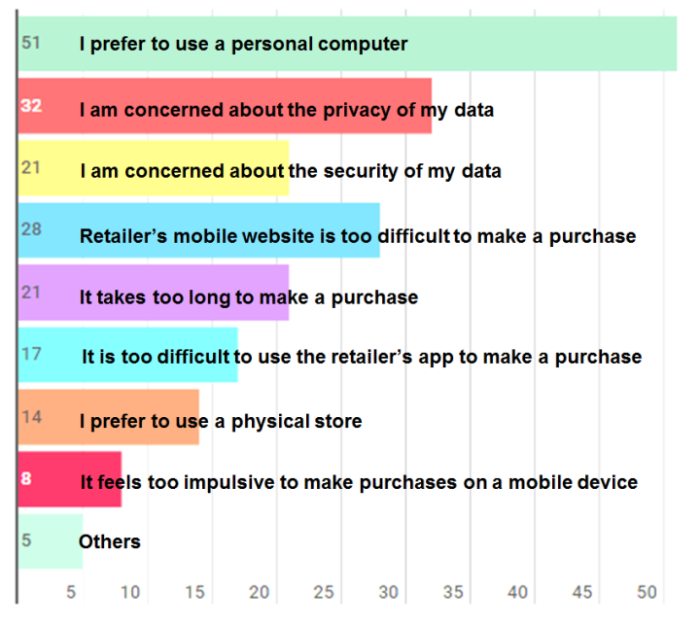
There is no dispute on mobile being the key channel for customers across all age groups and geographies. However; according to a Business Insider Report 40% of the top 100 global retailers do not have a dedicated mobile website. This is despite the fact that 71% of shoppers believe that they will get a better deal online than in stores. Also, 53% of all online traffic comes from smartphones, but they drive only 29% of all online sales. The basis for this anomaly can be found in PwC report which says that 70% of all consumers prefer researching for products online and buying them in stores. A report by The Economist Intelligence Unit sheds more light on what prevents consumers from completing their purchase on mobile:

Why don’t you purchase products or services using your mobile device more often?

Top 3 reasons (% respondents)

chart

Source: How mobile is transforming retail Bricks, clicks, tweets and texts across the omnichannel shopping mall, The Economist Intelligence Unit

It can be concluded from the above chart that while there may be a traditional bias towards using desktops for purchases, there are some lingering issues in the mobile strategy adopted by retailers. Many of the retail apps are not ready enough to provide a seamless shopping experience to customers. Moreover, a large number of retailers see mobile as merely a promotional tool and hence their apps carry a minuscule portion of what is being offered in store to ‘real buyers’. Having said that, promotions is a big category in itself and drives a lot of interest from customers. Retailers have the opportunity to make most of their promotions via mobile as 60% of US consumers want to receive real-time promotions and offers on their mobile. To get better deals, they are willing to share data on their likes and preferences and install such apps from retailers.

3.eric-nordstrom-e1466059371502

As customers’ definition of service continues to evolve, we are focused on being responsive and delivering services and experiences that are important to them…our customers have asked us to make Nordstrom Rewards more flexible. They’ve told us they want to be able to earn points whether they use their Nordstrom card when they shop with us or pay in another way, and today we hope we’ve delivered on their request.

Erik Nordstrom, Co-President, Nordstrom commented after the company’s decision allowing members to earn benefits regardless of how they choose to pay for purchases across its store, outlet store or digital channels.

The readiness for mobile based promotions has caught marketers’ attention and according to a report 60% of North American retailers plan to have tools for ‘suggested selling based on previous purchases’ in next 3 years. Yet, marketers also need to provide due importance to privacy and cyber-security related issues in their online strategy, as these are big concerns for consumers. The data breach at Target has not been completely forgotten; US consumers rate personal devices more vulnerable (44%) than POS devices at retail stores (23%).

Crafting New Shopping Experiences for Customers

The challenges with mobile are widely known and retailers are addressing these challenges on priority basis. At the same time they are scrambling to create differentiation utilizing wearable technologies, Internet of Things (IOT) solutions and Augmented Reality. They are trying to not only improve shopping experience for their customers, but also create entirely new experiences for them.

For instance, Tesco offers Scan as you Shop option to its customers which basically lets customers scan item bar codes; this makes drastic reduction in waiting time at the checkout counters. Nordstrom is another retailer which has made significant investments in mobility with multiple apps for its customers. The company recently launched TextStyle, which is a unique text based personalized service connecting customers with their favorite salesperson or personal shopper.

“You wake up this morning and there is no hot water. Your water heater is broken. Most people are going to go to Google and try to find a plumber, right? We’re going to be there with you saying, ‘We’ve already picked the plumber in your market, we’ll 100% stand behind that plumber and they will be in your house today to replace your water heater what nobody else can do’. So online lead generation, connecting you to the right service providers, making sure there is good communication back and forth between the customer and Home Depot, we are really shooting that services business with a shot of adrenaline.”

4.kevin hoffman

Kevin Hofmann – SVP and President, Online, The Home Depot explaining his company’s focus on building the Do-It-For-Me customer experience.

leena munjal 

“We’re using digital innovation and this new store space in a different way which will enable us to deliver a superior shopping experience to our members…the store in Ft. Collins is a great example of how we are focusing on our best categories, stores and members and how the right blend of a physical store with Sears’ digital capabilities can deliver a fresh, innovative and convenient way for our members to shop.”

Leena Munjal, SVP, Customer Experience and Integrated Retail, Sears Holdings on the opening of the company’s hi-tech store which includes a humongous 122-inch interactive digital display that helps customers visualize how new appliances would appear in a full-scale kitchen with customization options on their tablets

Crafting amazing customer experiences is delicate task and requires considerable experience in understanding consumer behavior. This is where Big Data analytics may prove to be beneficial. At the same time IOT and Cognitive Technologies may also offer answer to challenges in sales and management in modern retail.

NRF-FitForCommerce Omni-Channel Retail Index: 2015 Holiday Findings
86% of retailers in the index provide a shared shopping cart from mobile to desktop
28% offer BOPIS
70% allow customers to buy online and return in store
46% have in-store signage about omni-channel service
48% have online-offline compatible loyalty programs

The Evolving World of Omni-Channel Retail

Retailers are bullish on omni-channel strategies as omni-channel is seen as the Holy Grail for engaging smartphone addicted consumers.

“Omni-channel can have a compounding impact on growth. EY experience and even retail annual reports demonstrate that customers who shop online and in-store spend twice as much as those who only shop in-store.”

Matthew Burton, EMEIA Omni-channel Leader, Supply Chain & Operations, EY

Still, there isn’t any simple formula to make a retail chain successful on multiple fronts; even Walmart has failed to crack the code. While omni-channel has been proposed as a strategy which could help retailers compete with online giants like Amazon; its successful implementation poses tough challenges in terms of supply chain and inventory management. An EY survey on omni-channel strategy in 2015 also reported these issues:

  • Big Data Challenge: 74% of the retailers reported that they do not have IT systems and capabilities that enable seamless visibility and fulfillment to end consumers.
  • Fulfillment Challenge: 40% retailers reported no mechanism to fulfill out-of-stocks

BOPIS is the Way Forward

eb9ee9d3-87c2-4b48-b9ab-cec166f4baf8.HR

Source: Blackhawk Engagement Solutions

Retailers are eagerly adopting BOPIS as a main avenue for implementing their omni-channel strategy.

  • In 2015, BOPIS contributed 30.2% to Sam’s Club and 22.6% to Kmart’s online sales
  • In 2015 holiday season Walmart saw maximum users opting for BOPIS followed by Best Buy, Target, Kmart and Macy’s
  • 69% of shoppers who used BOPIS in Christmas holiday season last year purchased additional items while picking up in store

As discussed earlier, fulfillment is a major challenge against retailers. Often customers are able to see a product available in stocks at the time of online booking, but find it otherwise when they arrive at store for pickup. At other times, they have to wait in long queues as the store staff has to attend regular customers and the BOPIS customers at the same time. Nonetheless, the trend is here to stay and there is no way around. To make BOPIS seamless, retailers need better data and inventory management solutions and may have to invest in upgrading their existing software. Further, the store staff has to be equipped with mobile solutions for assisting customers promptly.

The Future of Retail

In the recent times, retail has declined despite the rise in consumer spending. Although, consumer confidence has taken a dip to 92.6 from 94.7 in April, the consumer spending which accounts for two-thirds of US economic activity registered a 1% rise in April 2016, the largest month-on-month gain since August 2009. Still, the US Retail Sales YoY is forecasted to stay unchanged at 3% in May 2016 and reach 3.9% by May 2017.

The recent spike and sales projections are in line with McKinsey’s observations on the state of US retail where it says “slower growth rate is likely to extend well beyond the five-year time horizon, becoming the “new normal”. Within a tepid overall market, however, there will be several pockets of strong growth.” McKinsey also made following projections about the consumer profiles:

  • Millennials (population between ages 13 and 30) which constitute 15% of the US consumers, will account for close to 33% of total spending by 2022
  • However, baby boomers will drive major categories such as food (92%), housewares (73%), and apparel (56%)

Meanwhile, retailers are blaming changes in consumer spending patterns for their dismal performance – it has been reported that Americans aren’t buying clothes and are instead spending on real-estate, home furnishings, cars and boats. It will not be too wishful to assume that the spending spree would halt and consumer demand for retail items and apparels would peak up again. Perhaps, retailers will utilize this brief lull to boost their infrastructure for tackling the challenges of future.

The technology landscape is changing rapidly and will decide the fate of retailers. It remains to be seen if CIOs in retail organizations would go beyond their comfort zone to harness the benefits of technology; Gartner predicts that “By 2018, CIOs of at least two of the world’s largest multichannel retailers will be sued for data breaches.” Eventually, the future of retail would be defined by leaders who do a better management of their security as well as marketing and operations while maximizing the benefits of technology for their retail businesses.

Credencys Solutions Inc is a leading software solutions and managed services provider which has helped numerous businesses in retail leverage Mobile, Cloud, Big Data, Internet of Things and Cognitive Technologies for their business growth. Check out our resources and portfolio to know more about our solutions.

Re-imagine Retail: The Key Takeaway from Walmart’s Shareholder Conference 2023

Walmart’s shareholder meeting 2016 was attended by its 5,700 store employees and the board, who were entertained by late night TV star James Corden and musicians Katy Perry, Nick Jonas, Maxwell and Andy Grammer. Their mood was further lifted by their CEO’s announcement of the company plans to add $60 billion in new revenue growth over next three years. All this happened even as everyone expected the elephant in the room to be addressed – Amazon has surpassed Walmart in terms of market cap and the company experienced an end to its growth run with revenues shrinking for the first time since it went public in 1970.

Walmart in CEO Doug McMillon’s words is planning to “re-imagine retail again”. Given below is a small summary of how the retail giant is planning to make a comeback and the key takeaway it offers to any retailer – big or small:

The Company Will Make More Use Of Technology In 2016

Walmart wants to reduce inventory build-ups and increase availability for its store customers. For this, it has equipped its staff with handheld devices and apps which help in managing stocks. The company is also going to make some real use of drones in inventory management. Walmart has tested its drones in its large distribution centers where they took pictures of products on aisles and created alerts for items that ran out of stock or were misplaced. Walmart claims that these drones will be utilized at its warehouses to carry out routine inventory checkup – a process which used to take 30 days will now be completed in one day with these drones. Further, the company has initiated home deliveries after joining hands with Uber and Lyft.

Walmart Will Be Increasing Its Online Options, Including Groceries In 2016

What usually appears to be an obvious step is not always easy to implement – that’s perhaps the only excuse for Walmart, allowing itself to be in the backseat while others took the lead in online sales. A giant like Amazon which posted more than $79 billion worth of product sales in 2015, reported a 16 percent growth rate, which was higher than Walmart’s 12 percent growth in its e-commerce channel which accounted for less than $15 billion in sales. Walmart’s under performance in the e-commerce sector has perplexed analysts. However, the company is finally addressing this area and is putting a strategic focus on improving online sales. It will only be fair to assume that Walmart trying to adopt online model will have lesser friction in its way than it will have for Amazon trying to enter Brick and Mortar model.

The Company’s Mobile Payment System Walmart Pay Will Be Seen At Every Store Across The US

Walmart Pay (which essentially is a mobile wallet) is a part of Walmart App that lets users create/log into their Walmart account, enter and save their card details, and then pay in-store by scanning a QR code. Walmart Pay, which works on both Android and iOS, had more than 24 million users at the end of 2015. The solution is likely to ease payments for the company’s 140 million plus weekly store visitors in the future. Mobile Wallets are a useful innovation as they improve customers’ shopping experience, help them store and manage their payment receipts and also allow merchants to roll out offers.

With the likes of Wallmart joining the mobile payments bandwagon, mobile wallets from Apple, Samsung, Google and PayPal will also get a boost as customers are seeing a wider acceptance of wallets from merchants. Mobile payments are showing an uptrend in the US and are seen as the future of payments; according to a Business Insider report, by 2019, mobile payment volume will touch the $800 billion mark.

The Key Takeaway – Do Not Pick Up Technology As An Afterthought!

There are some other major initiatives like making product prices more competitive and re-launching the smiley face logo – all of which can perhaps turn things around for Walmart. However, the key takeaway or learning for retailers around the globe lies in Walmart’s increased focus on technology. Walmart has suffered due to technology disruptions made by Amazon and their likes. By not acting fast enough, it has allowed online players to gain advantage over its brick and mortar model.

Hence, retailers should take note of this and include technology as a core business strategy and not as an afterthought. Tapping into the modern smartphone crazy consumer base is essential for any retailer’s business. Mobile payments, e-commerce, digital coupons and i-beacons aren’t gimmicky fads – retailers can make most of these opportunities in technology as they also offer a lot of room for innovation and growth. Although the online space is very competitive, with proper applications one can leverage technology to make significant improvements not only in online sales but also in-store footfall.

credencys_retail_solutions

Credencys Solutions Inc is a leading software solution and managed services provider which has helped numerous businesses in retail leverage Mobile, Cloud, Big Data, Internet of Things and Cognitive Technologies for their business growth. Check out our resources and portfolio to know more about our solutions.

Augmented Reality Glasses: The Future Of Theaters!

Every industry, be it logistics, manufacturing, education, healthcare or entertainment are showing their utmost interest in taking a digital dive.

In the entertainment sector, the technology adoption is adding utility and novelty to these vertical. In our previous blog, how theater space could be revitalized by bringing movie posters to life, adding AR content to social media promotion, entertain kids with AR games and improving theater ambiance with AR glasses was explained.

Christophe Plotard said, “The glasses are a world first and we felt the show must go on – we are resilient. This technology is about uniting cultures through the arts – a way to get to know another culture.”

But, one thing was left undescribed. What’s that? How about a traveler who is expediting in a country where a language barrier won’t let him enjoy, ruins their experience and make a trip to the theater less thriving. How could this experience be turned upside down?

Incorporating augmented reality glasses would be a great feat for the theaters because in turn, it will certainly increase native as well as non-native people footfall.

Recently, theaters in Paris and Atos launched multilingual augmented reality glasses that enable foreign spectators to view the French theater performances in various languages hassle-free. Wearing the specs, perfectly synchronized translation into the air can be viewed by the spectators in front of their eyes. Integration of technology has alleviated the constraints in live entertainment.

Let’s see how AR connected glasses works

The glasses are similar to Google glasses have larger screens and long battery life. The glasses show the translation above the stage or screen in different languages. The Wi-Fi powered glasses augment the screen in real-time and position the words on a virtual and transparent screen in a language that spectator understand. Moreover, projected surtitles can be configured for each individual glasses, even for the font size, brightness, and color within the spectator’s field of view.

The benefits that are explained above are just the tip of the iceberg and much more are about to come with more innovations. Let us outline all those advantages.

  • Breaking down the language barriers, foreign theatergoers can enjoy live performances with customizable subtitles
  • Visual/hearing impaired people could get the most out of the events in the theaters through some adjustments to the glass
  • In addition to subtitles, superimposed 3D animation, the appearance of rain or augmented sceneries could be provided that improves the overall experience of the visitor.

Wrap-up

Bespoke glasses that’s making the most out of the augmented reality is engaging the spectators and uniting the people belonging to different communities and places across the globe. Apt alignment of the technology would certainly give a boost to the visitors stepping inside the theaters which indirectly impacts theaters’ ROI.

Leading theaters have geared up to join the digital race. So, where do you stand? Do you want to add an elite feel to your theater space leveraging cutting-edge technology? If yes, our consultant would help you to get the solution that perfectly suits your needs.

Credencys team is well-versed in engineering augmented reality solutions and developers rocks in glass app development to the perfection. Don’t wait anymore, get in touch with us today!

10 Reasons Why Businesses Should Blaze A Mobile Trail

Now, mobility has become all-imperative! In every sphere, smartphones are making the lives of the people a lot easier and comfortable. With the exponential growth of mobile phones out there, an unprecedented growth in the mobile customers is also observed.

According to Comscore, 80% of internet users owns a smartphone.

The existing mobile customers expecting the brands to go mobile way. It implies having a dedicated mobility application for businesses helps them engage more customers, adds credibility to their brand and bring them on the crest of a wave.

The crucial shift in user’s behavior and content consumption habits compelling businesses to develop mobile channels. Take a look at all the reasons why businesses should embrace mobility-The Driver Of Change.

1) The world has gone mobile

The power of the internet has connected everything. With traditional websites, businesses have made their online presence, but now it does not suffice to sustain, grow and prosper anymore. There is an urgent need to make existing websites responsive or engineer a mobile app as people prefer to use the services at fingertips and it’s better to connect with your customers where they are.

Presently, 69 percent of mobile users now browsing and buying products on their devices that are up 10 percent from 2013.

2) Enhance communication

Social media has become an integral part of the modern society. People spend a good amount of time while communicating on Facebook, Twitter and pretty more. Making smart use of the social media brands can improve their social standing. So, getting built a mobile app and integrating social media features would give a boost to business services and offerings.

3) Offer on-the-go marketing

Allowing the customers to reach brands when they want and wherever they want would reinforce the businesses. Innovating the marketing through mobile would make customers aware about your new offerings or discounts, which in turn establishes a long-term relationship with customers.

78% of Facebook users are mobile-only

According to an ad network survey, almost one in five consumers expect over 50 per cent of their overall digital spending to be carried out via a mobile device in 2016.

4) Gain customers’ insights

Placing business in the customer’s pocket, not only put a hole into the customer’s pocket, but also helps in analyzing how customer’s purchase. The mobile solutions collect the information about customer preference and based on the data deliver relevant personalized content to different individuals. This customization helps business to understand customer perspective and take the next merchandising decision accordingly.

5) Better sales and service

Best services are a key to drive more sales. Mobility solution transforming the way customers view and analyze the company offerings before making any purchase. The app helps in making more informed decisions by providing all the information that users need. Value-added services and support build a trust which increases customer loyalty.

6) Elevate customer interest

To know about businesses, users have to extract the data from different places that’s an arduous task. Instead, a mobile app is a one-stop point where users can get all the information they need. Plus, if making any changes to the content is notified to them on a regular basis. All this makes customers to take interest in your business.

7) Accessible anytime, anywhere

People have mobile phones with them at every point of time and can access it on-the-go. A dedicated mobile app enables users to access business and track their activities even in the middle of the night. The accessibility and immediate response from the business help in winning more customers.

8) Take hold of the target audience

Today, a large share of young generation and Millennials owns smartphones. Obsolete digital devices are neither enough engaging nor appealing to this chunk as mobile. The new digital asset- Mobile is highly used by the new generation for communicating with friends, browsing, buying and a lot more. Businesses can easily reach this audience by virtualizing the business with a mobile app.

9) The best formula to engage customers

Making the place in the customer’s mind through mobile solution is easy. Mobile app with easy interface and navigation allows customers to interact with businesses in the most innovative manner. Plus, smartly embedding the technology into the mobile app adds personalized value and uplift brands.

10) Maximize ROI

When sales and services got better, customer’s interest get boosted, and knowing customers’ insights, brands can do wonders. Also, mobility improves workflow, streamline operations, optimize processes and empowers resources. Certainly, revenue generation would be impacted and businesses will grow by leaps and bounds.

Epilogue

To sum it up mobile experiences have changed the game and taking the businesses towards northwards. Examining the world’s biggest paradigm shift, top honchos have adopted mobility solution to ironclad their business strategies. Getting built a mobile solution would transform your organization and standing ahead in the competition would justify your technology investment, so don’t wait anymore. Contact our consultants today to know more about mobile app development.