



Top 7 Manufacturing PIM Implementation Challenges (and How to Solve Them)
Product data now feeds every part of the business. It powers e-commerce, dealer portals, catalogs, compliance documents, and sales enablement. Yet Product Information Management (PIM) implementation is rarely smooth.
Manufacturers juggle legacy systems, scattered spreadsheets, and complex product structures. That is why so many PIM projects take longer than expected or never get fully adopted.
A few quick signals show why PIM matters so much in manufacturing:
Studies suggest that poor product data quality causes businesses to lose 15–25% of their revenue due to errors, delays, and inefficiencies.
Research also indicates that employees waste up to 30% of their time searching for or validating information instead of doing actual work.
When you scale that across thousands of SKUs and multiple plants or regions, the impact is huge. In this blog, we will guide you through the top 7 manufacturing PIM implementation challenges and provide practical solutions to address them.
Challenges #1. Underestimating Data Complexity
Manufacturing product data is messy. You are not just managing titles and descriptions. You also have:
- Technical specifications
- Variants and configurations
- Regulatory and safety attributes
- Engineering drawings and manuals
- Localized content for different markets
Many PIM implementations fail because teams believe they can “lift and shift” whatever is in an ERP or spreadsheet directly into the PIM. Once the project starts, they discover inconsistent attribute names, missing values, duplicate SKUs, and conflicting hierarchies.
How to Solve It
- Do a data discovery phase first: Scan your current product data sources. Identify where product data currently resides, how it flows, and who is responsible for it.
- Create a data model that accurately reflects the reality of manufacturing: Model families, variants, kits, assemblies, spare parts, and bundles are clearly labeled and defined. Think about how engineers, sales, and customers look at products.
- Define clear attribute standards: Standardize names, formats, and units for attributes like weight, dimensions, voltage, pressure, and material. This makes migration and future enrichment much easier.
Investing extra time here saves months of frustration later in your PIM implementation.
Challenges #2. Poor Data Quality and Incomplete Attributes
Most manufacturers know their data is “not perfect.” But the real extent only becomes visible when you start loading data into the PIM. Typical issues include:
- Missing or incomplete specs
- Outdated product information
- Duplicates across systems and spreadsheets
- Conflicting values for the same attribute
- Unstructured text where structured values should exist
Bad data in means bad data out. It weakens trust in the new PIM and slows adoption.
How to Solve It
- Run a data quality assessment before migration: Check for completeness, consistency, and accuracy. Categorize issues by criticality.
- Prioritize “business-critical” attributes: Focus first on attributes needed for sales, compliance, and customer experience. For example, attributes required for e-commerce, safety certificates, or key partner portals.
- Introduce validation rules and workflows: Utilize the PIM to enforce mandatory fields, accepted values, and approval steps before data is made live.
- Plan for iterative cleanup: You don’t need perfect data on day one. Start with your most important product lines. Improve quality over time using ongoing data stewardship.
Challenge #3. Lack of Clear Ownership and Governance
A common PIM implementation mistake in manufacturing is assuming “IT will handle it.” In reality, PIM is a business platform. It affects product management, engineering, marketing, e-commerce, sales, and compliance. When ownership is unclear, you get:
- Endless debates on attribute definitions
- Confusion over who approves content
- Slow response when something breaks
- Shadow spreadsheets created by frustrated teams
How to Solve It
- Define product data owners early: Determine who will own each product domain and key attribute sets. For example, engineering for technical specs, marketing for descriptions, legal or quality for regulatory data.
- Set up a data governance framework: Define policies for creating, modifying, and retiring data. Document naming conventions, approval processes, and escalation paths.
- Create a cross-functional data council: Include representatives from IT, product, marketing, sales, and compliance. Use this group to resolve conflicts and make decisions about the PIM roadmap.
- Assign data stewards: These individuals are responsible for managing the day-to-day quality of product information and ensuring that governance rules are followed.
Good governance turns PIM from a one-time project into a sustainable practice.
Challenge #4. Integrating PIM With Legacy Systems
Most manufacturers already have a complex IT landscape. ERP systems, PLM, CRM, e-commerce platforms, dealer portals, custom tools, and dozens of spreadsheets. PIM implementation can get stuck when integration is treated as an afterthought. Problems appear when:
- Data sync between ERP and PIM is not designed properly
- Multiple systems try to be the “source of truth” for the same data
- Performance issues arise as product volumes grow
How to Solve It
- Map your system landscape: Clarify which system serves as the system of record for each data type. For example, ERP for pricing and inventory management, PLM for engineering data, and PIM for product information management.
- Design integration flows up front: Decide what moves from one location to another, in what format, and how frequently. Use APIs, ESBs, or iPaaS tools whenever possible, rather than custom scripts.
- Start with critical integrations: Focus first on the systems that directly affect customers and revenue. For example, integration between PIM and e-commerce or PIM and key distributor feeds.
- Plan for scalability: Validate that your PIM and integration approach can handle future SKUs, new channels, and global rollouts.
Treat integration as a core part of your PIM implementation, not a side task.
Challenge #5. Low User Adoption and Change Fatigue
Even the best PIM platform fails if people do not use it. In manufacturing, many teams are used to spreadsheets or legacy tools. PIM can feel like extra work. If training and communication are weak, users revert to old habits. Common signs of poor adoption:
- Teams keep local Excel files instead of updating the PIM
- Product updates are delayed or bypass official workflows
- Business users say “PIM is an IT thing”
How to Solve It
- Involve users from day one: Bring product managers, marketing, and sales into workshops. Let them help design screens, workflows, and reports.
- Explain “what’s in it for me.”: Connect PIM benefits to daily pain points. For example, fewer manual updates, faster new product introductions, and less back-and-forth with sales or distributors.
- Offer role-based training: Teach only what each group needs. A product manager needs different training than a catalog designer or e-commerce specialist.
- Make it easy and intuitive: Configure user-friendly views, filters, and dashboards to enhance usability and user experience. Avoid clutter. If the system feels heavy, people will not use it.
- Celebrate quick wins: Showcase how PIM helped launch a new product faster or reduce catalog errors. Real stories build trust and momentum.

Start Your PIM Journey With Confidence. Download our step-by-step PIM implementation guide and learn the exact frameworks top manufacturers use to avoid delays and deliver results faster.
Challenge #6. Trying to Do Everything in Phase One
A big PIM implementation challenge in manufacturing is scope creep. Because PIM touches many teams and channels, it is tempting to solve every problem at once. Global rollout across all product lines, languages, and channels, with advanced automation, in a single phase.
This typically results in delays, frustration, and budget overruns.
How to Solve It
- Start with a focused use case: For example, “Improve e-commerce product content for our top 500 SKUs” or “Standardize product data for one region or product family.”
- Phase your rollout: Move from pilot to scale. Start with one business unit, then replicate patterns and best practices to others.
- Prioritize by business impact: Select the products, attributes, and channels that generate the most revenue or pose the greatest risk. Solve those first.
- Keep a clear roadmap: Show stakeholders what is in phase one and what comes next. This reduces pressure to bundle everything into the initial go-live.
A step-by-step PIM implementation is usually more successful and less stressful than a big-bang approach.
Challenge #7. Ignoring Channel and Customer Experience Needs
Some manufacturers still see PIM primarily as a back-office tool. They focus on internal structure and ignore how customers, distributors, and partners will use the data. As a result:
- Product content looks different across channels
- E-commerce descriptions are too technical or incomplete
- Distributors complain about missing attributes in feeds
- End customers struggle to compare products or configure the right options
How to Solve It
- Start from the customer and channel journeys: Understand how your products are researched, compared, and bought. Identify the content needed at each step.
- Create channel-ready templates: Define requirements for e-commerce, marketplaces, dealer portals, printed catalogs, and sales tools. Use the PIM to manage variations by channel.
- Balance technical and commercial content: Engineers need detailed specs. Buyers need benefits and use cases. Make room for both in your PIM model.
- Use PIM to support personalization: As you mature, your PIM can feed AI-driven recommendations, configurators, and localized experiences.
When you design your PIM implementation with the end user in mind, every channel benefits.
Best Practices for a Successful PIM Implementation in Manufacturing
Let us wrap up with a few practical tips you can apply to any manufacturing PIM project.
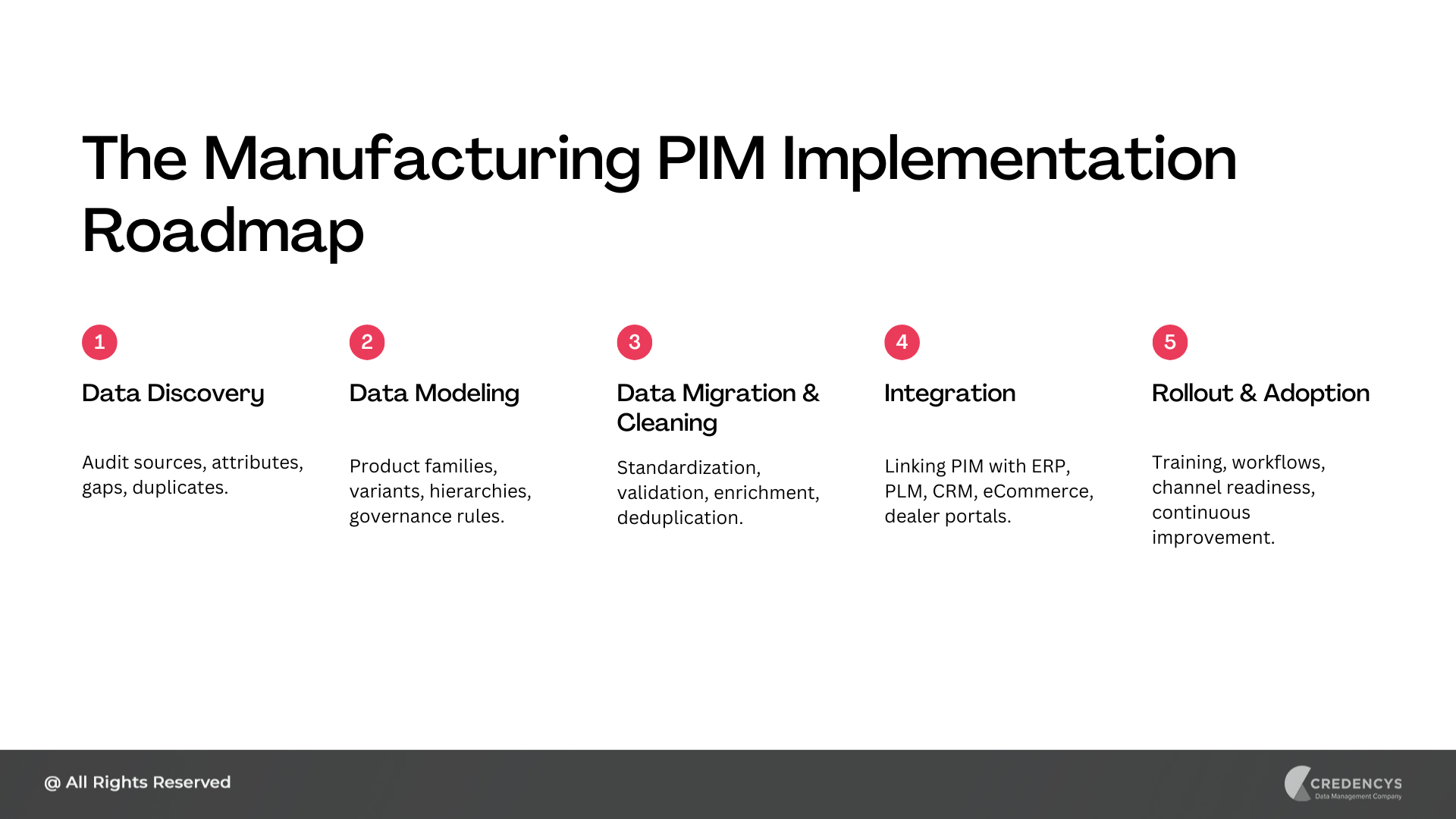
- Treat PIM as a strategic initiative: PIM is more than a software rollout. It shapes how product data is created, managed, and shared. Secure leadership support and connect PIM goals to revenue, compliance, and digital initiatives.
- Start small, prove value, then scale: Begin with a focused use case, such as enhancing e-commerce content or optimizing data for top-selling products or services. Prove the value, then expand to more product lines, regions, and channels.
- Combine people, process, and technology: PIM succeeds when the right roles, workflows, and governance support the technology. Establish clear ownership, define how data flows, and avoid relying solely on the tool to resolve issues.
- Keep improving after go-live: Go-live is only the start. Track key metrics such as data completeness, time to launch, and channel accuracy. Use this feedback to refine your model, workflows, and integrations.
Wrap Up
Manufacturing PIM implementation can feel overwhelming at first. Product structures are complex, teams work in silos, and data is often scattered across legacy systems.
But with the right approach, PIM becomes a powerful engine for growth. When you improve data quality, define clear ownership, and integrate systems thoughtfully, you create a foundation that supports every channel and team.
Success comes from starting small, focusing on real business impact, and keeping the customer experience at the center. Over time, PIM enables manufacturers to launch products faster, reduce errors, and deliver consistent information across all channels.
Done well, PIM implementation is not just a data project. It transforms how your manufacturing business operates, sells, and scales.
Want to See How PIM Can Transform Your Manufacturing Operations? Book a free consultation and discover the fastest path to cleaner data, quicker launches, and better customer experiences.







Tags: