



Product Attributes: How to Master Them with PIM
Every element of a product listing counts, but the attributes are among the most critical. From color and material to technical specifications and pricing details, attributes define how a product is discovered, understood, and trusted by customers.
According to a recent survey, 87% of online shoppers say accurate, detailed product content is the most important factor influencing their purchase decisions.
That means even a single missing or inconsistent attribute, such as an incorrect size or unclear material, can affect conversion rates, search visibility, and brand credibility.
However, as businesses scale their product lines and expand across channels, managing thousands of attributes manually becomes complex and error-prone. Using a modern Product Information Management (PIM) system can transform attribute chaos into a structured, business-enabling asset. A PIM helps retailers and brands transform scattered, inconsistent product data into structured, reliable, and SEO-friendly information that drives conversions and builds trust.
What You Will Learn
In this blog, you’ll learn:
- What product attributes are, and why they’re essential
- The role of product attributes in Product Information Management (PIM) systems
- Common challenges businesses face while managing attributes manually
- How a modern PIM system solves these challenges through automation and data governance
Definition of Product Attributes
Product attributes are the specific characteristics, features, or properties that describe a product and help differentiate it from competitors. These attributes define what a product is, how it looks, how it functions, and how it provides value to customers.
Product attributes are data points or descriptive elements that collectively form a complete and accurate representation of a product across sales channels, catalogs, or eCommerce platforms.
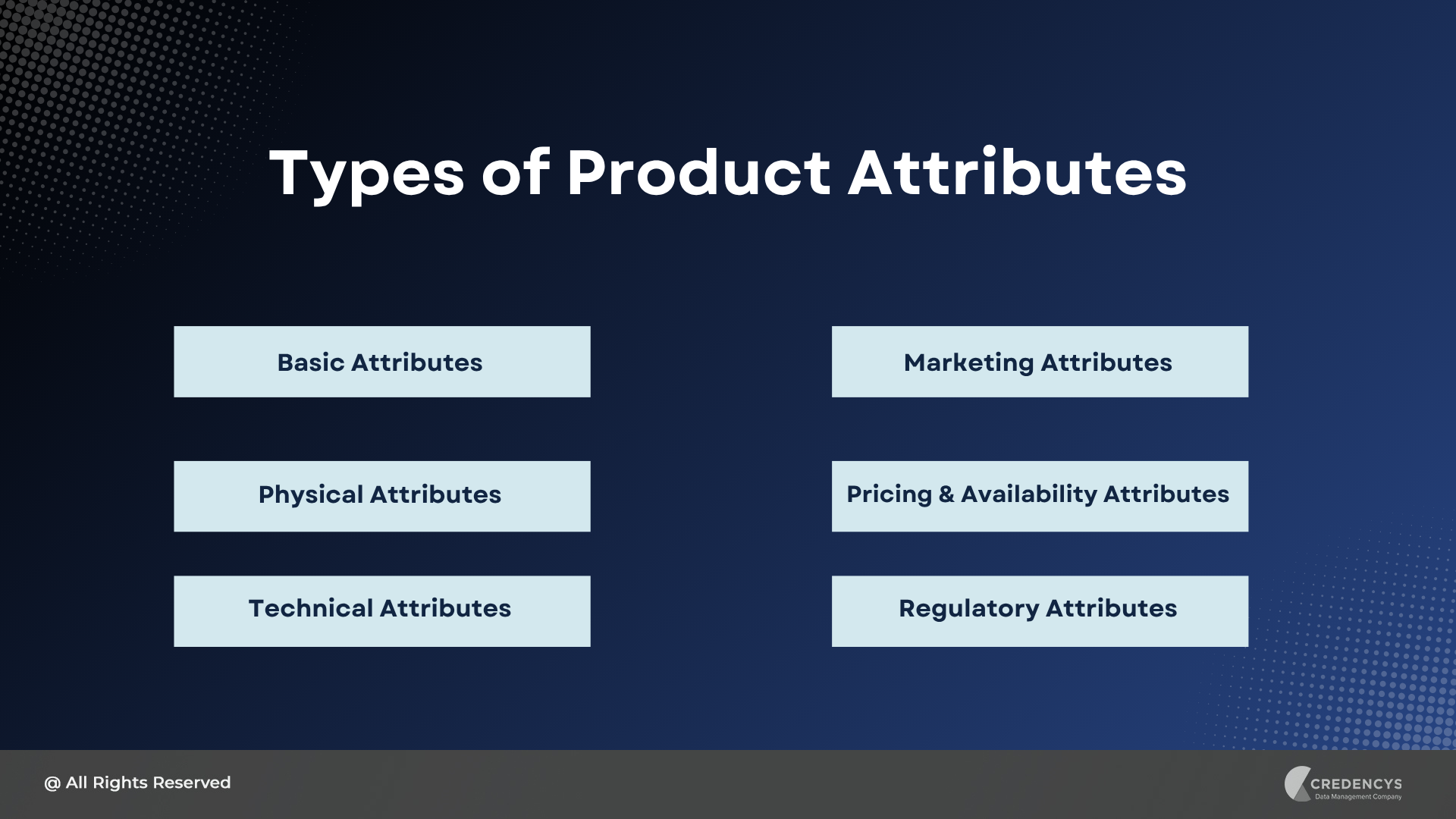
They range from fundamental identifiers (SKU, product name) to descriptive features (size, color, material), to commercial information (list price, margin), to marketing and channel metadata (hero image, bestseller flag, marketplace category).
Why Product Attributes Matter
- Improve product discovery: Help customers filter and find products faster on eCommerce platforms.
- Enable personalization: Allow retailers to offer tailored recommendations.
- Support omnichannel consistency: Ensure uniform product information across websites, apps, marketplaces, and print catalogs.
- Enhance SEO: Descriptive attributes improve product visibility in search engines.
- Simplify data management: In Product Information Management (PIM) systems, structured attributes make product data easier to maintain, enrich, and distribute.
Importance of Product Attributes in PIM (Product Information Management)
Product attributes are the backbone of any Product Information Management (PIM) system. They define how product data is structured, stored, managed, and shared across multiple sales and marketing channels. In a PIM environment, attributes are not just descriptive fields—they are the foundation that drives product discoverability, consistency, and conversion.
Here’s why product attributes are so crucial in PIM:
1. Create a Single Source of Truth
A well-defined set of product attributes ensures that all product data resides in a single centralized system, eliminating inconsistencies across ERP, eCommerce, and marketplace platforms.
- Every product entry follows the same structure.
- Data accuracy and reliability increase across teams and systems.
- Updates in PIM automatically reflect across all connected channels
2. Enable Rich and Consistent Product Information
Attributes help standardize how product data is presented. This ensures that every channel—online store, marketplace, or print catalog—delivers a consistent and engaging product experience.
- Titles, descriptions, materials, and specifications remain uniform.
- Marketing teams can enrich content without losing structure.
- Customers see complete and accurate details regardless of channel.
3. Improve Product Discovery and SEO
Structured attributes like color, material, brand, and category make it easier for customers to find products through filters, search results, and navigation tools.
- Better attribute tagging boosts internal site search and SEO rankings.
- Helps AI-driven recommendation engines deliver relevant results.
- Enhances the overall product browsing experience.
4. Simplify Multi-channel Publishing
Every channel (e.g., Amazon, Shopify, Zalando, or Magento) requires specific product attributes and formats. PIM systems automatically map attributes to channel-specific requirements.
- Reduces manual data entry and format errors.
- Ensures faster time-to-market for new products.
- Makes scaling to new marketplaces seamless.
5. Enable Personalization and AI-driven Automation
AI-powered PIM systems use product attributes to:
- Auto-generate product descriptions and titles.
- Recommend complementary products.
- Categorize products intelligently.
- Detect missing or inconsistent data fields.
6. Support Compliance and Localization
Attributes in PIM make it easy to manage regulatory, linguistic, and region-specific requirements.
- Add localization attributes for language, currency, and region.
- Store compliance data, such as “CE certified” or “Made in India.”
- Meet legal and marketplace-specific labeling norms.
7. Accelerate New Product Launches
When attributes are standardized, new product setup becomes fast and error-free.
- Teams can use predefined templates for each category.
- Missing attribute alerts prevent incomplete product listings.
- Reduces approval delays and accelerates go-to-market time.
8. Enable Better Data Governance and Analytics
Attributes act as data governance enablers, ensuring that all products follow the same taxonomy and structure.
- Simplifies reporting and analytics (e.g., “Top-selling brand by material type”).
- Reduces duplication and data chaos.
- Ensures long-term scalability of your PIM implementation.
Challenges in Managing Product Attributes and How PIM Solves Them
| Challenges in Managing Product Attributes | How PIM Solves the Challenges |
|---|---|
| Inconsistent Data Across Channels | PIM centralizes product data in a single repository, ensuring that all attributes—like titles, descriptions, and images—remain consistent across websites, marketplaces, and print catalogs. |
| Manual Data Entry and Errors | Automates product data import and validation. PIM enforces attribute rules and templates to reduce human error and maintain clean, standardized product information. |
| Lack of Attribute Standardization | Enables the creation of attribute sets and data models tailored to each product category, ensuring every SKU follows a uniform structure and taxonomy. |
| Difficulty Managing Large Product Catalogs | Scales effortlessly with product growth. Users can bulk edit, import, and enrich thousands of product attributes simultaneously through predefined templates. |
| Poor Collaboration Between Teams | PIM streamlines workflows by allowing marketing, merchandising, and technical teams to collaborate in real time, with role-based access and version control. |
| Slow New Product Introductions | Predefined attribute sets and automated validation help teams onboard new SKUs quickly and launch products faster across multiple sales channels. |
| Incomplete or Missing Attribute Data | PIM identifies gaps using data completeness rules and highlights missing mandatory attributes, ensuring every product listing is complete before publishing. |
| Multi-language and Localization Issues | Supports multilingual and regional attributes (e.g., size, currency, measurement units) to manage and publish localized product data. |
Conclusion: Turn Product Attributes into a Strategic Advantage
In today’s digital-first marketplace, product attributes are far more than just data points — they are the language your products use to communicate with your customers. When managed effectively, they transform how your brand is discovered, perceived, and trusted across every channel.
Yet, managing attributes manually or across disconnected systems often results in data silos, inconsistencies, and missed opportunities. A modern Product Information Management (PIM) system bridges these gaps, bringing all product attributes into one intelligent hub — enabling accuracy, consistency, and scalability across your product ecosystem.
By leveraging PIM, businesses can not only streamline data governance but also enhance product discovery, boost SEO performance, and accelerate go-to-market timelines. In essence, a strong attribute strategy powered by PIM doesn’t just improve your product data — it drives better business outcomes and customer experiences.

Ready to take control of your product data? Discover how Credencys helps global retailers and brands build AI-powered PIM systems that turn complex product data into a competitive advantage.
Frequently Asked Questions (FAQs)
1. What are product attributes?
Product attributes are the characteristics or features that describe a product — such as size, color, material, brand, and SKU — helping differentiate it from competitors.
2. Why are product attributes important?
They improve product discovery and personalization, enhance SEO, and ensure consistent information across all sales channels, boosting trust and conversions.
3. What is a PIM system?
A Product Information Management (PIM) system centralizes and manages all product data, ensuring accuracy, consistency, and faster updates across platforms.
4. How does a PIM help manage product attributes?
PIM automates data entry, standardizes attributes, identifies missing information, and syncs product details across eCommerce, ERP, and marketplaces.
5. What are common challenges in managing product attributes?
Manual errors, inconsistent data, a lack of standardization, missing attributes, and difficulties in handling large catalogs or multilingual data.
6. What are the best practices for managing attributes in PIM?
Use standardized attribute sets, clear naming conventions, and validation rules; automate enrichment and ensure collaboration between teams.







Tags: