


Automating Product Taxonomy & Categorization with Artificial Intelligence
Retailers, these days, manage sprawling catalogs with thousands or even millions of SKUs. Each product carries unique attributes such as size, color, material, and function, all of which need to be organized under a well-defined taxonomy.
A product taxonomy is a structured classification system that helps retailers arrange their products into logical categories and subcategories. When managed correctly, it improves product discoverability, enhances site search performance, and supports consistent data across channels.
However, maintaining this taxonomy manually is no small task. Product lines evolve, new categories emerge, and customer search behavior shifts constantly.
As a result, taxonomy drift, where product categories gradually lose their logical consistency, becomes inevitable.
Studies found that 68% of eCommerce websites have low-performing category taxonomies, underscoring how common this challenge is.
Retailers often end up with misclassified, duplicate, or overlapping categories that make it harder for customers to find what they’re looking for. That’s where machine learning (ML) comes in.
ML models can automatically categorize products, detect taxonomy inconsistencies, and even suggest new category hierarchies based on data patterns. By leveraging ML, retailers can ensure their product catalogs remain clean, searchable, and scalable, without endless manual intervention.
What You’ll Learn
- Why traditional taxonomy management struggles at scale
- How machine learning models automate product categorization
- Ways ML detects taxonomy drift and suggests hierarchy improvements
- Key business benefits
Why Traditional Taxonomy Management Falls Short
Most retail organizations start with manual taxonomy management, spreadsheets, human tagging, and review cycles. It works when you’re dealing with a few hundred SKUs.
But once your catalog grows into tens of thousands of products sourced from multiple vendors, the cracks begin to show.
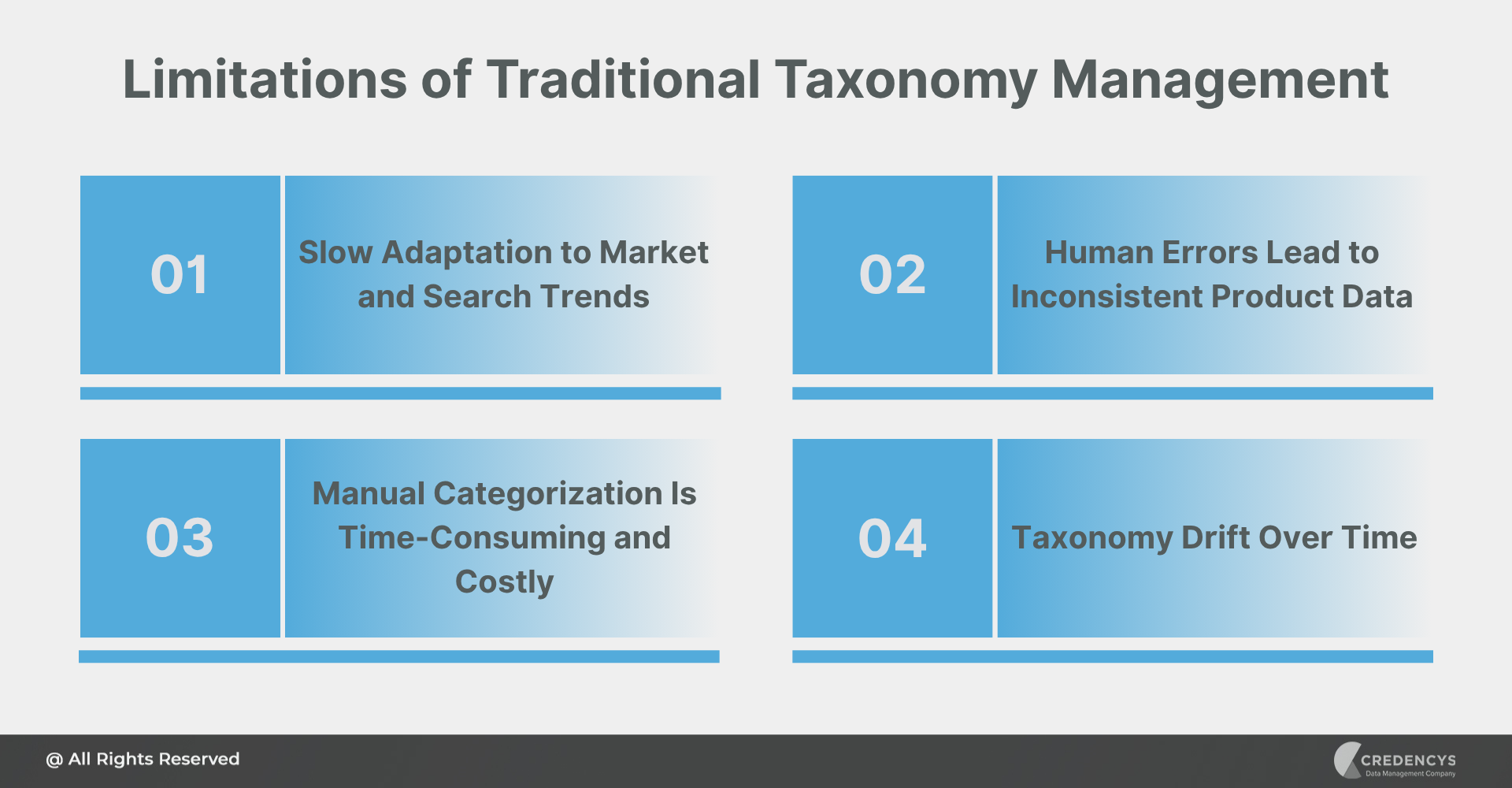
1. Slow Adaptation to Market and Search Trends
Customer behavior and search intent change faster than traditional taxonomies can adapt. Manual updates lag behind seasonal demand, new product types, or emerging attributes, which limits visibility and hurts conversion rates.
Manual taxonomy management doesn’t scale. It slows down product onboarding, leads to misclassifications, and degrades the customer experience.
2. Human Errors Lead to Inconsistent Product Data
Two merchandisers might categorize the same product differently based on personal judgment, for example, labeling a “Bluetooth speaker” under Electronics > Accessories versus Electronics > Audio Devices. These inconsistencies compound over time, making it difficult to maintain clean data across marketplaces, channels, and analytics platforms.
3. Manual Categorization Is Time-Consuming and Costly
Catalog teams often spend hours assigning or validating product categories. When new products arrive daily, manual efforts can’t keep pace.
A small error or inconsistent tag at this stage can cascade into inaccurate search results, poor recommendations, and confusing navigation.
4. Taxonomy Drift Over Time
As your product line evolves, categories get added, merged, or renamed. Without an automated system to detect and reconcile changes, taxonomy drift becomes inevitable.
The result? Duplicate nodes, overlapping categories, and outdated hierarchies that confuse both customers and internal systems.
To overcome these challenges, forward-thinking retailers are turning to machine learning models that can automatically classify, validate, and evolve taxonomies based on data, not guesswork.
How Machine Learning Automates Product Categorization
ML brings scale, consistency, and intelligence to product taxonomy management. Instead of relying on human interpretation, ML models learn from existing data, such as product titles, descriptions, attributes, and even images, to automatically classify items into the most accurate categories.
Below is a simplified breakdown of how the process works:
1. Data Preparation: Building the Foundation
The accuracy of any ML model starts with clean, structured data.
- Input sources: Product titles, descriptions, specifications, and sometimes images or metadata from multiple vendors.
- Feature extraction: Natural Language Processing (NLP) techniques like TF-IDF, word embeddings, or transformer-based encodings convert text into numerical vectors that capture semantic meaning.
- Labeling: The existing product categories serve as training labels. Over time, these labels can be refined as the model learns and adapts.
This stage ensures that the model understands the relationships between product attributes and their respective categories.

Get Your Product Data AI-Ready with Expert Help from Credencys. Our Team Ensures Your Data is Clean, Structured, and Optimized for Intelligent Categorization.
2. Model Training: Teaching the Model to Classify
Once the dataset is ready, ML algorithms learn to identify the best-fitting category for each product. Common approaches include:
- Traditional models like Logistic Regression or Random Forest for structured text and tabular data.
- Deep learning models for unstructured data, especially product titles, descriptions, and images.
- Hybrid models that combine textual and visual signals to improve categorization accuracy.
As the model is trained, it starts recognizing subtle differences, such as distinguishing “running shoes” from “trail running shoes” based on descriptive patterns.
3. Evaluation: Measuring Accuracy with Real Data
After training, the model’s predictions are tested on unseen products to measure accuracy.
- A confusion matrix helps visualize correct vs. incorrect classifications, showing where the model tends to confuse similar categories.
- Key performance metrics include precision, recall, and F1-score, which together indicate how well the model balances accuracy and completeness.
For instance, if the model classifies “wireless earbuds” as “wired headphones”, that error is quickly visible and can be corrected during retraining.
4. Continuous Learning: Keeping the Taxonomy Up to Date
Unlike manual systems, ML models continuously learn from new data.
- As new SKUs are introduced or categories evolve, the model re-trains itself using updated examples.
- Over time, it improves in identifying subtle category differences and adapting to new product lines or naming trends.
This makes taxonomy management self-evolving, ensuring accuracy even as catalogs expand and consumer behaviors change.
Machine Learning automates what used to be manual, repetitive work. It transforms taxonomy management from a static, reactive process into an intelligent system that classifies, validates, and evolves dynamically, improving both operational efficiency and customer experience.
Smart Taxonomy Maintenance with Machine Learning
Building an accurate taxonomy is only half the battle. Maintaining it as your catalog evolves is where most retailers struggle.
Product lines expand, new categories appear, and consumer search behavior shifts; all of which can make even a well-structured taxonomy obsolete within months. Machine Learning doesn’t just automate categorization; it continuously maintains and optimizes your taxonomy by identifying inconsistencies, redundancies, and emerging category relationships.
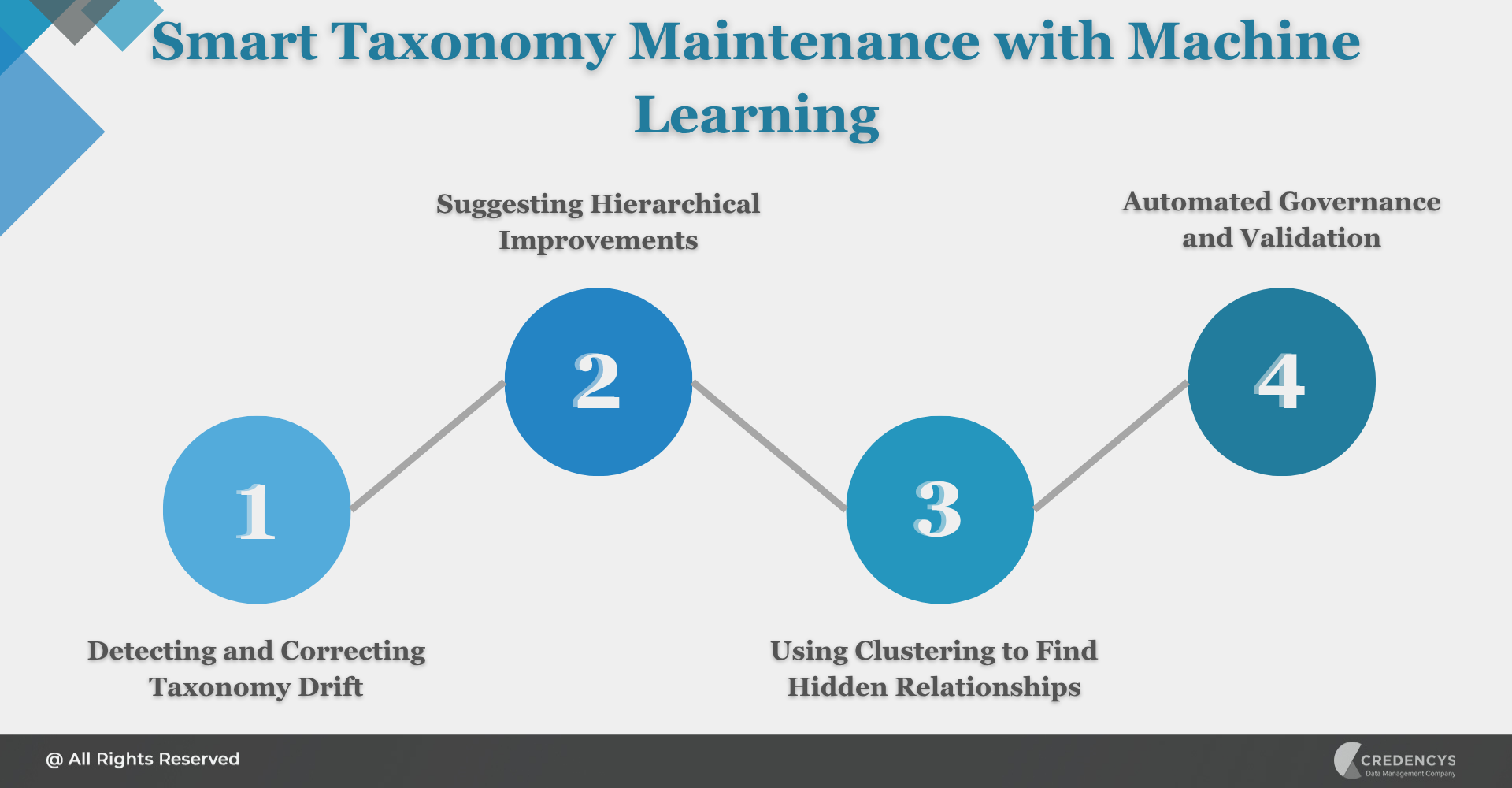
1. Detecting and Correcting Taxonomy Drift
Over time, taxonomy drift occurs when product categories lose alignment with actual product data or market trends. ML models can detect drift by analyzing classification patterns, for example, noticing that products previously labeled under “Home Electronics” are now more frequently described with “Smart Home” attributes.
This signals that a taxonomy update is needed, either by renaming or restructuring categories to reflect real-world changes.
Result: Your taxonomy remains relevant and aligned with how customers search and how products evolve.
2. Suggesting Hierarchical Improvements
ML can also suggest adjustments to the taxonomy hierarchy. Using statistical correlations and co-occurrence analysis, it identifies relationships among categories and subcategories, recommending:
- Merges, such as combining “Smart Speakers” and “Bluetooth Speakers” under one parent category.
- Splits, like, separating “Women’s Apparel” into “Formal Wear” and “Casual Wear” based on product attributes.
- Renames, such as (e.g., updating “Mobile Accessories” to “Smartphone Accessories” for better contextual accuracy.
These intelligent suggestions prevent taxonomy bloat and maintain logical structure as the product range grows.
3. Using Clustering to Find Hidden Relationships
Clustering algorithms like k-means or hierarchical clustering group products based on similarity in attributes or textual descriptions. This helps uncover latent groupings that might not exist in the current taxonomy.
For example:
- Discovering that “gaming laptops” and “creator laptops” form distinct clusters, even if both were previously under “Laptops.”
- Identifying emerging micro-categories, such as “eco-friendly cleaning products,” based on recurring keywords and metadata.
By analyzing these clusters, teams can make data-backed taxonomy updates instead of relying on assumptions.
Uncover Hidden Product Relationships and Emerging Categories with AI-driven Insights from Credencys. Turn your Catalog Data into a Powerful Source of Competitive Advantage
4. Automated Governance and Validation
ML-driven systems can monitor category-level performance continuously, detecting anomalies like:
- Products are repeatedly reclassified into different categories (a sign of inconsistent taxonomy).
- High error rates in specific branches of the hierarchy.
- Rapidly growing subcategories that may need splitting for better discoverability.
This layer of governance ensures taxonomy integrity while freeing catalog managers from routine audits.
Machine Learning turns taxonomy maintenance into an adaptive, self-improving process. Instead of periodic clean-ups, your taxonomy evolves continuously, staying in sync with market trends, product updates, and customer behavior.
Business Benefits of ML-Driven Categorization
Automating taxonomy and product categorization with Machine Learning is a strategic enabler. By removing manual dependencies and bringing intelligence to catalog management, retailers can dramatically improve efficiency, accuracy, and the overall shopping experience.
Here are the key business benefits:
1. Operational Efficiency & Cost Reduction
Manual categorization is labor-intensive and slow. ML models automate these repetitive tasks, enabling teams to focus on higher-value activities like taxonomy strategy and quality review.
- Faster onboarding: ML can categorize thousands of SKUs in minutes instead of days.
- Lower overhead: Reduces the cost of manual data entry and post-launch corrections.
- Scalability: Handles product spikes during seasonal campaigns without additional staff.
2. Continuous Adaptation to Market Dynamics
ML keeps pace with emerging trends automatically. As new product lines or terminologies appear (e.g., “smart fitness bands” evolving into “wearable health trackers”), the model adapts, reclassifying and updating the taxonomy structure.
This ensures your catalog always reflects how customers search and shop today, not how they did last year.
3. Consistent Product Data Across Channels
In multi-channel retail, taxonomy consistency is crucial. ML models ensure that the same product attributes and categories are applied uniformly across your PIM, marketplaces, and eCommerce platforms.
This consistency eliminates confusion between systems, improves analytics accuracy, and enhances brand trust with customers.
4. Improved Product Findability
Accurate, ML-powered categorization ensures that every product is placed exactly where customers expect to find it.
- Better alignment between search queries and product metadata improves on-site search accuracy.
- Enhanced recommendation engines and filter logic help customers discover related products faster.
5. Enhanced Data Quality & Analytics
Clean and consistent taxonomy translates directly to more reliable analytics.
- Category-level sales reports, inventory forecasts, and performance dashboards become more accurate.
- Teams can easily identify top-performing segments or underperforming product categories.
- Marketing and merchandising decisions become data-driven rather than assumption-based.
6. Better Customer Experience
Ultimately, an intelligently maintained taxonomy creates a frictionless shopping journey. Customers find relevant products faster, browse more confidently, and are exposed to better cross-sell and upsell opportunities, all of which contribute to stronger loyalty and higher lifetime value.
Machine Learning transforms taxonomy management from a back-office function into a growth driver. It strengthens product discoverability, speeds up catalog operations, and ensures your digital shelf is always optimized for both internal efficiency and customer satisfaction.
Conclusion
As retail catalogs expand and customer expectations rise, traditional taxonomy management simply can’t keep up. Manual categorization leads to inconsistencies, slow onboarding, and poor product discoverability, all of which directly impact conversion and customer experience.
Machine Learning offers a smarter, scalable alternative. By automating classification, detecting taxonomy drift, and continuously refining category hierarchies, ML turns static taxonomies into living, adaptive systems that evolve with your business and your customers.
Retailers who embrace this shift gain more than efficiency; they gain accuracy, agility, and deeper product intelligence across their ecosystem.
Bring Intelligence and Automation into Your PIM Taxonomy with Credencys. Our AI-PIM Specialists Help you Design, Train, and Deploy ML-driven Categorization Models That Keep Your Catalog Clean, Consistent, and Conversion-Ready.







Tags: