

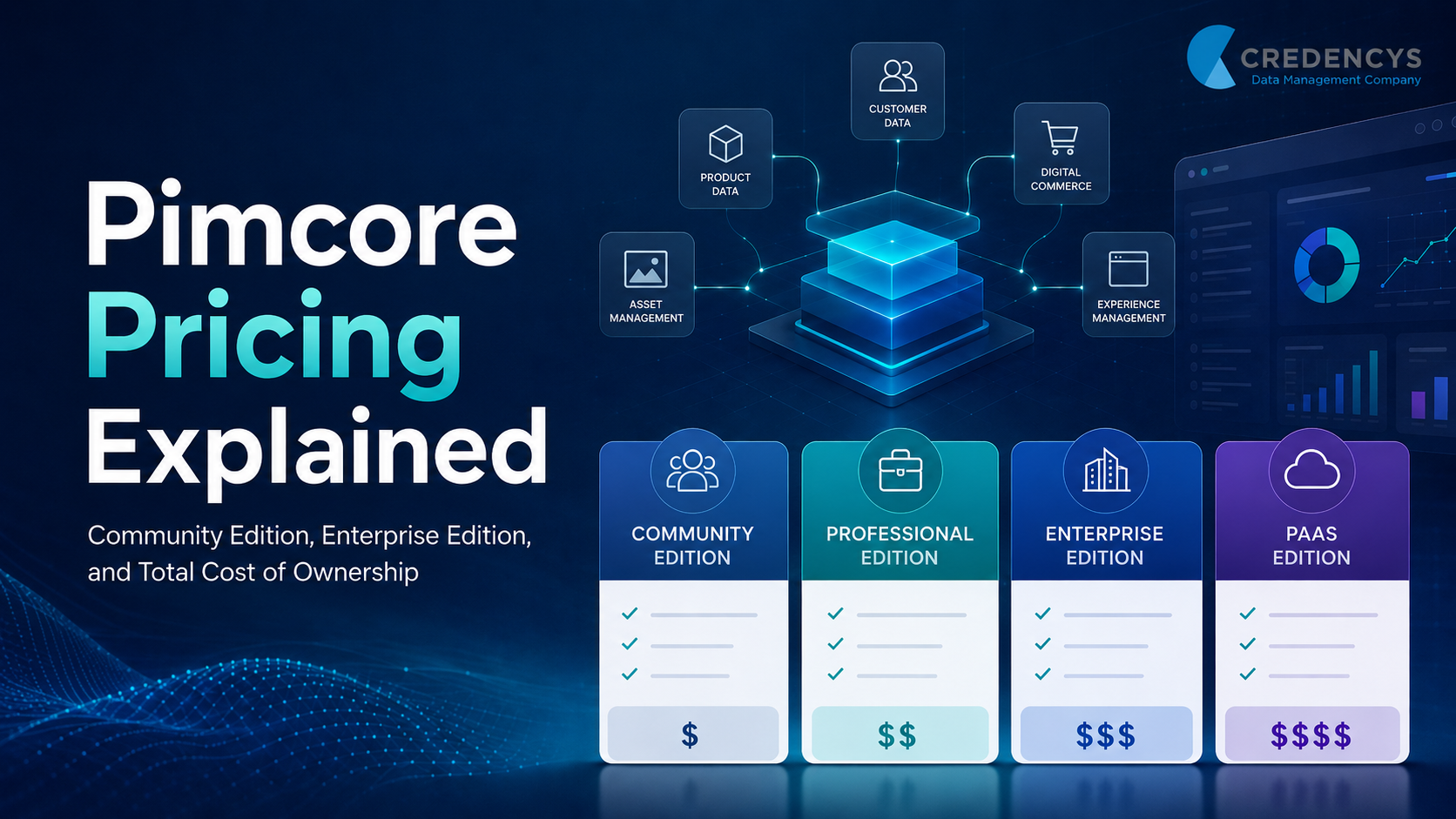
Pimcore Pricing 2026: Editions, Licence and Total Cost
Short answer: Pimcore pricing depends on the edition: the Community Edition is free for eligible organizations under the Pimcore Open Core License; Pimcore lists Professional at $9,900 per year and Enterprise at $29,900 per year (on-premises), and PaaS on request (pimcore.com, checked 14 October 2026). Implementation, hosting, and support are extra and usually cost more.
Pimcore is widely known as a flexible platform for product information management, master data management, digital asset management, digital experience management, commerce, and omnichannel data delivery. For businesses that want to centralize product data, reduce data silos, improve governance, and deliver consistent digital experiences, Pimcore can become a strong foundation for enterprise digital transformation.
But when companies start evaluating Pimcore, one of the first questions they ask is: How much does Pimcore cost? The answer is not limited to a single license fee.
Pimcore pricing depends on the edition you choose, your deployment model, support expectations, infrastructure needs, implementation scope, integration requirements, data migration complexity, customization needs, and long-term scalability goals. For some organizations, Pimcore Community Edition may suit non-production, academic, non-profit, or eligible smaller businesses.
For growing and enterprise businesses, Professional Edition, Enterprise Edition, or PaaS Edition may offer the commercial licensing, support, enterprise features, and operational reliability needed for production-grade use.
This blog explains Pimcore pricing across Community, Professional, Enterprise, and PaaS editions. It also breaks down the total cost of ownership so you can evaluate the real investment required to implement, operate, and scale Pimcore successfully.
How Pimcore Pricing Works
Pimcore pricing is structured around editions and deployment models. Businesses can choose from Community Edition, Professional Edition, Enterprise Edition, and PaaS Edition based on their commercial use case, feature requirements, support needs, and preferred infrastructure model.
The key point is that Pimcore cost isn’t limited to the annual subscription or license fee. The total investment may include software licensing, implementation, hosting, customization, integrations, data migration, training, support, and continuous optimization.
A business that only needs a basic PIM setup will have a very different cost structure compared to an enterprise that wants to use Pimcore for PIM, DAM, MDM, DXP, Commerce, workflow automation, data quality management, customer data, portals, and syndication. In most enterprise scenarios, the better question is not only “What is the Pimcore license cost?” but also “What will it cost to implement, operate, scale, and maintain Pimcore in a way that supports business goals?”
Pimcore pricing should be evaluated across three layers:
- Edition and licensing cost
- Implementation and customization cost
- Long-term ownership and operational cost
Together, these factors help businesses choose the right Pimcore edition.
Pimcore Community Edition Pricing
Pimcore Community Edition is the entry-level option for organizations that want to build, test, and explore Pimcore’s open-core capabilities. It provides access to essential Pimcore capabilities, including PIM, MDM, DAM, and DXP features.
However, it is important to understand the current licensing conditions clearly. Pimcore Community Edition is licensed under the Pimcore Open Core License, also known as POCL. Pimcore states that the Community Edition is ideal for non-production use, academic environments, non-profits, and businesses with annual revenue under EUR/USD 5 million.
This means Community Edition can be a strong option for learning, experimentation, development, academic projects, eligible non-profit use, and smaller businesses that meet the revenue criteria. For commercial production deployments outside the eligibility scope, businesses should evaluate Professional Edition or Enterprise Edition.
Best suited for
Pimcore Community Edition is best suited for:
- Non-production environments
- Testing and evaluation
- Academic institutions
- Non-profit organizations
- Smaller businesses within Pimcore’s revenue eligibility threshold
- Teams exploring Pimcore before selecting a commercial edition
Key cost considerations
Community Edition can reduce initial software licensing cost, but it does not eliminate the overall cost of using Pimcore. Businesses still need to consider implementation, hosting, development, integrations, data migration, support, upgrades, and internal team training.
For enterprises, Community Edition may not be the right fit if they need commercial licensing, service-level agreements, advanced support, enterprise-grade capabilities, or a production-ready operating model.
Pimcore Professional Edition Pricing
Pimcore Professional Edition is a commercial edition for growing businesses ready to move beyond Community Edition, but that may not need a full enterprise package. It currently lists Professional Edition at $9,900 per year for on-premises deployment.
Professional Edition provides core Pimcore capabilities, a commercial licensing model, and access to the Pimcore Store. Pimcore describes this edition as suitable for growing businesses that need PIM, MDM, DAM, DXP, licensing, and Store access without moving directly to a full enterprise package.
Best suited for
Pimcore Professional Edition is best suited for:
- Growing businesses that need commercial licensing
- Companies moving beyond Community Edition
- Organizations that want access to the Pimcore Store
- Businesses that need core PIM, MDM, DAM, and DXP capabilities
- Teams that prefer to host Pimcore in their own infrastructure or partner-managed environment
Key cost considerations
Professional Edition can be a practical choice for businesses that need a license-compliant production setup but do not require the full Enterprise Edition feature set, advanced SLAs, or managed PaaS operations. However, businesses should still budget for implementation, configuration, hosting, integrations, data migration, customization, and ongoing support.
The edition price is only one part of the total investment.
Pimcore Enterprise Edition Pricing
Pimcore Enterprise Edition is designed for businesses that need advanced capabilities, scalability, compliance, support, and deployment flexibility. It currently lists Enterprise Edition from $29,900 per year for on-premises deployment.
Enterprise Edition is often the right choice when Pimcore becomes a mission-critical platform for product data, master data, digital assets, digital experiences, commerce, workflows, customer data, and omnichannel delivery. Pimcore highlights several Enterprise Edition capabilities, including Digital Commerce Framework, Customer Data Platform, Personalization Engine for DXP, Pimcore Experience Portals, Pimcore Copilot, Data Quality Management, Workflow Automation and Integration, and Advanced Reporting and Dashboards.
Best suited for
Pimcore Enterprise Edition is best suited for:
- Enterprises with complex product data requirements
- Businesses managing large product catalogs and multiple data domains
- Companies that need advanced workflow automation and governance
- Organizations that require stronger support, SLAs, and long-term scalability
- Enterprises that need deployment flexibility across private cloud, public cloud, or private data center environments
- Businesses using Pimcore across PIM, MDM, DAM, DXP, Commerce, CDP, portals, and data syndication
Key cost considerations
Enterprise Edition has a higher annual subscription cost than Professional Edition, but it can deliver greater value for businesses that need advanced features, support, scalability, and enterprise-grade control. For large organizations, weak governance, poor integrations, inconsistent product data, slow product launches, and manual workarounds can cost far more than choosing the right edition from the start.
Pimcore PaaS Edition Pricing
Pimcore PaaS Edition is a managed Platform-as-a-Service option for businesses that want Pimcore with managed hosting, operations, scalability, monitoring, and support. It lists PaaS as a custom quote (“tailored to you”).
PaaS is designed for organizations that want to reduce the internal burden of infrastructure management. Instead of managing hosting, operations, monitoring, backups, scalability, and platform reliability internally, businesses can use a managed model.
Pimcore positions PaaS as an all-inclusive option, including hosting, operations, support, profiling, monitoring, and alerting.
Best suited for
Pimcore PaaS Edition is best suited for:
- Enterprises that want managed Pimcore operations
- Businesses that do not want to manage hosting internally
- Teams that need a faster setup and operational reliability
- Organizations that require scalability, monitoring, alerting, and support
- Companies looking for a cloud-ready Pimcore deployment model
Key cost considerations
PaaS can reduce internal infrastructure complexity, but businesses should evaluate data residency, compliance requirements, hosting preferences, performance needs, integration architecture, and long-term operating costs before selecting this model. For organizations that do not want to invest heavily in internal DevOps and infrastructure management, PaaS can be a strong option.
Pimcore Pricing Comparison: Which Edition Should You Choose?
Here is a simplified comparison of Pimcore editions:
| Pimcore Edition | Starting Price | Deployment Model | Best For |
|---|---|---|---|
| Community Edition | Free within defined eligibility | Cloud or on-premises | Non-production use, academic use, non-profits, and eligible smaller businesses |
| Professional Edition | $9,900/year | On-premises | Growing businesses that need commercial licensing and core Pimcore capabilities |
| Enterprise Edition | From $29,900/year | On-premises or private/public cloud | Enterprises that need advanced features, support, scalability, governance, and flexibility |
| PaaS Edition | Custom quote | Platform-as-a-Service | Businesses that want managed hosting, operations, monitoring, scalability, and support |
Choose Community Edition if
You are exploring Pimcore, using it in a non-production environment, working in an academic or non-profit context, or fall within Pimcore’s stated eligibility criteria.
Choose Professional Edition if
You need commercial licensing, core Pimcore capabilities, and access to the Pimcore Store, but don’t need the full enterprise feature set.
Choose Enterprise Edition if
Pimcore will become a business-critical platform, and you need advanced features, SLAs, governance, scalability, compliance, deployment flexibility, and enterprise support.
Choose PaaS Edition if
You want Pimcore with managed hosting, operations, support, scalability, monitoring, and reduced infrastructure responsibility.
What Impacts Pimcore Total Cost of Ownership?
Pimcore’s annual edition pricing is only one part of the total cost. Pimcore’s total cost of ownership depends on how you implement, integrate, operate, and scale the platform over time.
Here are the major factors that influence Pimcore TCO.
1. Edition and licensing
The selected Pimcore edition directly affects annual subscription cost, commercial usage rights, available features, support access, and deployment options. A smaller business may begin with Community or Professional Edition, while a large enterprise may require Enterprise or PaaS for advanced features, support, and scalability.
2. Implementation scope
The broader the implementation scope, the higher the investment. A basic PIM implementation will usually cost less than a multi-domain platform covering PIM, DAM, MDM, DXP, Commerce, CDP, Experience Portals, workflow automation, and data syndication.
Define the implementation scope based on business priorities, not just available platform features.
3. Data modeling complexity
Data modeling is one of the most important parts of a Pimcore project. Businesses with simple product structures may need fewer attributes, relationships, and classifications.
Enterprises with complex catalogs may need advanced product hierarchies, variants, bundles, categories, localized fields, technical specifications, and channel-specific attributes. The more complex the data model, the more effort it takes to design, validate, test, and optimize.
4. Data migration
Data migration cost depends on the number of source systems, data quality, SKU volume, number of attributes, digital asset volume, duplicate records, missing values, mapping rules, and validation requirements. Migrating clean and structured data is faster.
Migrating inconsistent, duplicate, incomplete, or unstructured data requires more effort. A well-planned migration includes data audit, cleansing, normalization, mapping, test migration, validation, and final migration.
5. System integrations
Most enterprise Pimcore implementations require integrations with ERP, CRM, eCommerce platforms, marketplaces, supplier portals, DAM systems, analytics tools, print systems, data warehouses, and internal applications. Integration complexity depends on the number of systems, API availability, data exchange frequency, middleware requirements, real-time synchronization needs, and business rules.
Strong integration planning can reduce long-term maintenance costs and prevent data silos.
6. Customization requirements
Pimcore is highly flexible, but customization should be carefully planned. Custom workflows, dashboards, user interfaces, APIs, modules, connectors, portals, business rules, and automation can increase implementation cost.
However, the right customization can also improve efficiency, reduce manual work, and support business-specific needs. The goal should be to customize where it creates measurable value and avoid unnecessary complexity.
7. Hosting and infrastructure
For on-premises or self-managed cloud deployments, businesses need to budget for infrastructure, servers, cloud resources, security, backups, monitoring, DevOps, scaling, and performance management. With PaaS, the managed service model includes many of these operational responsibilities, but the annual platform cost is higher.
The right hosting model depends on internal IT capabilities, compliance needs, performance expectations, and long-term operating preferences.
8. Support and maintenance
Pimcore requires ongoing support after go-live. Businesses should plan for bug fixes, performance optimization, upgrades, integration monitoring, security updates, workflow changes, and new feature development.
A strong support model ensures that Pimcore continues to perform well as product catalogs, channels, users, and business requirements grow.
9. Training and change management
User adoption directly affects the return on Pimcore investment. Product managers, marketing teams, eCommerce teams, data stewards, regional users, suppliers, and IT teams may all interact with Pimcore in different ways.
Training helps users follow workflows, maintain data quality, and use the platform correctly. Without proper training, teams may keep relying on spreadsheets and manual workarounds, reducing the platform’s value.
10. Continuous optimization
Don’t treat Pimcore implementation as a one-time project. As businesses add new products, brands, markets, channels, and customer experiences, the platform should evolve.
Continuous optimization may include improving workflows, adding new integrations, expanding data models, refining dashboards, automating manual processes, and improving data governance.
How to Estimate Pimcore Implementation Cost
To estimate Pimcore implementation cost accurately, businesses need to evaluate both technical and business requirements. Key questions include:
- How many products, SKUs, and variants do you need to manage?
- How many product categories and attributes are required?
- How many source systems will send data to Pimcore?
- How many channels will receive product data from Pimcore?
- What is the current quality of product data?
- How many digital assets need to be migrated and connected?
- Are workflows and approval processes simple or complex?
- How many integrations are required?
- Is localization or multi-language content required?
- Is Pimcore being used only for PIM or also for DAM, MDM, DXP, Commerce, CDP, portals, or syndication?
- Will the platform be hosted internally, in the cloud, or through PaaS?
- What level of support and maintenance is needed after go-live?
Base a realistic cost estimate on actual business complexity rather than a generic price range. For example, two companies may both select Pimcore Enterprise Edition, but their total cost can differ significantly.
A single-region business with one eCommerce integration will have a different implementation cost than a global enterprise with multiple brands, several ERPs, multiple marketplaces, complex approval workflows, and thousands of digital assets.
Community vs Professional vs Enterprise vs PaaS: How to Decide
The right Pimcore edition depends on your business maturity, commercial requirements, technical complexity, and long-term growth strategy.
Community Edition
Choose Community Edition when you are exploring Pimcore, building a proof of concept, working in a non-production environment, or operating within Pimcore’s eligibility criteria. It can be a good starting point, but businesses should carefully review the licensing conditions before using it for commercial production.
Professional Edition
Choose Professional Edition when you need commercial licensing and core Pimcore capabilities without moving into a full enterprise package. This edition suits growing businesses that want a compliant, practical path beyond Community Edition.
Enterprise Edition
Choose Enterprise Edition when Pimcore will support mission-critical business processes. This edition suits enterprises that need advanced features, support, governance, compliance, scalability, deployment flexibility, and long-term platform reliability.
PaaS Edition
Choose PaaS Edition when you want Pimcore with managed hosting, operations, monitoring, scalability, and support. This option helps organizations reduce internal infrastructure responsibility and focus more on business outcomes.
How Credencys Helps You Optimize Pimcore Cost and TCO
Pimcore pricing decisions should not be made in isolation. The right edition should align with your business model, product data complexity, implementation scope, integration needs, support expectations, and long-term roadmap.
As a Pimcore Strategic Partner, Credencys helps enterprises evaluate Pimcore from both a technology and business perspective. Our team works with businesses to understand their current data landscape, identify the right implementation approach, and build scalable Pimcore solutions that reduce long-term complexity.
Credencys helps businesses:
- Choose the right Pimcore edition
- Define implementation scope
- Build scalable product and master data models
- Reduce unnecessary customization
- Plan integrations efficiently
- Improve data quality before migration
- Configure workflows and governance
- Select the right hosting and deployment model
- Estimate total cost of ownership
- Build a phased roadmap for Pimcore adoption
- Support and optimize the platform after go-live
This approach helps enterprises avoid overpaying for capabilities they don’t need while building a future-ready Pimcore platform that scales with business growth. For businesses in retail, CPG, manufacturing, automotive, grocery, distribution, and eCommerce, Credencys brings deep experience in product data management, master data management, digital asset management, integrations, governance, and omnichannel delivery.
Is Pimcore Free?
Pimcore is open core: since version 2025.1, it ships under the Pimcore Open Core License (POCL). The Community Edition is free for non-production use, academic and non-profit organizations, and companies with annual revenue under EUR/USD 5 million; other companies need a paid Professional, Enterprise, or PaaS edition.
Even with a free edition, you pay for hosting, implementation, and support.
Pimcore Projects and Results
- US wholesale distributor: Pimcore upgrade, 40% faster backend processing
- Leading European jewelry brand: 41% fewer product launch delays
- SM Retail: 59% faster pricing updates
For a first estimate of your total cost, use the PIM cost calculator or book a free PIM assessment.
Frequently Asked Questions
How much does Pimcore cost?
Pimcore lists Professional at $9,900 per year and Enterprise at $29,900 per year for on-premises deployment, with PaaS priced on request (pimcore.com, October 2026). The Community Edition is free for eligible organizations.
Implementation and hosting are extra.
Is Pimcore Community Edition free for commercial use?
Only for eligible organizations: under the POCL license, it is free for non-production use, academic and non-profit organizations, and companies with annual revenue under EUR/USD 5 million. Larger companies need a paid edition.
What does Pimcore PaaS cost?
Pimcore shows PaaS as a custom quote. It includes hosting, operations, support, and monitoring, so compare it with running Pimcore yourself.
What drives Pimcore total cost of ownership?
Edition and license, implementation scope, data model complexity, migration, integrations, customization, hosting, support, and training. Implementation and integrations are usually the largest items.
Final Thoughts
Pimcore pricing depends on more than the edition you choose. While Community Edition, Professional Edition, Enterprise Edition, and PaaS Edition provide different licensing and deployment options, the real cost depends on implementation scope, data complexity, integrations, customization, hosting, support, training, and long-term optimization.
For enterprises, the best approach is to evaluate Pimcore through the lens of total cost of ownership. A well-planned Pimcore implementation can help reduce data silos, improve product data quality, accelerate product launches, streamline workflows, and create a scalable foundation for digital transformation.
Working with an experienced Pimcore partner like Credencys can help you choose the right edition, control implementation costs, and maximize the long-term value of your Pimcore investment.





Tags: