


Pimcore Product Information Management: How Retail and CPG Enterprises Build Commerce-Ready Product Data
Retail and CPG enterprises are under constant pressure to launch products faster, manage growing SKU complexity, and deliver consistent product experiences across every digital and physical channel.
According to Gartner, poor data quality costs organizations an average of $12.9 million annually, and for retail and CPG businesses, inconsistent product information directly impacts customer experience, conversions, returns, and operational efficiency.
However, product data is often scattered across ERP systems, spreadsheets, supplier files, DAM tools, eCommerce platforms, marketplace templates, and legacy applications. This creates disconnected product information, duplicate work, inconsistent content, slow approvals, and delayed go-to-market.
For commerce-led businesses, product information is no longer just backend data. It directly impacts product discovery, customer trust, conversion rates, marketplace performance, and brand consistency.
This is where Pimcore Product Information Management helps. Pimcore Product Information Management enables enterprises to centralize, enrich, validate, manage, and distribute product data across multiple channels from a single platform.
For retail and CPG businesses, it acts as the foundation for commerce-ready product data and scalable digital growth.
What is Pimcore Product Information Management?
Pimcore Product Information Management is a centralized platform that helps businesses manage product data across its complete lifecycle. It allows organizations to collect product data from multiple sources, structure it according to business requirements, enrich it with marketing and technical information, validate it for quality, and publish it across various sales and customer engagement channels.
With Pimcore PIM, enterprises can manage:
- Product names and SKUs
- Product descriptions
- Categories and subcategories
- Product attributes and specifications
- Variants and bundles
- Pricing-related product details
- Images, videos, manuals, and documents
- Translations and localized product content
- Channel-specific product information
- Product relationships and cross-sell data
Instead of relying on disconnected tools and manual updates, businesses can use Pimcore Product Information Management to create a single source of truth for product information. This helps product, marketing, merchandising, sales, compliance, and digital commerce teams work with accurate, up-to-date product data.
Why Product Information Management Matters for Retail and CPG
Retail and CPG companies operate in product-heavy and channel-heavy environments. Every product must be enriched, validated, localized, approved, and distributed across multiple platforms.
- A small product data issue can create a larger business impact.
- An incorrect product specification can increase returns.
- A missing product image can reduce conversions.
- An inconsistent description can affect brand trust.
- A delayed approval can slow product launches.
- A marketplace formatting error can prevent products from going live.
That is why product information management has become a strategic priority for CIOs and Heads of Digital.
- Growing SKU Complexity
- Omnichannel Commerce Requirements
- Faster Product Launch Expectations
- Customer Experience and Conversion Impact
- Marketplace and Compliance Needs
Common Product Data Challenges Retail and CPG Enterprises Face
Before implementing a PIM system, many enterprises deal with product data issues that affect both operations and customer-facing experiences. Here are the most common challenges.
- Product data scattered across ERP, spreadsheets, DAM, and eCommerce systems
- Manual updates that slow down teams
- Inconsistent product information across channels
- Delayed launches due to lengthy approvals
- Weak governance and limited data ownership
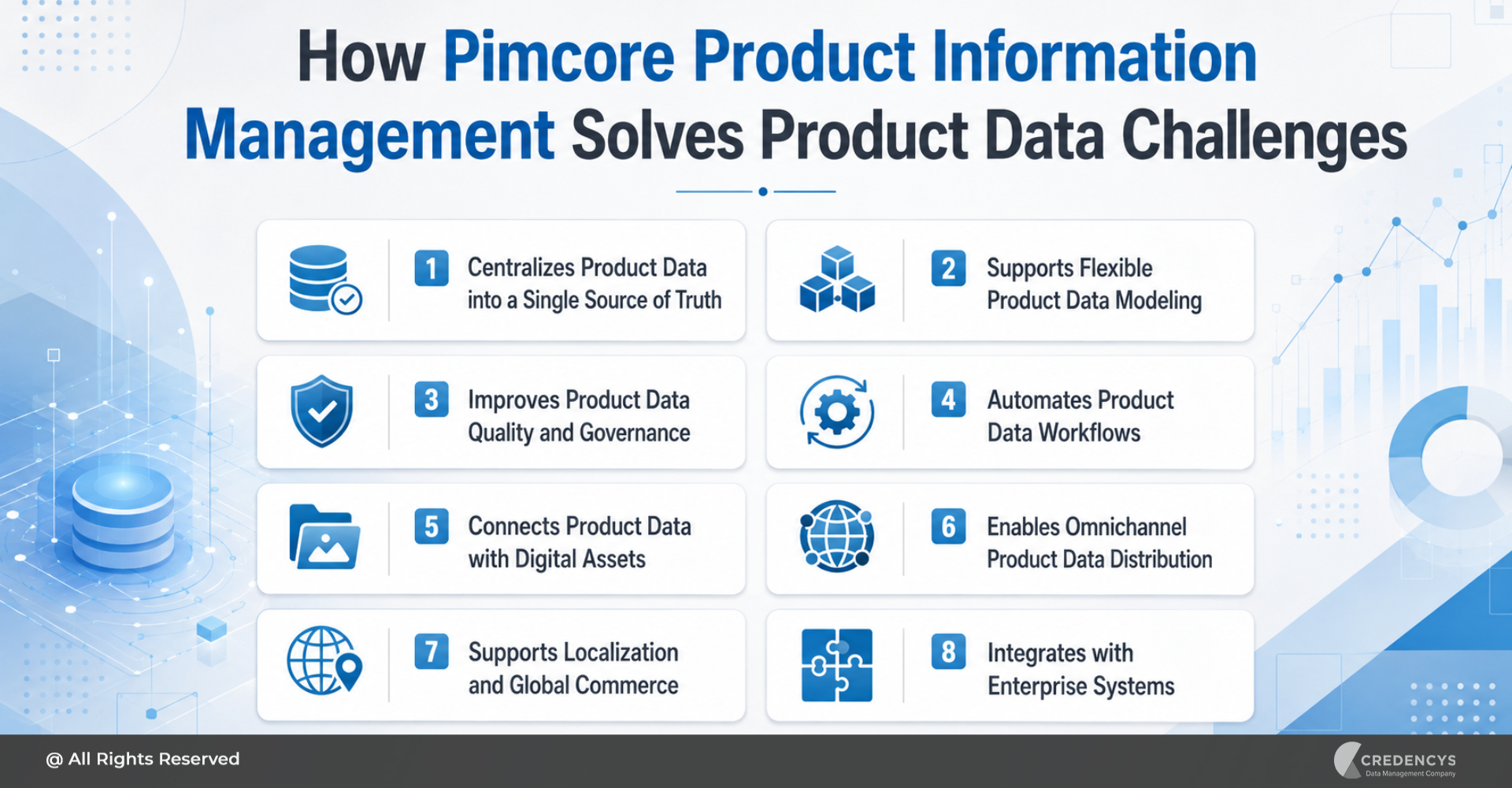
How Pimcore Product Information Management Solves These Challenges
Pimcore Product Information Management helps enterprises move from scattered product data to a centralized, governed, and commerce-ready product data ecosystem.
1. Centralizes Product Data into a Single Source of Truth
Pimcore PIM allows businesses to consolidate product information from multiple systems into a single centralized platform. This creates a single source of truth for product data.
Teams no longer need to depend on multiple spreadsheets, disconnected systems, or outdated files. With centralized product data, businesses can improve consistency, reduce duplicate work, and make product information easily accessible to the right teams.
2. Supports Flexible Product Data Modeling
Retail and CPG businesses do not have simple product structures. A fashion retailer may need to manage variants in size, color, fabric, collection, season, and style.
A CPG brand may need to manage ingredients, packaging size, nutrition facts, allergens, certifications, and regional product claims. Pimcore enables businesses to create flexible product data models that match their industry, catalog structure, and channel requirements.
This flexibility helps enterprises manage complex product hierarchies, variants, bundles, attributes, relationships, and localized content.
3. Improves Product Data Quality and Governance
Product data quality is critical for digital commerce success. Pimcore PIM helps improve product data quality through validation rules, completeness checks, workflows, user roles, and approval processes.
Teams can define mandatory fields, assign ownership, track product data progress, and ensure that only approved and accurate information is published. This helps reduce errors, improve data consistency, and create more reliable product experiences.
4. Automates Product Data Workflows
Manual product data workflows often slow down commerce teams. Pimcore enables structured workflows for product creation, enrichment, approval, translation, compliance review, and publishing.
For example, a new product can move from the product team to the marketing team for content enrichment, then to the compliance team for review, and finally to the digital team for publishing. This workflow-driven approach reduces manual follow-ups, improves accountability, and accelerates product launches.
5. Connects Product Data with Digital Assets
Product information is incomplete without digital assets. Retail and CPG teams need product images, videos, packaging shots, user manuals, safety documents, brand files, and promotional assets.
Pimcore combines product information management with digital asset management capabilities. This allows businesses to connect product data with relevant images, videos, documents, and other media assets.
As a result, teams can deliver richer and more consistent product experiences across channels.
6. Enables Omnichannel Product Data Distribution
Retail and CPG enterprises need to distribute product data across websites, marketplaces, mobile apps, catalogs, POS systems, distributor portals, and partner platforms. Pimcore PIM helps prepare and distribute product information for multiple channels.
This allows businesses to maintain consistent core product data while adapting content based on channel-specific requirements.
7. Supports Localization and Global Commerce
For enterprises operating across multiple countries and regions, product data must be localized. This includes translations, regional descriptions, currency-specific information, localized images, country-specific compliance data, and market-specific product claims.
Pimcore Product Information Management supports localization and multilingual product content management, helping global businesses deliver relevant product information across markets.
8. Integrates with Enterprise Systems
Product data does not operate in isolation. It needs to connect with ERP, CRM, eCommerce platforms, DAM systems, supplier systems, marketplace platforms, and analytics tools.
Pimcore can be integrated with existing enterprise systems to create a connected product data ecosystem. This helps businesses streamline data flow from source systems to customer-facing channels.
Pimcore Product Information Management Use Cases for Retail and CPG
Pimcore Product Information Management can help retail and CPG enterprises improve the accuracy, speed, and consistency of product data. Here are some key retail use cases.
Omnichannel Product Catalog Management
Retailers can use Pimcore PIM to manage product catalogs across online stores, marketplaces, mobile apps, social commerce, and physical retail systems. This ensures that customers see accurate and consistent product information across every touchpoint.
Faster Seasonal Product Launches
Seasonal launches require speed. Retailers need to quickly prepare product descriptions, images, prices, variants, and promotional content.
Pimcore helps streamline product data workflows, enabling teams to launch seasonal collections faster.
Marketplace and Retailer Data Readiness
Different marketplaces have different product data standards. Pimcore allows retailers to structure, enrich, and prepare product data based on marketplace-specific requirements.
This helps reduce listing errors and improve marketplace readiness.
Product Variant and Category Management
Retail products often have multiple variants, such as size, color, style, material, and packaging. Pimcore enables businesses to manage product variants, parent-child relationships, category-specific attributes, and product hierarchies with greater control.
Packaging, Ingredient, and Compliance Data Management
CPG product data often includes ingredients, nutrition details, packaging information, certifications, regulatory claims, and safety information. Pimcore helps structure and manage this information in a centralized and governed environment.
Localization for Regional Markets
CPG brands operating globally need to adapt product content for different languages, countries, packaging standards, and regulatory needs. Pimcore supports localization, helping businesses create region-specific product experiences.
Pimcore PIM vs Traditional Product Data Management
Many enterprises still manage product information using spreadsheets, ERP records, shared folders, and manual processes. This approach may work for small catalogs, but it becomes difficult to scale as products, channels, and markets grow.
| Area | Traditional Product Data Management | Pimcore Product Information Management |
|---|---|---|
| Product data storage | Data stored across spreadsheets, ERP, folders, and disconnected tools | Centralized product data repository |
| Data quality | Manual checks and inconsistent validation | Validation rules, completeness checks, and workflows |
| Product enrichment | Slow and dependent on multiple teams | Structured enrichment workflows |
| Digital assets | Managed separately in folders or DAM tools | Product data connected with digital assets |
| Channel distribution | Manual exports and uploads | Automated and structured omnichannel publishing |
| Scalability | Difficult to scale with growing SKUs | Flexible data modeling for complex catalogs |
| Governance | Limited ownership and control | Role-based access, workflows, and approvals |
| Localization | Manual translations and regional updates | Centralized multilingual product content management |
Pimcore Product Information Management gives enterprises a more scalable and governed approach to managing product information.
When Should Enterprises Consider Pimcore Product Information Management?
Retail and CPG businesses should consider Pimcore Product Information Management when product data begins to impede growth. Here are some signs that your business needs a PIM solution:
- Product information is managed across multiple systems
- Teams rely heavily on spreadsheets for product updates
- The SKU count is growing rapidly
- Product launches are delayed due to manual workflows
- Product descriptions, images, or attributes are inconsistent across channels
- eCommerce and marketplace teams need different product data formats
- Product data quality issues are affecting customer experience
- Teams spend too much time correcting product content manually
- The business needs multilingual or region-specific product content
- Product data needs to be connected with digital assets
- The organization wants to improve omnichannel commerce readiness
If these challenges are becoming common, Pimcore PIM can help create a more structured, scalable, and efficient product data ecosystem.
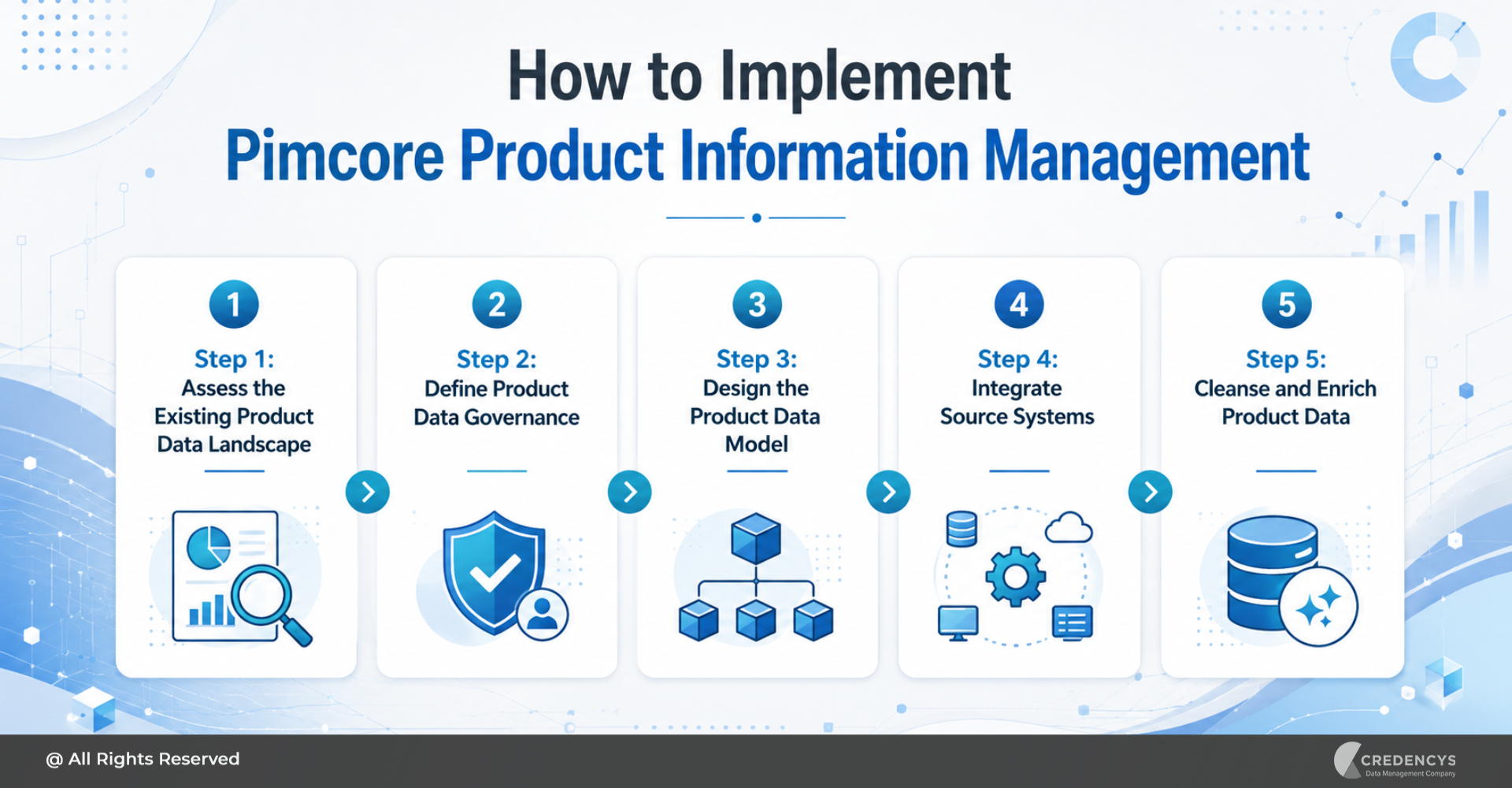
How to Implement Pimcore Product Information Management Successfully
A successful Pimcore PIM implementation requires more than software setup. It needs a clear product data strategy, governance model, integration plan, and adoption roadmap.
Here is a step-by-step approach.
Step 1: Assess the Existing Product Data Landscape
Start by identifying where product data currently exists. This may include ERP systems, spreadsheets, supplier files, DAM tools, eCommerce platforms, marketplace templates, and legacy databases.
Evaluate the quality, completeness, ownership, and flow of product data across these systems.
Step 2: Define Product Data Governance
Product data governance defines how product information will be created, enriched, approved, updated, and published. This includes:
- Product data ownership
- Approval workflows
- Mandatory fields
- Validation rules
- Data quality standards
- Role-based access
- Publishing responsibilities
A strong governance framework ensures that product data remains accurate and reliable over time.
Step 3: Design the Product Data Model
The product data model is the foundation of a successful PIM implementation. It should support product categories, variants, attributes, relationships, localization, digital assets, and channel-specific requirements.
For retail and CPG businesses, this step is critical because product structures can be complex and constantly evolving.
Step 4: Integrate Source Systems
Pimcore PIM should be connected to source systems such as ERP systems, supplier systems, legacy databases, and DAM platforms. This helps automate data flow and reduces manual data entry.
A proper integration plan ensures that Pimcore receives accurate product data from upstream systems and distributes enriched product data to downstream channels.
Step 5: Cleanse and Enrich Product Data
Before publishing product data, businesses should clean, standardize, and enrich it. This may include correcting duplicate records, standardizing attributes, improving descriptions, adding images, filling missing fields, and preparing localized content.
Clean and enriched data improves customer experience and reduces operational errors.
Why Choose Credencys for Pimcore Product Information Management?
Pimcore Product Information Management can deliver significant value when it is implemented with the right strategy, architecture, and execution approach. Credencys helps retail and CPG enterprises implement Pimcore PIM solutions that are aligned with business goals, digital commerce priorities, and product data complexity.
With deep experience in Pimcore implementation, data management, system integration, and enterprise digital transformation, Credencys helps businesses turn fragmented product information into a scalable and governed product data ecosystem. Credencys Can Help With:
- Pimcore consulting and roadmap planning
- Pimcore PIM implementation
- Product data modeling
- Product data migration
- Pimcore customization
- Workflow and approval configuration
- DAM and PIM integration
- ERP, eCommerce, marketplace, and third-party integrations
- Product data governance setup
- Omnichannel product data syndication
- Ongoing support and optimization
Credencys focuses on building Pimcore solutions that are not just technically sound but also practical for business users. The goal is to help enterprises improve product data accuracy, accelerate product launches, reduce manual effort, and deliver consistent product experiences across all channels.
Conclusion
For retail and CPG enterprises, product information has become a core driver of digital commerce performance. Accurate and consistent product data improves product discovery, customer trust, marketplace readiness, conversion rates, and the omnichannel customer experience.
However, managing product data across spreadsheets, ERP systems, DAM tools, eCommerce platforms, and marketplaces can create complexity and slow down growth. Pimcore Product Information Management helps businesses centralize, enrich, govern, and distribute product data from one scalable platform.
It enables retail and CPG enterprises to move from fragmented product data to a commerce-ready product information ecosystem. With the right Pimcore implementation partner, businesses can use Pimcore PIM to improve product data quality, accelerate product launches, and build a stronger foundation for omnichannel commerce.
FAQs
1. What is Pimcore Product Information Management?
Pimcore Product Information Management is a centralized platform that helps businesses manage, enrich, validate, and distribute product information across eCommerce platforms, marketplaces, catalogs, and other digital channels.
2. Why is Pimcore Product Information Management important for retail businesses?
Pimcore Product Information Management helps retailers manage large product catalogs, maintain consistent product content, improve data quality, and publish product information across multiple sales channels faster.
3. How does Pimcore PIM help CPG companies?
Pimcore PIM helps CPG companies manage product descriptions, packaging information, ingredients, digital assets, compliance data, localization, and retailer-specific product requirements from a centralized platform.
4. What types of product data can Pimcore PIM manage?
Pimcore PIM can manage SKUs, product names, descriptions, attributes, specifications, categories, variants, pricing-related information, images, videos, documents, translations, and channel-specific content.
5. Why should businesses choose Credencys for Pimcore PIM implementation?
Credencys helps businesses plan, implement, customize, integrate, and optimize Pimcore PIM solutions based on their product data complexity, digital commerce goals, and enterprise technology landscape.







Tags: