

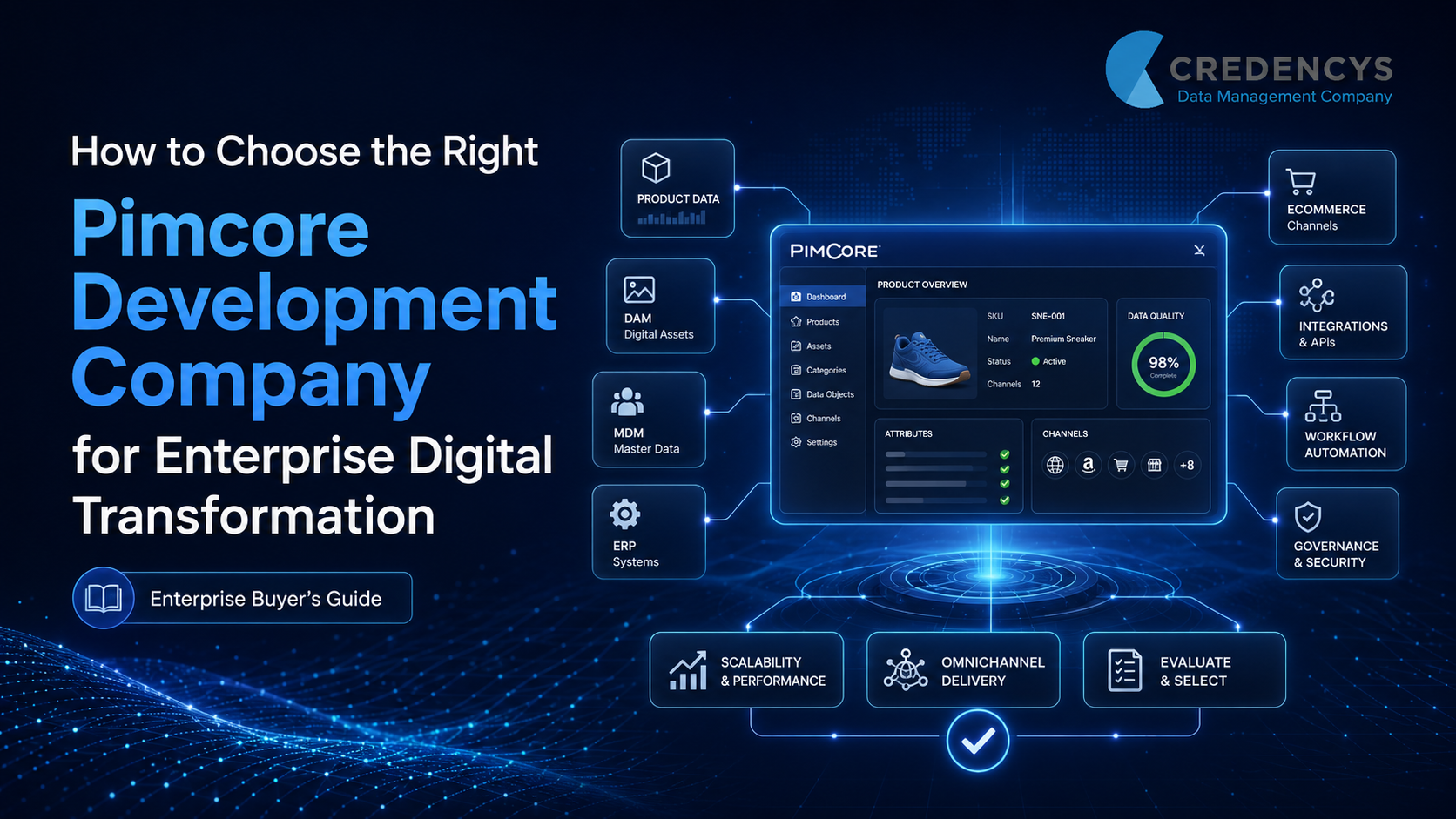
How to Choose the Right Pimcore Development Company for Enterprise Digital Transformation
Enterprise digital transformation is no longer limited to launching a new website, modernizing an eCommerce platform, or moving business systems to the cloud. For product-driven businesses, transformation starts with data.
As product catalogs grow, customer touchpoints expand, and sales channels become more complex, businesses need a reliable way to manage product information, digital assets, master data, workflows, and customer experiences from one centralized ecosystem. This is where Pimcore becomes a powerful platform for enterprises that want to bring structure, consistency, and scalability to their digital operations.
However, the success of a Pimcore project depends heavily on the expertise of the implementation and development partner. Pimcore is flexible, modular, and highly customizable, but that flexibility also requires the right strategy, architecture, data modeling, integrations, and governance.
Choosing the right Pimcore development company can help enterprises build a strong foundation for product information management, digital asset management, master data management, digital commerce, and omnichannel experience delivery. The right partner does not simply develop features. It helps businesses solve data challenges, streamline workflows, integrate systems, improve product data quality, and create a scalable digital ecosystem.
In this blog, we will explore how to choose the right Pimcore development company for enterprise digital transformation, what factors to evaluate, which red flags to avoid, and why Credencys is a trusted Pimcore development partner for businesses looking to unlock the full potential of Pimcore.
Why Choosing the Right Pimcore Development Company Matters
Pimcore gives enterprises the flexibility to manage product data, digital assets, master data, customer data, content, commerce, and omnichannel delivery from a unified platform. But to achieve real business value, the platform must be implemented and customized around the organization’s specific data structure, business processes, technology stack, and growth goals.
This is where the role of a reliable Pimcore development company becomes critical.
A basic development vendor may only focus on configuration or coding. But an experienced Pimcore development partner looks at the bigger picture. It understands how product data moves across the enterprise, how teams enrich and approve information, how digital assets are linked to product records, how ERP and eCommerce platforms exchange data, and how content needs to be delivered across websites, marketplaces, apps, print catalogs, and partner portals.
For growing enterprises, Pimcore development is not just a technical project. It is a data transformation initiative.
The wrong partner can lead to poorly designed data models, unnecessary customization, weak governance, integration issues, delayed timelines, and low user adoption. These issues can reduce the value of Pimcore and make it difficult for teams to manage product data efficiently.
On the other hand, the right Pimcore development company helps businesses:
- Build a scalable product data architecture
- Create clean and flexible data models
- Improve product data quality and completeness
- Connect PIM, DAM, MDM, ERP, CRM, eCommerce, and marketplace systems
- Automate product enrichment and approval workflows
- Reduce manual data handling
- Improve omnichannel consistency
- Support future growth across brands, regions, and channels
For enterprise digital transformation, the right Pimcore partner brings together technical development, data management expertise, integration capabilities, and industry understanding. This combination ensures that Pimcore is not just deployed as another system, but established as a central platform for scalable, governed, and connected digital operations.
Key Factors to Consider When Choosing a Pimcore Development Company
Choosing the right Pimcore development company requires more than checking technical skills or comparing project costs. Enterprises need a partner that understands Pimcore’s flexibility, product data complexity, integration requirements, governance models, and long-term business scalability.
Here are the most important factors to evaluate before making a decision.
1. Proven Pimcore Expertise
The first thing to look for is hands-on Pimcore experience. A reliable Pimcore development company should have practical knowledge of Pimcore’s core capabilities, including PIM, DAM, MDM, DXP, Commerce, data syndication, portals, workflows, and integrations.
Enterprises should evaluate whether the company has delivered Pimcore projects for businesses with complex data structures, multiple channels, large product catalogs, and enterprise-grade integration needs. Experience matters because Pimcore projects often require more than standard development. They need strong data modeling, process understanding, and platform customization.
2. Certified Pimcore Developers and Consultants
Pimcore-certified developers and consultants bring platform-specific knowledge that helps reduce implementation risks. They understand Pimcore architecture, development standards, data modeling capabilities, customization options, APIs, workflows, and integration patterns.
A company with certified Pimcore experts is better equipped to design scalable solutions, avoid unnecessary customization, follow best practices, and ensure that the platform remains flexible for future business needs.
3. Strong Product Data Management Experience
Pimcore development is deeply connected to product data management. The right partner should understand how product information is created, enriched, validated, approved, and distributed across channels.
Look for a company that can help with product hierarchies, categories, attributes, variants, relationships, classifications, localization, supplier data, digital assets, and channel-specific content. This expertise is critical for building a Pimcore solution that supports real business workflows instead of just storing data.
4. Enterprise Integration Capabilities
Most enterprise Pimcore projects require integrations with multiple systems such as ERP, CRM, eCommerce platforms, DAM systems, marketplaces, supplier portals, analytics tools, and data warehouses.
A strong Pimcore development company should be able to define a clear integration strategy, manage API development, enable data synchronization, support bidirectional data exchange, and ensure that information flows smoothly across the enterprise technology ecosystem.
Without strong integration planning, businesses may continue to face data silos even after implementing Pimcore.
5. Data Migration and Data Quality Approach
Data migration is one of the most critical parts of any Pimcore project. The right development company should not simply move old data into Pimcore. It should assess, clean, normalize, deduplicate, map, and validate the data before migration.
A strong partner will also help businesses define data quality rules, completeness checks, validation workflows, and governance standards to ensure that Pimcore becomes a trusted source of product information.
6. Custom Development Capabilities
Every enterprise has different processes, approval flows, data structures, and channel requirements. A Pimcore development company should be able to customize the platform without making it unnecessarily complex.
This may include custom modules, dashboards, user interfaces, product portals, supplier portals, marketplace connectors, workflow automation, APIs, and business-specific extensions.
The goal is not to customize everything. The goal is to customize only where it creates business value and supports long-term scalability.
7. Industry-Specific Understanding
Product data challenges differ across industries. A retailer may need faster catalog onboarding and marketplace syndication. A manufacturer may need technical specifications, spare parts data, and documentation management. A CPG brand may need packaging data, compliance details, and retailer-specific product content.
The right Pimcore development partner should understand the industry context and design the solution around business-specific product data requirements.
8. Scalable Architecture and Future Readiness
Enterprise digital transformation is not a one-time project. Businesses continue to add new products, brands, regions, languages, channels, suppliers, and customer experiences.
A reliable Pimcore development company should design the platform with future scalability in mind. This includes flexible data models, reusable components, integration-ready architecture, performance planning, governance frameworks, and room for future AI, automation, analytics, and omnichannel expansion.
9. Agile Delivery and Transparent Communication
Pimcore projects involve multiple stakeholders, including IT, product teams, marketing, eCommerce, operations, data teams, and leadership. Clear communication is essential.
Look for a partner that follows a structured delivery approach with discovery workshops, sprint planning, milestones, documentation, testing cycles, demos, stakeholder reviews, and clear reporting. This helps reduce confusion and keeps the project aligned with business expectations.
10. Post-Launch Support and Optimization
A successful Pimcore project does not end at go-live. After launch, businesses may need support for performance optimization, workflow improvements, integration monitoring, user training, upgrades, enhancements, and new channel rollouts.
The right Pimcore development company should offer long-term support and continuous optimization to help the platform evolve with business needs.
Red Flags to Avoid When Hiring a Pimcore Development Company
Not every technology partner that offers Pimcore services has the right mix of platform expertise, data management experience, and enterprise delivery capability. Choosing the wrong Pimcore development company can lead to delays, rework, poor adoption, and a solution that fails to scale. Here are the key red flags to watch for:
1. Limited Pimcore Experience
A company with only general web development or eCommerce experience may not be equipped to handle complex Pimcore requirements such as PIM, DAM, MDM, workflows, integrations, and omnichannel data delivery.
2. Weak Product Data Understanding
Pimcore development requires more than coding. If the company does not ask about your product attributes, variants, categories, taxonomies, localization, enrichment process, and channel needs, it may not understand enterprise product data complexity.
3. No Clear Data Migration Strategy
A weak partner may simply import old data into Pimcore without cleaning duplicates, fixing missing fields, normalizing formats, or validating data quality. This can carry existing problems into the new platform.
4. Poor Integration Planning
Enterprise Pimcore solutions often connect with ERP, CRM, eCommerce, DAM, marketplaces, supplier portals, and analytics tools. Without a clear integration strategy, businesses may continue facing data silos and synchronization issues.
5. Too Much Customization
Pimcore is flexible, but unnecessary customization can make the platform difficult to maintain and upgrade. The right partner should know when to configure, when to customize, and when to keep things simple.
6. Lack of Governance and Workflow Planning
Without clear ownership, approval flows, validation rules, and publishing processes, Pimcore can become another unmanaged data repository instead of a trusted product data platform.
7. No Industry-Specific Context
Retail, CPG, manufacturing, automotive, grocery, and distribution businesses all have different product data needs. A one-size-fits-all approach can miss important business requirements.
8. Weak Documentation and Support
Poor documentation and no post-launch support can make your internal teams dependent on the vendor for every change. A reliable Pimcore partner should provide knowledge transfer, user training, and ongoing optimization support.
9. Price-First Approach
Choosing the lowest-cost vendor may seem practical initially, but weak architecture, poor migration, and incomplete integrations can become expensive to fix later. Focus on long-term value, not just upfront cost.
Questions to Ask Before Hiring a Pimcore Development Company
Before finalizing a Pimcore development company, enterprises should ask the right questions to understand the partner’s technical strength, data management maturity, delivery process, and long-term support capability.
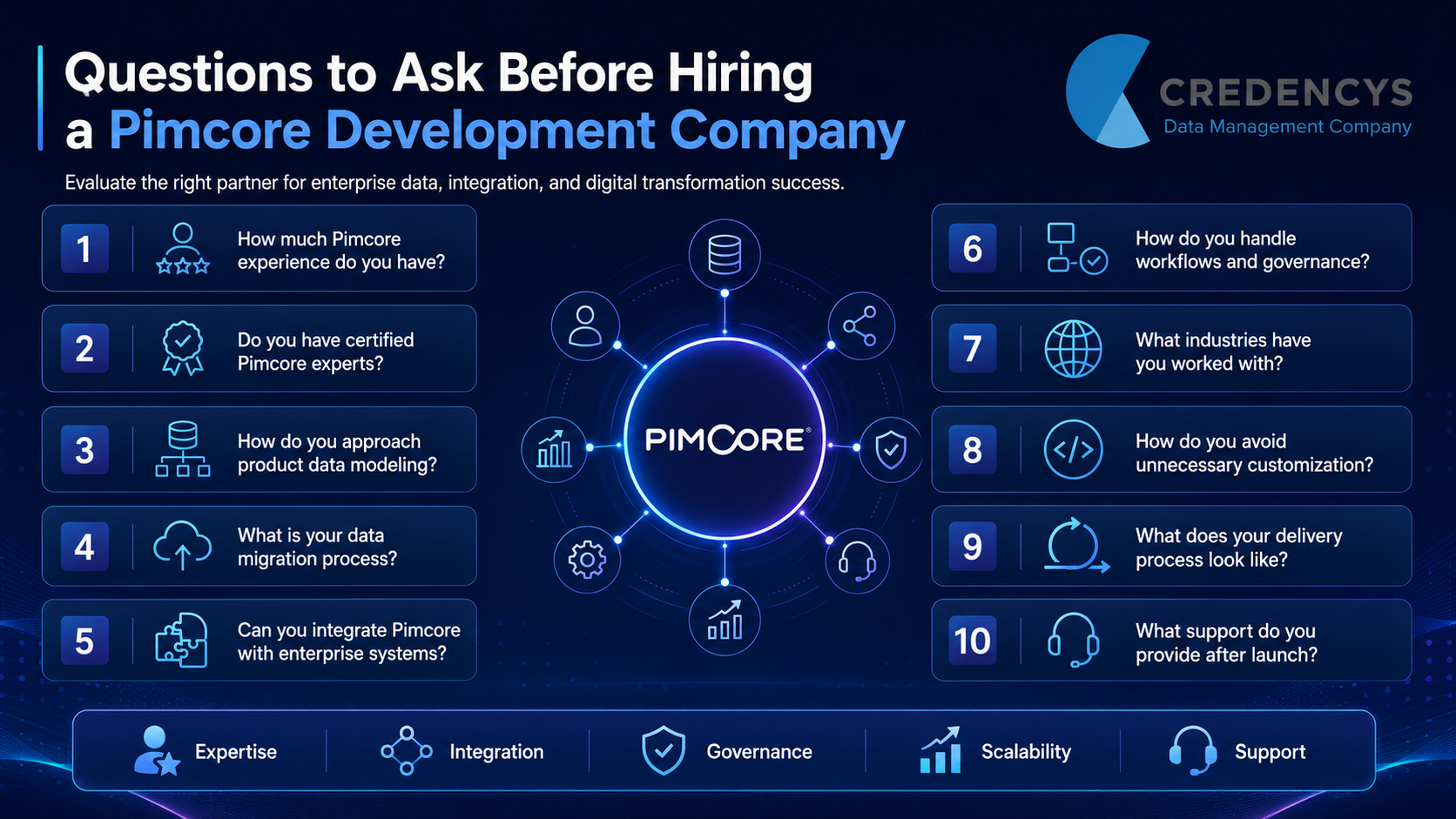
Here are some important questions to include in your evaluation:
1. How much experience do you have with Pimcore projects?
Ask about the number and type of Pimcore projects the company has delivered, especially across PIM, DAM, MDM, Commerce, DXP, and enterprise integrations.
2. Do you have certified Pimcore developers and consultants?
Certified experts bring platform-specific knowledge and can help reduce risks related to architecture, customization, scalability, and best practices.
3. How do you approach product data modeling?
The company should be able to explain how it designs product hierarchies, attributes, variants, classifications, relationships, localization, and channel-specific data structures.
4. What is your data migration process?
Ask how the company handles data audit, cleansing, normalization, mapping, validation, test migration, and final migration.
5. Can you integrate Pimcore with our enterprise systems?
A strong partner should have experience integrating Pimcore with ERP, CRM, eCommerce platforms, DAM, marketplaces, supplier portals, analytics tools, and other business systems.
6. How do you manage workflows and governance?
The company should help define data ownership, user roles, approval flows, validation rules, publishing processes, and governance standards.
7. What industries have you worked with?
Industry experience matters because product data complexity varies across retail, CPG, manufacturing, automotive, grocery, distribution, and other sectors.
8. How do you avoid unnecessary customization?
Ask how the company balances Pimcore’s native capabilities with custom development to keep the platform scalable and maintainable.
9. What does your delivery process look like?
The partner should provide a structured process for discovery, planning, development, testing, demos, documentation, training, and go-live.
10. What support do you provide after launch?
Look for a company that offers post-launch support, performance optimization, upgrades, user assistance, and continuous improvement.
Why Enterprises Choose Credencys as Their Pimcore Development Company
Choosing the right Pimcore development company is easier when the partner has proven platform expertise, enterprise data management experience, and a clear understanding of how digital transformation works across complex business environments.
Credencys is a Pimcore Strategic Partner with a strong focus on helping enterprises build scalable data and experience management solutions. The company brings together Pimcore consultants, solution architects, developers, data specialists, and integration experts to help businesses centralize product data, improve governance, automate workflows, and deliver consistent digital experiences across channels.
As a Pimcore partner, Credencys is recognized for delivering advanced PIM and MDM solutions, along with expertise across PIM, MDM, DAM, DXP, and Commerce for enterprise customers.
Credencys’ Pimcore capabilities are built around the needs of modern enterprises that manage large product catalogs, disconnected systems, complex digital assets, and multiple sales channels. Instead of treating Pimcore as only a development platform, Credencys approaches it as a strategic foundation for product data management, master data management, digital asset management, commerce, and omnichannel delivery.
What Makes Credencys a Reliable Pimcore Development Company?
Pimcore Strategic Partner
Credencys is a Strategic Partner of Pimcore and helps businesses unlock the full potential of Pimcore for data and experience management.
Certified Pimcore Expertise
Credencys has a team of 100+ certified Pimcore developers with experience in implementing Pimcore solutions across different business requirements and industry verticals.
Strong PIM and MDM Experience
Credencys has successfully implemented 200+ PIM/MDM solutions, helping businesses create trusted, governed, and scalable product and master data ecosystems.
End-to-End Pimcore Development Services
From consulting and architecture to development, integration, migration, deployment, and support, Credencys provides full-cycle Pimcore development services for enterprise needs.
Enterprise Integration Capabilities
Credencys helps connect Pimcore with ERP, CRM, eCommerce platforms, DAM systems, marketplaces, analytics tools, and other enterprise applications to reduce data silos and improve operational efficiency.
Industry-Focused Delivery
With experience across retail, manufacturing, distribution, CPG, automotive, grocery, and eCommerce, Credencys understands how product data challenges differ by industry and designs Pimcore solutions accordingly.
Governance, Data Quality, and Workflow Automation
Credencys helps businesses define data ownership, validation rules, approval workflows, completeness checks, and publishing processes so Pimcore becomes a trusted system of record.
Case Study: How Credencys Helped SM Retail Streamline Product Management
Credencys worked with SM Retail, the Philippines’ leading omni-channel retail brand with more than 1,300 outlets nationwide. As the business scaled across physical and digital channels, its existing PIM system struggled with performance issues, delayed pricing updates, and challenges in syndicating accurate product data across channels.
The Challenge
SM Retail faced issues such as inaccurate product data, delayed launches, high operational costs, limited access control, and inconsistent product information across channels.
The Solution
Credencys deployed a custom PIM solution within four months and introduced PIM, DAM, and CMS frameworks for end-to-end product lifecycle management. The team also implemented role-based access, automated pricing updates, and product data validation workflows.
The Business Impact
The solution delivered:
- 80% reduction in pricing update time
- 50% improvement in operational efficiency
- Stronger data governance
- Improved product data accuracy and security
Final Checklist for Selecting the Right Pimcore Development Company
Before choosing a Pimcore development company, make sure the partner can support both your technical requirements and long-term digital transformation goals.
Use this checklist during evaluation:
- Proven experience in Pimcore development and implementation
- Certified Pimcore developers and consultants
- Strong expertise across PIM, DAM, MDM, DXP, and Commerce
- Clear understanding of enterprise product data management
- Ability to design scalable data models and workflows
- Experience with ERP, CRM, eCommerce, DAM, and marketplace integrations
- Structured data migration and data quality approach
- Industry experience relevant to your business
- Capability to build custom modules, portals, dashboards, and APIs
- Strong governance, documentation, and training process
- Transparent delivery methodology with clear milestones
- Reliable post-launch support and optimization







Tags: