


How is AI Transforming Retail Demand Forecasting
Retail demand can shift quickly because of promotions, pricing, seasonality, local preferences, weather, inventory availability, and customer behavior. AI is already a strategic priority.
NVIDIA’s 2026 retail and CPG survey found that 91% of organizations were using or evaluating AI, while 90% planned to increase their AI budgets. Yet many forecasting teams still rely on historical sales, static spreadsheets, and periodic updates.
AI-driven retail demand forecasting connects sales, inventory, product, customer, and external signals to improve forecast accuracy and accelerate decisions across planning, replenishment, pricing, and supply chain.
What is Retail Demand Forecasting?
Retail demand forecasting is the process of predicting future product demand using historical sales, inventory, promotions, pricing, customer behavior, market conditions, and other relevant business signals. Retailers use forecasts to decide what to buy, where to allocate stock, how much to replenish, when to run promotions, and how to plan staffing or markdowns.
The goal is not only to produce a forecast number. It is to ensure the right products are available in the right channel, at the right location, and at the right time while protecting margins and the customer experience.
For an omnichannel retailer, this requires visibility across stores, eCommerce, marketplaces, warehouses, and fulfillment locations. It also requires an understanding of how demand differs by SKU, category, region, store format, and customer segment.
Why Traditional Retail Demand Forecasting Falls Short
Traditional retail demand forecasting usually relies on past sales, broad seasonal assumptions, and manual adjustments by planners. It can work for stable products, but it becomes less reliable when demand is affected by several changing variables at once.
Historical sales do not always explain the full situation. A decline may reflect weaker customer demand, but it could also result from an out-of-stock condition, a discontinued assortment, a fulfillment delay, or reduced promotion activity.
A temporary sales spike may be caused by discounting rather than sustained demand. Retail data is also commonly spread across POS, ERP, eCommerce, WMS, CRM, PIM, loyalty, marketing, and supplier platforms, making strong data integration services essential for creating a complete demand view.
When those systems are disconnected, planners spend too much time consolidating spreadsheets and too little time improving decisions. This creates predictable constraints:
- Forecasts update too slowly to respond to change.
- Planning happens at the category level rather than at the SKU and location levels.
- Promotions and price changes are treated as assumptions instead of measurable demand drivers.
- New products are difficult to forecast because they lack sales history.
- Inventory decisions are made without a complete view of supply, demand, and customer signals.
Traditional methods explain what happened previously. AI helps retailers understand what may happen next, why it may happen, and where action is most urgent.
Traditional Retail Forecasting vs AI-Powered Demand Forecasting
| Capability | Traditional Retail Forecasting | AI-Powered Retail Demand Forecasting |
|---|---|---|
| Data Inputs | Historical sales and manual adjustments | Historical, real-time, behavioral, operational, and external data |
| Forecast Updates | Weekly or monthly | Continuous or near-real-time refreshes |
| Planning Detail | Broad category or region views | SKU, store, channel, location, and segment-level forecasts |
| Promotions | Manual assumptions | Promotion-aware demand modeling |
| New Products | Limited historical reference | Similar products, attributes, and category patterns |
| Decision Support | Static reports | Alerts, recommendations, and exception-based actions |
| Improvement Cycle | Periodic updates | Continuous learning and monitoring |
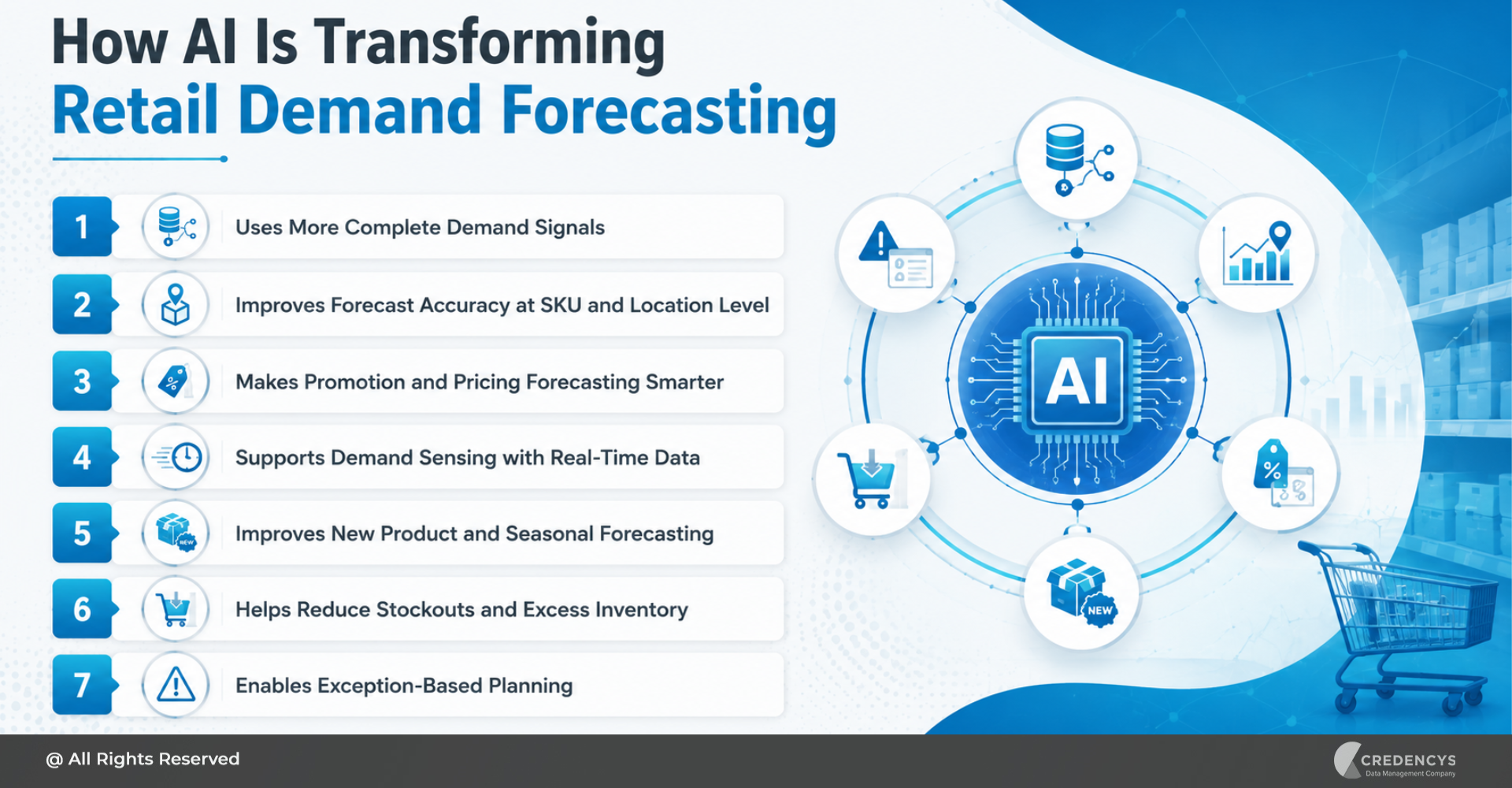
How AI Is Transforming Retail Demand Forecasting
1. Uses More Complete Demand Signals
Traditional forecasting often relies primarily on past sales. AI can combine a broader range of demand signals, including:
- POS and eCommerce sales
- Store and warehouse inventory
- Promotions, discounts, and pricing changes
- Product attributes and availability
- Returns and cancellations
- Supplier lead times
- Marketing activity
- Customer behavior
- Weather, local events, and regional trends
This helps retailers understand why demand is changing. For example, a sales decline may reflect an out-of-stock issue rather than lower customer interest.
A spike may be linked to a campaign, local event, or increased online engagement.
2. Improves Forecast Accuracy at SKU and Location Level
Demand is rarely the same across stores, regions, channels, or customer groups. AI can forecast demand at a more granular level, including:
- SKU
- Store
- Warehouse
- Channel
- Geography
- Customer segment
This helps retailers avoid broad averages that hide local variation. An apparel retailer, for example, can allocate different sizes by store format and local demand.
A grocery retailer can adjust seasonal inventory based on regional buying patterns.
3. Makes Promotion and Pricing Forecasting Smarter
Promotions can increase sales, but they can also distort demand. AI helps retailers evaluate:
- Expected promotion lift
- Margin impact
- Product substitution
- Cannibalization risk
- Inventory availability
- Post-promotion demand changes
- Channel-level campaign performance
This gives planning and merchandising teams a stronger basis for promotion decisions. AI-driven pricing follows the same principle.
Better pricing recommendations depend on current inventory, demand signals, cost information, customer segments, and margin rules.
4. Supports Demand Sensing with Real-Time Data
Demand sensing improves short-term forecasting by using current signals rather than relying solely on historical trends. Relevant signals may include:
- Recent sales velocity
- Store-level inventory movement
- Online browsing and cart activity
- Order cancellations
- Campaign performance
- Weather changes
- Local events
- Supply disruptions
AI can identify meaningful shifts before they appear in the next weekly or monthly planning cycle. This capability depends on connected data and reliable real-time data pipelines.
Current operational signals must be available, quality-checked, and connected to the workflows where decisions are made.
5. Improves New Product and Seasonal Forecasting
New products have little or no sales history. Seasonal demand can also vary by region, climate, channel, promotion strategy, and calendar timing.
AI can use alternative signals such as:
- Similar product performance
- Product attributes
- Historical category trends
- Price bands
- Customer preferences
- Seasonal patterns
- Assortment context
- Regional demand behavior
For fashion, this may include style, color, material, price point, and size range. For holiday or back-to-school assortments, it may include past campaign performance and local buying patterns.
Accurate product information is essential. Product hierarchies, categories, variants, availability, and lifecycle status must be complete and standardized before AI can produce reliable forecasts.
6. Helps Reduce Stockouts and Excess Inventory
Forecast quality directly affects inventory outcomes. When demand is underestimated, retailers risk:
- Stockouts
- Lost sales
- Lower customer satisfaction
- Emergency replenishment costs
When demand is overestimated, retailers risk:
- Excess inventory
- Higher holding costs
- Markdown pressure
- Working-capital constraints
AI can flag fast-moving SKUs, slow-moving products, potential stockouts, and inventory imbalances earlier. This gives teams more time to transfer, replenish, promote, bundle, or mark down inventory.
A connected retail product data foundation also helps teams improve inventory visibility, assortment decisions, and product availability across channels.
7. Enables Exception-Based Planning
Retail planners should not need to review every SKU, store, and forecast manually. AI can prioritize exceptions such as:
- Unusual sales spikes or drops
- Low forecast confidence
- Promotion underperformance
- Supplier delays
- Inventory imbalance
- High stockout risk
- Demand changes affecting availability
This allows planners to focus on the decisions where human expertise adds the most value.
Planner overrides also remain important. Local events, supplier conversations, and merchandising decisions may not yet be visible in the data. Tracking overrides creates useful feedback for improving future forecasts.
Retail Demand Forecasting Use Cases Across the Value Chain
Merchandising and Assortment Planning
Forecasts help teams decide which products to carry by store, channel, season, and region. They support assortment localization, range planning, and product-lifecycle decisions.
Inventory Allocation and Replenishment
Retailers can allocate stock based on expected demand and adjust replenishment as conditions change. This improves availability while reducing unnecessary inventory movement and overstocking.
Pricing and Promotions
AI helps estimate promotion lift, markdown risk, substitution effects, and margin impact. This supports more disciplined decisions about where and when to discount.
Supply Chain and Procurement
Better demand visibility improves purchase planning, supplier coordination, lead-time management, and inbound inventory planning. It can reduce rush orders and support stronger supplier collaboration.
Store Operations and Omnichannel Fulfillment
Demand intelligence supports staffing, shelf availability, store fulfillment, and channel-level inventory decisions. It also helps retailers improve product availability across digital and physical channels.
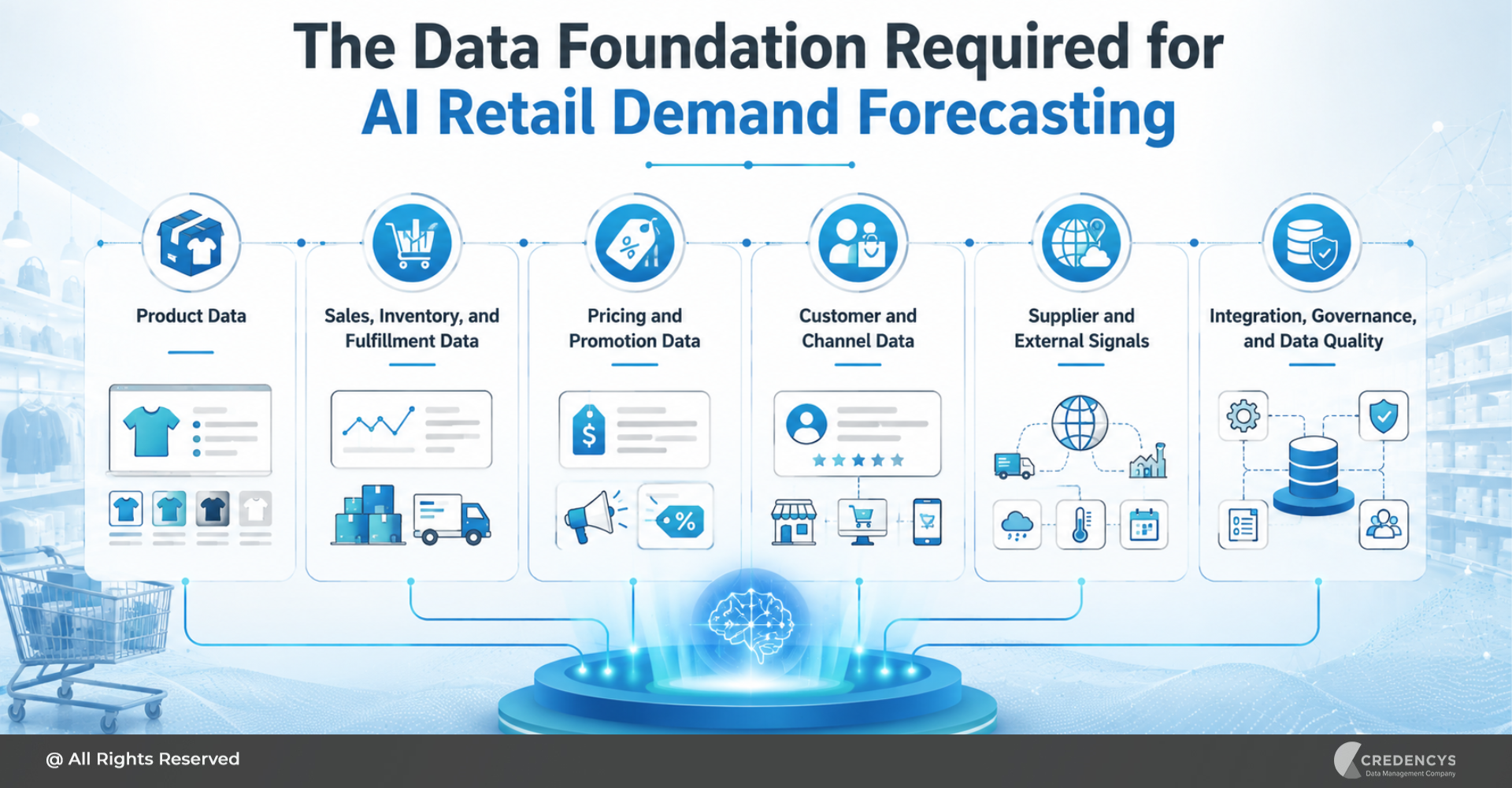
The Data Foundation Required for AI Retail Demand Forecasting
AI demand forecasting is only as reliable as the data behind it. Retailers need connected, governed, and current information across several areas.
Product Data
Accurate product data helps AI understand what is being forecast. Key information includes:
- Product hierarchies and categories
- Attributes and specifications
- Sizes, colors, and variants
- Product lifecycle status
- Availability and assortment details
Incomplete or inconsistent attributes can weaken demand forecasts and product recommendations. Product Information Management helps standardize this information before it is used by AI.
Sales, Inventory, and Fulfillment Data
Retailers need visibility into what is selling, what is available, and where inventory is located. Important signals include:
- POS and eCommerce sales
- Store and warehouse inventory
- Stockout history
- Replenishment activity
- Returns and cancellations
- Order fulfillment data
Without this information, a model may mistake lost sales caused by unavailable inventory for low demand.
Pricing and Promotion Data
AI needs context around price changes, discounts, promotions, campaigns, and markdowns. This helps forecasting models separate genuine demand growth from temporary promotion-driven uplift.
Customer and Channel Data
A connected Customer 360 solution can reveal behavior across:
- Stores
- eCommerce
- Loyalty programs
- Marketplaces
- Customer service interactions
- Marketing campaigns
This improves visibility into channel preferences, buying behavior, and customer-driven demand patterns.
Supplier and External Signals
Supplier lead times, shipment delays, local events, weather, and regional conditions can all influence demand and availability. Including relevant external signals helps retailers create more responsive short-term forecasts.
Integration, Governance, and Data Quality
Retail data is commonly spread across ERP, POS, eCommerce, CRM, WMS, PIM, DAM, loyalty, marketing, and supplier systems. Strong data engineering services and integration capabilities help connect these sources through APIs, pipelines, cloud data platforms, and governed data models.
Retailers also need:
- Shared data definitions
- Clear ownership
- Quality checks
- Freshness monitoring
- Access controls
- Issue-resolution processes
A sophisticated model cannot compensate for incomplete, delayed, or unreliable inputs.
A Practical Framework for Implementing AI Demand Forecasting
1. Start With a High-Value Forecasting Problem
Choose a problem with measurable value, such as reducing stockouts in a high-volume category, improving seasonal planning, lowering excess stock, optimizing promotions, or improving store-level replenishment. A focused start helps validate the data, model, workflow, and business value.
2. Assess Current Data Readiness
Review data availability, quality, granularity, integration, freshness, and ownership. Identify where critical signals are missing, delayed, inconsistent, or inaccessible.
Merchandising, supply chain, finance, IT, data, and operations teams should all contribute.
3. Build a Connected Retail Data Layer
Bring together POS, eCommerce, inventory, product, customer, promotion, supplier, and external data. Build reusable pipelines and governed data models rather than creating a separate data flow for each forecasting project.
4. Select the Right AI and Forecasting Approach
There is no single model for every retail category. The right approach depends on demand volatility, product lifecycle, data availability, forecast horizon, seasonality, and the decision being supported.
Prioritize decision quality and business value over algorithm complexity.
5. Embed Forecasts into Retail Workflows
Forecasts should influence replenishment, allocation, pricing, merchandising, procurement, and supply chain decisions. Show confidence levels, key drivers, exceptions, recommended actions, and relevant constraints so users can interpret and act on the output.
6. Monitor Performance and Improve Continuously
Track forecast accuracy, bias, stockout rates, excess inventory, markdowns, planner overrides, and business outcomes with strong data observability. Retail conditions change continuously, so models, data inputs, and business rules need regular review.
7. Scale Across Categories, Channels, and Regions
After proving value in a focused use case, expand to more categories, locations, channels, and regions. Each extension should have clear ownership, measurable outcomes, and the data foundation required for reliable forecasting.
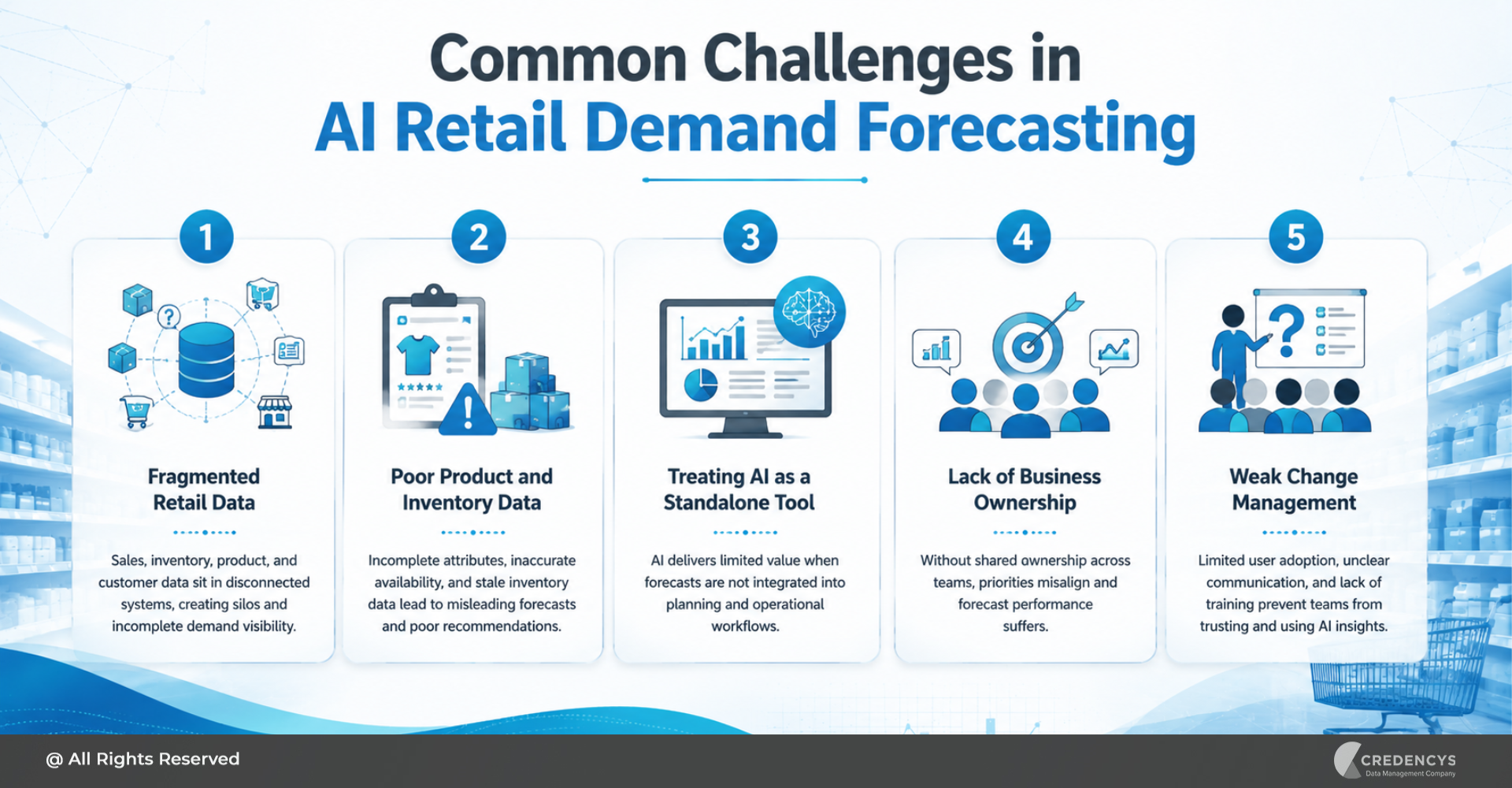
Common Challenges in AI Retail Demand Forecasting
Fragmented Retail Data
Sales, inventory, product, customer, and supplier data often sit in disconnected systems. This makes it difficult to create a complete demand view and limits the quality of AI forecasts.
Poor Product and Inventory Data
Incorrect attributes, missing variants, stale availability data, and weak location-level visibility can produce misleading recommendations. Data quality work should be treated as part of the forecasting initiative, not as a separate technical task.
Treating AI as a Standalone Tool
Forecasting creates value only when it is embedded in planning and operational workflows. AI outputs should inform decisions on replenishment, allocation, merchandising, pricing, procurement, and supply chain.
Lack of Business Ownership
Merchandising, supply chain, finance, operations, IT, and data teams all influence forecast outcomes. Retailers need shared ownership of goals, decisions, and performance measures.
Weak Change Management
Planners need visibility into forecast drivers, confidence levels, assumptions, and exceptions. They also need clarity on when to trust the forecast, when to override it, and how to act on the insight.
How Credencys Helps Retailers Build AI-Powered Demand Forecasting
Credencys helps retailers build the data, analytics, and AI foundation required for more accurate retail demand forecasting. Our capabilities include retail data strategy, data engineering and integration, Product Information Management, Customer 360, data quality and governance, real-time data pipelines, analytics and BI, AI/ML solutions, demand forecasting, dynamic pricing, promotion optimization, Databricks consulting, Snowflake consulting, and cloud data platform modernization.
We help retailers connect demand signals across product, customer, inventory, pricing, supplier, and sales systems. This enables forecasting solutions that improve inventory planning, promotion performance, operational efficiency, and customer availability.
Conclusion
Retail demand forecasting is no longer limited to historical sales and periodic planning cycles. AI helps retailers use connected, current, and contextual data to forecast demand at a more granular level, respond faster to change, and improve decisions across inventory, pricing, merchandising, supply chain, and customer operations.
The goal is not only to predict demand more accurately. It is to make demand intelligence available where decisions happen.
Retailers that invest in trusted data, practical AI/ML capabilities, and connected planning workflows can reduce inventory risk, improve product availability, and build more responsive operations. To assess your retail data readiness, forecasting workflows, and AI opportunities, talk to retail data experts.
Frequently Asked Questions
What is retail demand forecasting?
Retail demand forecasting is the process of predicting future product demand using sales, inventory, promotions, customer behavior, market conditions, and other relevant business signals.
How does AI improve retail demand forecasting?
AI analyzes more data sources, identifies changing demand patterns, improves SKU and location-level forecasts, detects anomalies, and updates predictions as new information becomes available.
What data is needed for AI retail demand forecasting?
Key inputs include sales, inventory, product information, pricing, promotions, customer behavior, supplier lead times, returns, store data, and external market signals.
Can AI help reduce stockouts and excess inventory?
Yes. AI forecasting helps retailers identify demand changes earlier, improve replenishment, optimize inventory allocation, and reduce the risk of understocking or overstocking.
What is demand sensing in retail?
Demand sensing uses current or near-real-time signals, such as recent sales, inventory movement, customer behavior, weather, or promotions, to improve short-term forecasts.



Tags: