


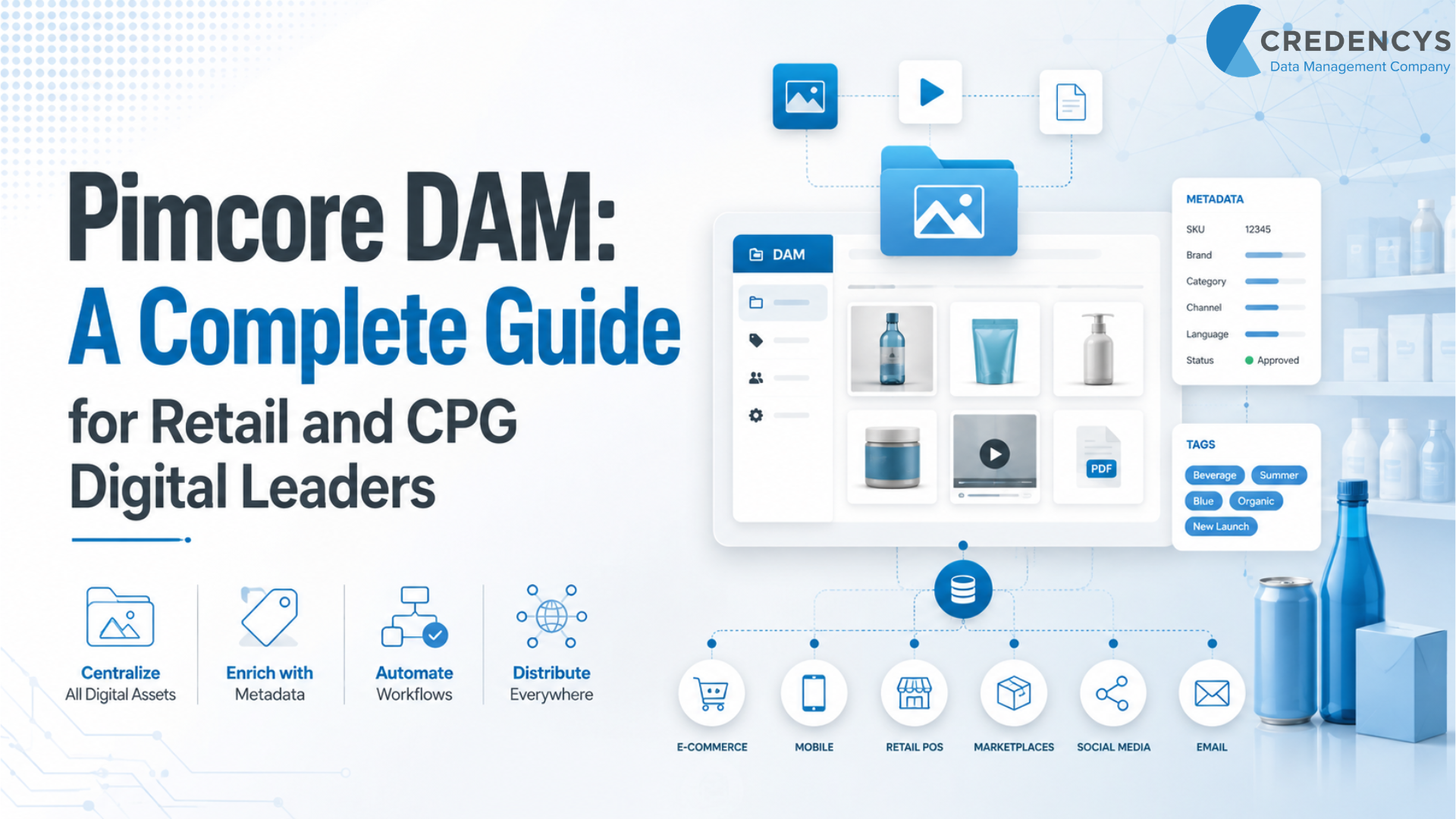
Pimcore DAM: A Complete Guide for Retail and CPG Digital Leaders
Retail and CPG brands rely on thousands of digital assets to support product launches, marketing campaigns, eCommerce experiences, and marketplace listings. As product catalogs and customer touchpoints grow, managing these assets becomes increasingly challenging.
Studies show that employees spend nearly 20% of their workweek searching for information, while organizations lose valuable time and resources due to duplicated or outdated content.
Additionally, consistent product content can significantly improve conversion rates, making effective asset management a business priority rather than just an operational need. Marketing teams often store creatives in one system, product teams manage images in another, agencies share files via email or in shared folders, and regional teams create localized versions independently.
Over time, assets become scattered, duplicated, outdated, and difficult to govern. This directly impacts product launches, campaign execution, brand consistency, and customer experience.
That is where Pimcore DAM helps. Pimcore DAM provides a centralized platform for storing, organizing, managing, enriching, transforming, approving, and distributing digital assets across channels.
For Retail and CPG brands struggling with scattered product images, videos, packaging files, and marketing assets, a centralized Digital Asset Management solution helps create a single source of truth for approved content. It is a foundation for faster content operations, consistent brand experiences, and scalable growth in digital commerce.
What is Pimcore DAM?
Pimcore DAM is part of the broader Pimcore platform, which helps businesses manage product data, digital assets, customer experiences, and commerce operations from a connected ecosystem. These digital assets can include:
- Product images
- Lifestyle images
- Product videos
- Brand creatives
- Packaging files
- Logos and brand guidelines
- PDF documents
- Product manuals
- Sell sheets
- Certificates and compliance documents
- Campaign assets
- Marketplace-ready media files
Instead of storing assets across shared folders, drives, emails, creative tools, and disconnected systems, Pimcore DAM brings them into one structured environment. Teams can organize assets, add metadata, manage versions, define usage rights, control access, run approval workflows, and distribute approved assets to different channels.
For Retail and CPG businesses, Pimcore DAM is especially valuable because digital assets are closely connected to product experiences. A product listing is incomplete without the right image, video, packaging visual, specification sheet, or supporting document.
When Pimcore DAM integrates with Pimcore PIM, brands can link product information to the right digital assets. This helps teams ensure that every product has accurate, approved, and channel-ready content before it is published.
Why Digital Asset Management Matters for Retail and CPG Brands
Retail and CPG businesses manage thousands of products, multiple brands, several product categories, and a wide range of sales channels. A single SKU may require multiple assets, including front-view images, side-view images, lifestyle shots, videos, packaging files, ingredient labels, instruction manuals, certifications, promotional creatives, and marketplace-specific image variations.
Now multiply this across regions, languages, brands, retailers, and campaigns. Without a centralized DAM system, content operations become slow and inconsistent.
Teams often spend too much time searching for files, validating versions, resizing images, checking approvals, and confirming whether an asset is ready for publishing. In many cases, they recreate existing assets because they cannot quickly find the right file.
This creates several business challenges:
- Product launches get delayed because assets are missing or incomplete.
- Marketing campaigns slow down due to manual asset coordination.
- Brand consistency suffers across channels and regions.
- eCommerce teams publish outdated or incorrect visuals.
- Retail partners receive inconsistent content.
- Creative teams spend time on repetitive requests.
- Compliance teams struggle to control approved packaging or claim-related assets.
- Customers see inconsistent product experiences across touchpoints.
For CMOs, these problems are not just operational inefficiencies. They affect brand trust, conversion, campaign performance, and speed to market.
A strong DAM foundation helps marketing and digital teams move faster while maintaining control over the quality, accuracy, and consistency of digital assets.
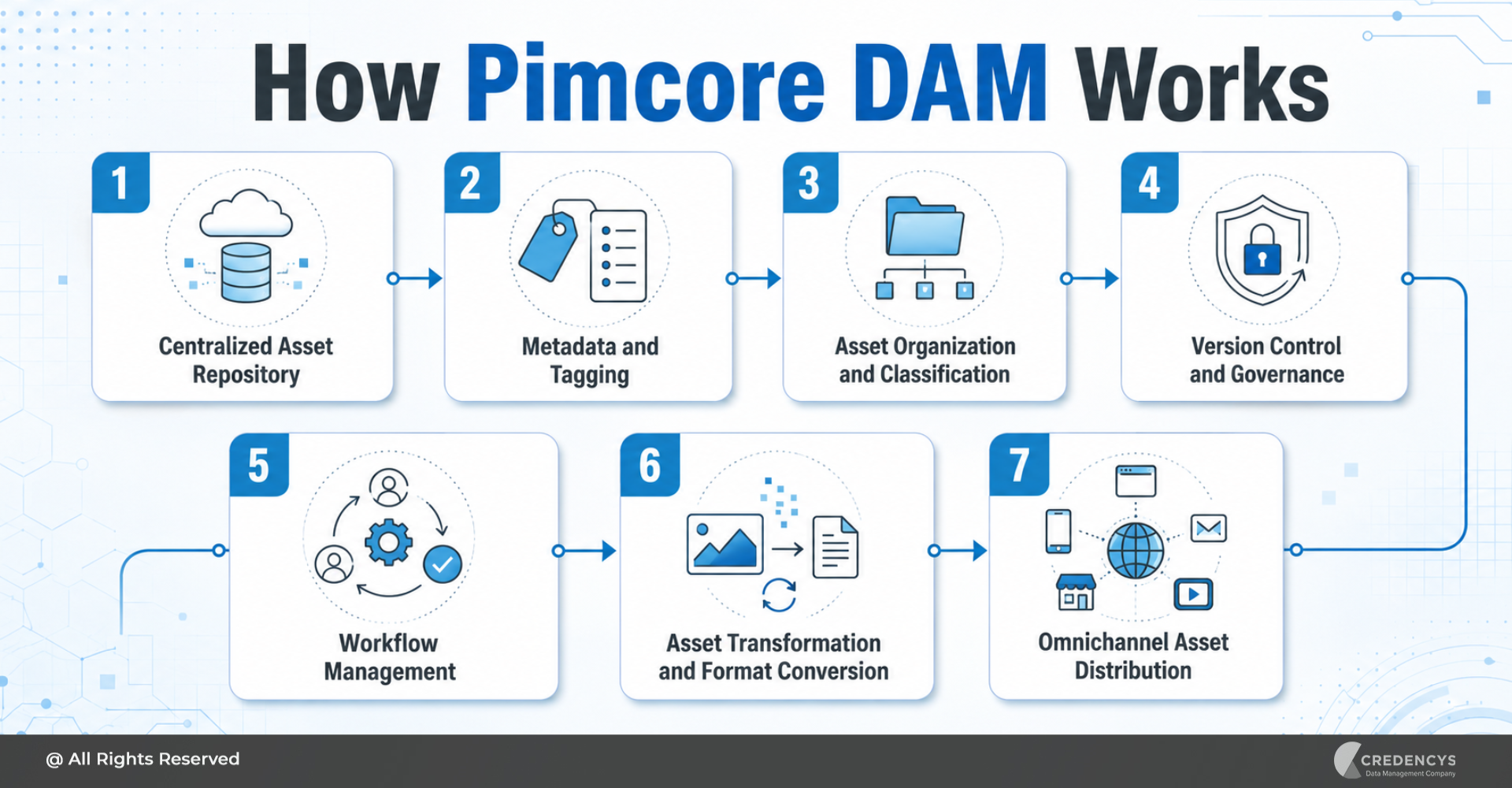
How Pimcore DAM Works
Pimcore DAM creates a centralized, structured, and governed environment for managing the complete lifecycle of digital assets. A successful DAM setup requires the right metadata structure, workflows, integrations, and governance model, which makes Pimcore implementation services important for enterprise teams.
Here is how Pimcore DAM works in a practical business environment.
1. Centralized Asset Repository
Pimcore DAM brings all digital assets into one centralized repository. This gives marketing, product, creative, eCommerce, sales, and agency teams a single place to access approved assets.
Instead of depending on shared drives, email threads, desktop folders, or disconnected platforms, teams can use Pimcore DAM as the source of truth for digital assets. A centralized repository reduces confusion and helps ensure that every team works with the right assets.
2. Metadata and Tagging
Digital assets are only useful when teams can find and use them easily. Pimcore DAM allows assets to be enriched with metadata and tags.
Metadata can include asset name, asset type, product category, SKU, brand, region, language, campaign, usage rights, approval status, expiration date, file format, and channel requirements. This makes it easier for teams to search, filter, retrieve, and reuse assets.
Instead of asking, “Where is the latest product image?”, teams can quickly find the approved version using metadata-based search.
3. Asset Organization and Classification
Pimcore DAM helps businesses organize assets based on their operational needs. Assets can be structured by product category, SKU, brand, region, campaign, market, channel, retailer, season, or asset type.
This gives teams a logical and scalable way to manage large asset libraries. A well-defined structure ensures that assets are easier to manage as product catalogs, campaigns, and channels grow.
4. Version Control and Governance
One of the biggest risks in digital asset management is the use of outdated or unapproved assets. The wrong product image, an outdated packaging file, an incorrect claim, or an expired creative can create brand, legal, and customer-experience issues.
Pimcore DAM helps businesses manage asset versions and governance. Teams can maintain updated versions, track changes, manage approvals, and control which assets are available for use.
This ensures that only the latest and approved files are distributed across channels.
5. Workflow Management
Digital assets usually go through multiple stages before they are ready for use. A product image may need to be uploaded, reviewed, edited, approved, tagged, linked to a product, resized, and published.
Campaign creatives may need approval from marketing, brand, legal, and regional teams. Pimcore DAM supports structured workflows for asset creation, review, approval, publishing, and updates.
This reduces manual follow-ups and gives teams more visibility into the asset lifecycle. Marketing leaders can see where assets are stuck, which files are approved, and what is ready for distribution.
Better workflows help teams launch products and campaigns faster without losing control over quality and compliance.
6. Asset Transformation and Format Conversion
Different channels require different asset formats. A product image for an eCommerce website may need a different size than an image for Amazon, a mobile app, a social media campaign, or a print catalog.
Manually resizing and reformatting assets can slow down content operations. Pimcore DAM helps teams create and manage asset variations for different channels, formats, resolutions, and devices.
Instead of creating every variation manually, teams can streamline asset preparation and improve speed.
7. Omnichannel Asset Distribution
Once assets are approved and ready, they need to reach the right channels. Pimcore DAM helps businesses distribute digital assets across websites, eCommerce platforms, marketplaces, CMS platforms, mobile apps, catalogs, retailer portals, and other systems.
This ensures that product and brand assets are not only stored centrally but also delivered efficiently. For digital leaders, this is where DAM becomes more than an asset library.
It becomes an operational layer that supports omnichannel product experiences.
Key Features of Pimcore DAM
Pimcore DAM provides a wide range of capabilities that support asset management at scale. Some of the key features include:
- Centralized digital asset repository
- Metadata management
- Advanced search and filtering
- Asset classification
- Version control
- Role-based access control
- Workflow and approval management
- Asset preview
- Image and video management
- Asset transformation
- Product asset linking
- PIM integration
- CMS and eCommerce integration
- Omnichannel publishing
- Brand asset governance
These features help businesses move beyond basic file storage and build a governed, scalable, and connected asset management ecosystem. With the right Pimcore development services, businesses can customize DAM workflows, connect assets with product data, and integrate Pimcore with commerce, CMS, ERP, and marketplace systems.
Pimcore DAM and PIM: Why the Combination Matters
DAM and PIM solve different but connected business problems. A PIM system manages product information, including product names, descriptions, attributes, specifications, categories, pricing details, and channel-specific content.
A DAM system manages digital assets such as images, videos, documents, graphics, and marketing files. For Retail and CPG brands, these two systems need to work together.
A product experience is not complete with product data alone. Customers also need accurate visuals, videos, manuals, packaging details, and supporting content.
Similarly, a product image becomes more useful when it is linked to the correct SKU, variant, category, and channel. When Pimcore DAM and Pimcore PIM are connected, businesses can manage product data and digital assets together.
This helps teams ensure that:
- Every product has the right images and videos.
- Assets are linked to the correct SKU or product variant.
- Product pages are complete before publishing.
- Marketplace content meets channel requirements.
- Marketing and product teams work from the same source of truth.
- Product launches move faster across channels.
- Customers receive consistent product experiences.
For CMOs and digital leaders, the PIM-DAM connection is critical because it directly supports product experience management. It helps brands deliver accurate, engaging, and consistent product content across every customer touchpoint.
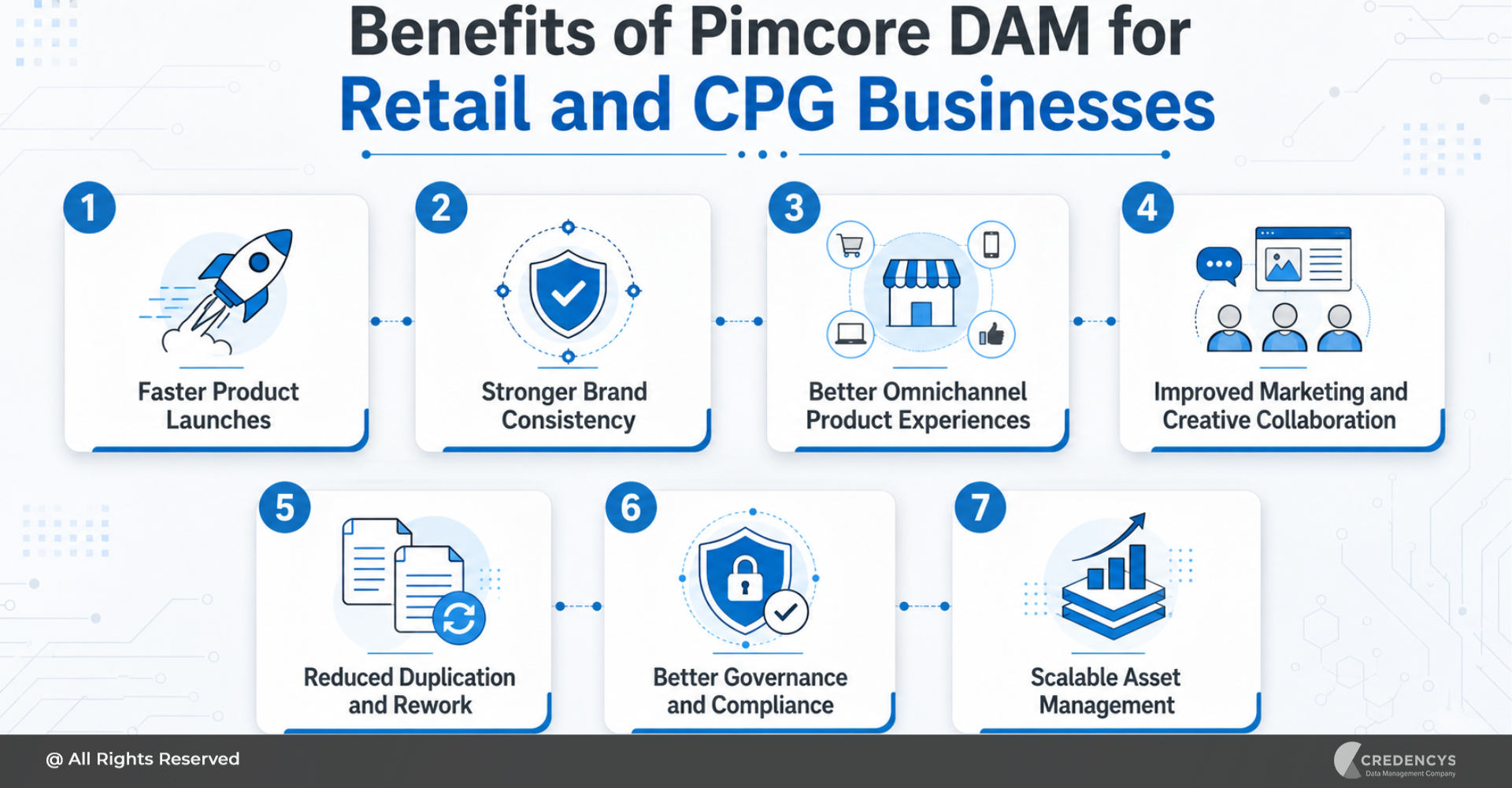
Benefits of Pimcore DAM for Retail and CPG Businesses
Pimcore DAM delivers value across marketing, product, creative, eCommerce, and digital operations. Here are the most important business benefits.
1. Faster Product Launches
Product launches often stall because assets are missing, scattered, outdated, or awaiting approval. Pimcore DAM gives teams quick access to approved and channel-ready assets.
Product images, videos, documents, and marketing files can be organized, reviewed, linked, and distributed more efficiently. This helps Retail and CPG brands reduce launch delays and bring products to market faster.
2. Stronger Brand Consistency
Brand consistency becomes difficult when different teams, agencies, regions, and partners use different versions of assets. Pimcore DAM helps centralize approved brand and product assets.
It gives teams better control over which assets can be used and where. This ensures that customers see consistent visuals, messaging, packaging, and campaign experiences across websites, marketplaces, social media, retailer portals, and offline channels.
3. Better Omnichannel Product Experiences
Today’s customers may discover a product on social media, compare it on a marketplace, view it on a retailer’s website, and purchase it through a mobile app. If product images, videos, and content differ across these channels, it weakens trust.
Pimcore DAM helps brands deliver consistent digital assets across touchpoints. When connected with PIM and commerce systems, it ensures that product data and product visuals work together.
This leads to more complete, accurate, and engaging product experiences.
4. Improved Marketing and Creative Collaboration
Marketing, creative, product, eCommerce, legal, sales, and agency teams often need to collaborate on the same assets. Without a DAM system, collaboration happens through emails, chat messages, shared folders, and manual reviews.
Pimcore DAM creates a more structured collaboration environment. Teams can access the same repository, follow approval workflows, manage versions, and reduce repetitive asset requests.
This helps creative teams spend less time searching and sending files and more time producing high-value content.
5. Reduced Duplication and Rework
When teams cannot find the right asset, they often recreate it. This leads to duplicated work, unnecessary creative costs, and inconsistent asset versions.
Pimcore DAM improves asset discoverability through metadata, tagging, classification, and search. Teams can quickly find and reuse approved assets instead of recreating them.
This improves operational efficiency and reduces content waste.
6. Better Governance and Compliance
Retail and CPG brands need strong governance over product visuals, packaging files, regulatory content, claims, and usage rights. Pimcore DAM helps teams manage approvals, access rights, versions, and usage rules.
This reduces the risk of publishing outdated packaging, incorrect claims, expired creatives, or non-compliant assets. For businesses operating across multiple regions, governance becomes even more important because asset requirements may vary by geography, language, market, and retailer.
7. Scalable Asset Management
As businesses grow, asset volumes grow with them. More products, brands, categories, channels, campaigns, languages, and regions create more complexity.
Pimcore DAM provides businesses with a scalable foundation for managing this complexity. It helps teams organize assets, connect them with product data, automate workflows, and distribute content efficiently across channels.
This makes it easier for brands to scale digital commerce without creating operational bottlenecks.
Pimcore DAM Use Cases for Retail and CPG
Pimcore DAM can support several high-impact use cases for Retail and CPG businesses.
1. Product Image and Video Management
Retailers and CPG brands can manage product images, lifestyle images, videos, 360-degree views, product demos, and usage visuals from one central platform. These assets can be linked to products, enriched with metadata, and distributed to the right channels.
2. Marketplace Content Distribution
Marketplaces often have strict content requirements. Pimcore DAM helps teams prepare and manage channel-ready assets for marketplaces, retailer portals, eCommerce websites, and digital shelf platforms.
This improves content readiness and reduces manual publishing effort.
3. Brand Asset Management
Brands can centralize logos, brand guidelines, campaign creatives, templates, packaging visuals, and approved marketing assets. This ensures that internal teams, agencies, and external partners use the right brand assets.
4. Packaging and Label Asset Management
CPG companies can manage packaging artwork, product labels, compliance documents, ingredient visuals, claims-related content, and regional packaging variations. This helps improve control over sensitive and regulated assets.
5. Campaign Asset Management
Marketing teams can organize campaign assets by season, launch, product line, promotion, geography, or target audience. This improves campaign execution and makes it easier to reuse assets across channels.
6. Product Catalog and Sales Enablement Assets
Pimcore DAM can support catalogs, sell sheets, brochures, product PDFs, sales decks, manuals, and partner-facing materials. Sales and channel teams can access approved, updated assets without depending on manual requests.
7. Localized Asset Management
Retail and CPG brands operating across geographies need localized assets for different regions, languages, and market requirements. Pimcore DAM helps manage localized versions while maintaining governance and consistency.
Common Challenges Pimcore DAM Helps Solve
Pimcore DAM helps businesses solve several asset management challenges, including:
- Scattered digital assets across systems
- Difficulty finding approved files
- Use of outdated or incorrect assets
- Slow creative and marketing approvals
- Duplicate asset creation
- Inconsistent product visuals across channels
- Manual resizing and formatting
- Poor collaboration between teams and agencies
- Limited governance over usage rights and versions
- Delayed product launches and campaign rollouts
By solving these issues, Pimcore DAM helps brands improve speed, consistency, and control across digital operations.
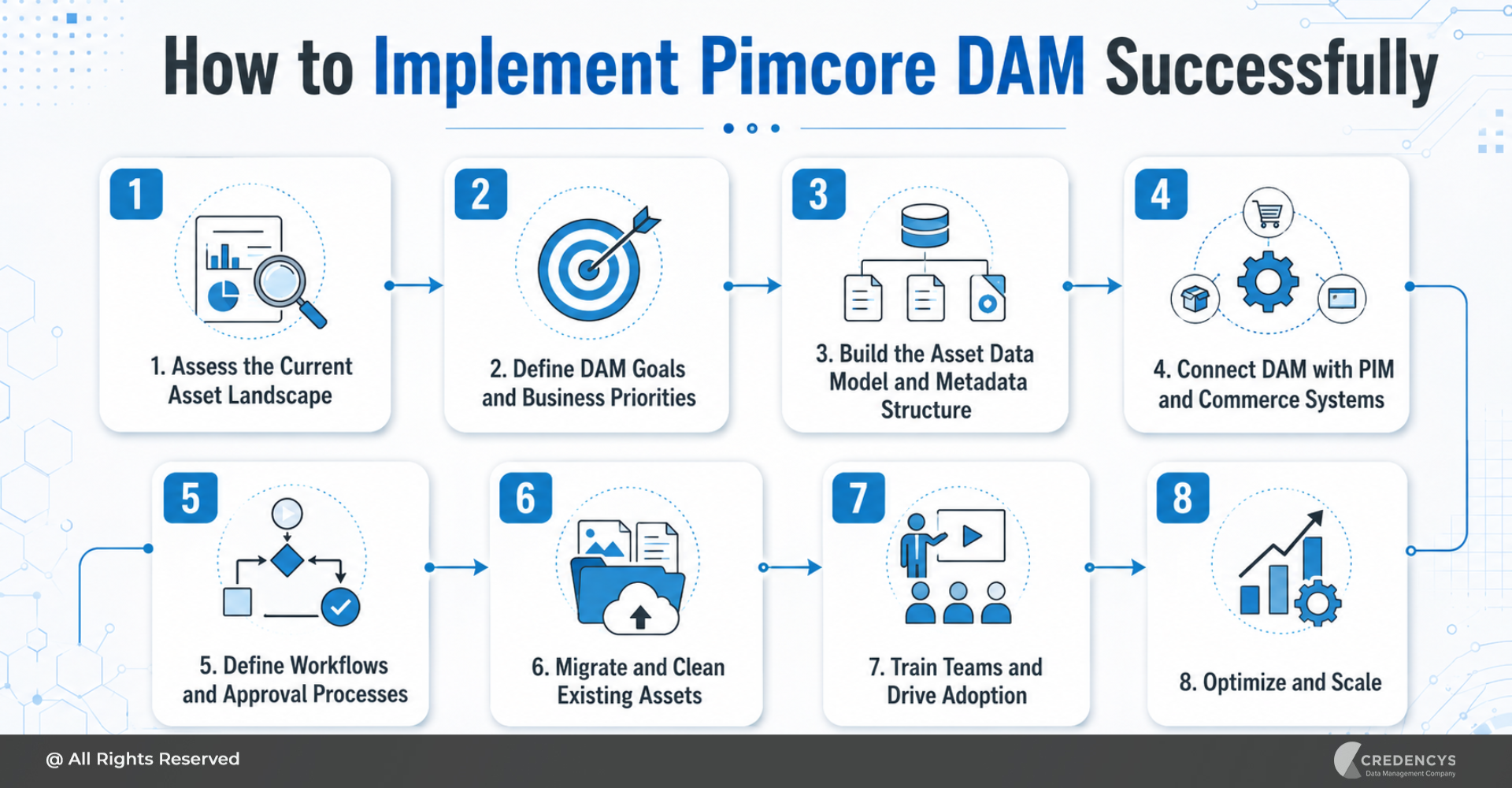
How to Implement Pimcore DAM Successfully
Before implementation, businesses should define clear goals, asset structures, approval processes, and governance rules. This detailed guide on DAM implementation best practices can help teams plan the process more effectively.
Step 1: Assess the Current Asset Landscape
Start by understanding where digital assets are stored today, who uses them, how they are organized, and what problems teams face. This includes reviewing shared drives, agency folders, PIM systems, CMS platforms, eCommerce backends, marketing tools, and local storage.
The goal is to identify duplication, outdated assets, missing metadata, workflow gaps, and governance issues.
Step 2: Define DAM Goals and Business Priorities
Next, define what the DAM system should help the business achieve. For some brands, the priority may be faster product launches.
For others, it may be brand consistency, campaign efficiency, marketplace readiness, content governance, or better PIM-DAM integration. Clear goals help define the right implementation approach.
Step 3: Build the Asset Data Model and Metadata Structure
Metadata is the foundation of a successful DAM system. Define asset types, metadata fields, tagging rules, folder structures, naming conventions, approval status, usage rights, product relationships, and channel requirements.
A strong metadata structure makes assets easier to search, manage, reuse, and distribute.
Step 4: Connect DAM with PIM and Commerce Systems
Pimcore DAM delivers greater value when connected with the broader digital ecosystem. Integrate DAM with PIM, eCommerce platforms, CMS, ERP, marketplaces, retailer portals, and other systems where assets are created, managed, or published.
This helps ensure that assets flow efficiently across business processes and customer-facing channels.
Step 5: Define Workflows and Approval Processes
Set up workflows for asset upload, review, approval, publishing, updates, and archiving. Define which teams are responsible at each stage.
Marketing, brand, creative, product, legal, and eCommerce teams may all need different roles in the workflow. Structured workflows reduce delays and improve governance.
Step 6: Migrate and Clean Existing Assets
Asset migration should include cleaning, deduplication, classification, and metadata enrichment. Do not move every file into the DAM without review.
Archive outdated assets, remove duplicates, identify approved versions, and enrich assets with the right metadata. This creates a cleaner and more useful DAM foundation.
Step 7: Train Teams and Drive Adoption
DAM success depends on adoption. Train marketing, product, creative, eCommerce, sales, and agency teams on how to search, upload, tag, approve, and use assets.
Create clear guidelines so teams understand how Pimcore DAM fits into daily workflows.
Step 8: Optimize and Scale
Once the DAM system is live, continue improving it. Track adoption, review metadata quality, optimize workflows, add integrations, and expand usage across more teams, brands, markets, and channels.
DAM implementation should evolve with business growth.
If your internal team needs technical support, you can also hire Pimcore developers to configure, customize, and integrate the DAM system based on your business requirements.
How Credencys Helps Businesses Implement Pimcore DAM
Credencys helps Retail and CPG businesses implement Pimcore DAM as part of a scalable product-experience and data-management ecosystem. Our Pimcore experts help businesses assess their current asset landscape, define the right DAM strategy, design metadata structures, integrate DAM with PIM and commerce systems, migrate existing assets, configure workflows, and enable teams for long-term adoption.
With deep expertise in Pimcore implementation, PIM, MDM, DAM, data integration, and digital commerce, Credencys helps businesses create a centralized foundation for product content, digital assets, and omnichannel experiences.
Conclusion
Pimcore DAM helps Retail and CPG brands bring structure, governance, and speed to digital asset management. By centralizing assets, enriching them with metadata, linking them with product data, and distributing them across channels, Pimcore DAM enables brands to deliver consistent, accurate, and engaging product experiences at scale.
For CMOs and digital leaders, Pimcore DAM is not just a content operations tool. It is a foundation for faster campaigns, stronger brand consistency, improved product experiences, and scalable omnichannel growth.
FAQs
1. What is Pimcore DAM?
Pimcore DAM is a digital asset management system that helps businesses store, organize, manage, enrich, and distribute digital assets such as images, videos, documents, graphics, and product files from a centralized platform.
2. How does Pimcore DAM work?
Pimcore DAM centralizes digital assets, enriches them with metadata, organizes them into folders and taxonomies, manages workflows and approvals, and distributes approved assets across digital channels.
3. Can Pimcore DAM support omnichannel content delivery?
Yes. Pimcore DAM can help businesses manage and distribute approved digital assets across websites, marketplaces, mobile apps, catalogs, retail portals, and other digital channels.
4. Who should use Pimcore DAM?
Pimcore DAM is useful for marketing, product, eCommerce, and creative teams, as well as agencies, digital leaders, and brand managers who need to manage digital assets at scale.
5. How can Credencys help with Pimcore DAM implementation?
Credencys helps businesses plan, implement, integrate, and optimize Pimcore DAM to centralize digital assets, improve workflows, connect assets with product data, and support omnichannel content delivery.






Tags: