


AI Data Governance: How to Build Trustworthy Enterprise AI
Enterprise AI is moving from pilots into customer experiences, forecasting, pricing, operations, and decision support. The challenge is no longer only choosing a model.
It is ensuring the data, prompts, integrations, and actions behind that model can be trusted. AI data governance gives enterprises the policies, ownership, controls, and monitoring needed to use AI responsibly at scale.
A strong AI-ready data foundation is equally important because governance cannot compensate for fragmented, inaccurate, or inaccessible enterprise data. It protects data, improves decision quality, and gives business teams confidence in AI-generated recommendations and automated actions.
What is AI Data Governance?
AI data governance is the framework of policies, roles, processes, and controls that ensures data used by AI systems is accurate, secure, traceable, compliant, and responsibly managed throughout the AI lifecycle. It covers more than training data.
It includes information used to fine-tune, test, deploy, and monitor models; documents retrieved by generative AI applications; real-time data used for predictions; prompts; model outputs; and the actions an AI agent may take. A practical program should answer a few essential questions:
- Is the data fit for the intended use case?
- Who owns the data, model, and business outcome?
- Which systems and data can the AI access?
- When must a person review or approve an action?
- How will the enterprise detect, investigate, and correct errors?
Traditional data governance manages enterprise data. AI data governance extends those controls to model behavior, AI outputs, automated decisions, and AI-specific risk.
Why AI Data Governance Matters for Enterprises
AI can improve speed and scale, but it can also scale weak assumptions, bad data, and poor decisions. Without governance, enterprises risk deploying systems that rely on incomplete information, expose sensitive data, produce biased outcomes, or issue recommendations that teams cannot explain.
Poor data is a common issue. A forecasting model may miss demand changes if sales, inventory, promotion, or product hierarchy data are incomplete.
A personalization model may recommend irrelevant products when customer identities are fragmented across channels. Strong data quality for AI is, therefore, a foundation for trustworthy AI.
Enterprises also need reliable real-time data pipelines to ensure AI systems can use fresh, contextual information for decisions that cannot wait for batch updates. Governance also protects business trust.
Employees are more likely to use AI when they know the system has approved data sources, clear decision boundaries, human escalation paths, and accountable owners. For executive teams, this makes governance an operating model requirement rather than a compliance exercise.
Data governance is the foundation. AI data governance builds on it by defining how data is used in AI, how models are evaluated, and how outputs or actions are controlled.
AI security adds safeguards against unauthorized access, malicious prompts, unsafe tool use, and data exposure.
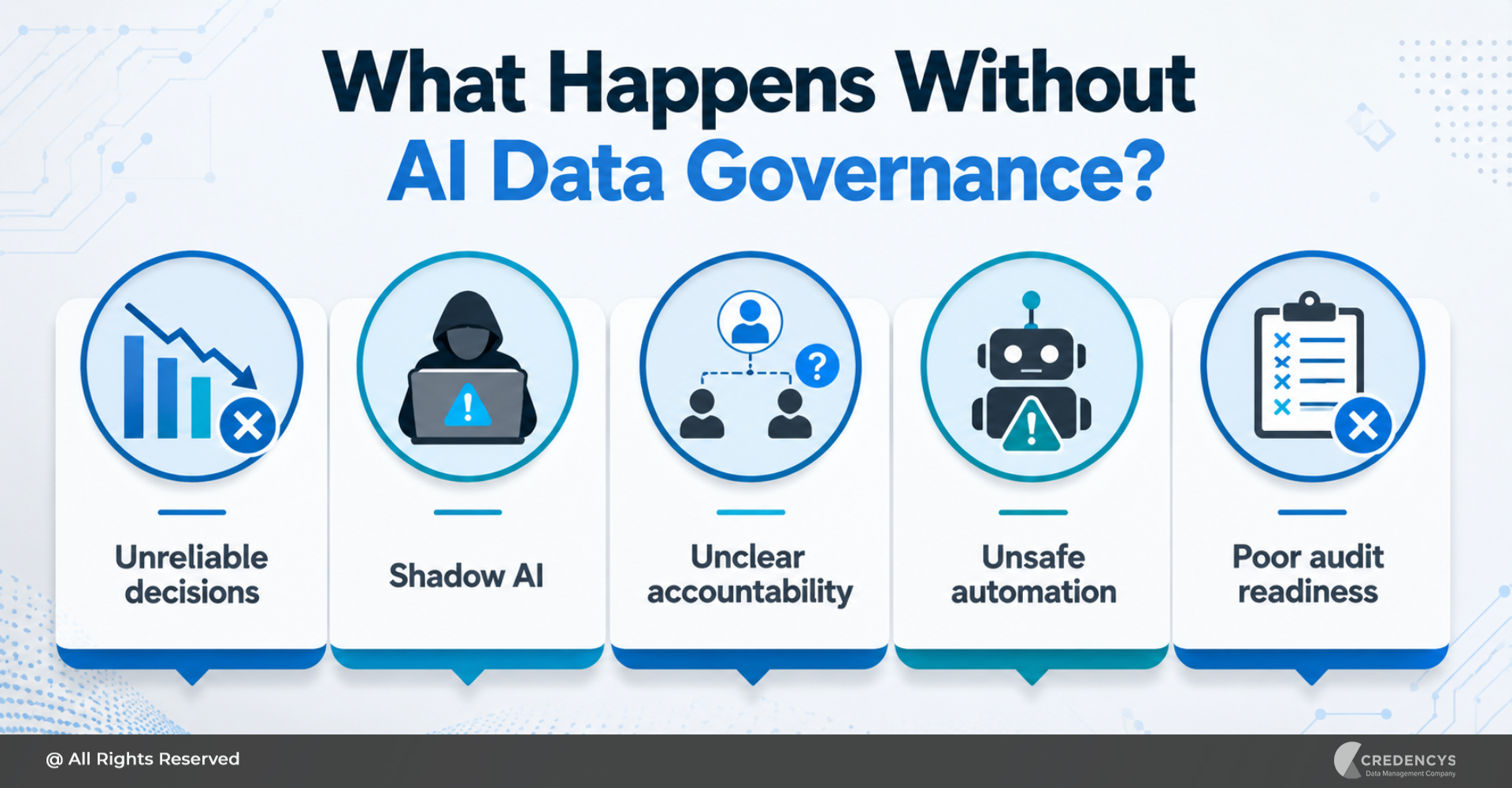
What Happens Without AI Data Governance?
Without clear governance, AI adoption often becomes fragmented and difficult to scale.
- Unreliable decisions: Inaccurate, duplicated, stale, or biased data can reduce model accuracy and create inconsistent outputs.
- Shadow AI: Employees may use unapproved tools without visibility into what information is shared or how results are used.
- Unclear accountability: When an AI recommendation is wrong, teams may not know who owns the investigation, remediation, or the final decision.
- Unsafe automation: An agent may be able to recommend a change safely, but executing a price update, payment, customer communication, or system configuration may require human approval.
- Poor audit readiness: Without an inventory, documentation, lineage, and monitoring, it becomes difficult to demonstrate how AI systems are used and controlled.
The Core Pillars of AI Data Governance
1. AI Strategy, Policies, and Ownership
Define approved and prohibited AI use cases, acceptable data usage, risk tolerance, escalation paths, and review requirements. Assign ownership across business, data, AI, security, legal, and compliance teams.
Business leaders should own outcomes. Technical teams should own the reliability and controls that support them.
AI governance works best when it is a shared operating model rather than a responsibility assigned to one team.
2. Data Quality and Data Readiness
Assess whether the data is accurate, complete, consistent, current, representative, and appropriate for the use case. Profile data sources, apply quality rules, resolve duplicates, improve Master Data Management, and monitor freshness through scalable data engineering services.
A model cannot produce reliable outcomes from unreliable inputs. This is why data quality must be assessed before data is used for training, retrieval, recommendations, or automated decisions.
For retail and CPG enterprises, Product Information Management also helps ensure that product attributes, taxonomy, specifications, and availability data are reliable before AI uses them.
3. Privacy, Security, and Access Control
Classify sensitive data and apply role-based permissions, masking, encryption, retention policies, and least-privilege access. AI applications should receive only the information and access to tools required for their intended purpose, not broad access to enterprise systems by default.
This is particularly important for generative AI tools and AI agents connected to internal knowledge bases or business applications.
4. Model and Use-Case Governance
Maintain an AI inventory that records each use case, owner, purpose, users, model type, data sources, risk level, evaluation criteria, approval status, and review history. This creates visibility across the enterprise and helps leaders identify which systems require stronger controls, closer monitoring, or formal approval.
5. Transparency and Documentation
Document what the AI system is designed to do, the data it uses, its intended users, known limitations, evaluation process, and escalation path. Users do not need every technical detail.
However, they need enough context to use AI outputs responsibly and understand when human review is required.
6. Human Oversight and Decision Accountability
Define when AI can inform, recommend, automate, or act. The required oversight should depend on the sensitivity, commercial impact, reversibility, and customer effect of a decision.
Human review is especially important for high-impact financial, operational, customer-facing, or compliance-related actions.
7. Monitoring and Continuous Improvement
Governance continues after launch. Monitor data drift, model drift, output quality, user feedback, security events, policy exceptions, and business outcomes.
Define when teams should investigate, retrain, pause, roll back, or retire an AI system. This helps keep AI reliable as data, workflows, and business conditions change.
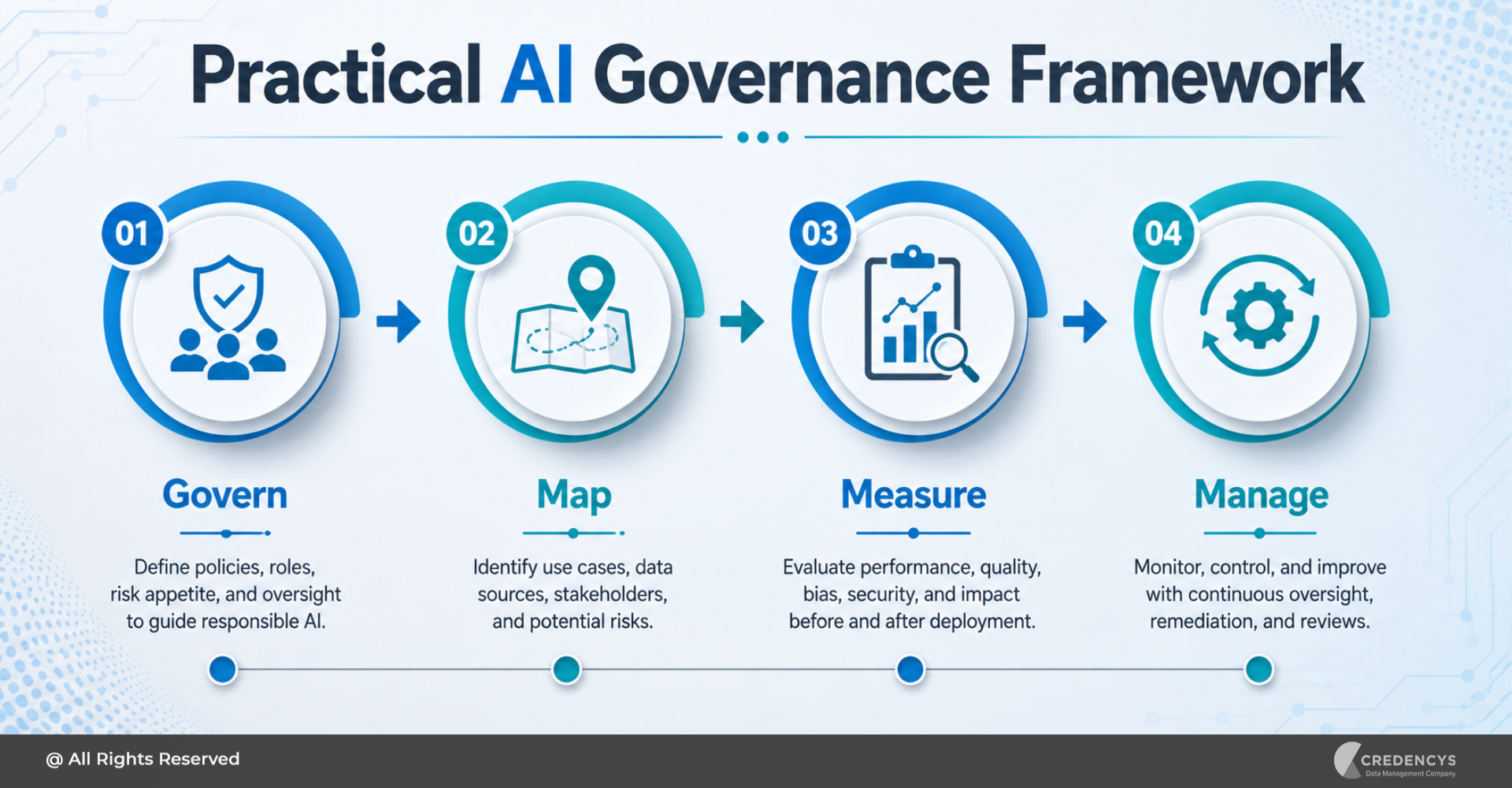
A Practical AI Governance Framework: Govern, Map, Measure, Manage
A practical enterprise framework can follow four connected stages.
Govern
Set the foundation. Define AI policies, ownership, risk appetite, use-case approval criteria, and incident processes.
Establish a cross-functional governance group that includes business, data, AI, security, legal, and compliance stakeholders. This ensures that AI decisions are reviewed from both value and risk perspectives.
Map
Document the use case. Identify its business objective, users, data sources, affected stakeholders, automation level, integrations, and potential impact.
Mapping clarifies where data enters the system, where outputs go, and where risks can emerge. It also creates a clear record of the intended use of the AI system.
Measure
Evaluate whether the system is fit for use. Measure data quality, model performance, output relevance, bias, security, robustness, and business impact.
The evaluation criteria should match the use case. A customer-facing chatbot, for example, should be evaluated differently from a demand forecasting model or a pricing recommendation engine.
Manage
Operate the AI system with controls. Implement access boundaries, monitoring dashboards, alert thresholds, review cadences, remediation workflows, change controls, and rollback criteria.
Treat AI systems as managed business capabilities, not one-time technology deployments.
AI Governance Across the Lifecycle
AI governance should be embedded from use-case intake through retirement.
- Use-case intake: Classify risk based on data sensitivity, decision impact, automation level, and potential harm if the output is wrong.
- Data selection and preparation: Confirm that data is approved, sufficiently complete, privacy-aware, traceable, and fit for the use case. Trusted customer, product, supplier, and operational data are especially important for enterprise AI.
- Model selection or procurement: Document capabilities, limitations, data handling, security posture, vendor responsibilities, and integration requirements. Buying a third-party AI tool does not remove governance responsibility.
- Testing and deployment: Test normal scenarios, edge cases, unsafe behavior, and failure conditions. Before launch, set access permissions, output guardrails, human review rules, and escalation paths.
- Production monitoring: Track data freshness, model performance, output quality, user overrides, business outcomes, and policy exceptions. Reassess after material changes to the data, model, prompts, tools, or workflow.
Governance for Generative AI and AI Agents
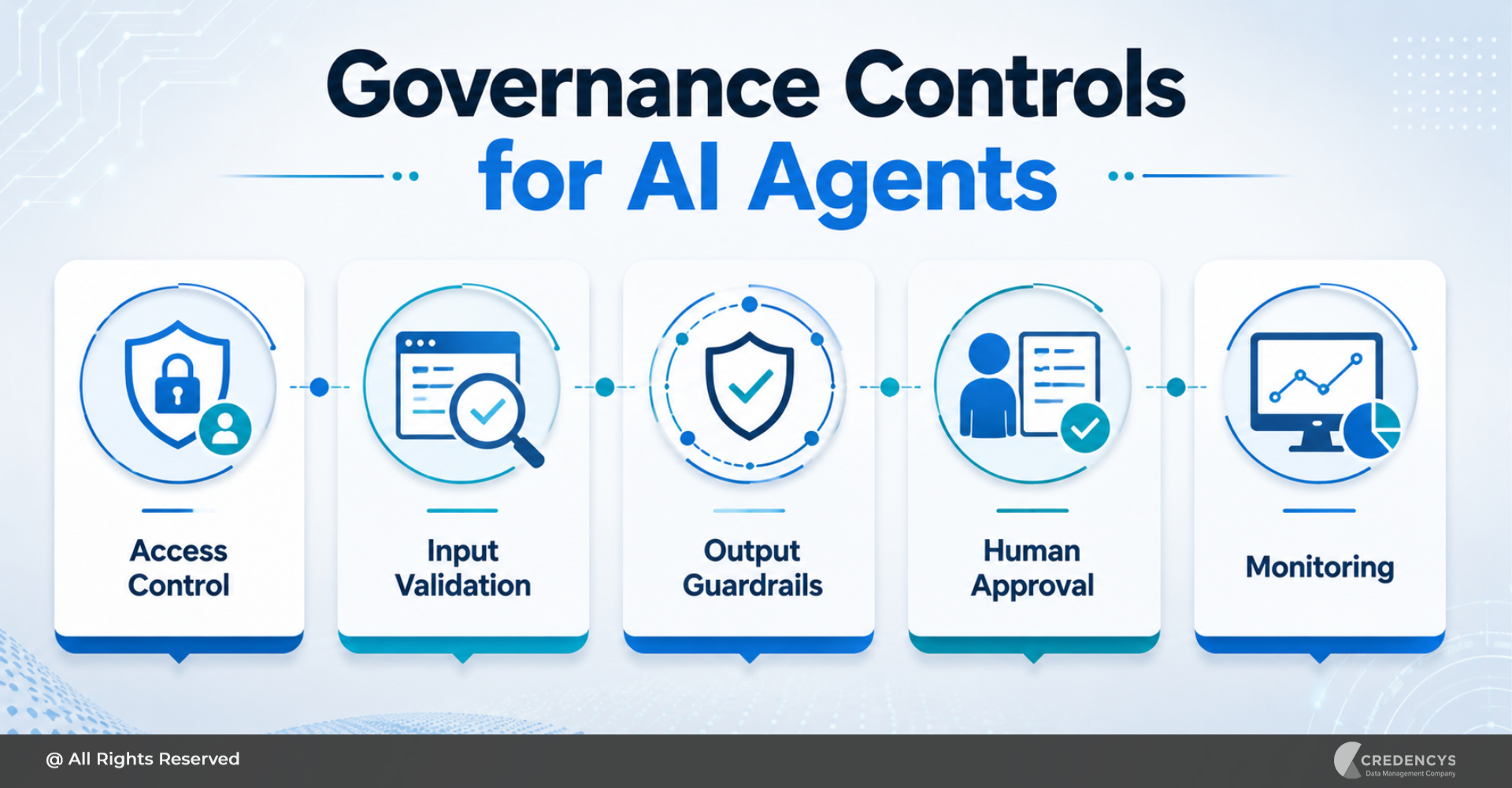
Generative AI and AI agents need additional controls because they can retrieve information, generate content, call tools, and trigger actions. First, govern inputs. Define what users can submit, what external content can be consumed, and how untrusted content is separated from system instructions.
This reduces the risk of harmful or misleading prompts influencing the application. Second, govern retrieval sources.
In retrieval-augmented generation systems, the knowledge base should be current, accurate, permission-controlled, and traceable. An AI system should not retrieve content that a user is not authorized to see.
Third, validate outputs. Use guardrails, structured formats, policy checks, and human review for high-impact content.
An agent may draft a supplier communication or recommend a change to a purchase order, while a person approves the final external action. Finally, restrict tool access. Agents should operate with minimum permissions.
They may summarize information or recommend actions, but they should not approve payments, alter contracts, or change system configurations without explicit approval controls and monitoring in place.
AI Data Governance in Retail and CPG
Retail and CPG AI use cases rely on connected data across customers, products, inventory, suppliers, and transactions.
- Customer 360 and personalization: Govern consent, identity resolution, profile freshness, and the use of behavioral data so that recommendations remain relevant and respectful.
- Dynamic pricing: Validate product, demand, inventory, cost, competitor, and margin data. Establish approval rules for changes with significant revenue or customer impact.
- Demand forecasting: Monitor sales, inventory, promotions, product hierarchies, and external signals across categories and regions. Data freshness and coverage directly affect forecast reliability.
- Product recommendations and content: Ensure product attributes, availability, specifications, images, and taxonomy are accurate before AI recommends products or creates content.
- Supplier and inventory intelligence: Govern supplier, material, logistics, and risk data, and define when AI can recommend actions versus when procurement or supply chain teams must approve them.
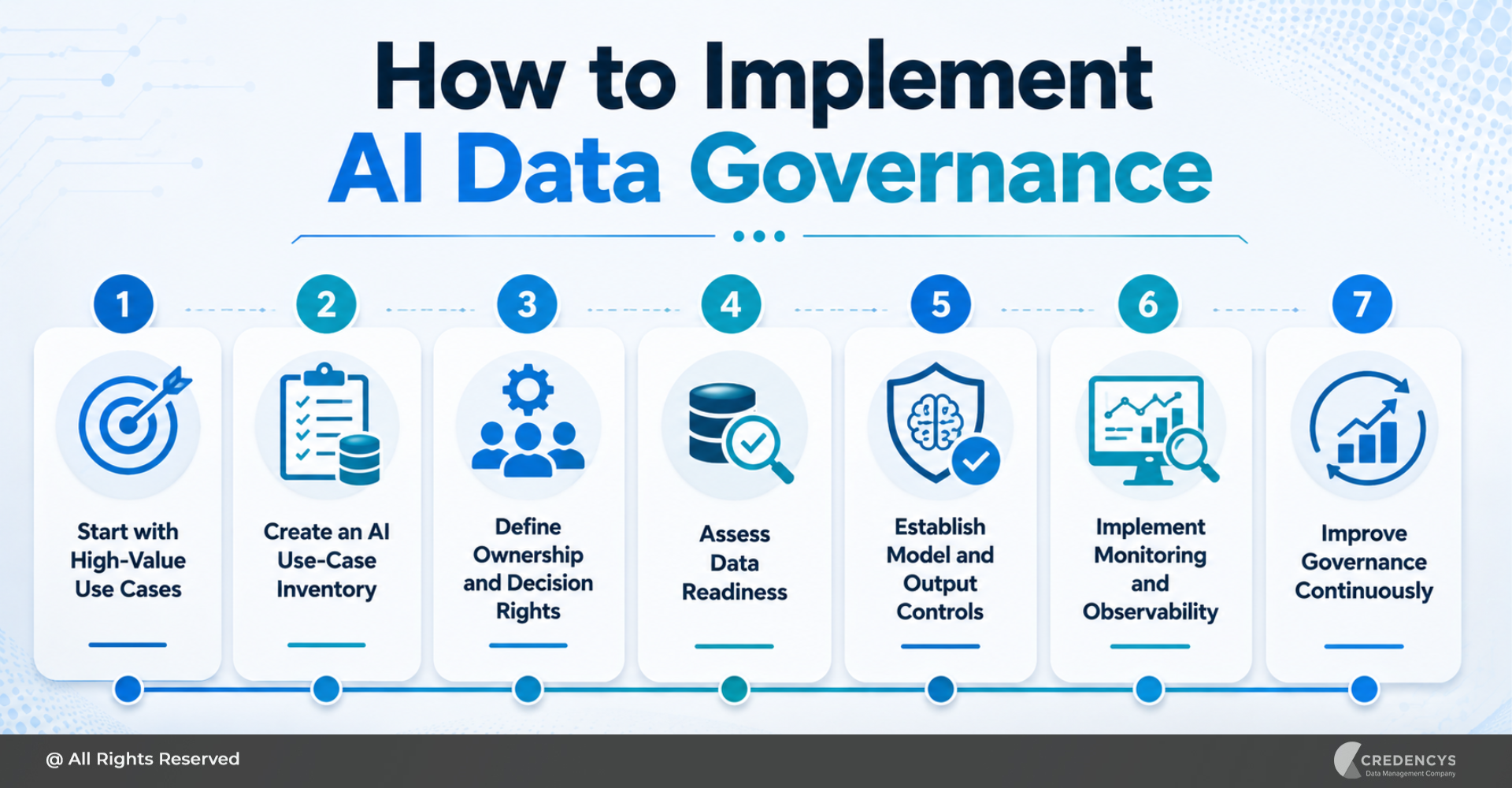
How to Implement AI Data Governance
1. Start with High-Value Use Cases
Begin with customer-facing, revenue-impacting, operationally important, or higher-risk applications instead of trying to govern every AI idea at once.
2. Create an AI Use-Case Inventory
Record each initiative’s purpose, owner, users, model type, data sources, risk level, automation level, and deployment status.
3. Define Ownership and Decision Rights
Clarify accountability for business outcomes, data quality, model performance, security, compliance, and incident response.
4. Assess Data Readiness
Evaluate data quality, lineage, privacy, permissions, completeness, freshness, and bias before data is used by AI.
5. Establish Model and Output Controls
Define evaluation standards, guardrails, approval requirements, human review processes, and rollback procedures.
6. Implement Monitoring and Observability
Track technical and business indicators, including drift, output quality, user overrides, incidents, and policy exceptions.
7. Improve Governance Continuously
Use audit findings, user feedback, model outcomes, and changing business requirements to refine controls over time.
AI Governance Metrics Enterprises Should Track
| Metric | What It Measures | Why It Matters |
|---|---|---|
| AI Use-Case Coverage | Percentage of AI systems included in the inventory | Reduces unmanaged AI risk |
| Data Quality Score | Accuracy, completeness, consistency, and timeliness of AI data | Improves model reliability |
| Model Performance | Accuracy, relevance, error rate, and business impact | Tracks AI effectiveness |
| Drift Rate | Changes in data or model behavior over time | Signals when reassessment is needed |
| Human Override Rate | How often do people change AI recommendations | Reveals performance or trust gaps |
| Incident Rate | Security, privacy, output, or policy issues | Shows operational risk |
| Time to Remediate | Time needed to resolve AI issues | Measures governance responsiveness |
How Credencys Helps Build Trustworthy Enterprise AI
Trustworthy AI requires more than a model. It requires trusted data, scalable pipelines, clear governance, modern platforms, and business accountability.
Credencys helps enterprises build AI-ready data ecosystems through data engineering, data quality improvement, data governance, Master Data Management, Product Information Management, Customer 360, real-time pipelines, Databricks consulting, Snowflake consulting, AI/ML enablement, and generative AI solutions. We help organizations assess data readiness, modernize data platforms, establish governance controls, and deploy AI use cases that support measurable business outcomes across retail, CPG, manufacturing, and supply chain operations.
Conclusion
Governance is what makes enterprise AI scalable. Organizations cannot rely on experimentation alone when AI affects customer experiences, commercial decisions, operational workflows, and business outcomes.
Trustworthy AI requires accurate data, clear ownership, controlled access, documented use cases, human oversight, and continuous monitoring. The purpose of AI data governance is not to restrict innovation.
It is to create the confidence needed to use AI where it matters most. With the right data foundation and operating model, enterprises can move from isolated pilots to reliable, repeatable, and responsible AI adoption.
FAQs
What is AI data governance?
AI data governance is the framework of policies, roles, processes, and controls that ensures data used by AI systems is accurate, secure, traceable, compliant, and responsibly managed.
Why is AI data governance important?
It improves AI reliability, protects sensitive data, reduces operational risk, maintains accountability, and builds trust in AI-driven decisions.
What is the difference between AI governance and data governance?
Data governance manages enterprise data quality, ownership, access, and compliance. AI governance extends those controls to models, prompts, outputs, automated actions, and AI-specific risks.
What are the key pillars of AI data governance?
Key pillars include strategy and ownership, data quality, privacy and security, model governance, transparency, human oversight, and continuous monitoring.
How should enterprises govern AI agents?
Enterprises should apply least-privilege access, validate outputs, monitor tool use, test for unsafe behavior, and require human approval for high-impact actions.







Tags: