

What is Semarchy - An Exclusive Overview of the Semarchy Data Platform
Organizations depend on customer, product, supplier, employee, location, and material data to run daily operations and make strategic decisions. However, that data is often scattered across ERP, CRM, eCommerce, supply chain, analytics, and legacy systems.
This fragmentation creates duplicate records, inconsistent definitions, weak governance, integration delays, and unreliable reporting. It also limits the value organizations can gain from analytics, machine learning, and artificial intelligence.
So, what is Semarchy, and how does it help address these challenges? Semarchy is a modern enterprise data management platform that helps organizations integrate, govern, improve, and deliver trusted data across business domains.
The Semarchy Data Platform combines master data management, data quality, data integration, governance, DataOps, and data product capabilities within a unified environment. For enterprises evaluating Semarchy, working with a trusted Semarchy implementation partner can help align the platform with existing systems, data domains, governance workflows, and AI readiness goals.
In this guide, we explain what Semarchy is, its primary capabilities, common use cases, implementation steps, deployment options, and the factors businesses should consider before adopting it.
What is Semarchy? – An Overview
Semarchy is a data management software provider best known for its master data management and data integration capabilities. Its current offering, the Semarchy Data Platform, brings together the tools required to create trusted golden records, govern enterprise data, connect source systems, and deliver reusable data products.
As part of a broader master data management consulting services strategy, Semarchy helps organizations consolidate and govern data related to:
- Customer
- Product and parts
- Supplier and vendor
- Material
- Employee
- Location and asset
- Financial hierarchy
- Reference data
Semarchy helps organizations consolidate records from different systems, apply data quality and business rules, identify duplicates, establish survivorship logic, and distribute trusted information to downstream applications.
Semarchy at a Glance
- Creates a consistent and governed source of truth across business domains.
- Supports multi-domain master data management on a unified platform.
- Connects cloud and on-premises data sources through low-code integration.
- Enables data stewardship, approval workflows, auditability, and role-based access.
- Converts trusted master data into reusable datasets, APIs, applications, and other data products.
- Supports modern DataOps practices through integration with tools such as VS Code, Git, and CI/CD pipelines.
- Delivers deployment flexibility through SaaS, Snowflake, self-hosted cloud, and on-premises options.
- Provides governed and contextualized data for analytics, machine learning, and AI initiatives.
Semarchy has evolved beyond a traditional MDM hub. The platform now supports the broader lifecycle of designing, governing, developing, and delivering trusted enterprise data.
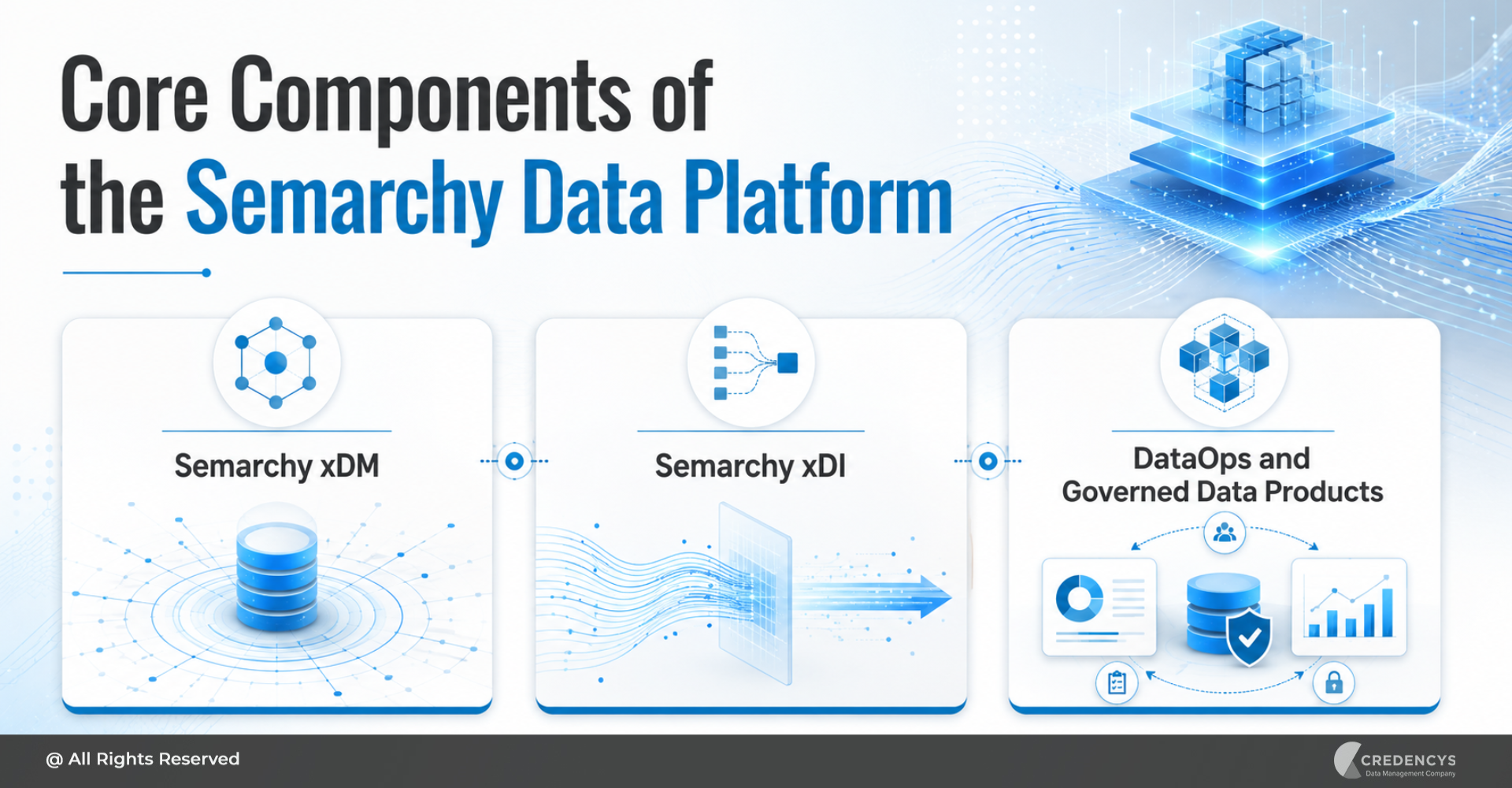
Core Components of the Semarchy Data Platform
The Semarchy Data Platform unifies data management, governance, integration, and product delivery. Its core capabilities are built around Semarchy’s established xDM and xDI technologies, supported by newer DataOps and AI-assisted functionality.
Semarchy xDM
Semarchy xDM provides the platform’s master data management foundation. It allows organizations to model entities, attributes, hierarchies, relationships, and business rules for one or more data domains.
With Semarchy xDM, businesses can:
- Consolidate records from multiple source systems.
- Validate and standardize incoming data.
- Match and merge duplicate records.
- Configure survivorship rules to determine trusted attribute values.
- Create authoritative golden records.
- Define stewardship and approval workflows.
- Track changes through history, audit logs, and lineage.
- Publish governed data through generated APIs.
The flexible data model allows companies to begin with one high-priority domain and expand to additional domains without adopting separate MDM tools.
Semarchy xDI
Semarchy xDI supports data integration across cloud, on-premises, and hybrid environments. Its low-code design capabilities help teams create and operate ELT and data movement pipelines without relying entirely on manually written integration code.
Organizations can use xDI to:
- Connect databases, applications, files, APIs, warehouses, and cloud platforms.
- Extract, transform, and load data.
- Apply mapping and transformation rules.
- Automate batch and scheduled data flows.
- Synchronize trusted data with operational and analytical systems.
- Support migrations and broader data modernization programs.
Together, xDM and xDI help organizations connect data sources, improve data quality, govern master records, and make trusted data available where it is needed.
DataOps and Governed Data Products
The Semarchy Data Platform extends these capabilities with a DataOps-oriented development experience. Data teams can use familiar development practices, including version control, collaborative branching, testing, and CI/CD.
The platform also helps organizations package trusted data as governed data products. These products may include golden-record datasets, APIs, applications, dashboards, or AI-ready datasets with clearly defined ownership, lineage, metadata, and access controls.
Key Functionality of Semarchy
Understanding what Semarchy is also requires examining how its capabilities work together.
Master Data Management
Semarchy consolidates fragmented master data into complete and reliable golden records. It supports multi-domain data models, hierarchies, relationships, matching, merging, survivorship, and controlled record creation.
This enables applications and teams to use consistent information on customers, products, suppliers, employees, materials, and locations.
Data Quality
Organizations can define rules for validation, standardization, cleansing, enrichment, and matching based on their business requirements. Data quality controls can be applied during data entry, ingestion, stewardship, and publishing.
Dashboards and workflows help data owners identify issues, resolve exceptions, and monitor the ongoing health of critical records.
Data Governance and Stewardship
Semarchy supports governance through role-based permissions, business rules, approval processes, audit trails, metadata, and data stewardship. Business users can review potential duplicates, correct records, approve changes, and manage exceptions through guided applications.
This connects governance policies with day-to-day data operations rather than treating governance as a separate documentation exercise.
Data Integration
Semarchy connects data across ERP, CRM, eCommerce, supply chain, data warehouse, and other enterprise systems. Low-code integration helps teams design repeatable pipelines and deliver trusted records to operational and analytical consumers.
Data Products and APIs
Trusted records can be delivered as discoverable and reusable data products. Auto-generated APIs make governed data available to applications, developers, workflows, and digital experiences.
This reduces the need for teams to recreate the same datasets independently for every project.
AI-Ready Data
AI initiatives depend on accurate, contextualized, governed, and explainable data. Semarchy helps prepare this foundation by combining quality rules, ownership, lineage, metadata, and consistent identifiers.
Its AI-assisted capabilities can also support selected design, enrichment, classification, and stewardship activities while keeping human review and governance controls in the process.
Flexible Deployment
Businesses can choose the deployment model that matches their architecture, security, and operational requirements. Current options include fully managed SaaS, deployment within Snowflake, self-hosted cloud environments, and on-premises infrastructure.
Organizations already using Snowflake can also explore Semarchy MDM in Snowflake to reduce unnecessary data movement and make trusted master data available closer to analytics and AI workloads.
How Does Semarchy Help Businesses Address Data Management Challenges?
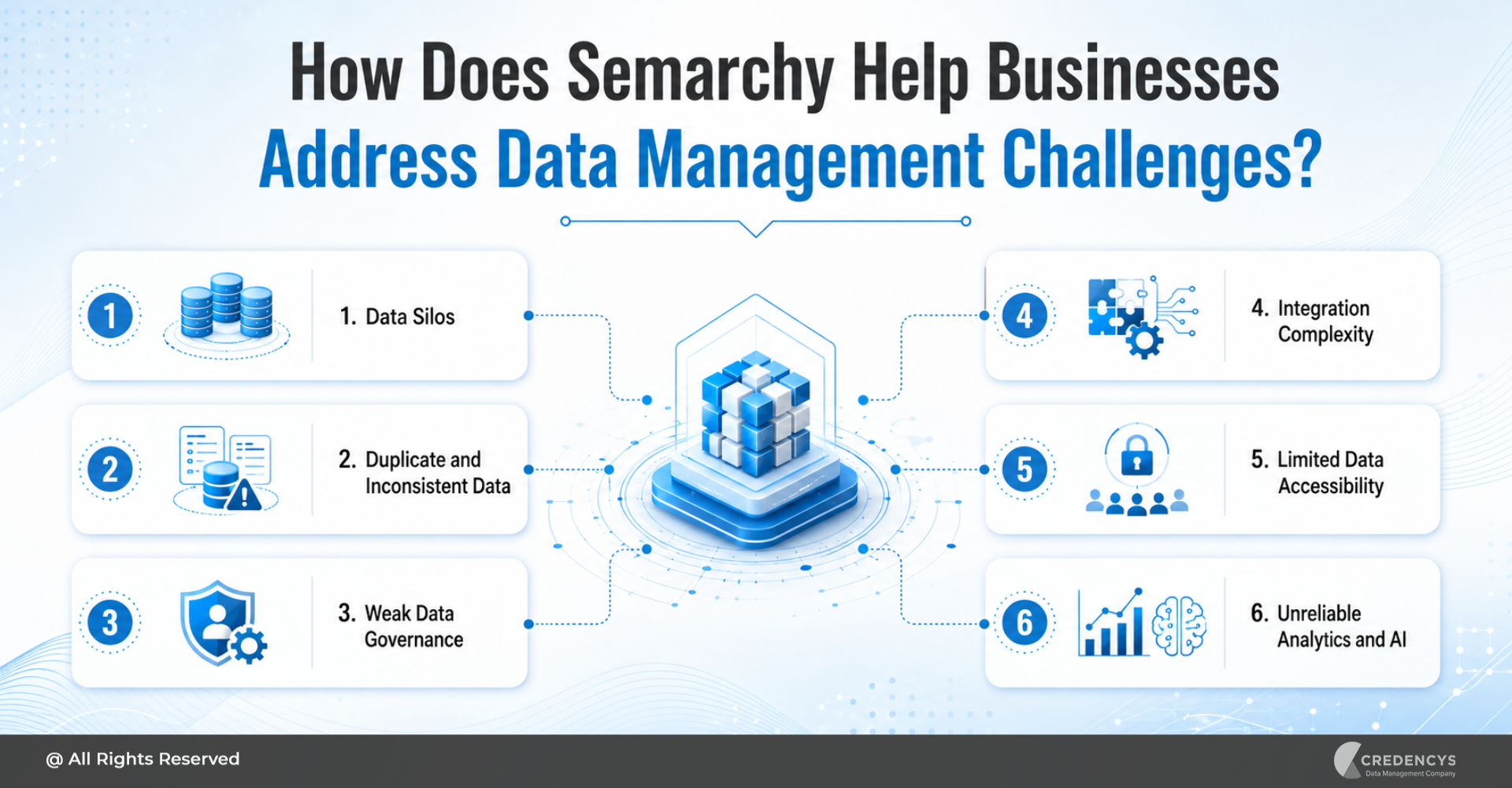
1. Data Silos
Customer, product, supplier, and other critical records often exist in disconnected systems. Semarchy consolidates these records and creates consistent golden records that can be shared across the enterprise.
2. Duplicate and Inconsistent Data
Duplicate records, missing values, and conflicting attributes reduce trust in operational and analytical data. Semarchy applies validation, matching, merging, and survivorship rules to improve accuracy and consistency.
3. Weak Data Governance
Policies are difficult to enforce when ownership and accountability are unclear. Semarchy enables organizations to define roles, workflows, permissions, approval rules, and audit trails around critical data.
4. Integration Complexity
Point-to-point integrations become expensive and difficult to maintain as the application landscape grows. Semarchy xDI supports reusable low-code data pipelines that connect cloud, on-premises, and hybrid systems.
5. Limited Data Accessibility
Trusted data delivers value only when applications and users can consume it. Semarchy publishes governed records through APIs, datasets, and data applications while retaining access and quality controls.
6. Unreliable Analytics and AI
Reports, predictive models, and AI applications yield poor results when the source data is incomplete or inconsistent. Semarchy provides governed and contextualized information that supports more reliable analytics and AI use cases.
3 Essential Pillars of Semarchy
1. Data Management
Semarchy provides the capabilities required to model, match, merge, ensure quality, manage hierarchy, and maintain golden records for enterprise master data. Organizations can start with a focused use case, such as Customer 360 or supplier data, and gradually extend the platform to additional domains.
2. Data Governance
Governance capabilities establish ownership, accountability, access, and control. Data stewards can review changes, resolve quality issues, approve records, and track historical activity.
This helps organizations align data operations with internal policies and regulatory requirements.
3. Data Integration
Integration connects the MDM platform with systems that create and consume data. Semarchy supports ingestion, transformation, synchronization, and publishing across operational systems, cloud platforms, and analytical environments.
These three pillars work together. Integration brings data into the platform, management improves and consolidates it, and governance ensures it remains trusted and controlled.
How Semarchy Helps Different Industries
Retail and eCommerce
Retailers can create consistent customer and product records across commerce platforms, stores, loyalty systems, marketplaces, and marketing applications. Trusted data supports personalization, inventory visibility, reporting, and omnichannel experiences.
Manufacturing
Manufacturers can strengthen visibility into suppliers, products, parts, and assets through master data management for manufacturing. This improves procurement, production planning, supply chain coordination, maintenance, and regulatory reporting.
Consumer Packaged Goods
CPG companies can manage product hierarchies, packaging, suppliers, materials, and market-specific information. Consistent master data supports faster product launches and reliable distribution across regions and channels.
Logistics and Supply Chain
Logistics organizations can unify customer, supplier, employee, location, and item data across port, warehouse, transportation, and enterprise systems. This improves traceability, data exchange, and operational decision-making.
How to Get Started with Semarchy
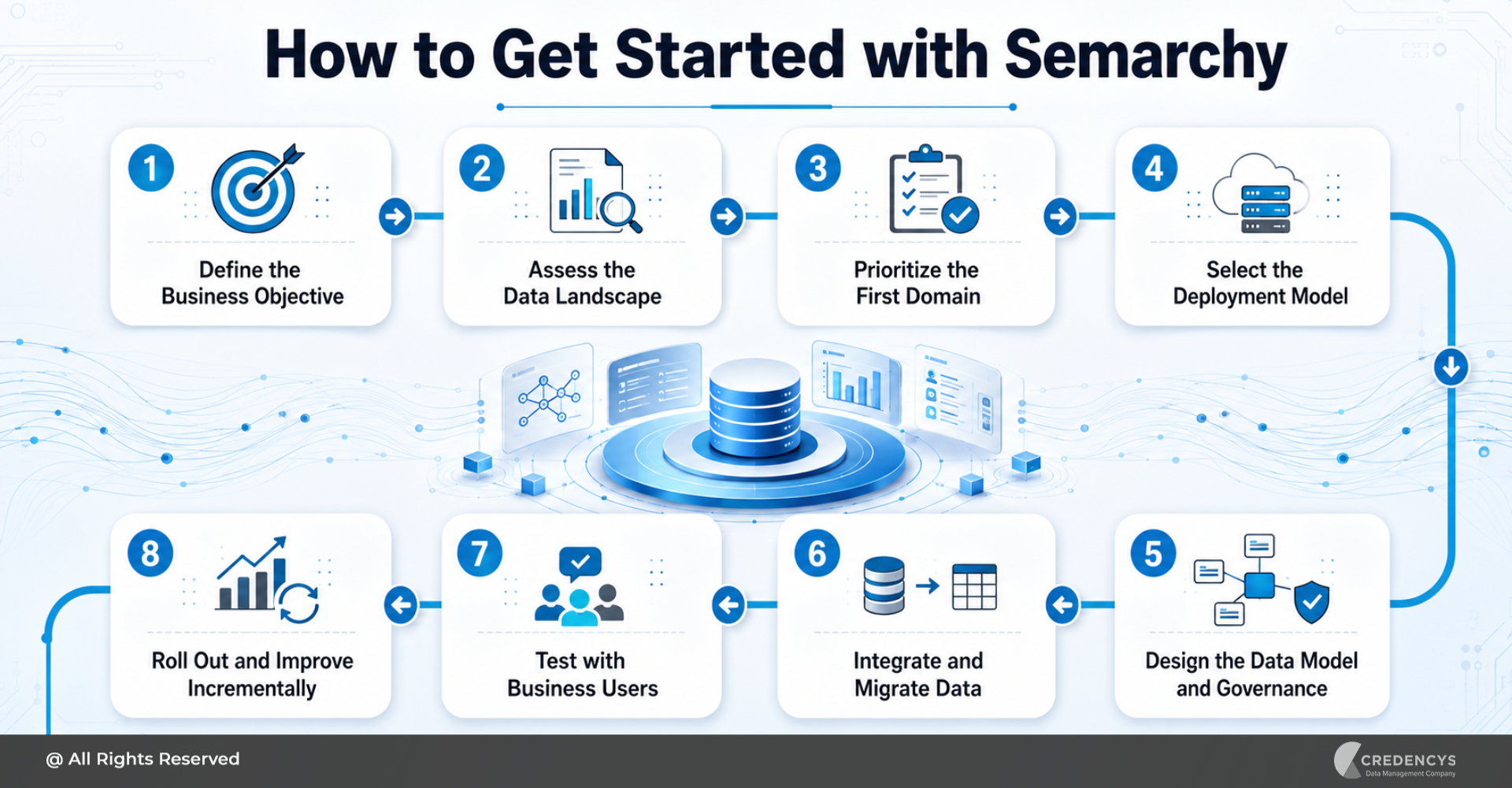
1. Define the Business Objective
Identify the outcome the organization wants to achieve, such as Customer 360, supplier governance, product data consistency, regulatory reporting, or AI readiness.
2. Assess the Data Landscape
Document source systems, downstream consumers, data owners, quality issues, integrations, policies, and existing MDM processes.
3. Prioritize the First Domain
Begin with a domain that has a clear business sponsor, measurable pain points, and a realistic implementation scope.
4. Select the Deployment Model
Evaluate SaaS, Snowflake, self-hosted cloud, and on-premises deployment based on security, data residency, architecture, scalability, and operational ownership.
5. Design the Data Model and Governance
Define entities, attributes, relationships, hierarchies, business rules, ownership, stewardship responsibilities, and approval workflows.
6. Integrate and Migrate Data
Connect the required sources, cleanse and map records, migrate historical data, and establish publishing processes for downstream applications.
7. Test with Business Users
Validate matching, survivorship, quality rules, workflows, APIs, security, and usability with data stewards and business stakeholders.
8. Roll Out and Improve Incrementally
Launch the initial use case, monitor adoption and data quality, and then expand to additional domains, systems, and data products.
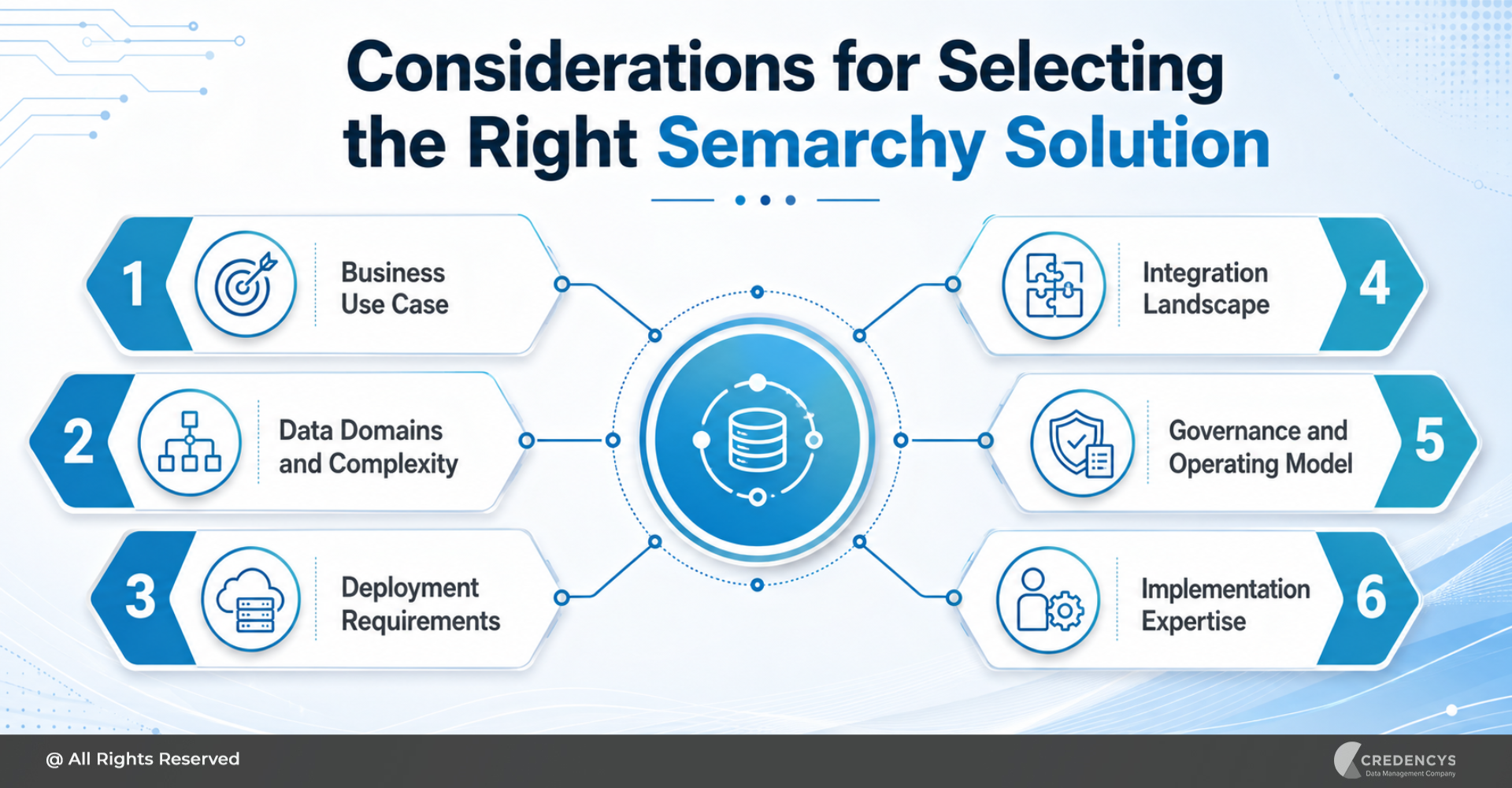
Considerations for Selecting the Right Semarchy Solution
Business Use Case
Clarify whether the priority is MDM, Customer 360, supplier data, product and material data, reference data, integration modernization, data products, or AI readiness.
Data Domains and Complexity
Consider the number of domains, record volumes, relationships, hierarchies, source systems, matching requirements, and governance workflows involved.
Deployment Requirements
Evaluate security, compliance, data residency, existing cloud investments, Snowflake usage, infrastructure ownership, and internal support capabilities.
Integration Landscape
Review how Semarchy will connect with ERP, CRM, eCommerce, supply chain, data warehouse, analytics, and AI platforms.
Governance and Operating Model
Define who owns the data, who approves changes, how quality will be measured, and how business and IT teams will collaborate.
Implementation Expertise
An experienced Semarchy implementation partner can support strategy, architecture, data modeling, integration, migration, governance, testing, training, and ongoing optimization.
Wrapping Up
What is Semarchy? It is a unified enterprise data platform that combines master data management, data integration, data quality, governance, DataOps, and data product delivery.
The platform helps organizations replace fragmented and inconsistent information with trusted golden records and governed data products. Its multi-domain capabilities, flexible deployment options, and support for analytics and AI make it relevant to organizations modernizing their data foundations.
However, technology alone does not determine the success of an MDM initiative. Businesses also need a clear use case, well-defined governance, reliable integrations, phased delivery, and strong user adoption.
Credencys helps enterprises assess their data landscape, design Semarchy solutions, migrate from legacy platforms, implement multi-domain MDM, integrate enterprise systems, and establish scalable governance processes.
Frequently Asked Questions
1. What Is Semarchy Used For?
Semarchy is used to integrate, improve, govern, consolidate, and distribute enterprise data. Common use cases include multi-domain MDM, Customer 360, supplier data management, product and material data, reference data, data integration, and AI-ready data.
2. Is Semarchy an MDM Platform?
Yes. Master data management remains a core capability of the Semarchy Data Platform. The platform also includes capabilities in data quality, integration, governance, DataOps, and data product delivery.
3. What is the Difference Between Semarchy xDM and xDI?
Semarchy xDM focuses on master data management, including data modeling, quality, matching, merging, governance, stewardship, and golden records. Semarchy xDI focuses on low-code data integration, transformation, and pipeline development.
4. Can Semarchy Run in Snowflake?
Yes. Semarchy supports deployment within Snowflake for organizations that want to manage master data closer to their Snowflake workloads and reduce unnecessary data movement.
5. Does Semarchy Support Multiple Data Domains?
Yes. Organizations can manage customer, product, supplier, employee, material, location, asset, financial hierarchy, and reference data within a multi-domain environment.
6. How Does Semarchy Support AI Initiatives?
Semarchy improves the quality, context, consistency, lineage, governance, and accessibility of data used by AI and machine learning systems. It also includes AI-assisted capabilities for selected development and stewardship tasks.




Tags: